




GOALS
Think of a goal as your final destination,
if you don’t know what your final
destination is, there is no way to plan on
how to get there.
Why Goals Fail
• The goal was not written down.
• The goal was unrealistic or not specific enough.
• The goal is not really believable or little commitment
  exists.
• Keep changing or switching goals with the weather
• The person who set the goal has not told anyone else for
  added accountability, help and support.
Examples of bad Goals:

“I want to get faster”
 Is this goal set up as a goal
that is easily measurable? Is
  there a time limit to this?
          How about:
            Correct
“I presently run the 40 in
    5.0 seconds and by
December 1, I want to be
    able to run the 40
          in 4.9”
Examples of good individual goals:
“Increase my ability to juggle from 5 consecutive
 juggles to 10 consecutive juggles in the next 60
                      days”


   “Improve my vertical jump by 2 inches by
               December 15”
Once you have your goals (and your sub goals) you need to
figure out how you are going to be able to accomplish these
   goals. You want to be as specific as possible in order to
  achieve your objective of achieving each of the sub goals
                  and the ultimate goals.
Types of Goals
• Long Term Goals:
  10-year, 5-year and 1-year goals
• Short Term Goals:
  goals for the next 9 months, 6 months and 3
  months
• Immediate Goals:
  1-30 days from now
Steps Toward Setting Effective
Goals
" The establishment of a clear and central
   purpose or goal in life is the starting point
   of all success."
- Brian Tracy
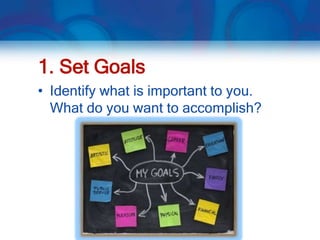
1. Set Goals
• Identify what is important to you.
  What do you want to accomplish?
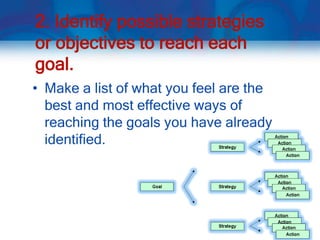
2. Identify possible strategies
or objectives to reach each
goal.
• Make a list of what you feel are the
  best and most effective ways of
  reaching the goals you have already
  identified.
3. Select the best strategies
• Now that you have made a list of
  several ways to achieve your goal,
  recognize which of these strategies
  will work best for you.
4. Outline specific plans to
accomplish each strategy.
• Once you have narrowed down your strategy
  list, you can begin to make very detailed and
  specific plans to accomplish each strategy
  and ultimately reach your goal.
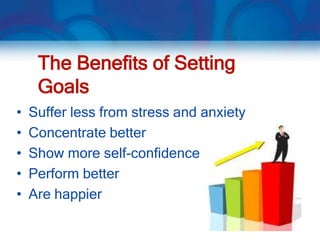
The Benefits of Setting
     Goals
•   Suffer less from stress and anxiety
•   Concentrate better
•   Show more self-confidence
•   Perform better
•   Are happier
adeel_tc@hotmail.com 0315-4632432

Goals

  • 2.
  • 4.
    Think of agoal as your final destination, if you don’t know what your final destination is, there is no way to plan on how to get there.
  • 5.
    Why Goals Fail •The goal was not written down. • The goal was unrealistic or not specific enough. • The goal is not really believable or little commitment exists. • Keep changing or switching goals with the weather • The person who set the goal has not told anyone else for added accountability, help and support.
  • 6.
    Examples of badGoals: “I want to get faster” Is this goal set up as a goal that is easily measurable? Is there a time limit to this? How about: Correct “I presently run the 40 in 5.0 seconds and by December 1, I want to be able to run the 40 in 4.9”
  • 7.
    Examples of goodindividual goals: “Increase my ability to juggle from 5 consecutive juggles to 10 consecutive juggles in the next 60 days” “Improve my vertical jump by 2 inches by December 15”
  • 8.
    Once you haveyour goals (and your sub goals) you need to figure out how you are going to be able to accomplish these goals. You want to be as specific as possible in order to achieve your objective of achieving each of the sub goals and the ultimate goals.
  • 9.
    Types of Goals •Long Term Goals: 10-year, 5-year and 1-year goals • Short Term Goals: goals for the next 9 months, 6 months and 3 months • Immediate Goals: 1-30 days from now
  • 10.
    Steps Toward SettingEffective Goals " The establishment of a clear and central purpose or goal in life is the starting point of all success." - Brian Tracy
  • 11.
    1. Set Goals •Identify what is important to you. What do you want to accomplish?
  • 12.
    2. Identify possiblestrategies or objectives to reach each goal. • Make a list of what you feel are the best and most effective ways of reaching the goals you have already identified.
  • 13.
    3. Select thebest strategies • Now that you have made a list of several ways to achieve your goal, recognize which of these strategies will work best for you.
  • 14.
    4. Outline specificplans to accomplish each strategy. • Once you have narrowed down your strategy list, you can begin to make very detailed and specific plans to accomplish each strategy and ultimately reach your goal.
  • 15.
    The Benefits ofSetting Goals • Suffer less from stress and anxiety • Concentrate better • Show more self-confidence • Perform better • Are happier
  • 17.