Dr Sumit Banerjee
INTRODUCTION
Goal-A goal is a desired result that a person
plans and commits to achieve.
Goalsetting-Goal setting involves the
development of an action plan
designed
to motivate and guide a person or group
toward a goal.
Dr Sumit Banerjee
Dr Sumit Banerjee
WHY SETTING GOALS?
It gives you long-term vision and short-term
motivation .
It focuses your acquisition of knowledge, and
helps you to organize your time and your resources
so that you can make the very most of your life.
It allows to measure your progress because you
always have a fixed endpoint
or benchmark to compare with.
Goals help you achieve your highest
Dr Sumit Banerjee
Dr Sumit Banerjee
TYPES OF GOAL
ShortT
ermGoal-
 A short-term goal is something you want to do in the near
future. The near future can mean today, this week, this
month, or even this year.
 A short-term goal is something you want to accomplish
soon.
LongT
ermGoal-
 A long term goal is that goal which takes a long time to
achieve.
Dr Sumit Banerjee
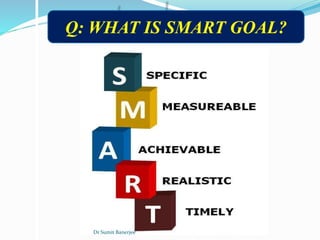
Q: WHAT IS SMART GOAL?
Dr Sumit Banerjee
?
Dr Sumit Banerjee
STEPS TO SET GOAL
1.Identify
Goals
2.Set
Objectives
3.List
Obstacles
6.DevelopA
Plan
5.ListSkills
4.Identify
People
7.List
Benefits
Dr Sumit Banerjee
INSPIRATIONAL STORY
Dr Sumit Banerjee
INSPIRATIONAL STORY
•He wanted to be the greatest bodybuilder in the
world which meant winning the title of Mr. Olympia.
He became the youngest ever Mr. Olympia at the age
of 23 (he won the title seven times).
•He wanted financial success. He was a millionaire by
the age of 30 (this was before Hollywood).
•He wanted to become a successful
Dr Sumit Banerjee
CONCLUSION
 Goal setting is not just about identifying what you
want to achieve but also how you will achieve it
(process goals) and measure that achievement .
 Beginners require very short term, easily achieved
goals to boost their self- confidence whereas the
experienced individual need more challenging yet
realistic goals.
Dr Sumit Banerjee
Dr Sumit Banerjee

Goal setting

  • 1.
  • 2.
    INTRODUCTION Goal-A goal isa desired result that a person plans and commits to achieve. Goalsetting-Goal setting involves the development of an action plan designed to motivate and guide a person or group toward a goal. Dr Sumit Banerjee
  • 3.
  • 4.
    WHY SETTING GOALS? Itgives you long-term vision and short-term motivation . It focuses your acquisition of knowledge, and helps you to organize your time and your resources so that you can make the very most of your life. It allows to measure your progress because you always have a fixed endpoint or benchmark to compare with. Goals help you achieve your highest Dr Sumit Banerjee
  • 5.
  • 6.
    TYPES OF GOAL ShortT ermGoal- A short-term goal is something you want to do in the near future. The near future can mean today, this week, this month, or even this year.  A short-term goal is something you want to accomplish soon. LongT ermGoal-  A long term goal is that goal which takes a long time to achieve. Dr Sumit Banerjee
  • 7.
    Q: WHAT ISSMART GOAL? Dr Sumit Banerjee
  • 8.
  • 9.
    STEPS TO SETGOAL 1.Identify Goals 2.Set Objectives 3.List Obstacles 6.DevelopA Plan 5.ListSkills 4.Identify People 7.List Benefits Dr Sumit Banerjee
  • 10.
  • 11.
    INSPIRATIONAL STORY •He wantedto be the greatest bodybuilder in the world which meant winning the title of Mr. Olympia. He became the youngest ever Mr. Olympia at the age of 23 (he won the title seven times). •He wanted financial success. He was a millionaire by the age of 30 (this was before Hollywood). •He wanted to become a successful Dr Sumit Banerjee
  • 12.
    CONCLUSION  Goal settingis not just about identifying what you want to achieve but also how you will achieve it (process goals) and measure that achievement .  Beginners require very short term, easily achieved goals to boost their self- confidence whereas the experienced individual need more challenging yet realistic goals. Dr Sumit Banerjee
  • 13.