TIMEMANAGMENT
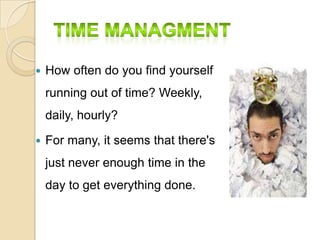
 How often do you find yourself
running out of time? Weekly,
daily, hourly?
 For many, it seems that there's
just never enough time in the
day to get everything done.
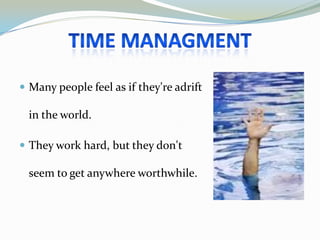
 Many people feel as if they're adrift
in the world.
 They work hard, but they don't
seem to get anywhere worthwhile.
 Would you set out on a
major journey with no real
idea of your destination?
 Probably not!!!!!!!
 A skill that enables you to
differentiate between what
you need to do and what
you’d prefer to do
IMPORTANCE OF TIME MANAGEMENT
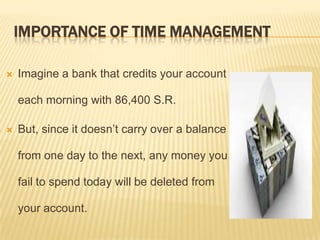
 Imagine a bank that credits your account
each morning with 86,400 S.R.
 But, since it doesn’t carry over a balance
from one day to the next, any money you
fail to spend today will be deleted from
your account.
IMPORTANCE OF TIME MANAGEMENT
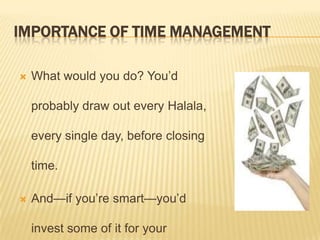
 What would you do? You’d
probably draw out every Halala,
every single day, before closing
time.
 And—if you’re smart—you’d
invest some of it for your
Importance of Time Management
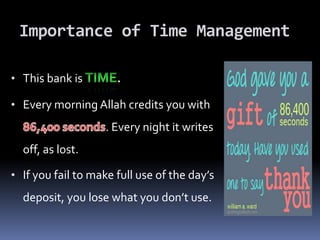
• This bank is .
• Every morning Allah credits you with
. Every night it writes
off, as lost.
• If you fail to make full use of the day’s
deposit, you lose what you don’t use.
Exercise……..
 Read the following list, then
choose five words that you feel
best apply to time. Allow
yourself a little creativity in
your choices.
 Spent
 White
 Friendly
 Opportunity
 Lively
 Unclaimed
 Exhausting
 Hollow
 Ready
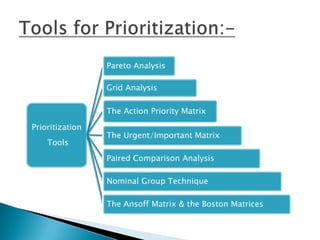
 Busy
 Handy
 Effective
 Mountainous
 Relentless
 Tense
 Valley-like
 Empty
 Energetic
 Restless
 Bumpy
 Jammed
 Blank
 Exciting
 Available
 You view time as something to be
filled.
as you’re probably
not under very great time pressures.
 On the other hand,
, allowing others to
• You view time as an enemy.
• It can mean that you’re presently
overstressed by environment and
responsibilities or that you feel that time
controls you.
• In either case, some change will be
necessary before you can truly manage
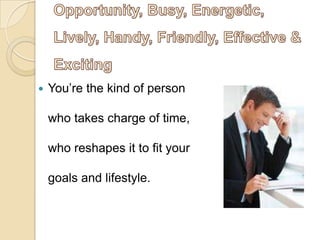
 You’re the kind of person
who takes charge of time,
who reshapes it to fit your
goals and lifestyle.
 Like many people, you probably have
mixed feelings about time. By this
presentation, those feelings should
change.
 You should be able to view time as an
ally, not as a bully or an enemy.
Exercise ??
 How many hours do you spend daily :-
* Sleeping * Working
* Eating & Drinking * Sports
* House Hold Activity * Caring for others
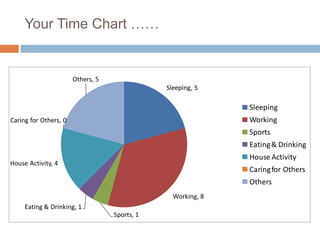
Your Time Chart ……
Sleeping, 5
Working, 8
Sports, 1
Eating & Drinking, 1
House Activity, 4
Caring for Others, 0
Others, 5
Sleeping
Working
Sports
Eating& Drinking
House Activity
Caringfor Others
Others
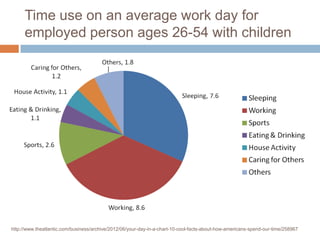
Time use on an average work day for
employed person ages 26-54 with children
http://www.theatlantic.com/business/archive/2012/06/your-day-in-a-chart-10-cool-facts-about-how-americans-spend-our-time/258967
ACTIVITY LOGS
 An Activity Log (also known as an Activity
Diary or a Job Activity Log) is a written
record of how you spend your time.
Benefits of Activity Log
 Help you to build up an accurate
picture of what you do during the day,
and how you invest your time.
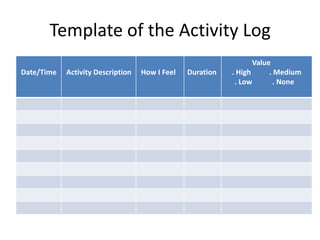
Template of the Activity Log
Date/Time Activity Description How I Feel Duration
Value
. High . Medium
. Low . None
 SETTING GOALS
 PRIORITIZATION
 STOP PROCRASTINATION
 DELEGATION
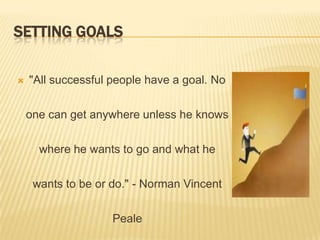
SETTING GOALS
 "All successful people have a goal. No
one can get anywhere unless he knows
where he wants to go and what he
wants to be or do." - Norman Vincent
Peale
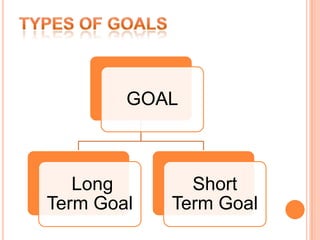
GOAL
Long
Term Goal
Short
Term Goal
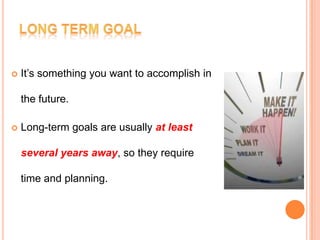
 It’s something you want to accomplish in
the future.
 Long-term goals are usually at least
several years away, so they require
time and planning.
LONG TERM GOALS
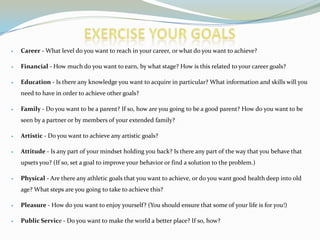
 To give a broad, balanced coverage of all
important areas in your life, try to set
goals in some of the following
categories:-
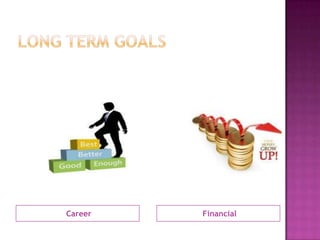
Career Financial
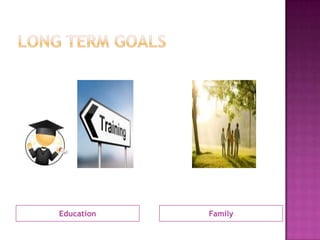
Education Family
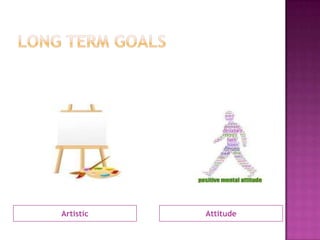
Artistic Attitude
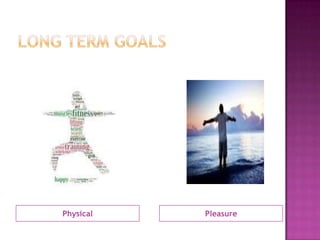
Physical Pleasure
Public Service
Career - What level do you want to reach in your career, or what do you want to achieve?
Financial - How much do you want to earn, by what stage? How is this related to your career goals?
Education - Is there any knowledge you want to acquire in particular? What information and skills will you
need to have in order to achieve other goals?
Family - Do you want to be a parent? If so, how are you going to be a good parent? How do you want to be
seen by a partner or by members of your extended family?
Artistic - Do you want to achieve any artistic goals?
Attitude - Is any part of your mindset holding you back? Is there any part of the way that you behave that
upsets you? (If so, set a goal to improve your behavior or find a solution to the problem.)
Physical - Are there any athletic goals that you want to achieve, or do you want good health deep into old
age? What steps are you going to take to achieve this?
Pleasure - How do you want to enjoy yourself? (You should ensure that some of your life is for you!)
Public Service - Do you want to make the world a better place? If so, how?
SHORT TERM GOALS
Once you have set your lifetime goals, set a
of smaller goals that you
need to complete if you are to reach your
lifetime plan.
SHORT TERM GOALS
 Then create a ,
, and a of
progressively smaller goals that you should reach
to achieve your lifetime goals.
 Each of these should be based on the previous
plan.
SHORT TERM GOALS
Then create a of things
that you should do today to work towards
your lifetime goals.
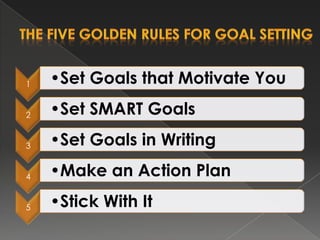
1 •Set Goals that Motivate You
2 •Set SMART Goals
3 •Set Goals in Writing
4 •Make an Action Plan
5 •Stick With It
1. Set Goals that Motivate You
 To make sure your goal is motivating,
1. Write down why it's valuable and important to you.
2. Ask yourself, "If I were to share my goal with others,
what would I tell them to convince them it was a
worthwhile goal?"
2. Set SMART Goals Cont.
SPECIFIC
 You need goals to show you the way.
 Make it clear, well defined & easy as you can
to get where you want to go by defining
precisely where you want to end up.
2. Set SMART Goals Cont.
MEASURABLE
 Without a way to measure your success
you miss out on the celebration that
comes with knowing you have actually
achieved something, so you have to
Include precise amounts, dates, and so
on in your goals
2. Set SMART Goals Cont.
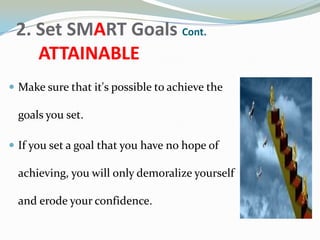
ATTAINABLE
 Make sure that it's possible to achieve the
goals you set.
 If you set a goal that you have no hope of
achieving, you will only demoralize yourself
and erode your confidence.
2. Set SMART Goals Cont.
RELEVANT
 Goals should be relevant to the direction
you want your life and career to take. Set
widely scattered and inconsistent goals,
and you'll fritter your time – and your life
– away.
2. Set SMART Goals Cont.
TIME BOUND
 You goals must have a deadline.
 When you are working on a deadline, your
sense of urgency increases and
achievement will come that much quicker.
3. Set Goals in Writing
 Writing down a goal makes it REAL and TANGIBLE.
 Frame your goal statement positively to be a source
of motivation for you.
 Use the word "will" instead of "would like to" or
"might."
3. Set Goals in Writing Cont.
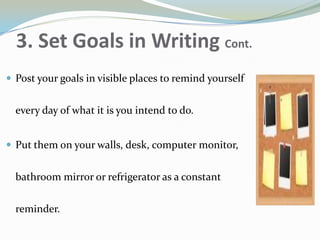
 Post your goals in visible places to remind yourself
every day of what it is you intend to do.
 Put them on your walls, desk, computer monitor,
bathroom mirror or refrigerator as a constant
reminder.
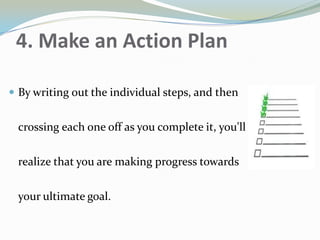
4. Make an Action Plan
 By writing out the individual steps, and then
crossing each one off as you complete it, you'll
realize that you are making progress towards
your ultimate goal.
5. Stick With It
 Remember, goal setting is an ongoing activity
not just a means to an end.
 Build in reminders to keep yourself on track,
and make regular time-slots available to
review your goals.
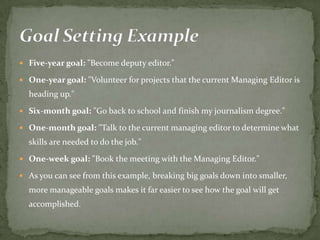
 lifetime goals are as follows:
"To be managing editor
of the magazine
that I work for."
 Five-year goal: "Become deputy editor."
 One-year goal: "Volunteer for projects that the current Managing Editor is
heading up."
 Six-month goal: "Go back to school and finish my journalism degree."
 One-month goal: "Talk to the current managing editor to determine what
skills are needed to do the job."
 One-week goal: "Book the meeting with the Managing Editor."
 As you can see from this example, breaking big goals down into smaller,
more manageable goals makes it far easier to see how the goal will get
accomplished.
Prioritization
 As a principle, it means doing 'first things
first;'
 As a process, it means evaluating a group
of items and ranking them in their order of
importance or urgency.
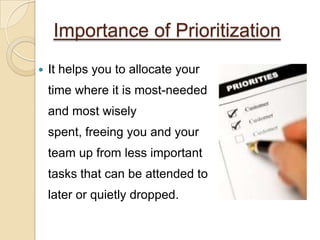
Importance of Prioritization
 It helps you to allocate your
time where it is most-needed
and most wisely
spent, freeing you and your
team up from less important
tasks that can be attended to
later or quietly dropped.
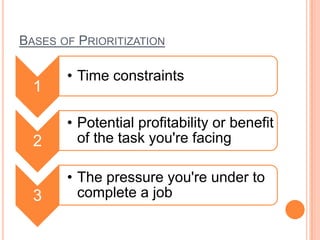
BASES OF PRIORITIZATION
1
• Time constraints
2
• Potential profitability or benefit
of the task you're facing
3
• The pressure you're under to
complete a job
 Important where other people are
depending on you to complete a
task, and particularly where this
task is on the critical path of an
important project
Profitability or benefit
 The most commonly-used and
rational basis for prioritization.
Whether this is based on a subjective
guess at value or a sophisticated
financial evaluation, it often gives the
most efficient results.
Pressure
 It's a brave (and maybe foolish)
person who resists his boss's
pressure to complete a task,
when that pressure is reasonable
and legitimate.
Prioritization
Tools
Pareto Analysis
Grid Analysis
The Action Priority Matrix
The Urgent/Important Matrix
Paired Comparison Analysis
Nominal Group Technique
The Ansoff Matrix & the Boston Matrices
1- Paired Comparison
Analysis
 When you're choosing between many different
options, how do you decide on the best way
forward?
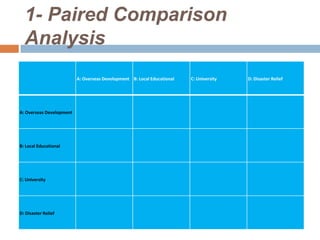
1- Paired Comparison
Analysis
A: Overseas Development B: Local Educational C: University D: Disaster Relief
A: Overseas Development
B: Local Educational
C: University
D: Disaster Relief
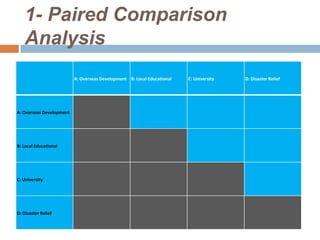
1- Paired Comparison
Analysis
A: Overseas Development B: Local Educational C: University D: Disaster Relief
A: Overseas Development
B: Local Educational
C: University
D: Disaster Relief
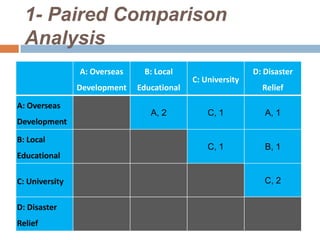
1- Paired Comparison
Analysis
A: Overseas
Development
B: Local
Educational
C: University
D: Disaster
Relief
A: Overseas
Development
A, 2 C, 1 A, 1
B: Local
Educational
C, 1 B, 1
C: University C, 2
D: Disaster
Relief
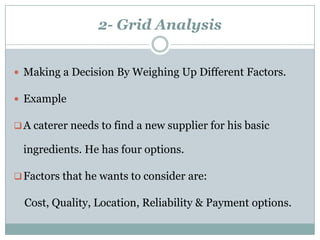
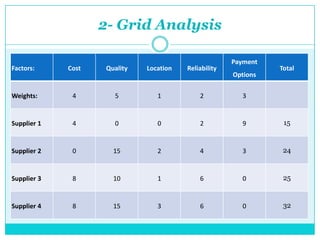
2- Grid Analysis
 Making a Decision By Weighing Up Different Factors.
 Example
A caterer needs to find a new supplier for his basic
ingredients. He has four options.
Factors that he wants to consider are:
Cost, Quality, Location, Reliability & Payment options.
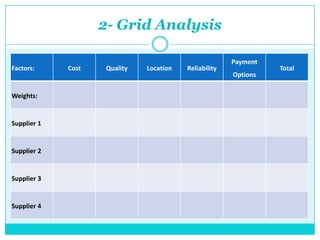
2- Grid Analysis
Factors: Cost Quality Location Reliability
Payment
Options
Total
Weights:
Supplier 1
Supplier 2
Supplier 3
Supplier 4
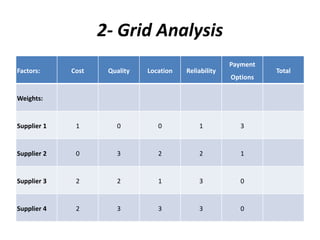
2- Grid Analysis
Factors: Cost Quality Location Reliability
Payment
Options
Total
Weights:
Supplier 1 1 0 0 1 3
Supplier 2 0 3 2 2 1
Supplier 3 2 2 1 3 0
Supplier 4 2 3 3 3 0
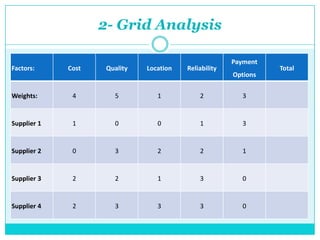
2- Grid Analysis
Factors: Cost Quality Location Reliability
Payment
Options
Total
Weights: 4 5 1 2 3
Supplier 1 1 0 0 1 3
Supplier 2 0 3 2 2 1
Supplier 3 2 2 1 3 0
Supplier 4 2 3 3 3 0
2- Grid Analysis
Factors: Cost Quality Location Reliability
Payment
Options
Total
Weights: 4 5 1 2 3
Supplier 1 4 0 0 2 9 15
Supplier 2 0 15 2 4 3 24
Supplier 3 8 10 1 6 0 25
Supplier 4 8 15 3 6 0 32
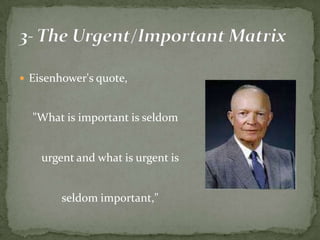
 Eisenhower's quote,
"What is important is seldom
urgent and what is urgent is
seldom important,"
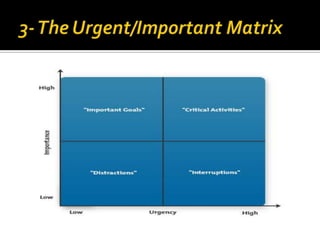
3- The Urgent/Important Matrix
 Dr. Stephen Covey brought the idea into
the mainstream and gave it the name
in his 1994 business classic,
"The 7 Habits of Highly Effective People."
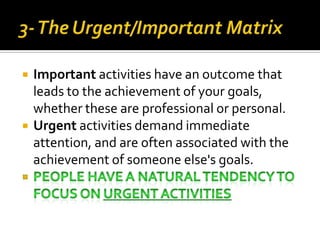
 Important activities have an outcome that
leads to the achievement of your goals,
whether these are professional or personal.
 Urgent activities demand immediate
attention, and are often associated with the
achievement of someone else's goals.
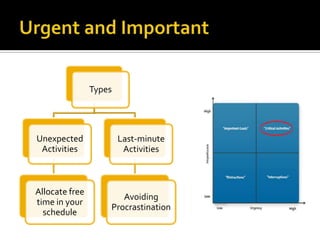
Types
Unexpected
Activities
Allocate free
time in your
schedule
Last-minute
Activities
Avoiding
Procrastination
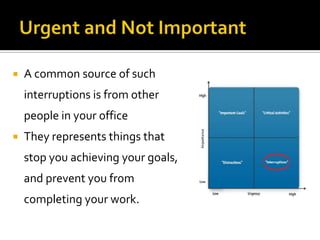
 A common source of such
interruptions is from other
people in your office
 They represents things that
stop you achieving your goals,
and prevent you from
completing your work.
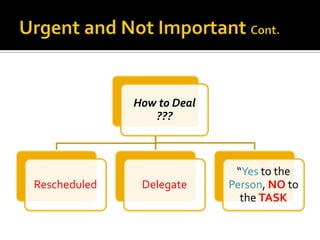
How to Deal
???
Rescheduled Delegate
“Yes to the
Person, NO to
the TASK
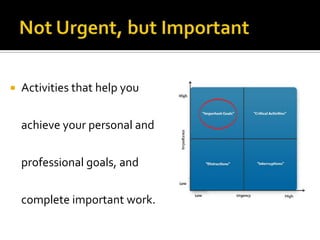
 Activities that help you
achieve your personal and
professional goals, and
complete important work.
 Make sure that you have plenty of time to
do these things properly, so that they do
not become urgent.
 Remember to leave enough time in your
schedule to deal with unforeseen problems.
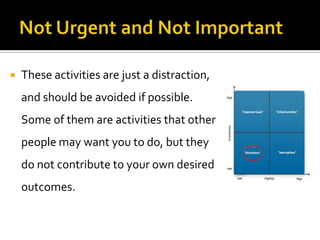
 These activities are just a distraction,
and should be avoided if possible.
Some of them are activities that other
people may want you to do, but they
do not contribute to your own desired
outcomes.
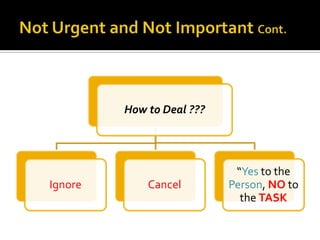
How to Deal ???
Ignore Cancel
“Yes to the
Person, NO to
the TASK
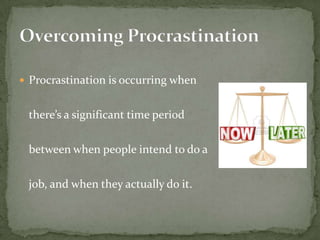
 Procrastination is occurring when
there’s a significant time period
between when people intend to do a
job, and when they actually do it.
Are You Procrastinator ???
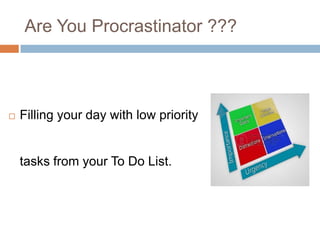
 Filling your day with low priority
tasks from your To Do List.
Are You Procrastinator ???
 Reading e-mails several times without
starting work on them or deciding
what you’re going to do with them.
Are You Procrastinator ???
 Sitting down to start a high-priority
task, and almost immediately going off
to make a cup of coffee.
Are You Procrastinator ???
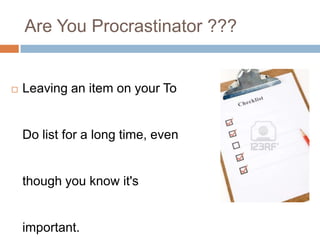
 Leaving an item on your To
Do list for a long time, even
though you know it's
important.
Are You Procrastinator ???
 Regularly saying "Yes" to
unimportant tasks that others ask
you to do, and filling your time
with these instead of getting on
with the important tasks already
on your list.
Are You Procrastinator ???
 Waiting for the “right mood”
or the “right time” to tackle
the important task at hand.
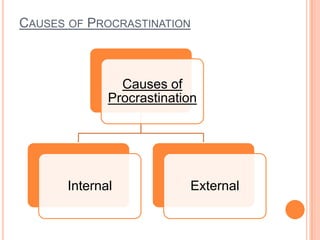
CAUSES OF PROCRASTINATION
Causes of
Procrastination
Internal External
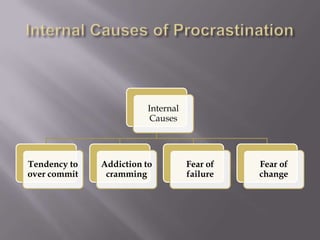
Internal
Causes
Tendency to
over commit
Addiction to
cramming
Fear of
failure
Fear of
change
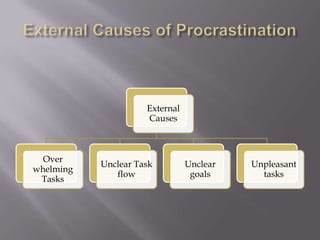
External
Causes
Over
whelming
Tasks
Unclear Task
flow
Unclear
goals
Unpleasant
tasks
Exercise
 Make a list of business duties, personal
responsibilities, and long-term goals that you’ve
done nothing about (e.g., changing careers, getting
married), short-term tasks (that complaint letter),
telephone calls, a vacation—anything you can think
of, large or small, that you should be doing but
haven’t gotten around to. You may be surprised at
the number of tasks backlogged in your mind.
 For each item on your list, try to identify which of
the eight procrastination causes probably reflects
the major reason you’re putting off this task.
 Some of the tasks may have more than one reason
causing you to procrastinate.
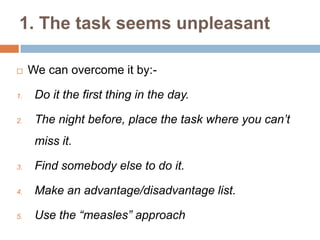
1. The task seems unpleasant
 We can overcome it by:-
1. Do it the first thing in the day.
2. The night before, place the task where you can’t
miss it.
3. Find somebody else to do it.
4. Make an advantage/disadvantage list.
5. Use the “measles” approach
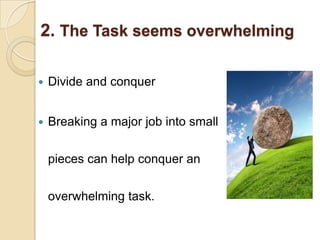
2. The Task seems overwhelming
 Divide and conquer
 Breaking a major job into small
pieces can help conquer an
overwhelming task.
2. The Task seems overwhelming Cont.
 Find a solitary place to do it.
 Close your office door and make
clear to everyone that you are not
to be disturbed.
 Go off on a “work vacation” to do
what you must in pleasant
surroundings, undisturbed.
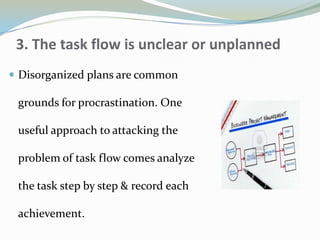
3. The task flow is unclear or unplanned
 Disorganized plans are common
grounds for procrastination. One
useful approach to attacking the
problem of task flow comes analyze
the task step by step & record each
achievement.
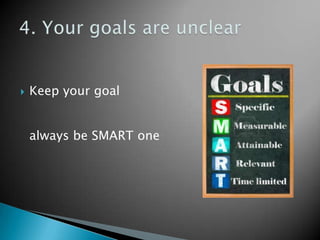
 Keep your goal
always be SMART one
5. You fear change.
 If you procrastinate because
you’re resisting change—any
of the following might work for
you:
5. You fear change. Cont.
 Change your physical
environment.
 Old habits cling to old places.
 Try a new room, a new chair, a
5. You fear change. Cont.
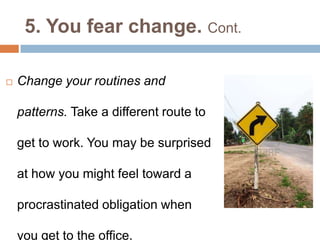
 Change your routines and
patterns. Take a different route to
get to work. You may be surprised
at how you might feel toward a
procrastinated obligation when
you get to the office.
5. You fear change. Cont.
 Do nothing. Just walk into
your home or office, sit down,
and stare at the wall. You’ll
soon be so bored that a
change will be precisely what
you want.
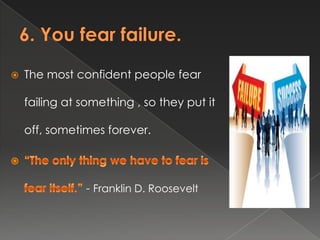
 The most confident people fear
failing at something , so they put it
off, sometimes forever.
- Franklin D. Roosevelt
7. You tend to over commit
 Many people are so dedicated,
ambitious, or enthusiastic that they
take on far more than they should—at
work, at home, or in their
7. You tend to over commit
Cont.
1
• Inability to say no
2
• A desire to please other
3
• Great virtues of a zest for life
4
• Broad range of interests
7. You tend to over commit
Cont.
 In the future, before volunteering
to take on new commitments,
take a few moments to review
those commitments you’ve
already made but haven’t
completed.
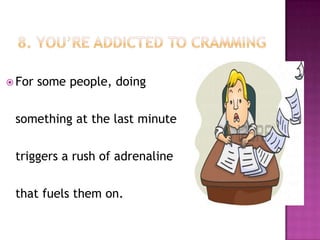
 For some people, doing
something at the last minute
triggers a rush of adrenaline
that fuels them on.
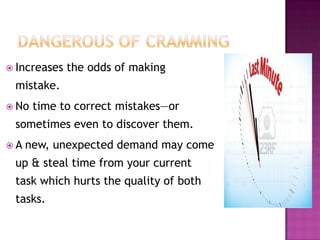
 Increases the odds of making
mistake.
 No time to correct mistakes—or
sometimes even to discover them.
 A new, unexpected demand may come
up & steal time from your current
task which hurts the quality of both
tasks.
 You must convince yourself that
cramming is dangerous & do
your best to stop it regularly.
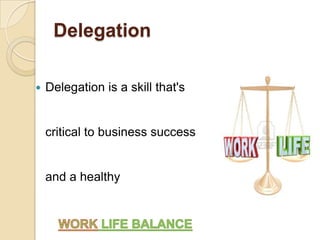
Delegation
 Delegation is a skill that's
critical to business success
and a healthy
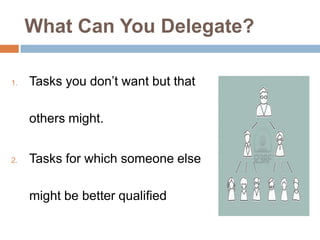
What Can You Delegate?
1. Tasks you don’t want but that
others might.
2. Tasks for which someone else
might be better qualified
 Ask yourself which ones most often apply to you.
1. I’ll lose control of the task.
2. I’m the only person who can do it right.
3. I’ll look bad for giving it to someone else.
4. I’m afraid that I don’t have the authority to delegate.
5. If the person to whom I delegate the task succeeds, I
may become dispensable.
6. I just never thought of it.
The Key Steps of Delegation
 Deciding to delegate is a minor part of
the battle.
 Doing it right is a much bigger
challenge.
1. Identify the task to be delegated
 Once you’ve freed your mind from
thoughts that defeat delegation,
begin to determine which tasks
that could be delegated.
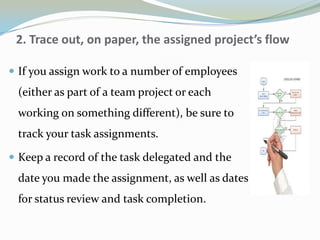
2. Trace out, on paper, the assigned project’s flow
 If you assign work to a number of employees
(either as part of a team project or each
working on something different), be sure to
track your task assignments.
 Keep a record of the task delegated and the
date you made the assignment, as well as dates
for status review and task completion.
3. Find the right person
 It’s important to be aware of the unique talents
and aptitudes of the people you work with and
who work for you.
 The better you are at assessing the talents of
those you manage—or of colleagues— the more
successful you’ll be at delegating.
4. Explain the assignment
 Sit down with the person to
whom you’ve delegated and walk
through your flowchart’s steps.
 Encourage questions. (A
monologue rarely achieves clear
communication.)
5. Explain the benefits
 Everyone is concerned with the
WIIFM—the What’s in It for Me?
 If you want to defuse resistance to
the task you’re delegating (and the
it’s-not-my-job syndrome), make
liberal use of benefits language.
6. Specify your standards
 As when you create goals, you
must convince the person to whom
you delegate that you hold high
expectations.
 Until his or her performance
meets your standards, the task will
remain incomplete.
7. Discuss deadlines
 When you delegate, always set
deadlines, including intermediary
status review dates.
 If you empower the person in the
process, by sharing responsibility from
the start, you’ll reinforce his or her
motivation.
8. Establish a reporting method
 Articulate your expectations to
the person you delegate to , either
be written? Oral ? Lengthy?
Summarized?
9. Encourage questions
 Encourage the person to ask any
questions that may be still unvoiced.
 Have the person summarize the
assignment as he or she understands it.
 Finally, summarize steps 4 through 9 in a
brief, written memo to the person and, if
appropriate, send a copy to your boss.
10. Conduct unscheduled status checks
 Feel free to informally drop in on anyone to
whom you’ve delegated. Be prepared to
adjust procedures and goals as necessary.
 you may even have to pull the project and
find a new person to do it or do it yourself.
11. Evaluate results
Ask yourself the following 8 questions:
 Did the person meet the deadline? If not, was it because it
was unreasonable?
 Did the person achieve all goals?
 Did the person meet, exceed, or fall short of your
expectations?
11. Evaluate results
 Were there any surprises?
 Did the person realize the promised benefits?
 Was this the right person for this task? Would you
delegate to this person again?
 Was the final report thorough?
 Was your emotional reluctance to delegate
extinguished? If not, why not?
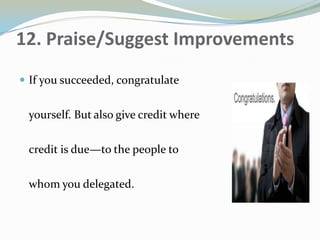
12. Praise/Suggest Improvements
 If you succeeded, congratulate
yourself. But also give credit where
credit is due—to the people to
whom you delegated.
 At least recognize the effort, suggest
improvements for next time, and transform
the whole process into a learning
experience for you and for the person to
whom you delegated.
Some Advices
• A 30 – 40 min. nap can snap a person out of the
doldrums.
• If you need to remember something for a very long
time, study it in the afternoon, Mornings favor short-
term memory.
• Your senses become sharpest in the late afternoon
and early evening.
• Mid-afternoon is the best time to do uncomplicated
or repetitive chores.
Sources ,,,
• http://en.wikipedia.org/wiki/Time_management
• http://www.mindtools.com/page6.html
• http://www.mindtools.com/pages/article/newCT_94.htm
• http://www.mindtools.com/pages/article/newTMC_90.htm
• http://www.mindtools.com/pages/article/newTED_01.htm
• http://www.mindtools.com/pages/article/newHTE_94.htm
• http://www.dumblittleman.com/2008/02/11-solid-ways-to-improve-your-time.html
• http://sbinfocanada.about.com/library/glossary/bldef-pim.htm
• http://sbinfocanada.about.com/od/worklifebalance/a/delegate.htm

Time managment

  • 1.
  • 2.
     How oftendo you find yourself running out of time? Weekly, daily, hourly?  For many, it seems that there's just never enough time in the day to get everything done.
  • 3.
     Many peoplefeel as if they're adrift in the world.  They work hard, but they don't seem to get anywhere worthwhile.
  • 4.
     Would youset out on a major journey with no real idea of your destination?  Probably not!!!!!!!
  • 5.
     A skillthat enables you to differentiate between what you need to do and what you’d prefer to do
  • 6.
    IMPORTANCE OF TIMEMANAGEMENT  Imagine a bank that credits your account each morning with 86,400 S.R.  But, since it doesn’t carry over a balance from one day to the next, any money you fail to spend today will be deleted from your account.
  • 7.
    IMPORTANCE OF TIMEMANAGEMENT  What would you do? You’d probably draw out every Halala, every single day, before closing time.  And—if you’re smart—you’d invest some of it for your
  • 8.
    Importance of TimeManagement • This bank is . • Every morning Allah credits you with . Every night it writes off, as lost. • If you fail to make full use of the day’s deposit, you lose what you don’t use.
  • 9.
    Exercise……..  Read thefollowing list, then choose five words that you feel best apply to time. Allow yourself a little creativity in your choices.
  • 10.
     Spent  White Friendly  Opportunity  Lively  Unclaimed  Exhausting  Hollow  Ready  Busy  Handy  Effective  Mountainous  Relentless  Tense  Valley-like  Empty  Energetic  Restless  Bumpy  Jammed  Blank  Exciting  Available
  • 11.
     You viewtime as something to be filled. as you’re probably not under very great time pressures.  On the other hand, , allowing others to
  • 12.
    • You viewtime as an enemy. • It can mean that you’re presently overstressed by environment and responsibilities or that you feel that time controls you. • In either case, some change will be necessary before you can truly manage
  • 13.
     You’re thekind of person who takes charge of time, who reshapes it to fit your goals and lifestyle.
  • 14.
     Like manypeople, you probably have mixed feelings about time. By this presentation, those feelings should change.  You should be able to view time as an ally, not as a bully or an enemy.
  • 15.
    Exercise ??  Howmany hours do you spend daily :- * Sleeping * Working * Eating & Drinking * Sports * House Hold Activity * Caring for others
  • 16.
    Your Time Chart…… Sleeping, 5 Working, 8 Sports, 1 Eating & Drinking, 1 House Activity, 4 Caring for Others, 0 Others, 5 Sleeping Working Sports Eating& Drinking House Activity Caringfor Others Others
  • 17.
    Time use onan average work day for employed person ages 26-54 with children http://www.theatlantic.com/business/archive/2012/06/your-day-in-a-chart-10-cool-facts-about-how-americans-spend-our-time/258967
  • 18.
    ACTIVITY LOGS  AnActivity Log (also known as an Activity Diary or a Job Activity Log) is a written record of how you spend your time.
  • 19.
    Benefits of ActivityLog  Help you to build up an accurate picture of what you do during the day, and how you invest your time.
  • 20.
    Template of theActivity Log Date/Time Activity Description How I Feel Duration Value . High . Medium . Low . None
  • 21.
     SETTING GOALS PRIORITIZATION  STOP PROCRASTINATION  DELEGATION
  • 22.
    SETTING GOALS  "Allsuccessful people have a goal. No one can get anywhere unless he knows where he wants to go and what he wants to be or do." - Norman Vincent Peale
  • 23.
  • 24.
     It’s somethingyou want to accomplish in the future.  Long-term goals are usually at least several years away, so they require time and planning.
  • 25.
    LONG TERM GOALS To give a broad, balanced coverage of all important areas in your life, try to set goals in some of the following categories:-
  • 26.
  • 27.
  • 28.
  • 29.
  • 30.
  • 31.
    Career - Whatlevel do you want to reach in your career, or what do you want to achieve? Financial - How much do you want to earn, by what stage? How is this related to your career goals? Education - Is there any knowledge you want to acquire in particular? What information and skills will you need to have in order to achieve other goals? Family - Do you want to be a parent? If so, how are you going to be a good parent? How do you want to be seen by a partner or by members of your extended family? Artistic - Do you want to achieve any artistic goals? Attitude - Is any part of your mindset holding you back? Is there any part of the way that you behave that upsets you? (If so, set a goal to improve your behavior or find a solution to the problem.) Physical - Are there any athletic goals that you want to achieve, or do you want good health deep into old age? What steps are you going to take to achieve this? Pleasure - How do you want to enjoy yourself? (You should ensure that some of your life is for you!) Public Service - Do you want to make the world a better place? If so, how?
  • 32.
    SHORT TERM GOALS Onceyou have set your lifetime goals, set a of smaller goals that you need to complete if you are to reach your lifetime plan.
  • 33.
    SHORT TERM GOALS Then create a , , and a of progressively smaller goals that you should reach to achieve your lifetime goals.  Each of these should be based on the previous plan.
  • 34.
    SHORT TERM GOALS Thencreate a of things that you should do today to work towards your lifetime goals.
  • 35.
    1 •Set Goalsthat Motivate You 2 •Set SMART Goals 3 •Set Goals in Writing 4 •Make an Action Plan 5 •Stick With It
  • 36.
    1. Set Goalsthat Motivate You  To make sure your goal is motivating, 1. Write down why it's valuable and important to you. 2. Ask yourself, "If I were to share my goal with others, what would I tell them to convince them it was a worthwhile goal?"
  • 37.
    2. Set SMARTGoals Cont. SPECIFIC  You need goals to show you the way.  Make it clear, well defined & easy as you can to get where you want to go by defining precisely where you want to end up.
  • 38.
    2. Set SMARTGoals Cont. MEASURABLE  Without a way to measure your success you miss out on the celebration that comes with knowing you have actually achieved something, so you have to Include precise amounts, dates, and so on in your goals
  • 39.
    2. Set SMARTGoals Cont. ATTAINABLE  Make sure that it's possible to achieve the goals you set.  If you set a goal that you have no hope of achieving, you will only demoralize yourself and erode your confidence.
  • 40.
    2. Set SMARTGoals Cont. RELEVANT  Goals should be relevant to the direction you want your life and career to take. Set widely scattered and inconsistent goals, and you'll fritter your time – and your life – away.
  • 41.
    2. Set SMARTGoals Cont. TIME BOUND  You goals must have a deadline.  When you are working on a deadline, your sense of urgency increases and achievement will come that much quicker.
  • 42.
    3. Set Goalsin Writing  Writing down a goal makes it REAL and TANGIBLE.  Frame your goal statement positively to be a source of motivation for you.  Use the word "will" instead of "would like to" or "might."
  • 43.
    3. Set Goalsin Writing Cont.  Post your goals in visible places to remind yourself every day of what it is you intend to do.  Put them on your walls, desk, computer monitor, bathroom mirror or refrigerator as a constant reminder.
  • 44.
    4. Make anAction Plan  By writing out the individual steps, and then crossing each one off as you complete it, you'll realize that you are making progress towards your ultimate goal.
  • 45.
    5. Stick WithIt  Remember, goal setting is an ongoing activity not just a means to an end.  Build in reminders to keep yourself on track, and make regular time-slots available to review your goals.
  • 46.
     lifetime goalsare as follows: "To be managing editor of the magazine that I work for."
  • 47.
     Five-year goal:"Become deputy editor."  One-year goal: "Volunteer for projects that the current Managing Editor is heading up."  Six-month goal: "Go back to school and finish my journalism degree."  One-month goal: "Talk to the current managing editor to determine what skills are needed to do the job."  One-week goal: "Book the meeting with the Managing Editor."  As you can see from this example, breaking big goals down into smaller, more manageable goals makes it far easier to see how the goal will get accomplished.
  • 48.
    Prioritization  As aprinciple, it means doing 'first things first;'  As a process, it means evaluating a group of items and ranking them in their order of importance or urgency.
  • 49.
    Importance of Prioritization It helps you to allocate your time where it is most-needed and most wisely spent, freeing you and your team up from less important tasks that can be attended to later or quietly dropped.
  • 51.
    BASES OF PRIORITIZATION 1 •Time constraints 2 • Potential profitability or benefit of the task you're facing 3 • The pressure you're under to complete a job
  • 52.
     Important whereother people are depending on you to complete a task, and particularly where this task is on the critical path of an important project
  • 53.
    Profitability or benefit The most commonly-used and rational basis for prioritization. Whether this is based on a subjective guess at value or a sophisticated financial evaluation, it often gives the most efficient results.
  • 54.
    Pressure  It's abrave (and maybe foolish) person who resists his boss's pressure to complete a task, when that pressure is reasonable and legitimate.
  • 55.
    Prioritization Tools Pareto Analysis Grid Analysis TheAction Priority Matrix The Urgent/Important Matrix Paired Comparison Analysis Nominal Group Technique The Ansoff Matrix & the Boston Matrices
  • 56.
    1- Paired Comparison Analysis When you're choosing between many different options, how do you decide on the best way forward?
  • 57.
    1- Paired Comparison Analysis A:Overseas Development B: Local Educational C: University D: Disaster Relief A: Overseas Development B: Local Educational C: University D: Disaster Relief
  • 58.
    1- Paired Comparison Analysis A:Overseas Development B: Local Educational C: University D: Disaster Relief A: Overseas Development B: Local Educational C: University D: Disaster Relief
  • 59.
    1- Paired Comparison Analysis A:Overseas Development B: Local Educational C: University D: Disaster Relief A: Overseas Development A, 2 C, 1 A, 1 B: Local Educational C, 1 B, 1 C: University C, 2 D: Disaster Relief
  • 60.
    2- Grid Analysis Making a Decision By Weighing Up Different Factors.  Example A caterer needs to find a new supplier for his basic ingredients. He has four options. Factors that he wants to consider are: Cost, Quality, Location, Reliability & Payment options.
  • 61.
    2- Grid Analysis Factors:Cost Quality Location Reliability Payment Options Total Weights: Supplier 1 Supplier 2 Supplier 3 Supplier 4
  • 62.
    2- Grid Analysis Factors:Cost Quality Location Reliability Payment Options Total Weights: Supplier 1 1 0 0 1 3 Supplier 2 0 3 2 2 1 Supplier 3 2 2 1 3 0 Supplier 4 2 3 3 3 0
  • 63.
    2- Grid Analysis Factors:Cost Quality Location Reliability Payment Options Total Weights: 4 5 1 2 3 Supplier 1 1 0 0 1 3 Supplier 2 0 3 2 2 1 Supplier 3 2 2 1 3 0 Supplier 4 2 3 3 3 0
  • 64.
    2- Grid Analysis Factors:Cost Quality Location Reliability Payment Options Total Weights: 4 5 1 2 3 Supplier 1 4 0 0 2 9 15 Supplier 2 0 15 2 4 3 24 Supplier 3 8 10 1 6 0 25 Supplier 4 8 15 3 6 0 32
  • 65.
     Eisenhower's quote, "Whatis important is seldom urgent and what is urgent is seldom important,"
  • 66.
    3- The Urgent/ImportantMatrix  Dr. Stephen Covey brought the idea into the mainstream and gave it the name in his 1994 business classic, "The 7 Habits of Highly Effective People."
  • 67.
     Important activitieshave an outcome that leads to the achievement of your goals, whether these are professional or personal.  Urgent activities demand immediate attention, and are often associated with the achievement of someone else's goals.
  • 69.
    Types Unexpected Activities Allocate free time inyour schedule Last-minute Activities Avoiding Procrastination
  • 70.
     A commonsource of such interruptions is from other people in your office  They represents things that stop you achieving your goals, and prevent you from completing your work.
  • 71.
    How to Deal ??? RescheduledDelegate “Yes to the Person, NO to the TASK
  • 72.
     Activities thathelp you achieve your personal and professional goals, and complete important work.
  • 73.
     Make surethat you have plenty of time to do these things properly, so that they do not become urgent.  Remember to leave enough time in your schedule to deal with unforeseen problems.
  • 74.
     These activitiesare just a distraction, and should be avoided if possible. Some of them are activities that other people may want you to do, but they do not contribute to your own desired outcomes.
  • 75.
    How to Deal??? Ignore Cancel “Yes to the Person, NO to the TASK
  • 76.
     Procrastination isoccurring when there’s a significant time period between when people intend to do a job, and when they actually do it.
  • 77.
    Are You Procrastinator???  Filling your day with low priority tasks from your To Do List.
  • 78.
    Are You Procrastinator???  Reading e-mails several times without starting work on them or deciding what you’re going to do with them.
  • 79.
    Are You Procrastinator???  Sitting down to start a high-priority task, and almost immediately going off to make a cup of coffee.
  • 80.
    Are You Procrastinator???  Leaving an item on your To Do list for a long time, even though you know it's important.
  • 81.
    Are You Procrastinator???  Regularly saying "Yes" to unimportant tasks that others ask you to do, and filling your time with these instead of getting on with the important tasks already on your list.
  • 82.
    Are You Procrastinator???  Waiting for the “right mood” or the “right time” to tackle the important task at hand.
  • 83.
    CAUSES OF PROCRASTINATION Causesof Procrastination Internal External
  • 84.
    Internal Causes Tendency to over commit Addictionto cramming Fear of failure Fear of change
  • 85.
  • 86.
    Exercise  Make alist of business duties, personal responsibilities, and long-term goals that you’ve done nothing about (e.g., changing careers, getting married), short-term tasks (that complaint letter), telephone calls, a vacation—anything you can think of, large or small, that you should be doing but haven’t gotten around to. You may be surprised at the number of tasks backlogged in your mind.  For each item on your list, try to identify which of the eight procrastination causes probably reflects the major reason you’re putting off this task.  Some of the tasks may have more than one reason causing you to procrastinate.
  • 87.
    1. The taskseems unpleasant  We can overcome it by:- 1. Do it the first thing in the day. 2. The night before, place the task where you can’t miss it. 3. Find somebody else to do it. 4. Make an advantage/disadvantage list. 5. Use the “measles” approach
  • 88.
    2. The Taskseems overwhelming  Divide and conquer  Breaking a major job into small pieces can help conquer an overwhelming task.
  • 89.
    2. The Taskseems overwhelming Cont.  Find a solitary place to do it.  Close your office door and make clear to everyone that you are not to be disturbed.  Go off on a “work vacation” to do what you must in pleasant surroundings, undisturbed.
  • 90.
    3. The taskflow is unclear or unplanned  Disorganized plans are common grounds for procrastination. One useful approach to attacking the problem of task flow comes analyze the task step by step & record each achievement.
  • 91.
     Keep yourgoal always be SMART one
  • 92.
    5. You fearchange.  If you procrastinate because you’re resisting change—any of the following might work for you:
  • 93.
    5. You fearchange. Cont.  Change your physical environment.  Old habits cling to old places.  Try a new room, a new chair, a
  • 94.
    5. You fearchange. Cont.  Change your routines and patterns. Take a different route to get to work. You may be surprised at how you might feel toward a procrastinated obligation when you get to the office.
  • 95.
    5. You fearchange. Cont.  Do nothing. Just walk into your home or office, sit down, and stare at the wall. You’ll soon be so bored that a change will be precisely what you want.
  • 96.
     The mostconfident people fear failing at something , so they put it off, sometimes forever. - Franklin D. Roosevelt
  • 97.
    7. You tendto over commit  Many people are so dedicated, ambitious, or enthusiastic that they take on far more than they should—at work, at home, or in their
  • 98.
    7. You tendto over commit Cont. 1 • Inability to say no 2 • A desire to please other 3 • Great virtues of a zest for life 4 • Broad range of interests
  • 99.
    7. You tendto over commit Cont.  In the future, before volunteering to take on new commitments, take a few moments to review those commitments you’ve already made but haven’t completed.
  • 100.
     For somepeople, doing something at the last minute triggers a rush of adrenaline that fuels them on.
  • 101.
     Increases theodds of making mistake.  No time to correct mistakes—or sometimes even to discover them.  A new, unexpected demand may come up & steal time from your current task which hurts the quality of both tasks.
  • 102.
     You mustconvince yourself that cramming is dangerous & do your best to stop it regularly.
  • 103.
    Delegation  Delegation isa skill that's critical to business success and a healthy
  • 104.
    What Can YouDelegate? 1. Tasks you don’t want but that others might. 2. Tasks for which someone else might be better qualified
  • 105.
     Ask yourselfwhich ones most often apply to you. 1. I’ll lose control of the task. 2. I’m the only person who can do it right. 3. I’ll look bad for giving it to someone else. 4. I’m afraid that I don’t have the authority to delegate. 5. If the person to whom I delegate the task succeeds, I may become dispensable. 6. I just never thought of it.
  • 106.
    The Key Stepsof Delegation  Deciding to delegate is a minor part of the battle.  Doing it right is a much bigger challenge.
  • 107.
    1. Identify thetask to be delegated  Once you’ve freed your mind from thoughts that defeat delegation, begin to determine which tasks that could be delegated.
  • 108.
    2. Trace out,on paper, the assigned project’s flow  If you assign work to a number of employees (either as part of a team project or each working on something different), be sure to track your task assignments.  Keep a record of the task delegated and the date you made the assignment, as well as dates for status review and task completion.
  • 109.
    3. Find theright person  It’s important to be aware of the unique talents and aptitudes of the people you work with and who work for you.  The better you are at assessing the talents of those you manage—or of colleagues— the more successful you’ll be at delegating.
  • 110.
    4. Explain theassignment  Sit down with the person to whom you’ve delegated and walk through your flowchart’s steps.  Encourage questions. (A monologue rarely achieves clear communication.)
  • 111.
    5. Explain thebenefits  Everyone is concerned with the WIIFM—the What’s in It for Me?  If you want to defuse resistance to the task you’re delegating (and the it’s-not-my-job syndrome), make liberal use of benefits language.
  • 112.
    6. Specify yourstandards  As when you create goals, you must convince the person to whom you delegate that you hold high expectations.  Until his or her performance meets your standards, the task will remain incomplete.
  • 113.
    7. Discuss deadlines When you delegate, always set deadlines, including intermediary status review dates.  If you empower the person in the process, by sharing responsibility from the start, you’ll reinforce his or her motivation.
  • 114.
    8. Establish areporting method  Articulate your expectations to the person you delegate to , either be written? Oral ? Lengthy? Summarized?
  • 115.
    9. Encourage questions Encourage the person to ask any questions that may be still unvoiced.  Have the person summarize the assignment as he or she understands it.  Finally, summarize steps 4 through 9 in a brief, written memo to the person and, if appropriate, send a copy to your boss.
  • 116.
    10. Conduct unscheduledstatus checks  Feel free to informally drop in on anyone to whom you’ve delegated. Be prepared to adjust procedures and goals as necessary.  you may even have to pull the project and find a new person to do it or do it yourself.
  • 117.
    11. Evaluate results Askyourself the following 8 questions:  Did the person meet the deadline? If not, was it because it was unreasonable?  Did the person achieve all goals?  Did the person meet, exceed, or fall short of your expectations?
  • 118.
    11. Evaluate results Were there any surprises?  Did the person realize the promised benefits?  Was this the right person for this task? Would you delegate to this person again?  Was the final report thorough?  Was your emotional reluctance to delegate extinguished? If not, why not?
  • 119.
    12. Praise/Suggest Improvements If you succeeded, congratulate yourself. But also give credit where credit is due—to the people to whom you delegated.
  • 120.
     At leastrecognize the effort, suggest improvements for next time, and transform the whole process into a learning experience for you and for the person to whom you delegated.
  • 121.
    Some Advices • A30 – 40 min. nap can snap a person out of the doldrums. • If you need to remember something for a very long time, study it in the afternoon, Mornings favor short- term memory. • Your senses become sharpest in the late afternoon and early evening. • Mid-afternoon is the best time to do uncomplicated or repetitive chores.
  • 122.
    Sources ,,, • http://en.wikipedia.org/wiki/Time_management •http://www.mindtools.com/page6.html • http://www.mindtools.com/pages/article/newCT_94.htm • http://www.mindtools.com/pages/article/newTMC_90.htm • http://www.mindtools.com/pages/article/newTED_01.htm • http://www.mindtools.com/pages/article/newHTE_94.htm • http://www.dumblittleman.com/2008/02/11-solid-ways-to-improve-your-time.html • http://sbinfocanada.about.com/library/glossary/bldef-pim.htm • http://sbinfocanada.about.com/od/worklifebalance/a/delegate.htm