ORGANIZATION AND
ENVIRONMENT
Chapter 3
ByAbhyuday Shah
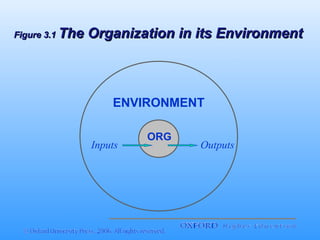
Figure 3.1

The Organization in its Environment

ENVIRONMENT
Inputs

ORG

Outputs
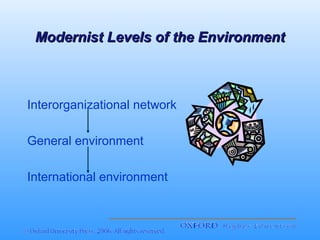
Modernist Levels of the Environment

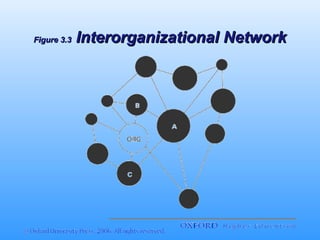
Interorganizational network
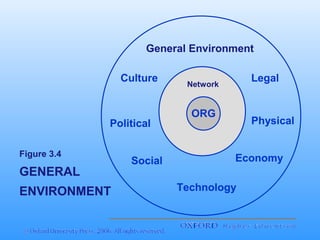
General environment
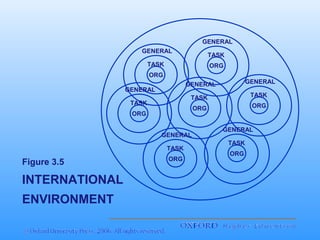
International environment
Organizational Environment
Modernist theory, the environment …
lies outside the boundary of the organization.
provides the organization with resources and absorbs
its products and services.
imposes constraints upon and demands adaptation
from the organization.
Organizational Environment
Symbolic-Interpretivists suggest environments …
are social constructions.
organizational members construct environmental
features they think are significant.
different organizations construct their environments
differently based on management’s interpretation.
Organizational Environment
Postmodernists see environment as…
fragmented
boundaryless
image-driven
simulacra
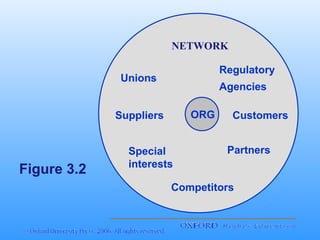
NETWORK
Regulatory

Unions

Agencies
ORG

Suppliers

Figure 3.2

Special
interests

Customers
Partners

Competitors
Managing the Environment
Buffering
Protecting the internal
organizational environment from
environmental shocks.

Example: Material, labour, or capital shortages.
Managing the Environment
Boundary Spanning
– Environmental monitoring activities.
– Representing the organizational interests to the
environment.
•
•
•
•

Public relations
Advertising
Sales
Recruiting efforts
Stakeholder theory
Organizations operate under a social contract
that guarantees certain rights to those who have
a stake in the organization’s activities or
outcomes. Those attending to stakeholder
demands will be more successful.
Interorganizational Network
Stakeholders:
Any actor that affects or is
affected by the organization.

Network actors:
Investors, competitors,
employees, media, suppliers,
distributors, government, the
physical environment, etc.
Figure 3.3

Interorganizational Network
General Environment
Culture

Political
Figure 3.4

GENERAL
ENVIRONMENT

Social

Legal

Network

ORG

Physical
Economy

Technology
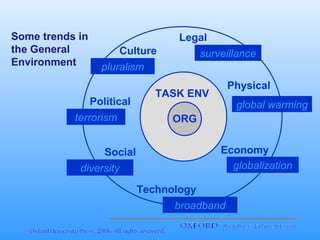
Some trends in
the General
Environment

Legal
Culture

surveillance

pluralism
Political

terrorism

Physical

TASK ENV

global warming

ORG
Economy
globalization

Social
diversity
Technology

broadband
GENERAL
GENERAL

TASK

TASK

ORG

ORG
GENERAL
TASK

TASK

TASK

ORG

GENERAL

GENERAL

ORG

ORG
GENERAL
TASK

Figure 3.5

INTERNATIONAL
ENVIRONMENT

ORG

GENERAL
TASK
ORG
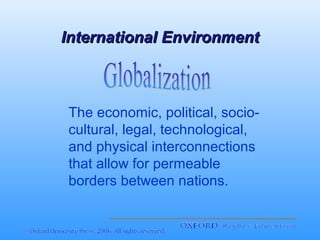
International Environment

The economic, political, sociocultural, legal, technological,
and physical interconnections
that allow for permeable
borders between nations.
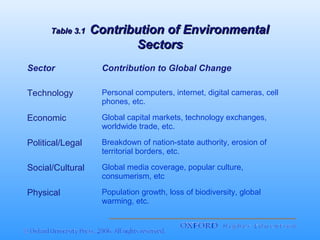
Table 3.1

Contribution of Environmental
Sectors

Sector

Contribution to Global Change

Technology

Personal computers, internet, digital cameras, cell
phones, etc.

Economic

Global capital markets, technology exchanges,
worldwide trade, etc.

Political/Legal

Breakdown of nation-state authority, erosion of
territorial borders, etc.

Social/Cultural

Global media coverage, popular culture,
consumerism, etc

Physical

Population growth, loss of biodiversity, global
warming, etc.
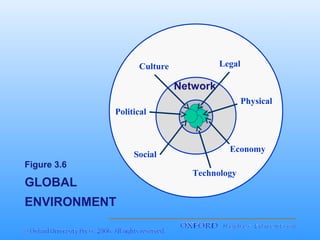
Legal

Culture

Network
Physical
Political

Social
Figure 3.6

GLOBAL
ENVIRONMENT

Economy
Technology
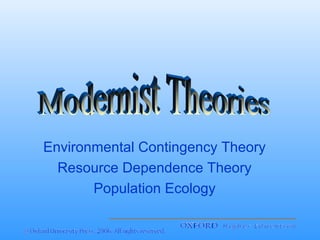
Environmental Contingency Theory
Resource Dependence Theory
Population Ecology
Environmental Contingency Theory

Successful organizations match their internal
structure to environmental characteristics (dynamic
or stable).

(Burns & Stalker, Lawrence &
Lorsch)
Environmental Contingency Theory
Stable Environments
•
•
•

Routine activities
Strict lines of authority
Distinct areas of responsibility

Rapidly Changing Environments
• Flexibility
• Application of skill where needed
• Changing work patterns
Environmental Contingency Theory
Information Perspective on
Uncertainty
Uncertainty is experienced by individuals
when they make decisions, rather than in the
environment itself.
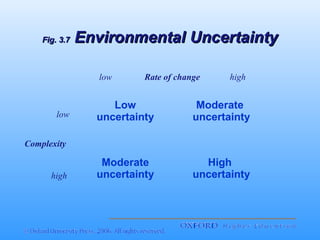
Fig. 3.7

Environmental Uncertainty
low

low

Rate of change

high

Low
uncertainty

Moderate
uncertainty

Moderate
uncertainty

High
uncertainty

Complexity
high
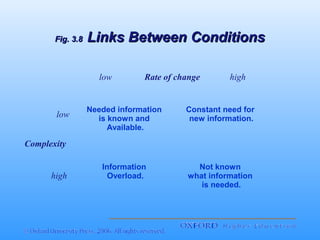
Fig. 3.8

Links Between Conditions
low

low

Rate of change

high

Needed information
is known and
Available.

Constant need for
new information.

Information
Overload.

Not known
what information
is needed.

Complexity
high
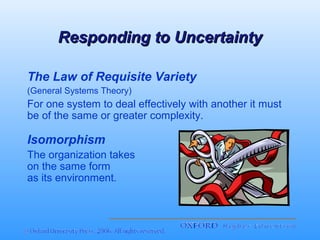
Responding to Uncertainty
The Law of Requisite Variety
(General Systems Theory)

For one system to deal effectively with another it must
be of the same or greater complexity.

Isomorphism
The organization takes
on the same form
as its environment.
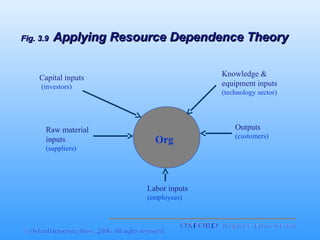
Resource Dependence Theory
Analysis of the
interorganizational
network can help the
organization understand
the power/dependence
relationships that exist
between it and other
network actors.
Power and Dependence
An organization depends on resources
controlled by the environment.

The environment therefore has power over an
organization and can influence decision
making.
Fig. 3.9

Applying Resource Dependence Theory
Knowledge &
equipment inputs

Capital inputs
(investors)

Raw material
inputs
(suppliers)

(technology sector)

Outputs

Org

Labor inputs
(employees)

(customers)
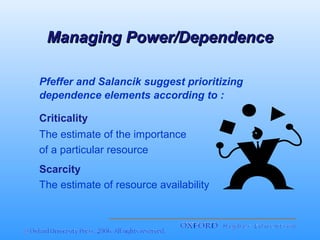
Managing Power/Dependence
Pfeffer and Salancik suggest prioritizing
dependence elements according to :
Criticality
The estimate of the importance
of a particular resource
Scarcity
The estimate of resource availability
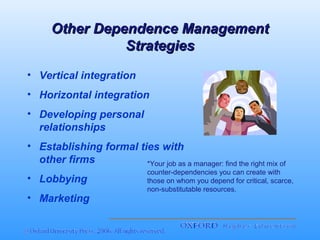
Other Dependence Management
Strategies
• Vertical integration
• Horizontal integration
• Developing personal
relationships
• Establishing formal ties with
other firms
*Your job as a manager: find the right mix of
• Lobbying
• Marketing

counter-dependencies you can create with
those on whom you depend for critical, scarce,
non-substitutable resources.
Population Ecology
Organizations within an ecological niche are competitively
interdependent and compete for survival.
Study how & why some
organizations survive.

• Variation
• Selection
• Retention
• Operation at the level of
the environment
Population Ecology
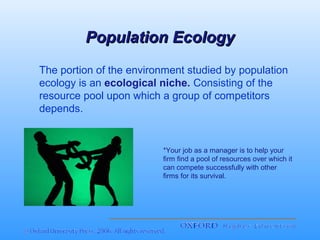
The portion of the environment studied by population
ecology is an ecological niche. Consisting of the
resource pool upon which a group of competitors
depends.

*Your job as a manager is to help your
firm find a pool of resources over which it
can compete successfully with other
firms for its survival.
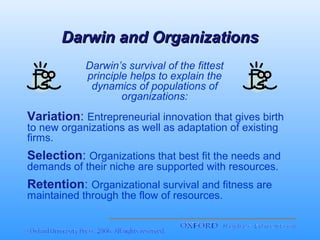
Darwin and Organizations
Darwin’s survival of the fittest
principle helps to explain the
dynamics of populations of
organizations:

Variation: Entrepreneurial innovation that gives birth
to new organizations as well as adaptation of existing
firms.

Selection: Organizations that best fit the needs and
demands of their niche are supported with resources.

Retention: Organizational survival and fitness are
maintained through the flow of resources.
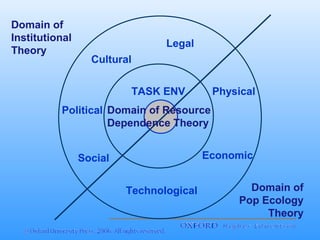
Domain of
Institutional
Theory

Legal
Cultural
TASK ENV

Physical

Political Domain of Resource
Dependence Theory
Economic

Social
Technological

Domain of
Pop Ecology
Theory
Institutional Theory
The Enacted Environment
Ambiguity Theory
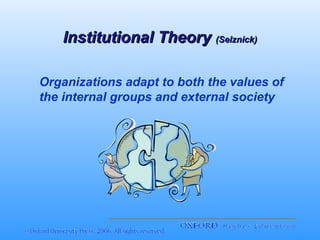
Institutional Theory (Selznick)
Organizations adapt to both the values of
the internal groups and external society
Institutional Theory

(DiMaggio & Powell)

An organization is institutionalized by the
following contexts:
1. Technical, Economic, or Physical
e.g. production and exchange of
goods in a market

2. Social, Cultural, Legal, or Political
e.g. conforming to norms, values, rules,
and beliefs upheld by society.
Institutional Pressures
Coercive: Pressure to conform that comes from
the government in the form of rules or laws.
Normative: Pressure from cultural
expectations.
Mimetic: The desire of one organization to
look like another. Usually used as a response to
uncertainty.
Social Legitimacy
Institutional environments reward organizations for adopting
acceptable practices and structures. Without this acceptance,
organizations can be driven out of business.

Your job as a manager is to to help your firm mimic practices indicated by the
institutional environment through coercion or normative expectation in order to
ensure its social legitimacy.
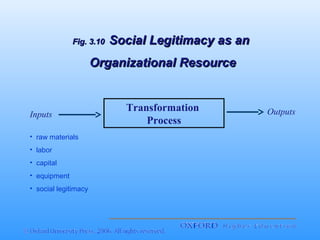
Fig. 3.10

Social Legitimacy as an

Organizational Resource

Inputs
• raw materials
• labor
• capital
• equipment
• social legitimacy

Transformation
Process

Outputs
Enacted Environment
The conditions of the environment
cannot be separated from managers
perceptions of those conditions.
When decision makers respond to
their perceptions they enact the
environment they anticipated.

(Weick)
Ambiguity Theory
Encouraging multiple interpretations of goals,
vision, and actions to produce different
strategies.
Deconstruction
Trace discursive and non-discursive
influences over time
Fragmented environment
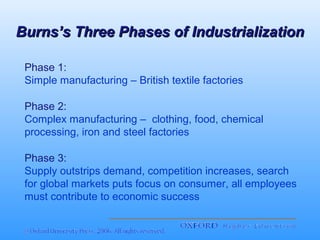
Burns’s Three Phases of Industrialization
Phase 1:
Simple manufacturing – British textile factories
Phase 2:
Complex manufacturing – clothing, food, chemical
processing, iron and steel factories
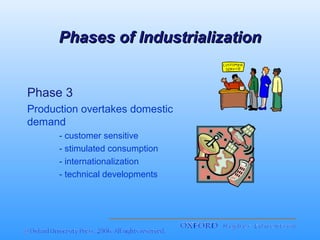
Phase 3:
Supply outstrips demand, competition increases, search
for global markets puts focus on consumer, all employees
must contribute to economic success
Phases of Industrialization

Phase 1:
The Factory System Productivity through
machines and routinization.

(Burns)
Phases of Industrialization

Phase 2:
Greater product variety, more
complex production processes,
growth in bureaucracy
- Control, routine, and specialization.
- Development of management structure
Phases of Industrialization
Phase 3
Production overtakes domestic
demand
- customer sensitive
- stimulated consumption
- internationalization
- technical developments
Post-Industrialism
Society is organized around
the creation of knowledge
and uses of information.
Society is shaped by its
method of acquiring and
distributing knowledge.

(Bell)
Avoiding Hegemony
Hegemony is the practice of interpreting
the interests of the ruling class as
universal.
- Surface language that implies the dominance
of one group over others.
- Give voice to others.

ORGANIZATION AND ENVIRONMENT