Globalization and its Discontents
Roundtable Discussion
Klaus Schmidt-Hebbel
Pontifical Catholic University of Chile
kschmidt-hebbel@uc.cl
Western Economic Association International
Santiago (Chile) Conference, 06 January 2017
On Globalization and its Discontents
• Globalization is the process of international integration arising
from the interchange of world views, products, ideas, and
other aspects of culture (Wikipedia)
• Human history has known forceful globalization as a result of
wars and violent dominance: from the displacement of
neandertals by homo sapiens (100.000 years ago) to Russia’s
invasion of Ukraine (now)
• Peaceful and rule-based globalization is a modern invention,
enshrined in national laws and international agreements.
• The Winter of Our Discontent is John Steinbeck's last novel,
published in 1961
• This title is a reference to the first two lines of William
Shakespeare's Richard III: "Now is the winter of our discontent /
Made glorious summer by this sun [or son] of York"
• Globalization and Its Discontents is the title of Joseph Stiglitz’s
book, published in 2002.
Outline
1. Globalization and its Measures
2. Globalization and its “Contents”:
Globalization and Growth
3. Globalization and its “Contents and
Discontents”: Globalization and
Distribution
4. Implications for Globalization Research and
Policy
1. Globalization and its Measures
What is Globalization? (1)
Very generally:
Globalization or international integration
implies (free) cross-border mobility of:
• Things
• Finance
• Ideas
• People
What is Globalization? (2)
More specifically, globalization comprises:
A. Economic globalization:
• Free trade in goods and services
• Free mobility of finance (capital)
• Free mobility of labor and migrants
• Free mobility of technology
B. Int’l adoption of economic institutions:
• Market economy; macro and micro institutions
• Environmental and labor standards, …
C. Int’l adoption of political institutions and regimes
• Rule of law, human rights, democracy, ...
D. Social and cultural globalization
• Spreading of norms, English usage, internet, ….
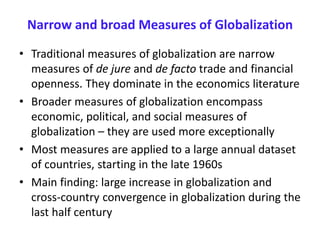
Narrow and broad Measures of Globalization
• Traditional measures of globalization are narrow
measures of de jure and de facto trade and financial
openness. They dominate in the economics literature
• Broader measures of globalization encompass
economic, political, and social measures of
globalization – they are used more exceptionally
• Most measures are applied to a large annual dataset
of countries, starting in the late 1960s
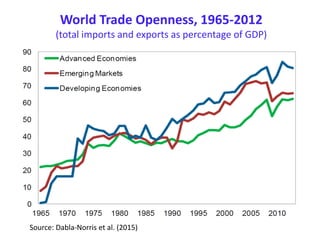
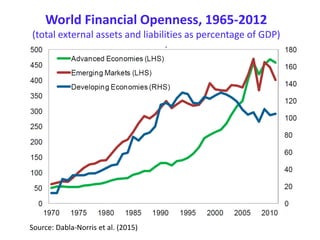
• Main finding: large increase in globalization and
cross-country convergence in globalization during the
last half century
World Trade Openness, 1965-2012
(total imports and exports as percentage of GDP)
Source: Dabla-Norris et al. (2015)
World Financial Openness, 1965-2012
(total external assets and liabilities as percentage of GDP)
Source: Dabla-Norris et al. (2015)
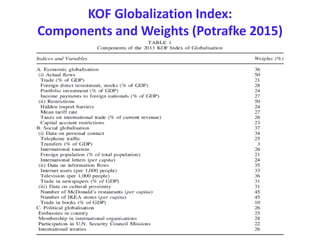
KOF Globalization Index:
Components and Weights (Potrafke 2015)
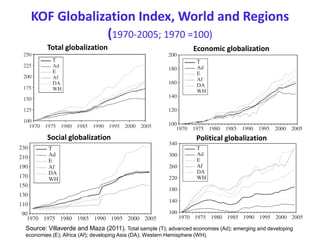
KOF Globalization Index, World and Regions
(1970-2005; 1970 =100)
Total globalization Economic globalization
Social globalization Political globalization
Source: Villaverde and Maza (2011). Total sample (T); advanced economies (Ad); emerging and developing
economies (E); Africa (Af); developing Asia (DA); Western Hemisphere (WH).
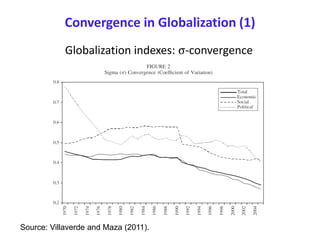
Convergence in Globalization (1)
Globalization indexes: σ-convergence
Source: Villaverde and Maza (2011).
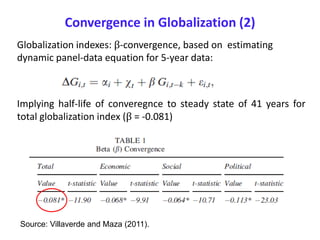
Globalization indexes: β-convergence, based on estimating
dynamic panel-data equation for 5-year data:
Implying half-life of converegnce to steady state of 41 years for
total globalization index (β = -0.081)
Source: Villaverde and Maza (2011).
Convergence in Globalization (2)
2. Globalization and its “Contents”:
Globalization and Growth
• A large body of evidence (based on partial models –
see below) tends to show that particular measures of
globalization – such as trade and financial
globalization – contribute positively and significantly
to:
– Higher (average) per capita growth
– Higher (average) per capita income levels
– Faster (average) income convergence
Non-linear Effects of Globalization on Growth
and Growth Volatility
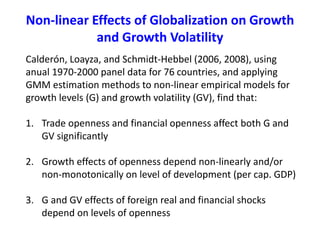
Calderón, Loayza, and Schmidt-Hebbel (2006, 2008), using
anual 1970-2000 panel data for 76 countries, and applying
GMM estimation methods to non-linear empirical models for
growth levels (G) and growth volatility (GV), find that:
1. Trade openness and financial openness affect both G and
GV significantly
2. Growth effects of openness depend non-linearly and/or
non-monotonically on level of development (per cap. GDP)
3. G and GV effects of foreign real and financial shocks
depend on levels of openness
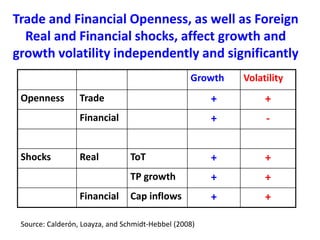
Trade and Financial Openness, as well as Foreign
Real and Financial shocks, affect growth and
growth volatility independently and significantly
Source: Calderón, Loayza, and Schmidt-Hebbel (2008)
Growth Volatility
Openness Trade + +
Financial + -
Shocks Real ToT + +
TP growth + +
Financial Cap inflows + +
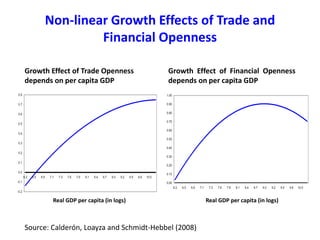
Growth Effect of Financial Openness
depends on per capita GDP
Growth Effect of Trade Openness
depends on per capita GDP
Real GDP per capita (in logs) Real GDP per capita (in logs)
Source: Calderón, Loayza and Schmidt-Hebbel (2008)
Non-linear Growth Effects of Trade and
Financial Openness
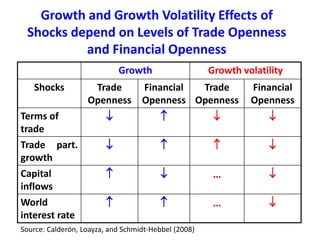
Growth and Growth Volatility Effects of
Shocks depend on Levels of Trade Openness
and Financial Openness
Source: Calderón, Loayza, and Schmidt-Hebbel (2008)
Growth Growth volatility
Shocks Trade
Openness
Financial
Openness
Trade
Openness
Financial
Openness
Terms of
trade
   
Trade part.
growth
   
Capital
inflows
  … 
World
interest rate
  … 
3. Globalization and its “Contents and
Discontents”:
Globalization and Distribution
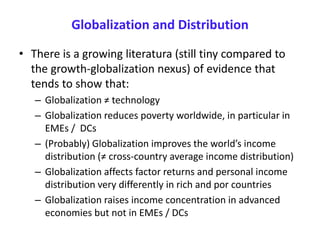
• There is a growing literatura (still tiny compared to
the growth-globalization nexus) of evidence that
tends to show that:
– Globalization ≠ technology
– Globalization reduces poverty worldwide, in particular in
EMEs / DCs
– (Probably) Globalization improves the world’s income
distribution (≠ cross-country average income distribution)
– Globalization affects factor returns and personal income
distribution very differently in rich and por countries
– Globalization raises income concentration in advanced
economies but not in EMEs / DCs
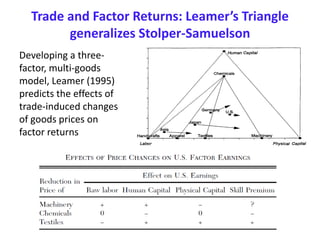
Trade and Factor Returns: Leamer’s Triangle
generalizes Stolper-Samuelson
Developing a three-
factor, multi-goods
model, Leamer (1995)
predicts the effects of
trade-induced changes
of goods prices on
factor returns
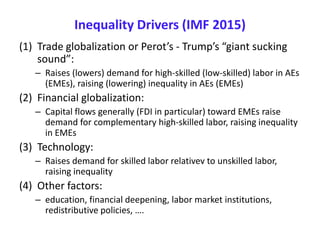
Inequality Drivers (IMF 2015)
(1) Trade globalization or Perot’s - Trump’s “giant sucking
sound”:
– Raises (lowers) demand for high-skilled (low-skilled) labor in AEs
(EMEs), raising (lowering) inequality in AEs (EMEs)
(2) Financial globalization:
– Capital flows generally (FDI in particular) toward EMEs raise
demand for complementary high-skilled labor, raising inequality
in EMEs
(3) Technology:
– Raises demand for skilled labor relativev to unskilled labor,
raising inequality
(4) Other factors:
– education, financial deepening, labor market institutions,
redistributive policies, ….
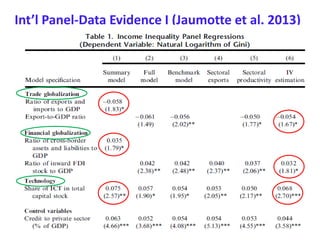
Int’l Panel-Data Evidence I (Jaumotte et al. 2013)
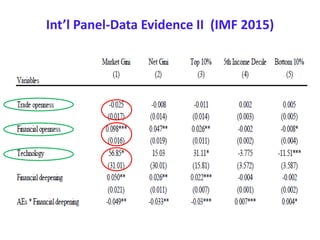
Int’l Panel-Data Evidence II (IMF 2015)
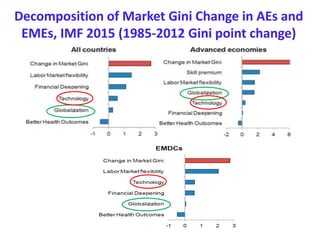
Decomposition of Market Gini Change in AEs and
EMEs, IMF 2015 (1985-2012 Gini point change)
4. Implications for
Globalization Research and Policy
Globalization Research Challenges
• Better analytical models:
– (Separate, joint) contribution of globalization and technology to
growth
– (Separate, joint) contribution of globalization and technology to
poverty and to income distribution
– Understanding the links (bi-causality) between globalization and
technology
• Better empirical work:
– Closer links between empirical and analytical models
– Based on broader measures of globalization (beyond trade and
financial openness)
– Considering well-founded interactions between technology and
globalization
– Addressing classical econometric problems
Who are the Globalization Discontents?
• Average agent and voter wins with globalization
• But there are losers: very few in absolute terms (poverty
declines), more in relative terms (especially in AEs)
• Risk-averse agents are hurt by larger uncertainty (not higher
income volatility) due to globalization (and other changes)
• Voters scared by large amounts of immigrants
• Political economy: few losers (especialy those who have much
to loose) and many risk-averse agents form effective coalitions
that block or revert globalization reforms that benefit majority
of winners and less-risk averse agents
• Politicians exploit coalitions against globalization to gain
power:
– 2016: Brexit plebiscite (June), Trump election (November)
– 2017: Prospects of anti-EU and anti-globalization populists from the
left and the right that may win European elections
Globalization: Welfare and Policy Implications
• Let me submit my reading of the literature’s implications for a first-
best globalization :
– Free trade in goods, services, capital, technology, ideas, and institutions
(except some extreme forms of predatory dumping, i.e., Chinese steel)
– Not: free mobility of people. Interior solution may be optimal: quota
systems à la AUS, NZD, CAN
• Economists:
– disseminate better our research results
– discuss positive and welfare implications
– take seriously and evaluate positive and welfare implications of anti-
globalization (protectionist) policy proposals
• Policy implications for governments
– Promote full globalization, except free mobility of people
– Compensate losers selectively and temporarily. Example: training
programs for displaced workers
References
• Dabla-Norris, M. E., Kochhar, M. K., Suphaphiphat, M. N., Ricka, M. F.,
and Tsounta, E. (2015). Causes and consequences of income inequality:
a global perspective. International Monetary Fund.
• Jaumotte, F., Lall, S., and Papageorgiou, C. (2013). Rising income
inequality: technology, or trade and financial globalization?. IMF
Economic Review, 61(2), 271-309.
• Leamer, E. E. (1995). The Heckscher-Ohlin model in theory and
practice.
• Villaverde, J. and A. Maza. (2011). Globalisation, growth and
convergence. The World Economy, 34(6), 952-971.
• Calderón, C., N. Loayza, and K. Schmidt-Hebbel (2006). “External Conditions
and Growth Performance”, in R. J. Caballero, C. Calderón, and L. F. Céspedes
(editors): External Vulnerability and Preventive Policies. Santiago: Central
Bank of Chile.
• Calderón, C., Loayza, N., and Schmidt-Hebbel, K. (2008). “Does Openness
imply Greater Vulnerability?” Working paper No. 292, Central Bank of Chile.
• Potrafke, N. (2015). The evidence on globalisation. The World
Economy, 38(3), 509-552.
References
• Tytell, I., & Jaumotte, F. (2008). How has the globalization of labor affected
the labor income share in advanced countries?. IMF Working Papers, 1-54.
References
Globalization and its Discontents
Roundtable Discussion
Klaus Schmidt-Hebbel
Pontifical Catholic University of Chile
kschmidt-hebbel@uc.cl
Western Economic Association International
Santiago (Chile) Conference, 06 January 2017

Globalization and its Discontents - Roundtable Discussion

  • 1.
    Globalization and itsDiscontents Roundtable Discussion Klaus Schmidt-Hebbel Pontifical Catholic University of Chile kschmidt-hebbel@uc.cl Western Economic Association International Santiago (Chile) Conference, 06 January 2017
  • 2.
    On Globalization andits Discontents • Globalization is the process of international integration arising from the interchange of world views, products, ideas, and other aspects of culture (Wikipedia) • Human history has known forceful globalization as a result of wars and violent dominance: from the displacement of neandertals by homo sapiens (100.000 years ago) to Russia’s invasion of Ukraine (now) • Peaceful and rule-based globalization is a modern invention, enshrined in national laws and international agreements. • The Winter of Our Discontent is John Steinbeck's last novel, published in 1961 • This title is a reference to the first two lines of William Shakespeare's Richard III: "Now is the winter of our discontent / Made glorious summer by this sun [or son] of York" • Globalization and Its Discontents is the title of Joseph Stiglitz’s book, published in 2002.
  • 3.
    Outline 1. Globalization andits Measures 2. Globalization and its “Contents”: Globalization and Growth 3. Globalization and its “Contents and Discontents”: Globalization and Distribution 4. Implications for Globalization Research and Policy
  • 4.
  • 5.
    What is Globalization?(1) Very generally: Globalization or international integration implies (free) cross-border mobility of: • Things • Finance • Ideas • People
  • 6.
    What is Globalization?(2) More specifically, globalization comprises: A. Economic globalization: • Free trade in goods and services • Free mobility of finance (capital) • Free mobility of labor and migrants • Free mobility of technology B. Int’l adoption of economic institutions: • Market economy; macro and micro institutions • Environmental and labor standards, … C. Int’l adoption of political institutions and regimes • Rule of law, human rights, democracy, ... D. Social and cultural globalization • Spreading of norms, English usage, internet, ….
  • 7.
    Narrow and broadMeasures of Globalization • Traditional measures of globalization are narrow measures of de jure and de facto trade and financial openness. They dominate in the economics literature • Broader measures of globalization encompass economic, political, and social measures of globalization – they are used more exceptionally • Most measures are applied to a large annual dataset of countries, starting in the late 1960s • Main finding: large increase in globalization and cross-country convergence in globalization during the last half century
  • 8.
    World Trade Openness,1965-2012 (total imports and exports as percentage of GDP) Source: Dabla-Norris et al. (2015)
  • 9.
    World Financial Openness,1965-2012 (total external assets and liabilities as percentage of GDP) Source: Dabla-Norris et al. (2015)
  • 10.
    KOF Globalization Index: Componentsand Weights (Potrafke 2015)
  • 11.
    KOF Globalization Index,World and Regions (1970-2005; 1970 =100) Total globalization Economic globalization Social globalization Political globalization Source: Villaverde and Maza (2011). Total sample (T); advanced economies (Ad); emerging and developing economies (E); Africa (Af); developing Asia (DA); Western Hemisphere (WH).
  • 12.
    Convergence in Globalization(1) Globalization indexes: σ-convergence Source: Villaverde and Maza (2011).
  • 13.
    Globalization indexes: β-convergence,based on estimating dynamic panel-data equation for 5-year data: Implying half-life of converegnce to steady state of 41 years for total globalization index (β = -0.081) Source: Villaverde and Maza (2011). Convergence in Globalization (2)
  • 14.
    2. Globalization andits “Contents”: Globalization and Growth
  • 15.
    Globalization and Growth •A large body of evidence (based on partial models – see below) tends to show that particular measures of globalization – such as trade and financial globalization – contribute positively and significantly to: – Higher (average) per capita growth – Higher (average) per capita income levels – Faster (average) income convergence
  • 16.
    Non-linear Effects ofGlobalization on Growth and Growth Volatility Calderón, Loayza, and Schmidt-Hebbel (2006, 2008), using anual 1970-2000 panel data for 76 countries, and applying GMM estimation methods to non-linear empirical models for growth levels (G) and growth volatility (GV), find that: 1. Trade openness and financial openness affect both G and GV significantly 2. Growth effects of openness depend non-linearly and/or non-monotonically on level of development (per cap. GDP) 3. G and GV effects of foreign real and financial shocks depend on levels of openness
  • 17.
    Trade and FinancialOpenness, as well as Foreign Real and Financial shocks, affect growth and growth volatility independently and significantly Source: Calderón, Loayza, and Schmidt-Hebbel (2008) Growth Volatility Openness Trade + + Financial + - Shocks Real ToT + + TP growth + + Financial Cap inflows + +
  • 18.
    Growth Effect ofFinancial Openness depends on per capita GDP Growth Effect of Trade Openness depends on per capita GDP Real GDP per capita (in logs) Real GDP per capita (in logs) Source: Calderón, Loayza and Schmidt-Hebbel (2008) Non-linear Growth Effects of Trade and Financial Openness
  • 19.
    Growth and GrowthVolatility Effects of Shocks depend on Levels of Trade Openness and Financial Openness Source: Calderón, Loayza, and Schmidt-Hebbel (2008) Growth Growth volatility Shocks Trade Openness Financial Openness Trade Openness Financial Openness Terms of trade     Trade part. growth     Capital inflows   …  World interest rate   … 
  • 20.
    3. Globalization andits “Contents and Discontents”: Globalization and Distribution
  • 21.
    Globalization and Distribution •There is a growing literatura (still tiny compared to the growth-globalization nexus) of evidence that tends to show that: – Globalization ≠ technology – Globalization reduces poverty worldwide, in particular in EMEs / DCs – (Probably) Globalization improves the world’s income distribution (≠ cross-country average income distribution) – Globalization affects factor returns and personal income distribution very differently in rich and por countries – Globalization raises income concentration in advanced economies but not in EMEs / DCs
  • 22.
    Trade and FactorReturns: Leamer’s Triangle generalizes Stolper-Samuelson Developing a three- factor, multi-goods model, Leamer (1995) predicts the effects of trade-induced changes of goods prices on factor returns
  • 23.
    Inequality Drivers (IMF2015) (1) Trade globalization or Perot’s - Trump’s “giant sucking sound”: – Raises (lowers) demand for high-skilled (low-skilled) labor in AEs (EMEs), raising (lowering) inequality in AEs (EMEs) (2) Financial globalization: – Capital flows generally (FDI in particular) toward EMEs raise demand for complementary high-skilled labor, raising inequality in EMEs (3) Technology: – Raises demand for skilled labor relativev to unskilled labor, raising inequality (4) Other factors: – education, financial deepening, labor market institutions, redistributive policies, ….
  • 24.
    Int’l Panel-Data EvidenceI (Jaumotte et al. 2013)
  • 25.
  • 26.
    Decomposition of MarketGini Change in AEs and EMEs, IMF 2015 (1985-2012 Gini point change)
  • 27.
  • 28.
    Globalization Research Challenges •Better analytical models: – (Separate, joint) contribution of globalization and technology to growth – (Separate, joint) contribution of globalization and technology to poverty and to income distribution – Understanding the links (bi-causality) between globalization and technology • Better empirical work: – Closer links between empirical and analytical models – Based on broader measures of globalization (beyond trade and financial openness) – Considering well-founded interactions between technology and globalization – Addressing classical econometric problems
  • 29.
    Who are theGlobalization Discontents? • Average agent and voter wins with globalization • But there are losers: very few in absolute terms (poverty declines), more in relative terms (especially in AEs) • Risk-averse agents are hurt by larger uncertainty (not higher income volatility) due to globalization (and other changes) • Voters scared by large amounts of immigrants • Political economy: few losers (especialy those who have much to loose) and many risk-averse agents form effective coalitions that block or revert globalization reforms that benefit majority of winners and less-risk averse agents • Politicians exploit coalitions against globalization to gain power: – 2016: Brexit plebiscite (June), Trump election (November) – 2017: Prospects of anti-EU and anti-globalization populists from the left and the right that may win European elections
  • 30.
    Globalization: Welfare andPolicy Implications • Let me submit my reading of the literature’s implications for a first- best globalization : – Free trade in goods, services, capital, technology, ideas, and institutions (except some extreme forms of predatory dumping, i.e., Chinese steel) – Not: free mobility of people. Interior solution may be optimal: quota systems à la AUS, NZD, CAN • Economists: – disseminate better our research results – discuss positive and welfare implications – take seriously and evaluate positive and welfare implications of anti- globalization (protectionist) policy proposals • Policy implications for governments – Promote full globalization, except free mobility of people – Compensate losers selectively and temporarily. Example: training programs for displaced workers
  • 31.
    References • Dabla-Norris, M.E., Kochhar, M. K., Suphaphiphat, M. N., Ricka, M. F., and Tsounta, E. (2015). Causes and consequences of income inequality: a global perspective. International Monetary Fund. • Jaumotte, F., Lall, S., and Papageorgiou, C. (2013). Rising income inequality: technology, or trade and financial globalization?. IMF Economic Review, 61(2), 271-309. • Leamer, E. E. (1995). The Heckscher-Ohlin model in theory and practice.
  • 32.
    • Villaverde, J.and A. Maza. (2011). Globalisation, growth and convergence. The World Economy, 34(6), 952-971. • Calderón, C., N. Loayza, and K. Schmidt-Hebbel (2006). “External Conditions and Growth Performance”, in R. J. Caballero, C. Calderón, and L. F. Céspedes (editors): External Vulnerability and Preventive Policies. Santiago: Central Bank of Chile. • Calderón, C., Loayza, N., and Schmidt-Hebbel, K. (2008). “Does Openness imply Greater Vulnerability?” Working paper No. 292, Central Bank of Chile. • Potrafke, N. (2015). The evidence on globalisation. The World Economy, 38(3), 509-552. References
  • 33.
    • Tytell, I.,& Jaumotte, F. (2008). How has the globalization of labor affected the labor income share in advanced countries?. IMF Working Papers, 1-54. References
  • 34.
    Globalization and itsDiscontents Roundtable Discussion Klaus Schmidt-Hebbel Pontifical Catholic University of Chile kschmidt-hebbel@uc.cl Western Economic Association International Santiago (Chile) Conference, 06 January 2017