Meeting Document Summary Sheet
Document Title:
Global Economic Outlook: ABAC I 2017
Purpose:
For information
Issue:
The key messages of the presentation are:
 Global growth should be higher in 2017/2018 than 2016, but still lower than historical
averages
 Near term risks to the forecast are skewed downward
 Secular drag on growth due to slowing growth in trade, productivity, and the labor force
Background:
Global economic outlook
Proposal /Recommendations:
None
Decision Points:
For information only
Document: Program 37-005
Draft: FIRST
Date: 11 February 2017
Source: FEWG Chair
Meeting: Bangkok, Thailand
Global Macroeconomic Outlook
Richard Cantor, ABAC USA ABAC I, Bangkok, February 2017
Document: Program 37-005
Draft: FIRST
Date: 11 February 2017
Source: FEWG Chair
Meeting: Bangkok, Thailand
2Global Macroeconomic Outlook, February 2017
Key Messages
Secular drag on growth due to slowing growth in trade,
productivity, and the labor force3
2
Global growth should be higher in ’17 & ’18 than ‘16,
but still lower than historical averages1
Near-term risks to the forecast are skewed downward
3Global Macroeconomic Outlook, February 2017
Baseline Forecast
1
4
Global Macroeconomic Outlook, February 2017
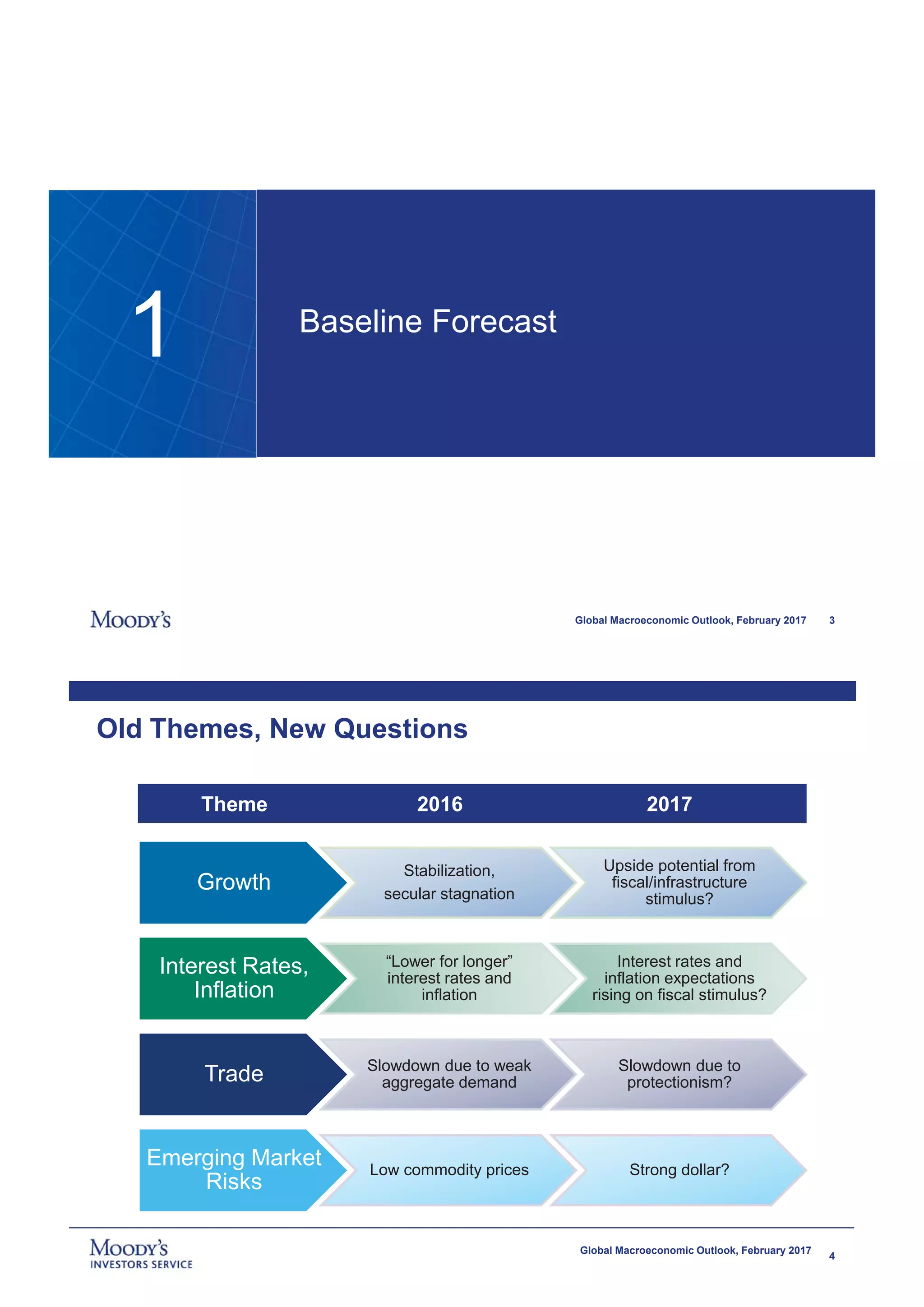
Old Themes, New Questions
Theme 2016 2017
Growth
Stabilization,
secular stagnation
Upside potential from
fiscal/infrastructure
stimulus?
Interest Rates,
Inflation
“Lower for longer”
interest rates and
inflation
Interest rates and
inflation expectations
rising on fiscal stimulus?
Trade Slowdown due to weak
aggregate demand
Slowdown due to
protectionism?
Emerging Market
Risks
Low commodity prices Strong dollar?
5Global Macroeconomic Outlook, February 2017
Factors Supporting Modestly Improved 2017 Outlook
Improved
domestic
fundamentals
Expansionary
fiscal policies
Stable
commodity
prices
Stable Chinese
demand
6
Global Macroeconomic Outlook, February 2017
Global Economic Growth Will Stabilize in 2017, but Will
Remain at Historically Low Levels
We forecast G20 real GDP growth of around 3% in 2017, up from 2.6% in 2016.
Source: Moody’s Investors Service
-4
-2
0
2
4
6
8
10
2000 2001 2002 2003 2004 2005 2006 2007 2008 2009 2010 2011 2012 2013 2014 2015 2016 2017 2018
G-20 Emerging G-20 Advanced G-20 All
7
Global Macroeconomic Outlook, February 2017
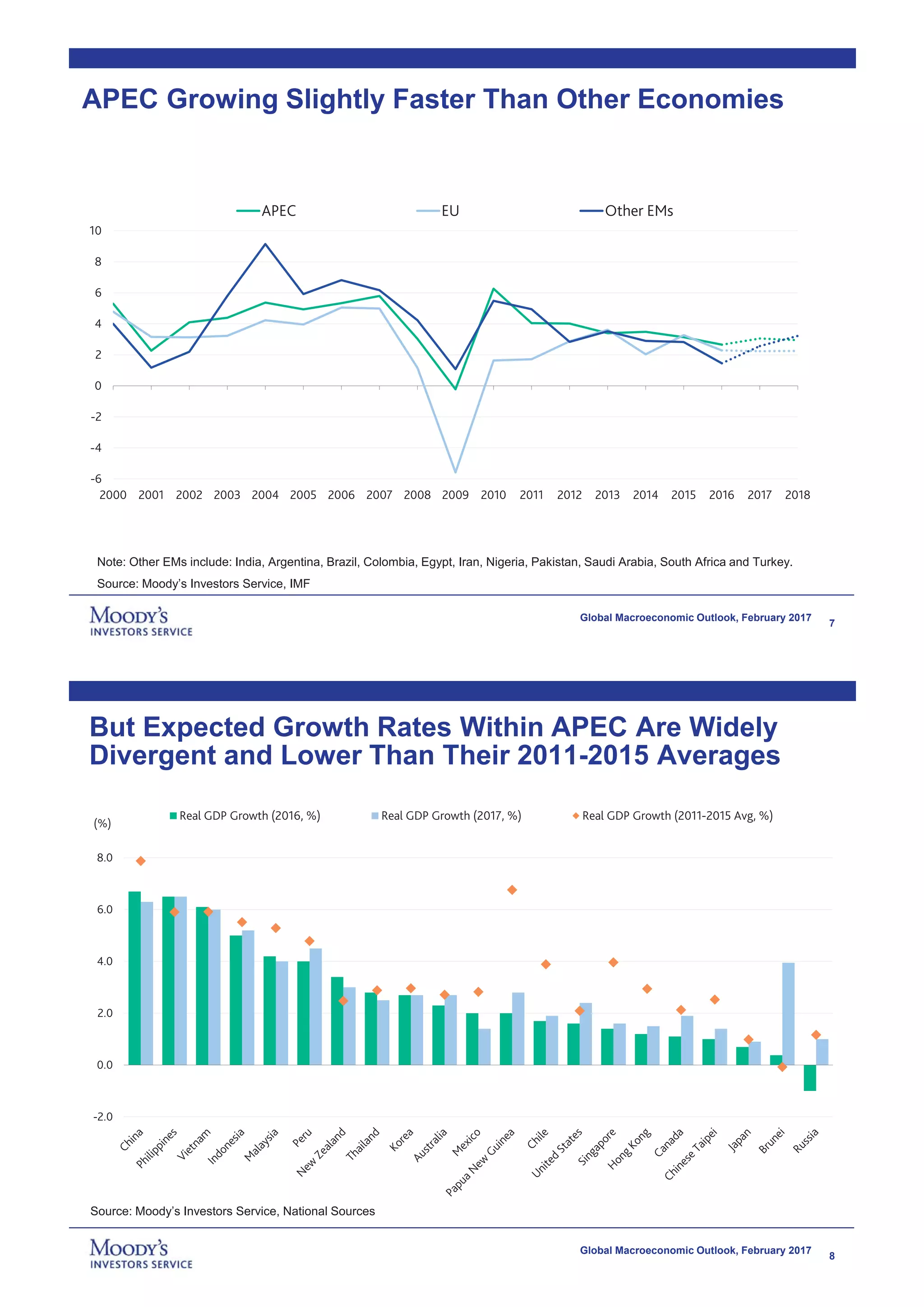
APEC Growing Slightly Faster Than Other Economies
Note: Other EMs include: India, Argentina, Brazil, Colombia, Egypt, Iran, Nigeria, Pakistan, Saudi Arabia, South Africa and Turkey.
Source: Moody’s Investors Service, IMF
-6
-4
-2
0
2
4
6
8
10
2000 2001 2002 2003 2004 2005 2006 2007 2008 2009 2010 2011 2012 2013 2014 2015 2016 2017 2018
APEC EU Other EMs
8
Global Macroeconomic Outlook, February 2017
-2.0
0.0
2.0
4.0
6.0
8.0
(%)
Real GDP Growth (2016, %) Real GDP Growth (2017, %) Real GDP Growth (2011-2015 Avg, %)
But Expected Growth Rates Within APEC Are Widely
Divergent and Lower Than Their 2011-2015 Averages
Source: Moody’s Investors Service, National Sources
9
Global Macroeconomic Outlook, February 2017
Main Downside Risks to the Outlook
2
10
Global Macroeconomic Outlook, February 2017
Key Risks
Fallout from unanticipated share risk in US interest
rates and/or dollar
Risk of a sudden and sharp deceleration in China
3
2
Increased economic and geopolitical risks associated
with shifts in US trade and foreign policies1
Potential for further rise in political risk and
fragmentation of the EU, especially the euro area4
11
Global Macroeconomic Outlook, February 2017
Rise in protectionist sentiment may lead to the renegotiation of existing trade
pacts and reduced appetite for new deals.
US Trade Disruption Would Impact Many Economies
APEC Exports to the US as a % Share of National GDP (2015)
0.0
5.0
10.0
15.0
20.0
25.0
30.0
Note: Data is not available for Chinese Taipei.
Source: Moody’s Investors Service, IMF
12
Global Macroeconomic Outlook, February 2017
APEC Economies Open to Trade Might Be Indirectly
Exposed to US Trade Even If Direct Trade With US Is Low
0
50
100
150
200
250
300
350
400
450
0
5
10
15
20
25
30
Exports to US as Share of National GDP (%) Openness of the Economy (RHS, %)
Note: Data is not available for Chinese Taipei. Openness of the Economy is defined as (Exports*0.5 + Imports*0.5)/GDP
Source: Moody’s Investors Service, IMF
13
Global Macroeconomic Outlook, February 2017
Declining Returns on Investment in China Implies Limits
on Effectiveness of Credit Generation to Sustain Growth
Return on Assets for Industrial Corporates
Sources: Moody’s Investors Service, WIND
* Total social financing (TSF) is an official measure of broad credit in the financial system consisting of formal bank loans, shadow banking
activities, direct financing (bond and equity issuance) and others (e.g. microcredit). The series shown above reflects our adjustments from May
2015 onwards to account for distortions from the local government debt swap program.
Growth of GDP and Credit
14
Global Macroeconomic Outlook, February 2017
Under an assumption of full pass-through to exchange rates, a 20% US border
adjustment tax could result in a 25% appreciation of the US dollar.
Source: Moody’s Investors Service, Federal Reserve Bank of St. Louis. Note: Shading denotes recessions.
Large Dollar Exchange Rate Adjustment Could Have
Global Repercussions
60
70
80
90
100
110
120
130
140
150
1970 1975 1980 1985 1990 1995 2000 2005 2010 2015
Index (Mar-1973=100) Nominal Trade Weighted U.S. Dollar Index: Major Currencies
Nominal Dollar
Index - Full Border
Tax Adjustment
(Illustrative)
15
Global Macroeconomic Outlook, February 2017
FFRANCE
Presidential Election:
23 April and 7 May
(2nd round) 2017
Legislative Election:
11 June and 18 June
(2nd round) 2017
ITALY
Federal Election:
By 23 May 2018
(potentially in 2017)
HUNGARY
Parliamentary Election:
In or before Spring 2018
CZECH REPUBLIC
Parliamentary Election:
In or before October 2017
GERMANY
Federal Election:
24 September 2017
NETHERLANDS
Legislative Election:
15 March 2017
EU Election Risks Could Weigh on Outlook in 2017
Busy Europe election schedule and EU fragmentation concerns will generate policy
uncertainty and could trigger bouts of market volatility
Source: Moody’s Investors Service
16
Global Macroeconomic Outlook, February 2017
Key Long-Run Drivers of the Global
Macro Outlook3
17
Global Macroeconomic Outlook, February 2017
Global Productivity Growth Much Weaker Post-Crisis
Source: Moody’s Investors Service, Haver Analytics
-1.5
-1.0
-0.5
0.0
0.5
1.0
1.5
2.0
2.5
3.0
3.5
Productivity growth weakens
1998 - 2007 Average
2011 - 2016
Average
Productivity (SA, Y-o-Y % Change)
18
Global Macroeconomic Outlook, February 2017
Global Trade Growth Much Weaker Post-Crisis
Source: Moody’s Investors Service, Haver Analytics
Ratio of Global Trade to G20 GDP, 2010 = 100
Note: World trade: average of global imports and exports of goods, 2016 is based on Q1 and Q2 data
40.0
50.0
60.0
70.0
80.0
90.0
100.0
110.0
120.0
130.0
140.0
1998
1999
2000
2001
2002
2003
2004
2005
2006
2007
2008
2009
2010
2011
2012
2013
2014
2015
2016
Trade/GDP Pre-crisis trade trend
Trade grows
twice as fast
as GDP
Trade growth
slower
than GDP
Possible Explanations
• Supply-chain benefits
exhausted
• Weak demand for
investment and, thus,
import-intensive
capital goods
• Rising protectionism
evident in rise in non-
tariff barriers
19
Global Macroeconomic Outlook, February 2017
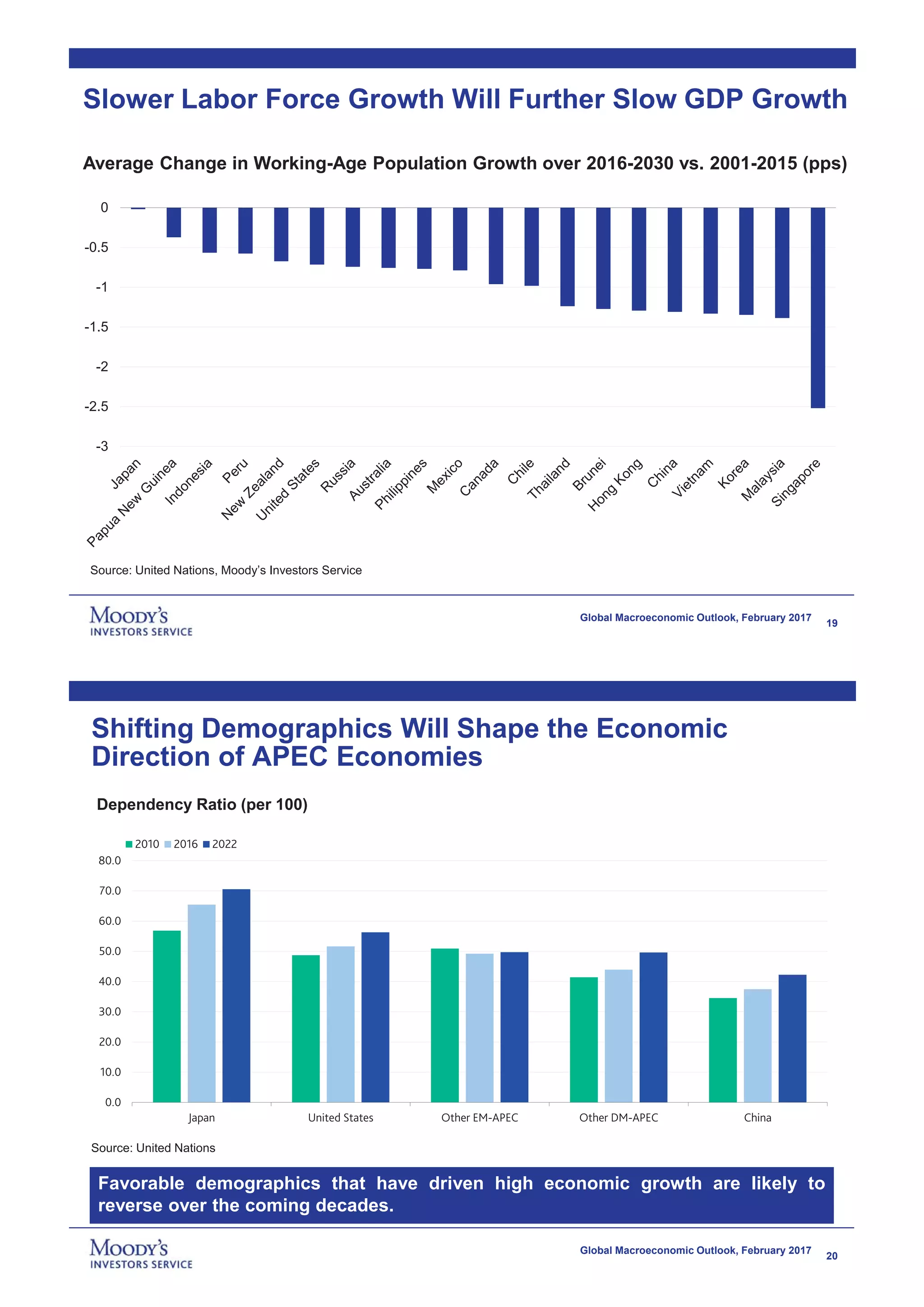
Slower Labor Force Growth Will Further Slow GDP Growth
Average Change in Working-Age Population Growth over 2016-2030 vs. 2001-2015 (pps)
Source: United Nations, Moody’s Investors Service
-3
-2.5
-2
-1.5
-1
-0.5
0
20
Global Macroeconomic Outlook, February 2017
Shifting Demographics Will Shape the Economic
Direction of APEC Economies
Source: United Nations
Favorable demographics that have driven high economic growth are likely to
reverse over the coming decades.
Dependency Ratio (per 100)
0.0
10.0
20.0
30.0
40.0
50.0
60.0
70.0
80.0
Japan United States Other EM-APEC Other DM-APEC China
2010 2016 2022
21
Global Macroeconomic Outlook, February 2017
0
50
100
150
200
250
300
350
400
450
InThousand
Global Americas Asia Europe Afria Rest
Trend of Global Automation Process
Source: Moody’s Investors Service, International Federation of Robotics
Technological Innovation Crucial Catalyst for Growth
But Threatens Job Security in Some Sectors
Annual Global Supply of Industrial Robots
23Global Macroeconomic Outlook, February 2017
© 2017 Moody’s Corporation, Moody’s Investors Service, Inc., Moody’s Analytics, Inc. and/or their licensors
and affiliates (collectively, “MOODY’S”). All rights reserved.
CREDIT RATINGS ISSUED BY MOODY'S INVESTORS SERVICE, INC. AND ITS RATINGS AFFILIATES
(“MIS”) ARE MOODY’S CURRENT OPINIONS OF THE RELATIVE FUTURE CREDIT RISK OF ENTITIES,
CREDIT COMMITMENTS, OR DEBT OR DEBT-LIKE SECURITIES, AND MOODY’S PUBLICATIONS MAY
INCLUDE MOODY’S CURRENT OPINIONS OF THE RELATIVE FUTURE CREDIT RISK OF ENTITIES,
CREDIT COMMITMENTS, OR DEBT OR DEBT-LIKE SECURITIES. MOODY’S DEFINES CREDIT RISK AS
THE RISK THAT AN ENTITY MAY NOT MEET ITS CONTRACTUAL, FINANCIAL OBLIGATIONS AS THEY
COME DUE AND ANY ESTIMATED FINANCIAL LOSS IN THE EVENT OF DEFAULT. CREDIT RATINGS
DO NOT ADDRESS ANY OTHER RISK, INCLUDING BUT NOT LIMITED TO: LIQUIDITY RISK, MARKET
VALUE RISK, OR PRICE VOLATILITY. CREDIT RATINGS AND MOODY’S OPINIONS INCLUDED IN
MOODY’S PUBLICATIONS ARE NOT STATEMENTS OF CURRENT OR HISTORICAL FACT. MOODY’S
PUBLICATIONS MAY ALSO INCLUDE QUANTITATIVE MODEL-BASED ESTIMATES OF CREDIT RISK
AND RELATED OPINIONS OR COMMENTARY PUBLISHED BY MOODY’S ANALYTICS, INC. CREDIT
RATINGS AND MOODY’S PUBLICATIONS DO NOT CONSTITUTE OR PROVIDE INVESTMENT OR
FINANCIAL ADVICE, AND CREDIT RATINGS AND MOODY’S PUBLICATIONS ARE NOT AND DO NOT
PROVIDE RECOMMENDATIONS TO PURCHASE, SELL, OR HOLD PARTICULAR SECURITIES.
NEITHER CREDIT RATINGS NOR MOODY’S PUBLICATIONS COMMENT ON THE SUITABILITY OF AN
INVESTMENT FOR ANY PARTICULAR INVESTOR. MOODY’S ISSUES ITS CREDIT RATINGS AND
PUBLISHES MOODY’S PUBLICATIONS WITH THE EXPECTATION AND UNDERSTANDING THAT EACH
INVESTOR WILL, WITH DUE CARE, MAKE ITS OWN STUDY AND EVALUATION OF EACH SECURITY
THAT IS UNDER CONSIDERATION FOR PURCHASE, HOLDING, OR SALE.
MOODY’S CREDIT RATINGS AND MOODY’S PUBLICATIONS ARE NOT INTENDED FOR USE BY
RETAIL INVESTORS AND IT WOULD BE RECKLESS AND INAPPROPRIATE FOR RETAIL INVESTORS
TO USE MOODY’S CREDIT RATINGS OR MOODY’S PUBLICATIONS WHEN MAKING AN INVESTMENT
DECISION. IF IN DOUBT YOU SHOULD CONTACT YOUR FINANCIAL OR OTHER PROFESSIONAL
ADVISER.
ALL INFORMATION CONTAINED HEREIN IS PROTECTED BY LAW, INCLUDING BUT NOT LIMITED TO,
COPYRIGHT LAW, AND NONE OF SUCH INFORMATION MAY BE COPIED OR OTHERWISE
REPRODUCED, REPACKAGED, FURTHER TRANSMITTED, TRANSFERRED, DISSEMINATED,
REDISTRIBUTED OR RESOLD, OR STORED FOR SUBSEQUENT USE FOR ANY SUCH PURPOSE, IN
WHOLE OR IN PART, IN ANY FORM OR MANNER OR BY ANY MEANS WHATSOEVER, BY ANY
PERSON WITHOUT MOODY’S PRIOR WRITTEN CONSENT.
All information contained herein is obtained by MOODY’S from sources believed by it to be accurate and
reliable. Because of the possibility of human or mechanical error as well as other factors, however, all
information contained herein is provided “AS IS” without warranty of any kind. MOODY'S adopts all necessary
measures so that the information it uses in assigning a credit rating is of sufficient quality and from sources
MOODY'S considers to be reliable including, when appropriate, independent third-party sources. However,
MOODY’S is not an auditor and cannot in every instance independently verify or validate information received
in the rating process or in preparing the Moody’s publications.
To the extent permitted by law, MOODY’S and its directors, officers, employees, agents, representatives,
licensors and suppliers disclaim liability to any person or entity for any indirect, special, consequential, or
incidental losses or damages whatsoever arising from or in connection with the information contained herein
or the use of or inability to use any such information, even if MOODY’S or any of its directors, officers,
employees, agents, representatives, licensors or suppliers is advised in advance of the possibility of such
losses or damages, including but not limited to: (a) any loss of present or prospective profits or (b) any loss or
damage arising where the relevant financial instrument is not the subject of a particular credit rating assigned
by MOODY’S.
To the extent permitted by law, MOODY’S and its directors, officers, employees, agents, representatives,
licensors and suppliers disclaim liability for any direct or compensatory losses or damages caused to any
person or entity, including but not limited to by any negligence (but excluding fraud, willful misconduct or any
other type of liability that, for the avoidance of doubt, by law cannot be excluded) on the part of, or any
contingency within or beyond the control of, MOODY’S or any of its directors, officers, employees, agents,
representatives, licensors or suppliers, arising from or in connection with the information contained herein or
the use of or inability to use any such information.
NO WARRANTY, EXPRESS OR IMPLIED, AS TO THE ACCURACY, TIMELINESS, COMPLETENESS,
MERCHANTABILITY OR FITNESS FOR ANY PARTICULAR PURPOSE OF ANY SUCH RATING OR
OTHER OPINION OR INFORMATION IS GIVEN OR MADE BY MOODY’S IN ANY FORM OR MANNER
WHATSOEVER.
Moody’s Investors Service, Inc., a wholly-owned credit rating agency subsidiary of Moody’s Corporation
(“MCO”), hereby discloses that most issuers of debt securities (including corporate and municipal bonds,
debentures, notes and commercial paper) and preferred stock rated by Moody’s Investors Service, Inc. have,
prior to assignment of any rating, agreed to pay to Moody’s Investors Service, Inc. for appraisal and rating
services rendered by it fees ranging from $1,500 to approximately $2,500,000. MCO and MIS also maintain
policies and procedures to address the independence of MIS’s ratings and rating processes. Information
regarding certain affiliations that may exist between directors of MCO and rated entities, and between entities
who hold ratings from MIS and have also publicly reported to the SEC an ownership interest in MCO of more
than 5%, is posted annually at www.moodys.com under the heading “Investor Relations — Corporate
Governance — Director and Shareholder Affiliation Policy.”
Additional terms for Australia only: Any publication into Australia of this document is pursuant to the Australian
Financial Services License of MOODY’S affiliate, Moody’s Investors Service Pty Limited ABN 61 003 399
657AFSL 336969 and/or Moody’s Analytics Australia Pty Ltd ABN 94 105 136 972 AFSL 383569 (as
applicable). This document is intended to be provided only to “wholesale clients” within the meaning of section
761G of the Corporations Act 2001. By continuing to access this document from within Australia, you
represent to MOODY’S that you are, or are accessing the document as a representative of, a “wholesale
client” and that neither you nor the entity you represent will directly or indirectly disseminate this document or
its contents to “retail clients” within the meaning of section 761G of the Corporations Act 2001. MOODY’S
credit rating is an opinion as to the creditworthiness of a debt obligation of the issuer, not on the equity
securities of the issuer or any form of security that is available to retail investors. It would be reckless and
inappropriate for retail investors to use MOODY’S credit ratings or publications when making an investment
decision. If in doubt you should contact your financial or other professional adviser.
Additional terms for Japan only: Moody's Japan K.K. (“MJKK”) is a wholly-owned credit rating agency
subsidiary of Moody's Group Japan G.K., which is wholly-owned by Moody’s Overseas Holdings Inc., a
wholly-owned subsidiary of MCO. Moody’s SF Japan K.K. (“MSFJ”) is a wholly-owned credit rating agency
subsidiary of MJKK. MSFJ is not a Nationally Recognized Statistical Rating Organization (“NRSRO”).
Therefore, credit ratings assigned by MSFJ are Non-NRSRO Credit Ratings. Non-NRSRO Credit Ratings are
assigned by an entity that is not a NRSRO and, consequently, the rated obligation will not qualify for certain
types of treatment under U.S. laws. MJKK and MSFJ are credit rating agencies registered with the Japan
Financial Services Agency and their registration numbers are FSA Commissioner (Ratings) No. 2 and 3
respectively.
MJKK or MSFJ (as applicable) hereby disclose that most issuers of debt securities (including corporate and
municipal bonds, debentures, notes and commercial paper) and preferred stock rated by MJKK or MSFJ (as
applicable) have, prior to assignment of any rating, agreed to pay to MJKK or MSFJ (as applicable) for
appraisal and rating services rendered by it fees ranging from JPY200,000 to approximately JPY350,000,000.
MJKK and MSFJ also maintain policies and procedures to address Japanese regulatory requirements.
This publication does not announce a credit rating action. For any credit ratings referenced in this publication, please see the ratings tab on the issuer/entity page on www.moodys.com for the most updated credit rating
action information and rating history.

Global Macroeconomic Outlook

  • 1.
    Meeting Document SummarySheet Document Title: Global Economic Outlook: ABAC I 2017 Purpose: For information Issue: The key messages of the presentation are:  Global growth should be higher in 2017/2018 than 2016, but still lower than historical averages  Near term risks to the forecast are skewed downward  Secular drag on growth due to slowing growth in trade, productivity, and the labor force Background: Global economic outlook Proposal /Recommendations: None Decision Points: For information only Document: Program 37-005 Draft: FIRST Date: 11 February 2017 Source: FEWG Chair Meeting: Bangkok, Thailand
  • 2.
    Global Macroeconomic Outlook RichardCantor, ABAC USA ABAC I, Bangkok, February 2017 Document: Program 37-005 Draft: FIRST Date: 11 February 2017 Source: FEWG Chair Meeting: Bangkok, Thailand 2Global Macroeconomic Outlook, February 2017 Key Messages Secular drag on growth due to slowing growth in trade, productivity, and the labor force3 2 Global growth should be higher in ’17 & ’18 than ‘16, but still lower than historical averages1 Near-term risks to the forecast are skewed downward
  • 3.
    3Global Macroeconomic Outlook,February 2017 Baseline Forecast 1 4 Global Macroeconomic Outlook, February 2017 Old Themes, New Questions Theme 2016 2017 Growth Stabilization, secular stagnation Upside potential from fiscal/infrastructure stimulus? Interest Rates, Inflation “Lower for longer” interest rates and inflation Interest rates and inflation expectations rising on fiscal stimulus? Trade Slowdown due to weak aggregate demand Slowdown due to protectionism? Emerging Market Risks Low commodity prices Strong dollar?
  • 4.
    5Global Macroeconomic Outlook,February 2017 Factors Supporting Modestly Improved 2017 Outlook Improved domestic fundamentals Expansionary fiscal policies Stable commodity prices Stable Chinese demand 6 Global Macroeconomic Outlook, February 2017 Global Economic Growth Will Stabilize in 2017, but Will Remain at Historically Low Levels We forecast G20 real GDP growth of around 3% in 2017, up from 2.6% in 2016. Source: Moody’s Investors Service -4 -2 0 2 4 6 8 10 2000 2001 2002 2003 2004 2005 2006 2007 2008 2009 2010 2011 2012 2013 2014 2015 2016 2017 2018 G-20 Emerging G-20 Advanced G-20 All
  • 5.
    7 Global Macroeconomic Outlook,February 2017 APEC Growing Slightly Faster Than Other Economies Note: Other EMs include: India, Argentina, Brazil, Colombia, Egypt, Iran, Nigeria, Pakistan, Saudi Arabia, South Africa and Turkey. Source: Moody’s Investors Service, IMF -6 -4 -2 0 2 4 6 8 10 2000 2001 2002 2003 2004 2005 2006 2007 2008 2009 2010 2011 2012 2013 2014 2015 2016 2017 2018 APEC EU Other EMs 8 Global Macroeconomic Outlook, February 2017 -2.0 0.0 2.0 4.0 6.0 8.0 (%) Real GDP Growth (2016, %) Real GDP Growth (2017, %) Real GDP Growth (2011-2015 Avg, %) But Expected Growth Rates Within APEC Are Widely Divergent and Lower Than Their 2011-2015 Averages Source: Moody’s Investors Service, National Sources
  • 6.
    9 Global Macroeconomic Outlook,February 2017 Main Downside Risks to the Outlook 2 10 Global Macroeconomic Outlook, February 2017 Key Risks Fallout from unanticipated share risk in US interest rates and/or dollar Risk of a sudden and sharp deceleration in China 3 2 Increased economic and geopolitical risks associated with shifts in US trade and foreign policies1 Potential for further rise in political risk and fragmentation of the EU, especially the euro area4
  • 7.
    11 Global Macroeconomic Outlook,February 2017 Rise in protectionist sentiment may lead to the renegotiation of existing trade pacts and reduced appetite for new deals. US Trade Disruption Would Impact Many Economies APEC Exports to the US as a % Share of National GDP (2015) 0.0 5.0 10.0 15.0 20.0 25.0 30.0 Note: Data is not available for Chinese Taipei. Source: Moody’s Investors Service, IMF 12 Global Macroeconomic Outlook, February 2017 APEC Economies Open to Trade Might Be Indirectly Exposed to US Trade Even If Direct Trade With US Is Low 0 50 100 150 200 250 300 350 400 450 0 5 10 15 20 25 30 Exports to US as Share of National GDP (%) Openness of the Economy (RHS, %) Note: Data is not available for Chinese Taipei. Openness of the Economy is defined as (Exports*0.5 + Imports*0.5)/GDP Source: Moody’s Investors Service, IMF
  • 8.
    13 Global Macroeconomic Outlook,February 2017 Declining Returns on Investment in China Implies Limits on Effectiveness of Credit Generation to Sustain Growth Return on Assets for Industrial Corporates Sources: Moody’s Investors Service, WIND * Total social financing (TSF) is an official measure of broad credit in the financial system consisting of formal bank loans, shadow banking activities, direct financing (bond and equity issuance) and others (e.g. microcredit). The series shown above reflects our adjustments from May 2015 onwards to account for distortions from the local government debt swap program. Growth of GDP and Credit 14 Global Macroeconomic Outlook, February 2017 Under an assumption of full pass-through to exchange rates, a 20% US border adjustment tax could result in a 25% appreciation of the US dollar. Source: Moody’s Investors Service, Federal Reserve Bank of St. Louis. Note: Shading denotes recessions. Large Dollar Exchange Rate Adjustment Could Have Global Repercussions 60 70 80 90 100 110 120 130 140 150 1970 1975 1980 1985 1990 1995 2000 2005 2010 2015 Index (Mar-1973=100) Nominal Trade Weighted U.S. Dollar Index: Major Currencies Nominal Dollar Index - Full Border Tax Adjustment (Illustrative)
  • 9.
    15 Global Macroeconomic Outlook,February 2017 FFRANCE Presidential Election: 23 April and 7 May (2nd round) 2017 Legislative Election: 11 June and 18 June (2nd round) 2017 ITALY Federal Election: By 23 May 2018 (potentially in 2017) HUNGARY Parliamentary Election: In or before Spring 2018 CZECH REPUBLIC Parliamentary Election: In or before October 2017 GERMANY Federal Election: 24 September 2017 NETHERLANDS Legislative Election: 15 March 2017 EU Election Risks Could Weigh on Outlook in 2017 Busy Europe election schedule and EU fragmentation concerns will generate policy uncertainty and could trigger bouts of market volatility Source: Moody’s Investors Service 16 Global Macroeconomic Outlook, February 2017 Key Long-Run Drivers of the Global Macro Outlook3
  • 10.
    17 Global Macroeconomic Outlook,February 2017 Global Productivity Growth Much Weaker Post-Crisis Source: Moody’s Investors Service, Haver Analytics -1.5 -1.0 -0.5 0.0 0.5 1.0 1.5 2.0 2.5 3.0 3.5 Productivity growth weakens 1998 - 2007 Average 2011 - 2016 Average Productivity (SA, Y-o-Y % Change) 18 Global Macroeconomic Outlook, February 2017 Global Trade Growth Much Weaker Post-Crisis Source: Moody’s Investors Service, Haver Analytics Ratio of Global Trade to G20 GDP, 2010 = 100 Note: World trade: average of global imports and exports of goods, 2016 is based on Q1 and Q2 data 40.0 50.0 60.0 70.0 80.0 90.0 100.0 110.0 120.0 130.0 140.0 1998 1999 2000 2001 2002 2003 2004 2005 2006 2007 2008 2009 2010 2011 2012 2013 2014 2015 2016 Trade/GDP Pre-crisis trade trend Trade grows twice as fast as GDP Trade growth slower than GDP Possible Explanations • Supply-chain benefits exhausted • Weak demand for investment and, thus, import-intensive capital goods • Rising protectionism evident in rise in non- tariff barriers
  • 11.
    19 Global Macroeconomic Outlook,February 2017 Slower Labor Force Growth Will Further Slow GDP Growth Average Change in Working-Age Population Growth over 2016-2030 vs. 2001-2015 (pps) Source: United Nations, Moody’s Investors Service -3 -2.5 -2 -1.5 -1 -0.5 0 20 Global Macroeconomic Outlook, February 2017 Shifting Demographics Will Shape the Economic Direction of APEC Economies Source: United Nations Favorable demographics that have driven high economic growth are likely to reverse over the coming decades. Dependency Ratio (per 100) 0.0 10.0 20.0 30.0 40.0 50.0 60.0 70.0 80.0 Japan United States Other EM-APEC Other DM-APEC China 2010 2016 2022
  • 12.
    21 Global Macroeconomic Outlook,February 2017 0 50 100 150 200 250 300 350 400 450 InThousand Global Americas Asia Europe Afria Rest Trend of Global Automation Process Source: Moody’s Investors Service, International Federation of Robotics Technological Innovation Crucial Catalyst for Growth But Threatens Job Security in Some Sectors Annual Global Supply of Industrial Robots
  • 13.
    23Global Macroeconomic Outlook,February 2017 © 2017 Moody’s Corporation, Moody’s Investors Service, Inc., Moody’s Analytics, Inc. and/or their licensors and affiliates (collectively, “MOODY’S”). All rights reserved. CREDIT RATINGS ISSUED BY MOODY'S INVESTORS SERVICE, INC. AND ITS RATINGS AFFILIATES (“MIS”) ARE MOODY’S CURRENT OPINIONS OF THE RELATIVE FUTURE CREDIT RISK OF ENTITIES, CREDIT COMMITMENTS, OR DEBT OR DEBT-LIKE SECURITIES, AND MOODY’S PUBLICATIONS MAY INCLUDE MOODY’S CURRENT OPINIONS OF THE RELATIVE FUTURE CREDIT RISK OF ENTITIES, CREDIT COMMITMENTS, OR DEBT OR DEBT-LIKE SECURITIES. MOODY’S DEFINES CREDIT RISK AS THE RISK THAT AN ENTITY MAY NOT MEET ITS CONTRACTUAL, FINANCIAL OBLIGATIONS AS THEY COME DUE AND ANY ESTIMATED FINANCIAL LOSS IN THE EVENT OF DEFAULT. CREDIT RATINGS DO NOT ADDRESS ANY OTHER RISK, INCLUDING BUT NOT LIMITED TO: LIQUIDITY RISK, MARKET VALUE RISK, OR PRICE VOLATILITY. CREDIT RATINGS AND MOODY’S OPINIONS INCLUDED IN MOODY’S PUBLICATIONS ARE NOT STATEMENTS OF CURRENT OR HISTORICAL FACT. MOODY’S PUBLICATIONS MAY ALSO INCLUDE QUANTITATIVE MODEL-BASED ESTIMATES OF CREDIT RISK AND RELATED OPINIONS OR COMMENTARY PUBLISHED BY MOODY’S ANALYTICS, INC. CREDIT RATINGS AND MOODY’S PUBLICATIONS DO NOT CONSTITUTE OR PROVIDE INVESTMENT OR FINANCIAL ADVICE, AND CREDIT RATINGS AND MOODY’S PUBLICATIONS ARE NOT AND DO NOT PROVIDE RECOMMENDATIONS TO PURCHASE, SELL, OR HOLD PARTICULAR SECURITIES. NEITHER CREDIT RATINGS NOR MOODY’S PUBLICATIONS COMMENT ON THE SUITABILITY OF AN INVESTMENT FOR ANY PARTICULAR INVESTOR. MOODY’S ISSUES ITS CREDIT RATINGS AND PUBLISHES MOODY’S PUBLICATIONS WITH THE EXPECTATION AND UNDERSTANDING THAT EACH INVESTOR WILL, WITH DUE CARE, MAKE ITS OWN STUDY AND EVALUATION OF EACH SECURITY THAT IS UNDER CONSIDERATION FOR PURCHASE, HOLDING, OR SALE. MOODY’S CREDIT RATINGS AND MOODY’S PUBLICATIONS ARE NOT INTENDED FOR USE BY RETAIL INVESTORS AND IT WOULD BE RECKLESS AND INAPPROPRIATE FOR RETAIL INVESTORS TO USE MOODY’S CREDIT RATINGS OR MOODY’S PUBLICATIONS WHEN MAKING AN INVESTMENT DECISION. IF IN DOUBT YOU SHOULD CONTACT YOUR FINANCIAL OR OTHER PROFESSIONAL ADVISER. ALL INFORMATION CONTAINED HEREIN IS PROTECTED BY LAW, INCLUDING BUT NOT LIMITED TO, COPYRIGHT LAW, AND NONE OF SUCH INFORMATION MAY BE COPIED OR OTHERWISE REPRODUCED, REPACKAGED, FURTHER TRANSMITTED, TRANSFERRED, DISSEMINATED, REDISTRIBUTED OR RESOLD, OR STORED FOR SUBSEQUENT USE FOR ANY SUCH PURPOSE, IN WHOLE OR IN PART, IN ANY FORM OR MANNER OR BY ANY MEANS WHATSOEVER, BY ANY PERSON WITHOUT MOODY’S PRIOR WRITTEN CONSENT. All information contained herein is obtained by MOODY’S from sources believed by it to be accurate and reliable. Because of the possibility of human or mechanical error as well as other factors, however, all information contained herein is provided “AS IS” without warranty of any kind. MOODY'S adopts all necessary measures so that the information it uses in assigning a credit rating is of sufficient quality and from sources MOODY'S considers to be reliable including, when appropriate, independent third-party sources. However, MOODY’S is not an auditor and cannot in every instance independently verify or validate information received in the rating process or in preparing the Moody’s publications. To the extent permitted by law, MOODY’S and its directors, officers, employees, agents, representatives, licensors and suppliers disclaim liability to any person or entity for any indirect, special, consequential, or incidental losses or damages whatsoever arising from or in connection with the information contained herein or the use of or inability to use any such information, even if MOODY’S or any of its directors, officers, employees, agents, representatives, licensors or suppliers is advised in advance of the possibility of such losses or damages, including but not limited to: (a) any loss of present or prospective profits or (b) any loss or damage arising where the relevant financial instrument is not the subject of a particular credit rating assigned by MOODY’S. To the extent permitted by law, MOODY’S and its directors, officers, employees, agents, representatives, licensors and suppliers disclaim liability for any direct or compensatory losses or damages caused to any person or entity, including but not limited to by any negligence (but excluding fraud, willful misconduct or any other type of liability that, for the avoidance of doubt, by law cannot be excluded) on the part of, or any contingency within or beyond the control of, MOODY’S or any of its directors, officers, employees, agents, representatives, licensors or suppliers, arising from or in connection with the information contained herein or the use of or inability to use any such information. NO WARRANTY, EXPRESS OR IMPLIED, AS TO THE ACCURACY, TIMELINESS, COMPLETENESS, MERCHANTABILITY OR FITNESS FOR ANY PARTICULAR PURPOSE OF ANY SUCH RATING OR OTHER OPINION OR INFORMATION IS GIVEN OR MADE BY MOODY’S IN ANY FORM OR MANNER WHATSOEVER. Moody’s Investors Service, Inc., a wholly-owned credit rating agency subsidiary of Moody’s Corporation (“MCO”), hereby discloses that most issuers of debt securities (including corporate and municipal bonds, debentures, notes and commercial paper) and preferred stock rated by Moody’s Investors Service, Inc. have, prior to assignment of any rating, agreed to pay to Moody’s Investors Service, Inc. for appraisal and rating services rendered by it fees ranging from $1,500 to approximately $2,500,000. MCO and MIS also maintain policies and procedures to address the independence of MIS’s ratings and rating processes. Information regarding certain affiliations that may exist between directors of MCO and rated entities, and between entities who hold ratings from MIS and have also publicly reported to the SEC an ownership interest in MCO of more than 5%, is posted annually at www.moodys.com under the heading “Investor Relations — Corporate Governance — Director and Shareholder Affiliation Policy.” Additional terms for Australia only: Any publication into Australia of this document is pursuant to the Australian Financial Services License of MOODY’S affiliate, Moody’s Investors Service Pty Limited ABN 61 003 399 657AFSL 336969 and/or Moody’s Analytics Australia Pty Ltd ABN 94 105 136 972 AFSL 383569 (as applicable). This document is intended to be provided only to “wholesale clients” within the meaning of section 761G of the Corporations Act 2001. By continuing to access this document from within Australia, you represent to MOODY’S that you are, or are accessing the document as a representative of, a “wholesale client” and that neither you nor the entity you represent will directly or indirectly disseminate this document or its contents to “retail clients” within the meaning of section 761G of the Corporations Act 2001. MOODY’S credit rating is an opinion as to the creditworthiness of a debt obligation of the issuer, not on the equity securities of the issuer or any form of security that is available to retail investors. It would be reckless and inappropriate for retail investors to use MOODY’S credit ratings or publications when making an investment decision. If in doubt you should contact your financial or other professional adviser. Additional terms for Japan only: Moody's Japan K.K. (“MJKK”) is a wholly-owned credit rating agency subsidiary of Moody's Group Japan G.K., which is wholly-owned by Moody’s Overseas Holdings Inc., a wholly-owned subsidiary of MCO. Moody’s SF Japan K.K. (“MSFJ”) is a wholly-owned credit rating agency subsidiary of MJKK. MSFJ is not a Nationally Recognized Statistical Rating Organization (“NRSRO”). Therefore, credit ratings assigned by MSFJ are Non-NRSRO Credit Ratings. Non-NRSRO Credit Ratings are assigned by an entity that is not a NRSRO and, consequently, the rated obligation will not qualify for certain types of treatment under U.S. laws. MJKK and MSFJ are credit rating agencies registered with the Japan Financial Services Agency and their registration numbers are FSA Commissioner (Ratings) No. 2 and 3 respectively. MJKK or MSFJ (as applicable) hereby disclose that most issuers of debt securities (including corporate and municipal bonds, debentures, notes and commercial paper) and preferred stock rated by MJKK or MSFJ (as applicable) have, prior to assignment of any rating, agreed to pay to MJKK or MSFJ (as applicable) for appraisal and rating services rendered by it fees ranging from JPY200,000 to approximately JPY350,000,000. MJKK and MSFJ also maintain policies and procedures to address Japanese regulatory requirements. This publication does not announce a credit rating action. For any credit ratings referenced in this publication, please see the ratings tab on the issuer/entity page on www.moodys.com for the most updated credit rating action information and rating history.