Globalization: A Comprehensive
Overview
by Nigora Xakimova
Defining Globalization
Globalization refers to the interconnectedness and interdependence of nations,
individuals, and societies worldwide. It encompasses a range of processes that
have intensified in recent decades, leading to a shrinking world in terms of both
distance and time. This interconnectedness is driven by factors such as
technological advancements, economic liberalization, and political shifts,
leading to increased cross-border flows of goods, services, capital, information,
and people.
The Drivers of Globalization
Globalization has been propelled by a confluence of factors, each playing a
crucial role in shaping the interconnected world we live in today. Technological
advancements, particularly in transportation and communication, have
facilitated the movement of goods, people, and ideas across borders. The rise
of global trade and investment, fueled by economic liberalization and the
removal of trade barriers, has further accelerated globalization. Moreover,
political changes, such as the collapse of the Soviet Union and the emergence
of new economic powers, have fostered new global economic and political
connections.
The Economic Impact of Globalization
Globalization has had a profound impact on the global economy, bringing about both benefits and challenges.
On the positive side, it has led to increased economic growth, trade, and investment, fostering greater prosperity
in many regions. The flow of capital and technology has enabled developing countries to access resources and
technologies previously unavailable, leading to rapid economic development in some cases.
However, globalization has also contributed to income inequality, job displacement, and environmental
degradation. The concentration of wealth in developed countries and the outsourcing of jobs to regions with
lower labor costs have led to concerns about economic disparities and the erosion of middle-class jobs in
developed economies.
The Social and Cultural Impact of Globalization
Globalization has significantly influenced social and cultural spheres, leading to greater cultural exchange and the
diffusion of ideas. The flow of information through mass media and the internet has exposed people to diverse
cultures and lifestyles, fostering cultural understanding and appreciation.
However, globalization has also raised concerns about cultural homogenization and the erosion of unique cultural
identities. The dominance of Western cultures and media in global markets has raised questions about the
preservation of local traditions and the potential for cultural imperialism.
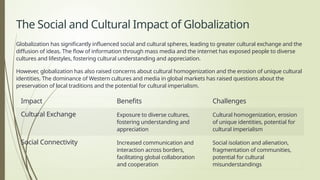
Impact Benefits Challenges
Cultural Exchange Exposure to diverse cultures,
fostering understanding and
appreciation
Cultural homogenization, erosion
of unique identities, potential for
cultural imperialism
Social Connectivity Increased communication and
interaction across borders,
facilitating global collaboration
and cooperation
Social isolation and alienation,
fragmentation of communities,
potential for cultural
misunderstandings
The Environmental Impact of Globalization
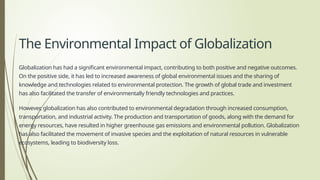
Globalization has had a significant environmental impact, contributing to both positive and negative outcomes.
On the positive side, it has led to increased awareness of global environmental issues and the sharing of
knowledge and technologies related to environmental protection. The growth of global trade and investment
has also facilitated the transfer of environmentally friendly technologies and practices.
However, globalization has also contributed to environmental degradation through increased consumption,
transportation, and industrial activity. The production and transportation of goods, along with the demand for
energy resources, have resulted in higher greenhouse gas emissions and environmental pollution. Globalization
has also facilitated the movement of invasive species and the exploitation of natural resources in vulnerable
ecosystems, leading to biodiversity loss.
The Political Implications of Globalization
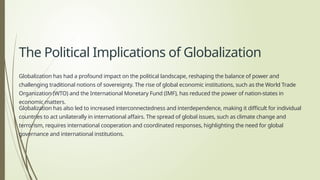
Globalization has had a profound impact on the political landscape, reshaping the balance of power and
challenging traditional notions of sovereignty. The rise of global economic institutions, such as the World Trade
Organization (WTO) and the International Monetary Fund (IMF), has reduced the power of nation-states in
economic matters.
Globalization has also led to increased interconnectedness and interdependence, making it difficult for individual
countries to act unilaterally in international affairs. The spread of global issues, such as climate change and
terrorism, requires international cooperation and coordinated responses, highlighting the need for global
governance and international institutions.
The Future of Globalization
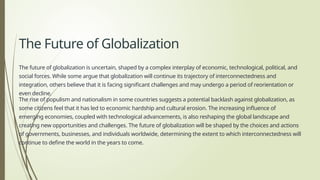
The future of globalization is uncertain, shaped by a complex interplay of economic, technological, political, and
social forces. While some argue that globalization will continue its trajectory of interconnectedness and
integration, others believe that it is facing significant challenges and may undergo a period of reorientation or
even decline.
The rise of populism and nationalism in some countries suggests a potential backlash against globalization, as
some citizens feel that it has led to economic hardship and cultural erosion. The increasing influence of
emerging economies, coupled with technological advancements, is also reshaping the global landscape and
creating new opportunities and challenges. The future of globalization will be shaped by the choices and actions
of governments, businesses, and individuals worldwide, determining the extent to which interconnectedness will
continue to define the world in the years to come.
Thank you attention!

Globalization.pptxhgjyfjtyfffdyffyyffyfyyfyf

  • 1.
  • 2.
    Defining Globalization Globalization refersto the interconnectedness and interdependence of nations, individuals, and societies worldwide. It encompasses a range of processes that have intensified in recent decades, leading to a shrinking world in terms of both distance and time. This interconnectedness is driven by factors such as technological advancements, economic liberalization, and political shifts, leading to increased cross-border flows of goods, services, capital, information, and people.
  • 3.
    The Drivers ofGlobalization Globalization has been propelled by a confluence of factors, each playing a crucial role in shaping the interconnected world we live in today. Technological advancements, particularly in transportation and communication, have facilitated the movement of goods, people, and ideas across borders. The rise of global trade and investment, fueled by economic liberalization and the removal of trade barriers, has further accelerated globalization. Moreover, political changes, such as the collapse of the Soviet Union and the emergence of new economic powers, have fostered new global economic and political connections.
  • 4.
    The Economic Impactof Globalization Globalization has had a profound impact on the global economy, bringing about both benefits and challenges. On the positive side, it has led to increased economic growth, trade, and investment, fostering greater prosperity in many regions. The flow of capital and technology has enabled developing countries to access resources and technologies previously unavailable, leading to rapid economic development in some cases. However, globalization has also contributed to income inequality, job displacement, and environmental degradation. The concentration of wealth in developed countries and the outsourcing of jobs to regions with lower labor costs have led to concerns about economic disparities and the erosion of middle-class jobs in developed economies.
  • 5.
    The Social andCultural Impact of Globalization Globalization has significantly influenced social and cultural spheres, leading to greater cultural exchange and the diffusion of ideas. The flow of information through mass media and the internet has exposed people to diverse cultures and lifestyles, fostering cultural understanding and appreciation. However, globalization has also raised concerns about cultural homogenization and the erosion of unique cultural identities. The dominance of Western cultures and media in global markets has raised questions about the preservation of local traditions and the potential for cultural imperialism. Impact Benefits Challenges Cultural Exchange Exposure to diverse cultures, fostering understanding and appreciation Cultural homogenization, erosion of unique identities, potential for cultural imperialism Social Connectivity Increased communication and interaction across borders, facilitating global collaboration and cooperation Social isolation and alienation, fragmentation of communities, potential for cultural misunderstandings
  • 6.
    The Environmental Impactof Globalization Globalization has had a significant environmental impact, contributing to both positive and negative outcomes. On the positive side, it has led to increased awareness of global environmental issues and the sharing of knowledge and technologies related to environmental protection. The growth of global trade and investment has also facilitated the transfer of environmentally friendly technologies and practices. However, globalization has also contributed to environmental degradation through increased consumption, transportation, and industrial activity. The production and transportation of goods, along with the demand for energy resources, have resulted in higher greenhouse gas emissions and environmental pollution. Globalization has also facilitated the movement of invasive species and the exploitation of natural resources in vulnerable ecosystems, leading to biodiversity loss.
  • 7.
    The Political Implicationsof Globalization Globalization has had a profound impact on the political landscape, reshaping the balance of power and challenging traditional notions of sovereignty. The rise of global economic institutions, such as the World Trade Organization (WTO) and the International Monetary Fund (IMF), has reduced the power of nation-states in economic matters. Globalization has also led to increased interconnectedness and interdependence, making it difficult for individual countries to act unilaterally in international affairs. The spread of global issues, such as climate change and terrorism, requires international cooperation and coordinated responses, highlighting the need for global governance and international institutions.
  • 8.
    The Future ofGlobalization The future of globalization is uncertain, shaped by a complex interplay of economic, technological, political, and social forces. While some argue that globalization will continue its trajectory of interconnectedness and integration, others believe that it is facing significant challenges and may undergo a period of reorientation or even decline. The rise of populism and nationalism in some countries suggests a potential backlash against globalization, as some citizens feel that it has led to economic hardship and cultural erosion. The increasing influence of emerging economies, coupled with technological advancements, is also reshaping the global landscape and creating new opportunities and challenges. The future of globalization will be shaped by the choices and actions of governments, businesses, and individuals worldwide, determining the extent to which interconnectedness will continue to define the world in the years to come.
  • 9.