THE GLOBAL WATER CYCLE
Kumu Pa Nakea
October 2014
WHY DO WE CARE ABOUT
WATER?
All life on Earth requires some form of water to survive.
“Ola I ka wai a ka ‘opua”
There is life in the water from the clouds!”
~ Pukui “Olelo No’eau No. 2482
WATER IS A VITAL SUBSTANCE
Water is necessary for the development
& nourishment of life.
WHY WE CARE ABOUT WATER?
– Can you survive without water?
– Where do you get the water you use at home?
– Where is most of the water on Earth located?
– Is there such a thing as “new” water?
– What are the processes involved in the global
water cycle?
Oxygen
HydrogenHydrogen 75% of Earth is covered by water,
and water rich–clouds fill the sky.
Earth is a
water planet!
Water Molecule – H20
WHERE IS THE WATER?
– 90% of the water is in the Ocean.
– Freshwater seems abundant, but is in limited
supply.
– Only 3% of our planet is freshwater.
– 2% is contained in the glaciers & ice sheets
– 1% is found in lakes, rivers & wetland areas
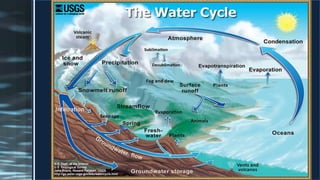
WHAT IS THE WATER CYCLE?
WHAT ARE SOME COMPONENTS OF
THE WATER CYCLE?
WATER
CYCLE
– Describes how the water evaporates from the surface
of the earth, rises into the atmosphere, cools and
condenses into rain or snow in clouds, and falls again
to the surface as precipitation.
– The sun heats the Earth’s surface water, causing that
surface water to evaporate (gas).
– This water vapor then rises into the earth’s atmosphere
where it cools and condenses into liquid droplets.
WATER
CYCLE
– These droplets combine and grow until they become
too heavy and fall to the earth as PRECIPITATION
(liquid if rain, solid if snow). The water falling on land
collects into the oceans, where it will once more
evaporate.
– The cycling of water in and out of the atmosphere is a
significant aspect of weather patterns on Earth.
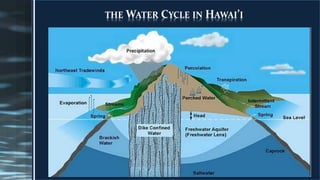
THE WATER CYCLE IN HAWAI’I
COMPONENTS OF THE WATER CYCLE
 Evaporation &
Transpiration
 Condensation
 Precipitation
 Infiltration
 Collection
EVAPORATION
When water is heated by radiant energy it
turns into water vapor.
TRANSPIRATION
Transpiration is evaporation from plants.
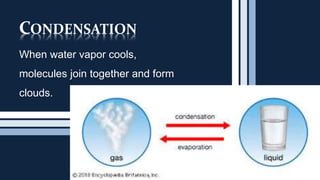
CONDENSATION
When water vapor cools,
molecules join together and form
clouds.
PRECIPITATION
When clouds get heavy the water
falls as rain, sleet, snow or hail.
INFILTRATION
The process by which water on the
ground surface enters the soil.
COLLECTION
This is when water that falls from the clouds as
rain, snow, hail or sleet, collects in the oceans,
rivers, lakes and streams.
WATER IS PRACTICALLY EVERYWHERE ON EARTH.
Water is the only common
substance that can exist
naturally as a gas, liquid
or solid at a small range of
temperatures & pressures.
WHAT PARTS OF THE WATER CYCLE REQUIRE ENERGY FROM
THE SUN?
ENERGY
FROM THE
SUN
STAGES
THAT
REQUIRE
SOLAR
RADIATION
(HEAT).
Solar
Radiation
Evaporation
Transpiration
Infiltration
Runoff
Precipitation
Condensation
Groundwater
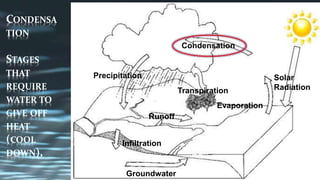
WHICH PARTS OF THE WATER CYCLE REQUIRE THE WATER
MOLECULES TO GIVE AWAY HEAT ENERGY (COOL DOWN)?
CONDENSA
TION
STAGES
THAT
REQUIRE
WATER TO
GIVE OFF
HEAT
(COOL
DOWN).
Solar
Radiation
Evaporation
Transpiration
Infiltration
Runoff
Precipitation
Condensation
Groundwater
WHAT PARTS OF THE WATER CYCLE ARE CAUSED BY THE
FORCE OF GRAVITY?
GRAVITY
STAGES
DRIVEN BY
FORCE OF
GRAVITY
Solar
Radiation
Evaporation
Transpiration
Infiltration
Runoff
Precipitation
Condensation
Groundwater
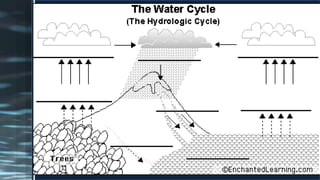
WHAT IS HAPPENING IN YOUR DIAGRAM?
• Explain the processes involved in the water cycle in your diagram.
• What effect will the sun have on the water cycle? The shade?
• What caused the water to evaporate from the ocean?
• Where does the water go?
Global Water Cycle in Hawaii

Global Water Cycle in Hawaii

Editor's Notes

  • #2 This template is in widescreen format and demonstrates how transitions, animations, and multimedia choreography can be used to enrich a presentation.
  • #3 Evaporation – liquid turning into gas Condensation – gas turning into liquid Precipitation – solid turning into liquid
  • #4 All life on Earth requires some form of water to survive. What are some organisms that need a lot of water to survive? How about humans? What percentage of our bodies is made up of water?
  • #6 90% in the Ocean. Freshwater seems abundant, but it is actually in limited supply. Only 3% of our planet is freshwater. A majority of this water, about 2% is contained in glaciers and ice sheets or stored underground. The remaining 1%(accessible and usable by humans) is found in lakes, rivers and wetland areas or transported through the atmosphere in the form of water vapor, clouds, & precipitation. See: http://pmm.nasa.gov/education/videos/show-me-water
  • #7 90% in the Ocean. Freshwater seems abundant, but it is actually in limited supply. Only 3% of our planet is freshwater. A majority of this water, about 2% is contained in glaciers and ice sheets or stored underground. The remaining 1%(accessible and usable by humans) is found in lakes, rivers and wetland areas or transported through the atmosphere in the form of water vapor, clouds, & precipitation.
  • #8 90% in the Ocean. Freshwater seems abundant, but it is actually in limited supply. Only 3% of our planet is freshwater. A majority of this water, about 2% is contained in glaciers and ice sheets or stored underground. The remaining 1%(accessible and usable by humans) is found in lakes, rivers and wetland areas or transported through the atmosphere in the form of water vapor, clouds, & precipitation. See: http://pmm.nasa.gov/education/videos/show-me-water
  • #9 IN the water cycle, the sun heats the Earth’s surface water, causing that surface water to evaporate (gas). This water vapor then rises into the earth’s atmosphere where it cools and condenses into liquid droplets. These droplets combine and grow until they become too heavy and fall to the earth as precipitation (liquid if rain, solid if snow).
  • #10 The water cycle describes how water evaporates from the surface of the earth, rises into the atmosphere, cools and condenses into rain or snow in clouds, and falls again to the surface as precipitation. The water falling on land collects in rivers and lakes, soil, and porous layers of rock, and much of it flows back into the oceans, where it will once more evaporate. The cycling of water in and out of the atmosphere is a significant aspect of the weather patterns on Earth.
  • #11 The water cycle describes how water evaporates from the surface of the earth, rises into the atmosphere, cools and condenses into rain or snow in clouds, and falls again to the surface as precipitation. The water falling on land collects in rivers and lakes, soil, and porous layers of rock, and much of it flows back into the oceans, where it will once more evaporate. The cycling of water in and out of the atmosphere is a significant aspect of the weather patterns on Earth. IN the water cycle, the sun heats the Earth’s surface water, causing that surface water to evaporate (gas). This water vapor then rises into the earth’s atmosphere where it cools and condenses into liquid droplets. These droplets combine and grow until they become too heavy and fall to the earth as precipitation (liquid if rain, solid if snow).
  • #12 The water cycle describes how water evaporates from the surface of the earth, rises into the atmosphere, cools and condenses into rain or snow in clouds, and falls again to the surface as precipitation. The water falling on land collects in rivers and lakes, soil, and porous layers of rock, and much of it flows back into the oceans, where it will once more evaporate. The cycling of water in and out of the atmosphere is a significant aspect of the weather patterns on Earth. IN the water cycle, the sun heats the Earth’s surface water, causing that surface water to evaporate (gas). This water vapor then rises into the earth’s atmosphere where it cools and condenses into liquid droplets. These droplets combine and grow until they become too heavy and fall to the earth as precipitation (liquid if rain, solid if snow).
  • #13 IN the water cycle, the sun heats the Earth’s surface water, causing that surface water to evaporate (gas). This water vapor then rises into the earth’s atmosphere where it cools and condenses into liquid droplets. These droplets combine and grow until they become too heavy and fall to the earth as precipitation (liquid if rain, solid if snow).
  • #14 The water cycle describes how water evaporates from the surface of the earth, rises into the atmosphere, cools and condenses into rain or snow in clouds, and falls again to the surface as precipitation. The water falling on land collects in rivers and lakes, soil, and porous layers of rock, and much of it flows back into the oceans, where it will once more evaporate. The cycling of water in and out of the atmosphere is a significant aspect of the weather patterns on Earth.
  • #15 Earth’s water is always in movement and is always changing states, from liquid to vapor to ices and back again. IN the water cycle, the sun heats the Earth’s surface water, causing that surface water to evaporate (gas). This water vapor then rises into the earth’s atmosphere where it cools and condenses into liquid droplets. These droplets combine and grow until they become too heavy and fall to the earth as precipitation (liquid if rain, solid if snow)
  • #16 Evaporation – liquid turning into gas Condensation – gas turning into liquid Precipitation – solid turning into liquid
  • #17 Evaporation – liquid turning into gas Condensation – gas turning into liquid Precipitation – solid turning into liquid
  • #18 Evaporation – liquid turning into gas Condensation – gas turning into liquid Precipitation – solid turning into liquid
  • #19 Evaporation – liquid turning into gas Condensation – gas turning into liquid Precipitation – solid turning into liquid
  • #21 Water is temporarily stored in lakes, glaciers, underground, or living organisms. The water can move from these places by streams and rivers, returns to the oceans, is used by plants or animals or is evaporated back into the atmosphere.
  • #22 Evaporation – liquid turning into gas Condensation – gas turning into liquid Precipitation – solid turning into liquid
  • #23 The water cycle describes how water evaporates from the surface of the earth, rises into the atmosphere, cools and condenses into rain or snow in clouds, and falls again to the surface as precipitation. The water falling on land collects in rivers and lakes, soil, and porous layers of rock, and much of it flows back into the oceans, where it will once more evaporate. The cycling of water in and out of the atmosphere is a significant aspect of the weather patterns on Earth.
  • #25 The water cycle describes how water evaporates from the surface of the earth, rises into the atmosphere, cools and condenses into rain or snow in clouds, and falls again to the surface as precipitation. The water falling on land collects in rivers and lakes, soil, and porous layers of rock, and much of it flows back into the oceans, where it will once more evaporate. The cycling of water in and out of the atmosphere is a significant aspect of the weather patterns on Earth.
  • #27 The water cycle describes how water evaporates from the surface of the earth, rises into the atmosphere, cools and condenses into rain or snow in clouds, and falls again to the surface as precipitation. The water falling on land collects in rivers and lakes, soil, and porous layers of rock, and much of it flows back into the oceans, where it will once more evaporate. The cycling of water in and out of the atmosphere is a significant aspect of the weather patterns on Earth.
  • #29 Describe what is happening in your diagram of the water cycle. What effect will the sun have on your water cycle? The shade? What caused the water to evaporate from the paper or in the "ocean"? Where did the water go? Explain the processes involved in the water cycle that took place inside your diagram. Where do you get the water you use in your house from? Where is mot of the water on Earth located? Is there such a thing as “new” water?