ANDi NGO TiNA NGUYEN PERiOD 2 PHYSiCS
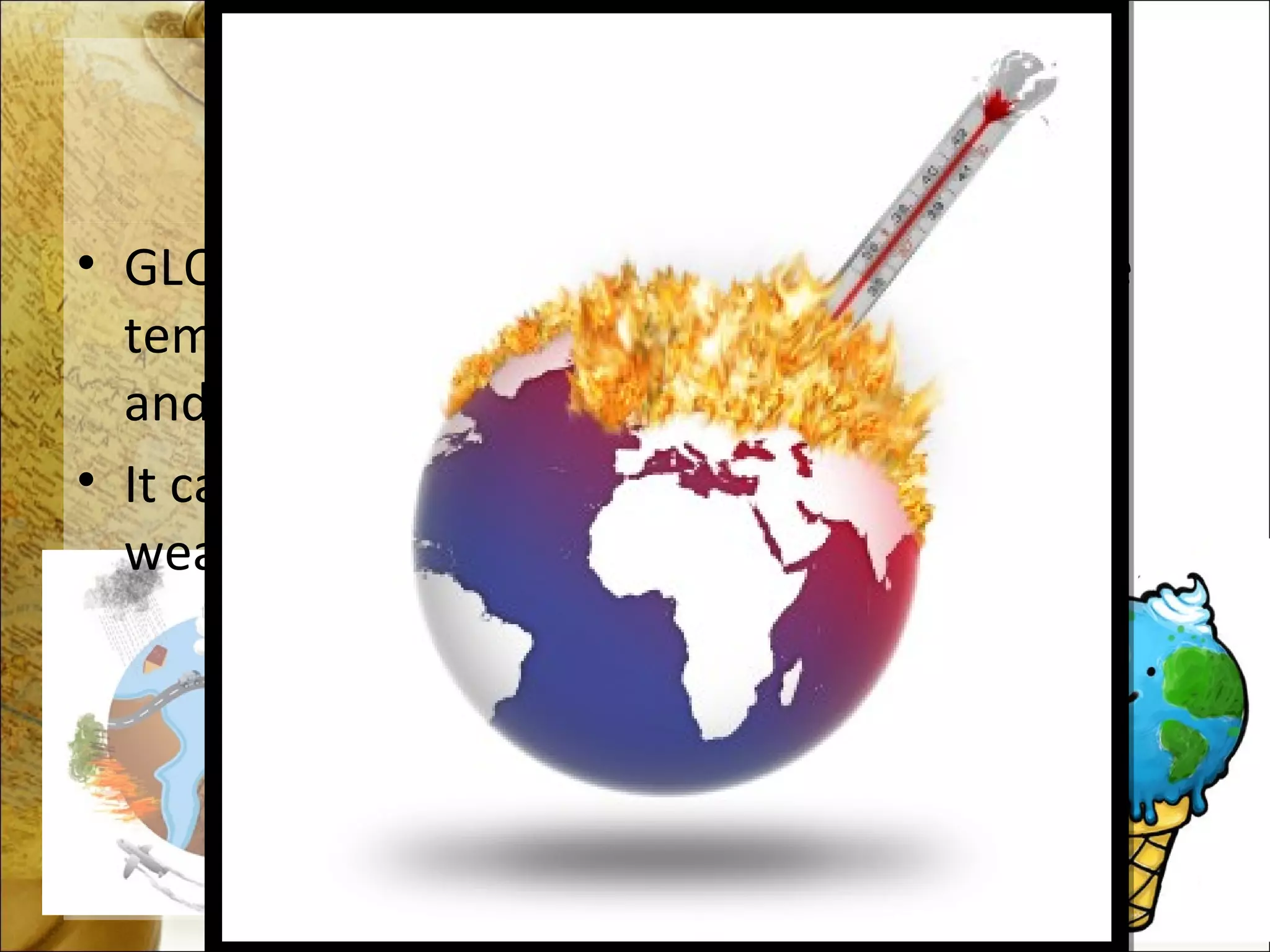
What is Global Warming? GLOBAL WARMING is a rapid rise in average temperature of the Earth’s near surface air and ocean It can alter Earth’s climate or long-term weather patterns
 
First, What are Greenhouse Gases? Greenhouse gases are atmospheric gases.  In order of relative abundance, water vapor, carbon dioxide (CO 2 ), methane (CH 4 ), nitrous oxide (N 2 O), and ozone (O 3 ) are naturally occurring greenhouse gases.  The greenhouse gases that are only caused by humans are Chlorofluorocarbons (CFCs,) hydrofluorocarbons (HFCs), perfluorocarbons (PFCs), and sulfur hexafluoride (SF 6 )
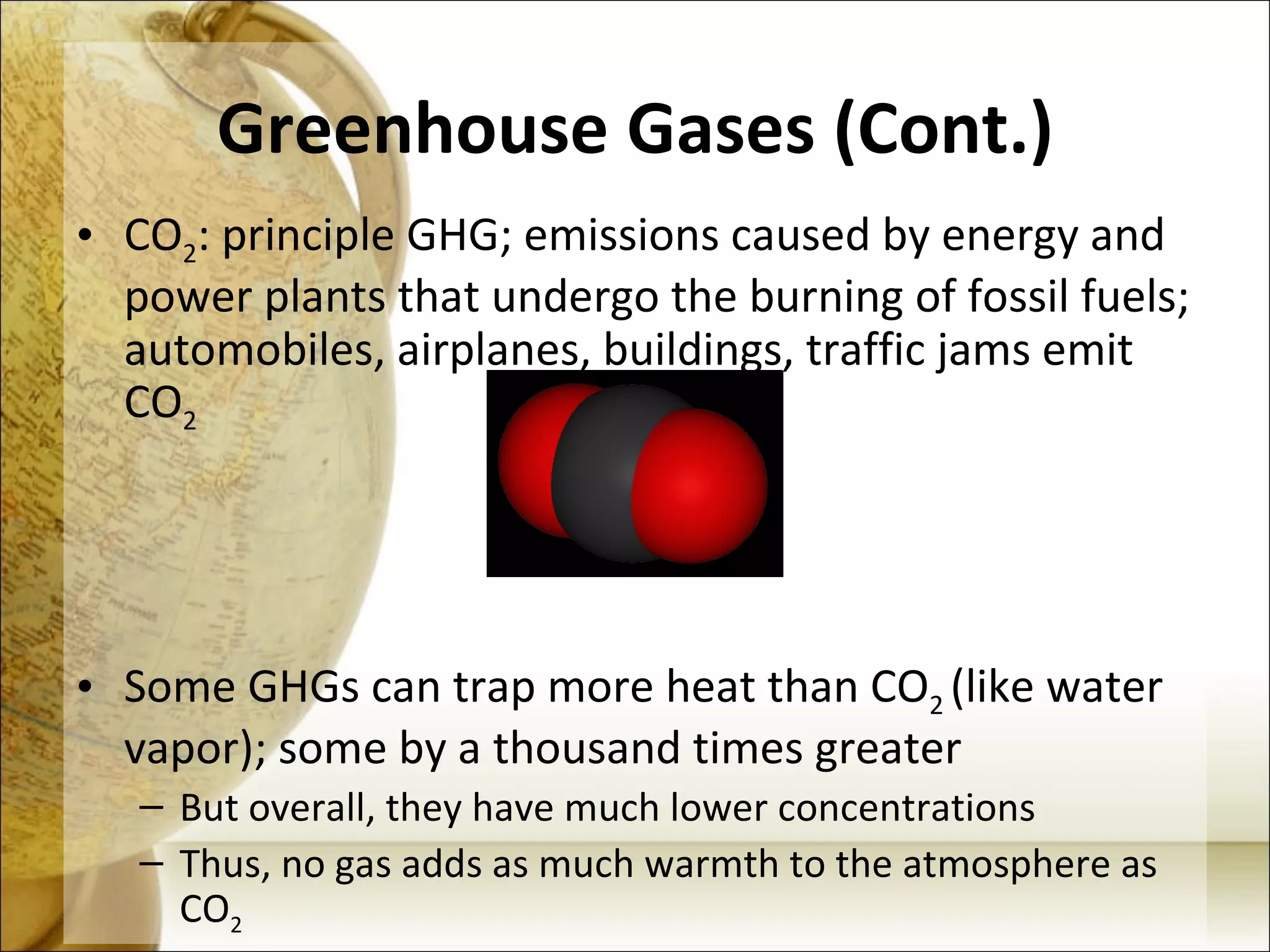
Greenhouse Gases (Cont.) CO 2 : principle GHG; emissions caused by energy and power plants that undergo the burning of fossil fuels; automobiles, airplanes, buildings, traffic jams emit CO 2 Some GHGs can trap more heat than CO 2  (like water vapor); some by a thousand times greater But overall, they have much lower concentrations Thus, no gas adds as much warmth to the atmosphere as CO 2
Greenhouse Effect Sun radiates energy through atmosphere heating the surface Surface absorbs solar energy    releases it back to atmosphere as IR radiation; some of goes back into space Some of IR radiation absorbed by greenhouse gases    re-emit energy as heat back toward surface Thus, the Greenhouse Effect prevents Earth from losing heat Without the greenhouse effect, the surface of the Earth would be about 60 Fahrenheit degrees cooler, making almost impossible for life to sustain itself
BUT!
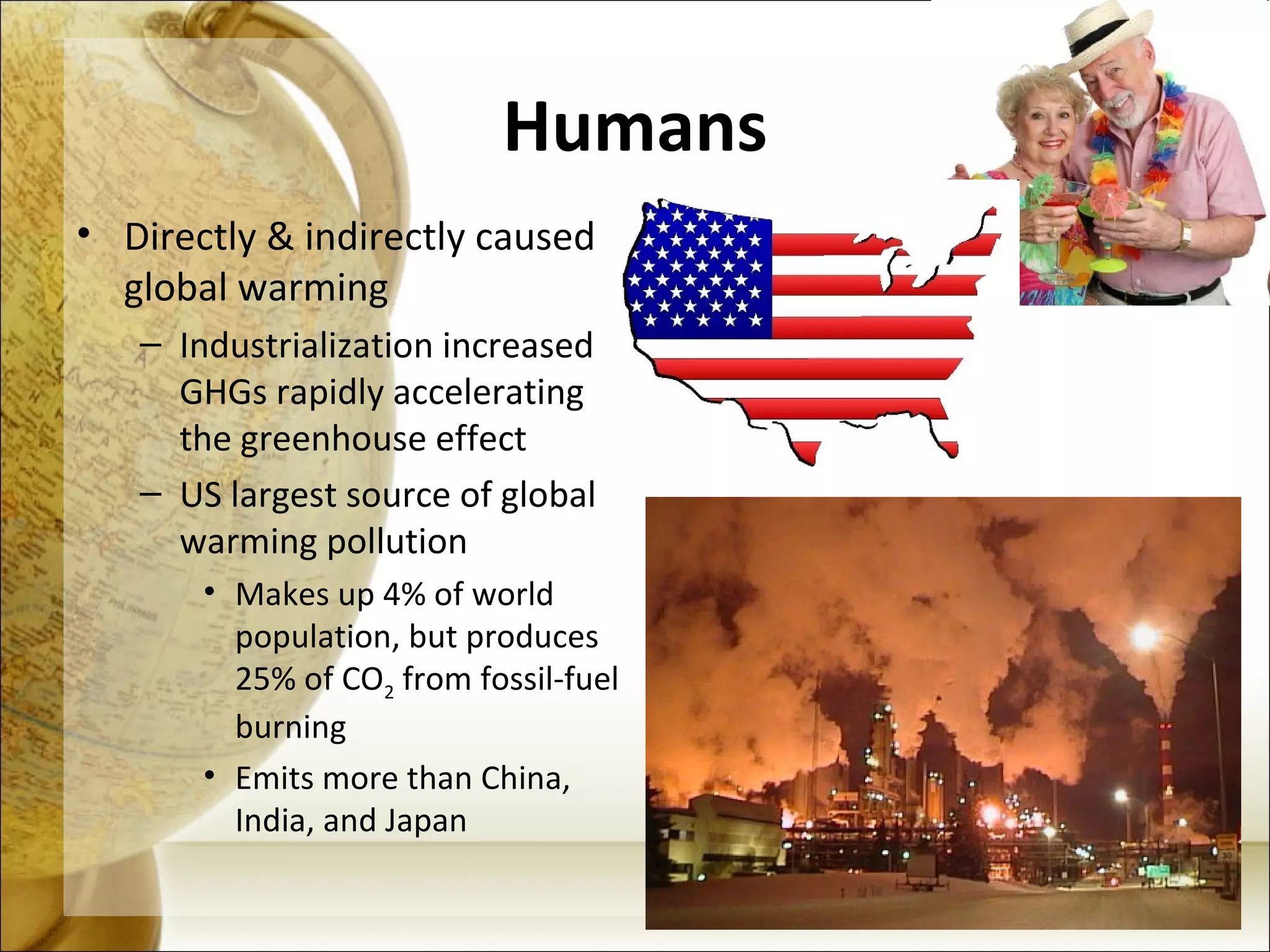
Humans Directly & indirectly caused global warming Industrialization increased GHGs rapidly accelerating the greenhouse effect US largest source of global warming pollution Makes up 4% of world population, but produces 25% of CO 2  from fossil-fuel burning Emits more than China, India, and Japan
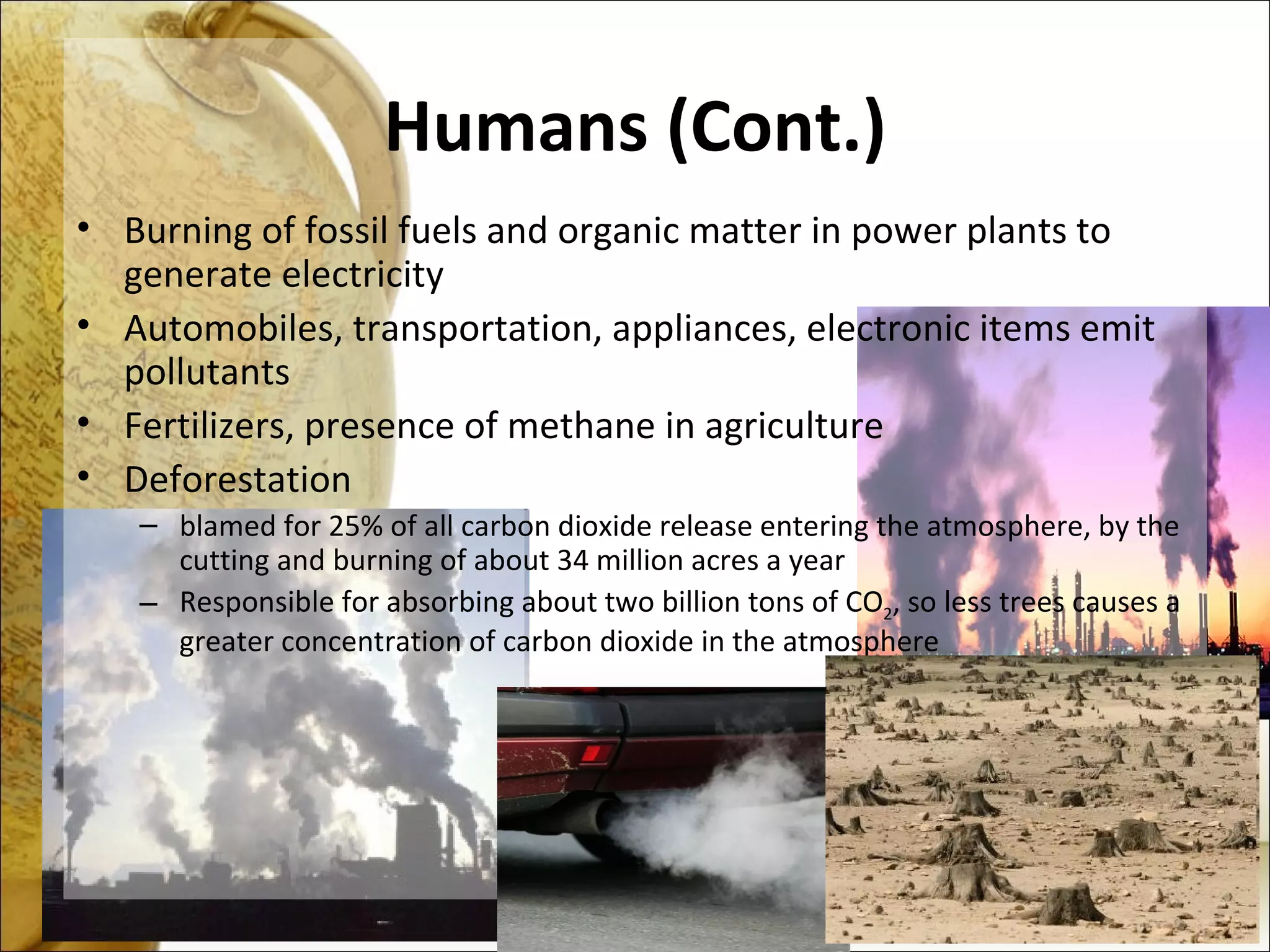
Humans (Cont.) Burning of fossil fuels and organic matter in power plants to generate electricity Automobiles, transportation, appliances, electronic items emit pollutants Fertilizers, presence of methane in agriculture Deforestation  blamed for 25% of all carbon dioxide release entering the atmosphere, by the cutting and burning of about 34 million acres a year Responsible for absorbing about two billion tons of CO 2 , so less trees causes a greater concentration of carbon dioxide in the atmosphere
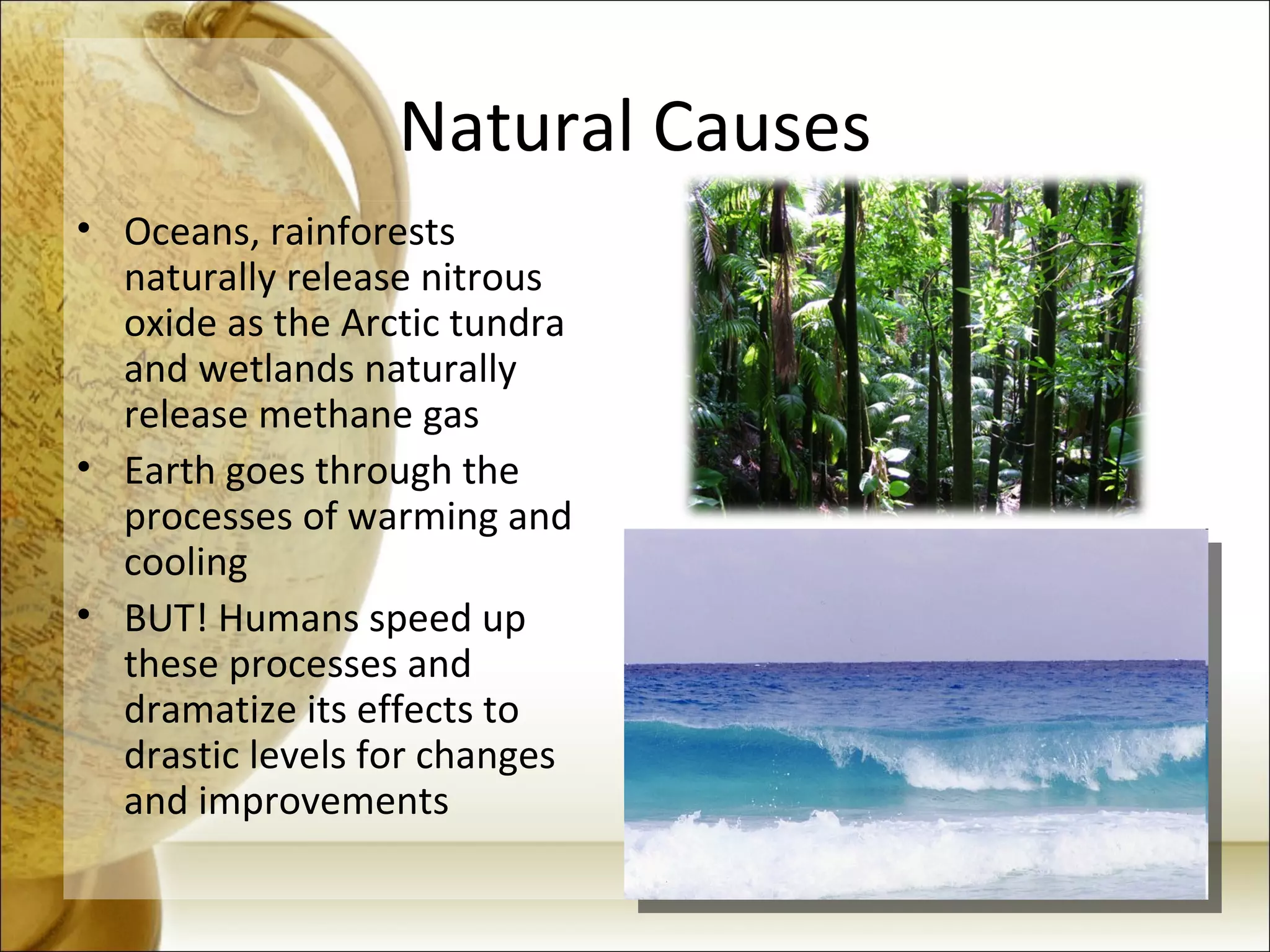
Natural Causes Oceans, rainforests naturally release nitrous oxide as the Arctic tundra and wetlands naturally release methane gas Earth goes through the processes of warming and cooling BUT! Humans speed up these processes and dramatize its effects to drastic levels for changes and improvements
 
Increasing global temperatures - predicted to rise by about 3° to 5°C by end of year 2100 Major Effect
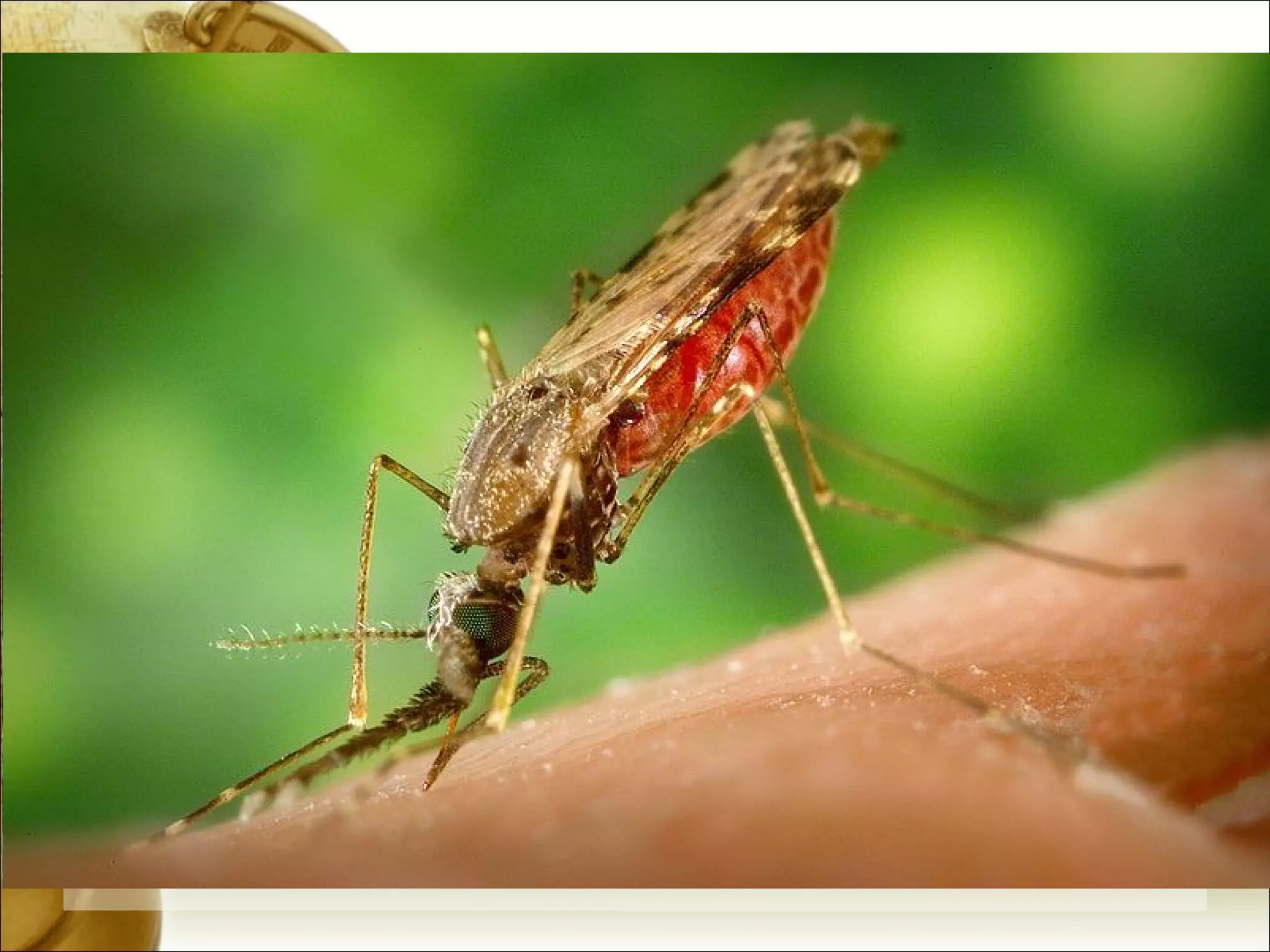
Changes in season - longer summers, shorter winters Weather changes - lengthened, intensified, and frequently occurring  extreme weather events Loss of Arctic Sea Ice - thinning continues at  4 inches/year = loss of ability to reflect heat back into space = faster warming Melting of permafrost (solid structures of frozen soil of arctic and subarctic regions) - carbon it once held can be released; ground will become unstable and eroded Tundra was once a carbon sink but b/c of increasing temps, is now a carbon emitter Increasing rates and widespread of diseases as mosquitoes breed easiest warmer waters
Rising sea levels as warm temperatures cause melting of polar ice Threatens island states and coastal regions with possibility of major damages and even submergence Regions will face erosion, contamination of fresh underground water, and damaged coastal ecology, amounting
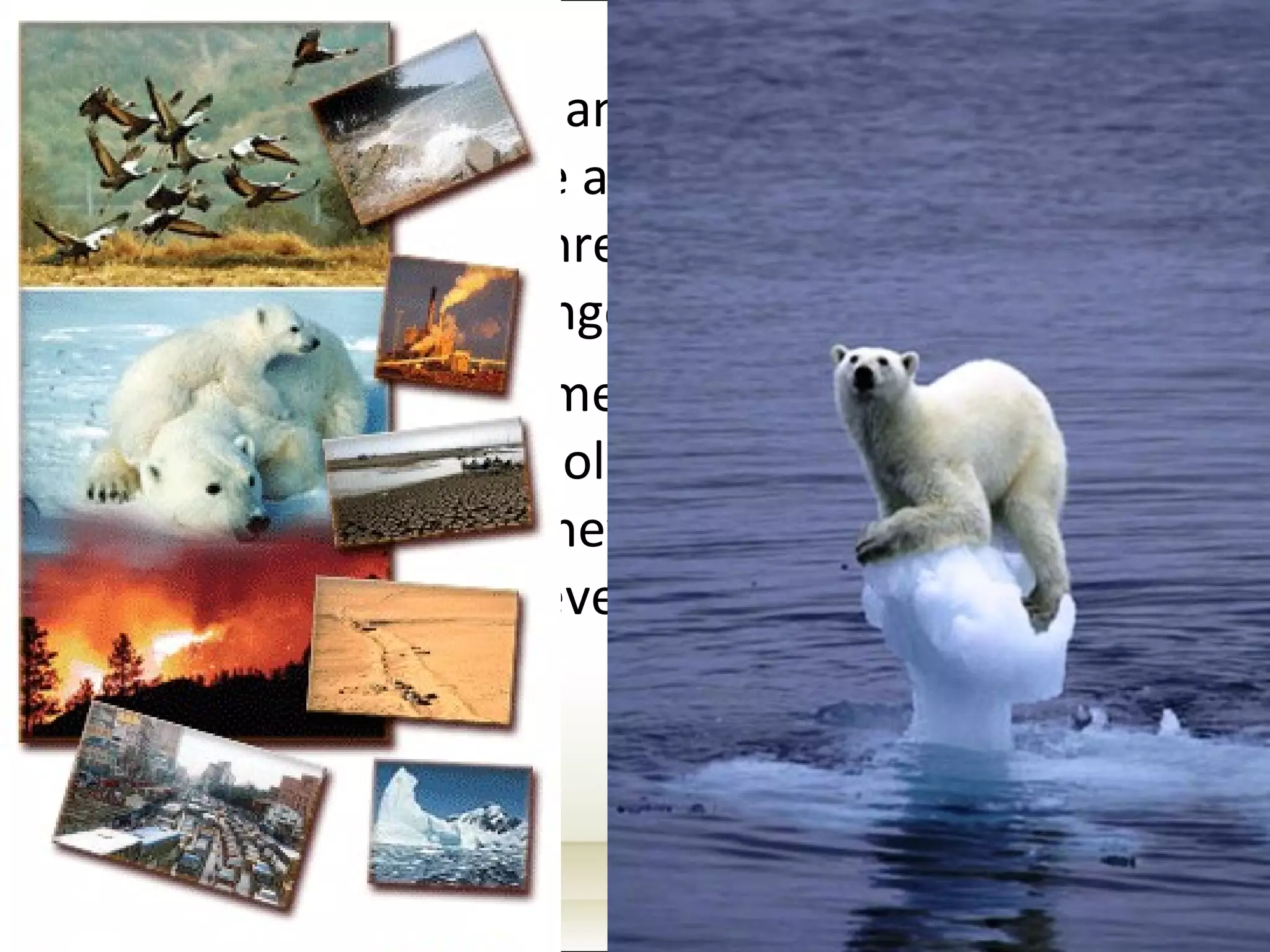
Extinction of many animal species - scientists estimate that there are about 1 million species currently threatened with extinction due to climate changes and loss of habitats Global warming is melting the polar bears’ habitat; stranded polar bears are drowning in large numbers as they try to swim hundreds of miles to find whatever ice still remains
 
Small Changes = Big Difference Conserve energy Use CFLs instead of an incandescent bulb to keep nearly 700 lbs. of CO 2  out of the air over the bulb’s lifetime Choose appliances with the Energy Star label Nearly a ton of carbon dioxide in total could be reduced Make your home energy efficient Drive vehicles with good mileage, bike, walk, or take public transportation Or work at home If driving, take less than 2 minutes to warm up; more time wastes fuel and adds to pollution and global warming
Three R’s Reduce: Waste of paper by reusing it as scratch paper Waste of plastics by using glass containers Reuse: Plastic grocery bags Anything Recycle: Anything you can’t reuse such as plastics, paper products, or glass by taking them to a local recycling bin This isn’t an R but use cloth bags instead of paper bags at grocery stores to save trees
Reduce Carbon Emissions Use existing technology to create and advance cleaner cars and alternative  energy resources More studies on: renewable energy sources such as:  Wind, sun, and geothermal
Kyoto Protocol International treaty proposed to United Nations Framework Convention on Climate Change Intended to achieve “stabilization of greenhouse gas concentrations in the atmosphere at a level that would prevent dangerous anthropogenic interference with the climate system” Legally forces for reduction of carbon dioxide, methane, nitrous oxide, sulphur hexafluoride and gases hydrofluorocarbons and perfluorocarbons produced by industrialized nations  Industrialized countries will agree to reduce their collective greenhouse gas emissions by 5.2% compared to the year 1990 (for the U.S., national limitations range from 7% reduction) U.S. has yet ratified nor withdrawn from the Protocol - Kyoto Protocol is nonbinding on the U.S. unless ratified; President Obama has not yet taken any action with the senate that would change the U.S.’s position towards the protocol.  The  America’s Climate Security Act of 2007 , commonly referred to as the  Cap and Trade Bill , was proposed in U.S. Bill was proposed for greater U.S. alignment similar to Kyoto standards and goals and provides for establishment of a federal bureau of Carbon Trading, Regulation, and Enforcement
Bibliography &quot;Cause and effect for global warming | Time for change.&quot;  Time for change | For whom enough is too little - nothing is ever enough . 02 Apr. 2009 <http://timeforchange.org/cause-and-effect-for-global-warming>.  &quot;EcoBridge.&quot;  EcoBridge . 02 Apr. 2009 <http://www.ecobridge.org/>. &quot;Effects of Global Warming Accelerating.&quot;  RTE News  11 Mar. 2009. 1 Apr. 2009 <http://www.rte.ie/news/2009/0311/climate.html>. &quot;Global Warming Causes, Climate Change Causes - National Geographic.&quot;  Environment Facts, Environment Science, Global Warming, Natural Disasters, Ecosystems, Green Living - National Geographics . National Geographics. 02 Apr. 2009 <http://environment.nationalgeographic.com/environment/global-warming/gw-causes.html>. &quot;NRDC: Global Warming Basics.&quot;  NRDC: Natural Resources Defense Council - The Earth's Best Defense . NRDC. 02 Apr. 2009 <http://www.nrdc.org/globalWarming/f101.asp>. Nodvin, Stephen C. (Lead Author); Kevin Vranes (Topic Editor). 2009. &quot;Global warming.&quot; In: Encyclopedia of Earth. Eds. Cutler J. Cleveland (Washington, D.C.: Environmental Information Coalition, National Council for Science and the Environment). [First published in the Encyclopedia of Earth March 14, 2007; Last revised February 2, 2009; Retrieved April 1, 2009]. <http://www.eoearth.org/article/Global_warming>
 

Global Warming P P T [97 03]

  • 1.
    ANDi NGO TiNANGUYEN PERiOD 2 PHYSiCS
  • 2.
    What is GlobalWarming? GLOBAL WARMING is a rapid rise in average temperature of the Earth’s near surface air and ocean It can alter Earth’s climate or long-term weather patterns
  • 3.
  • 4.
    First, What areGreenhouse Gases? Greenhouse gases are atmospheric gases. In order of relative abundance, water vapor, carbon dioxide (CO 2 ), methane (CH 4 ), nitrous oxide (N 2 O), and ozone (O 3 ) are naturally occurring greenhouse gases. The greenhouse gases that are only caused by humans are Chlorofluorocarbons (CFCs,) hydrofluorocarbons (HFCs), perfluorocarbons (PFCs), and sulfur hexafluoride (SF 6 )
  • 5.
    Greenhouse Gases (Cont.)CO 2 : principle GHG; emissions caused by energy and power plants that undergo the burning of fossil fuels; automobiles, airplanes, buildings, traffic jams emit CO 2 Some GHGs can trap more heat than CO 2 (like water vapor); some by a thousand times greater But overall, they have much lower concentrations Thus, no gas adds as much warmth to the atmosphere as CO 2
  • 6.
    Greenhouse Effect Sunradiates energy through atmosphere heating the surface Surface absorbs solar energy  releases it back to atmosphere as IR radiation; some of goes back into space Some of IR radiation absorbed by greenhouse gases  re-emit energy as heat back toward surface Thus, the Greenhouse Effect prevents Earth from losing heat Without the greenhouse effect, the surface of the Earth would be about 60 Fahrenheit degrees cooler, making almost impossible for life to sustain itself
  • 7.
  • 8.
    Humans Directly &indirectly caused global warming Industrialization increased GHGs rapidly accelerating the greenhouse effect US largest source of global warming pollution Makes up 4% of world population, but produces 25% of CO 2 from fossil-fuel burning Emits more than China, India, and Japan
  • 9.
    Humans (Cont.) Burningof fossil fuels and organic matter in power plants to generate electricity Automobiles, transportation, appliances, electronic items emit pollutants Fertilizers, presence of methane in agriculture Deforestation blamed for 25% of all carbon dioxide release entering the atmosphere, by the cutting and burning of about 34 million acres a year Responsible for absorbing about two billion tons of CO 2 , so less trees causes a greater concentration of carbon dioxide in the atmosphere
  • 10.
    Natural Causes Oceans,rainforests naturally release nitrous oxide as the Arctic tundra and wetlands naturally release methane gas Earth goes through the processes of warming and cooling BUT! Humans speed up these processes and dramatize its effects to drastic levels for changes and improvements
  • 11.
  • 12.
    Increasing global temperatures- predicted to rise by about 3° to 5°C by end of year 2100 Major Effect
  • 13.
    Changes in season- longer summers, shorter winters Weather changes - lengthened, intensified, and frequently occurring extreme weather events Loss of Arctic Sea Ice - thinning continues at 4 inches/year = loss of ability to reflect heat back into space = faster warming Melting of permafrost (solid structures of frozen soil of arctic and subarctic regions) - carbon it once held can be released; ground will become unstable and eroded Tundra was once a carbon sink but b/c of increasing temps, is now a carbon emitter Increasing rates and widespread of diseases as mosquitoes breed easiest warmer waters
  • 14.
    Rising sea levelsas warm temperatures cause melting of polar ice Threatens island states and coastal regions with possibility of major damages and even submergence Regions will face erosion, contamination of fresh underground water, and damaged coastal ecology, amounting
  • 15.
    Extinction of manyanimal species - scientists estimate that there are about 1 million species currently threatened with extinction due to climate changes and loss of habitats Global warming is melting the polar bears’ habitat; stranded polar bears are drowning in large numbers as they try to swim hundreds of miles to find whatever ice still remains
  • 16.
  • 17.
    Small Changes =Big Difference Conserve energy Use CFLs instead of an incandescent bulb to keep nearly 700 lbs. of CO 2 out of the air over the bulb’s lifetime Choose appliances with the Energy Star label Nearly a ton of carbon dioxide in total could be reduced Make your home energy efficient Drive vehicles with good mileage, bike, walk, or take public transportation Or work at home If driving, take less than 2 minutes to warm up; more time wastes fuel and adds to pollution and global warming
  • 18.
    Three R’s Reduce:Waste of paper by reusing it as scratch paper Waste of plastics by using glass containers Reuse: Plastic grocery bags Anything Recycle: Anything you can’t reuse such as plastics, paper products, or glass by taking them to a local recycling bin This isn’t an R but use cloth bags instead of paper bags at grocery stores to save trees
  • 19.
    Reduce Carbon EmissionsUse existing technology to create and advance cleaner cars and alternative energy resources More studies on: renewable energy sources such as: Wind, sun, and geothermal
  • 20.
    Kyoto Protocol Internationaltreaty proposed to United Nations Framework Convention on Climate Change Intended to achieve “stabilization of greenhouse gas concentrations in the atmosphere at a level that would prevent dangerous anthropogenic interference with the climate system” Legally forces for reduction of carbon dioxide, methane, nitrous oxide, sulphur hexafluoride and gases hydrofluorocarbons and perfluorocarbons produced by industrialized nations Industrialized countries will agree to reduce their collective greenhouse gas emissions by 5.2% compared to the year 1990 (for the U.S., national limitations range from 7% reduction) U.S. has yet ratified nor withdrawn from the Protocol - Kyoto Protocol is nonbinding on the U.S. unless ratified; President Obama has not yet taken any action with the senate that would change the U.S.’s position towards the protocol. The America’s Climate Security Act of 2007 , commonly referred to as the Cap and Trade Bill , was proposed in U.S. Bill was proposed for greater U.S. alignment similar to Kyoto standards and goals and provides for establishment of a federal bureau of Carbon Trading, Regulation, and Enforcement
  • 21.
    Bibliography &quot;Cause andeffect for global warming | Time for change.&quot; Time for change | For whom enough is too little - nothing is ever enough . 02 Apr. 2009 <http://timeforchange.org/cause-and-effect-for-global-warming>.  &quot;EcoBridge.&quot; EcoBridge . 02 Apr. 2009 <http://www.ecobridge.org/>. &quot;Effects of Global Warming Accelerating.&quot; RTE News 11 Mar. 2009. 1 Apr. 2009 <http://www.rte.ie/news/2009/0311/climate.html>. &quot;Global Warming Causes, Climate Change Causes - National Geographic.&quot; Environment Facts, Environment Science, Global Warming, Natural Disasters, Ecosystems, Green Living - National Geographics . National Geographics. 02 Apr. 2009 <http://environment.nationalgeographic.com/environment/global-warming/gw-causes.html>. &quot;NRDC: Global Warming Basics.&quot; NRDC: Natural Resources Defense Council - The Earth's Best Defense . NRDC. 02 Apr. 2009 <http://www.nrdc.org/globalWarming/f101.asp>. Nodvin, Stephen C. (Lead Author); Kevin Vranes (Topic Editor). 2009. &quot;Global warming.&quot; In: Encyclopedia of Earth. Eds. Cutler J. Cleveland (Washington, D.C.: Environmental Information Coalition, National Council for Science and the Environment). [First published in the Encyclopedia of Earth March 14, 2007; Last revised February 2, 2009; Retrieved April 1, 2009]. <http://www.eoearth.org/article/Global_warming>
  • 22.