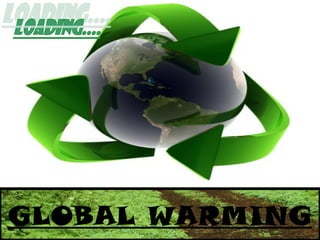
GLOBAL WARMING
Environment displacing with
global warming.
Our presentation has three
contents. First, there are
causes of global warming, then
the effects and then finally we
will tell you the solutions of it
so that we can save the earth
and the environment.
What is Global Warming?
The increase in the earth’s temperature due to the increased
concentration of green house gases like CO2, methane, helium
is known as global warming.
Causes of global warming
It includes 4 factors-
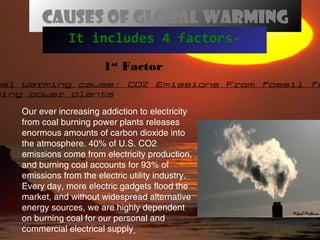
bal Warming cause: CO2 Emissions From fossil fu
ning power plants
1st
Factor
Our ever increasing addiction to electricity
from coal burning power plants releases
enormous amounts of carbon dioxide into
the atmosphere. 40% of U.S. CO2
emissions come from electricity production,
and burning coal accounts for 93% of
emissions from the electric utility industry.
Every day, more electric gadgets flood the
market, and without widespread alternative
energy sources, we are highly dependent
on burning coal for our personal and
commercial electrical supply
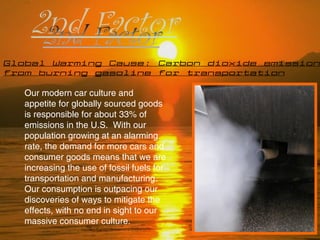
Global Warming Cause: Carbon dioxide emissions
from burning gasoline for transportation
Our modern car culture and
appetite for globally sourced goods
is responsible for about 33% of
emissions in the U.S. With our
population growing at an alarming
rate, the demand for more cars and
consumer goods means that we are
increasing the use of fossil fuels for
transportation and manufacturing.
Our consumption is outpacing our
discoveries of ways to mitigate the
effects, with no end in sight to our
massive consumer culture.
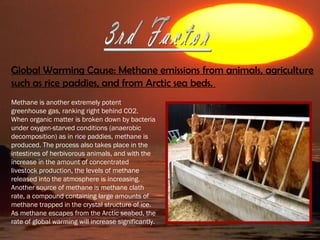
Global Warming Cause: Methane emissions from animals, agriculture
such as rice paddies, and from Arctic sea beds.
Methane is another extremely potent
greenhouse gas, ranking right behind CO2.
When organic matter is broken down by bacteria
under oxygen-starved conditions (anaerobic
decomposition) as in rice paddies, methane is
produced. The process also takes place in the
intestines of herbivorous animals, and with the
increase in the amount of concentrated
livestock production, the levels of methane
released into the atmosphere is increasing.
Another source of methane is methane clath
rate, a compound containing large amounts of
methane trapped in the crystal structure of ice.
As methane escapes from the Arctic seabed, the
rate of global warming will increase significantly.
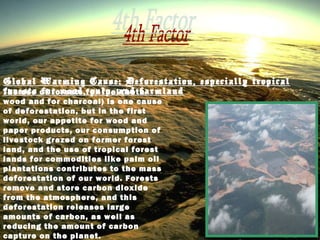
The use of forests for fuel (both
wood and for charcoal) is one cause
of deforestation, but in the first
world, our appetite for wood and
paper products, our consumption of
livestock grazed on former forest
land, and the use of tropical forest
lands for commodities like palm oil
plantations contributes to the mass
deforestation of our world. Forests
remove and store carbon dioxide
from the atmosphere, and this
deforestation releases large
amounts of carbon, as well as
reducing the amount of carbon
capture on the planet.
Global Warming Cause: Deforestation, especially tropical
forests for wood, pulp, and farmland
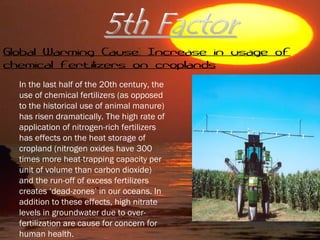
In the last half of the 20th century, the
use of chemical fertilizers (as opposed
to the historical use of animal manure)
has risen dramatically. The high rate of
application of nitrogen-rich fertilizers
has effects on the heat storage of
cropland (nitrogen oxides have 300
times more heat-trapping capacity per
unit of volume than carbon dioxide)
and the run-off of excess fertilizers
creates ‘dead-zones’ in our oceans. In
addition to these effects, high nitrate
levels in groundwater due to over-
fertilization are cause for concern for
human health.
Global Warming Cause: Increase in usage of
chemical fertilizers on croplands
Effects of global warming
It includes 5 deadliest factors
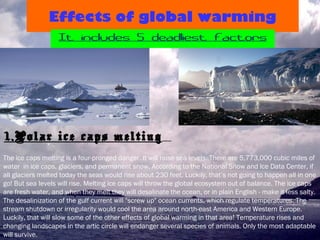
1.Polar ice caps melting
The ice caps melting is a four-pronged danger. It will raise sea levels. There are 5,773,000 cubic miles of
water in ice caps, glaciers, and permanent snow. According to the National Snow and Ice Data Center, if
all glaciers melted today the seas would rise about 230 feet. Luckily, that’s not going to happen all in one
go! But sea levels will rise. Melting ice caps will throw the global ecosystem out of balance. The ice caps
are fresh water, and when they melt they will desalinate the ocean, or in plain English - make it less salty.
The desalinization of the gulf current will "screw up" ocean currents, which regulate temperatures. The
stream shutdown or irregularity would cool the area around north-east America and Western Europe.
Luckily, that will slow some of the other effects of global warming in that area! Temperature rises and
changing landscapes in the artic circle will endanger several species of animals. Only the most adaptable
will survive.
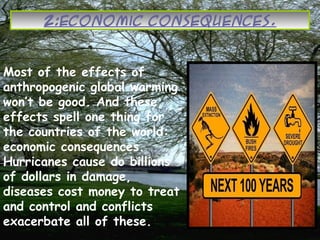
2:Economic Consequences.
Most of the effects of
anthropogenic global warming
won’t be good. And these
effects spell one thing for
the countries of the world:
economic consequences.
Hurricanes cause do billions
of dollars in damage,
diseases cost money to treat
and control and conflicts
exacerbate all of these.
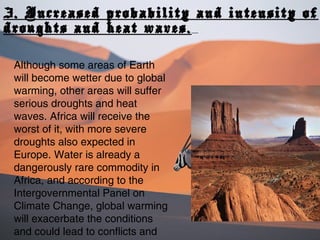
3. Increased probability and intensity of
droughts and heat waves.
Although some areas of Earth
will become wetter due to global
warming, other areas will suffer
serious droughts and heat
waves. Africa will receive the
worst of it, with more severe
droughts also expected in
Europe. Water is already a
dangerously rare commodity in
Africa, and according to the
Intergovernmental Panel on
Climate Change, global warming
will exacerbate the conditions
and could lead to conflicts and
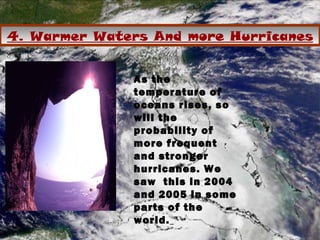
4. Warmer Waters And more Hurricanes
As the
temperature of
oceans rises, so
will the
probability of
more frequent
and stronger
hurricanes. We
saw this in 2004
and 2005 in some
parts of the
world.
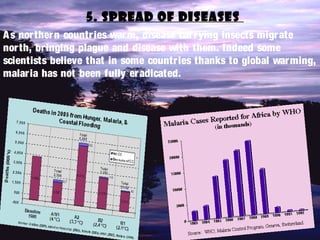
5. Spread of diseaseS
As northern countries warm, disease carrying insects migrate
north, bringing plague and disease with them. Indeed some
scientists believe that in some countries thanks to global warming,
malaria has not been fully eradicated.
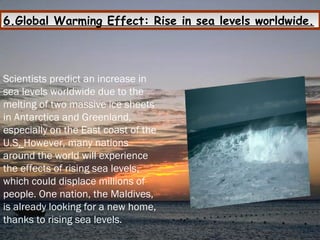
6.Global Warming Effect: Rise in sea levels worldwide.
Scientists predict an increase in
sea levels worldwide due to the
melting of two massive ice sheets
in Antarctica and Greenland,
especially on the East coast of the
U.S. However, many nations
around the world will experience
the effects of rising sea levels,
which could displace millions of
people. One nation, the Maldives,
is already looking for a new home,
thanks to rising sea levels.
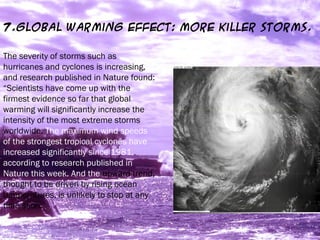
7.Global Warming Effect: More killer storms.
The severity of storms such as
hurricanes and cyclones is increasing,
and research published in Nature found:
“Scientists have come up with the
firmest evidence so far that global
warming will significantly increase the
intensity of the most extreme storms
worldwide. The maximum wind speeds
of the strongest tropical cyclones have
increased significantly since 1981,
according to research published in
Nature this week. And the upward trend,
thought to be driven by rising ocean
temperatures, is unlikely to stop at any
time soon.”
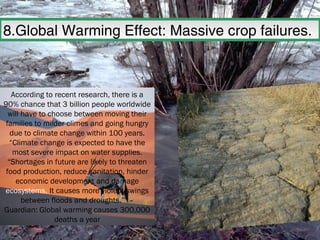
8.Global Warming Effect: Massive crop failures.
According to recent research, there is a
90% chance that 3 billion people worldwide
will have to choose between moving their
families to milder climes and going hungry
due to climate change within 100 years.
“Climate change is expected to have the
most severe impact on water supplies.
“Shortages in future are likely to threaten
food production, reduce sanitation, hinder
economic development and damage
ecosystems. It causes more violent swings
between floods and droughts.”" –
Guardian: Global warming causes 300,000
deaths a year
Solutions for Global
Warming.
Solutions for global warming.
Global warming may or may not be a
problem.  Man may or may not be driving
it.  Given the uncertainties, a significant
amount of global regret may apply if we
divert too much of our global wealth to
solving what may be a non-existent or
trivial problem, especially if that diversion
mires billions in poverty.  On the other
hand, we may also regret not doing
anything if man-made global warming does
turn out to be a problem.  It is therefore
prudent to examine what steps we can take
that would prove beneficial whether or not
anthropogenic global warming turns out to
be a problem.  These steps can be termed
“no regrets” policies.
Top Three “No Regrets”
Policies
1st
..…
Subsidies to energy R&D cost taxpayers millions of
dollars while producing minimal benefits. While
these programs may be relatively small given the
size of domestic energy markets, they serve little, if
any, useful purpose while subsidizing large
corporations at taxpayer expense. The potential
threat of global warming, whether it is real or not,
is simply one more reason to eliminate these
subsidy programs. An international agreement
aimed at ending energy subsidy with binding
targets would be a significant victory for emissions
reduction. Unlike Kyoto, which forces an energy
starvation diet on its participants, such a treaty
would be a move to combat energy obesity.
  1.Eliminate all subsidies to fuel use.
2nd
policy
Much of the concern over global warming’s potential for harm in the US relates to sea
level rise and the flooding that will result.  However, much of the investment in
potentially vulnerable areas is a result of the Federal flood Insurance Program.  This
program encourages building in vulnerable areas by acting as a moral hazard: people take
greater risks because the government has said it will help bear that risk. Reform would
reduce the moral hazard connected with building on vulnerable land, transferring the risk
from the taxpayer to the private sector, which is likely to take a more realistic view of
the issue.
2.Repeal the Federal Flood Insurance
Program.
3rd
policy
Reform Air Traffic Control Systems.
Greater demand for air travel means more flights, which means
greater fuel use and increased emissions. Yet, the current
government-operated system of air traffic control, based on a
1920s-era system of beacons, may hinder innovations that could
reduce fuel use and emissions. As a general rule, the shorter the
flight, the less fuel will be consumed. Yet neither airlines nor
pilots have the freedom to choose the most direct and economical
route. Giving pilots freedom to map their own course is an
attractive and desirable change in the eyes of the industry, and
the impact on the environment would be tremendous. As well as
saving considerable amounts of greenhouse gas emissions, the
policy will deliver significant benefits in terms of time and
expense to the US economy. By obviating significant reductions in
service levels associated with more routine applications of
emissions reduction policy, it is to be preferred to that approach.
Some steps to keep in mind…
• Reduce the amount of
greenhouse gases
emitted into the
atmosphere, or
• Mitigate, prevents or
reduces a harm
associated with global
warming, or
• Provide greater
capacity for dealing
with problems
associated with global
warming.
• Without imposing
significant cost or
diverting economic
activity.

Global warming

  • 1.
  • 2.
    Environment displacing with globalwarming. Our presentation has three contents. First, there are causes of global warming, then the effects and then finally we will tell you the solutions of it so that we can save the earth and the environment. What is Global Warming? The increase in the earth’s temperature due to the increased concentration of green house gases like CO2, methane, helium is known as global warming.
  • 3.
    Causes of globalwarming It includes 4 factors- bal Warming cause: CO2 Emissions From fossil fu ning power plants 1st Factor Our ever increasing addiction to electricity from coal burning power plants releases enormous amounts of carbon dioxide into the atmosphere. 40% of U.S. CO2 emissions come from electricity production, and burning coal accounts for 93% of emissions from the electric utility industry. Every day, more electric gadgets flood the market, and without widespread alternative energy sources, we are highly dependent on burning coal for our personal and commercial electrical supply
  • 4.
    Global Warming Cause:Carbon dioxide emissions from burning gasoline for transportation Our modern car culture and appetite for globally sourced goods is responsible for about 33% of emissions in the U.S. With our population growing at an alarming rate, the demand for more cars and consumer goods means that we are increasing the use of fossil fuels for transportation and manufacturing. Our consumption is outpacing our discoveries of ways to mitigate the effects, with no end in sight to our massive consumer culture.
  • 5.
    Global Warming Cause:Methane emissions from animals, agriculture such as rice paddies, and from Arctic sea beds. Methane is another extremely potent greenhouse gas, ranking right behind CO2. When organic matter is broken down by bacteria under oxygen-starved conditions (anaerobic decomposition) as in rice paddies, methane is produced. The process also takes place in the intestines of herbivorous animals, and with the increase in the amount of concentrated livestock production, the levels of methane released into the atmosphere is increasing. Another source of methane is methane clath rate, a compound containing large amounts of methane trapped in the crystal structure of ice. As methane escapes from the Arctic seabed, the rate of global warming will increase significantly.
  • 6.
    The use offorests for fuel (both wood and for charcoal) is one cause of deforestation, but in the first world, our appetite for wood and paper products, our consumption of livestock grazed on former forest land, and the use of tropical forest lands for commodities like palm oil plantations contributes to the mass deforestation of our world. Forests remove and store carbon dioxide from the atmosphere, and this deforestation releases large amounts of carbon, as well as reducing the amount of carbon capture on the planet. Global Warming Cause: Deforestation, especially tropical forests for wood, pulp, and farmland
  • 7.
    In the lasthalf of the 20th century, the use of chemical fertilizers (as opposed to the historical use of animal manure) has risen dramatically. The high rate of application of nitrogen-rich fertilizers has effects on the heat storage of cropland (nitrogen oxides have 300 times more heat-trapping capacity per unit of volume than carbon dioxide) and the run-off of excess fertilizers creates ‘dead-zones’ in our oceans. In addition to these effects, high nitrate levels in groundwater due to over- fertilization are cause for concern for human health. Global Warming Cause: Increase in usage of chemical fertilizers on croplands
  • 8.
    Effects of globalwarming It includes 5 deadliest factors 1.Polar ice caps melting The ice caps melting is a four-pronged danger. It will raise sea levels. There are 5,773,000 cubic miles of water in ice caps, glaciers, and permanent snow. According to the National Snow and Ice Data Center, if all glaciers melted today the seas would rise about 230 feet. Luckily, that’s not going to happen all in one go! But sea levels will rise. Melting ice caps will throw the global ecosystem out of balance. The ice caps are fresh water, and when they melt they will desalinate the ocean, or in plain English - make it less salty. The desalinization of the gulf current will "screw up" ocean currents, which regulate temperatures. The stream shutdown or irregularity would cool the area around north-east America and Western Europe. Luckily, that will slow some of the other effects of global warming in that area! Temperature rises and changing landscapes in the artic circle will endanger several species of animals. Only the most adaptable will survive.
  • 9.
    2:Economic Consequences. Most ofthe effects of anthropogenic global warming won’t be good. And these effects spell one thing for the countries of the world: economic consequences. Hurricanes cause do billions of dollars in damage, diseases cost money to treat and control and conflicts exacerbate all of these.
  • 10.
    3. Increased probabilityand intensity of droughts and heat waves. Although some areas of Earth will become wetter due to global warming, other areas will suffer serious droughts and heat waves. Africa will receive the worst of it, with more severe droughts also expected in Europe. Water is already a dangerously rare commodity in Africa, and according to the Intergovernmental Panel on Climate Change, global warming will exacerbate the conditions and could lead to conflicts and
  • 11.
    4. Warmer WatersAnd more Hurricanes As the temperature of oceans rises, so will the probability of more frequent and stronger hurricanes. We saw this in 2004 and 2005 in some parts of the world.
  • 12.
    5. Spread ofdiseaseS As northern countries warm, disease carrying insects migrate north, bringing plague and disease with them. Indeed some scientists believe that in some countries thanks to global warming, malaria has not been fully eradicated.
  • 13.
    6.Global Warming Effect:Rise in sea levels worldwide. Scientists predict an increase in sea levels worldwide due to the melting of two massive ice sheets in Antarctica and Greenland, especially on the East coast of the U.S. However, many nations around the world will experience the effects of rising sea levels, which could displace millions of people. One nation, the Maldives, is already looking for a new home, thanks to rising sea levels.
  • 14.
    7.Global Warming Effect:More killer storms. The severity of storms such as hurricanes and cyclones is increasing, and research published in Nature found: “Scientists have come up with the firmest evidence so far that global warming will significantly increase the intensity of the most extreme storms worldwide. The maximum wind speeds of the strongest tropical cyclones have increased significantly since 1981, according to research published in Nature this week. And the upward trend, thought to be driven by rising ocean temperatures, is unlikely to stop at any time soon.”
  • 15.
    8.Global Warming Effect:Massive crop failures. According to recent research, there is a 90% chance that 3 billion people worldwide will have to choose between moving their families to milder climes and going hungry due to climate change within 100 years. “Climate change is expected to have the most severe impact on water supplies. “Shortages in future are likely to threaten food production, reduce sanitation, hinder economic development and damage ecosystems. It causes more violent swings between floods and droughts.”" – Guardian: Global warming causes 300,000 deaths a year
  • 16.
  • 17.
    Solutions for globalwarming. Global warming may or may not be a problem.  Man may or may not be driving it.  Given the uncertainties, a significant amount of global regret may apply if we divert too much of our global wealth to solving what may be a non-existent or trivial problem, especially if that diversion mires billions in poverty.  On the other hand, we may also regret not doing anything if man-made global warming does turn out to be a problem.  It is therefore prudent to examine what steps we can take that would prove beneficial whether or not anthropogenic global warming turns out to be a problem.  These steps can be termed “no regrets” policies.
  • 18.
    Top Three “NoRegrets” Policies 1st ..… Subsidies to energy R&D cost taxpayers millions of dollars while producing minimal benefits. While these programs may be relatively small given the size of domestic energy markets, they serve little, if any, useful purpose while subsidizing large corporations at taxpayer expense. The potential threat of global warming, whether it is real or not, is simply one more reason to eliminate these subsidy programs. An international agreement aimed at ending energy subsidy with binding targets would be a significant victory for emissions reduction. Unlike Kyoto, which forces an energy starvation diet on its participants, such a treaty would be a move to combat energy obesity.   1.Eliminate all subsidies to fuel use.
  • 19.
    2nd policy Much of theconcern over global warming’s potential for harm in the US relates to sea level rise and the flooding that will result.  However, much of the investment in potentially vulnerable areas is a result of the Federal flood Insurance Program.  This program encourages building in vulnerable areas by acting as a moral hazard: people take greater risks because the government has said it will help bear that risk. Reform would reduce the moral hazard connected with building on vulnerable land, transferring the risk from the taxpayer to the private sector, which is likely to take a more realistic view of the issue. 2.Repeal the Federal Flood Insurance Program.
  • 20.
    3rd policy Reform Air TrafficControl Systems. Greater demand for air travel means more flights, which means greater fuel use and increased emissions. Yet, the current government-operated system of air traffic control, based on a 1920s-era system of beacons, may hinder innovations that could reduce fuel use and emissions. As a general rule, the shorter the flight, the less fuel will be consumed. Yet neither airlines nor pilots have the freedom to choose the most direct and economical route. Giving pilots freedom to map their own course is an attractive and desirable change in the eyes of the industry, and the impact on the environment would be tremendous. As well as saving considerable amounts of greenhouse gas emissions, the policy will deliver significant benefits in terms of time and expense to the US economy. By obviating significant reductions in service levels associated with more routine applications of emissions reduction policy, it is to be preferred to that approach.
  • 21.
    Some steps tokeep in mind… • Reduce the amount of greenhouse gases emitted into the atmosphere, or • Mitigate, prevents or reduces a harm associated with global warming, or • Provide greater capacity for dealing with problems associated with global warming. • Without imposing significant cost or diverting economic activity.