

Group Members
• Usman Zakir
• M. Qammar-uz-zaman

     COMSATS SAHIWAL
Dell (Introduction)
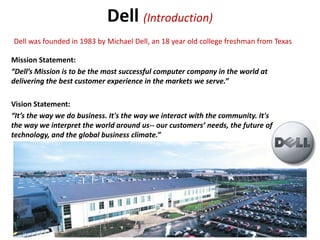
Dell was founded in 1983 by Michael Dell, an 18 year old college freshman from Texas

Mission Statement:
“Dell’s Mission is to be the most successful computer company in the world at
delivering the best customer experience in the markets we serve.”

Vision Statement:
“It’s the way we do business. It's the way we interact with the community. It's
the way we interpret the world around us-- our customers’ needs, the future of
technology, and the global business climate.”
Dell In China
                                        Dell competes in the PC industry, selling
                                        enterprise systems, desktop computers and
                                        notebook computers.


• Founded in 1984
• World’s largest computer vendor
•   Revenues of $41 billion in 2004
•   Operates in 13 Asia Pacific markets with sales of $4.3B in 2004
•   Entered China in 1995 via export
•   Started focusing on China in 1998
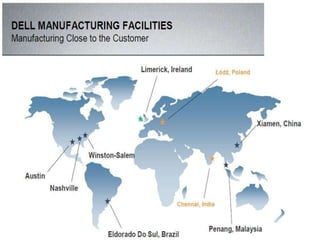
    – In 1998 established a local manufacturing and distribution operation
• In 2004, Dell PCs captured 7% share in China
Dell strategies in China
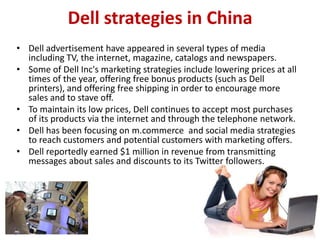
• Dell advertisement have appeared in several types of media
  including TV, the internet, magazine, catalogs and newspapers.
• Some of Dell Inc's marketing strategies include lowering prices at all
  times of the year, offering free bonus products (such as Dell
  printers), and offering free shipping in order to encourage more
  sales and to stave off.
• To maintain its low prices, Dell continues to accept most purchases
  of its products via the internet and through the telephone network.
• Dell has been focusing on m.commerce and social media strategies
  to reach customers and potential customers with marketing offers.
• Dell reportedly earned $1 million in revenue from transmitting
  messages about sales and discounts to its Twitter followers.
Key Strategic Issues
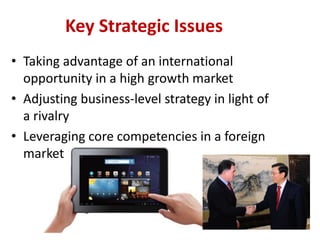
• Taking advantage of an international
  opportunity in a high growth market
• Adjusting business-level strategy in light of
  a rivalry
• Leveraging core competencies in a foreign
  market
External Analysis:
      Key Environmental Factors
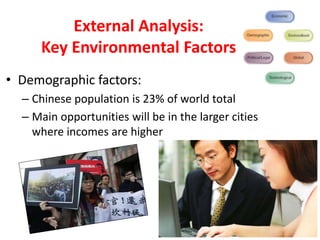
• Demographic factors:
  – Chinese population is 23% of world total
  – Main opportunities will be in the larger cities
    where incomes are higher
External Analysis:
          Key Environmental Factors
• Sociocultural:
   – Purchasing expectations (try before they buy)
   – Chinese attitudes and culture becoming more similar in
     purchasing patterns and work ethic to U.S.
• Economic:
   –   Chinese economy grew 9.8% in 2005
   –   Total retail sales increased 13%
   –   China’s PC market estimated to grow 19% in 2004-2005
   –   Low per capita incomes and unevenly distributed
        • Average US $1,583
        • Urban US $5,000
        • Middle class (200 million people) US $8,000
External Analysis:
         Key Environmental Factors
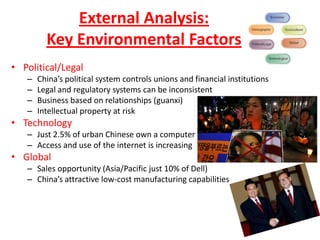
• Political/Legal
   –   China’s political system controls unions and financial institutions
   –   Legal and regulatory systems can be inconsistent
   –   Business based on relationships (guanxi)
   –   Intellectual property at risk
• Technology
   – Just 2.5% of urban Chinese own a computer
   – Access and use of the internet is increasing
• Global
   – Sales opportunity (Asia/Pacific just 10% of Dell)
   – China’s attractive low-cost manufacturing capabilities
External Analysis:
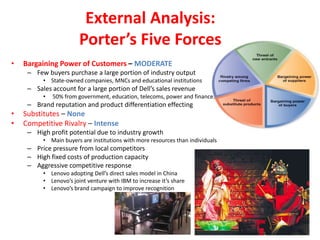
                        Porter’s Five Forces
•   Bargaining Power of Customers – MODERATE
     – Few buyers purchase a large portion of industry output
          • State-owned companies, MNCs and educational institutions
     – Sales account for a large portion of Dell’s sales revenue
          •   50% from government, education, telecoms, power and finance.
     – Brand reputation and product differentiation effecting
•   Substitutes – None
•   Competitive Rivalry – Intense
     – High profit potential due to industry growth
          • Main buyers are institutions with more resources than individuals
     – Price pressure from local competitors
     – High fixed costs of production capacity
     – Aggressive competitive response
          • Lenovo adopting Dell’s direct sales model in China
          • Lenovo’s joint venture with IBM to increase it’s share
          • Lenovo’s brand campaign to improve recognition
Competitors
• Future objectives:
   – Build market share rapidly
• Current strategy:
   –   Cost leadership (Lenovo, Founder, Tongfang)
   –   Differentiation (HP, IBM & Compaq)
   –   Focused on consumer market
   –   Lenovo positioning itself to challenge in high-end
Competitors
• Key Strengths:
  – Chinese competitors: market knowledge and
    low cost advantage.
  – American competitors: technology and brand
    recognition
• Key Weaknesses:
  – Chinese competitors: brand recognition
  – American competitors: higher costs
Customer
• High-end Customers
   –   State-owned companies
   –   MNCs
   –   Government
   –   Educational institutions
   –   Large Corporate Accounts (1,500+ employees in Telecoms, Power and
       Finance
• Individual Consumers
• Behavior:
   –   Consumer market is price sensitive
   –   Prefer a trial use of PCs before purchase
   –   Internet purchases were uncommon but internet users increasing
   –   Best way to reach is through retailing (Kiosks)
   –   Value product quality, especially high-end customers
   –   Brand loyal
Internal Analysis
Key Resources
• Key tangible resources:
   – WW(world wide) market leadership & financial resources
   ($8B in China)
   – Direct sales system and customer service
   – Local production plant in China
   – Alliance with Oracle
   – Manufacturing (“Build-to-order) and low inventory” strategy
   – “Just-in-time” model (6 days vs. 40 days of supply)
   – Portfolio of award-winning products
• Key intangible resources:
   – Strong brand
   – Reputation (“Dell experience” of high-quality products, support
     and service)
   – Innovative in its technology, business practices and customer
     service


              http://www.dell.com/content/topics/global.aspx/corp/en/home?c=us&l=en&s=corp
Core Competencies
• Ability to simplify PCs and the supply chain since
  their beginning
• Ability to understand customer needs and deliver
  innovative technology and services
• Ability to use technology to simultaneously
  improve customer experience and contain costs
• Ability to operate a direct business model
Value Chain Analysis
• Primary activities of value:
   – Operations: Manufacturing processes contain costs
     well
   – Outbound logistics: Direct sales model
   – Service: High responsiveness to customer needs
• Support activities of value:
   – Technological development: Innovative web site
   and IT infrastructure
   – Firm infrastructure: Visionary founder and
     management team
Summary SWOT
Strengths & Weaknesses
• Strengths:
   –   Reputation
   –   Manufacturing plant (build-to-order capability, JIT)
   –   Direct sales model (on line and phone order capability)
   –   Strong sales revenue in 2003 ($8 Billion)
   –   Strategic alliance with Oracle
   –   Product performance (Best Overseas PC Corporation
       Award)
• Weaknesses
   – No low cost advantage that will allow them to compete
     in the consumer segment
   – Possible cost advantages not realized from their China
     plant
Opportunities
• Large population in China and economic growth
  potential (Dell’s fourth largest market)
   – PC market expected to grow by 19%
   – Only 2.5% of urban Chinese own PCs
• Sales potential in larger cities
• Reduction in tariffs on IT products makes it less
  costly to export to China
• Expansion into Japan, Korea and Taiwan
Risks/ Threats
• Low GDP per capita in China
• Weak government protection of IP
• Moderately high threat of entry of new
  competitors
• Intense rivalry among competitors
• Lenovo-IBM joint venture
• Lenovo’s copying of Dell’s direct sales model
• Lenovo’s attempts to boost brand recognition
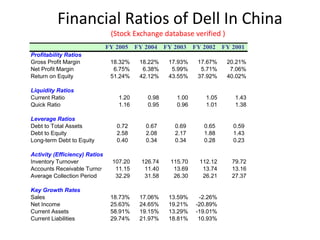
Financial Ratios of Dell In China
                            (Stock Exchange database verified )
                           FY 2005 FY 2004 FY 2003 FY 2002 FY 2001
Profitability Ratios
Gross Profit Margin         18.32%    18.22%   17.93%   17.67%    20.21%
Net Profit Margin            6.75%     6.38%    5.99%    5.71%     7.06%
Return on Equity            51.24%    42.12%   43.55%   37.92%    40.02%

Liquidity Ratios
Current Ratio                  1.20     0.98     1.00      1.05     1.43
Quick Ratio                    1.16     0.95     0.96      1.01     1.38

Leverage Ratios
Debt to Total Assets          0.72     0.67     0.69      0.65     0.59
Debt to Equity                2.58     2.08     2.17      1.88     1.43
Long-term Debt to Equity      0.40     0.34     0.34      0.28     0.23

Activity (Efficiency) Ratios
Inventory Turnover           107.20   126.74   115.70    112.12    79.72
Accounts Receivable Turnover 11.15     11.40    13.69     13.74    13.16
Average Collection Period     32.29    31.58    26.30     26.21    27.37

Key Growth Rates
Sales                       18.73%    17.06%   13.59%    -2.26%
Net Income                  25.63%    24.65%   19.21%   -20.89%
Current Assets              58.91%    19.15%   13.29%   -19.01%
Current Liabilities         29.74%    21.97%   18.81%    10.93%
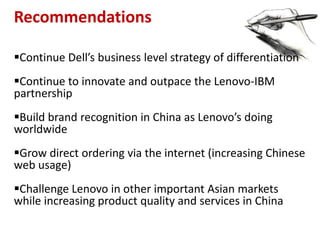
Recommendations

Continue Dell’s business level strategy of differentiation
Continue to innovate and outpace the Lenovo-IBM
partnership
Build brand recognition in China as Lenovo’s doing
worldwide
Grow direct ordering via the internet (increasing Chinese
web usage)
Challenge Lenovo in other important Asian markets
while increasing product quality and services in China
Cont… (recommendations)

 Prepare for wireless/mobility trend and strengthen notebook
  offering

 Eventually broaden reach to penetrate low-end and rural
  areas
   o Develop the infrastructure to service, support and sell
     (different than urban areas)
   o Requires a low-cost, differentiated product line
   o Learn the Chinese market to overcome local rivals
   o Explore alternative sales channels (besides direct) to reach
     small cities
Thank You

Global project

  • 2.
    Group Members • UsmanZakir • M. Qammar-uz-zaman COMSATS SAHIWAL
  • 3.
    Dell (Introduction) Dell wasfounded in 1983 by Michael Dell, an 18 year old college freshman from Texas Mission Statement: “Dell’s Mission is to be the most successful computer company in the world at delivering the best customer experience in the markets we serve.” Vision Statement: “It’s the way we do business. It's the way we interact with the community. It's the way we interpret the world around us-- our customers’ needs, the future of technology, and the global business climate.”
  • 5.
    Dell In China Dell competes in the PC industry, selling enterprise systems, desktop computers and notebook computers. • Founded in 1984 • World’s largest computer vendor • Revenues of $41 billion in 2004 • Operates in 13 Asia Pacific markets with sales of $4.3B in 2004 • Entered China in 1995 via export • Started focusing on China in 1998 – In 1998 established a local manufacturing and distribution operation • In 2004, Dell PCs captured 7% share in China
  • 6.
    Dell strategies inChina • Dell advertisement have appeared in several types of media including TV, the internet, magazine, catalogs and newspapers. • Some of Dell Inc's marketing strategies include lowering prices at all times of the year, offering free bonus products (such as Dell printers), and offering free shipping in order to encourage more sales and to stave off. • To maintain its low prices, Dell continues to accept most purchases of its products via the internet and through the telephone network. • Dell has been focusing on m.commerce and social media strategies to reach customers and potential customers with marketing offers. • Dell reportedly earned $1 million in revenue from transmitting messages about sales and discounts to its Twitter followers.
  • 7.
    Key Strategic Issues •Taking advantage of an international opportunity in a high growth market • Adjusting business-level strategy in light of a rivalry • Leveraging core competencies in a foreign market
  • 8.
    External Analysis: Key Environmental Factors • Demographic factors: – Chinese population is 23% of world total – Main opportunities will be in the larger cities where incomes are higher
  • 9.
    External Analysis: Key Environmental Factors • Sociocultural: – Purchasing expectations (try before they buy) – Chinese attitudes and culture becoming more similar in purchasing patterns and work ethic to U.S. • Economic: – Chinese economy grew 9.8% in 2005 – Total retail sales increased 13% – China’s PC market estimated to grow 19% in 2004-2005 – Low per capita incomes and unevenly distributed • Average US $1,583 • Urban US $5,000 • Middle class (200 million people) US $8,000
  • 10.
    External Analysis: Key Environmental Factors • Political/Legal – China’s political system controls unions and financial institutions – Legal and regulatory systems can be inconsistent – Business based on relationships (guanxi) – Intellectual property at risk • Technology – Just 2.5% of urban Chinese own a computer – Access and use of the internet is increasing • Global – Sales opportunity (Asia/Pacific just 10% of Dell) – China’s attractive low-cost manufacturing capabilities
  • 11.
    External Analysis: Porter’s Five Forces • Bargaining Power of Customers – MODERATE – Few buyers purchase a large portion of industry output • State-owned companies, MNCs and educational institutions – Sales account for a large portion of Dell’s sales revenue • 50% from government, education, telecoms, power and finance. – Brand reputation and product differentiation effecting • Substitutes – None • Competitive Rivalry – Intense – High profit potential due to industry growth • Main buyers are institutions with more resources than individuals – Price pressure from local competitors – High fixed costs of production capacity – Aggressive competitive response • Lenovo adopting Dell’s direct sales model in China • Lenovo’s joint venture with IBM to increase it’s share • Lenovo’s brand campaign to improve recognition
  • 12.
    Competitors • Future objectives: – Build market share rapidly • Current strategy: – Cost leadership (Lenovo, Founder, Tongfang) – Differentiation (HP, IBM & Compaq) – Focused on consumer market – Lenovo positioning itself to challenge in high-end
  • 13.
    Competitors • Key Strengths: – Chinese competitors: market knowledge and low cost advantage. – American competitors: technology and brand recognition • Key Weaknesses: – Chinese competitors: brand recognition – American competitors: higher costs
  • 14.
    Customer • High-end Customers – State-owned companies – MNCs – Government – Educational institutions – Large Corporate Accounts (1,500+ employees in Telecoms, Power and Finance • Individual Consumers • Behavior: – Consumer market is price sensitive – Prefer a trial use of PCs before purchase – Internet purchases were uncommon but internet users increasing – Best way to reach is through retailing (Kiosks) – Value product quality, especially high-end customers – Brand loyal
  • 15.
  • 16.
    Key Resources • Keytangible resources: – WW(world wide) market leadership & financial resources ($8B in China) – Direct sales system and customer service – Local production plant in China – Alliance with Oracle – Manufacturing (“Build-to-order) and low inventory” strategy – “Just-in-time” model (6 days vs. 40 days of supply) – Portfolio of award-winning products • Key intangible resources: – Strong brand – Reputation (“Dell experience” of high-quality products, support and service) – Innovative in its technology, business practices and customer service http://www.dell.com/content/topics/global.aspx/corp/en/home?c=us&l=en&s=corp
  • 17.
    Core Competencies • Abilityto simplify PCs and the supply chain since their beginning • Ability to understand customer needs and deliver innovative technology and services • Ability to use technology to simultaneously improve customer experience and contain costs • Ability to operate a direct business model
  • 18.
    Value Chain Analysis •Primary activities of value: – Operations: Manufacturing processes contain costs well – Outbound logistics: Direct sales model – Service: High responsiveness to customer needs • Support activities of value: – Technological development: Innovative web site and IT infrastructure – Firm infrastructure: Visionary founder and management team
  • 19.
  • 20.
    Strengths & Weaknesses •Strengths: – Reputation – Manufacturing plant (build-to-order capability, JIT) – Direct sales model (on line and phone order capability) – Strong sales revenue in 2003 ($8 Billion) – Strategic alliance with Oracle – Product performance (Best Overseas PC Corporation Award) • Weaknesses – No low cost advantage that will allow them to compete in the consumer segment – Possible cost advantages not realized from their China plant
  • 21.
    Opportunities • Large populationin China and economic growth potential (Dell’s fourth largest market) – PC market expected to grow by 19% – Only 2.5% of urban Chinese own PCs • Sales potential in larger cities • Reduction in tariffs on IT products makes it less costly to export to China • Expansion into Japan, Korea and Taiwan
  • 22.
    Risks/ Threats • LowGDP per capita in China • Weak government protection of IP • Moderately high threat of entry of new competitors • Intense rivalry among competitors • Lenovo-IBM joint venture • Lenovo’s copying of Dell’s direct sales model • Lenovo’s attempts to boost brand recognition
  • 23.
    Financial Ratios ofDell In China (Stock Exchange database verified ) FY 2005 FY 2004 FY 2003 FY 2002 FY 2001 Profitability Ratios Gross Profit Margin 18.32% 18.22% 17.93% 17.67% 20.21% Net Profit Margin 6.75% 6.38% 5.99% 5.71% 7.06% Return on Equity 51.24% 42.12% 43.55% 37.92% 40.02% Liquidity Ratios Current Ratio 1.20 0.98 1.00 1.05 1.43 Quick Ratio 1.16 0.95 0.96 1.01 1.38 Leverage Ratios Debt to Total Assets 0.72 0.67 0.69 0.65 0.59 Debt to Equity 2.58 2.08 2.17 1.88 1.43 Long-term Debt to Equity 0.40 0.34 0.34 0.28 0.23 Activity (Efficiency) Ratios Inventory Turnover 107.20 126.74 115.70 112.12 79.72 Accounts Receivable Turnover 11.15 11.40 13.69 13.74 13.16 Average Collection Period 32.29 31.58 26.30 26.21 27.37 Key Growth Rates Sales 18.73% 17.06% 13.59% -2.26% Net Income 25.63% 24.65% 19.21% -20.89% Current Assets 58.91% 19.15% 13.29% -19.01% Current Liabilities 29.74% 21.97% 18.81% 10.93%
  • 24.
    Recommendations Continue Dell’s businesslevel strategy of differentiation Continue to innovate and outpace the Lenovo-IBM partnership Build brand recognition in China as Lenovo’s doing worldwide Grow direct ordering via the internet (increasing Chinese web usage) Challenge Lenovo in other important Asian markets while increasing product quality and services in China
  • 25.
    Cont… (recommendations)  Preparefor wireless/mobility trend and strengthen notebook offering  Eventually broaden reach to penetrate low-end and rural areas o Develop the infrastructure to service, support and sell (different than urban areas) o Requires a low-cost, differentiated product line o Learn the Chinese market to overcome local rivals o Explore alternative sales channels (besides direct) to reach small cities
  • 26.