There	
  is	
  no	
  “oops”	
  clause	
  to	
  
                                                    Privacy	
  LegislaFon	


Feb	
  27,	
  2013	


Presented	
  by	
  Robby	
  Gulri,	
  VP	
  Products	
  
gulri@echoworx.com	
  
For	
  product	
  inquiries,	
  Ryan	
  Vaudry,	
  Account	
  Director	
  
vaudry@echoworx.com	
  
                                                                                                  1	
  
Compliance	
  Simplified	
  –	
  Achieve	
  ,	
  Illustrate,	
  Maintain	
  
Industry	
  leading	
  Educa2on	
  
                                                       Todays	
  Webinar	


                                          •  Please	
  ask	
  ques2ons	
  
                                          •  Todays	
  slides	
  are	
  available	
  	
  
                                          hGp://compliancy-­‐group.com/slides023/	
  
    Cer2fied	
  Partner	
  Program	


                     •  Past	
  webinars	
  and	
  recordings	
  
                                          hGp://compliancy-­‐group.com/webinar/	


                                                                                855.85HIPAA	
  
                                          	
                              www.compliancygroup.com	
  
Privacy	
  legisla2on	
  is	
  
    everywhere	


                                  3	
  
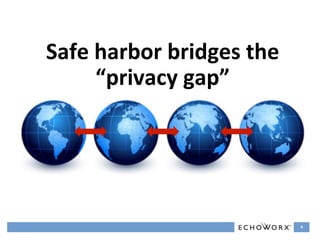
Safe	
  harbor	
  bridges	
  the	
  
        “privacy	
  gap”	


                                       4	
  
Safe	
  harbor	
  
•  Policy	
  agreement	
  between	
  the	
  United	
  States	
  Department	
  of	
  
   Commerce	
  and	
  the	
  European	
  Union	
  (E.U.)	
  
•  Regulates	
  the	
  way	
  that	
  U.S.	
  companies	
  export	
  and	
  handle	
  the	
  
   personal	
  data	
  of	
  European	
  ciFzens	
  	
  
•  Before	
  safe	
  harbor	
  it	
  was	
  almost	
  illegal	
  to	
  transfer	
  personal	
  data	
  
   outside	
  of	
  Europe	
  
•  Safe	
  harbor	
  sFpulates	
  that	
  companies	
  collecFng	
  personal	
  data	
  must:	
  
   –  inform	
  the	
  people	
  that	
  the	
  data	
  is	
  being	
  gathered	
  
   –  tell	
  them	
  what	
  will	
  be	
  done	
  with	
  it	
  
   –  obtain	
  permission	
  to	
  pass	
  on	
  the	
  informaFon	
  to	
  a	
  third	
  party	
  
   –  allow	
  people	
  access	
  to	
  the	
  data	
  gathered	
  
   –  assure	
  data	
  integrity	
  and	
  security	
  
   –  guarantee	
  a	
  means	
  of	
  enforcing	
  compliance	
  must	
  be	
  guaranteed	


                                                                                                          5	
  
Safe	
  harbor	
  framework	
  
• 7	
  Privacy	
  Principles	
  
  – NoFce,	
  Choice,	
  Onward	
  Transfer,	
  Access,	
  Data	
  
    Integrity,	
  Security,	
  Enforcement	
  
  – 15	
  FAQ’s	
  
• Standards	
  for	
  Email	
  Encryp2on	
  
• Series	
  of	
  leIers	
  between	
  the	
  European	
  
  Commission,	
  Department	
  of	
  Commerce,	
  Federal	
  
  Trade	
  Commission,	
  and	
  Department	
  of	
  
  TransportaFon	
  

                                                                      6	
  
IT’S	
  THE	
  LAW!	


                          7	
  
Examples	
  of	
  highly	
  enforced	
  regula2ons	
  
•  HIPAA	
  mandates	
  that	
  all	
  protected	
  health	
  informaFon	
  should	
  be	
  encrypted	
  on	
  public	
  
   networks	
  
•  MassachuseIs	
  encryp2on	
  law	
  states	
  that	
  all	
  personal	
  informaFon	
  stored	
  on	
  laptops	
  and	
  
   other	
  portable	
  devices	
  must	
  be	
  encrypted	
  
•  The	
  Italian	
  personal	
  data	
  protec2on	
  code	
  states	
  that	
  personal	
  data	
  shared	
  between	
  
   healthcare	
  bodies	
  and	
  professionals	
  must	
  be	
  performed	
  using	
  encrypFon	
  technology	
  
•  California	
  bill	
  AB	
  1950	
  mandates	
  all	
  organizaFons	
  that	
  use	
  personal	
  electronic	
  records	
  
   must	
  establish	
  precauFonary	
  measures	
  to	
  protect	
  data	
  
•  Michigan	
  encryp2on	
  law	
  states	
  that	
  personal	
  idenFfying	
  informaFon	
  must	
  be	
  stored	
  in	
  an	
  
   encrypted	
  format	
  
•  The	
  Spanish	
  royal	
  decree	
  states	
  that	
  sensiFve	
  data	
  may	
  only	
  be	
  transmiGed	
  electronically	
  
   if	
  the	
  data	
  is	
  encrypted	
  first	
  
•  Nevada	
  encryp2on	
  law	
  states	
  that	
  businesses	
  must	
  encrypt	
  all	
  informaFon	
  transferred	
  
   electronically	
  
•  Canadian	
  department	
  of	
  jus2ce	
  states	
  that	
  private	
  informaFon	
  should	
  be	
  locked	
  in	
  
   cabinets,	
  protected	
  with	
  passwords	
  and	
  protected	
  with	
  encrypFon	


                                                                                                                                 8	
  
Regula2ons	
  are	
  complex	
  
•  Sectoral	
  regulaFons	
  are	
  different	
  for	
  healthcare,	
  financial	
  
   services,	
  banking,	
  insurance,	
  and	
  more	
  
•  Federal	
  regulaFons	
  	
  include	
  HIPAA,	
  PCI,	
  SOX,	
  Children	
  On-­‐Line	
  
   InformaFon	
  
•  State	
  Laws	
  require	
  data	
  	
  breach	
  noFficaFons	
  
•  Agency	
  regulaFons	
  include	
  FTC,	
  Office	
  of	
  Treasury,	
  SEC,	
  etc	
  
•  Global	
  laws	
  include	
  safe	
  harboring	
  and	
  export	
  laws	


                                                                                                 9	
  
What	
  exactly	
  are	
  we	
  protec2ng	
  
An	
  individuals	
  personal	
  informaFon	
  or	
  PI	
  
   •      Name	
  	
                       Data	
  includes:	
  
   •      IniFals	


                                           •  Personal	
  details	
  like	
  salary,	
  bank	
  
   •      Address	
  	
                         balance,	
  etc.	
  
   •      SSN	
  	
                        •  Consumer	
  and	
  employee	
  e-­‐mail	
  
                                           •  Internal	
  reports	
  
   •      Phone	
  number	
  	
            •  Expressions	
  of	
  interest	
  on	
  parFcular	
  
   •      Email	
  address	
  	
                topics	
  	
  
                                           •  IT	
  logs	
  of	
  originaFng	
  IP	
  addresses	
  
   •      Photographs	
  	
                •  Internet	
  transmission	
  data	
  like	
  
                                                parFcular	
  web	
  pages	
  viewed,	
  etc.	
  
   •      Fingerprints	


   •      and	
  more	
  …	


                                                                                                      10	
  
Regulated	
  versus	
  non-­‐regulated	
  data	
  
REGULATED	
  DATA	
                                      NON-­‐REGULATED	
  DATA	
  
•  Personal	
  informaFon:	
                             •  Intellectual	
  property:	
  
   –  Health	
  data:	
  disease	
  history,	
              –  R&D	
  
      biometric	
  idenFfies	
  such	
  as	
                 –  Technical	
  Specs	
  
      reFnal	
  scans,	
  DNA	
  
                                                            –  	
  DocumentaFon	
  
   –  Financial	
  data:	
  pin	
  codes,	
  
      account	
  numbers,	
  billing	
  details,	
          –  Source	
  Code	
  
      credit	
  card	
  informaFon	
                        –  Diagrams,	
  formulas,	
  and	
  
   –  Personal	
  data:	
  social	
  security	
                calculaFons	
  
      numbers,	
  fingerprints,	
  race,	
                   –  Manufacturing	
  and	
  
      ethnicity,	
  sex/orientaFon,	
                          development	
  processes	
  
      religious	
  belief,	
  poliFcal	
  opinion,	
  
      trade	
  union	
  membership,	
  
      physical/mental	
  health	
  or	
  
      condiFons,	
  criminal	
  record	
  

                                                                                                   11	
  
Key	
  vulnerabili2es	
  and	
  risks	
  
•  Third-party vendors who handle data transfers
•  Lost devices such as laptops, portable media and back-up tapes
•  Dumpster diving
•  Peer-to-peer networks such as iPods, file sharing, etc.
•  Email scams such as phishing
•  Internet routers that are not protected
•  Using SSNs for authentication and insecure storing of SSNs
•  Improper access to facilities and physical equipment
•  Mobile and home-based workforce without VPN controls, device
   management, and remote security processes
•  Social Engineering risks and internal call centers not prepared to
   handle these risks


                                                                        12	
  
Email	
  poses	
  the	
  biggest	
  risk	
  
•  Email	
  is	
  s2ll	
  the	
  #	
  1	
  business	
  
   communica2ons	
  tool	
  
    –  Workers	
  spend	
  an	
  average	
  of	
  152	
  minutes	
  
       per	
  day	
  on	
  email	
  
    –  Worldwide	
  email	
  accounts	
  by	
  2014	
  are	
  
       projected	
  at	
  3.8	
  billion	
  

•  Widespread	
  misuse	
  of	
  email	
  
    –  1	
  in	
  5	
  outgoing	
  emails	
  contain	
  content	
  that	
  
       poses	
  a	
  legal,	
  financial,	
  or	
  regulatory	
  risk	
  

•  High	
  risk	
  
    –  89%	
  of	
  unsolicited	
  email	
  contain	
  malware	
  
    –  Email	
  is	
  the	
  most	
  common	
  “aGack”	
  method	
  
         for	
  hackers	
  
    –  75%	
  of	
  all	
  corporate	
  email	
  contain	
  some	
  
         Intellectual	
  Property	


                                                                              13	
  
Email	
  poses	
  the	
  biggest	
  risk	
  
•  Embedded	
  links	
  and	
  file	
  aGachments	
  all	
  pose	
  a	
  high	
  risk	
  
•  Highest	
  profile	
  of	
  data	
  breaches	
  generally	
  involve	
  email	
  and	
  the	
  
   intercepFon	
  of	
  email	
  
•  Ongoing	
  educaFon	
  is	
  required	
  for	
  employees,	
  partners,	
  and	
  
   customers	
  
•  An	
  email	
  encrypFon	
  soluFon	
  that	
  “just	
  works”	
  is	
  required	
  to	
  protect	
  
   privacy	
  and	
  sensiFve	
  informaFon	
  
   –  Email	
  encrypFon	
  technology	
  must	
  be	
  easy	
  to	
  use	
  and	
  deploy	
  
   –  ComplexiFes	
  of	
  encrypFng	
  email	
  should	
  be	
  hidden	
  from	
  the	
  end-­‐user	
  
   –  Email	
  encrypFon	
  	
  soluFon	
  must	
  be	
  standards	
  based	
  
   –  Email	
  encrypFon	
  soluFon	
  must	
  be	
  powerful	
  and	
  military	
  grade	


                                                                                                           14	
  
Understanding	
  data	
  intercep2on	
  
•  Spear	
  Phishing	
  –	
  aGacks	
  directed	
  at	
  high	
  profile	
  targets	
  
•  Spoofing	
  /	
  Spam	
  –	
  Disguised	
  email	
  that	
  introduces	
  viruses	
  and	
  
   malware	
  into	
  systems	
  to	
  extract	
  informaFon	
  
•  Phishing	
  –	
  Disguised	
  email	
  designed	
  to	
  acquire	
  passwords	
  and	
  
   other	
  confidenFal	
  informaFon	
  relaFng	
  to	
  privacy	
  
•  Cache	
  Poisoning	
  –	
  DNS	
  compromises	
  for	
  URL	
  redirecFon	
  
•  Denial	
  of	
  Service	
  –	
  Bring	
  down	
  a	
  mail	
  server	
  with	
  high	
  volume	
  of	
  
   emails	
  to	
  then	
  extract	
  informaFon	
  
•  Man	
  in	
  the	
  Middle	
  –	
  Intercept	
  outgoing	
  email	
  at	
  various	
  points	
  of	
  
   delivery	
  to	
  gain	
  access	
  to	
  private	
  informaFon	


                                                                                                              15	
  
 
Three	
  	
  steps	
  to	
  compliance	
  
      Develop	
  privacy	
  policies	
  
      •  Needs/risk	
  assessment	
  
      •  Define	
  policies	
  	
  
      •  Create	
  clear	
  rules	
  for	
  the	
  distribuFon	
  of	
  confidenFal	
  info	
  	
  
      •  Provide	
  and	
  support	
  an	
  easy	
  to	
  use	
  technical	
  soluFon	
  to	
  enforce	
  policies	
  and	
  procedures	


      Eliminate	
  human	
  error	
  	
  
      •  People	
  make	
  mistakes	
  	
  
      •  Most	
  data	
  is	
  compromised	
  inadvertently	
  	
  
      •  Up	
  to	
  80%	
  of	
  breaches	
  are	
  caused	
  internally	


      Protect	
  confiden2al	
  informa2on	
  	
  
      •  Apply	
  encrypFon	
  to	
  all	
  confidenFal	
  info,	
  across	
  all	
  plaoorms	
  and	
  devices	
  
      •  Enforce	
  encrypFon	
  automaFcally	
  using	
  a	
  policy	
  engine	
  
      •  Alternately	
  encrypt	
  emails	
  directly	
  from	
  the	
  desktop	


                                                                                                                                                  16	
  
Protec2ng	
  confiden2al	
  
  informa2on	
  using	
  
encryp2on	
  puts	
  you	
  on	
  
   the	
  right	
  track	
  to	
  
     compliance	
  
                                     17	
  
You	
  can	
  pay	
  for	
  encryp2on	
  now	
  …	
  
             or	
  pay	
  more	
  later	
  
     Country	
       Cost	
  per	
  Record	
     Cost	
  of	
  Breach	


     Australia	
     $114	
                      $1.83M	
  
     France	
        $119	
                      $2.53M	
  
     Germany	
       $177	
                      $3.44M	
  
     UK	
            $98	
                       $2.57M	
  
     USA	
           $204	
                      $6.75M	
  
     Average	
       $142	
                      $3.43M	
  
                                                              Source:	
  Ponemon	
  2011	


                                                                                               18	
  
Consequences	
  of	
  non-­‐compliance	
  
• Significant	
  fines	
  
• Loss	
  of	
  reputaFon	
  
• Loss	
  of	
  customers	
  
• IntercepFon	
  /	
  disclosure	
  of	
  outgoing	
  email	
  
• Likelihood	
  of	
  inbound	
  email	
  aGacks	
  
• Loss/thes	
  of	
  private	
  informaFon	


                                                                  19	
  
Disclosing	
  data	
  breaches	
  
•  Before	
  there	
  was	
  no	
  law	
  to	
  disclose	
  a	
  data	
  breach	
  
•  Today	
  all	
  data	
  breaches	
  have	
  to	
  be	
  disclosed	
  to	
  the	
  effected	
  parFes:	
  
•  OrganizaFons	
  must:	
  
   –  Disclose	
  any	
  breach	
  of	
  security	
  	
  
   –  Provide	
  noFficaFon	
  of	
  the	
  breach	
  in	
  the	
  most	
  expedient	
  Fme	
  possible	
  
   –  Provide	
  noFficaFon	
  without	
  unreasonable	
  delay	
  	
  
   –  Provide	
  noFficaFon	
  to	
  a	
  major	
  media	
  outlet	
  
   –  Data	
  breaches	
  on	
  a	
  data	
  breach	
  noFficaFon	
  website	
  
   –  Individuals	
  have	
  to	
  be	
  compensated	
  for	
  their	
  loss	
  
   –  IdenFty	
  thes	
  consFtute	
  big	
  dollar	
  payout	


                                                                                                              20	
  
California	
  SB	
  1386	
  
•  If	
  a	
  breach	
  occurs,	
  the	
  affected	
  enFFes	
  must:	
  
   –  Disclose	
  any	
  breach	
  of	
  security	
  of	
  the	
  system	
  
   –  Following	
  discovery	
  with	
  noFficaFon	
  of	
  the	
  breach	
  in	
  the	
  most	
  expedient	
  
      Fme	
  possible	
  and	
  without	
  unreasonable	
  delay	
  in	
  wriFng	
  to	
  any	
  resident	
  in	
  
      California	
  whose	
  unencrypted	
  personal	
  informaFon	
  was	
  or	
  is	
  reasonably	
  
      believed	
  to	
  have	
  been	
  acquired	
  by	
  an	
  unauthorized	
  party	
  
•  A	
  Model	
  for	
  most	
  of	
  the	
  US	
  State	
  Data	
  Breach	
  noFficaFon	
  laws	
  
•  A	
  Model	
  for	
  many	
  global	
  data	
  breach	
  laws	
  and	
  privacy	
  laws	


                                                                                                                 21	
  
Physical	
  security	
  
•  Don’t	
  forget	
  physical	
  security	
  
•  This	
  is	
  osen	
  overlooked	
  and	
  neglected	
  
•  Restrict	
  and	
  monitor	
  access	
  to	
  servers	
  
•  Secure	
  faciliFes	
  and	
  infrastructure	
  
•  Alert	
  on	
  all	
  systems	
  disrupFons	
  and	
  outages	


                                                                       22	
  
Compliance	
  
MisconcepFons	
                                        Best	
  PracFce	
  
•  Compliance	
  with	
  certain	
  laws	
             •  OrganizaFons	
  must	
  acFvely	
  
   does	
  not	
  equal	
  Compliance	
  with	
           manage	
  ALL	
  compliance	
  
   all	
  laws	
                                          regulaFons	
  
•  Federal	
  PCI	
  Compliance	
  does	
              •  No	
  shortcut	
  for	
  regulatory	
  
   not	
  equal	
  compliance	
  with	
  State	
          analysis	
  
   oriented	
  PCI	
  Laws.	
  	
  Each	
  state	
  
                                                       •  Need	
  an	
  approach	
  that	
  scales	
  
   has	
  a	
  different	
  perspecFve	
  on	
  
   PCI	
                                                  –  Many	
  naFonal,	
  state,	
  and	
  
                                                             global	
  regulaFons	
  and	
  more	
  
                                                             coming	
  
                                                       •  Email	
  and	
  Data	
  Encryp2on	
  is	
  
                                                          part	
  of	
  all	
  these	
  regula2ons	


                                                                                                         23	
  
HIPAA	
  
• 6,499	
  acFve	
  HIPAA	
  privacy	
  rule	
  invesFgaFons	
  
  underway	
  
• 23%	
  of	
  total	
  HIPAA	
  privacy	
  complaints	
  resulted	
  in	
  fines	
  
• PenalFes	
  are	
  based	
  on	
   intent 	
  behind	
  the	
  violaFon	
  
• Fines	
  of	
  up	
  to	
  $1.5	
  million	
  	
  
• Mandatory	
  audits	
  by	
  U.S.A.	
  HHS	


                                                                                  24	
  
HIPAA	
  
 A	
  licensed	
  pracFcal	
  nurse	
  who	
  pled	
       Nearly	
  three	
  dozen	
  hospital	
  workers	
  
 guilty	
  to	
  wrongfully	
  disclosing	
  a	
           at	
  Allina	
  Hospitals	
  were	
  fired	
  
 paFent’s	
  health	
  informaFon	
  for	
                 Thursday	
  aser	
  violaFng	
  privacy	
  rules	
  
 personal	
  gain	
  faces	
  a	
  maximum	
               involving	
  a	
  high-­‐profile	
  overdose	
  case	
  
 penalty	
  of	
  10	
  years	
  imprisonment,	
  a	
      (2011)	
  
 $250,000	
  fine	
  or	
  both	
  (2011)	


                                                        The	
  reason	
  for	
  the	
  firings	
  is	
  the	
  same	
  
 Andrea	
  Smith,	
  LPN,	
  25,	
  of	
  Trumann,	
       for	
  all	
  of	
  them:	
  Looking	
  up	
  medical	
  
 Arkansas,	
  and	
  her	
  husband,	
  JusHn	
            informaHon	
  about	
  Trevor	
  Robinson	
  
 Smith,	
  were	
  indicted	
  on	
  federal	
             and	
  the	
  other	
  people	
  involved	
  without	
  
 charges	
  of	
  conspiracy	
  to	
  violate	
  and	
     permission.	
  	
  All	
  these	
  are	
  classified	
  as	
  
 substanHve	
  violaHons	
  of	
  the	
  Health	
          HIPAA	
  violaHons
 Insurance	
  Portability	
  and	
  
 Accountability	
  Act	
  (HIPAA)	
  in	
  
 December	


                                                                                                                            25	
  
HIPAA	
  
 A	
  former	
  UCLA	
  Health	
  System	
                      Cignet	
  Health	
  of	
  Prince	
  George’s	
  
 employee	
  became	
  the	
  first	
  person	
  in	
            County	
  in	
  Washington	
  has	
  been	
  fined	
  
 the	
  naFon	
  to	
  be	
  sentenced	
  to	
  federal	
       a	
  total	
  of	
  $4.3	
  million	
  for	
  violaFons	
  of	
  
 prison	
  for	
  violaFng	
  HIPAA	
                           HIPAA	


 Huping	
  Zhou,	
  47,	
  of	
  Los	
  Angeles,	
  was	
       The	
  Department	
  of	
  Health	
  and	
  
 sentenced	
  to	
  four	
  months	
  in	
  prison	
  on	
      Human	
  Services	
  Office	
  of	
  Civil	
  Rights	
  
 April	
  27,	
  2010	
  aUer	
  pleading	
  guilty	
  in	
     alleges	
  Cignet	
  violated	
  41	
  paHents’	
  
 January	
  to	
  four	
  misdemeanor	
  counts	
               rights	
  in	
  2008	
  and	
  2009	
  by	
  not	
  
 of	
  accessing	
  and	
  reading	
  the	
                     providing	
  them	
  access	
  to	
  their	
  medical	
  
 confidenHal	
  medical	
  records	
  of	
  his	
                records	
  in	
  a	
  reasonable	
  amount	
  of	
  
 supervisors	
  and	
  high-­‐profile	
                          Hme	
  
 celebriHes,	
  according	
  to	
  the	
  U.S.	
  
 AXorney’s	
  Office	
  for	
  the	
  
 Central	
  District	
  of	
  California.	
  Zhou	
  was	
  
 also	
  fined	
  $2,000	
  

                                                                                                                                    26	
  
HIPAA	
  
 HIPAA	
  violaFons	
  can	
  be	
  applied	
  to	
           California	
  recently	
  (Jan	
  2012)	
  fined	
  14	
  
 both	
  larger	
  and	
  smaller	
  medical	
                hospitals	
  a	
  total	
  of	
  $850,000	
  for	
  a	
  
 offices	
                                                      variety	
  of	
  errors	
  that	
  put	
  paFents	
  and	
  
 	
                                                           paFent	
  data	
  at	
  risk	
  
 Phoenix	
  Cardiac	
  Surgery	
  a	
  small	
                	
  
 surgery	
  center	
  with	
  5	
  physicians	
  was	
        The	
  highest	
  penalty	
  of	
  $100,000	
  was	
  
 recently	
  fined	
  (April	
  2012)	
  $100,000	
            assessed	
  on	
  two	
  hospitals:	
  	
  Mission	
  
 by	
  OCR	
  for	
  failing	
  to	
  protect	
  paHent	
     Hospital	
  Regional	
  Medical	
  Center,	
  
 informaHon	
                                                 Mission	
  Viejo,	
  and	
  	
  Scripps	
  Memorial	
  
                                                              Hospital	
  La	
  Jolla	
  for	
  various	
  HIPAA	
  
                                                              violaHons.	
  	
  The	
  rest	
  of	
  the	
  penalHes	
  
                                                              were	
  for	
  $50,000	
  or	
  $25,000.	
  Most	
  
                                                              were	
  for	
  failure	
  to	
  follow	
  best	
  
                                                              pracHces	
  for	
  PHI	
  protecHon	


                                                                                                                             27	
  
HIPAA	
  
•  Controls	
  physical	
  security,	
  data	
  protecFon,	
  policies	
  and	
  procedures	
  
•  Must	
  encrypt	
  paFent	
  health	
  informaFon	
  (PHI)	
  transmiGed	
  over	
  public	
  
   networks	
  
•  May	
  use	
  and	
  disclose	
  PHI	
  only	
  as	
  permiGed	
  
•  May	
  disclose	
  PHI	
  to	
  business	
  associates	
  only	
  if	
  it	
  obtains	
  “saFsfactory	
  
   assurance”	
  that	
  the	
  business	
  associate	
  will	
  properly	
  safeguard	
  the	
  
   informaFon	
  
•  Not	
  compliant	
  if	
  business	
  associate	
  agreement	
  is	
  not	
  adequate,	
  not	
  in	
  
   place,	
  or	
  not	
  enforced	
  
•  More	
  info:	
  hGp://www.hhs.gov/ocr/privacy/	


                                                                                                           28	
  
Gramm-­‐Leach-­‐Bliley	
  act	
  (GLBA)	
  
•  Financial	
  InsFtuFons	
  can	
  be	
  fined	
  up	
  to	
  $100,000	
  for	
  each	
  violaFon	
  
•  ExecuFves	
  could	
  be	
  fined	
  up	
  to	
  $10,000	
  for	
  each	
  violaFon	
  
•  Criminal	
  penalFes	
  may	
  include	
  up	
  to	
  five	
  years	
  in	
  prison	
  
•  financial	
  InsFtuFon	
  must	
  noFfy	
  individuals	
  if	
  their	
  personal	
  financial	
  
   informaFon	
  is	
  used	
  or	
  shared	
  inappropriately	
  
   REQUIREMENTS	
                                                 EXAMPLE	
  
   •  Data	
  encrypFon	
  with	
  the	
  ability	
               FTC	
  cracked	
  down	
  on	
  a	
  mortgage	
  
      to	
  log	
  and	
  audit	
  should	
  be	
  a	
  key	
     company	
  for	
  violaFng	
  the	
  privacy	
  
      part	
  of	
  any	
  GLBA	
  compliance	
                   rules	
  of	
  the	
  GLBA	
  
      plan	
                                                      	
  
   •  Regulators	
  want	
  to	
  see	
  clear	
                  The	
  result:	
  10	
  years	
  of	
  
      proof	
  that	
  informaFon	
  security	
                   company	
  audits	


      policies	
  are	
  in	
  place	
  and	
  are	
              	
  
      being	
  enforced	


                                                                                                                      29	
  
Payment	
  card	
  industry	
  (PCI)	
  
•  PCI	
  safeguards	
  payment	
  cardholder	
  data	
  
•  67%	
  of	
  PCI-­‐regulated	
  companies	
  are	
  sFll	
  not	
  in	
  full	
  compliance	
  with	
  
   the	
  standard	
  (InformaFon	
  Week,	
  April	
  2012)	
  
•  PCI	
  data	
  breaches	
  increased	
  from	
  79%	
  in	
  2009	
  to	
  85%	
  in	
  2012	
  
   (Ponemon	
  2012)	
  
•  Two	
  of	
  the	
  largest	
  Credit	
  Card	
  thess	
  in	
  history	
  
•  Heartland	
  CorporaFon:	
  intruders	
  broke	
  into	
  its	
  systems	
  and	
  stole	
  data	
  
   of	
  more	
  than	
  130	
  million	
  credit	
  and	
  debit	
  cards	
  (2012)	
  
•  TJ	
  Maxx	
  had	
  94	
  million	
  cards	
  compromised	
  (2007)	


                                                                                                             30	
  
Payment	
  card	
  industry	
  requirements	
  
       Control	
  Objec2ves	
                                   PCI	
  DSS	
  Requirements	
  
                                                                1.	
  Install	
  and	
  maintain	
  a	
  firewall	
  configuraFon	
  to	
  
       Build	
  and	
  Maintain	
  a	
  Secure	
                protect	
  cardholder	
  data	
  
       Network 	
  	
                                           2.	
  Do	
  not	
  use	
  vendor-­‐supplied	
  defaults	
  for	
  system	
  
                                                                passwords	
  and	
  other	
  security	
  parameters	
  
                                                                3.	
  Protect	
  stored	
  cardholder	
  data	
  
       Protect	
  Cardholder	
  Data                 	
  	
     4.	
  Encrypt	
  transmission	
  of	
  cardholder	
  data	
  across	
  
                                                                open,	
  public	
  networks	
  
                                                                5.	
  Use	
  and	
  regularly	
  update	
  anF-­‐virus	
  sosware	
  on	
  
       Maintain	
  a	
  Vulnerability	
                         all	
  systems	
  commonly	
  affected	
  by	
  malware	
  
       Management	
  Program                         	
  	
     6.	
  Develop	
  and	
  maintain	
  secure	
  systems	
  and	
  
                                                                applicaFons	
  
                                                                7.	
  Restrict	
  access	
  to	
  cardholder	
  data	
  by	
  business	
  
       Implement	
  Strong	
  Access	
                          need-­‐to-­‐know	
  
       Control	
  Measures 	
  	
                               8.	
  Assign	
  a	
  unique	
  ID	
  to	
  each	
  person	
  with	
  
                                                                computer	
  access	
  
                                                                9.	
  Restrict	
  physical	
  access	
  to	
  cardholder	
  data	
  
       Regularly	
  Monitor	
  and	
  Test	
                    10.	
  Track	
  and	
  monitor	
  all	
  access	
  to	
  network	
  
       Networks	
  	
                                           resources	
  and	
  cardholder	
  data	
  

                                                                11.	
  Regularly	
  test	
  security	
  systems	
  and	
  processes	
  
       Maintain	
  an	
  InformaFon	
                           12.	
  Maintain	
  a	
  policy	
  that	
  addresses	
  informaFon	
  
       Security	
  Policy      	
  	
                           security	


                                                                                                                                               31	
  
Privacy	
  &	
  security	
  globally	
  
•  Examples	
  of	
  countries	
  w/	
  Data	
  ProtecFon	
  
             Countries	
  with	
  Data	
  Privacy	
  Laws	
  
             15	
  EU	
  Members	
                              Hungary	
  
             ArgenFna	
                                         Iceland	
  
             Australia	
                                        Israel	
  
             Brazil	
                                           New	
  Zealand	
  
             Bulgaria	
                                         Norway	
  
             Canada	
                                           Paraguay	
  
             Chile	
                                            Poland	
  
             Czech	
  Republic	
                                Russia	
  
             Estonia	
                                          Slovakia	
  
             Hong	
  Kong	
                                     Switzerland	
  
             Japan	
                                            Taiwan	
  
                                                                                     32	
  
Privacy	
  &	
  security	
  globally	
  
•  Examples	
  of	
  countries	
  with	
  limited	
  or	
  no	
  data	
  protecFon	
  
              Countries	
  without	
  Data	
  Privacy	
  
              Laws	
  
              Most	
  of	
  Asia	
  expect	
  Russia	
      Philippines	
  
              China	
                                       Singapore	
  (evolving)	
  
              India	
  (in	
  progress	
  quickly)	
        Central	
  America	
  
              Africa	
                                      Mexico	
  
              Malaysia	
                                    Middle	
  East	
  except	
  Israel	


                                                                                                     33	
  
Global	
  regula2ons	
  
U.S.A.	
  Sectoral	
  Laws	
                                    Outside	
  the	
  U.S.A.	
  
 •  HIPAA-­‐Health	
  Insurance	
  Portability	
  and	
          •  Countries	
  with	
  Comprehensive	
  Privacy	
  
    Accountability	
  Act	
                                         laws	
  (e.g.	
  EEA,	
  Japan,	
  ArgenFna,	
  Canada,	
  
 •  HITECH-­‐Health	
  InformaFon	
  Technology	
                   Australia)	
  
    for	
  Economic	
  and	
  Clinical	
  Health	
  Act	
        •  Countries	
  with	
  sectoral	
  laws	
  or	
  as	
  part	
  of	
  
 •  FCRA-­‐Fair	
  Credit	
  ReporFng	
  Act-­‐impacts	
            their	
  consFtuFon:	
  Colombia,	
  Paraguay,	
  
    employment	
  re	
  credit	
  checks	
                          Venezuela,	
  Ecuador,	
  Uruguay	
  
 •  COPPA-­‐Children s	
  Online	
  Privacy	
  
    ProtecFon	
  Act-­‐impacts	
  markeFng	
  to	
               •  EU-­‐	
  Data	
  ProtecFon	
  DirecFve: Safe	
  
    children	
                                                        Harbor	
  as	
  it	
  relates	
  to	
  EU	
  DirecFve	
  
 •  CAN-­‐SPAM-­‐Controlling	
  Assault	
  on	
  Non-­‐
    Solicited	
  Pornography	
  and	
  MarkeFng	
  
 •  TSR-­‐TelemarkeFng	
  Sales	
  Rule,	
  DNC-­‐Do	
  
    Not	
  Call,	
  DNF-­‐Do	
  Not	
  Fax	
  
 •  GLBA-­‐Gramm-­‐Leach	
  Bliley-­‐impacts	
  
    Financial	
  informaFon	
  
 •  FTC	
  Act	
  (unfair	
  and	
  decepFve	
  pracFces)	
  
 •  GINA-­‐GeneFc	
  InformaFon	
  
    NondiscriminaFon	
  Act	


                                                                                                                                    34	
  
Privacy	
  in	
  Australia	
  
•  Privacy	
  in	
  Australian	
  law	
  is	
  the	
  right	
  of	
  natural	
  persons	
  to	
  protect	
  their	
  
   personal	
  life	
  from	
  invasion	
  and	
  to	
  control	
  the	
  flow	
  of	
  their	
  personal	
  
   informaFon.	
  	
  
•  Privacy	
  is	
  not	
  an	
  absolute	
  right;	
  it	
  differs	
  in	
  different	
  contexts	
  and	
  is	
  
   balanced	
  against	
  other	
  compeFng	
  rights	
  and	
  duFes.	
  	
  
•  It	
  is	
  affected	
  by	
  the	
  Australian	
  common	
  law	
  and	
  a	
  range	
  of	
  
   Commonwealth,	
  State	
  and	
  Territorial	
  laws	
  and	
  administraFve	
  
   arrangements.	


                                                                                                                     35	
  
Privacy	
  in	
  Australia	
  
•  Privacy	
  can	
  be	
  divided	
  into	
  a	
  number	
  of	
  separate,	
  but	
  related,	
  
   concepts:	
  
   –  InformaFon	
  privacy,	
  which	
  involves	
  the	
  establishment	
  of	
  rules	
  governing	
  
      the	
  collecFon	
  and	
  handling	
  of	
  personal	
  data	
  such	
  as	
  credit	
  informaFon,	
  
      and	
  medical	
  and	
  government	
  records.	
  It	
  is	
  also	
  known	
  as	
  'data	
  protecFon'	
  
   –  Bodily	
  privacy,	
  which	
  concerns	
  the	
  protecFon	
  of	
  people’s	
  physical	
  selves	
  
      against	
  invasive	
  procedures	
  such	
  as	
  geneFc	
  tests,	
  drug	
  tesFng	
  and	
  cavity	
  
      searches	
  
   –  Privacy	
  of	
  communica2ons,	
  which	
  covers	
  the	
  security	
  and	
  privacy	
  of	
  
      mail,	
  telephones,	
  e-­‐mail	
  and	
  other	
  forms	
  of	
  communica2on	
  
   –  Territorial	
  privacy,	
  which	
  concerns	
  the	
  seyng	
  of	
  limits	
  on	
  intrusion	
  into	
  
      the	
  domesFc	
  and	
  other	
  environments	
  such	
  as	
  the	
  workplace	
  or	
  public	
  
      space.	
  This	
  includes	
  searches,	
  video	
  surveillance	
  and	
  ID	
  checks	


                                                                                                                    36	
  
Privacy	
  in	
  Brazil	
  
•  A	
  Brazilian	
  ciFzen's	
  privacy	
  is	
  protected	
  by	
  the	
  country's	
  consFtuFon	
  
   which	
  states:	
  	
  
   –  The	
  inHmacy,	
  private	
  life,	
  honor	
  and	
  image	
  of	
  the	
  people	
  are	
  inviolable,	
  
      with	
  assured	
  right	
  to	
  indenizaHon	
  by	
  material	
  or	
  moral	
  damage	
  resulHng	
  
      from	
  its	
  violaHon	


                                                                                                                      37	
  
Privacy	
  in	
  Canada	
  
•  Federal	
  Personal	
  Informa2on	
  Protec2on	
  and	
  
   Electronic	
  Documents	
  Act	
  (PIPEDA)	
  governs	
  the	
  
   collecFon,	
  use	
  and	
  disclosure	
  of	
  personal	
  informaFon	
  
   in	
  connecFon	
  with	
  commercial	
  acFviFes	
  and	
  personal	
  
   informaFon	
  about	
  employees	
  of	
  federal	
  works,	
  
   undertakings	
  and	
  businesses	
  
•  Does	
  not	
  apply	
  to	
  non-­‐commercial	
  organizaFons	
  or	
  
   provincial	
  governments	
  
•  Personal	
  informa2on	
  collected,	
  used	
  by	
  the	
  federal	
  
   government	
  is	
  governed	
  by	
  the	
  Privacy	
  Act	
  
•  Many	
  provinces	
  have	
  enacted	
  similar	
  provincial	
  
   legislaFon	
  such	
  as	
  the	
  Ontario	
  Freedom	
  of	
  
   InformaFon	
  and	
  ProtecFon	
  of	
  Privacy	
  Act	
  which	
  
   applies	
  to	
  public	
  bodies	
  in	
  that	
  province	


                                                                                38	
  
Privacy	
  in	
  India	
  
•  New	
  privacy	
  rules	
  and	
  laws	
  (June	
  2011)	
  
   –  Any	
  organizaFon	
  that	
  processes	
  personal	
  informaFon	
  must	
  obtain	
  wriGen	
  
      consent	
  from	
  the	
  data	
  subjects	
  before	
  undertaking	
  certain	
  acFviFes	
  
•  InformaFon	
  Technology	
  (Amendment)	
  Act,	
  2008	
  
   –  SecFon	
  43A	
  deals	
  with	
  implementaFon	
  of	
  reasonable	
  security	
  pracFces	
  
      for	
  sensiFve	
  personal	
  data	
  or	
  informaFon	
  and	
  provides	
  for	
  the	
  
      compensaFon	
  of	
  the	
  person	
  affected	
  by	
  wrongful	
  loss	
  or	
  wrongful	
  gain	
  
      including	
  encrypFon	
  
   –  SecFon	
  72A	
  which	
  provides	
  for	
  imprisonment	
  for	
  a	
  period	
  up	
  to	
  3	
  years	
  
      and/or	
  a	
  fine	
  up	
  to	
  Rs.5,00,000	
  for	
  a	
  person	
  who	
  causes	
  wrongful	
  loss	
  or	
  
      wrongful	
  gain	
  by	
  disclosing	
  personal	
  informaFon	
  of	
  another	
  person	
  while	
  
      providing	
  services	
  under	
  the	
  terms	
  of	
  lawful	
  contract	


                                                                                                                       39	
  
Privacy	
  in	
  Taiwan	
  
•  Computer	
  Processed	
  Personal	
  
   Informa2on	
  Protec2on	
  Act	
  was	
  
   enacted	
  in	
  1995	
  in	
  order	
  to	
  protect	
  
   personal	
  informaFon	
  processed	
  by	
  
   computers	
  
•  The	
  general	
  provision	
  specified	
  the	
  
   purpose	
  of	
  the	
  law,	
  defined	
  crucial	
  
   terms,	
  prohibited	
  individuals	
  from	
  
   waiving	
  certain	
  rights.	


                                                               40	
  
Resources	
  
•  hGp://www.sc.gov/bcp/menus/consumer/data/child.shtm	
  
•  hGp://www.sc.gov/bcp/menus/consumer/data/idt.shtm	
  
•  hGp://www.sc.gov/bcp/menus/consumer/data/privacy.shtm	
  
•  HIPAA	
  Privacy	
  Rule:	
  hGp://privacyruleandresearch.nih.gov/	
  
•  Data	
  Privacy	
  Day:	
  hGp://dataprivacyday2010.org/	
  
•  IAPP-­‐InternaFonal	
  AssociaFon	
  of	
  Privacy	
  Professionals:	
  	
  
   hGps://www.privacyassociaFon.org/	
  	
  
•  AICPA.org	
  	
  
•  hGp://www.hhs.gov/ocr/privacy/	


                                                                                  41	
  
Compliance	
  Simplified	
  –	
  Achieve	
  ,	
  Illustrate,	
  Maintain	
  

                        Compliance	
  Simplified!	
  
                                       HIPAA	
  Compliance	
  
                 Achieve	
             HITECH	
  Attestation	
  
                                       Meaningful	
  Use	
  core	
  measure	
  
Illustrate	
  
                                        15	
  
                                            Free	
  Demo	
  and	
  15	
  Day	
  
                      Maintain	
                     Evaluation	
  
                                                855.85HIPAA	


                                      http://compliancy-­‐group.com/	


                                             New	
  &	
  Past	
  	
  Webinars	
  
                                      http://compliancy-­‐group.com/
                                                      webinar/	
                        855.85HIPAA	


                    www.compliancygroup.com	
  
Thank	
  you	


Presented	
  by	
  Robby	
  Gulri,	
  VP	
  Products	
  
gulri@echoworx.com	
  
For	
  product	
  inquiries,	
  Ryan	
  Vaudry,	
  Account	
  Director	
  
vaudry@echoworx.com	
  
                                                                              43	
  

Health Data Encryption: The Seven Principals of Privacy

  • 1.
    There  is  no  “oops”  clause  to   Privacy  LegislaFon   Feb  27,  2013   Presented  by  Robby  Gulri,  VP  Products   gulri@echoworx.com   For  product  inquiries,  Ryan  Vaudry,  Account  Director   vaudry@echoworx.com   1  
  • 2.
    Compliance  Simplified  –  Achieve  ,  Illustrate,  Maintain   Industry  leading  Educa2on   Todays  Webinar     •  Please  ask  ques2ons   •  Todays  slides  are  available     hGp://compliancy-­‐group.com/slides023/   Cer2fied  Partner  Program       •  Past  webinars  and  recordings   hGp://compliancy-­‐group.com/webinar/     855.85HIPAA     www.compliancygroup.com  
  • 3.
    Privacy  legisla2on  is   everywhere   3  
  • 4.
    Safe  harbor  bridges  the   “privacy  gap”   4  
  • 5.
    Safe  harbor   • Policy  agreement  between  the  United  States  Department  of   Commerce  and  the  European  Union  (E.U.)   •  Regulates  the  way  that  U.S.  companies  export  and  handle  the   personal  data  of  European  ciFzens     •  Before  safe  harbor  it  was  almost  illegal  to  transfer  personal  data   outside  of  Europe   •  Safe  harbor  sFpulates  that  companies  collecFng  personal  data  must:   –  inform  the  people  that  the  data  is  being  gathered   –  tell  them  what  will  be  done  with  it   –  obtain  permission  to  pass  on  the  informaFon  to  a  third  party   –  allow  people  access  to  the  data  gathered   –  assure  data  integrity  and  security   –  guarantee  a  means  of  enforcing  compliance  must  be  guaranteed   5  
  • 6.
    Safe  harbor  framework   • 7  Privacy  Principles   – NoFce,  Choice,  Onward  Transfer,  Access,  Data   Integrity,  Security,  Enforcement   – 15  FAQ’s   • Standards  for  Email  Encryp2on   • Series  of  leIers  between  the  European   Commission,  Department  of  Commerce,  Federal   Trade  Commission,  and  Department  of   TransportaFon   6  
  • 7.
  • 8.
    Examples  of  highly  enforced  regula2ons   •  HIPAA  mandates  that  all  protected  health  informaFon  should  be  encrypted  on  public   networks   •  MassachuseIs  encryp2on  law  states  that  all  personal  informaFon  stored  on  laptops  and   other  portable  devices  must  be  encrypted   •  The  Italian  personal  data  protec2on  code  states  that  personal  data  shared  between   healthcare  bodies  and  professionals  must  be  performed  using  encrypFon  technology   •  California  bill  AB  1950  mandates  all  organizaFons  that  use  personal  electronic  records   must  establish  precauFonary  measures  to  protect  data   •  Michigan  encryp2on  law  states  that  personal  idenFfying  informaFon  must  be  stored  in  an   encrypted  format   •  The  Spanish  royal  decree  states  that  sensiFve  data  may  only  be  transmiGed  electronically   if  the  data  is  encrypted  first   •  Nevada  encryp2on  law  states  that  businesses  must  encrypt  all  informaFon  transferred   electronically   •  Canadian  department  of  jus2ce  states  that  private  informaFon  should  be  locked  in   cabinets,  protected  with  passwords  and  protected  with  encrypFon   8  
  • 9.
    Regula2ons  are  complex   •  Sectoral  regulaFons  are  different  for  healthcare,  financial   services,  banking,  insurance,  and  more   •  Federal  regulaFons    include  HIPAA,  PCI,  SOX,  Children  On-­‐Line   InformaFon   •  State  Laws  require  data    breach  noFficaFons   •  Agency  regulaFons  include  FTC,  Office  of  Treasury,  SEC,  etc   •  Global  laws  include  safe  harboring  and  export  laws   9  
  • 10.
    What  exactly  are  we  protec2ng   An  individuals  personal  informaFon  or  PI   •  Name     Data  includes:   •  IniFals       •  Personal  details  like  salary,  bank   •  Address     balance,  etc.   •  SSN     •  Consumer  and  employee  e-­‐mail   •  Internal  reports   •  Phone  number     •  Expressions  of  interest  on  parFcular   •  Email  address     topics     •  IT  logs  of  originaFng  IP  addresses   •  Photographs     •  Internet  transmission  data  like   parFcular  web  pages  viewed,  etc.   •  Fingerprints       •  and  more  …       10  
  • 11.
    Regulated  versus  non-­‐regulated  data   REGULATED  DATA   NON-­‐REGULATED  DATA   •  Personal  informaFon:   •  Intellectual  property:   –  Health  data:  disease  history,   –  R&D   biometric  idenFfies  such  as   –  Technical  Specs   reFnal  scans,  DNA   –   DocumentaFon   –  Financial  data:  pin  codes,   account  numbers,  billing  details,   –  Source  Code   credit  card  informaFon   –  Diagrams,  formulas,  and   –  Personal  data:  social  security   calculaFons   numbers,  fingerprints,  race,   –  Manufacturing  and   ethnicity,  sex/orientaFon,   development  processes   religious  belief,  poliFcal  opinion,   trade  union  membership,   physical/mental  health  or   condiFons,  criminal  record   11  
  • 12.
    Key  vulnerabili2es  and  risks   •  Third-party vendors who handle data transfers •  Lost devices such as laptops, portable media and back-up tapes •  Dumpster diving •  Peer-to-peer networks such as iPods, file sharing, etc. •  Email scams such as phishing •  Internet routers that are not protected •  Using SSNs for authentication and insecure storing of SSNs •  Improper access to facilities and physical equipment •  Mobile and home-based workforce without VPN controls, device management, and remote security processes •  Social Engineering risks and internal call centers not prepared to handle these risks 12  
  • 13.
    Email  poses  the  biggest  risk   •  Email  is  s2ll  the  #  1  business   communica2ons  tool   –  Workers  spend  an  average  of  152  minutes   per  day  on  email   –  Worldwide  email  accounts  by  2014  are   projected  at  3.8  billion   •  Widespread  misuse  of  email   –  1  in  5  outgoing  emails  contain  content  that   poses  a  legal,  financial,  or  regulatory  risk   •  High  risk   –  89%  of  unsolicited  email  contain  malware   –  Email  is  the  most  common  “aGack”  method   for  hackers   –  75%  of  all  corporate  email  contain  some   Intellectual  Property     13  
  • 14.
    Email  poses  the  biggest  risk   •  Embedded  links  and  file  aGachments  all  pose  a  high  risk   •  Highest  profile  of  data  breaches  generally  involve  email  and  the   intercepFon  of  email   •  Ongoing  educaFon  is  required  for  employees,  partners,  and   customers   •  An  email  encrypFon  soluFon  that  “just  works”  is  required  to  protect   privacy  and  sensiFve  informaFon   –  Email  encrypFon  technology  must  be  easy  to  use  and  deploy   –  ComplexiFes  of  encrypFng  email  should  be  hidden  from  the  end-­‐user   –  Email  encrypFon    soluFon  must  be  standards  based   –  Email  encrypFon  soluFon  must  be  powerful  and  military  grade   14  
  • 15.
    Understanding  data  intercep2on   •  Spear  Phishing  –  aGacks  directed  at  high  profile  targets   •  Spoofing  /  Spam  –  Disguised  email  that  introduces  viruses  and   malware  into  systems  to  extract  informaFon   •  Phishing  –  Disguised  email  designed  to  acquire  passwords  and   other  confidenFal  informaFon  relaFng  to  privacy   •  Cache  Poisoning  –  DNS  compromises  for  URL  redirecFon   •  Denial  of  Service  –  Bring  down  a  mail  server  with  high  volume  of   emails  to  then  extract  informaFon   •  Man  in  the  Middle  –  Intercept  outgoing  email  at  various  points  of   delivery  to  gain  access  to  private  informaFon   15  
  • 16.
      Three    steps  to  compliance   Develop  privacy  policies   •  Needs/risk  assessment   •  Define  policies     •  Create  clear  rules  for  the  distribuFon  of  confidenFal  info     •  Provide  and  support  an  easy  to  use  technical  soluFon  to  enforce  policies  and  procedures       Eliminate  human  error     •  People  make  mistakes     •  Most  data  is  compromised  inadvertently     •  Up  to  80%  of  breaches  are  caused  internally       Protect  confiden2al  informa2on     •  Apply  encrypFon  to  all  confidenFal  info,  across  all  plaoorms  and  devices   •  Enforce  encrypFon  automaFcally  using  a  policy  engine   •  Alternately  encrypt  emails  directly  from  the  desktop     16  
  • 17.
    Protec2ng  confiden2al   informa2on  using   encryp2on  puts  you  on   the  right  track  to   compliance   17  
  • 18.
    You  can  pay  for  encryp2on  now  …   or  pay  more  later   Country   Cost  per  Record   Cost  of  Breach   Australia   $114   $1.83M   France   $119   $2.53M   Germany   $177   $3.44M   UK   $98   $2.57M   USA   $204   $6.75M   Average   $142   $3.43M   Source:  Ponemon  2011   18  
  • 19.
    Consequences  of  non-­‐compliance   • Significant  fines   • Loss  of  reputaFon   • Loss  of  customers   • IntercepFon  /  disclosure  of  outgoing  email   • Likelihood  of  inbound  email  aGacks   • Loss/thes  of  private  informaFon   19  
  • 20.
    Disclosing  data  breaches   •  Before  there  was  no  law  to  disclose  a  data  breach   •  Today  all  data  breaches  have  to  be  disclosed  to  the  effected  parFes:   •  OrganizaFons  must:   –  Disclose  any  breach  of  security     –  Provide  noFficaFon  of  the  breach  in  the  most  expedient  Fme  possible   –  Provide  noFficaFon  without  unreasonable  delay     –  Provide  noFficaFon  to  a  major  media  outlet   –  Data  breaches  on  a  data  breach  noFficaFon  website   –  Individuals  have  to  be  compensated  for  their  loss   –  IdenFty  thes  consFtute  big  dollar  payout   20  
  • 21.
    California  SB  1386   •  If  a  breach  occurs,  the  affected  enFFes  must:   –  Disclose  any  breach  of  security  of  the  system   –  Following  discovery  with  noFficaFon  of  the  breach  in  the  most  expedient   Fme  possible  and  without  unreasonable  delay  in  wriFng  to  any  resident  in   California  whose  unencrypted  personal  informaFon  was  or  is  reasonably   believed  to  have  been  acquired  by  an  unauthorized  party   •  A  Model  for  most  of  the  US  State  Data  Breach  noFficaFon  laws   •  A  Model  for  many  global  data  breach  laws  and  privacy  laws   21  
  • 22.
    Physical  security   • Don’t  forget  physical  security   •  This  is  osen  overlooked  and  neglected   •  Restrict  and  monitor  access  to  servers   •  Secure  faciliFes  and  infrastructure   •  Alert  on  all  systems  disrupFons  and  outages   22  
  • 23.
    Compliance   MisconcepFons   Best  PracFce   •  Compliance  with  certain  laws   •  OrganizaFons  must  acFvely   does  not  equal  Compliance  with   manage  ALL  compliance   all  laws   regulaFons   •  Federal  PCI  Compliance  does   •  No  shortcut  for  regulatory   not  equal  compliance  with  State   analysis   oriented  PCI  Laws.    Each  state   •  Need  an  approach  that  scales   has  a  different  perspecFve  on   PCI   –  Many  naFonal,  state,  and   global  regulaFons  and  more   coming   •  Email  and  Data  Encryp2on  is   part  of  all  these  regula2ons   23  
  • 24.
    HIPAA   • 6,499  acFve  HIPAA  privacy  rule  invesFgaFons   underway   • 23%  of  total  HIPAA  privacy  complaints  resulted  in  fines   • PenalFes  are  based  on   intent  behind  the  violaFon   • Fines  of  up  to  $1.5  million     • Mandatory  audits  by  U.S.A.  HHS   24  
  • 25.
    HIPAA   A  licensed  pracFcal  nurse  who  pled   Nearly  three  dozen  hospital  workers   guilty  to  wrongfully  disclosing  a   at  Allina  Hospitals  were  fired   paFent’s  health  informaFon  for   Thursday  aser  violaFng  privacy  rules   personal  gain  faces  a  maximum   involving  a  high-­‐profile  overdose  case   penalty  of  10  years  imprisonment,  a   (2011)   $250,000  fine  or  both  (2011)       The  reason  for  the  firings  is  the  same   Andrea  Smith,  LPN,  25,  of  Trumann,   for  all  of  them:  Looking  up  medical   Arkansas,  and  her  husband,  JusHn   informaHon  about  Trevor  Robinson   Smith,  were  indicted  on  federal   and  the  other  people  involved  without   charges  of  conspiracy  to  violate  and   permission.    All  these  are  classified  as   substanHve  violaHons  of  the  Health   HIPAA  violaHons Insurance  Portability  and   Accountability  Act  (HIPAA)  in   December   25  
  • 26.
    HIPAA   A  former  UCLA  Health  System   Cignet  Health  of  Prince  George’s   employee  became  the  first  person  in   County  in  Washington  has  been  fined   the  naFon  to  be  sentenced  to  federal   a  total  of  $4.3  million  for  violaFons  of   prison  for  violaFng  HIPAA   HIPAA       Huping  Zhou,  47,  of  Los  Angeles,  was   The  Department  of  Health  and   sentenced  to  four  months  in  prison  on   Human  Services  Office  of  Civil  Rights   April  27,  2010  aUer  pleading  guilty  in   alleges  Cignet  violated  41  paHents’   January  to  four  misdemeanor  counts   rights  in  2008  and  2009  by  not   of  accessing  and  reading  the   providing  them  access  to  their  medical   confidenHal  medical  records  of  his   records  in  a  reasonable  amount  of   supervisors  and  high-­‐profile   Hme   celebriHes,  according  to  the  U.S.   AXorney’s  Office  for  the   Central  District  of  California.  Zhou  was   also  fined  $2,000   26  
  • 27.
    HIPAA   HIPAA  violaFons  can  be  applied  to   California  recently  (Jan  2012)  fined  14   both  larger  and  smaller  medical   hospitals  a  total  of  $850,000  for  a   offices   variety  of  errors  that  put  paFents  and     paFent  data  at  risk   Phoenix  Cardiac  Surgery  a  small     surgery  center  with  5  physicians  was   The  highest  penalty  of  $100,000  was   recently  fined  (April  2012)  $100,000   assessed  on  two  hospitals:    Mission   by  OCR  for  failing  to  protect  paHent   Hospital  Regional  Medical  Center,   informaHon   Mission  Viejo,  and    Scripps  Memorial   Hospital  La  Jolla  for  various  HIPAA   violaHons.    The  rest  of  the  penalHes   were  for  $50,000  or  $25,000.  Most   were  for  failure  to  follow  best   pracHces  for  PHI  protecHon   27  
  • 28.
    HIPAA   •  Controls  physical  security,  data  protecFon,  policies  and  procedures   •  Must  encrypt  paFent  health  informaFon  (PHI)  transmiGed  over  public   networks   •  May  use  and  disclose  PHI  only  as  permiGed   •  May  disclose  PHI  to  business  associates  only  if  it  obtains  “saFsfactory   assurance”  that  the  business  associate  will  properly  safeguard  the   informaFon   •  Not  compliant  if  business  associate  agreement  is  not  adequate,  not  in   place,  or  not  enforced   •  More  info:  hGp://www.hhs.gov/ocr/privacy/   28  
  • 29.
    Gramm-­‐Leach-­‐Bliley  act  (GLBA)   •  Financial  InsFtuFons  can  be  fined  up  to  $100,000  for  each  violaFon   •  ExecuFves  could  be  fined  up  to  $10,000  for  each  violaFon   •  Criminal  penalFes  may  include  up  to  five  years  in  prison   •  financial  InsFtuFon  must  noFfy  individuals  if  their  personal  financial   informaFon  is  used  or  shared  inappropriately   REQUIREMENTS   EXAMPLE   •  Data  encrypFon  with  the  ability   FTC  cracked  down  on  a  mortgage   to  log  and  audit  should  be  a  key   company  for  violaFng  the  privacy   part  of  any  GLBA  compliance   rules  of  the  GLBA   plan     •  Regulators  want  to  see  clear   The  result:  10  years  of   proof  that  informaFon  security   company  audits       policies  are  in  place  and  are     being  enforced     29  
  • 30.
    Payment  card  industry  (PCI)   •  PCI  safeguards  payment  cardholder  data   •  67%  of  PCI-­‐regulated  companies  are  sFll  not  in  full  compliance  with   the  standard  (InformaFon  Week,  April  2012)   •  PCI  data  breaches  increased  from  79%  in  2009  to  85%  in  2012   (Ponemon  2012)   •  Two  of  the  largest  Credit  Card  thess  in  history   •  Heartland  CorporaFon:  intruders  broke  into  its  systems  and  stole  data   of  more  than  130  million  credit  and  debit  cards  (2012)   •  TJ  Maxx  had  94  million  cards  compromised  (2007)   30  
  • 31.
    Payment  card  industry  requirements   Control  Objec2ves   PCI  DSS  Requirements   1.  Install  and  maintain  a  firewall  configuraFon  to   Build  and  Maintain  a  Secure   protect  cardholder  data   Network     2.  Do  not  use  vendor-­‐supplied  defaults  for  system   passwords  and  other  security  parameters   3.  Protect  stored  cardholder  data   Protect  Cardholder  Data     4.  Encrypt  transmission  of  cardholder  data  across   open,  public  networks   5.  Use  and  regularly  update  anF-­‐virus  sosware  on   Maintain  a  Vulnerability   all  systems  commonly  affected  by  malware   Management  Program     6.  Develop  and  maintain  secure  systems  and   applicaFons   7.  Restrict  access  to  cardholder  data  by  business   Implement  Strong  Access   need-­‐to-­‐know   Control  Measures     8.  Assign  a  unique  ID  to  each  person  with   computer  access   9.  Restrict  physical  access  to  cardholder  data   Regularly  Monitor  and  Test   10.  Track  and  monitor  all  access  to  network   Networks     resources  and  cardholder  data   11.  Regularly  test  security  systems  and  processes   Maintain  an  InformaFon   12.  Maintain  a  policy  that  addresses  informaFon   Security  Policy     security   31  
  • 32.
    Privacy  &  security  globally   •  Examples  of  countries  w/  Data  ProtecFon   Countries  with  Data  Privacy  Laws   15  EU  Members   Hungary   ArgenFna   Iceland   Australia   Israel   Brazil   New  Zealand   Bulgaria   Norway   Canada   Paraguay   Chile   Poland   Czech  Republic   Russia   Estonia   Slovakia   Hong  Kong   Switzerland   Japan   Taiwan   32  
  • 33.
    Privacy  &  security  globally   •  Examples  of  countries  with  limited  or  no  data  protecFon   Countries  without  Data  Privacy   Laws   Most  of  Asia  expect  Russia   Philippines   China   Singapore  (evolving)   India  (in  progress  quickly)   Central  America   Africa   Mexico   Malaysia   Middle  East  except  Israel   33  
  • 34.
    Global  regula2ons   U.S.A.  Sectoral  Laws   Outside  the  U.S.A.   •  HIPAA-­‐Health  Insurance  Portability  and   •  Countries  with  Comprehensive  Privacy   Accountability  Act   laws  (e.g.  EEA,  Japan,  ArgenFna,  Canada,   •  HITECH-­‐Health  InformaFon  Technology   Australia)   for  Economic  and  Clinical  Health  Act   •  Countries  with  sectoral  laws  or  as  part  of   •  FCRA-­‐Fair  Credit  ReporFng  Act-­‐impacts   their  consFtuFon:  Colombia,  Paraguay,   employment  re  credit  checks   Venezuela,  Ecuador,  Uruguay   •  COPPA-­‐Children s  Online  Privacy   ProtecFon  Act-­‐impacts  markeFng  to   •  EU-­‐  Data  ProtecFon  DirecFve: Safe   children   Harbor  as  it  relates  to  EU  DirecFve   •  CAN-­‐SPAM-­‐Controlling  Assault  on  Non-­‐ Solicited  Pornography  and  MarkeFng   •  TSR-­‐TelemarkeFng  Sales  Rule,  DNC-­‐Do   Not  Call,  DNF-­‐Do  Not  Fax   •  GLBA-­‐Gramm-­‐Leach  Bliley-­‐impacts   Financial  informaFon   •  FTC  Act  (unfair  and  decepFve  pracFces)   •  GINA-­‐GeneFc  InformaFon   NondiscriminaFon  Act     34  
  • 35.
    Privacy  in  Australia   •  Privacy  in  Australian  law  is  the  right  of  natural  persons  to  protect  their   personal  life  from  invasion  and  to  control  the  flow  of  their  personal   informaFon.     •  Privacy  is  not  an  absolute  right;  it  differs  in  different  contexts  and  is   balanced  against  other  compeFng  rights  and  duFes.     •  It  is  affected  by  the  Australian  common  law  and  a  range  of   Commonwealth,  State  and  Territorial  laws  and  administraFve   arrangements.   35  
  • 36.
    Privacy  in  Australia   •  Privacy  can  be  divided  into  a  number  of  separate,  but  related,   concepts:   –  InformaFon  privacy,  which  involves  the  establishment  of  rules  governing   the  collecFon  and  handling  of  personal  data  such  as  credit  informaFon,   and  medical  and  government  records.  It  is  also  known  as  'data  protecFon'   –  Bodily  privacy,  which  concerns  the  protecFon  of  people’s  physical  selves   against  invasive  procedures  such  as  geneFc  tests,  drug  tesFng  and  cavity   searches   –  Privacy  of  communica2ons,  which  covers  the  security  and  privacy  of   mail,  telephones,  e-­‐mail  and  other  forms  of  communica2on   –  Territorial  privacy,  which  concerns  the  seyng  of  limits  on  intrusion  into   the  domesFc  and  other  environments  such  as  the  workplace  or  public   space.  This  includes  searches,  video  surveillance  and  ID  checks   36  
  • 37.
    Privacy  in  Brazil   •  A  Brazilian  ciFzen's  privacy  is  protected  by  the  country's  consFtuFon   which  states:     –  The  inHmacy,  private  life,  honor  and  image  of  the  people  are  inviolable,   with  assured  right  to  indenizaHon  by  material  or  moral  damage  resulHng   from  its  violaHon   37  
  • 38.
    Privacy  in  Canada   •  Federal  Personal  Informa2on  Protec2on  and   Electronic  Documents  Act  (PIPEDA)  governs  the   collecFon,  use  and  disclosure  of  personal  informaFon   in  connecFon  with  commercial  acFviFes  and  personal   informaFon  about  employees  of  federal  works,   undertakings  and  businesses   •  Does  not  apply  to  non-­‐commercial  organizaFons  or   provincial  governments   •  Personal  informa2on  collected,  used  by  the  federal   government  is  governed  by  the  Privacy  Act   •  Many  provinces  have  enacted  similar  provincial   legislaFon  such  as  the  Ontario  Freedom  of   InformaFon  and  ProtecFon  of  Privacy  Act  which   applies  to  public  bodies  in  that  province   38  
  • 39.
    Privacy  in  India   •  New  privacy  rules  and  laws  (June  2011)   –  Any  organizaFon  that  processes  personal  informaFon  must  obtain  wriGen   consent  from  the  data  subjects  before  undertaking  certain  acFviFes   •  InformaFon  Technology  (Amendment)  Act,  2008   –  SecFon  43A  deals  with  implementaFon  of  reasonable  security  pracFces   for  sensiFve  personal  data  or  informaFon  and  provides  for  the   compensaFon  of  the  person  affected  by  wrongful  loss  or  wrongful  gain   including  encrypFon   –  SecFon  72A  which  provides  for  imprisonment  for  a  period  up  to  3  years   and/or  a  fine  up  to  Rs.5,00,000  for  a  person  who  causes  wrongful  loss  or   wrongful  gain  by  disclosing  personal  informaFon  of  another  person  while   providing  services  under  the  terms  of  lawful  contract   39  
  • 40.
    Privacy  in  Taiwan   •  Computer  Processed  Personal   Informa2on  Protec2on  Act  was   enacted  in  1995  in  order  to  protect   personal  informaFon  processed  by   computers   •  The  general  provision  specified  the   purpose  of  the  law,  defined  crucial   terms,  prohibited  individuals  from   waiving  certain  rights.   40  
  • 41.
    Resources   •  hGp://www.sc.gov/bcp/menus/consumer/data/child.shtm   •  hGp://www.sc.gov/bcp/menus/consumer/data/idt.shtm   •  hGp://www.sc.gov/bcp/menus/consumer/data/privacy.shtm   •  HIPAA  Privacy  Rule:  hGp://privacyruleandresearch.nih.gov/   •  Data  Privacy  Day:  hGp://dataprivacyday2010.org/   •  IAPP-­‐InternaFonal  AssociaFon  of  Privacy  Professionals:     hGps://www.privacyassociaFon.org/     •  AICPA.org     •  hGp://www.hhs.gov/ocr/privacy/     41  
  • 42.
    Compliance  Simplified  –  Achieve  ,  Illustrate,  Maintain   Compliance  Simplified!     HIPAA  Compliance   Achieve     HITECH  Attestation     Meaningful  Use  core  measure   Illustrate   15   Free  Demo  and  15  Day   Maintain   Evaluation   855.85HIPAA       http://compliancy-­‐group.com/     New  &  Past    Webinars   http://compliancy-­‐group.com/ webinar/   855.85HIPAA     www.compliancygroup.com  
  • 43.
    Thank  you   Presented  by  Robby  Gulri,  VP  Products   gulri@echoworx.com   For  product  inquiries,  Ryan  Vaudry,  Account  Director   vaudry@echoworx.com   43