Protecting Your
  Business
       from the
Single Greatest Threat
   of the 21st Century

                                     Presented by:
                                    Mack Jackson
                         MJ Computer Concepts Inc.
Identity Theft
    Is the fastest growing crime of the 21st
     century
    Something few people know about, and
     even fewer know what to do about it
    It directly affects you, your customers and
     your employees
    There are new federal, state and industry
     regulations that require you to take action
Knowledge is Power
    Protect your business – and keep out of
     legal trouble
    Gain the trust, loyalty of your customers
    Protect your employees
    Set yourself apart from your competitors
Digital Connected World


 •   Computers, Internet, smart phones

 •   Amazing technologies, opportunities

 •   Exciting age of information and
     communication
With the amazing
technology,
comes the bad people…

  The “Cyber Criminal”
  Crooks have adapted
  The new threats we face are devastating
  The unprepared and complacent are being
   victimized
The Crime:


Identity Theft and Fraud
         Personal
         Financial
         Medical
         Criminal
Identity Theft
and Fraud
    Confidential information is the new currency
     of thieves
    Sophisticated under ground market for
     stolen personal and financial information
    Old school theft
    Today’s Cyber Criminal
    Doctor’s Office
    Family Members
Why should you be concerned
    as a business owner
        or manager?
Businesses:
The main source of stolen
identities, cyber-crime and fraud in
America.
The Problem:
Exposure, Loss
or Theft of…
   Customer information
   Employee information
   Business information
   Financial information

      Photo Copiers
    NY Cyber Ring Bust
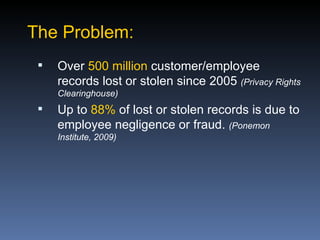
The Problem:
    Over 500 million customer/employee
     records lost or stolen since 2005 (Privacy Rights
     Clearinghouse)
    Up to 88% of lost or stolen records is due to
     employee negligence or fraud. (Ponemon
     Institute, 2009)
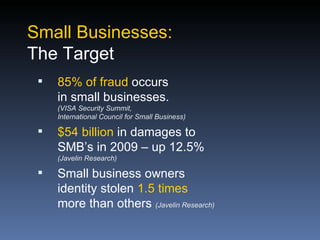
Small Businesses:
The Target
    85% of fraud occurs
     in small businesses.
     (VISA Security Summit,
     International Council for Small Business)

    $54 billion in damages to
     SMB’s in 2009 – up 12.5%
     (Javelin Research)

    Small business owners
     identity stolen 1.5 times
     more than others (Javelin Research)
How it Happens:

   Employees/Insiders
   Hackers/Criminals
How it Happens:


    Viruses, spyware, keyloggers
    Social engineering, phishing
    Computer hi-jacking
    “Dumpster-divers”
What’s at Stake?
Devastating consequences
   with a data breach!
Lost CUSTOMERS
       Lost trust and loyalty
       After a data breach:
          40% will consider ending the
          relationship
          20% will no longer do business
          with you
          5% are considering legal action
    (CIO Magazine)
Damaged IMAGE
   Your personal and
    business reputation is at
    stake
Stolen Money
   Global cyber-crime rings
    stealing money directly
    from business bank
    accounts
Recovery COSTS
   Disruption of business
   Financial damages
   Customer reparations
   Restore image
BUSINESSES now bear the
biggest liability and the greatest
 financial risk from identity theft
             and fraud
Major Federal Laws
      Red Flags Rule
      Applies to anyone who arranges for or extends credit
      or payment terms, or who provides products or
      services and bills or invoices the customer.

      GLBA (Gramm-Leach-Bliley Act)
      Applies to any business or organization that handles
      personal financial related information (such as banks,
      insurance/securities agencies, lenders, accountants & tax
      preparers, real estate professionals, and others).

      HIPAA / HI-TECH (Health Insurance Portability and
      Accountability Act)
      Applies to anyone who handles personal health
      information and health insurance information - as well as
      those who service or support healthcare organizations.
State Laws

       48 states now have one or more laws
       that hold businesses responsible for
       protecting the customer information
       they collect.

       State laws are also interstate laws.
       Businesses typically must comply with
       laws in states where any of their
       customers reside.
State Laws


         Nevada State Law
         ( NRS 603A.010 Breach Notification Law)
Industry Regulations

        PCI Compliance (Payment Card Industry)
        Applies to anyone who accepts credit cards


        Enforced by the PCI Standards Council
        and all merchant banks that handle card
        processing
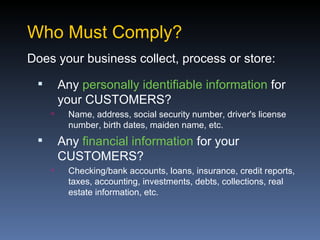
Who Must Comply?
Does your business collect, process or store:

        Any personally identifiable information for
         your CUSTOMERS?
          Name, address, social security number, driver's license
           number, birth dates, maiden name, etc.
        Any financial information for your
         CUSTOMERS?
          Checking/bank accounts, loans, insurance, credit reports,
           taxes, accounting, investments, debts, collections, real
           estate information, etc.
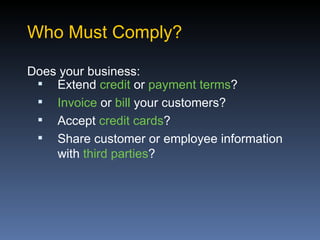
Who Must Comply?

Does your business:
  Extend credit or payment terms?
  Invoice or bill your customers?
  Accept credit cards?
  Share customer or employee information
    with third parties?
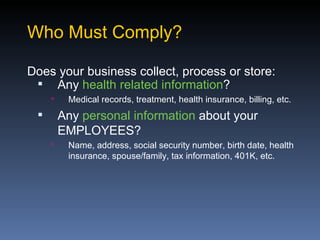
Who Must Comply?

Does your business collect, process or store:
  Any health related information?
         Medical records, treatment, health insurance, billing, etc.
        Any personal information about your
         EMPLOYEES?
         Name, address, social security number, birth date, health
          insurance, spouse/family, tax information, 401K, etc.
If you answered “YES” to any of these
            questions –

 …You are held liable under one or
more federal and state law or industry
             regulation.
Fines, Penalties, Liabilities…
Payment Card Industry (PCI)
   High transaction fees
   $10,000 fine on first violation
   Account termination
Civil or Criminal Action
   Individual and class action lawsuits
   Punitive damages, possible imprisonment for
    reckless or negligent disclosure
Fines, Penalties, Liabilities…
Federal
   Starts at $2,500 - $3,500 fine per record lost or
    stolen
   Up to millions per violation or incident
   Owners and officers can be held personally liable
States
   Fines and penalties ranging from $500 to $5,000
    per record lost or stolen
Non-Compliance Risks:
Fines, Penalties, Liabilities


In the event of a breach…
Heavy fines and penalties for negligence can be
assessed against your business, and owners can be
held personally liable.
Serious Threat…
Serious Consequences…
How to:
  PROTECT your customers,
 employees, and your business.

Get COMPLIANT with all the laws
       and regulations.
“Reasonableness” Standard

          (It doesn’t have to be
        complex and expensive…)

“In our investigations, we look at the overall
security the firm has implemented and its
reasonableness… I emphasize that the
standard is “reasonableness”, not perfection.”
(FTC Chairman, Deborah Platt Majoras)
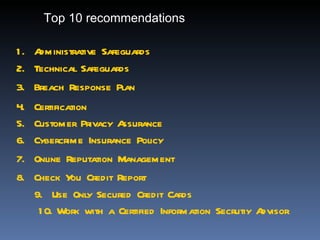
Top 10 recommendations

1. Administrative Safeguards
2. Technical Safeguards
3. Breach Response Plan
4.   Certification
5.   Customer Privacy A ssurance
6.   Cybercrime Insurance Policy
7.   Online Reputation Management
8.   Check Y Credit Report
              ou
     9. Use Only Secured Credit Cards
      1 0. Work with a Certified Information Secrutiy Advisor
Protection & Compliance


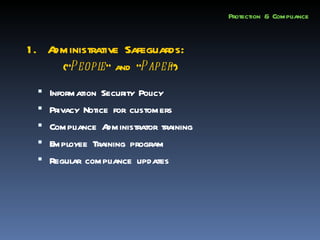
1. Administrative Safeguards:
      (“P eopl and “P aper”)
             e”
  Information Security Policy
  Privacy Notice for customers
  Compliance A dministrator training
  Employee Training program
  Regular compliance updates
Protection & Compliance


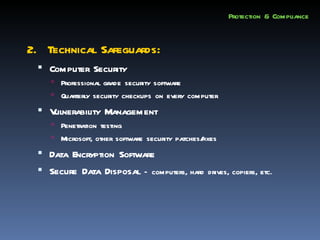
2. Technical Safeguards:
  Computer Security
     Professional grade security software
     Quarterly security checkups on every computer

  Vulnerability Management
     Penetration testing
     Microsoft, other software security patches/
                                                fixes
  Data Encryption Software
  Secure Data Disposal – computers, hard drives, copiers, etc.
Protection & Compliance


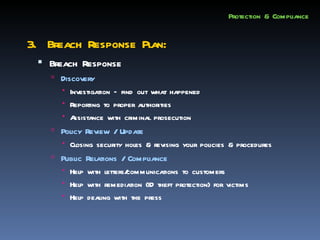
3. Breach Response Plan:
  Breach Response
     Discovery
       Investigation – find out what happened
       Reporting to proper authorities
       A ssistance with criminal prosecution
     Policy Review / Update
        Closing security holes & revising your policies & procedures
     Public Relations / Compliance
       Help with letters/
                         communications to customers
       Help with remediation (ID theft protection) for victims
       Help dealing with the press
Protection & Compliance


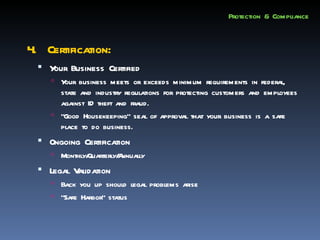
4. Certification:
   Y Business Certified
     our
      Y business meets or exceeds minimum requirements in federal,
        our
       state and industry regulations for protecting customers and employees
       against ID theft and fraud.
      “Good Housekeeping” seal of approval that your business is a safe
       place to do business.
   Ongoing Certification
      Monthly/
              Quarterly/ nnually
                       A
   Legal Validation
      Back you up should legal problems arise
      “Safe Harbor” status
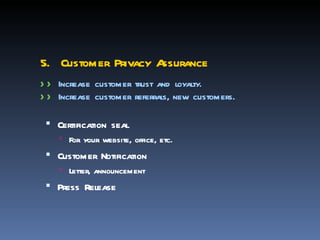
5. Customer Privacy Assurance
> > Increase customer trust and loyalty.
> > Increase customer referrals, new customers.

  Certification seal
     For your website, office, etc.
  Customer Notification
     Letter, announcement
  Press Release
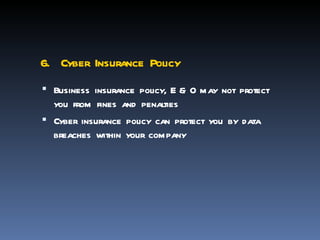
6. Cyber Insurance Policy
 Business insurance policy, E & O may not protect
  you from fines and penalties
 Cyber insurance policy can protect you by data
  breaches within your company
7. Online Reputation Management:
 Online social media networking protection
 Creating good press about your name and business
 Press Releases
 Moving bad press to the back on search engines
8. Check Y Credit Report
          ou
 Check your credit report 4 times a year
 A your young family members
   lso
9. Use Secured Credit Cards
 Avoid using credit cards with the WiFi sign on the
  back of the card.
 Have your bank reissue a new card.
1 0. Work with a CISA consultant
  Certified Information System Advisor
For more information on upcoming
   seminars on compliance and
regulations protection contact us at
          702-868-0808
   MJ Computer Concepts Inc.


   Thank you!

Powerpoint mack jackson

  • 1.
    Protecting Your Business from the Single Greatest Threat of the 21st Century Presented by: Mack Jackson MJ Computer Concepts Inc.
  • 2.
    Identity Theft  Is the fastest growing crime of the 21st century  Something few people know about, and even fewer know what to do about it  It directly affects you, your customers and your employees  There are new federal, state and industry regulations that require you to take action
  • 3.
    Knowledge is Power  Protect your business – and keep out of legal trouble  Gain the trust, loyalty of your customers  Protect your employees  Set yourself apart from your competitors
  • 4.
    Digital Connected World • Computers, Internet, smart phones • Amazing technologies, opportunities • Exciting age of information and communication
  • 5.
    With the amazing technology, comesthe bad people…  The “Cyber Criminal”  Crooks have adapted  The new threats we face are devastating  The unprepared and complacent are being victimized
  • 6.
    The Crime: Identity Theftand Fraud Personal Financial Medical Criminal
  • 7.
    Identity Theft and Fraud  Confidential information is the new currency of thieves  Sophisticated under ground market for stolen personal and financial information  Old school theft  Today’s Cyber Criminal  Doctor’s Office  Family Members
  • 8.
    Why should yoube concerned as a business owner or manager?
  • 9.
    Businesses: The main sourceof stolen identities, cyber-crime and fraud in America.
  • 10.
    The Problem: Exposure, Loss orTheft of…  Customer information  Employee information  Business information  Financial information Photo Copiers NY Cyber Ring Bust
  • 11.
    The Problem:  Over 500 million customer/employee records lost or stolen since 2005 (Privacy Rights Clearinghouse)  Up to 88% of lost or stolen records is due to employee negligence or fraud. (Ponemon Institute, 2009)
  • 12.
    Small Businesses: The Target  85% of fraud occurs in small businesses. (VISA Security Summit, International Council for Small Business)  $54 billion in damages to SMB’s in 2009 – up 12.5% (Javelin Research)  Small business owners identity stolen 1.5 times more than others (Javelin Research)
  • 13.
    How it Happens:  Employees/Insiders  Hackers/Criminals
  • 14.
    How it Happens:  Viruses, spyware, keyloggers  Social engineering, phishing  Computer hi-jacking  “Dumpster-divers”
  • 15.
    What’s at Stake? Devastatingconsequences with a data breach!
  • 16.
    Lost CUSTOMERS  Lost trust and loyalty  After a data breach:  40% will consider ending the relationship  20% will no longer do business with you  5% are considering legal action (CIO Magazine)
  • 17.
    Damaged IMAGE  Your personal and business reputation is at stake
  • 18.
    Stolen Money  Global cyber-crime rings stealing money directly from business bank accounts
  • 19.
    Recovery COSTS  Disruption of business  Financial damages  Customer reparations  Restore image
  • 20.
    BUSINESSES now bearthe biggest liability and the greatest financial risk from identity theft and fraud
  • 21.
    Major Federal Laws Red Flags Rule Applies to anyone who arranges for or extends credit or payment terms, or who provides products or services and bills or invoices the customer. GLBA (Gramm-Leach-Bliley Act) Applies to any business or organization that handles personal financial related information (such as banks, insurance/securities agencies, lenders, accountants & tax preparers, real estate professionals, and others). HIPAA / HI-TECH (Health Insurance Portability and Accountability Act) Applies to anyone who handles personal health information and health insurance information - as well as those who service or support healthcare organizations.
  • 22.
    State Laws 48 states now have one or more laws that hold businesses responsible for protecting the customer information they collect. State laws are also interstate laws. Businesses typically must comply with laws in states where any of their customers reside.
  • 23.
    State Laws Nevada State Law ( NRS 603A.010 Breach Notification Law)
  • 24.
    Industry Regulations PCI Compliance (Payment Card Industry) Applies to anyone who accepts credit cards Enforced by the PCI Standards Council and all merchant banks that handle card processing
  • 25.
    Who Must Comply? Doesyour business collect, process or store:  Any personally identifiable information for your CUSTOMERS?  Name, address, social security number, driver's license number, birth dates, maiden name, etc.  Any financial information for your CUSTOMERS?  Checking/bank accounts, loans, insurance, credit reports, taxes, accounting, investments, debts, collections, real estate information, etc.
  • 26.
    Who Must Comply? Doesyour business:  Extend credit or payment terms?  Invoice or bill your customers?  Accept credit cards?  Share customer or employee information with third parties?
  • 27.
    Who Must Comply? Doesyour business collect, process or store:  Any health related information?  Medical records, treatment, health insurance, billing, etc.  Any personal information about your EMPLOYEES?  Name, address, social security number, birth date, health insurance, spouse/family, tax information, 401K, etc.
  • 28.
    If you answered“YES” to any of these questions – …You are held liable under one or more federal and state law or industry regulation.
  • 29.
    Fines, Penalties, Liabilities… PaymentCard Industry (PCI)  High transaction fees  $10,000 fine on first violation  Account termination Civil or Criminal Action  Individual and class action lawsuits  Punitive damages, possible imprisonment for reckless or negligent disclosure
  • 30.
    Fines, Penalties, Liabilities… Federal  Starts at $2,500 - $3,500 fine per record lost or stolen  Up to millions per violation or incident  Owners and officers can be held personally liable States  Fines and penalties ranging from $500 to $5,000 per record lost or stolen
  • 31.
    Non-Compliance Risks: Fines, Penalties,Liabilities In the event of a breach… Heavy fines and penalties for negligence can be assessed against your business, and owners can be held personally liable.
  • 32.
  • 33.
    How to: PROTECT your customers, employees, and your business. Get COMPLIANT with all the laws and regulations.
  • 34.
    “Reasonableness” Standard (It doesn’t have to be complex and expensive…) “In our investigations, we look at the overall security the firm has implemented and its reasonableness… I emphasize that the standard is “reasonableness”, not perfection.” (FTC Chairman, Deborah Platt Majoras)
  • 35.
    Top 10 recommendations 1.Administrative Safeguards 2. Technical Safeguards 3. Breach Response Plan 4. Certification 5. Customer Privacy A ssurance 6. Cybercrime Insurance Policy 7. Online Reputation Management 8. Check Y Credit Report ou 9. Use Only Secured Credit Cards 1 0. Work with a Certified Information Secrutiy Advisor
  • 36.
    Protection & Compliance 1.Administrative Safeguards: (“P eopl and “P aper”) e”  Information Security Policy  Privacy Notice for customers  Compliance A dministrator training  Employee Training program  Regular compliance updates
  • 37.
    Protection & Compliance 2.Technical Safeguards:  Computer Security  Professional grade security software  Quarterly security checkups on every computer  Vulnerability Management  Penetration testing  Microsoft, other software security patches/ fixes  Data Encryption Software  Secure Data Disposal – computers, hard drives, copiers, etc.
  • 38.
    Protection & Compliance 3.Breach Response Plan:  Breach Response  Discovery  Investigation – find out what happened  Reporting to proper authorities  A ssistance with criminal prosecution  Policy Review / Update  Closing security holes & revising your policies & procedures  Public Relations / Compliance  Help with letters/ communications to customers  Help with remediation (ID theft protection) for victims  Help dealing with the press
  • 39.
    Protection & Compliance 4.Certification:  Y Business Certified our  Y business meets or exceeds minimum requirements in federal, our state and industry regulations for protecting customers and employees against ID theft and fraud.  “Good Housekeeping” seal of approval that your business is a safe place to do business.  Ongoing Certification  Monthly/ Quarterly/ nnually A  Legal Validation  Back you up should legal problems arise  “Safe Harbor” status
  • 40.
    5. Customer PrivacyAssurance > > Increase customer trust and loyalty. > > Increase customer referrals, new customers.  Certification seal  For your website, office, etc.  Customer Notification  Letter, announcement  Press Release
  • 41.
    6. Cyber InsurancePolicy  Business insurance policy, E & O may not protect you from fines and penalties  Cyber insurance policy can protect you by data breaches within your company
  • 42.
    7. Online ReputationManagement:  Online social media networking protection  Creating good press about your name and business  Press Releases  Moving bad press to the back on search engines
  • 43.
    8. Check YCredit Report ou  Check your credit report 4 times a year  A your young family members lso
  • 44.
    9. Use SecuredCredit Cards  Avoid using credit cards with the WiFi sign on the back of the card.  Have your bank reissue a new card.
  • 45.
    1 0. Workwith a CISA consultant  Certified Information System Advisor
  • 46.
    For more informationon upcoming seminars on compliance and regulations protection contact us at 702-868-0808 MJ Computer Concepts Inc. Thank you!

Editor's Notes

  • #2 Over 10 million new victims 1 in 20 Adults Most vulnerable In Nevada 100,000 people How many of you know….. The internet technology bred savvy criminal more then law enforcement
  • #3 We have have all heard of Identity theft in the news. How it has affected the financial well being of countless individuals. Did you know that business owners are liable for stolen records of their customer and employees As a business owner you are responsible for protecting….. Federal laws?
  • #4 As business owners, we can protect ourselves with a little knowledge. Knowledge is power! If you know how to protect yourself, and your company, you fight back against ID T. With this knowledge, you will be a respected business, gain the trust and loyalty of your customers and protect your employees. This information can set your business far apart from your comp.
  • #5 Text more then talk on the phone stat. Friend fell in fountain OMG Nevada cell phone law Judi running stop sign
  • #6 So, who are the cyber criminals? National and Overseas under ground.
  • #7 Medical story – Health insurance usage and drugs Criminal – Bank robbery as your id
  • #9 Speakers are business owners
  • #15 Medical office throw out old patient records
  • #34 Some of you may think these rule are overwhelming. How much it would cost to hire a attorney, chief compliance officer, It director, web manager…. No, it does not.