4

4-1

The Global
Environment

Irwin/McGraw-Hill

©The McGraw-Hill Companies, Inc., 2000
4-2

The Global Environment
In

the past, managers have viewed the
global sector as closed.
Each country or market was assumed to be isolated
from others.
 Firms did not consider global competition, exports.


Today’s

environment is very different.

Managers need to view it as an open market.
 Organizations buy and sell around the world.
 Managers need to learn to compete globally.


Irwin/McGraw-Hill

©The McGraw-Hill Companies, Inc., 2000
4-3

Tariff Barriers
A





tariff is a barriers to trade.

Tariffs are taxes levied upon imports.
These seek to protect jobs in the home
country.
Other countries usually retaliate.

Free

trade: in a free trade
agreement, each country seeks
to specialize in things they
make most efficiently.


If India is more efficient in making
textiles, and the USA in making
computer software, then each country
should focus on these.

Irwin/McGraw-Hill

©The McGraw-Hill Companies, Inc., 2000
4-4

Distance & Culture Barriers
The





second leading cause of trade barriers.

Distance closed the markets as far as some managers
were concerned.
Communications could be difficult.
Languages and cultures were different.

During

the last 50 years, communications
and transportation technology has
dramatically improved.




Jet aircraft, fiber optics, satellites have provided fast,
secure communications and transportation.
These have also reduced cultural differences.

Irwin/McGraw-Hill

©The McGraw-Hill Companies, Inc., 2000
4-5

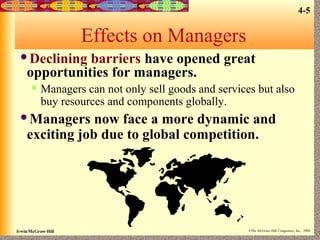
Effects on Managers
Declining

barriers have opened great
opportunities for managers.


Managers can not only sell goods and services but also
buy resources and components globally.

Managers

now face a more dynamic and
exciting job due to global competition.

Irwin/McGraw-Hill

©The McGraw-Hill Companies, Inc., 2000
4-6

Free Trade
NAFTA: North American Free Trade
Agreement.





Abolishes most tariffs on goods traded between
Mexico, Canada and the U.S.
Allows unrestricted cross-border flows of resources.
Many U.S. firms have now invested in Mexico.

This



is a manufacturing opportunity.

Wage costs are lower in Mexico.
Can serve Mexico with a plant in Mexico and reduce
freight.

Managers

threats.

Irwin/McGraw-Hill

face new opportunities and

©The McGraw-Hill Companies, Inc., 2000
4-7

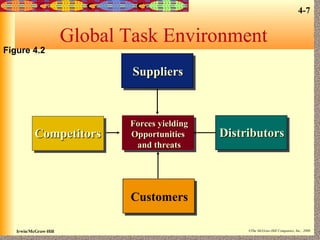
Figure 4.2

Global Task Environment
Suppliers

Competitors

Forces yielding
Opportunities
and threats

Distributors

Customers
Irwin/McGraw-Hill

©The McGraw-Hill Companies, Inc., 2000
4-8

Suppliers & Distributors
Managers

buy products from global
suppliers or make items abroad and supply
themselves.


Key is to keep quality high and costs low.

Global

outsourcing: firms buy inputs from
throughout the world.




GM might build engines in Mexico, transmissions in
Korea, and seats in the U.S.
Finished goods become global products.

Distributors:

each country often has a unique
system of distribution.
Managers must identify all the issues.

Irwin/McGraw-Hill



©The McGraw-Hill Companies, Inc., 2000
4-9

Customers & Competitors
Formerly

distinct national markets are
merging into a huge global market.



True for both consumer and business goods.
Creates large opportunities.

Still,

managers often must customize
products to fit the culture.


McDonald's sells a local soft drink in Brazil.

Global


competitors present new threats.

Increases competition abroad as well as at home.

Irwin/McGraw-Hill

©The McGraw-Hill Companies, Inc., 2000
4-10

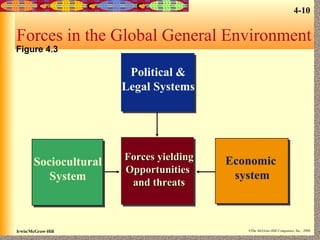
Forces in the Global General Environment

Figure 4.3

Political &
Legal Systems

Sociocultural
System

Irwin/McGraw-Hill

Forces yielding
Opportunities
and threats

Economic
system

©The McGraw-Hill Companies, Inc., 2000
4-11

Political-Legal Forces
Results

from diverse and changing nature
of each countries’ political system.
Representative democracies: such as the
U.S., Britain, Canada.






Citizens elect leaders who make decisions for
electorate.
Usually has a number of safeguards such as freedom
of expression, a fair court system, regular elections,
and limited terms for officials.
Well defined legal system and economic freedom.

Irwin/McGraw-Hill

©The McGraw-Hill Companies, Inc., 2000
4-12

Totalitarian

regimes: a single political party
or person monopolize power in a country.




Typically do not recognize or permit opposition.
Most safeguards found in a democracy do not exist.
Examples include Iran, Iraq, and China.

These

are difficult to do business with given
the lack of economic freedom.

Further,

human rights issues also cause
managers to avoid dealing with these
countries.

Irwin/McGraw-Hill

©The McGraw-Hill Companies, Inc., 2000
4-13

Economic Systems
Free

market economy: production of goods
and services is in private ownership.


Production is dictated by supply and demand.

Command

economy: decisions on what to
produce, how much, done by the government.


Most command economies are moving away from the
command economy.

Mixed

economy: certain economic sectors
controlled by private business, others are
government controlled.


Many mixed countries are moving toward a free
enterprise system.

Irwin/McGraw-Hill

©The McGraw-Hill Companies, Inc., 2000
4-14

Recent Trends
Current

shift away from totalitarian
dictators toward democratic regimes.




Very dramatic example seen in the collapse of the former
Soviet Republic.
Also very pronounced in Latin America and Africa.

With

this shift, has come a strong movement
toward free market systems.




This provides great opportunities to business managers
on a global level.
Many businesses are investing millions in former
totalitarian countries to seize these opportunities.

Irwin/McGraw-Hill

©The McGraw-Hill Companies, Inc., 2000
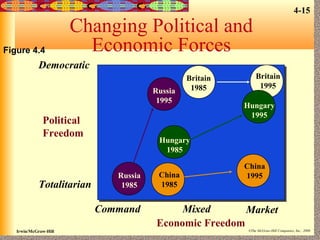
Figure 4.4

4-15

Changing Political and
Economic Forces

Democratic
Russia
1995

Political
Freedom

Totalitarian

Britain
1995
Hungary
1995

Hungary
1985
Russia
1985

Command
Irwin/McGraw-Hill

Britain
1985

China
1985

China
1995

Mixed
Market
Economic Freedom
©The McGraw-Hill Companies, Inc., 2000
4-16

Sociocultural Forces
National

culture: includes the values,
norms, knowledge, beliefs, and other
practices that unite a country.
Values: abstract ideas about what a
society believes to be good, desirable and
beautiful.




Provides attitudes for democracy, truth, appropriate
roles for men, and women.
Usually not static but very slow to change.

Irwin/McGraw-Hill

©The McGraw-Hill Companies, Inc., 2000
4-17

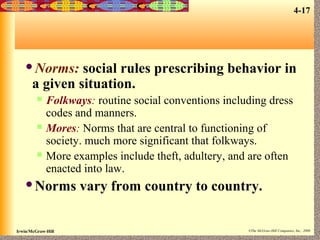
Norms:

social rules prescribing behavior in
a given situation.






Folkways: routine social conventions including dress
codes and manners.
Mores: Norms that are central to functioning of
society. much more significant that folkways.
More examples include theft, adultery, and are often
enacted into law.

Norms

Irwin/McGraw-Hill

vary from country to country.
©The McGraw-Hill Companies, Inc., 2000
4-18

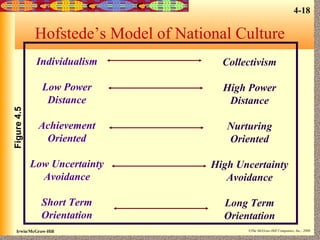
Hofstede’s Model of National Culture
Collectivism

Low Power
Distance

High Power
Distance

Achievement
Oriented

Nurturing
Oriented

Low Uncertainty
Avoidance

High Uncertainty
Avoidance

Short Term
Orientation

Figure 4.5

Individualism

Long Term
Orientation

Irwin/McGraw-Hill

©The McGraw-Hill Companies, Inc., 2000
4-19

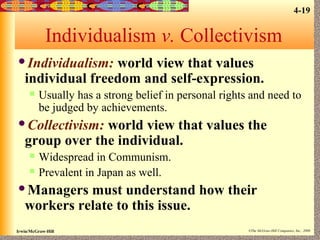
Individualism v. Collectivism
Individualism:

world view that values
individual freedom and self-expression.


Usually has a strong belief in personal rights and need to
be judged by achievements.

Collectivism:

world view that values the
group over the individual.



Widespread in Communism.
Prevalent in Japan as well.

Managers

must understand how their
workers relate to this issue.

Irwin/McGraw-Hill

©The McGraw-Hill Companies, Inc., 2000
4-20

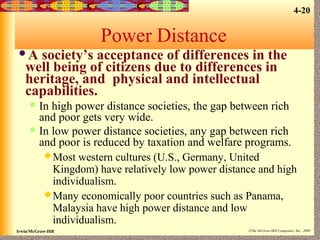
Power Distance
A

society’s acceptance of differences in the
well being of citizens due to differences in
heritage, and physical and intellectual
capabilities.



In high power distance societies, the gap between rich
and poor gets very wide.
In low power distance societies, any gap between rich
and poor is reduced by taxation and welfare programs.
 Most western cultures (U.S., Germany, United
Kingdom) have relatively low power distance and high
individualism.
 Many economically poor countries such as Panama,
Malaysia have high power distance and low
individualism.

Irwin/McGraw-Hill

©The McGraw-Hill Companies, Inc., 2000
4-21

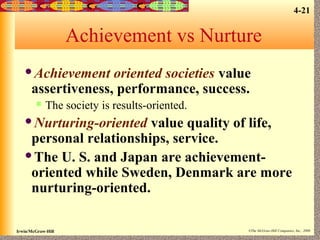
Achievement vs Nurture
Achievement

oriented societies value
assertiveness, performance, success.


The society is results-oriented.

Nurturing-oriented

value quality of life,
personal relationships, service.
The U. S. and Japan are achievementoriented while Sweden, Denmark are more
nurturing-oriented.
Irwin/McGraw-Hill

©The McGraw-Hill Companies, Inc., 2000
4-22

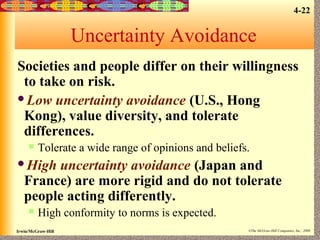
Uncertainty Avoidance
Societies and people differ on their willingness
to take on risk.
Low uncertainty avoidance (U.S., Hong
Kong), value diversity, and tolerate
differences.


Tolerate a wide range of opinions and beliefs.

High

uncertainty avoidance (Japan and
France) are more rigid and do not tolerate
people acting differently.


High conformity to norms is expected.

Irwin/McGraw-Hill

©The McGraw-Hill Companies, Inc., 2000
4-23

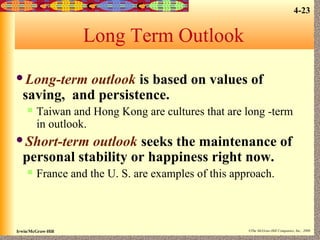
Long Term Outlook
Long-term

outlook is based on values of
saving, and persistence.


Taiwan and Hong Kong are cultures that are long -term
in outlook.

Short-term

outlook seeks the maintenance of
personal stability or happiness right now.


France and the U. S. are examples of this approach.

Irwin/McGraw-Hill

©The McGraw-Hill Companies, Inc., 2000
4-24

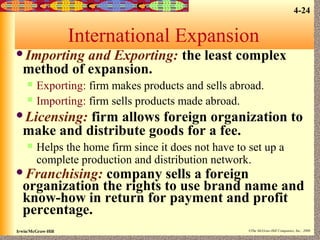
International Expansion
Importing

and Exporting: the least complex
method of expansion.



Exporting: firm makes products and sells abroad.
Importing: firm sells products made abroad.

Licensing:

firm allows foreign organization to
make and distribute goods for a fee.


Helps the home firm since it does not have to set up a
complete production and distribution network.

Franchising:

company sells a foreign
organization the rights to use brand name and
know-how in return for payment and profit
percentage.

Irwin/McGraw-Hill

©The McGraw-Hill Companies, Inc., 2000
4-25

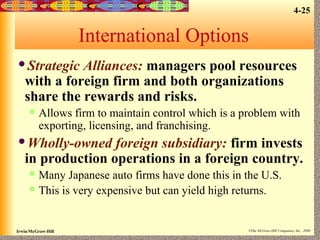
International Options
Strategic

Alliances: managers pool resources
with a foreign firm and both organizations
share the rewards and risks.


Allows firm to maintain control which is a problem with
exporting, licensing, and franchising.

Wholly-owned

foreign subsidiary: firm invests
in production operations in a foreign country.



Many Japanese auto firms have done this in the U.S.
This is very expensive but can yield high returns.

Irwin/McGraw-Hill

©The McGraw-Hill Companies, Inc., 2000
4-26

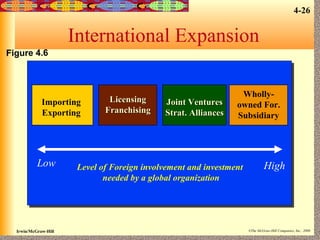
International Expansion
Figure 4.6

Importing
Exporting

Low

Irwin/McGraw-Hill

Licensing
Franchising

Joint Ventures
Strat. Alliances

Whollyowned For.
Subsidiary

Level of Foreign involvement and investment
needed by a global organization

High

©The McGraw-Hill Companies, Inc., 2000

Global Environment

  • 1.
  • 2.
    4-2 The Global Environment In thepast, managers have viewed the global sector as closed. Each country or market was assumed to be isolated from others.  Firms did not consider global competition, exports.  Today’s environment is very different. Managers need to view it as an open market.  Organizations buy and sell around the world.  Managers need to learn to compete globally.  Irwin/McGraw-Hill ©The McGraw-Hill Companies, Inc., 2000
  • 3.
    4-3 Tariff Barriers A    tariff isa barriers to trade. Tariffs are taxes levied upon imports. These seek to protect jobs in the home country. Other countries usually retaliate. Free trade: in a free trade agreement, each country seeks to specialize in things they make most efficiently.  If India is more efficient in making textiles, and the USA in making computer software, then each country should focus on these. Irwin/McGraw-Hill ©The McGraw-Hill Companies, Inc., 2000
  • 4.
    4-4 Distance & CultureBarriers The    second leading cause of trade barriers. Distance closed the markets as far as some managers were concerned. Communications could be difficult. Languages and cultures were different. During the last 50 years, communications and transportation technology has dramatically improved.   Jet aircraft, fiber optics, satellites have provided fast, secure communications and transportation. These have also reduced cultural differences. Irwin/McGraw-Hill ©The McGraw-Hill Companies, Inc., 2000
  • 5.
    4-5 Effects on Managers Declining barriershave opened great opportunities for managers.  Managers can not only sell goods and services but also buy resources and components globally. Managers now face a more dynamic and exciting job due to global competition. Irwin/McGraw-Hill ©The McGraw-Hill Companies, Inc., 2000
  • 6.
    4-6 Free Trade NAFTA: NorthAmerican Free Trade Agreement.    Abolishes most tariffs on goods traded between Mexico, Canada and the U.S. Allows unrestricted cross-border flows of resources. Many U.S. firms have now invested in Mexico. This   is a manufacturing opportunity. Wage costs are lower in Mexico. Can serve Mexico with a plant in Mexico and reduce freight. Managers threats. Irwin/McGraw-Hill face new opportunities and ©The McGraw-Hill Companies, Inc., 2000
  • 7.
    4-7 Figure 4.2 Global TaskEnvironment Suppliers Competitors Forces yielding Opportunities and threats Distributors Customers Irwin/McGraw-Hill ©The McGraw-Hill Companies, Inc., 2000
  • 8.
    4-8 Suppliers & Distributors Managers buyproducts from global suppliers or make items abroad and supply themselves.  Key is to keep quality high and costs low. Global outsourcing: firms buy inputs from throughout the world.   GM might build engines in Mexico, transmissions in Korea, and seats in the U.S. Finished goods become global products. Distributors: each country often has a unique system of distribution. Managers must identify all the issues. Irwin/McGraw-Hill  ©The McGraw-Hill Companies, Inc., 2000
  • 9.
    4-9 Customers & Competitors Formerly distinctnational markets are merging into a huge global market.   True for both consumer and business goods. Creates large opportunities. Still, managers often must customize products to fit the culture.  McDonald's sells a local soft drink in Brazil. Global  competitors present new threats. Increases competition abroad as well as at home. Irwin/McGraw-Hill ©The McGraw-Hill Companies, Inc., 2000
  • 10.
    4-10 Forces in theGlobal General Environment Figure 4.3 Political & Legal Systems Sociocultural System Irwin/McGraw-Hill Forces yielding Opportunities and threats Economic system ©The McGraw-Hill Companies, Inc., 2000
  • 11.
    4-11 Political-Legal Forces Results from diverseand changing nature of each countries’ political system. Representative democracies: such as the U.S., Britain, Canada.    Citizens elect leaders who make decisions for electorate. Usually has a number of safeguards such as freedom of expression, a fair court system, regular elections, and limited terms for officials. Well defined legal system and economic freedom. Irwin/McGraw-Hill ©The McGraw-Hill Companies, Inc., 2000
  • 12.
    4-12 Totalitarian regimes: a singlepolitical party or person monopolize power in a country.    Typically do not recognize or permit opposition. Most safeguards found in a democracy do not exist. Examples include Iran, Iraq, and China. These are difficult to do business with given the lack of economic freedom. Further, human rights issues also cause managers to avoid dealing with these countries. Irwin/McGraw-Hill ©The McGraw-Hill Companies, Inc., 2000
  • 13.
    4-13 Economic Systems Free market economy:production of goods and services is in private ownership.  Production is dictated by supply and demand. Command economy: decisions on what to produce, how much, done by the government.  Most command economies are moving away from the command economy. Mixed economy: certain economic sectors controlled by private business, others are government controlled.  Many mixed countries are moving toward a free enterprise system. Irwin/McGraw-Hill ©The McGraw-Hill Companies, Inc., 2000
  • 14.
    4-14 Recent Trends Current shift awayfrom totalitarian dictators toward democratic regimes.   Very dramatic example seen in the collapse of the former Soviet Republic. Also very pronounced in Latin America and Africa. With this shift, has come a strong movement toward free market systems.   This provides great opportunities to business managers on a global level. Many businesses are investing millions in former totalitarian countries to seize these opportunities. Irwin/McGraw-Hill ©The McGraw-Hill Companies, Inc., 2000
  • 15.
    Figure 4.4 4-15 Changing Politicaland Economic Forces Democratic Russia 1995 Political Freedom Totalitarian Britain 1995 Hungary 1995 Hungary 1985 Russia 1985 Command Irwin/McGraw-Hill Britain 1985 China 1985 China 1995 Mixed Market Economic Freedom ©The McGraw-Hill Companies, Inc., 2000
  • 16.
    4-16 Sociocultural Forces National culture: includesthe values, norms, knowledge, beliefs, and other practices that unite a country. Values: abstract ideas about what a society believes to be good, desirable and beautiful.   Provides attitudes for democracy, truth, appropriate roles for men, and women. Usually not static but very slow to change. Irwin/McGraw-Hill ©The McGraw-Hill Companies, Inc., 2000
  • 17.
    4-17 Norms: social rules prescribingbehavior in a given situation.    Folkways: routine social conventions including dress codes and manners. Mores: Norms that are central to functioning of society. much more significant that folkways. More examples include theft, adultery, and are often enacted into law. Norms Irwin/McGraw-Hill vary from country to country. ©The McGraw-Hill Companies, Inc., 2000
  • 18.
    4-18 Hofstede’s Model ofNational Culture Collectivism Low Power Distance High Power Distance Achievement Oriented Nurturing Oriented Low Uncertainty Avoidance High Uncertainty Avoidance Short Term Orientation Figure 4.5 Individualism Long Term Orientation Irwin/McGraw-Hill ©The McGraw-Hill Companies, Inc., 2000
  • 19.
    4-19 Individualism v. Collectivism Individualism: worldview that values individual freedom and self-expression.  Usually has a strong belief in personal rights and need to be judged by achievements. Collectivism: world view that values the group over the individual.   Widespread in Communism. Prevalent in Japan as well. Managers must understand how their workers relate to this issue. Irwin/McGraw-Hill ©The McGraw-Hill Companies, Inc., 2000
  • 20.
    4-20 Power Distance A society’s acceptanceof differences in the well being of citizens due to differences in heritage, and physical and intellectual capabilities.   In high power distance societies, the gap between rich and poor gets very wide. In low power distance societies, any gap between rich and poor is reduced by taxation and welfare programs.  Most western cultures (U.S., Germany, United Kingdom) have relatively low power distance and high individualism.  Many economically poor countries such as Panama, Malaysia have high power distance and low individualism. Irwin/McGraw-Hill ©The McGraw-Hill Companies, Inc., 2000
  • 21.
    4-21 Achievement vs Nurture Achievement orientedsocieties value assertiveness, performance, success.  The society is results-oriented. Nurturing-oriented value quality of life, personal relationships, service. The U. S. and Japan are achievementoriented while Sweden, Denmark are more nurturing-oriented. Irwin/McGraw-Hill ©The McGraw-Hill Companies, Inc., 2000
  • 22.
    4-22 Uncertainty Avoidance Societies andpeople differ on their willingness to take on risk. Low uncertainty avoidance (U.S., Hong Kong), value diversity, and tolerate differences.  Tolerate a wide range of opinions and beliefs. High uncertainty avoidance (Japan and France) are more rigid and do not tolerate people acting differently.  High conformity to norms is expected. Irwin/McGraw-Hill ©The McGraw-Hill Companies, Inc., 2000
  • 23.
    4-23 Long Term Outlook Long-term outlookis based on values of saving, and persistence.  Taiwan and Hong Kong are cultures that are long -term in outlook. Short-term outlook seeks the maintenance of personal stability or happiness right now.  France and the U. S. are examples of this approach. Irwin/McGraw-Hill ©The McGraw-Hill Companies, Inc., 2000
  • 24.
    4-24 International Expansion Importing and Exporting:the least complex method of expansion.   Exporting: firm makes products and sells abroad. Importing: firm sells products made abroad. Licensing: firm allows foreign organization to make and distribute goods for a fee.  Helps the home firm since it does not have to set up a complete production and distribution network. Franchising: company sells a foreign organization the rights to use brand name and know-how in return for payment and profit percentage. Irwin/McGraw-Hill ©The McGraw-Hill Companies, Inc., 2000
  • 25.
    4-25 International Options Strategic Alliances: managerspool resources with a foreign firm and both organizations share the rewards and risks.  Allows firm to maintain control which is a problem with exporting, licensing, and franchising. Wholly-owned foreign subsidiary: firm invests in production operations in a foreign country.   Many Japanese auto firms have done this in the U.S. This is very expensive but can yield high returns. Irwin/McGraw-Hill ©The McGraw-Hill Companies, Inc., 2000
  • 26.
    4-26 International Expansion Figure 4.6 Importing Exporting Low Irwin/McGraw-Hill Licensing Franchising JointVentures Strat. Alliances Whollyowned For. Subsidiary Level of Foreign involvement and investment needed by a global organization High ©The McGraw-Hill Companies, Inc., 2000