Vikas Sharma, PMP®
Principal Consultant
Public Sector & Government Practice
Global Developments in
Food Safety and Resource Efficiency
1
- Developed For -
Public Sector & Government Practice
Frost & Sullivan Asia Pacific
Introduction to Frost & Sullivan
Beijing
Tokyo
Toronto Frankfurt
New York
San Antonio
Shanghai
Paris
London
Milan
Warsaw
Dubai
Seoul
Delhi
Tel Aviv
2
Bangkok
Kuala Lumpur
Singapore
Jakarta
Mumbai
Shanghai
Sao Paulo
Buenos Aires
Sydney
Dubai
Mexico City
Cape Town
Bangalore
Delhi
Chennai
Bogota
Calcutta
Mebourne
Introduction to Frost & Sullivan
Aerospace & Defense
Automotive & Transportation
Chemicals, Materials & Food
MarketEngineeringResearch
EconomicResearch&Analysis
TechnicalInsights
FinancialBenchmarking&Analysis
CustomerResearch
GrowthWorkshops
ExecutiveSummitEvents
CorporateTraining
GrowthConsulting
Industry Practices Service Offerings
Electronics & Security
Consumer Technologies
3
Energy & Power Systems
Environmental & Building
Technologies
Healthcare
Industrial Automation &
Electronics
Information & Communication
Technologies
MarketEngineeringResearch
EconomicResearch&Analysis
TechnicalInsights
FinancialBenchmarking&Analysis
CustomerResearch
GrowthWorkshops
ExecutiveSummitEvents
CorporateTraining
GrowthConsulting
Measurement & Instrumentation
Minerals & Mining
Introduction to Frost & Sullivan
Frost & Sullivan
Public Sector & Government
Regulators
Industry
Development
Bodies
ExportPromotion
Bodies
4
Public Sector & Government
Practice
Multi-Lateral
Organizations
IndustryCorridor
Planners
Universities &
Centers of
Excellence
Implementation
agencies for
government
programs
2
Presentation Agenda
1
2
1 Introduction
3
Global Developments in Food Safety
Global Developments in Resource Efficiency
5
Introduction:
Importance of Accreditation in Today’s Global Market
Did the certification process add value?Importance of accredited certification
30%
40%
50%
40%
50%
6
0%
10%
20%
30%
0%
10%
20%
30%
Strongly
Agree
Agree Neutral Disagree Strongly
Disagree
Do Not
Know
Introduction:
Key Stakeholders Served by Accreditation
Government
RegulatorsConsumers
Served by
Accreditation
Regulators
BusinessesManufacturers
Consumers
7
Introduction:
The Global Context
Interamerican
Accreditation Cooperation
European Cooperation for
Accreditation
8
Pacific Accreditation
Cooperation
South African National
Accreditation System
Introduction:
The Global Context
9
Global Developments in Food Safety:
A High Priority Concern
Area of Concern Ranking 2011 Ranking 2010 Ranking 2009
Corporate
Responsibility
1 2 3
Food Safety remains a high priority concern for food retailers and
manufacturers
10
Food Safety 2 4 2
Economy and
Consumer Demand
3 1 1
Consumer Health and
Nutrition
4 7 7
Retailer Supplier
Relations
5 5 5
Global Developments in Food Safety:
A High Priority Concern
Consumer trust needs to be strengthened and maintained
11
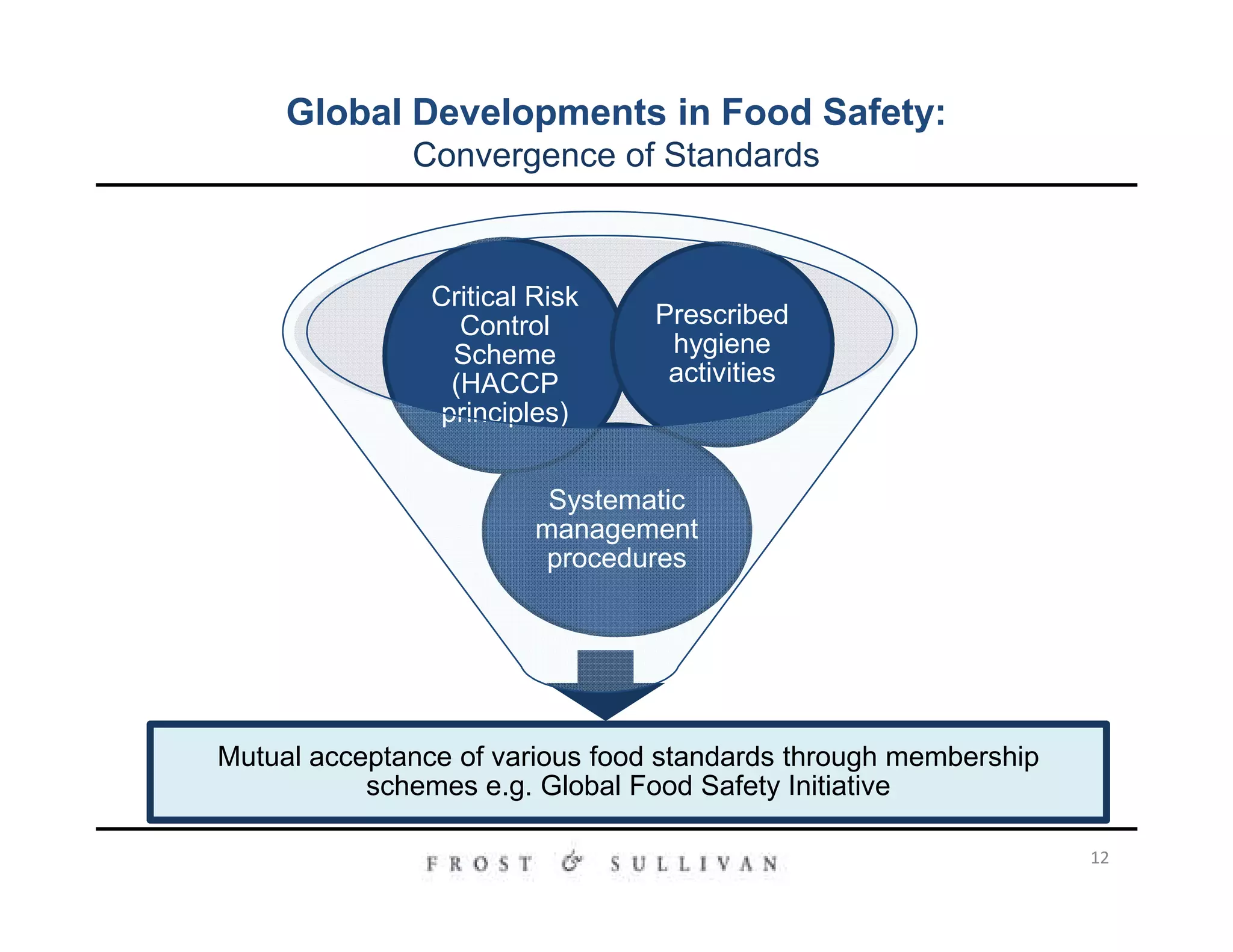
Global Developments in Food Safety:
Convergence of Standards
Critical Risk
Control
Scheme
(HACCP
principles)
Prescribed
hygiene
activities
12
Mutual acceptance of various food standards through membership
schemes e.g. Global Food Safety Initiative
Systematic
management
procedures
• Changes to British Retail Consortium
(BRC) Global Standard for Food Safety
- Reduced need for multiple customer audits
-New auditor training to ensure consistent BRC
audit approach
Trend away from multi-
level certification within
one standard:
Trend away from multi-
level certification within
one standard:
Global Developments in Food Safety:
Convergence of Standards
13
• International Food Standard (IFS) and
Safe Quality Food (SQF)
• GlobalGAP and Safe Quality Food (SQF)
Collaboration agreements
between international
food safety standards
Collaboration agreements
between international
food safety standards
Introducing
internationally
recognized
standards
Facilitating
independent
and transparent
wideWorld-wide
supply chains
meeting
common/
Global Developments in Food Safety:
Convergence of Standards
14
Cooperative
approach of
private
standards
Cooperative
approach of
private
standards
and transparent
auditing
Maintaining
consumer
confidence
Reducing costs
and liabilities
common/
minimum
standards
Global Developments in Resource Efficiency:
Energy Efficiency Standards
ISO
9001
ISO 50001 Energy Management System
Recognized framework for integrating energy
performance into management processes
Promote energy best practices
15
ISO
50001
ISO
4001Facilitate energy management
improvements
Implementation of new energy-
efficient technologies
Global Developments in Resource Efficiency:
Energy Efficiency Standards
Early adopters of ISO 50001 have reported significant benefits
- Achieve 10% energy conservation
- Savings of estimated 55M kWh of electricity
- Reduce carbon emissions by 35,000 tons
16
- Reduction of 10,200 tons of carbon emissions
- Savings of RMB 8M within 5 months
- Energy efficiency as criteria in selection of suppliers
- Easily adapted to existing EN 16001 implementation
Global Developments in Resource Efficiency:
Water Efficiency Standards
The Energy-Water Efficiency Nexus
• It has been estimated that globally, seven percent of
all energy is used to deliver water
• Energy is also an input in water treatment
17
• There is a move towards linking water utilities
services standards with ISO 50001
• ISO 24510 – “Activities relating to drinking water and
wastewater services — Guidelines for the
assessment and for the improvement of the service
to users”
Global Developments in Resource Efficiency:
Water Efficiency Schemes in Other Countries
• U.K.: Water Supply Regulations (mandatory):
WC suite performance specifications; BMA
Water Efficiency Labelling Scheme (voluntary)
• Germany: The Blue Angel (voluntary label)
• Europe: The Europe Eco-Label (voluntary label)
18
• Europe: The Europe Eco-Label (voluntary label)
• Australia: Australian WELS (mandatory label)
• U.S.: WaterSense (voluntary label), Energy Star
(voluntary label)
• Japan: Japan Eco Mark (voluntary label)
Frost & Sullivan
Frost & Sullivan, the Growth Partnership Company, enables clients to accelerate growth and achieve best in class positions in growth, innovation
and leadership. The company's Growth Partnership Service provides the CEO and the CEO's Growth Team with disciplined research and best
practice models to drive the generation, evaluation and implementation of powerful growth strategies. Frost & Sullivan leverages over 45 years of
experience in partnering with Global 1000 companies, emerging businesses and the investment community from more than 35 offices on six
continents.
To join our Growth Partnership, please visit http://www.frost.com.

Global Developments in Food Safety and Resource Efficiency

  • 1.
    Vikas Sharma, PMP® PrincipalConsultant Public Sector & Government Practice Global Developments in Food Safety and Resource Efficiency 1 - Developed For - Public Sector & Government Practice Frost & Sullivan Asia Pacific
  • 2.
    Introduction to Frost& Sullivan Beijing Tokyo Toronto Frankfurt New York San Antonio Shanghai Paris London Milan Warsaw Dubai Seoul Delhi Tel Aviv 2 Bangkok Kuala Lumpur Singapore Jakarta Mumbai Shanghai Sao Paulo Buenos Aires Sydney Dubai Mexico City Cape Town Bangalore Delhi Chennai Bogota Calcutta Mebourne
  • 3.
    Introduction to Frost& Sullivan Aerospace & Defense Automotive & Transportation Chemicals, Materials & Food MarketEngineeringResearch EconomicResearch&Analysis TechnicalInsights FinancialBenchmarking&Analysis CustomerResearch GrowthWorkshops ExecutiveSummitEvents CorporateTraining GrowthConsulting Industry Practices Service Offerings Electronics & Security Consumer Technologies 3 Energy & Power Systems Environmental & Building Technologies Healthcare Industrial Automation & Electronics Information & Communication Technologies MarketEngineeringResearch EconomicResearch&Analysis TechnicalInsights FinancialBenchmarking&Analysis CustomerResearch GrowthWorkshops ExecutiveSummitEvents CorporateTraining GrowthConsulting Measurement & Instrumentation Minerals & Mining
  • 4.
    Introduction to Frost& Sullivan Frost & Sullivan Public Sector & Government Regulators Industry Development Bodies ExportPromotion Bodies 4 Public Sector & Government Practice Multi-Lateral Organizations IndustryCorridor Planners Universities & Centers of Excellence Implementation agencies for government programs
  • 5.
    2 Presentation Agenda 1 2 1 Introduction 3 GlobalDevelopments in Food Safety Global Developments in Resource Efficiency 5
  • 6.
    Introduction: Importance of Accreditationin Today’s Global Market Did the certification process add value?Importance of accredited certification 30% 40% 50% 40% 50% 6 0% 10% 20% 30% 0% 10% 20% 30% Strongly Agree Agree Neutral Disagree Strongly Disagree Do Not Know
  • 7.
    Introduction: Key Stakeholders Servedby Accreditation Government RegulatorsConsumers Served by Accreditation Regulators BusinessesManufacturers Consumers 7
  • 8.
    Introduction: The Global Context Interamerican AccreditationCooperation European Cooperation for Accreditation 8 Pacific Accreditation Cooperation South African National Accreditation System
  • 9.
  • 10.
    Global Developments inFood Safety: A High Priority Concern Area of Concern Ranking 2011 Ranking 2010 Ranking 2009 Corporate Responsibility 1 2 3 Food Safety remains a high priority concern for food retailers and manufacturers 10 Food Safety 2 4 2 Economy and Consumer Demand 3 1 1 Consumer Health and Nutrition 4 7 7 Retailer Supplier Relations 5 5 5
  • 11.
    Global Developments inFood Safety: A High Priority Concern Consumer trust needs to be strengthened and maintained 11
  • 12.
    Global Developments inFood Safety: Convergence of Standards Critical Risk Control Scheme (HACCP principles) Prescribed hygiene activities 12 Mutual acceptance of various food standards through membership schemes e.g. Global Food Safety Initiative Systematic management procedures
  • 13.
    • Changes toBritish Retail Consortium (BRC) Global Standard for Food Safety - Reduced need for multiple customer audits -New auditor training to ensure consistent BRC audit approach Trend away from multi- level certification within one standard: Trend away from multi- level certification within one standard: Global Developments in Food Safety: Convergence of Standards 13 • International Food Standard (IFS) and Safe Quality Food (SQF) • GlobalGAP and Safe Quality Food (SQF) Collaboration agreements between international food safety standards Collaboration agreements between international food safety standards
  • 14.
    Introducing internationally recognized standards Facilitating independent and transparent wideWorld-wide supply chains meeting common/ GlobalDevelopments in Food Safety: Convergence of Standards 14 Cooperative approach of private standards Cooperative approach of private standards and transparent auditing Maintaining consumer confidence Reducing costs and liabilities common/ minimum standards
  • 15.
    Global Developments inResource Efficiency: Energy Efficiency Standards ISO 9001 ISO 50001 Energy Management System Recognized framework for integrating energy performance into management processes Promote energy best practices 15 ISO 50001 ISO 4001Facilitate energy management improvements Implementation of new energy- efficient technologies
  • 16.
    Global Developments inResource Efficiency: Energy Efficiency Standards Early adopters of ISO 50001 have reported significant benefits - Achieve 10% energy conservation - Savings of estimated 55M kWh of electricity - Reduce carbon emissions by 35,000 tons 16 - Reduction of 10,200 tons of carbon emissions - Savings of RMB 8M within 5 months - Energy efficiency as criteria in selection of suppliers - Easily adapted to existing EN 16001 implementation
  • 17.
    Global Developments inResource Efficiency: Water Efficiency Standards The Energy-Water Efficiency Nexus • It has been estimated that globally, seven percent of all energy is used to deliver water • Energy is also an input in water treatment 17 • There is a move towards linking water utilities services standards with ISO 50001 • ISO 24510 – “Activities relating to drinking water and wastewater services — Guidelines for the assessment and for the improvement of the service to users”
  • 18.
    Global Developments inResource Efficiency: Water Efficiency Schemes in Other Countries • U.K.: Water Supply Regulations (mandatory): WC suite performance specifications; BMA Water Efficiency Labelling Scheme (voluntary) • Germany: The Blue Angel (voluntary label) • Europe: The Europe Eco-Label (voluntary label) 18 • Europe: The Europe Eco-Label (voluntary label) • Australia: Australian WELS (mandatory label) • U.S.: WaterSense (voluntary label), Energy Star (voluntary label) • Japan: Japan Eco Mark (voluntary label)
  • 19.
    Frost & Sullivan Frost& Sullivan, the Growth Partnership Company, enables clients to accelerate growth and achieve best in class positions in growth, innovation and leadership. The company's Growth Partnership Service provides the CEO and the CEO's Growth Team with disciplined research and best practice models to drive the generation, evaluation and implementation of powerful growth strategies. Frost & Sullivan leverages over 45 years of experience in partnering with Global 1000 companies, emerging businesses and the investment community from more than 35 offices on six continents. To join our Growth Partnership, please visit http://www.frost.com.