GLOBAL
DEMOGRAPHY
Demography is a field in statistics that is concerned with births,
deaths, income, or the incidence of disease, which later illustrates the
changing structure of human populations. In the context of political
science, demography is a statistical study to determine world
population that can be used as a tool to identify certain phenomenon in
geopolitics, public administration, and others. The changing perspective
on technology and technological advancements and the movement of
international organizations (IOs) have made the world a global civil
society.
The idea of a global civil society was seen during the '90s as
"a mosaic of new groups, organizations, and movements that
started to appear, which both sought to challenge or resist
what was seen as'corporate' globalization and create
articulate models of social, economic, and political
development" (Heywood, 2011).The formation of a global
civil society is a result of a backlash against free-market
capitalism. It is in a global civil society where transnational
non-governmental organizations and social movements
operate and offer an alternative to transnational
corporations.
The role of a global civil society in global demography is its
salient influence on institutional decision-making, affecting
the populations at large.
Global demography is about the trends and practices in world politics.
It is the study of the issues and developments of the global population.
Basically, it lays out the present condition of the world and its population.
To understand this concept, citing an example of current world issues and humanitarian crises can
be done. In addition, this idea is also a tool in understanding migration and global citizenship.
According to Ronald Lee (2003), demography is currently in transition; the mortality rate
declined followed by fertility, causing population growth rates to accelerate and then to slow
down again. This demographic transition leads to low fertility, long life, and an old population.
The global demographic transition all began in the 19th century when Europeans were declining
in mortality rate (Lee, 2003) and there were some rising societies in Asian and Latin American
regions.
Lee (2003) explains that the transition to low mortality rate was
influenced by the reduction of contagious and infectious diseases
caused by advancements in medicine and improved nutrition because
of the presence of local and international markets due to better
transportation of goods. Meanwhile, the factors that led to low fertility
rate are the preference over child survival than number of child births
and the assumption that raising children is more costly than the
consumption of goods, as children render less economic contributions
due to years spent on education.
Aside from increasing birth rate, excessive movements of people
from one place to another are also a factor in overpopulation.
International migration is becoming more tremendous. Population is
part of human demography and since the world is shrinking, this
condition develops a concept of a globalized world wherein a state
population transcends into global population.
• The Demographic Transition
During the first half of the 20th century, demographers conceived the notion of the
demographic transition. The Demographic Transition Framework illustrates
population growth in terms of discrepancies and changes in two crude vital rates-
mortality and fertility.
Stage 1: Preindustrial Society - high and unstable birth and death rates, population
growth rate slow, importance of children, low life expectancy
Reasons for the changes in birth rate
1. Children are needed for farming.
2. They die at an early age due to illnesses.
3. No family planning and conception/giving
birth is encouraged by religion and society.
Reasons for the changes in death rate
1. Disease
2. Famine
3. Poor medical knowledge
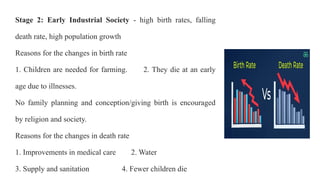
Stage 2: Early Industrial Society - high birth rates, falling
death rate, high population growth
Reasons for the changes in birth rate
1. Children are needed for farming. 2. They die at an early
age due to illnesses.
No family planning and conception/giving birth is encouraged
by religion and society.
Reasons for the changes in death rate
1. Improvements in medical care 2. Water
3. Supply and sanitation 4. Fewer children die
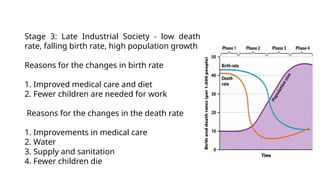
Stage 3: Late Industrial Society - low death
rate, falling birth rate, high population growth
Reasons for the changes in birth rate
1. Improved medical care and diet
2. Fewer children are needed for work
Reasons for the changes in the death rate
1. Improvements in medical care
2. Water
3. Supply and sanitation
4. Fewer children die
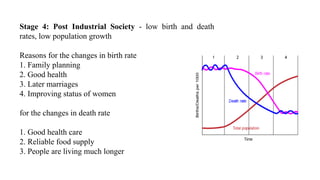
Stage 4: Post Industrial Society - low birth and death
rates, low population growth
Reasons for the changes in birth rate
1. Family planning
2. Good health
3. Later marriages
4. Improving status of women
for the changes in death rate
1. Good health care
2. Reliable food supply
3. People are living much longer
THANKS

GLOBAL-DEMOGRAPHY.pptx HUMSS 12 TOPIC 2ND

  • 1.
  • 2.
    Demography is afield in statistics that is concerned with births, deaths, income, or the incidence of disease, which later illustrates the changing structure of human populations. In the context of political science, demography is a statistical study to determine world population that can be used as a tool to identify certain phenomenon in geopolitics, public administration, and others. The changing perspective on technology and technological advancements and the movement of international organizations (IOs) have made the world a global civil society.
  • 3.
    The idea ofa global civil society was seen during the '90s as "a mosaic of new groups, organizations, and movements that started to appear, which both sought to challenge or resist what was seen as'corporate' globalization and create articulate models of social, economic, and political development" (Heywood, 2011).The formation of a global civil society is a result of a backlash against free-market capitalism. It is in a global civil society where transnational non-governmental organizations and social movements operate and offer an alternative to transnational corporations. The role of a global civil society in global demography is its salient influence on institutional decision-making, affecting the populations at large.
  • 4.
    Global demography isabout the trends and practices in world politics. It is the study of the issues and developments of the global population. Basically, it lays out the present condition of the world and its population. To understand this concept, citing an example of current world issues and humanitarian crises can be done. In addition, this idea is also a tool in understanding migration and global citizenship. According to Ronald Lee (2003), demography is currently in transition; the mortality rate declined followed by fertility, causing population growth rates to accelerate and then to slow down again. This demographic transition leads to low fertility, long life, and an old population. The global demographic transition all began in the 19th century when Europeans were declining in mortality rate (Lee, 2003) and there were some rising societies in Asian and Latin American regions.
  • 5.
    Lee (2003) explainsthat the transition to low mortality rate was influenced by the reduction of contagious and infectious diseases caused by advancements in medicine and improved nutrition because of the presence of local and international markets due to better transportation of goods. Meanwhile, the factors that led to low fertility rate are the preference over child survival than number of child births and the assumption that raising children is more costly than the consumption of goods, as children render less economic contributions due to years spent on education.
  • 6.
    Aside from increasingbirth rate, excessive movements of people from one place to another are also a factor in overpopulation. International migration is becoming more tremendous. Population is part of human demography and since the world is shrinking, this condition develops a concept of a globalized world wherein a state population transcends into global population.
  • 7.
    • The DemographicTransition During the first half of the 20th century, demographers conceived the notion of the demographic transition. The Demographic Transition Framework illustrates population growth in terms of discrepancies and changes in two crude vital rates- mortality and fertility. Stage 1: Preindustrial Society - high and unstable birth and death rates, population growth rate slow, importance of children, low life expectancy
  • 8.
    Reasons for thechanges in birth rate 1. Children are needed for farming. 2. They die at an early age due to illnesses. 3. No family planning and conception/giving birth is encouraged by religion and society. Reasons for the changes in death rate 1. Disease 2. Famine 3. Poor medical knowledge
  • 9.
    Stage 2: EarlyIndustrial Society - high birth rates, falling death rate, high population growth Reasons for the changes in birth rate 1. Children are needed for farming. 2. They die at an early age due to illnesses. No family planning and conception/giving birth is encouraged by religion and society. Reasons for the changes in death rate 1. Improvements in medical care 2. Water 3. Supply and sanitation 4. Fewer children die
  • 10.
    Stage 3: LateIndustrial Society - low death rate, falling birth rate, high population growth Reasons for the changes in birth rate 1. Improved medical care and diet 2. Fewer children are needed for work Reasons for the changes in the death rate 1. Improvements in medical care 2. Water 3. Supply and sanitation 4. Fewer children die
  • 11.
    Stage 4: PostIndustrial Society - low birth and death rates, low population growth Reasons for the changes in birth rate 1. Family planning 2. Good health 3. Later marriages 4. Improving status of women for the changes in death rate 1. Good health care 2. Reliable food supply 3. People are living much longer
  • 12.