PHYSICAL
Densely
populated
Examples Sparsely
populated
Examples
Relief Flat plains and
low-lying
undulating areas
Bangladesh High,rugged
mountains
Andes
Broad river valleys Ganges Valley Worn-down shield
lands
Canadian Shield
Foot hills of active
volcanoes
Etna, Pinatubo
Climate Evenly distributed
rainfall with no
temperatures
extremes
North-westEurope Limited annual
rainfall
Sahara Desert
Areas with:
1.high sunshine
totals
2.heavy snowfall
for tourism
1.Spanish coast Low annual
temperatures
Greenland
2.-Swiss alpine
valleys
High annual
humidity
Amazon rainforest
Seasonal
monsoon rainfall.
Bangladesh Unreliable
seasonal rainfall
Sahel
Vegetation Grassland (ease to
clear/farm)
Paris Basin Forest Amazonia,
Canadial Shield
Soil Deep fertile siltleft
by rivers
Nile Valley and
Delta
Thin soils in
mountainous or
glaciated areas.
Northern
Scandinavia
Volcanic soils Etna 1.Laking humus
2.affected by
leaching
1.Sahel
2.Rainforest
Natural
resources
Mineral, e.g. coal,
iron ore
Pennsylvania,
Johannesburg
Lacking minerals Ethiopia
Energy supplies,
e.g. HEP
RhĂ´ne Valley Lacking energy
supplies
North-eastBrazil
Water supply Reliable supplies North-westEurope Unreliable supplies Afganistan
Natural routes Gaps through
mountains,
confluence of
valleys.
Rhine Valley, Paris Mountain barrier Himalayas
HUMAN
Densely
populated
Examples Sparsely
populated
Examples
Economic Ports New York, Sydney Limited facilities for
ports
Bangladesh
Good roads,
railways, airports
Germany,
California
Poor transport
links
Himalayas
Industrial areas
(traditional)
Pittsburgh, Ruhr Lack of tourist
development
Sudan
Development of
tourism
Banff(Canada),
Jamaica
Lack of tourist
developments
Iraq
Money available California, south of Lack of Nepal, Gaza
for new high-tech
industries.
France government
investment
Political Government
investment
Tokyo region, north
Italy
Lack of
government
investment
Dem. Rep. of
Congo
New towns Satellite towns
around Cairo,
Brasilia
Depopulation of
rural and old
industrial areas
North-east Brazil,
Belgian coalfield
Reclamation of
land
Hong Kong Island,
Dutch polders
Loss of land, e.g.
deforestation, and
soil erosion
Amazonia,
Apennines, Sahel
Social Better housing
opportunities
Arizona Poor housing
opportunities
Afghanistan,
Soweto
Education , health
facilities,
entertainment
Sydney, Milan Limited education,
health facilities,
entertainment
Rwanda
Retirement areas Spanish costas,
Canary Islands
Poor facilities for
retirement
Eritrea
Population change depends mainly on the balance between the birth rate and the death rate. It
is also affected by migration.
Throughout history the world’s population has usually shown a natural increase. Exceptions
have occurred:
 During times of disease (the bubonic plague in the Middle Ages and the HIV/AIDS (Human
Immunodeficiency Virus, the virus that causes Acquired Immune Deficiency Syndrome) in
present-day southern Africa.
 As a result of war (western Europe during the two World Wars and in present day in
Afghanistan)
 Due to recent improvements in family planning and female education (either voluntary as in
several western European countries or enforcement as with China’s one-child policy).
Demographic transition model
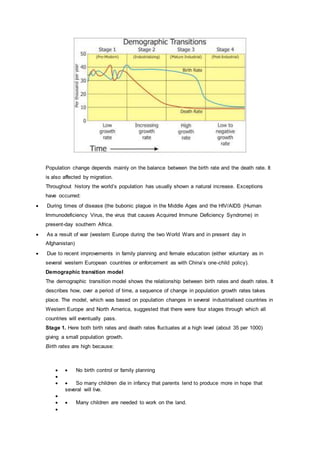
The demographic transition model shows the relationship between birth rates and death rates. It
describes how, over a period of time, a sequence of change in population growth rates takes
place. The model, which was based on population changes in several industrialised countries in
Western Europe and North America, suggested that there were four stages through which all
countries will eventually pass.
Stage 1. Here both birth rates and death rates fluctuates at a high level (about 35 per 1000)
giving a small population growth.
Birth rates are high because:
  No birth control or family planning

  So many children die in infancy that parents tend to produce more in hope that
several will live.

  Many children are needed to work on the land.

  Children are regarded as a sign of virility.

  Religious belief (e.g. Roman Catholics, Muslims and Hindus) encourage large
families.
High death rates, especially among children, are due to:
  Disease and plague (bubonic, cholera, kwashiorkor).

  Famine, uncertain food supplies, poor diet.

  Poor hygiene: no piped, clean water and no sewage disposal.

  Little medical science: few doctors, hospitals, drugs.
Stage 2. Birth rates remain high, but death rates fall rapidly to about 20 per 1000 people giving
a rapid population growth.
The fall in death rate results from:
  Improved medical care: vaccinations, hospitals, doctors, new drugs and scientific
inventions.

  Improved sanitation and water supply.

  Improvements in food production (both quality and quantity)

  Improved transport to move food, doctors, etc.

  A decrease in child mortality.
Stage 3. Birth rates fall rapidly, to perhaps 20 per 1000 people, while death rates continue to fall
slightly (15 per 1000 people) to give a slowly increasing population.
The fall in birth rate may be due to:
  Family planning: contraceptives, sterilisation, abortion and government incentives.

  A lower infant mortality rate, therefore less needs to have so many children.

  Increase industrialization and mechanization meaning fewer labourers are needed.

  Increased desire for material possessions (cars, holidays, bigger homes) and less
for large families.

  Emancipation of women, enabling them to follow their own careers rather than
being solely child bearers.
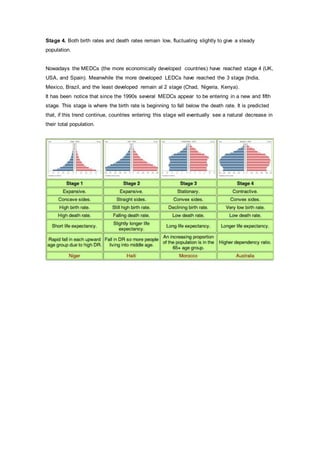
Stage 4. Both birth rates and death rates remain low, fluctuating slightly to give a steady
population.
Nowadays the MEDCs (the more economically developed countries) have reached stage 4 (UK,
USA, and Spain). Meanwhile the more developed LEDCs have reached the 3 stage (India,
Mexico, Brazil, and the least developed remain al 2 stage (Chad, Nigeria, Kenya).
It has been notice that since the 1990s several MEDCs appear to be entering in a new and fifth
stage. This stage is where the birth rate is beginning to fall below the death rate. It is predicted
that, if this trend continue, countries entering this stage will eventually see a natural decrease in
their total population.

Geography

  • 1.
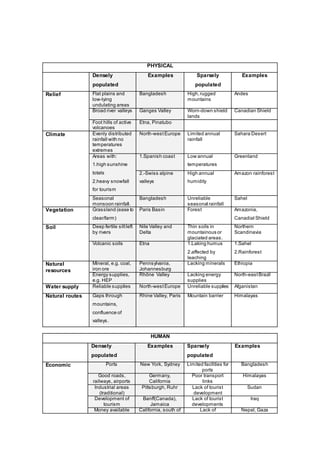
    PHYSICAL Densely populated Examples Sparsely populated Examples Relief Flatplains and low-lying undulating areas Bangladesh High,rugged mountains Andes Broad river valleys Ganges Valley Worn-down shield lands Canadian Shield Foot hills of active volcanoes Etna, Pinatubo Climate Evenly distributed rainfall with no temperatures extremes North-westEurope Limited annual rainfall Sahara Desert Areas with: 1.high sunshine totals 2.heavy snowfall for tourism 1.Spanish coast Low annual temperatures Greenland 2.-Swiss alpine valleys High annual humidity Amazon rainforest Seasonal monsoon rainfall. Bangladesh Unreliable seasonal rainfall Sahel Vegetation Grassland (ease to clear/farm) Paris Basin Forest Amazonia, Canadial Shield Soil Deep fertile siltleft by rivers Nile Valley and Delta Thin soils in mountainous or glaciated areas. Northern Scandinavia Volcanic soils Etna 1.Laking humus 2.affected by leaching 1.Sahel 2.Rainforest Natural resources Mineral, e.g. coal, iron ore Pennsylvania, Johannesburg Lacking minerals Ethiopia Energy supplies, e.g. HEP RhĂ´ne Valley Lacking energy supplies North-eastBrazil Water supply Reliable supplies North-westEurope Unreliable supplies Afganistan Natural routes Gaps through mountains, confluence of valleys. Rhine Valley, Paris Mountain barrier Himalayas HUMAN Densely populated Examples Sparsely populated Examples Economic Ports New York, Sydney Limited facilities for ports Bangladesh Good roads, railways, airports Germany, California Poor transport links Himalayas Industrial areas (traditional) Pittsburgh, Ruhr Lack of tourist development Sudan Development of tourism Banff(Canada), Jamaica Lack of tourist developments Iraq Money available California, south of Lack of Nepal, Gaza
  • 2.
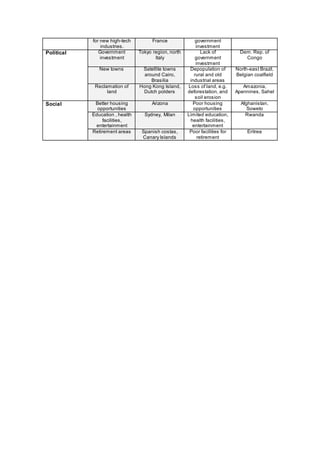
    for new high-tech industries. Francegovernment investment Political Government investment Tokyo region, north Italy Lack of government investment Dem. Rep. of Congo New towns Satellite towns around Cairo, Brasilia Depopulation of rural and old industrial areas North-east Brazil, Belgian coalfield Reclamation of land Hong Kong Island, Dutch polders Loss of land, e.g. deforestation, and soil erosion Amazonia, Apennines, Sahel Social Better housing opportunities Arizona Poor housing opportunities Afghanistan, Soweto Education , health facilities, entertainment Sydney, Milan Limited education, health facilities, entertainment Rwanda Retirement areas Spanish costas, Canary Islands Poor facilities for retirement Eritrea
  • 4.
    Population change dependsmainly on the balance between the birth rate and the death rate. It is also affected by migration. Throughout history the world’s population has usually shown a natural increase. Exceptions have occurred:  During times of disease (the bubonic plague in the Middle Ages and the HIV/AIDS (Human Immunodeficiency Virus, the virus that causes Acquired Immune Deficiency Syndrome) in present-day southern Africa.  As a result of war (western Europe during the two World Wars and in present day in Afghanistan)  Due to recent improvements in family planning and female education (either voluntary as in several western European countries or enforcement as with China’s one-child policy). Demographic transition model The demographic transition model shows the relationship between birth rates and death rates. It describes how, over a period of time, a sequence of change in population growth rates takes place. The model, which was based on population changes in several industrialised countries in Western Europe and North America, suggested that there were four stages through which all countries will eventually pass. Stage 1. Here both birth rates and death rates fluctuates at a high level (about 35 per 1000) giving a small population growth. Birth rates are high because:   No birth control or family planning    So many children die in infancy that parents tend to produce more in hope that several will live.    Many children are needed to work on the land. 
  • 5.
      Childrenare regarded as a sign of virility.    Religious belief (e.g. Roman Catholics, Muslims and Hindus) encourage large families. High death rates, especially among children, are due to:   Disease and plague (bubonic, cholera, kwashiorkor).    Famine, uncertain food supplies, poor diet.    Poor hygiene: no piped, clean water and no sewage disposal.    Little medical science: few doctors, hospitals, drugs. Stage 2. Birth rates remain high, but death rates fall rapidly to about 20 per 1000 people giving a rapid population growth. The fall in death rate results from:   Improved medical care: vaccinations, hospitals, doctors, new drugs and scientific inventions.    Improved sanitation and water supply.    Improvements in food production (both quality and quantity)    Improved transport to move food, doctors, etc.    A decrease in child mortality. Stage 3. Birth rates fall rapidly, to perhaps 20 per 1000 people, while death rates continue to fall slightly (15 per 1000 people) to give a slowly increasing population. The fall in birth rate may be due to:   Family planning: contraceptives, sterilisation, abortion and government incentives.    A lower infant mortality rate, therefore less needs to have so many children.    Increase industrialization and mechanization meaning fewer labourers are needed.    Increased desire for material possessions (cars, holidays, bigger homes) and less for large families.    Emancipation of women, enabling them to follow their own careers rather than being solely child bearers.
  • 6.
    Stage 4. Bothbirth rates and death rates remain low, fluctuating slightly to give a steady population. Nowadays the MEDCs (the more economically developed countries) have reached stage 4 (UK, USA, and Spain). Meanwhile the more developed LEDCs have reached the 3 stage (India, Mexico, Brazil, and the least developed remain al 2 stage (Chad, Nigeria, Kenya). It has been notice that since the 1990s several MEDCs appear to be entering in a new and fifth stage. This stage is where the birth rate is beginning to fall below the death rate. It is predicted that, if this trend continue, countries entering this stage will eventually see a natural decrease in their total population.