GLASGOW COMA SCALE
BY PETER N.N BScN/RN
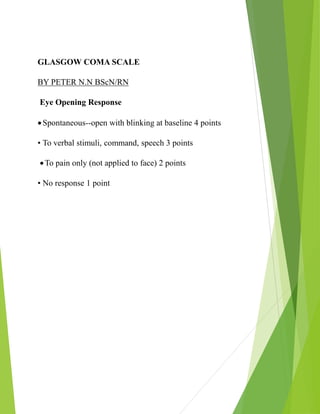
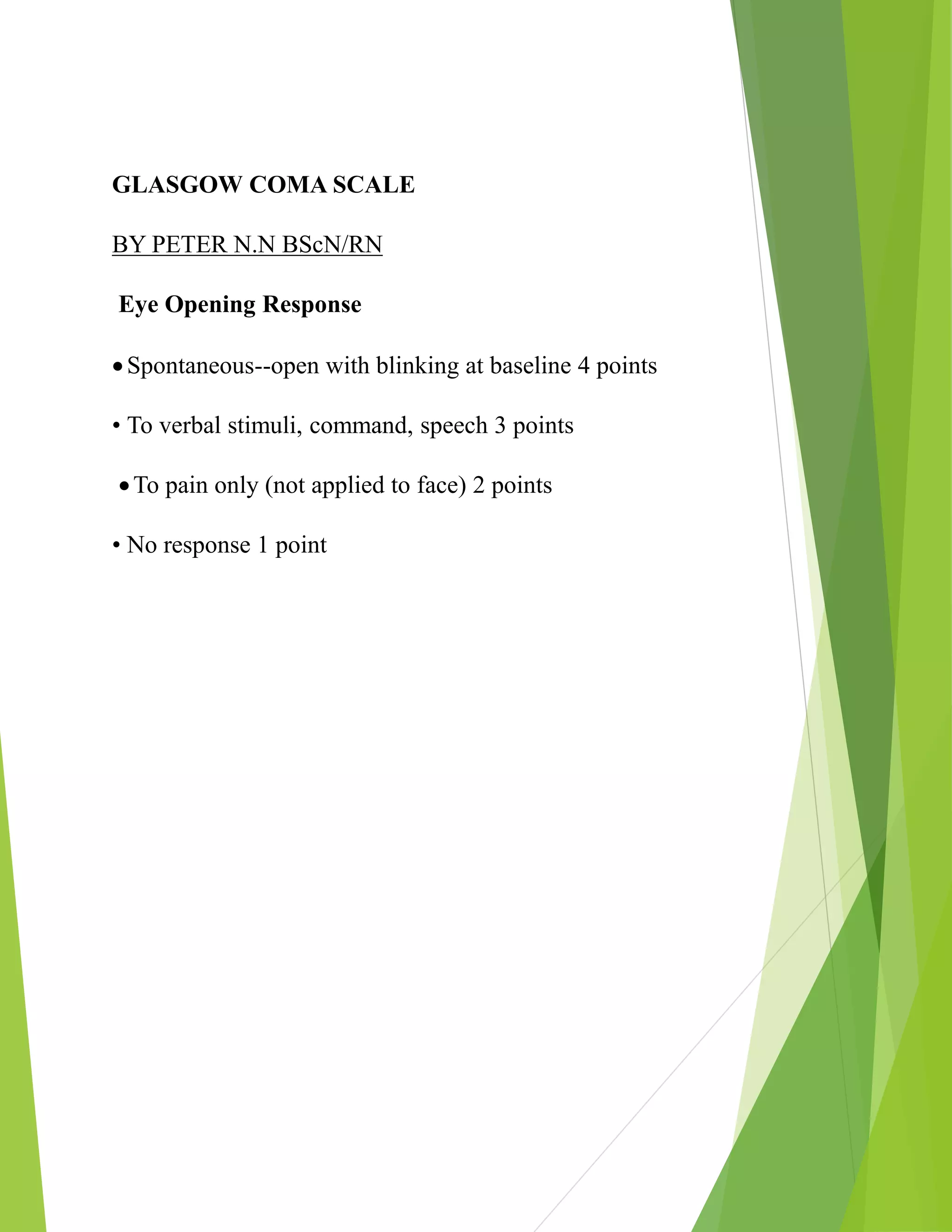
Eye Opening Response
Spontaneous--open with blinking at baseline 4 points
• To verbal stimuli, command, speech 3 points
To pain only (not applied to face) 2 points
• No response 1 point
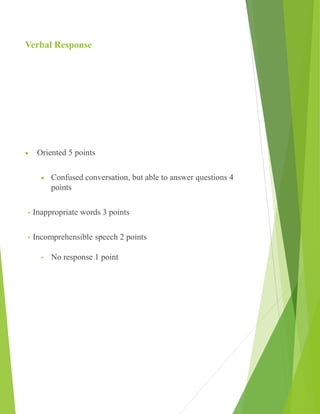
Verbal Response
 Oriented 5 points
 Confused conversation, but able to answer questions 4
points
• Inappropriate words 3 points
• Incomprehensible speech 2 points
• No response 1 point
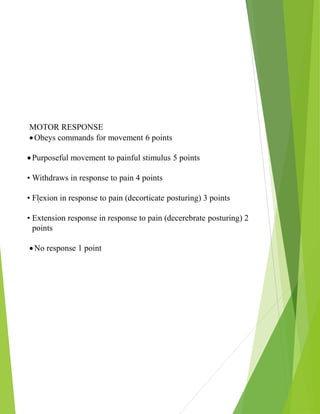
MOTOR RESPONSE
Obeys commands for movement 6 points
Purposeful movement to painful stimulus 5 points
• Withdraws in response to pain 4 points
• Flexion in response to pain (decorticate posturing) 3 points
• Extension response in response to pain (decerebrate posturing) 2
points
No response 1 point
.
References
 Teasdale G, Jennett B. Assessment of coma and
impaired consciousness. Lancet 1974; 81-84. Teasdale
G, Jennett B. Assessment and prognosis of coma after
head injury. Acta Neurochir 1976; 34:45-55
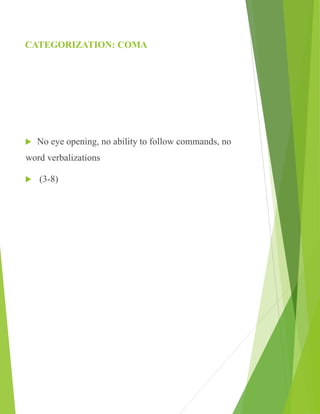
CATEGORIZATION: COMA
 No eye opening, no ability to follow commands, no
word verbalizations
 (3-8)
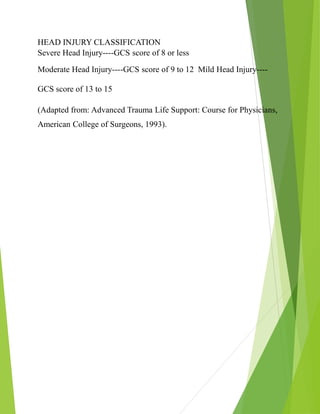
HEAD INJURY CLASSIFICATION
Severe Head Injury----GCS score of 8 or less
Moderate Head Injury----GCS score of 9 to 12 Mild Head Injury----
GCS score of 13 to 15
(Adapted from: Advanced Trauma Life Support: Course for Physicians,
American College of Surgeons, 1993).
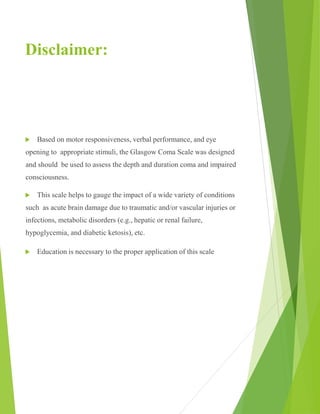
Disclaimer:
 Based on motor responsiveness, verbal performance, and eye
opening to appropriate stimuli, the Glasgow Coma Scale was designed
and should be used to assess the depth and duration coma and impaired
consciousness.
 This scale helps to gauge the impact of a wide variety of conditions
such as acute brain damage due to traumatic and/or vascular injuries or
infections, metabolic disorders (e.g., hepatic or renal failure,
hypoglycemia, and diabetic ketosis), etc.
 Education is necessary to the proper application of this scale
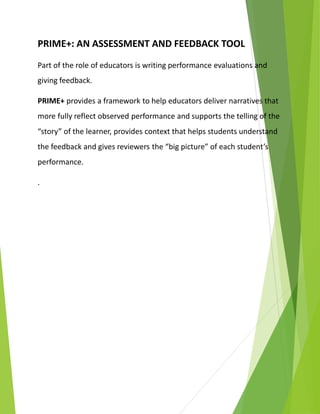
PRIME+: AN ASSESSMENT AND FEEDBACK TOOL
Part of the role of educators is writing performance evaluations and
giving feedback.
PRIME+ provides a framework to help educators deliver narratives that
more fully reflect observed performance and supports the telling of the
“story” of the learner, provides context that helps students understand
the feedback and gives reviewers the “big picture” of each student’s
performance.
.
CONT…
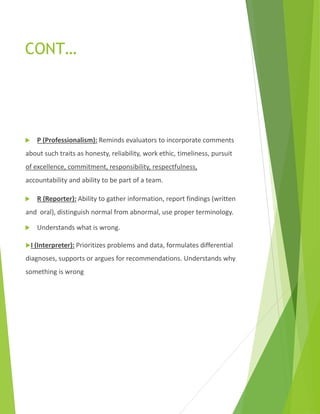
 P (Professionalism): Reminds evaluators to incorporate comments
about such traits as honesty, reliability, work ethic, timeliness, pursuit
of excellence, commitment, responsibility, respectfulness,
accountability and ability to be part of a team.
 R (Reporter): Ability to gather information, report findings (written
and oral), distinguish normal from abnormal, use proper terminology.
 Understands what is wrong.
I (Interpreter): Prioritizes problems and data, formulates differential
diagnoses, supports or argues for recommendations. Understands why
something is wrong
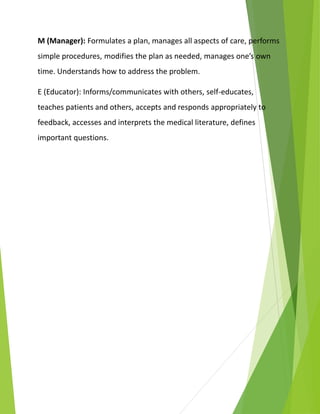
M (Manager): Formulates a plan, manages all aspects of care, performs
simple procedures, modifies the plan as needed, manages one’s own
time. Understands how to address the problem.
E (Educator): Informs/communicates with others, self-educates,
teaches patients and others, accepts and responds appropriately to
feedback, accesses and interprets the medical literature, defines
important questions.
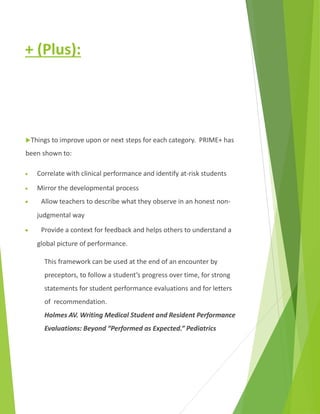
+ (Plus):
Things to improve upon or next steps for each category. PRIME+ has
been shown to:
 Correlate with clinical performance and identify at-risk students
 Mirror the developmental process
 Allow teachers to describe what they observe in an honest non-
judgmental way
 Provide a context for feedback and helps others to understand a
global picture of performance.
This framework can be used at the end of an encounter by
preceptors, to follow a student’s progress over time, for strong
statements for student performance evaluations and for letters
of recommendation.
Holmes AV. Writing Medical Student and Resident Performance
Evaluations: Beyond “Performed as Expected.” Pediatrics
REFERENCES:-
2014;(133):766-768. Pangaro L. A new vocabulary and other
innovations for improving descriptive in-training evaluations.
Academic Medicine 199: Nov;74(11):1203-7.
THANK YOU!!!

Glasgow coma scale

  • 1.
    GLASGOW COMA SCALE BYPETER N.N BScN/RN Eye Opening Response Spontaneous--open with blinking at baseline 4 points • To verbal stimuli, command, speech 3 points To pain only (not applied to face) 2 points • No response 1 point
  • 2.
    Verbal Response  Oriented5 points  Confused conversation, but able to answer questions 4 points • Inappropriate words 3 points • Incomprehensible speech 2 points • No response 1 point
  • 3.
    MOTOR RESPONSE Obeys commandsfor movement 6 points Purposeful movement to painful stimulus 5 points • Withdraws in response to pain 4 points • Flexion in response to pain (decorticate posturing) 3 points • Extension response in response to pain (decerebrate posturing) 2 points No response 1 point .
  • 4.
    References  Teasdale G,Jennett B. Assessment of coma and impaired consciousness. Lancet 1974; 81-84. Teasdale G, Jennett B. Assessment and prognosis of coma after head injury. Acta Neurochir 1976; 34:45-55
  • 5.
    CATEGORIZATION: COMA  Noeye opening, no ability to follow commands, no word verbalizations  (3-8)
  • 6.
    HEAD INJURY CLASSIFICATION SevereHead Injury----GCS score of 8 or less Moderate Head Injury----GCS score of 9 to 12 Mild Head Injury---- GCS score of 13 to 15 (Adapted from: Advanced Trauma Life Support: Course for Physicians, American College of Surgeons, 1993).
  • 7.
    Disclaimer:  Based onmotor responsiveness, verbal performance, and eye opening to appropriate stimuli, the Glasgow Coma Scale was designed and should be used to assess the depth and duration coma and impaired consciousness.  This scale helps to gauge the impact of a wide variety of conditions such as acute brain damage due to traumatic and/or vascular injuries or infections, metabolic disorders (e.g., hepatic or renal failure, hypoglycemia, and diabetic ketosis), etc.  Education is necessary to the proper application of this scale
  • 8.
    PRIME+: AN ASSESSMENTAND FEEDBACK TOOL Part of the role of educators is writing performance evaluations and giving feedback. PRIME+ provides a framework to help educators deliver narratives that more fully reflect observed performance and supports the telling of the “story” of the learner, provides context that helps students understand the feedback and gives reviewers the “big picture” of each student’s performance. .
  • 9.
    CONT…  P (Professionalism):Reminds evaluators to incorporate comments about such traits as honesty, reliability, work ethic, timeliness, pursuit of excellence, commitment, responsibility, respectfulness, accountability and ability to be part of a team.  R (Reporter): Ability to gather information, report findings (written and oral), distinguish normal from abnormal, use proper terminology.  Understands what is wrong. I (Interpreter): Prioritizes problems and data, formulates differential diagnoses, supports or argues for recommendations. Understands why something is wrong
  • 10.
    M (Manager): Formulatesa plan, manages all aspects of care, performs simple procedures, modifies the plan as needed, manages one’s own time. Understands how to address the problem. E (Educator): Informs/communicates with others, self-educates, teaches patients and others, accepts and responds appropriately to feedback, accesses and interprets the medical literature, defines important questions.
  • 11.
    + (Plus): Things toimprove upon or next steps for each category. PRIME+ has been shown to:  Correlate with clinical performance and identify at-risk students  Mirror the developmental process  Allow teachers to describe what they observe in an honest non- judgmental way  Provide a context for feedback and helps others to understand a global picture of performance. This framework can be used at the end of an encounter by preceptors, to follow a student’s progress over time, for strong statements for student performance evaluations and for letters of recommendation. Holmes AV. Writing Medical Student and Resident Performance Evaluations: Beyond “Performed as Expected.” Pediatrics
  • 12.
    REFERENCES:- 2014;(133):766-768. Pangaro L.A new vocabulary and other innovations for improving descriptive in-training evaluations. Academic Medicine 199: Nov;74(11):1203-7. THANK YOU!!!