WHY? 
Academic feedback is more strongly and 
consistently related to achievement than any 
other teaching behavior….This relationship 
is consistent regardless of grade, 
socioeconomic status, race, or school 
setting. ~ Bellon, Bellon & Blank
CLEAR TARGET 
We can differentiate between 
effective and ineffective academic 
feedback.
ACTIVITY 
• Pair up, one seated and one standing directly behind. 
• Seated person will receive pencil and a blank piece of 
paper. 
• Wait for further instruction. 
• You will have 3 minutes to complete this activity once 
the timer starts.
PREASSESSMENT 
• (1 minute) Individually, list as many characteristics of 
effective academic feedback as you can. 
• (2 minutes) Discuss each list as a group & decide on 
the top 2 most important characteristics.
WAYS IN WHICH WE RESPOND TO 
STUDENTS 
Evaluation – providing information by making a value judgment 
that rates, evaluates, praises, or criticizes what was done. 
Advice – letting a student know what you think they should do. 
Feedback – providing specific information about how a student is 
doing in his/her efforts to reach a goal.
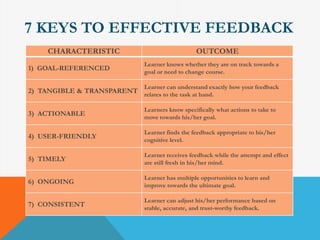
7 KEYS TO EFFECTIVE FEEDBACK 
CHARACTERISTIC OUTCOME 
1) GOAL-REFERENCED 
Learner knows whether they are on track towards a 
goal or need to change course. 
2) TANGIBLE & TRANSPARENT 
Learner can understand exactly how your feedback 
relates to the task at hand. 
3) ACTIONABLE 
Learners know specifically what actions to take to 
move towards his/her goal. 
4) USER-FRIENDLY 
Learner finds the feedback appropriate to his/her 
cognitive level. 
5) TIMELY 
Learner receives feedback while the attempt and effect 
are still fresh in his/her mind. 
6) ONGOING 
Learner has multiple opportunities to learn and 
improve towards the ultimate goal. 
7) CONSISTENT 
Learner can adjust his/her performance based on 
stable, accurate, and trust-worthy feedback.
EFFECTIVE VS. INEFFECTIVE 
FEEDBACK 
• Pair up with someone from your group. 
• Read each example, and based on the key characteristics, 
determine if it’s EFFECTIVE or INEFFECTIVE. 
Effective Feedback Ineffective Feedback
EFFECTIVE VS. INEFFECTIVE 
FEEDBACK 
• With your partner, focus on the examples deemed “ineffective” and 
improve them to make them more effective. 
• Record your improved examples on the provided handout. 
• Share your results with the others in your group and provide 
feedback to them.
THE POWER OF EFFECTIVE 
FEEDBACK 
http://youtu.be/hqh1MRWZjms 
Dayna, this is the butterfly video. I had to include just a link so that I could email it 
to you. It will be embedded in the actual ppt.)
REFERENCES 
“7 Keys to Effective Feedback” Educational Leadership, 
ASCD; Volume 70, Issue 1, September 2012. 
http://www.ascd.org/publications/educational-leadership/sept12/vol70/num01/Seven-Keys-to-Effective-Feedback.aspx

Effective Feedback

  • 2.
    WHY? Academic feedbackis more strongly and consistently related to achievement than any other teaching behavior….This relationship is consistent regardless of grade, socioeconomic status, race, or school setting. ~ Bellon, Bellon & Blank
  • 3.
    CLEAR TARGET Wecan differentiate between effective and ineffective academic feedback.
  • 4.
    ACTIVITY • Pairup, one seated and one standing directly behind. • Seated person will receive pencil and a blank piece of paper. • Wait for further instruction. • You will have 3 minutes to complete this activity once the timer starts.
  • 5.
    PREASSESSMENT • (1minute) Individually, list as many characteristics of effective academic feedback as you can. • (2 minutes) Discuss each list as a group & decide on the top 2 most important characteristics.
  • 6.
    WAYS IN WHICHWE RESPOND TO STUDENTS Evaluation – providing information by making a value judgment that rates, evaluates, praises, or criticizes what was done. Advice – letting a student know what you think they should do. Feedback – providing specific information about how a student is doing in his/her efforts to reach a goal.
  • 7.
    7 KEYS TOEFFECTIVE FEEDBACK CHARACTERISTIC OUTCOME 1) GOAL-REFERENCED Learner knows whether they are on track towards a goal or need to change course. 2) TANGIBLE & TRANSPARENT Learner can understand exactly how your feedback relates to the task at hand. 3) ACTIONABLE Learners know specifically what actions to take to move towards his/her goal. 4) USER-FRIENDLY Learner finds the feedback appropriate to his/her cognitive level. 5) TIMELY Learner receives feedback while the attempt and effect are still fresh in his/her mind. 6) ONGOING Learner has multiple opportunities to learn and improve towards the ultimate goal. 7) CONSISTENT Learner can adjust his/her performance based on stable, accurate, and trust-worthy feedback.
  • 8.
    EFFECTIVE VS. INEFFECTIVE FEEDBACK • Pair up with someone from your group. • Read each example, and based on the key characteristics, determine if it’s EFFECTIVE or INEFFECTIVE. Effective Feedback Ineffective Feedback
  • 9.
    EFFECTIVE VS. INEFFECTIVE FEEDBACK • With your partner, focus on the examples deemed “ineffective” and improve them to make them more effective. • Record your improved examples on the provided handout. • Share your results with the others in your group and provide feedback to them.
  • 10.
    THE POWER OFEFFECTIVE FEEDBACK http://youtu.be/hqh1MRWZjms Dayna, this is the butterfly video. I had to include just a link so that I could email it to you. It will be embedded in the actual ppt.)
  • 11.
    REFERENCES “7 Keysto Effective Feedback” Educational Leadership, ASCD; Volume 70, Issue 1, September 2012. http://www.ascd.org/publications/educational-leadership/sept12/vol70/num01/Seven-Keys-to-Effective-Feedback.aspx

Editor's Notes

  • #2 Room Setup: Make sure the room is set up with groups of desks or tables, ideally with an even number of chairs in each group. Throughout the lesson, participants will need to be able to easily be paired off and at other times need to be able to discuss with their small group. Welcome and introduce yourself. Present topic for session.
  • #3 Stress that everyone sitting in the room knows that they should be providing feedback. However, if we know how to improve our academic feedback so that it is as effective as possible, it will make a substantial difference in improving student achievement. Have someone read quote from slide. Instruct everyone to really think for a few seconds how powerful this is.
  • #4 Present clear target.
  • #5 Presenter’s Directions: (Total time: 5 minutes) Ask participants to pair off with one person staying seated and the partner standing directly behind them facing their seated partner. Pass out one blank sheet of paper and a pencil to the seated participant. Instruct the group that this short activity will demonstrate the power of effective feedback in reaching a goal successfully. It will also let the seated participant experience the role of the student as he/she receives feedback and the standing participant experience giving feedback to reach a desired goal. Inform the pairs that you will be handing a picture (everyone’s is the same) to the standing participant. They should NOT allow their partner to ever see the picture. They will be given three minutes to verbally describe the picture to the seated person. Remind them that they can talk, give as much detail as they want, and look at what their partner is drawing, but that they can NOT use their hands in any way. The seated person will listen and draw the picture based on their partner’s description. They MAY talk back and ask questions or ask for clarification. Ask if anyone needs more direction and if not, go ahead and pass out the pictures to the standing person. Start a timer for 3 minutes and announce for participants to begin. Call time, pencils down, and allow the seated person to see the original drawing. Draw attention to the symbolism of the flower representing the student outcome and how its success is directly tied to the feedback received. Take up pencils.
  • #6 Pass out one index card to each participant for a quick pre-assessment. Ask participants to individually list as many one-word characteristics of effective feedback as possible on their index card. Set timer for 1 minute and have participants begin. Call time, and then ask participants to discuss with their small group what they came up with and narrow it down as a group to the 2 most important characteristics. (at the presenter’s discretion: may need to change to only 1 characteristic based on time and size of whole group) Allow each group to share out their top characteristic(s) while presenter records the results on the sideboard (or document reader if you want to switch between it and the ppt).