GASTROENTEROLOGY 2013;145:946–953

Therapeutic Potential of Fecal
Microbiota Transplantation
Dr.Mohamed Shekhani
Introduction:
• GIT contains large/diverse microorganisms, bacteria most.
• At least 1014 bacteria is dominated by strict anaerobes includes
1000s of different species, many not yet cultured.
• These bacteria:
• Interact with the intestinal mucosa.
• Influence intestinal permeability
• Important for the absorption, distribution, metabolism, excretion
of nutrients
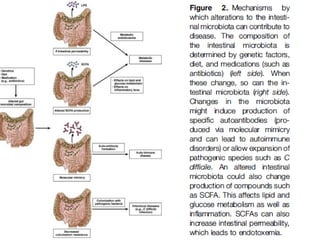
• Trigger (auto) immunity.
Introduction:
• The composition of the human intestinal microbiota is associated
with human health.
• The composition of the intestinal microbiota can be altered with:
• Diet
• Prebiotics
• Probiotics
• Antibiotics, which produce large changes in the bacterial
composition of the intestines.
• Recently with FMT.
Diet: Prebiotic effects or probiotic containing
• Dietary Fiber : Nonstarch polysaccharides of plant foods poorly
digested by human enzymes.
• Soluble components: pectiin, hemicelluloses, gums,mucilages; are
completely fermented by the bacterial flora
• Insoluble components are cellulose, some hemicelluloses, waxes,
and lignin primarily in plant cell walls as well as resistant starch are
only slightly fermented
• Some diet contains probiotics with positive effects on health as
yogurt.
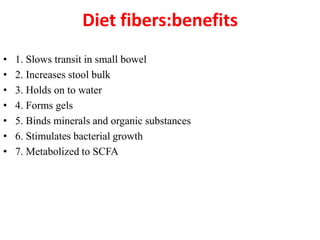
Diet fibers:benefits
•
•
•
•
•
•
•

1. Slows transit in small bowel
2. Increases stool bulk
3. Holds on to water
4. Forms gels
5. Binds minerals and organic substances
6. Stimulates bacterial growth
7. Metabolized to SCFA
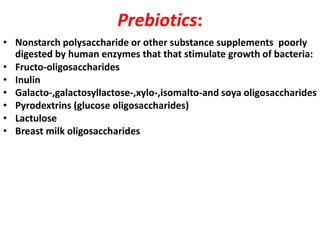
Prebiotics:
• Nonstarch polysaccharide or other substance supplements poorly
digested by human enzymes that that stimulate growth of bacteria:
• Fructo-oligosaccharides
• Inulin
• Galacto-,galactosyllactose-,xylo-,isomalto-and soya oligosaccharides
• Pyrodextrins (glucose oligosaccharides)
• Lactulose
• Breast milk oligosaccharides
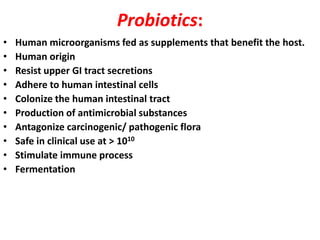
Probiotics:
•
•
•
•
•
•
•
•
•
•

Human microorganisms fed as supplements that benefit the host.
Human origin
Resist upper GI tract secretions
Adhere to human intestinal cells
Colonize the human intestinal tract
Production of antimicrobial substances
Antagonize carcinogenic/ pathogenic flora
Safe in clinical use at > 1010
Stimulate immune process
Fermentation
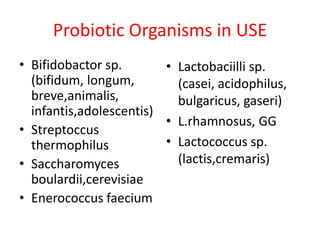
Probiotic Organisms in USE
• Bifidobactor sp.
• Lactobaciilli sp.
(bifidum, longum,
(casei, acidophilus,
breve,animalis,
bulgaricus, gaseri)
infantis,adolescentis)
• L.rhamnosus, GG
• Streptoccus
• Lactococcus sp.
thermophilus
(lactis,cremaris)
• Saccharomyces
boulardii,cerevisiae
• Enerococcus faecium
CLAIMS FOR PROBIOTICS
• Increase resistance to infection
• Decrease duration of diarrhea disease
• Stimulate immunity, modulate cytokine gene
expression, stimulate phagocytosis
• Beneficial effect on blood pressure,serum
cholesterol, diabetes mellitus,lactose
digestion and allergy
• Regression of tumors and reduction in
carcinogens
Antibiotics: effects on intestinal microbiota
• Antibiotic –associated colitis; PMC, CDI:
Clindamycin,lincomycin etc.
• Treated by Vancomycin or metronidazole.
• Antibiotics used as therpay through int
microbiotal composition manipulation:
neomycin,Rifazimin,metronidazole for HE.
• Metronidazole: in Crohn’s disease.
• Rifaximin for IBS-DP.
FMT: History
• The 1st description of human donor feces as a therapeutic agent
from China,5th century, Ge Hong, in the Handbook of Emergency
Medicine , prescribed ingestion of feces for a variety of conditions.
• Ralph Lewin“: consumption of fresh, warm camel feces has been
recommended by Bedouins as a remedy for bacterial dysentery;
• Its efficacy was confirmed by German soldiers in Africa during ww2”
• The 1st use in mainstream medicine in 1958 for PMC/CDI by
Eiseman et al.
• FMT has since increased in popularity due to its efficacy/ ease of
use for the treatment of CDI.
Methods of FMT:
• FMT: the administration of a fecal solution from a donor into the
intestinal tract of a recipient.
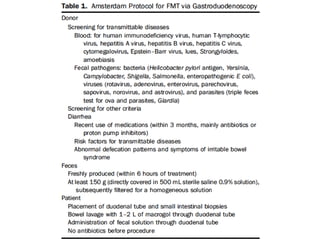
• Donor selection.
• Solution preparation.
• Administration of the transplant material.
Donor selection:
• Healthy donors from family members or friends ,newspaper
advertisements.
• Potential donors should be questioned about their travel history,
sexual behavior, previous operations, blood transfusions&other
factors that increase the risk of transmissible disease.
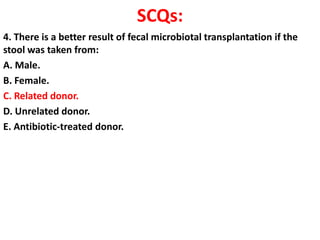
• Sightly higher rate of disease resolution if from related donors.
• No significant differences if different sex than the recipient.
• Donor / recipient microbiota composition including enterotypes
could increase the efficiency of FMT.
FMT preparation:
•
•
•
•

With Water > NS ,but higher relapse.
With milk or psyllium.
250 ml in NS.
Freshly passed within 6 hous better, but frozen banked stool nearly
similar.
• Avoid electrical blender.
Route of adminstration:
• Colonoscopy ,RETENTION ENEMA or OGD ,NGT,NJT.
• Via colonoscopy better results.
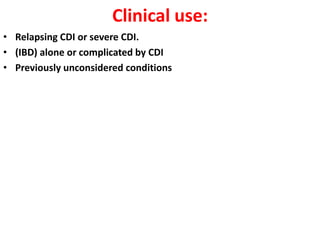
Clinical use:
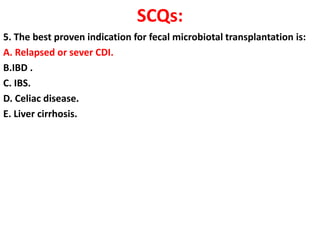
• Relapsing CDI or severe CDI.
• (IBD) alone or complicated by CDI
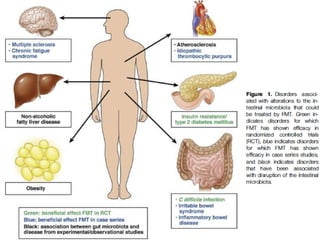
• Previously unconsidered conditions
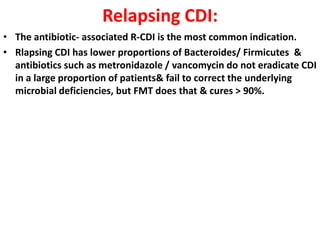
Relapsing CDI:
• The antibiotic- associated R-CDI is the most common indication.
• Rlapsing CDI has lower proportions of Bacteroides/ Firmicutes &
antibiotics such as metronidazole / vancomycin do not eradicate CDI
in a large proportion of patients& fail to correct the underlying
microbial deficiencies, but FMT does that & cures > 90%.
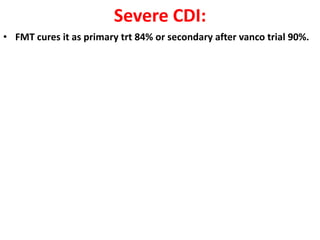
Severe CDI:
• FMT cures it as primary trt 84% or secondary after vanco trial 90%.
CDI in IBD:
• The latest ACG guidelines recommend CDI testing of all patients
hospitalized for IBD flares.
IBD:
• IBD have reduced numbers of the phyla Firmicutes / Bacteroidetes
&increased numbers of Actinobacteria / Proteobacteria .
• Findings indicate that remission of UC is possible with (multiple)
FMTs for a subgroup of patients.
• There are currently 6 registered trials testing FMT for patients with
IBD.
IBS:
• Some studies: Altered intestinal microbiota (decreased diversity
&numbers of Bacteroidetes ) in subsets of IBS.
• There are 50 published cases of use of FMT to treat patients with
diarrhea-predominant IBS & chronic constipation
• Substantial improvements were reported in 30 patients (60%), who
had improved defecation&an absence of bloating and abdominal
pain.
CFS:
• In an uncontrolled study of 60 patients with chronic fatigue
syndrome and gastrointestinal dysfunction treated with FMT, 50%
had resolved sleep deprivation, lethargy, or fatigue during a 15- to
20-year follow-up period.
Metabolic/CVD:
• Alterations in the composition of the intestinal microbiota have also
been associated with obesity /T2DM.
• Alterations in the intestinal microbiota might contribute to the
development of cardiometabolic diseases by increasing intestinal
permeability; metabolic endotoxemia , chronic inflammation
• Obese subjects have increased postprandial plasma levels of
bacteria or their proteins (mainly lipopolysaccharide or endotoxin)
because of increased intestinal permeability.
• FMT from lean donors significantly increased insulin sensitivity, by
increasing concentrations of butyrate-producing intestinal bacteria
in small & large intestine.
• FMT-based intervention studies are currently under way to see if
can reduce features of fatty liver disease &vascular inflammation.
Autoimmunity:
Adverse effects:
•
•
•
•
•
•

Safe till now.
Most patients experience diarrhea on the day of infusion.
A small %: belching/or abdominal cramping or constipation.
3 /317 (UGIB, peritonitis, enteritis).
Fever/abdominal tenderness in 3 of 4 CD patients.
Long-term follow-up studies have found that FMT is relatively free
of adverse effects.
The future:
• Future research could lead to the development of specific benefi
cial (probiotic) microbes or inhibitors of specific microbes and/or
their products that can improve human health via the intestinal
microbiota.
SCQs:
1. The intestinal microbiota can be always positively affected by the
following except:
A.Probiotics.
B.Prebiotics.
C. Antibiotics.
D. Fecal microbiotic transplantation.
E.Diet.
SCQs:
1. The intestinal microbiota can be always positively affected by the
following except:
A.Probiotics.
B.Prebiotics.
C. Antibiotics.
D. Fecal microbiotic transplantation.
E.Diet.
SCQs:
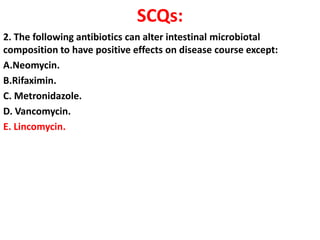
2. The following antibiotics can alter intestinal microbiotal
composition to have positive effects on disease course except:
A.Neomycin.
B.Rifaximin.
C. Metronidazole.
D. Vancomycin.
E. Lincomycin.
SCQs:
2. The following antibiotics can alter intestinal microbiotal
composition to have positive effects on disease course except:
A.Neomycin.
B.Rifaximin.
C. Metronidazole.
D. Vancomycin.
E. Lincomycin.
SCQs:
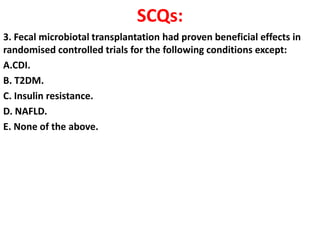
3. Fecal microbiotal transplantation had proven beneficial effects in
randomised controlled trials for the following conditions except:
A.CDI.
B. T2DM.
C. Insulin resistance.
D. NAFLD.
E. None of the above.
SCQs:
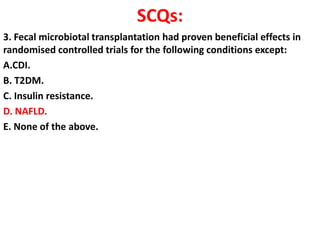
3. Fecal microbiotal transplantation had proven beneficial effects in
randomised controlled trials for the following conditions except:
A.CDI.
B. T2DM.
C. Insulin resistance.
D. NAFLD.
E. None of the above.
SCQs:
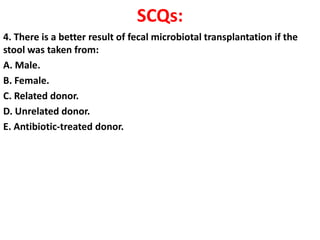
4. There is a better result of fecal microbiotal transplantation if the
stool was taken from:
A. Male.
B. Female.
C. Related donor.
D. Unrelated donor.
E. Antibiotic-treated donor.
SCQs:
4. There is a better result of fecal microbiotal transplantation if the
stool was taken from:
A. Male.
B. Female.
C. Related donor.
D. Unrelated donor.
E. Antibiotic-treated donor.
SCQs:
5. The best proven indication for fecal microbiotal transplantation is:
A. Relapsed or sever CDI.
B.IBD .
C. IBS.
D. Celiac disease.
E. Liver cirrhosis.
SCQs:
5. The best proven indication for fecal microbiotal transplantation is:
A. Relapsed or sever CDI.
B.IBD .
C. IBS.
D. Celiac disease.
E. Liver cirrhosis.

Git j club fmt.

  • 1.
    GASTROENTEROLOGY 2013;145:946–953 Therapeutic Potentialof Fecal Microbiota Transplantation Dr.Mohamed Shekhani
  • 2.
    Introduction: • GIT containslarge/diverse microorganisms, bacteria most. • At least 1014 bacteria is dominated by strict anaerobes includes 1000s of different species, many not yet cultured. • These bacteria: • Interact with the intestinal mucosa. • Influence intestinal permeability • Important for the absorption, distribution, metabolism, excretion of nutrients • Trigger (auto) immunity.
  • 3.
    Introduction: • The compositionof the human intestinal microbiota is associated with human health. • The composition of the intestinal microbiota can be altered with: • Diet • Prebiotics • Probiotics • Antibiotics, which produce large changes in the bacterial composition of the intestines. • Recently with FMT.
  • 4.
    Diet: Prebiotic effectsor probiotic containing • Dietary Fiber : Nonstarch polysaccharides of plant foods poorly digested by human enzymes. • Soluble components: pectiin, hemicelluloses, gums,mucilages; are completely fermented by the bacterial flora • Insoluble components are cellulose, some hemicelluloses, waxes, and lignin primarily in plant cell walls as well as resistant starch are only slightly fermented • Some diet contains probiotics with positive effects on health as yogurt.
  • 5.
    Diet fibers:benefits • • • • • • • 1. Slowstransit in small bowel 2. Increases stool bulk 3. Holds on to water 4. Forms gels 5. Binds minerals and organic substances 6. Stimulates bacterial growth 7. Metabolized to SCFA
  • 6.
    Prebiotics: • Nonstarch polysaccharideor other substance supplements poorly digested by human enzymes that that stimulate growth of bacteria: • Fructo-oligosaccharides • Inulin • Galacto-,galactosyllactose-,xylo-,isomalto-and soya oligosaccharides • Pyrodextrins (glucose oligosaccharides) • Lactulose • Breast milk oligosaccharides
  • 7.
    Probiotics: • • • • • • • • • • Human microorganisms fedas supplements that benefit the host. Human origin Resist upper GI tract secretions Adhere to human intestinal cells Colonize the human intestinal tract Production of antimicrobial substances Antagonize carcinogenic/ pathogenic flora Safe in clinical use at > 1010 Stimulate immune process Fermentation
  • 8.
    Probiotic Organisms inUSE • Bifidobactor sp. • Lactobaciilli sp. (bifidum, longum, (casei, acidophilus, breve,animalis, bulgaricus, gaseri) infantis,adolescentis) • L.rhamnosus, GG • Streptoccus • Lactococcus sp. thermophilus (lactis,cremaris) • Saccharomyces boulardii,cerevisiae • Enerococcus faecium
  • 9.
    CLAIMS FOR PROBIOTICS •Increase resistance to infection • Decrease duration of diarrhea disease • Stimulate immunity, modulate cytokine gene expression, stimulate phagocytosis • Beneficial effect on blood pressure,serum cholesterol, diabetes mellitus,lactose digestion and allergy • Regression of tumors and reduction in carcinogens
  • 10.
    Antibiotics: effects onintestinal microbiota • Antibiotic –associated colitis; PMC, CDI: Clindamycin,lincomycin etc. • Treated by Vancomycin or metronidazole. • Antibiotics used as therpay through int microbiotal composition manipulation: neomycin,Rifazimin,metronidazole for HE. • Metronidazole: in Crohn’s disease. • Rifaximin for IBS-DP.
  • 11.
    FMT: History • The1st description of human donor feces as a therapeutic agent from China,5th century, Ge Hong, in the Handbook of Emergency Medicine , prescribed ingestion of feces for a variety of conditions. • Ralph Lewin“: consumption of fresh, warm camel feces has been recommended by Bedouins as a remedy for bacterial dysentery; • Its efficacy was confirmed by German soldiers in Africa during ww2” • The 1st use in mainstream medicine in 1958 for PMC/CDI by Eiseman et al. • FMT has since increased in popularity due to its efficacy/ ease of use for the treatment of CDI.
  • 13.
    Methods of FMT: •FMT: the administration of a fecal solution from a donor into the intestinal tract of a recipient. • Donor selection. • Solution preparation. • Administration of the transplant material.
  • 14.
    Donor selection: • Healthydonors from family members or friends ,newspaper advertisements. • Potential donors should be questioned about their travel history, sexual behavior, previous operations, blood transfusions&other factors that increase the risk of transmissible disease. • Sightly higher rate of disease resolution if from related donors. • No significant differences if different sex than the recipient. • Donor / recipient microbiota composition including enterotypes could increase the efficiency of FMT.
  • 15.
    FMT preparation: • • • • With Water> NS ,but higher relapse. With milk or psyllium. 250 ml in NS. Freshly passed within 6 hous better, but frozen banked stool nearly similar. • Avoid electrical blender.
  • 16.
    Route of adminstration: •Colonoscopy ,RETENTION ENEMA or OGD ,NGT,NJT. • Via colonoscopy better results.
  • 18.
    Clinical use: • RelapsingCDI or severe CDI. • (IBD) alone or complicated by CDI • Previously unconsidered conditions
  • 19.
    Relapsing CDI: • Theantibiotic- associated R-CDI is the most common indication. • Rlapsing CDI has lower proportions of Bacteroides/ Firmicutes & antibiotics such as metronidazole / vancomycin do not eradicate CDI in a large proportion of patients& fail to correct the underlying microbial deficiencies, but FMT does that & cures > 90%.
  • 20.
    Severe CDI: • FMTcures it as primary trt 84% or secondary after vanco trial 90%.
  • 21.
    CDI in IBD: •The latest ACG guidelines recommend CDI testing of all patients hospitalized for IBD flares.
  • 22.
    IBD: • IBD havereduced numbers of the phyla Firmicutes / Bacteroidetes &increased numbers of Actinobacteria / Proteobacteria . • Findings indicate that remission of UC is possible with (multiple) FMTs for a subgroup of patients. • There are currently 6 registered trials testing FMT for patients with IBD.
  • 23.
    IBS: • Some studies:Altered intestinal microbiota (decreased diversity &numbers of Bacteroidetes ) in subsets of IBS. • There are 50 published cases of use of FMT to treat patients with diarrhea-predominant IBS & chronic constipation • Substantial improvements were reported in 30 patients (60%), who had improved defecation&an absence of bloating and abdominal pain.
  • 24.
    CFS: • In anuncontrolled study of 60 patients with chronic fatigue syndrome and gastrointestinal dysfunction treated with FMT, 50% had resolved sleep deprivation, lethargy, or fatigue during a 15- to 20-year follow-up period.
  • 25.
    Metabolic/CVD: • Alterations inthe composition of the intestinal microbiota have also been associated with obesity /T2DM. • Alterations in the intestinal microbiota might contribute to the development of cardiometabolic diseases by increasing intestinal permeability; metabolic endotoxemia , chronic inflammation • Obese subjects have increased postprandial plasma levels of bacteria or their proteins (mainly lipopolysaccharide or endotoxin) because of increased intestinal permeability. • FMT from lean donors significantly increased insulin sensitivity, by increasing concentrations of butyrate-producing intestinal bacteria in small & large intestine. • FMT-based intervention studies are currently under way to see if can reduce features of fatty liver disease &vascular inflammation.
  • 26.
  • 28.
    Adverse effects: • • • • • • Safe tillnow. Most patients experience diarrhea on the day of infusion. A small %: belching/or abdominal cramping or constipation. 3 /317 (UGIB, peritonitis, enteritis). Fever/abdominal tenderness in 3 of 4 CD patients. Long-term follow-up studies have found that FMT is relatively free of adverse effects.
  • 29.
    The future: • Futureresearch could lead to the development of specific benefi cial (probiotic) microbes or inhibitors of specific microbes and/or their products that can improve human health via the intestinal microbiota.
  • 30.
    SCQs: 1. The intestinalmicrobiota can be always positively affected by the following except: A.Probiotics. B.Prebiotics. C. Antibiotics. D. Fecal microbiotic transplantation. E.Diet.
  • 31.
    SCQs: 1. The intestinalmicrobiota can be always positively affected by the following except: A.Probiotics. B.Prebiotics. C. Antibiotics. D. Fecal microbiotic transplantation. E.Diet.
  • 32.
    SCQs: 2. The followingantibiotics can alter intestinal microbiotal composition to have positive effects on disease course except: A.Neomycin. B.Rifaximin. C. Metronidazole. D. Vancomycin. E. Lincomycin.
  • 33.
    SCQs: 2. The followingantibiotics can alter intestinal microbiotal composition to have positive effects on disease course except: A.Neomycin. B.Rifaximin. C. Metronidazole. D. Vancomycin. E. Lincomycin.
  • 34.
    SCQs: 3. Fecal microbiotaltransplantation had proven beneficial effects in randomised controlled trials for the following conditions except: A.CDI. B. T2DM. C. Insulin resistance. D. NAFLD. E. None of the above.
  • 35.
    SCQs: 3. Fecal microbiotaltransplantation had proven beneficial effects in randomised controlled trials for the following conditions except: A.CDI. B. T2DM. C. Insulin resistance. D. NAFLD. E. None of the above.
  • 36.
    SCQs: 4. There isa better result of fecal microbiotal transplantation if the stool was taken from: A. Male. B. Female. C. Related donor. D. Unrelated donor. E. Antibiotic-treated donor.
  • 37.
    SCQs: 4. There isa better result of fecal microbiotal transplantation if the stool was taken from: A. Male. B. Female. C. Related donor. D. Unrelated donor. E. Antibiotic-treated donor.
  • 38.
    SCQs: 5. The bestproven indication for fecal microbiotal transplantation is: A. Relapsed or sever CDI. B.IBD . C. IBS. D. Celiac disease. E. Liver cirrhosis.
  • 39.
    SCQs: 5. The bestproven indication for fecal microbiotal transplantation is: A. Relapsed or sever CDI. B.IBD . C. IBS. D. Celiac disease. E. Liver cirrhosis.