TREATING CLOSTRIDIUM
DIFFICILE INFECTION WITH FAECAL
MICROBIOTA TRANSPLANTATION
BY EDITH NGOBI BSc MSc
Barts and the London School of Medicine and Dentistry
2013
OBJECTIVES
 Overview of C. difficile
 Problems with recurrent C. difficile infections
 Faecal microbiota transplantation mechanisms
 Donor and recipient requirements
 Future of faecal microbiota transplantation
OVERVIEW OF C. DIFFICILE
 Gram positive rod
 Anaerobe
 Motile
 Spore (heat-resistant)
 Commensal flora in the guts of animals, humans
(up to 3%) and infants (66%)
 Produce toxins (enterotoxin - toxin A) and (cytotoxin
- toxin B)
OVERVIEW OF C. DIFFICILE INFECTION (CDI)
Symptoms
 Mild to serious diarrhoea
 Abdominal pain
 Fever
 Pseudomembranous colitis (serious cases)
 Asymptomatic (Carriers)
Treatment
 Metronidazole
 Oral vancomycin
 Fidaxomicin* (lower rate of recurrence)
 Relapse after treatment occurs in 15-30% of all cases.
*Treatment of CDI with fidaxomicin is still in clinical trials.
C. DIFFICILE INFECTION EPIDEMIC
 Affecting more young and healthy people with no
prior exposure to antibiotics or hospitals, people
with inflammatory bowel disease, people with
compromised immune systems and peripartum
women
 Rise in severe CDIs
 Relapse and recurrence is increasing (Recurrence
in 15–30% of patients after initial CDI and up to
65% of patients who experience 1 recurrence will
have subsequent recurrences).
 High cost of treating recurrent infection
 Recurrence leads to persistent use of antibiotics,
repeated hospitalizations, colectomies and death.
DIFFICULTIES OF ANTIBIOTIC TREATMENT
 Emergence of new strains that are more virulent
and more antibiotic resistant.
 Efficacy of antibiotic therapy decreases with
subsequent recurrences – metronidazole is losing
efficacy pushing vancomycin as 1st line drug.
 Vancomycin suppress both the pathogen as well as
the protective gut flora.
 Spores may remain and germinate into vegetative
forms after cessation of treatment, (although one
study showed 33% patients with recurrent CDI
presented with a new strain).
 Tapered or pulsed courses of vancomycin have
been proposed to reduce the rate of recurrence.
WHAT IS FAECAL MICROBIOTA
TRANSPLANTATION (FMT)?
 ‘The restoration of the colonic flora by introducing
healthy bacterial flora through infusion of stool
obtained from a healthy human donor.’
 Alternative treatment option for CDIs, FMT may
also be used to treat colitis, constipation, irritable
bowel syndrome, and some neurological conditions.
 Proved >90% cure rate against CDI
 Effectiveness is measured by the ‘resolution of
symptoms - the primary end point’ and ‘absence of
relapse within 8 weeks of FMT - the secondary end
point’.
HOW DOES FAECAL MICROBIOTA
TRANSPLANTATION WORK?
+
Resistant
C. difficile
multiply
and
produce
toxins
Normal flora
C. difficile
Antimicrobial drug
1
Kills
susceptible
bacteria
2 3
4
C. DIFFICILE
INFECTION
Symptoms
Toxin
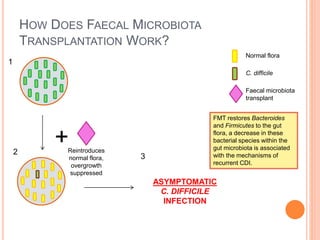
HOW DOES FAECAL MICROBIOTA
TRANSPLANTATION WORK?
Normal flora
C. difficile
Faecal microbiota
transplant
1
Reintroduces
normal flora,
overgrowth
suppressed
2
+
3
ASYMPTOMATIC
C. DIFFICILE
INFECTION
FMT restores Bacteroides
and Firmicutes to the gut
flora, a decrease in these
bacterial species within the
gut microbiota is associated
with the mechanisms of
recurrent CDI.
INDICATIONS
 Recurrent or relapsing CDI
 At least 3 episodes (mild to moderate) and failure of a 6
– 8 week taper with vancomycin with or without an
alternative antibiotic.
 At least 2 episodes (severe) resulting in hospitalization
and associated with significant morbidity.
 Moderate CDI not responding to standard therapy
for at least a week.
 Severe CDI (Pseudomembranous colitis) with no
response to standard therapy after 48 hours
DONOR SELECTION
 In theory, intimate contacts (spouse or partner) may
share infectious risk factors which may minimise the risk
of transmitting an infectious agent.
 In theory, maternal-line first-degree relatives (brother or
sister) may share greatest number of microbial species
in their intestinal microbiota with the recipient making for
a more tolerant transplant.
 In theory, men might make preferred donors over
women because women may harbour microbiota that is
more likely to result in irritable bowel syndrome (IBS).
 Although unrelated, healthy, thoroughly screened donors
may also be advantageous.
DONOR SELECTION
Screening
 Bacteria
 Viruses
 Parasites and ova
Exclusion factors
 HIV, Hepatitis B, Hepatitis C
 High-risk sexual behaviours
 Illicit drug use
 Known current communicable disease
 Metabolic disorders and others
Recipient exclusion factors
 In rare cases recipients may be excluded
DONOR AND RECIPIENT PREPARATION
Donor preparation
 May be given laxative the night before
 Should avoid foods the recipient may be allergic to
5 days before procedure
 Alert the clinician of symptoms of illness (Diarrhoea,
fever, vomiting, etc.)
Recipient preparation
 Administration of loperamide (enema &
colonoscopy route)
 Administration of a proton-pump inhibitor
(nasogastric tube route, evening before and
morning of procedure)
PROCESSING STOOL SAMPLE
 After passage, the stool sample should be used
within 24 hours (preferably within 6 hrs)
 Refrigerated, if necessary, but not frozen
 Diluted (saline or 4% milk)
 Homogenised (blended) to slurry consistency
 Filtered
 Final volume of 25–50 mL for use via nasogastric or
nasoduodenal tubes or 250–500 mL for use via
colonoscope or retention enema.
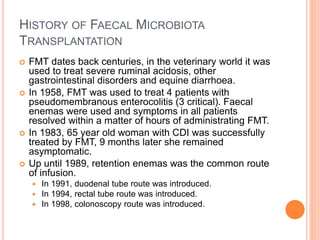
HISTORY OF FAECAL MICROBIOTA
TRANSPLANTATION
 FMT dates back centuries, in the veterinary world it was
used to treat severe ruminal acidosis, other
gastrointestinal disorders and equine diarrhoea.
 In 1958, FMT was used to treat 4 patients with
pseudomembranous enterocolitis (3 critical). Faecal
enemas were used and symptoms in all patients
resolved within a matter of hours of administrating FMT.
 In 1983, 65 year old woman with CDI was successfully
treated by FMT, 9 months later she remained
asymptomatic.
 Up until 1989, retention enemas was the common route
of infusion.
 In 1991, duodenal tube route was introduced.
 In 1994, rectal tube route was introduced.
 In 1998, colonoscopy route was introduced.
ADVANTAGES AND DISADVANTAGES OF
FAECAL MICROBIOTA TRANSPLANTATION
Advantages
 Extremely effective
(>90% efficacy)
 Readily available
 Inexpensive
 No significant adverse
effects
 Rapid response (hours
to days)
 Reduced risk of
antibiotic resistance
Disadvantages
 Unappealing nature
 Risk of transmitting
undetected diseases
MEDIA ATTENTION
http://www.cbc.ca/new
s/health/story/2007/11/
13/fecal-
transplant.html (2007)
http://www.cnn.co.uk/2012/09/26/health/f
ecal-transplant/index.html (2012)
http://www.bbc.co.uk/n
ews/health-20081895
(2012)
SUMMARY AND FUTURE
 Extremely effective treatment option for recurrent cases of
CDI, better outcomes compared to vancomycin therapy.
 Current and ongoing studies suggest that one could collect
and store one’s own faeces prior to antibiotic therapy. This is
then processed, filtered, refrigerated and stored so that in the
event of a CDI, FMT can be administered with the patient’s
own stool. This option is desirable as the patient’s own optimal
gut flora is restored.
 Standardisation of protocols – Is there a change in efficacy
with vancomycin and bowel lavage pre-treatment, the varying
routes of administration or amount of stool to be infused?
 Could FMT become the first line treatment option of CDI?
 There needs to be a change in attitudes both in doctors and
patients, and wider use of FMT should be investigated.
REFERENCES
 Bakken, J. S., Borody, T., Brandt, L. J., Brill, J. V., Demarco, D. C.,
Franzos, M. A., Kelly, C., Khoruts, A., Louie, T., Martinelli, L. P., Moore, T.
A., Russell, G., Surawicz, C. (2011). Treating Clostridium difficile
Infection With Fecal Microbiota Transplantation. Clinical
Gastroenterology and Hepatology; 9: 1044–1049.
 Nood, E.van., Vrieze, A., Nieuwdorp, M., Fuentes, S. Zoetendal, E. G.,
de Vos, W. M., Visser, C. E., Kuijper, E. J., Bartelsman, J. F. W. M.,
Tijssen, J. G. P., Speelman, P., Dijkgraaf, M. G. W., and Keller, J. J.
(2013). Duodenal Infusion of Donor Feces for Recurrent Clostridium
difficile. New England Journal of Medicine; 10.
 Rohlke, F. and Stollman, N. (2012). Fecal microbiota transplantation in
relapsing Clostridium difficile infection. Therapy Advances in
Gastroenterology; 5: 403–420.
 Borody, T. J., George, L., Andrews, P., Brandl, S., Noonan, S., Cole, P.,
Hyland, L., Morgan, A., Maysey, J; Moore-Jones, D (1989). Bowel-flora
alteration: a potential cure for inflammatory bowel disease and irritable
bowel syndrome? The Medical journal of Australia; 150: 604.

Treating Clostridium Difficile Infection With Faecal Microbiota Transplantation

  • 1.
    TREATING CLOSTRIDIUM DIFFICILE INFECTIONWITH FAECAL MICROBIOTA TRANSPLANTATION BY EDITH NGOBI BSc MSc Barts and the London School of Medicine and Dentistry 2013
  • 2.
    OBJECTIVES  Overview ofC. difficile  Problems with recurrent C. difficile infections  Faecal microbiota transplantation mechanisms  Donor and recipient requirements  Future of faecal microbiota transplantation
  • 3.
    OVERVIEW OF C.DIFFICILE  Gram positive rod  Anaerobe  Motile  Spore (heat-resistant)  Commensal flora in the guts of animals, humans (up to 3%) and infants (66%)  Produce toxins (enterotoxin - toxin A) and (cytotoxin - toxin B)
  • 4.
    OVERVIEW OF C.DIFFICILE INFECTION (CDI) Symptoms  Mild to serious diarrhoea  Abdominal pain  Fever  Pseudomembranous colitis (serious cases)  Asymptomatic (Carriers) Treatment  Metronidazole  Oral vancomycin  Fidaxomicin* (lower rate of recurrence)  Relapse after treatment occurs in 15-30% of all cases. *Treatment of CDI with fidaxomicin is still in clinical trials.
  • 5.
    C. DIFFICILE INFECTIONEPIDEMIC  Affecting more young and healthy people with no prior exposure to antibiotics or hospitals, people with inflammatory bowel disease, people with compromised immune systems and peripartum women  Rise in severe CDIs  Relapse and recurrence is increasing (Recurrence in 15–30% of patients after initial CDI and up to 65% of patients who experience 1 recurrence will have subsequent recurrences).  High cost of treating recurrent infection  Recurrence leads to persistent use of antibiotics, repeated hospitalizations, colectomies and death.
  • 6.
    DIFFICULTIES OF ANTIBIOTICTREATMENT  Emergence of new strains that are more virulent and more antibiotic resistant.  Efficacy of antibiotic therapy decreases with subsequent recurrences – metronidazole is losing efficacy pushing vancomycin as 1st line drug.  Vancomycin suppress both the pathogen as well as the protective gut flora.  Spores may remain and germinate into vegetative forms after cessation of treatment, (although one study showed 33% patients with recurrent CDI presented with a new strain).  Tapered or pulsed courses of vancomycin have been proposed to reduce the rate of recurrence.
  • 7.
    WHAT IS FAECALMICROBIOTA TRANSPLANTATION (FMT)?  ‘The restoration of the colonic flora by introducing healthy bacterial flora through infusion of stool obtained from a healthy human donor.’  Alternative treatment option for CDIs, FMT may also be used to treat colitis, constipation, irritable bowel syndrome, and some neurological conditions.  Proved >90% cure rate against CDI  Effectiveness is measured by the ‘resolution of symptoms - the primary end point’ and ‘absence of relapse within 8 weeks of FMT - the secondary end point’.
  • 8.
    HOW DOES FAECALMICROBIOTA TRANSPLANTATION WORK? + Resistant C. difficile multiply and produce toxins Normal flora C. difficile Antimicrobial drug 1 Kills susceptible bacteria 2 3 4 C. DIFFICILE INFECTION Symptoms Toxin
  • 9.
    HOW DOES FAECALMICROBIOTA TRANSPLANTATION WORK? Normal flora C. difficile Faecal microbiota transplant 1 Reintroduces normal flora, overgrowth suppressed 2 + 3 ASYMPTOMATIC C. DIFFICILE INFECTION FMT restores Bacteroides and Firmicutes to the gut flora, a decrease in these bacterial species within the gut microbiota is associated with the mechanisms of recurrent CDI.
  • 10.
    INDICATIONS  Recurrent orrelapsing CDI  At least 3 episodes (mild to moderate) and failure of a 6 – 8 week taper with vancomycin with or without an alternative antibiotic.  At least 2 episodes (severe) resulting in hospitalization and associated with significant morbidity.  Moderate CDI not responding to standard therapy for at least a week.  Severe CDI (Pseudomembranous colitis) with no response to standard therapy after 48 hours
  • 11.
    DONOR SELECTION  Intheory, intimate contacts (spouse or partner) may share infectious risk factors which may minimise the risk of transmitting an infectious agent.  In theory, maternal-line first-degree relatives (brother or sister) may share greatest number of microbial species in their intestinal microbiota with the recipient making for a more tolerant transplant.  In theory, men might make preferred donors over women because women may harbour microbiota that is more likely to result in irritable bowel syndrome (IBS).  Although unrelated, healthy, thoroughly screened donors may also be advantageous.
  • 12.
    DONOR SELECTION Screening  Bacteria Viruses  Parasites and ova Exclusion factors  HIV, Hepatitis B, Hepatitis C  High-risk sexual behaviours  Illicit drug use  Known current communicable disease  Metabolic disorders and others Recipient exclusion factors  In rare cases recipients may be excluded
  • 13.
    DONOR AND RECIPIENTPREPARATION Donor preparation  May be given laxative the night before  Should avoid foods the recipient may be allergic to 5 days before procedure  Alert the clinician of symptoms of illness (Diarrhoea, fever, vomiting, etc.) Recipient preparation  Administration of loperamide (enema & colonoscopy route)  Administration of a proton-pump inhibitor (nasogastric tube route, evening before and morning of procedure)
  • 14.
    PROCESSING STOOL SAMPLE After passage, the stool sample should be used within 24 hours (preferably within 6 hrs)  Refrigerated, if necessary, but not frozen  Diluted (saline or 4% milk)  Homogenised (blended) to slurry consistency  Filtered  Final volume of 25–50 mL for use via nasogastric or nasoduodenal tubes or 250–500 mL for use via colonoscope or retention enema.
  • 15.
    HISTORY OF FAECALMICROBIOTA TRANSPLANTATION  FMT dates back centuries, in the veterinary world it was used to treat severe ruminal acidosis, other gastrointestinal disorders and equine diarrhoea.  In 1958, FMT was used to treat 4 patients with pseudomembranous enterocolitis (3 critical). Faecal enemas were used and symptoms in all patients resolved within a matter of hours of administrating FMT.  In 1983, 65 year old woman with CDI was successfully treated by FMT, 9 months later she remained asymptomatic.  Up until 1989, retention enemas was the common route of infusion.  In 1991, duodenal tube route was introduced.  In 1994, rectal tube route was introduced.  In 1998, colonoscopy route was introduced.
  • 16.
    ADVANTAGES AND DISADVANTAGESOF FAECAL MICROBIOTA TRANSPLANTATION Advantages  Extremely effective (>90% efficacy)  Readily available  Inexpensive  No significant adverse effects  Rapid response (hours to days)  Reduced risk of antibiotic resistance Disadvantages  Unappealing nature  Risk of transmitting undetected diseases
  • 17.
  • 18.
    SUMMARY AND FUTURE Extremely effective treatment option for recurrent cases of CDI, better outcomes compared to vancomycin therapy.  Current and ongoing studies suggest that one could collect and store one’s own faeces prior to antibiotic therapy. This is then processed, filtered, refrigerated and stored so that in the event of a CDI, FMT can be administered with the patient’s own stool. This option is desirable as the patient’s own optimal gut flora is restored.  Standardisation of protocols – Is there a change in efficacy with vancomycin and bowel lavage pre-treatment, the varying routes of administration or amount of stool to be infused?  Could FMT become the first line treatment option of CDI?  There needs to be a change in attitudes both in doctors and patients, and wider use of FMT should be investigated.
  • 19.
    REFERENCES  Bakken, J.S., Borody, T., Brandt, L. J., Brill, J. V., Demarco, D. C., Franzos, M. A., Kelly, C., Khoruts, A., Louie, T., Martinelli, L. P., Moore, T. A., Russell, G., Surawicz, C. (2011). Treating Clostridium difficile Infection With Fecal Microbiota Transplantation. Clinical Gastroenterology and Hepatology; 9: 1044–1049.  Nood, E.van., Vrieze, A., Nieuwdorp, M., Fuentes, S. Zoetendal, E. G., de Vos, W. M., Visser, C. E., Kuijper, E. J., Bartelsman, J. F. W. M., Tijssen, J. G. P., Speelman, P., Dijkgraaf, M. G. W., and Keller, J. J. (2013). Duodenal Infusion of Donor Feces for Recurrent Clostridium difficile. New England Journal of Medicine; 10.  Rohlke, F. and Stollman, N. (2012). Fecal microbiota transplantation in relapsing Clostridium difficile infection. Therapy Advances in Gastroenterology; 5: 403–420.  Borody, T. J., George, L., Andrews, P., Brandl, S., Noonan, S., Cole, P., Hyland, L., Morgan, A., Maysey, J; Moore-Jones, D (1989). Bowel-flora alteration: a potential cure for inflammatory bowel disease and irritable bowel syndrome? The Medical journal of Australia; 150: 604.