
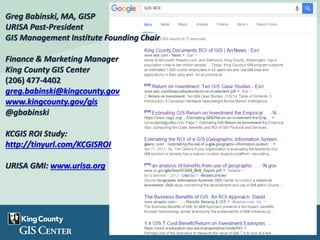
Greg Babinski, MA, GISP
King County GIS Center
Finance & Marketing Manager
URISA Past-President
URISA GIS Management Institute Founding Chair
FHWA GIS in Transportation Webinar
November 5, 2015
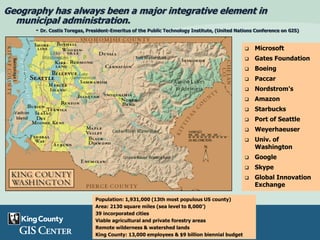
 Microsoft
 Gates Foundation
 Boeing
 Paccar
 Nordstrom's
 Amazon
 Starbucks
 Port of Seattle
 Weyerhaeuser
 Univ. of
Washington
 Google
 Skype
 Global Innovation
Exchange
Geography has always been a major integrative element in
municipal administration.
- Dr. Costis Toregas, President-Emeritus of the Public Technology Institute, (United Nations Conference on GIS)
Population: 1,931,000 (13th most populous US county)
Area: 2130 square miles (sea level to 8,000’)
39 incorporated cities
Viable agricultural and private forestry areas
Remote wilderness & watershed lands
King County: 13,000 employees & $9 billion biennial budget
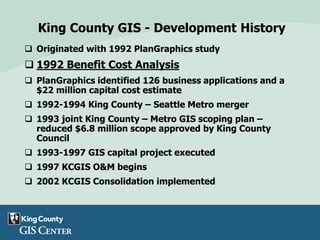
King County GIS - Development History:
 Originated with 1992 PlanGraphics study
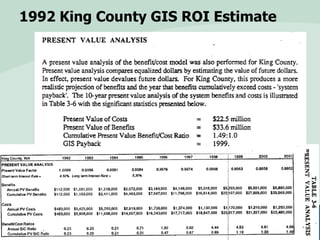
 1992 Benefit Cost Analysis
 PlanGraphics identified 126 business applications and a
$22 million capital cost estimate
 1992-1994 King County – Seattle Metro merger
 1993 joint King County – Metro GIS scoping plan –
reduced $6.8 million scope approved by King County
Council
 1993-1997 GIS capital project executed
 1997 KCGIS O&M begins
 2002 KCGIS Consolidation implemented
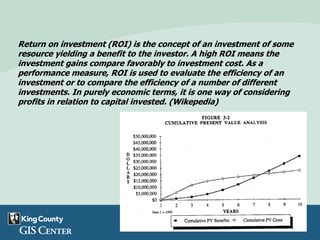
Return on investment (ROI) is the concept of an investment of some
resource yielding a benefit to the investor. A high ROI means the
investment gains compare favorably to investment cost. As a
performance measure, ROI is used to evaluate the efficiency of an
investment or to compare the efficiency of a number of different
investments. In purely economic terms, it is one way of considering
profits in relation to capital invested. (Wikepedia)
1992 King County GIS ROI Estimate
King County GIS - Development History
 Originated with 1992 PlanGraphics study
 1992 Benefit Cost Analysis
 PlanGraphics identified 126 business applications and a
$22 million capital cost estimate
 1992-1994 King County – Seattle Metro merger
 1993 joint King County – Metro GIS scoping plan –
reduced $6.8 million scope approved by King County
Council
 1993-1997 GIS capital project executed
 1997 KCGIS O&M begins
 2002 KCGIS Consolidation implemented
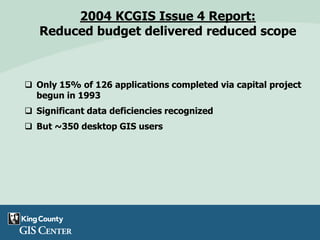
2004 KCGIS Issue 4 Report:
Reduced budget delivered reduced scope
 Only 15% of 126 applications completed via capital project
begun in 1993
 Significant data deficiencies recognized
 But ~350 desktop GIS users
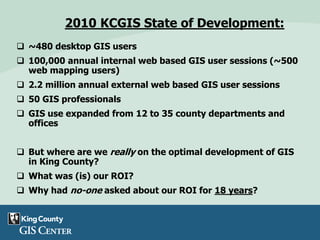
2010 KCGIS State of Development:
 ~480 desktop GIS users
 100,000 annual internal web based GIS user sessions (~500
web mapping users)
 2.2 million annual external web based GIS user sessions
 50 GIS professionals
 GIS use expanded from 12 to 35 county departments and
offices
 But where are we really on the optimal development of GIS
in King County?
 What was (is) our ROI?
 Why had no-one asked about our ROI for 18 years?
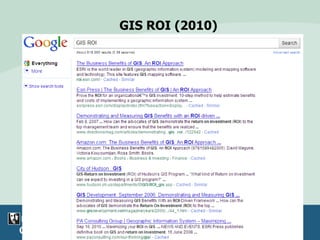
GIS ROI (2010)
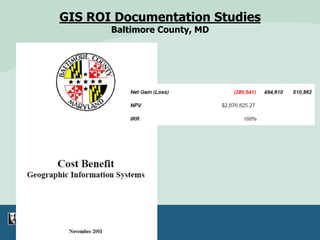
GIS ROI Documentation Studies
Baltimore County, MD
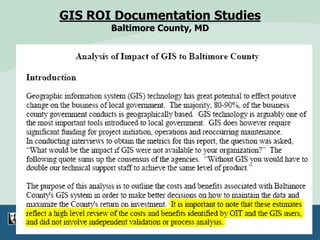
GIS ROI Documentation Studies
Baltimore County, MD
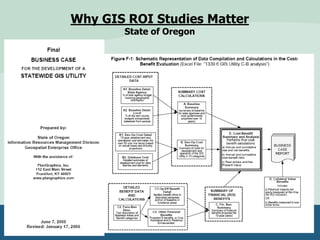
Why GIS ROI Studies Matter
State of Oregon
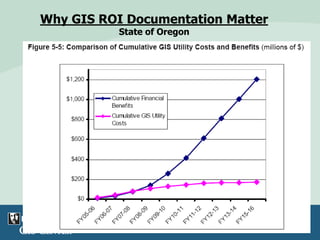
Why GIS ROI Documentation Matter
State of Oregon
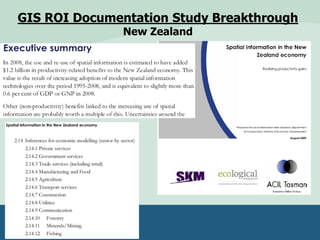
GIS ROI Documentation Study Breakthrough
New Zealand
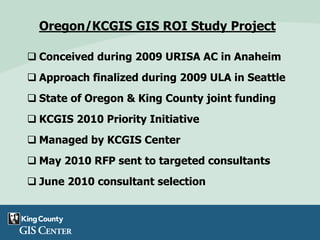
Oregon/KCGIS GIS ROI Study Project
 Conceived during 2009 URISA AC in Anaheim
 Approach finalized during 2009 ULA in Seattle
 State of Oregon & King County joint funding
 KCGIS 2010 Priority Initiative
 Managed by KCGIS Center
 May 2010 RFP sent to targeted consultants
 June 2010 consultant selection
KCGIS GIS ROI Study
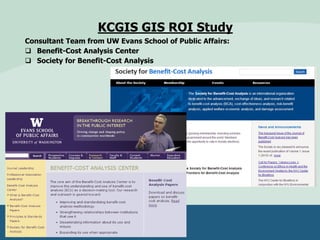
Consultant Team from UW Evans School of Public Affairs:
 Prof. Richard O. Zerbe
 Danielle Fumia & Travis Reynolds
 Pradeep Singh & Tyler Scott
KCGIS GIS ROI Study
Consultant Team from UW Evans School of Public Affairs:
 Benefit-Cost Analysis Center
 Society for Benefit-Cost Analysis
KCGIS GIS ROI Study
Scope of Work:
 Literature Review
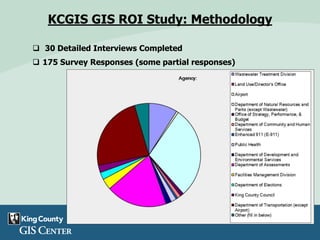
 Qualitative Interviews (n = 30)
 Quantitative Survey (n = 200)
 Final ROI Report
 Revised Interview/Survey Instruments for future
studies
Zerbe Methodology:
 ‘With versus without’ research design.
 What would have happened if KCGIS applications had not been
implemented and how is King County better off having them?
 Literature review and qualitative interviews will identify key
benefits associated with GIS applications (e.g., increased
productivity).
 Questionnaire will allow assessment of the extent to which these
benefits have been realized across different groups of users of GIS
applications, as opposed to what these users would have done in the
absence of GIS applications.
 By comparing the ‘with and without’ scenarios, we can assess and
monetize the added value of the GIS applications to compare to the
costs of implementation, maintenance, and/or additional training.’
KCGIS GIS ROI Study
With or without survey methodology:
 How has GIS altered agency output levels?
 Benefits associated with FTE reductions to produce the same (pre-GIS)
level of output
 Benefits associated with enhanced production with the same FTE levels
 Three stage analysis:
 Face-to-face structured interviews of agency heads and key employees
to assess the types of applications and business uses. Interviews were
used to build the online employee survey.
 Online survey of GIS-user employees and managers across King County
to record their pre and current (or with vs. without) GIS productivity by
output types.
 Interview and survey results were compiled by output type, agency,
and productivity levels. Results were then monetized.
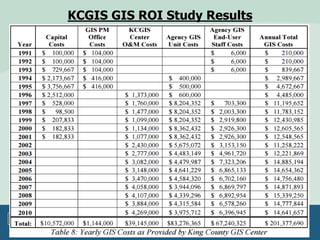
 Monetized benefits compared to detailed GIS capital, O&M,
and end-user costs
KCGIS GIS ROI Study: Methodology
KCGIS GIS ROI Study Results
 30 Detailed Interviews Completed
 175 Survey Responses (some partial responses)
KCGIS GIS ROI Study: Methodology
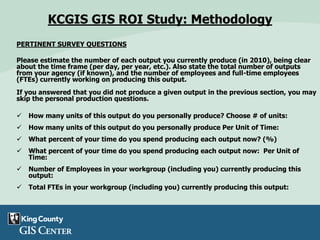
PERTINENT SURVEY QUESTIONS
Please estimate the number of each output you currently produce (in 2010), being clear
about the time frame (per day, per year, etc.). Also state the total number of outputs
from your agency (if known), and the number of employees and full-time employees
(FTEs) currently working on producing this output.
If you answered that you did not produce a given output in the previous section, you may
skip the personal production questions.
 How many units of this output do you personally produce? Choose # of units:
 How many units of this output do you personally produce Per Unit of Time:
 What percent of your time do you spend producing each output now? (%)
 What percent of your time do you spend producing each output now: Per Unit of
Time:
 Number of Employees in your workgroup (including you) currently producing this
output:
 Total FTEs in your workgroup (including you) currently producing this output:
KCGIS GIS ROI Study: Methodology
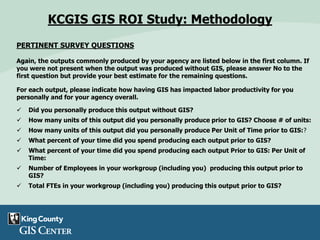
PERTINENT SURVEY QUESTIONS
Again, the outputs commonly produced by your agency are listed below in the first column. If
you were not present when the output was produced without GIS, please answer No to the
first question but provide your best estimate for the remaining questions.
For each output, please indicate how having GIS has impacted labor productivity for you
personally and for your agency overall.
 Did you personally produce this output without GIS?
 How many units of this output did you personally produce prior to GIS? Choose # of units:
 How many units of this output did you personally produce Per Unit of Time prior to GIS:?
 What percent of your time did you spend producing each output prior to GIS?
 What percent of your time did you spend producing each output Prior to GIS: Per Unit of
Time:
 Number of Employees in your workgroup (including you) producing this output prior to
GIS?
 Total FTEs in your workgroup (including you) producing this output prior to GIS?
KCGIS GIS ROI Study: Methodology
KCGIS GIS ROI Study Results
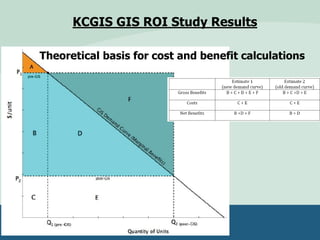
Theoretical basis for cost and benefit calculations
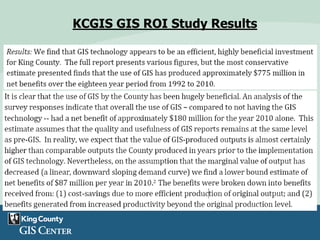
KCGIS GIS ROI Study Results
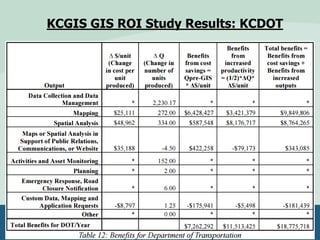
KCGIS GIS ROI Study Results: KCDOT
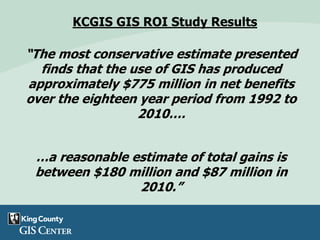
“The most conservative estimate presented
finds that the use of GIS has produced
approximately $775 million in net benefits
over the eighteen year period from 1992 to
2010….
…a reasonable estimate of total gains is
between $180 million and $87 million in
2010.”
KCGIS GIS ROI Study Results
Some Further Questions:
 At what stage is King County in the total potential business use
of GIS?
 Are the KCGIS results ‘good’?
 How do we know?
 Do we need similar studies of other large counties?
 Do we need similar surveys of mid-sized cities, where GIS
funding is often in jeopardy?
 Are government agency officials not now compelled to pursue
full GIS development?
KCGIS GIS ROI Study
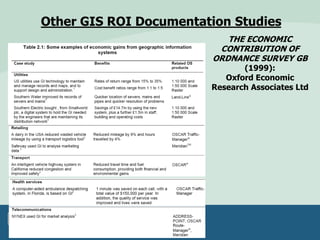
THE ECONOMIC
CONTRIBUTION OF
ORDNANCE SURVEY GB
(1999):
Oxford Economic
Research Associates Ltd
Other GIS ROI Documentation Studies
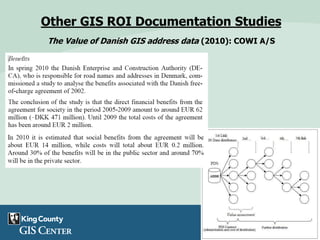
The Value of Danish GIS address data (2010): COWI A/S
Other GIS ROI Documentation Studies
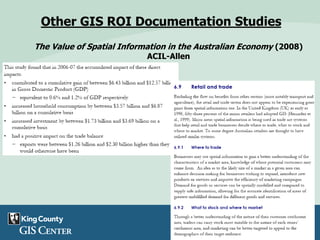
The Value of Spatial Information in the Australian Economy (2008)
ACIL-Allen
Other GIS ROI Documentation Studies
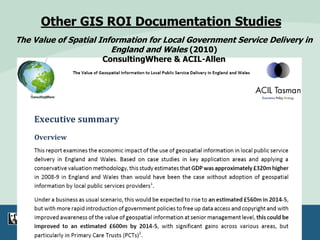
The Value of Spatial Information for Local Government Service Delivery in
England and Wales (2010)
ConsultingWhere & ACIL-Allen
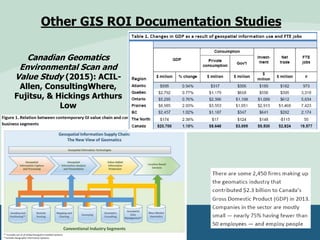
Canadian Geomatics
Environmental Scan and
Value Study (2015): ACIL-
Allen, ConsultingWhere,
Fujitsu, & Hickings Arthurs
Low
Other GIS ROI Documentation Studies
36
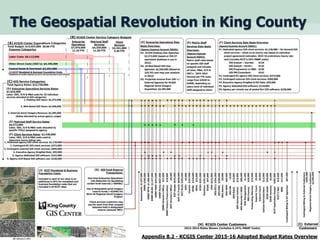
The Geospatial Revolution in King County
37
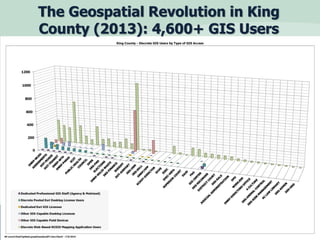
The Geospatial Revolution in King
County (2013): 4,600+ GIS Users
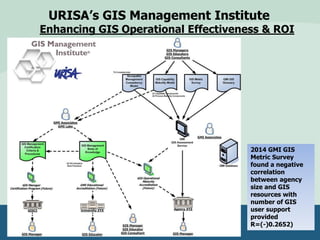
URISA’s GIS Management Institute
Enhancing GIS Operational Effectiveness & ROI
2014 GMI GIS
Metric Survey
found a negative
correlation
between agency
size and GIS
resources with
number of GIS
user support
provided
R=(-)0.2652)
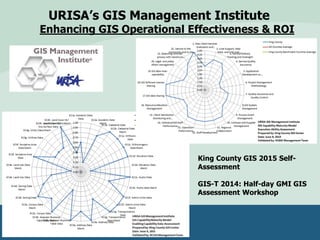
URISA’s GIS Management Institute
Enhancing GIS Operational Effectiveness & ROI
King County GIS 2015 Self-
Assessment
GIS-T 2014: Half-day GMI GIS
Assessment Workshop
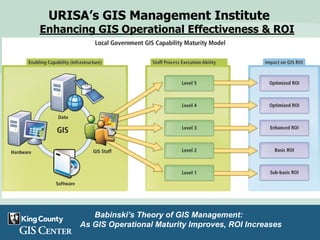
URISA’s GIS Management Institute
Enhancing GIS Operational Effectiveness & ROI
Babinski’s Theory of GIS Management:
As GIS Operational Maturity Improves, ROI Increases
Proposed Future Research
Enhancing GIS Operational Effectiveness & ROI
Cross-Sectional Study of GIS Capability, Maturity, Metrics & ROI:
 Study of at least 30 GIS operations
 Proposed study target: medium sized cities or counties (100K +/-
25%) in the US and Canada
 Study focused on current GIS ROI
 Each agency required to:
 Complete a current, validated GMI GIS Assessment (Metrics,
Capability, Process Maturity, Management Competency)
 Participate in a parallel GIS ROI analysis against the Zerbe GIS
ROI methodology
 Make the specifics of their results publically available for
research and analysis
 Zerbe research team will analyze and report on the causal
relationship between GIS metrics, capability, maturity, performance,
and ROI
Greg Babinski, MA, GISP
URISA Past-President
GIS Management Institute Founding Chair
Finance & Marketing Manager
King County GIS Center
(206) 477-4402
greg.babinski@kingcounty.gov
www.kingcounty.gov/gis
@gbabinski
KCGIS ROI Study:
http://tinyurl.com/KCGISROI
URISA GMI: www.urisa.org

GIS Return on Investment

  • 1.
    Greg Babinski, MA,GISP King County GIS Center Finance & Marketing Manager URISA Past-President URISA GIS Management Institute Founding Chair FHWA GIS in Transportation Webinar November 5, 2015
  • 3.
     Microsoft  GatesFoundation  Boeing  Paccar  Nordstrom's  Amazon  Starbucks  Port of Seattle  Weyerhaeuser  Univ. of Washington  Google  Skype  Global Innovation Exchange Geography has always been a major integrative element in municipal administration. - Dr. Costis Toregas, President-Emeritus of the Public Technology Institute, (United Nations Conference on GIS) Population: 1,931,000 (13th most populous US county) Area: 2130 square miles (sea level to 8,000’) 39 incorporated cities Viable agricultural and private forestry areas Remote wilderness & watershed lands King County: 13,000 employees & $9 billion biennial budget
  • 4.
    King County GIS- Development History:  Originated with 1992 PlanGraphics study  1992 Benefit Cost Analysis  PlanGraphics identified 126 business applications and a $22 million capital cost estimate  1992-1994 King County – Seattle Metro merger  1993 joint King County – Metro GIS scoping plan – reduced $6.8 million scope approved by King County Council  1993-1997 GIS capital project executed  1997 KCGIS O&M begins  2002 KCGIS Consolidation implemented
  • 5.
    Return on investment(ROI) is the concept of an investment of some resource yielding a benefit to the investor. A high ROI means the investment gains compare favorably to investment cost. As a performance measure, ROI is used to evaluate the efficiency of an investment or to compare the efficiency of a number of different investments. In purely economic terms, it is one way of considering profits in relation to capital invested. (Wikepedia)
  • 6.
    1992 King CountyGIS ROI Estimate
  • 7.
    King County GIS- Development History  Originated with 1992 PlanGraphics study  1992 Benefit Cost Analysis  PlanGraphics identified 126 business applications and a $22 million capital cost estimate  1992-1994 King County – Seattle Metro merger  1993 joint King County – Metro GIS scoping plan – reduced $6.8 million scope approved by King County Council  1993-1997 GIS capital project executed  1997 KCGIS O&M begins  2002 KCGIS Consolidation implemented
  • 8.
    2004 KCGIS Issue4 Report: Reduced budget delivered reduced scope  Only 15% of 126 applications completed via capital project begun in 1993  Significant data deficiencies recognized  But ~350 desktop GIS users
  • 9.
    2010 KCGIS Stateof Development:  ~480 desktop GIS users  100,000 annual internal web based GIS user sessions (~500 web mapping users)  2.2 million annual external web based GIS user sessions  50 GIS professionals  GIS use expanded from 12 to 35 county departments and offices  But where are we really on the optimal development of GIS in King County?  What was (is) our ROI?  Why had no-one asked about our ROI for 18 years?
  • 10.
  • 11.
    GIS ROI DocumentationStudies Baltimore County, MD
  • 12.
    GIS ROI DocumentationStudies Baltimore County, MD
  • 13.
    Why GIS ROIStudies Matter State of Oregon
  • 14.
    Why GIS ROIDocumentation Matter State of Oregon
  • 15.
    GIS ROI DocumentationStudy Breakthrough New Zealand
  • 16.
    Oregon/KCGIS GIS ROIStudy Project  Conceived during 2009 URISA AC in Anaheim  Approach finalized during 2009 ULA in Seattle  State of Oregon & King County joint funding  KCGIS 2010 Priority Initiative  Managed by KCGIS Center  May 2010 RFP sent to targeted consultants  June 2010 consultant selection
  • 17.
    KCGIS GIS ROIStudy Consultant Team from UW Evans School of Public Affairs:  Prof. Richard O. Zerbe  Danielle Fumia & Travis Reynolds  Pradeep Singh & Tyler Scott
  • 18.
    KCGIS GIS ROIStudy Consultant Team from UW Evans School of Public Affairs:  Benefit-Cost Analysis Center  Society for Benefit-Cost Analysis
  • 19.
    KCGIS GIS ROIStudy Scope of Work:  Literature Review  Qualitative Interviews (n = 30)  Quantitative Survey (n = 200)  Final ROI Report  Revised Interview/Survey Instruments for future studies
  • 20.
    Zerbe Methodology:  ‘Withversus without’ research design.  What would have happened if KCGIS applications had not been implemented and how is King County better off having them?  Literature review and qualitative interviews will identify key benefits associated with GIS applications (e.g., increased productivity).  Questionnaire will allow assessment of the extent to which these benefits have been realized across different groups of users of GIS applications, as opposed to what these users would have done in the absence of GIS applications.  By comparing the ‘with and without’ scenarios, we can assess and monetize the added value of the GIS applications to compare to the costs of implementation, maintenance, and/or additional training.’ KCGIS GIS ROI Study
  • 21.
    With or withoutsurvey methodology:  How has GIS altered agency output levels?  Benefits associated with FTE reductions to produce the same (pre-GIS) level of output  Benefits associated with enhanced production with the same FTE levels  Three stage analysis:  Face-to-face structured interviews of agency heads and key employees to assess the types of applications and business uses. Interviews were used to build the online employee survey.  Online survey of GIS-user employees and managers across King County to record their pre and current (or with vs. without) GIS productivity by output types.  Interview and survey results were compiled by output type, agency, and productivity levels. Results were then monetized.  Monetized benefits compared to detailed GIS capital, O&M, and end-user costs KCGIS GIS ROI Study: Methodology
  • 22.
    KCGIS GIS ROIStudy Results
  • 23.
     30 DetailedInterviews Completed  175 Survey Responses (some partial responses) KCGIS GIS ROI Study: Methodology
  • 24.
    PERTINENT SURVEY QUESTIONS Pleaseestimate the number of each output you currently produce (in 2010), being clear about the time frame (per day, per year, etc.). Also state the total number of outputs from your agency (if known), and the number of employees and full-time employees (FTEs) currently working on producing this output. If you answered that you did not produce a given output in the previous section, you may skip the personal production questions.  How many units of this output do you personally produce? Choose # of units:  How many units of this output do you personally produce Per Unit of Time:  What percent of your time do you spend producing each output now? (%)  What percent of your time do you spend producing each output now: Per Unit of Time:  Number of Employees in your workgroup (including you) currently producing this output:  Total FTEs in your workgroup (including you) currently producing this output: KCGIS GIS ROI Study: Methodology
  • 25.
    PERTINENT SURVEY QUESTIONS Again,the outputs commonly produced by your agency are listed below in the first column. If you were not present when the output was produced without GIS, please answer No to the first question but provide your best estimate for the remaining questions. For each output, please indicate how having GIS has impacted labor productivity for you personally and for your agency overall.  Did you personally produce this output without GIS?  How many units of this output did you personally produce prior to GIS? Choose # of units:  How many units of this output did you personally produce Per Unit of Time prior to GIS:?  What percent of your time did you spend producing each output prior to GIS?  What percent of your time did you spend producing each output Prior to GIS: Per Unit of Time:  Number of Employees in your workgroup (including you) producing this output prior to GIS?  Total FTEs in your workgroup (including you) producing this output prior to GIS? KCGIS GIS ROI Study: Methodology
  • 26.
    KCGIS GIS ROIStudy Results Theoretical basis for cost and benefit calculations
  • 27.
    KCGIS GIS ROIStudy Results
  • 28.
    KCGIS GIS ROIStudy Results: KCDOT
  • 29.
    “The most conservativeestimate presented finds that the use of GIS has produced approximately $775 million in net benefits over the eighteen year period from 1992 to 2010…. …a reasonable estimate of total gains is between $180 million and $87 million in 2010.” KCGIS GIS ROI Study Results
  • 30.
    Some Further Questions: At what stage is King County in the total potential business use of GIS?  Are the KCGIS results ‘good’?  How do we know?  Do we need similar studies of other large counties?  Do we need similar surveys of mid-sized cities, where GIS funding is often in jeopardy?  Are government agency officials not now compelled to pursue full GIS development? KCGIS GIS ROI Study
  • 31.
    THE ECONOMIC CONTRIBUTION OF ORDNANCESURVEY GB (1999): Oxford Economic Research Associates Ltd Other GIS ROI Documentation Studies
  • 32.
    The Value ofDanish GIS address data (2010): COWI A/S Other GIS ROI Documentation Studies
  • 33.
    The Value ofSpatial Information in the Australian Economy (2008) ACIL-Allen Other GIS ROI Documentation Studies
  • 34.
    Other GIS ROIDocumentation Studies The Value of Spatial Information for Local Government Service Delivery in England and Wales (2010) ConsultingWhere & ACIL-Allen
  • 35.
    Canadian Geomatics Environmental Scanand Value Study (2015): ACIL- Allen, ConsultingWhere, Fujitsu, & Hickings Arthurs Low Other GIS ROI Documentation Studies
  • 36.
  • 37.
    37 The Geospatial Revolutionin King County (2013): 4,600+ GIS Users
  • 38.
    URISA’s GIS ManagementInstitute Enhancing GIS Operational Effectiveness & ROI 2014 GMI GIS Metric Survey found a negative correlation between agency size and GIS resources with number of GIS user support provided R=(-)0.2652)
  • 39.
    URISA’s GIS ManagementInstitute Enhancing GIS Operational Effectiveness & ROI King County GIS 2015 Self- Assessment GIS-T 2014: Half-day GMI GIS Assessment Workshop
  • 40.
    URISA’s GIS ManagementInstitute Enhancing GIS Operational Effectiveness & ROI Babinski’s Theory of GIS Management: As GIS Operational Maturity Improves, ROI Increases
  • 41.
    Proposed Future Research EnhancingGIS Operational Effectiveness & ROI Cross-Sectional Study of GIS Capability, Maturity, Metrics & ROI:  Study of at least 30 GIS operations  Proposed study target: medium sized cities or counties (100K +/- 25%) in the US and Canada  Study focused on current GIS ROI  Each agency required to:  Complete a current, validated GMI GIS Assessment (Metrics, Capability, Process Maturity, Management Competency)  Participate in a parallel GIS ROI analysis against the Zerbe GIS ROI methodology  Make the specifics of their results publically available for research and analysis  Zerbe research team will analyze and report on the causal relationship between GIS metrics, capability, maturity, performance, and ROI
  • 42.
    Greg Babinski, MA,GISP URISA Past-President GIS Management Institute Founding Chair Finance & Marketing Manager King County GIS Center (206) 477-4402 greg.babinski@kingcounty.gov www.kingcounty.gov/gis @gbabinski KCGIS ROI Study: http://tinyurl.com/KCGISROI URISA GMI: www.urisa.org