Download to read offline
![BURISA 194 page 3 December 2012
FORTY YEARS OF BURISA
Alan Lodwick, BURISA Board Member since 1989
and BURISA Secretary, 1994-1999 and 2001-2010
This final BURISA newsletter provides an unrepeatable
opportunity to look back at the Association’s
development and achievements over its forty year
existence. It draws on material from the 193 previous
issues, from minutes of Board meetings and from
personal recollections of Board members.
The establishment of BURISA
BURISA was founded in 1972 with the help of a loan of
£200 from the Centre for Environmental Studies (CES :
an organisation which closed in the 1980s following
withdrawal of funding under the then government’s cull
of quangos). Its name was derived from that of a US
association, URISA, which had been established a few
years earlier and is still going strong (see elsewhere in
this and previous issues), now concentrating on
geographical information.
The Association’s establishment reflected the growing
importance being given to the use and analysis of
information by public bodies. Local Government was
about to be reorganised and “corporate management”
was the order of the day, while the 1968 Town and
Country Planning Act had for the first time required
local planning authorities to undertake surveys and keep
under review “the social, economic and environmental
conditions” in their areas. Also at this time, computing
technology had advanced to the point where it was
feasible for public organisations to contemplate its use
beyond basic financial applications to land and property,
transport and population databases and even forecasting.
BURISA’s first Editorial Board had seven members,
many of them close friends. They included Jeff Willis as
editor, then at the University of Liverpool but soon after
to move into local government on Merseyside to take a
lead in the development of information systems; Richard
Baxter of the Centre for Land Use and Built Form
Studies at Cambridge University and author of a classic
textbook Computer and Statistical Techniques for
Planners; and, David Rhind, then at the Experimental
Cartography Unit of the Royal College of Art,
subsequently Director General of Ordnance Survey
amongst many other senior positions and very well
known to subscribers through his regular involvement in
BURISA events, including our final conference in
October this year. The remaining members of the Board
were from local authorities together with a
representative from CES. There was also an advisory
board of three representing the Department of the
Environment (DoE) and the (then) OPCS.
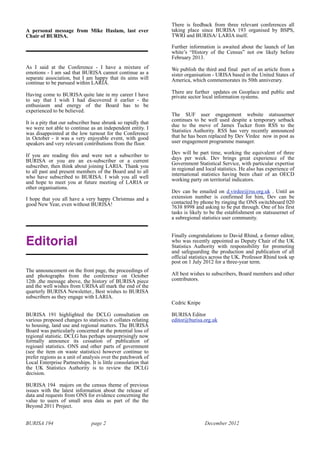
The first issue of the newsletter appeared in October
1972, announcing that:
“The aims of the BURISA newsletter can be
summarised as "making public relevant information
about information systems". The establishment of this
newsletter comes at a time when information system
activity is accelerating in every local authority, when
urban research is more and more influenced by data
availability and public decision making is changing to
take advantage of twentieth century technology.”
and,
“It will fill the large gap between the professional
journals and the personal contact .. [and]…it will raise
the level of debate by identifying major trends of
thought, allowing users to understand each others
problems, comparing solutions, helping to exploit the
resources available in this country to the full and
providing short cuts to important sources of
information.”
It included descriptions of developments at Leeds and
Coventry Councils, two of the pioneers in information
systems development in local government. It also
contained an article on the GISP Report which had been
published a month earlier. This long awaited report, on a
General Information System for Planning, gave
guidance to local authorities on how to collect and use
information for planning purposes and gave a further
impetus to the local developments which BURISA
intended to report. Spatial Referencing was another key
topic that would return in future issues.
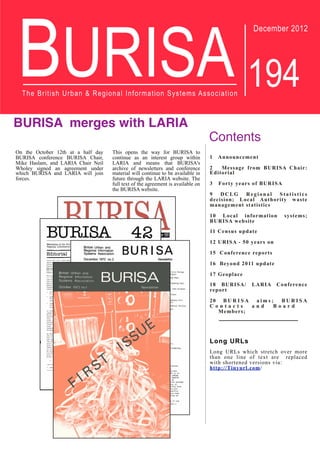
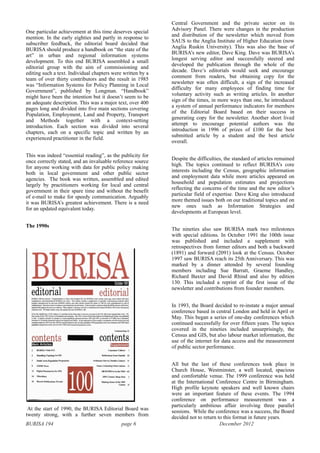
This newsletter was the only one ever to feature a
picture on the front page (reproduced in issue 130 and
this last edition). The content was typed and put together
laboriously. Sue Barrett, editor from 1976-1981,
subsequently described the “ghastly process of
assembling the typewritten text and getting it all to fit on
pages and pasting up. This was all done with scissors
and cow gum … with the headings put in manually
using letraset”. Word-processing, DTP and the internet
were not even on the horizon.
The 1970s
!](https://image.slidesharecdn.com/burisa194-220714171846-abf63122/85/BURISA-Newsletter-Issue-194-Final-Issue-3-320.jpg)
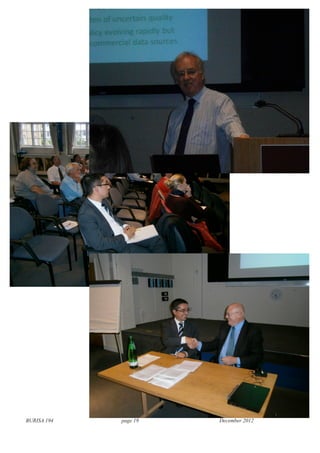

In December 2012, the British Urban and Regional Information Systems Association (BURISA) merged with LARIA, with both chairs signing an agreement to pursue BURISA's aims within LARIA. The final BURISA newsletter reflects on its 40-year history, acknowledging its achievements and the challenges that led to its closure, including a shrinking subscriber base. Key topics discussed include the cessation of DCLG regional statistics, updates on local information systems, and ongoing contributions from the census within the context of BURISA's legacy.


![5G Explained! A High Level Overview [Introduction]](https://cdn.slidesharecdn.com/ss_thumbnails/5gexplainedahighleveloverview-260119165306-cc137a3e-thumbnail.jpg?width=640&height=640&fit=bounds)


