International Refereed Journal of Engineering and Science (IRJES) 
ISSN (Online) 2319-183X, (Print) 2319-1821 
Volume 3, Issue 9 (September 2014), PP.35-38 
GI-FI, the Technology of New Era 
Desai Vaishali J.1, Ramani Shrusti K.2 
1Department of Computer Science, Saurashtra university, India 
2Department of Computer Science, Saurashtra university, India 
Abstract: - Gi-Fi (Gigabit Fidelity) or Gigabit Wireless refers to wireless communication at a data rate of more 
than one billion bits (gigabit) per second. Gi-Fi offers some advantages over Wi-Fi, a 
similar wireless technology. In that it offers faster information rate in Gbps, less power consumption and low 
cost for short range transmissions as compare to current technology. Gi-Fi consists of a chip which has the 
facility to deliver short-range multi gigabit data transfer in a local environment and compared to other 
technologies in the market it is ten times faster. Gi-Fi has the data transfer speed up to 5 gbps within a short 
range of 10 meters. It operates on the 60GHz frequency band. Gi-Fi is developed on an integrated wireless 
transceiver chip. It has both transmitter & receiver, integrated on a single chip which is fabricated using the 
CMOS (complementary metal–oxide–semiconductor) process and it also consists of a small antenna. Gi- 
Fi allows transferring large videos, audio files, data files etc. within few seconds. 
www.irjes.org 35 | Page 
Keywords:- Gi-Fi, CMOS, Wi-Fi 
I. INTRODUCTION 
Gigabit Wireless is the world‟s first transceiver integrated on a single chip which operates at 60GHz 
on the CMOS process. Wireless transfer of large files, audio and video data upto 5 gigabits per second is 
possible with this chip. The cost of wireless transfer rate is one-tenth and it provides ten times faster speed 
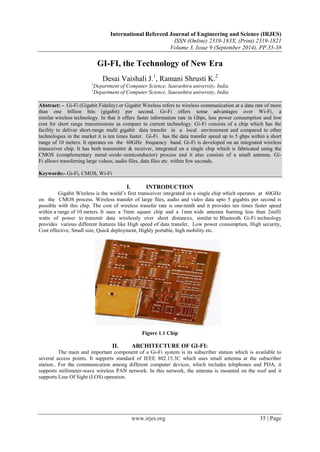
within a range of 10 meters. It uses a 5mm square chip and a 1mm wide antenna burning less than 2milli 
watts of power to transmit data wirelessly over short distances, similar to Bluetooth. Gi-Fi technology 
provides various different features like High speed of data transfer, Low power consumption, High security, 
Cost effective, Small size, Quick deployment, Highly portable, high mobility etc. 
Figure 1.1 Chip 
II. ARCHITECTURE OF GI-FI: 
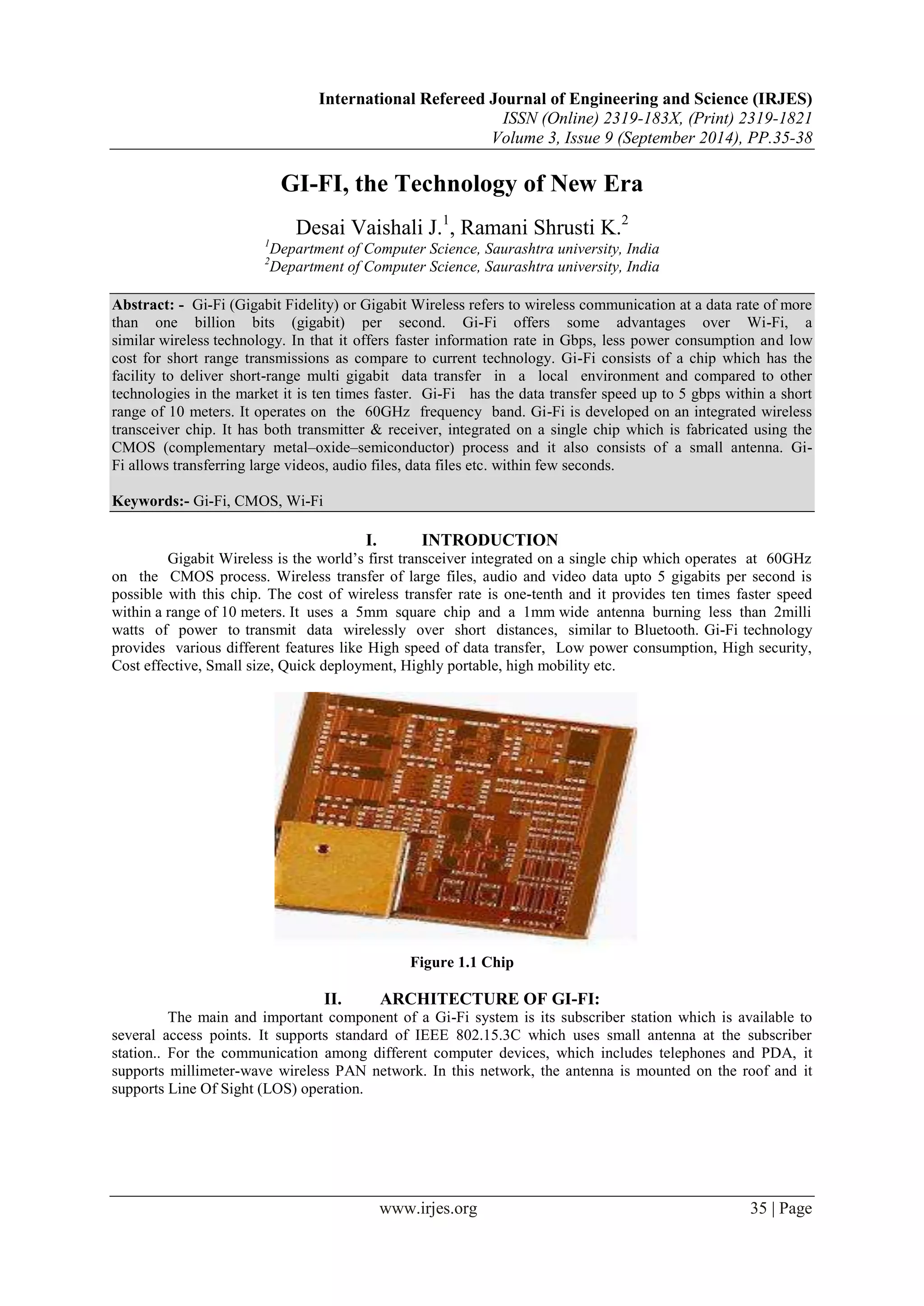
The main and important component of a Gi-Fi system is its subscriber station which is available to 
several access points. It supports standard of IEEE 802.15.3C which uses small antenna at the subscriber 
station.. For the communication among different computer devices, which includes telephones and PDA, it 
supports millimeter-wave wireless PAN network. In this network, the antenna is mounted on the roof and it 
supports Line Of Sight (LOS) operation.
GI-FI, the Technology of New Era 
Figure 2.1 Architecture of Gi-Fi 
www.irjes.org 36 | Page 
 What is 802.15.3C Technologies? 
This millimeter-Wave WPAN will operate in the new and clear band including 57-64 GHz unlicensed 
band defined by FCC 47 CFR 15.255. The millimeter-wave WPAN will allow high coexistence (close physical 
spacing) with all other microwave systems in the 802.15 family of WPANs. It transmits multiple signals 
simultaneously across the wireless transmission paths within separate frequencies to avoid interference. 
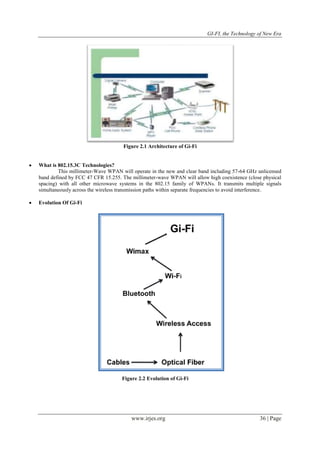
 Evolution Of Gi-Fi 
Figure 2.2 Evolution of Gi-Fi
GI-FI, the Technology of New Era 
III. WHY GI-FI ? 
 Comparison between Gi-Fi, Wi-Fi & Bluetooth 
Characteristics Gi-Fi Wi-Fi Bluetooth 
Development 
2004 1990 1998 
Start 
www.irjes.org 37 | Page 
Specification 
Authority 
NICTA IEEE, 
WECA 
Bluetooth 
SIG 
Frequency 57-64GHz 2.4 GHz 2.4 GHz 
Data Transfer 
Rate 
5 Gbps 11 Mbps 800 Kbps 
Range 10 Meters 100 Meters 10 Meters 
Power 
< 2 MW 10 MW 5MW 
Consumption 
Primary Devices Mobile phones, 
Home Devices, 
Electronics etc. 
Notebooks, 
Computers, 
Desktop 
Computers, 
Servers etc. 
Mobile phones, Home 
Devices, Electronics 
etc. 
Table 3.1 Gi-Fi Comparison 
IV. FEATURES OF GI-FI 
 High Security: 
As the IEEE 802.15.3C provides more security, it provides link level and service level security, where 
these features are optional. Point-to-point wireless systems operating at 60 GHz have been used for many years 
by the intelligence community for high security communications and by the military for satellite-to satellite 
communications. 
 High speed data transfer: 
The main invention of Gi-Fi is to provide higher bit rate Because of this high speed data transfer, we 
can transfer large video, audio, data files within seconds. .As the name itself indicates data transfer rate is in 
Giga bits per second it is 10 times faster than the present data transfer rate. The speed of Gi-Fi is 5 Gbps. An 
entire High-Definition (HD)movie could be transmitted to a mobile phone in a few seconds, and the phone 
could then upload the movie to a home computer or screen at the same speed. 
 Small Size: 
The chip, just 5mm per side, has a tiny 1mm antenna and uses the 60GHz „millimeter-wave‟ spectrum. 
 Low Power Consumption: 
This is the best feature because although the large amount of information is transferred, it utilizes milli-watts 
of power only. Generally in present technologies it takes 10mwatt power, which is very high but this 
technology consumes only 2mwatt power for data transfer of gigabits of information. 
 Cost-effective: 
Gi-Fi is based on an open, international standard due to which the use of low-cost, mass-produced 
chipsets, will bring down the cost automatically. This also results in integrated wireless transceiver chip which 
transfers data at high speed and low power at low price of $10 only which is very less as compared to present 
systems. As time will pass and development increases , the price of Gi-Fi will be decreased. 
V. APPLICATIONS 
 House Hold Appliances: 
Consumers could typically download a high definition movie from a kiosk in a matter of seconds to 
music player or smart phone and having got home could play it on a home theatre system or store it on a home 
server for future viewing, again within a few seconds, high speed internet access, streaming content download 
(video on demand, HDTV, home theater, etc.), real time streaming and wireless data bus for cable replacement.
GI-FI, the Technology of New Era 
www.irjes.org 38 | Page 
 Office Appliances: 
As it transfers data at high speeds which made work very easy, it also provides high quality of 
information from internet. 
 Video information transfer: 
By using present technologies video swapping takes hours of time, whereas by this we can transfer at a 
speed of Gbps. 
Data transfer rate is same for transfer of information from a PC to a cell or a cell to a PC. It can enable 
wireless monitors, the efficient transfer of data from digital camcorders, wireless printing of digital pictures 
from a camera without the need for an intervening personal computer and the transfer of files among cell phone 
handsets and other handheld devices like personal digital audio and video players. 
 Future Considerations: 
As the range is limited to shorter distances only we can expect the broad band with same speed and low 
power consumption. 
 Easily Embedded Into Devices 
 Wireless Office and Home Equipment 
 Great Reliability And Ability 
 Greater Potential 
 Wireless HD 
VI. CONCLUSION 
Within five years, Gi-Fi is the powerful technology for wireless networking. In this paper, the 
comparison is performed between Gi-Fi, Bluetooth and Wi-Fi technologies shows that these features along 
with some other benefits make it suitable to replace the existing wireless technologies. Gi-Fi offers High 
speed of data transfer, Low power consumption, High security, Cost effective, Quick deployment, Small size, 
Highly portable, high mobility etc.for short range transmissions as compare to current technology. Gi-Fi can 
be used in many devices such as media access control, Smartphone‟s, wireless PAN network. high cost of 
infrastructure have not yet possible for wi-fi to become a power network, then towards this problem the better 
technology despite the advantages of rate present technologies led to the introduction of new Gi-Fi. It 
removes cables that for many years ruled over the world and provides high speed data transfer rate. 
REFERENCES 
[1]. Ross, John, ―The Book of Wireless: A Painless Guide to Wi-Fi and Broadband Wireless, Second 
Edition, San Francisco, CA: No Starch Press, 2008 
[2]. GI-FI technology “Wikipedia” 
[3]. Gowtham S Shetty, ―GiFi: Next Generation Wireless Technology, Seminar report, Visvesvaraya 
Technological university Belgaum, 2011 
[4]. Report on “GI-FI Technology “. 
[5]. www.ieee.org

International Refereed Journal of Engineering and Science (IRJES)

  • 1.
    International Refereed Journalof Engineering and Science (IRJES) ISSN (Online) 2319-183X, (Print) 2319-1821 Volume 3, Issue 9 (September 2014), PP.35-38 GI-FI, the Technology of New Era Desai Vaishali J.1, Ramani Shrusti K.2 1Department of Computer Science, Saurashtra university, India 2Department of Computer Science, Saurashtra university, India Abstract: - Gi-Fi (Gigabit Fidelity) or Gigabit Wireless refers to wireless communication at a data rate of more than one billion bits (gigabit) per second. Gi-Fi offers some advantages over Wi-Fi, a similar wireless technology. In that it offers faster information rate in Gbps, less power consumption and low cost for short range transmissions as compare to current technology. Gi-Fi consists of a chip which has the facility to deliver short-range multi gigabit data transfer in a local environment and compared to other technologies in the market it is ten times faster. Gi-Fi has the data transfer speed up to 5 gbps within a short range of 10 meters. It operates on the 60GHz frequency band. Gi-Fi is developed on an integrated wireless transceiver chip. It has both transmitter & receiver, integrated on a single chip which is fabricated using the CMOS (complementary metal–oxide–semiconductor) process and it also consists of a small antenna. Gi- Fi allows transferring large videos, audio files, data files etc. within few seconds. www.irjes.org 35 | Page Keywords:- Gi-Fi, CMOS, Wi-Fi I. INTRODUCTION Gigabit Wireless is the world‟s first transceiver integrated on a single chip which operates at 60GHz on the CMOS process. Wireless transfer of large files, audio and video data upto 5 gigabits per second is possible with this chip. The cost of wireless transfer rate is one-tenth and it provides ten times faster speed within a range of 10 meters. It uses a 5mm square chip and a 1mm wide antenna burning less than 2milli watts of power to transmit data wirelessly over short distances, similar to Bluetooth. Gi-Fi technology provides various different features like High speed of data transfer, Low power consumption, High security, Cost effective, Small size, Quick deployment, Highly portable, high mobility etc. Figure 1.1 Chip II. ARCHITECTURE OF GI-FI: The main and important component of a Gi-Fi system is its subscriber station which is available to several access points. It supports standard of IEEE 802.15.3C which uses small antenna at the subscriber station.. For the communication among different computer devices, which includes telephones and PDA, it supports millimeter-wave wireless PAN network. In this network, the antenna is mounted on the roof and it supports Line Of Sight (LOS) operation.
  • 2.
    GI-FI, the Technologyof New Era Figure 2.1 Architecture of Gi-Fi www.irjes.org 36 | Page  What is 802.15.3C Technologies? This millimeter-Wave WPAN will operate in the new and clear band including 57-64 GHz unlicensed band defined by FCC 47 CFR 15.255. The millimeter-wave WPAN will allow high coexistence (close physical spacing) with all other microwave systems in the 802.15 family of WPANs. It transmits multiple signals simultaneously across the wireless transmission paths within separate frequencies to avoid interference.  Evolution Of Gi-Fi Figure 2.2 Evolution of Gi-Fi
  • 3.
    GI-FI, the Technologyof New Era III. WHY GI-FI ?  Comparison between Gi-Fi, Wi-Fi & Bluetooth Characteristics Gi-Fi Wi-Fi Bluetooth Development 2004 1990 1998 Start www.irjes.org 37 | Page Specification Authority NICTA IEEE, WECA Bluetooth SIG Frequency 57-64GHz 2.4 GHz 2.4 GHz Data Transfer Rate 5 Gbps 11 Mbps 800 Kbps Range 10 Meters 100 Meters 10 Meters Power < 2 MW 10 MW 5MW Consumption Primary Devices Mobile phones, Home Devices, Electronics etc. Notebooks, Computers, Desktop Computers, Servers etc. Mobile phones, Home Devices, Electronics etc. Table 3.1 Gi-Fi Comparison IV. FEATURES OF GI-FI  High Security: As the IEEE 802.15.3C provides more security, it provides link level and service level security, where these features are optional. Point-to-point wireless systems operating at 60 GHz have been used for many years by the intelligence community for high security communications and by the military for satellite-to satellite communications.  High speed data transfer: The main invention of Gi-Fi is to provide higher bit rate Because of this high speed data transfer, we can transfer large video, audio, data files within seconds. .As the name itself indicates data transfer rate is in Giga bits per second it is 10 times faster than the present data transfer rate. The speed of Gi-Fi is 5 Gbps. An entire High-Definition (HD)movie could be transmitted to a mobile phone in a few seconds, and the phone could then upload the movie to a home computer or screen at the same speed.  Small Size: The chip, just 5mm per side, has a tiny 1mm antenna and uses the 60GHz „millimeter-wave‟ spectrum.  Low Power Consumption: This is the best feature because although the large amount of information is transferred, it utilizes milli-watts of power only. Generally in present technologies it takes 10mwatt power, which is very high but this technology consumes only 2mwatt power for data transfer of gigabits of information.  Cost-effective: Gi-Fi is based on an open, international standard due to which the use of low-cost, mass-produced chipsets, will bring down the cost automatically. This also results in integrated wireless transceiver chip which transfers data at high speed and low power at low price of $10 only which is very less as compared to present systems. As time will pass and development increases , the price of Gi-Fi will be decreased. V. APPLICATIONS  House Hold Appliances: Consumers could typically download a high definition movie from a kiosk in a matter of seconds to music player or smart phone and having got home could play it on a home theatre system or store it on a home server for future viewing, again within a few seconds, high speed internet access, streaming content download (video on demand, HDTV, home theater, etc.), real time streaming and wireless data bus for cable replacement.
  • 4.
    GI-FI, the Technologyof New Era www.irjes.org 38 | Page  Office Appliances: As it transfers data at high speeds which made work very easy, it also provides high quality of information from internet.  Video information transfer: By using present technologies video swapping takes hours of time, whereas by this we can transfer at a speed of Gbps. Data transfer rate is same for transfer of information from a PC to a cell or a cell to a PC. It can enable wireless monitors, the efficient transfer of data from digital camcorders, wireless printing of digital pictures from a camera without the need for an intervening personal computer and the transfer of files among cell phone handsets and other handheld devices like personal digital audio and video players.  Future Considerations: As the range is limited to shorter distances only we can expect the broad band with same speed and low power consumption.  Easily Embedded Into Devices  Wireless Office and Home Equipment  Great Reliability And Ability  Greater Potential  Wireless HD VI. CONCLUSION Within five years, Gi-Fi is the powerful technology for wireless networking. In this paper, the comparison is performed between Gi-Fi, Bluetooth and Wi-Fi technologies shows that these features along with some other benefits make it suitable to replace the existing wireless technologies. Gi-Fi offers High speed of data transfer, Low power consumption, High security, Cost effective, Quick deployment, Small size, Highly portable, high mobility etc.for short range transmissions as compare to current technology. Gi-Fi can be used in many devices such as media access control, Smartphone‟s, wireless PAN network. high cost of infrastructure have not yet possible for wi-fi to become a power network, then towards this problem the better technology despite the advantages of rate present technologies led to the introduction of new Gi-Fi. It removes cables that for many years ruled over the world and provides high speed data transfer rate. REFERENCES [1]. Ross, John, ―The Book of Wireless: A Painless Guide to Wi-Fi and Broadband Wireless, Second Edition, San Francisco, CA: No Starch Press, 2008 [2]. GI-FI technology “Wikipedia” [3]. Gowtham S Shetty, ―GiFi: Next Generation Wireless Technology, Seminar report, Visvesvaraya Technological university Belgaum, 2011 [4]. Report on “GI-FI Technology “. [5]. www.ieee.org