Government Engineering College,
Bikaner
Submitted by:-
Tushar Choudhary
CSE
Submitted to:-
CSE Department,
Gi-Fi
Contents :
 Introduction to Gi-Fi
 Network Evolution
 Why Gi-Fi
 Comparision of bluetooth and Wi-Fi with Gi-Fi
 Disadvantage of bluetooth and Wi-Fi
Architecture of Gi-Fi
 Working of Gi-Fi
 Features of Gi-Fi
 Applications of Gi-Fi
 Technology Consideration
 Conclusion
 References
Introduction to Gi-Fi :
 Gi-Fi or Gigabit Wireless is the world's first
transceiver integrated on a single chip that operates
at 60GHz on the CMOS process.
 Gi-Fi allows wireless transfer of audio and video
data up to 5 gigabits per second.
 Gi-Fi is ten times the current maximum wireless
transfer rate usually within a range of 10 meters.
The GiFi operates on the 60GHz frequency band.
The GiFi measures 5mm square and it is
manufactured using existing complementary metal
– oxide-semiconductor(CMOS) technology.
 It was developed at the National Information And
Communication Technology Research Center in
MELBOURNE,AUSTRALIA.
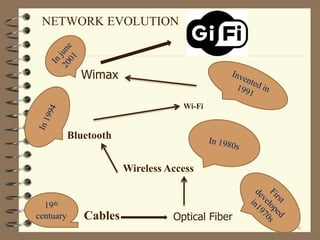
NETWORK EVOLUTION
Cables Optical Fiber
Wireless Access
Bluetooth
Wi-Fi
Wimax
19th
centuary
6
 The reason for pushing into Gi-Fi
technology is because of
slow rate,
high power consumption,
low range of frequency
operations of earlier technologies
i.e. Bluetooth and Wi-Fi.
Why Gi-Fi ?
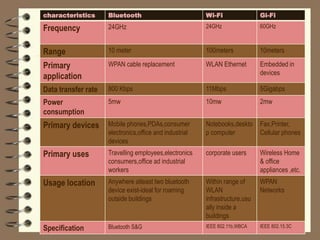
Comparison of Bluetooth and Wi-Fi with Gi-Fi
characteristics Bluetooth Wi-Fi Gi-Fi
Frequency 24GHz 24GHz 60GHz
Range 10 meter 100meters 10meters
Primary
application
WPAN cable replacement WLAN Ethernet Embedded in
devices
Data transfer rate 800 Kbps 11Mbps 5Gigabps
Power
consumption
5mw 10mw 2mw
Primary devices Mobile phones,PDAs,consumer
electronics,office and industrial
devices
Notebooks,deskto
p computer
Fax,Printer,
Cellular phones
Primary uses Travelling employees,electronics
consumers,office ad industrial
workers
corporate users Wireless Home
& office
appliances ,etc.
Usage location Anywhere atleast two bluetooth
device exist-ideal for roaming
outside buildings
Within range of
WLAN
infrastructure,usu
ally inside a
buildings
WPAN
Networks
Specification Bluetooth S&G IEEE 802.11b,WBCA IEEE 802.15.3C
Disadvantages of Bluetooth & Wi-Fi
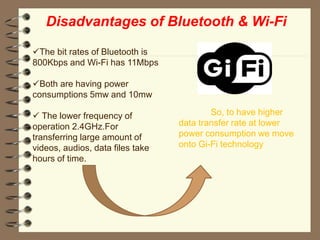
The bit rates of Bluetooth is
800Kbps and Wi-Fi has 11Mbps
Both are having power
consumptions 5mw and 10mw
 The lower frequency of
operation 2.4GHz.For
transferring large amount of
videos, audios, data files take
hours of time.
So, to have higher
data transfer rate at lower
power consumption we move
onto Gi-Fi technology
Architecture of Gi-Fi :
 It is based on standards of IEEE 802.15.3C
 The wireless span is computer network used
for communication among computer devices
(including telephones and personal digital
assistants) close to one person
 An 802.15.3c based system often uses small
antenna at the subscriber station. The antenna is
mounted on the roof. It supports line of sight
operation.
Working of Gi-Fi
 Use of Time Division Duplex for both
transmission and receiving.
 Conversion of data from IF range to RF 60Ghz
range.
 The incoming RF signal is first down converted to
an IF signal centered at 5 GHz and then to normal
data ranges.
 Then use heterodyne principle for this process to
avoid leakages.
 And then data is transferred.
FEATURES OF GI-FI :
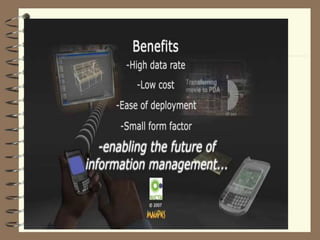
 High speed of data transfer
 Low power consumption
 High security
 Cost effective
 Small size
 Quick deployment
 Highly portable,highmobility
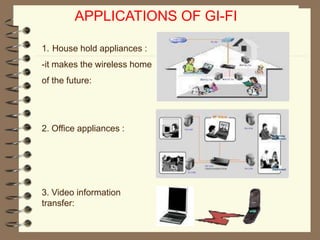
APPLICATIONS OF GI-FI
1. House hold appliances :
-it makes the wireless home
of the future:
2. Office appliances :
3. Video information
transfer:
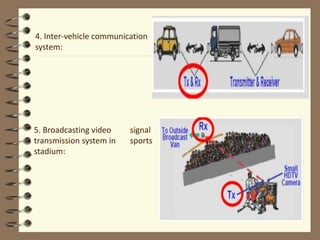
4. Inter-vehicle communication
system:
5. Broadcasting video signal
transmission system in sports
stadium:
TECHNOLOGY CONSIDERATIONS :
 The Gi-Fi integrated transceiver chip is may be launched by
starting of next year by NICTA,Australia will be first .
 Due to less cost of chip so many companies are forward to launch
with lower cost.
The potential of mw-WPAN for ultra fast data exchange has prompted
companies like Intel, LG, Matsushita (Panasonic), NEC, Samsung,
SiBEAM, Sony and Toshiba to form Wireless HD, an industry-led
effort to define a specification for the next generation consumer
electronics products.
CONCLUSION :
 Within five years, we expect Gi-Fi to be the
dominant technology for wireless networking.
 which will develop wire less home and
office of future.
 If the success of Wi-Fi and the imminent
wide usage of WiMAX is any indication, Gi-Fi
potentially can bring wireless broadband to the
enterprise in an entirely new way.
REFERENCES
 www.wikipedia.org
 www.ieee.org
 www.yuvaengineers.com
 www.seminarprojects.com
 www.sensable.com
 www.technologyreview.com
THANK YOU

gi-fippt-170302054028.pdf

  • 1.
    Government Engineering College, Bikaner Submittedby:- Tushar Choudhary CSE Submitted to:- CSE Department, Gi-Fi
  • 2.
    Contents :  Introductionto Gi-Fi  Network Evolution  Why Gi-Fi  Comparision of bluetooth and Wi-Fi with Gi-Fi  Disadvantage of bluetooth and Wi-Fi Architecture of Gi-Fi  Working of Gi-Fi
  • 3.
     Features ofGi-Fi  Applications of Gi-Fi  Technology Consideration  Conclusion  References
  • 4.
    Introduction to Gi-Fi:  Gi-Fi or Gigabit Wireless is the world's first transceiver integrated on a single chip that operates at 60GHz on the CMOS process.  Gi-Fi allows wireless transfer of audio and video data up to 5 gigabits per second.  Gi-Fi is ten times the current maximum wireless transfer rate usually within a range of 10 meters.
  • 5.
    The GiFi operateson the 60GHz frequency band. The GiFi measures 5mm square and it is manufactured using existing complementary metal – oxide-semiconductor(CMOS) technology.  It was developed at the National Information And Communication Technology Research Center in MELBOURNE,AUSTRALIA.
  • 6.
    NETWORK EVOLUTION Cables OpticalFiber Wireless Access Bluetooth Wi-Fi Wimax 19th centuary 6
  • 7.
     The reasonfor pushing into Gi-Fi technology is because of slow rate, high power consumption, low range of frequency operations of earlier technologies i.e. Bluetooth and Wi-Fi. Why Gi-Fi ?
  • 8.
    Comparison of Bluetoothand Wi-Fi with Gi-Fi
  • 9.
    characteristics Bluetooth Wi-FiGi-Fi Frequency 24GHz 24GHz 60GHz Range 10 meter 100meters 10meters Primary application WPAN cable replacement WLAN Ethernet Embedded in devices Data transfer rate 800 Kbps 11Mbps 5Gigabps Power consumption 5mw 10mw 2mw Primary devices Mobile phones,PDAs,consumer electronics,office and industrial devices Notebooks,deskto p computer Fax,Printer, Cellular phones Primary uses Travelling employees,electronics consumers,office ad industrial workers corporate users Wireless Home & office appliances ,etc. Usage location Anywhere atleast two bluetooth device exist-ideal for roaming outside buildings Within range of WLAN infrastructure,usu ally inside a buildings WPAN Networks Specification Bluetooth S&G IEEE 802.11b,WBCA IEEE 802.15.3C
  • 10.
    Disadvantages of Bluetooth& Wi-Fi The bit rates of Bluetooth is 800Kbps and Wi-Fi has 11Mbps Both are having power consumptions 5mw and 10mw  The lower frequency of operation 2.4GHz.For transferring large amount of videos, audios, data files take hours of time. So, to have higher data transfer rate at lower power consumption we move onto Gi-Fi technology
  • 11.
    Architecture of Gi-Fi:  It is based on standards of IEEE 802.15.3C  The wireless span is computer network used for communication among computer devices (including telephones and personal digital assistants) close to one person  An 802.15.3c based system often uses small antenna at the subscriber station. The antenna is mounted on the roof. It supports line of sight operation.
  • 12.
    Working of Gi-Fi Use of Time Division Duplex for both transmission and receiving.  Conversion of data from IF range to RF 60Ghz range.  The incoming RF signal is first down converted to an IF signal centered at 5 GHz and then to normal data ranges.  Then use heterodyne principle for this process to avoid leakages.  And then data is transferred.
  • 13.
    FEATURES OF GI-FI:  High speed of data transfer  Low power consumption  High security  Cost effective  Small size  Quick deployment  Highly portable,highmobility
  • 15.
    APPLICATIONS OF GI-FI 1.House hold appliances : -it makes the wireless home of the future: 2. Office appliances : 3. Video information transfer:
  • 16.
    4. Inter-vehicle communication system: 5.Broadcasting video signal transmission system in sports stadium:
  • 17.
    TECHNOLOGY CONSIDERATIONS : The Gi-Fi integrated transceiver chip is may be launched by starting of next year by NICTA,Australia will be first .  Due to less cost of chip so many companies are forward to launch with lower cost. The potential of mw-WPAN for ultra fast data exchange has prompted companies like Intel, LG, Matsushita (Panasonic), NEC, Samsung, SiBEAM, Sony and Toshiba to form Wireless HD, an industry-led effort to define a specification for the next generation consumer electronics products.
  • 18.
    CONCLUSION :  Withinfive years, we expect Gi-Fi to be the dominant technology for wireless networking.  which will develop wire less home and office of future.  If the success of Wi-Fi and the imminent wide usage of WiMAX is any indication, Gi-Fi potentially can bring wireless broadband to the enterprise in an entirely new way.
  • 19.
    REFERENCES  www.wikipedia.org  www.ieee.org www.yuvaengineers.com  www.seminarprojects.com  www.sensable.com  www.technologyreview.com
  • 20.