1
prabha.reddy95@gmail.com
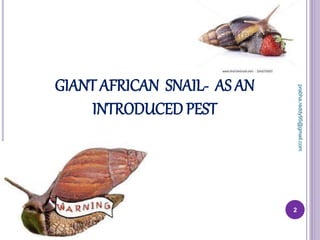
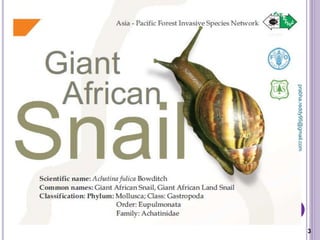
GIANT AFRICAN SNAIL- AS AN
INTRODUCED PEST
2
prabha.reddy95@gmail.com
3
prabha.reddy95@gmail.com
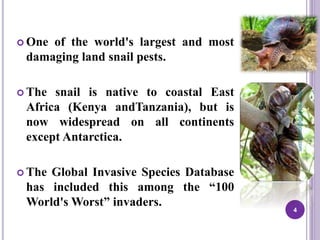
 One of the world's largest and most
damaging land snail pests.
 The snail is native to coastal East
Africa (Kenya andTanzania), but is
now widespread on all continents
except Antarctica.
 The Global Invasive Species Database
has included this among the “100
World's Worst” invaders.
4
prabha.reddy95@gmail.com
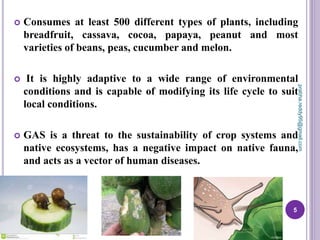
 Consumes at least 500 different types of plants, including
breadfruit, cassava, cocoa, papaya, peanut and most
varieties of beans, peas, cucumber and melon.
 It is highly adaptive to a wide range of environmental
conditions and is capable of modifying its life cycle to suit
local conditions.
 GAS is a threat to the sustainability of crop systems and
native ecosystems, has a negative impact on native fauna,
and acts as a vector of human diseases.
5
prabha.reddy95@gmail.com
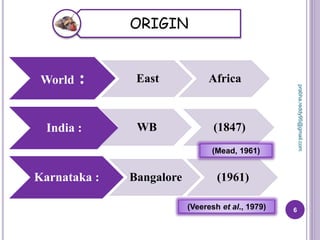
World : East Africa
India : WB (1847)
Karnataka : Bangalore (1961)
6
ORIGIN
(Veeresh et al., 1979)
(Mead, 1961)
prabha.reddy95@gmail.com
7
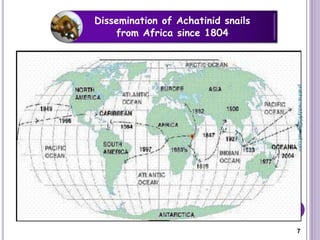
Dissemination of Achatinid snails
from Africa since 1804
prabha.reddy95@gmail.com
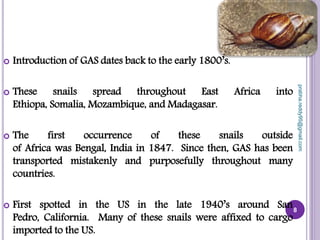
 Introduction of GAS dates back to the early 1800’s.
 These snails spread throughout East Africa into
Ethiopa, Somalia, Mozambique, and Madagasar.
 The first occurrence of these snails outside
of Africa was Bengal, India in 1847. Since then, GAS has been
transported mistakenly and purposefully throughout many
countries.
 First spotted in the US in the late 1940’s around San
Pedro, California. Many of these snails were affixed to cargo
imported to the US.
8
prabha.reddy95@gmail.com
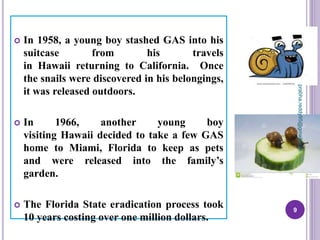
 In 1958, a young boy stashed GAS into his
suitcase from his travels
in Hawaii returning to California. Once
the snails were discovered in his belongings,
it was released outdoors.
 In 1966, another young boy
visiting Hawaii decided to take a few GAS
home to Miami, Florida to keep as pets
and were released into the family’s
garden.
 The Florida State eradication process took
10 years costing over one million dollars.
9
prabha.reddy95@gmail.com
10
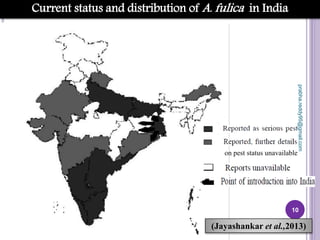
Current status and distribution of A. fulica in India
(Jayashankar et al.,2013)
on pest status unavailable
prabha.reddy95@gmail.com
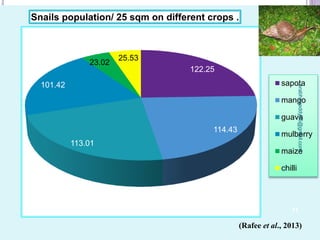
122.25
114.43
113.01
101.42
23.02
25.53
Snails population/ 25 sqm on different crops .
sapota
mango
guava
mulberry
maize
chilli
(Rafee et al., 2013)
11
prabha.reddy95@gmail.com
INVASIVENESS
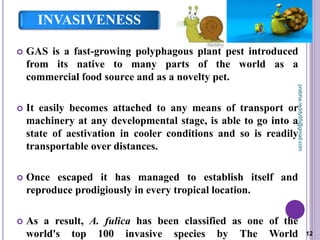
 GAS is a fast-growing polyphagous plant pest introduced
from its native to many parts of the world as a
commercial food source and as a novelty pet.
 It easily becomes attached to any means of transport or
machinery at any developmental stage, is able to go into a
state of aestivation in cooler conditions and so is readily
transportable over distances.
 Once escaped it has managed to establish itself and
reproduce prodigiously in every tropical location.
 As a result, A. fulica has been classified as one of the
world's top 100 invasive species by The World 12
prabha.reddy95@gmail.com
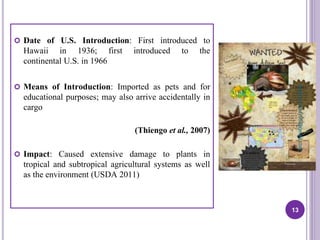
 Date of U.S. Introduction: First introduced to
Hawaii in 1936; first introduced to the
continental U.S. in 1966
 Means of Introduction: Imported as pets and for
educational purposes; may also arrive accidentally in
cargo
(Thiengo et al., 2007)
 Impact: Caused extensive damage to plants in
tropical and subtropical agricultural systems as well
as the environment (USDA 2011)
13
prabha.reddy95@gmail.com
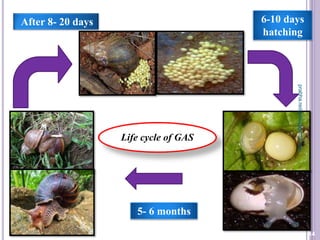
5- 6 months
Life cycle of GAS
6-10 days
hatching
After 8- 20 days
14
prabha.reddy95@gmail.com
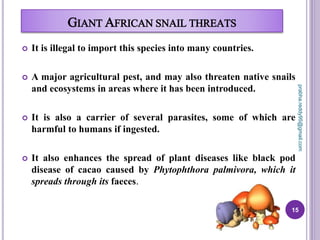
GIANT AFRICAN SNAIL THREATS
 It is illegal to import this species into many countries.
 A major agricultural pest, and may also threaten native snails
and ecosystems in areas where it has been introduced.
 It is also a carrier of several parasites, some of which are
harmful to humans if ingested.
 It also enhances the spread of plant diseases like black pod
disease of cacao caused by Phytophthora palmivora, which it
spreads through its faeces.
15
prabha.reddy95@gmail.com
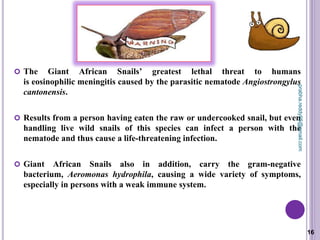
 The Giant African Snails’ greatest lethal threat to humans
is eosinophilic meningitis caused by the parasitic nematode Angiostrongylus
cantonensis.
 Results from a person having eaten the raw or undercooked snail, but even
handling live wild snails of this species can infect a person with the
nematode and thus cause a life-threatening infection.
 Giant African Snails also in addition, carry the gram-negative
bacterium, Aeromonas hydrophila, causing a wide variety of symptoms,
especially in persons with a weak immune system.
16
prabha.reddy95@gmail.com
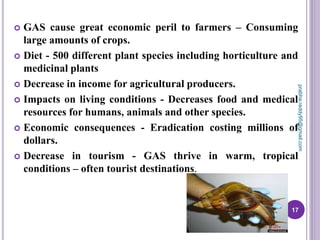
 GAS cause great economic peril to farmers – Consuming
large amounts of crops.
 Diet - 500 different plant species including horticulture and
medicinal plants
 Decrease in income for agricultural producers.
 Impacts on living conditions - Decreases food and medical
resources for humans, animals and other species.
 Economic consequences - Eradication costing millions of
dollars.
 Decrease in tourism - GAS thrive in warm, tropical
conditions – often tourist destinations.
17
prabha.reddy95@gmail.com
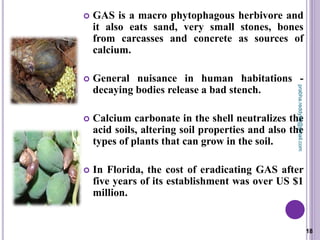
 GAS is a macro phytophagous herbivore and
it also eats sand, very small stones, bones
from carcasses and concrete as sources of
calcium.
 General nuisance in human habitations -
decaying bodies release a bad stench.
 Calcium carbonate in the shell neutralizes the
acid soils, altering soil properties and also the
types of plants that can grow in the soil.
 In Florida, the cost of eradicating GAS after
five years of its establishment was over US $1
million.
18
prabha.reddy95@gmail.com
DAMAGE
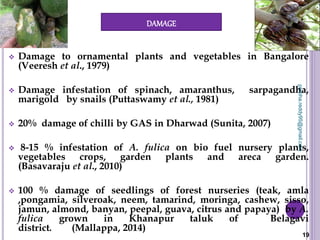
 Damage to ornamental plants and vegetables in Bangalore
(Veeresh et al., 1979)
 Damage infestation of spinach, amaranthus, sarpagandha,
marigold by snails (Puttaswamy et al., 1981)
 20% damage of chilli by GAS in Dharwad (Sunita, 2007)
 8-15 % infestation of A. fulica on bio fuel nursery plants,
vegetables crops, garden plants and areca garden.
(Basavaraju et al., 2010)
 100 % damage of seedlings of forest nurseries (teak, amla
,pongamia, silveroak, neem, tamarind, moringa, cashew, sisso,
jamun, almond, banyan, peepal, guava, citrus and papaya) by A.
fulica grown in Khanapur taluk of Belagavi
district. (Mallappa, 2014)
19
prabha.reddy95@gmail.com
AS AN INTRODUCED PEST...
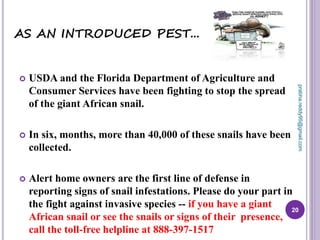
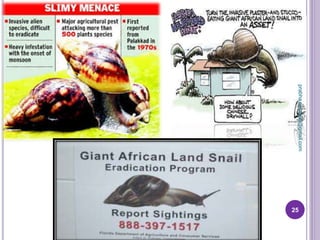
 USDA and the Florida Department of Agriculture and
Consumer Services have been fighting to stop the spread
of the giant African snail.
 In six, months, more than 40,000 of these snails have been
collected.
 Alert home owners are the first line of defense in
reporting signs of snail infestations. Please do your part in
the fight against invasive species -- if you have a giant
African snail or see the snails or signs of their presence,
call the toll-free helpline at 888-397-1517
20
prabha.reddy95@gmail.com
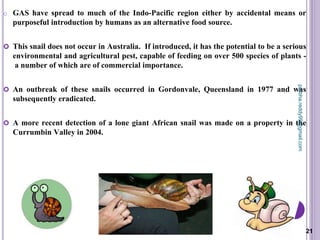
o GAS have spread to much of the Indo-Pacific region either by accidental means or
purposeful introduction by humans as an alternative food source.
 This snail does not occur in Australia. If introduced, it has the potential to be a serious
environmental and agricultural pest, capable of feeding on over 500 species of plants -
a number of which are of commercial importance.
 An outbreak of these snails occurred in Gordonvale, Queensland in 1977 and was
subsequently eradicated.
 A more recent detection of a lone giant African snail was made on a property in the
Currumbin Valley in 2004.
21
prabha.reddy95@gmail.com
MANAGEMENT
Prevention:
 Preventing its introduction is the most cost effective
option.
 Because of the huge risk that GAS poses and also
its multiple methods of dispersal, strict quarantine
and surveillance activities are necessary to control
its spread.
 Creating awareness about the various negative
impacts of the snail can help stop the illegal import
of GAS for trade and its international spread. 22
prabha.reddy95@gmail.com
CONTROL
 Control methods like collecting the snails by hand or
incinerating them with flame throwers have been used to
control infestations of GAS, but neither of these methods are
very effective.
 In China, the snail is used as a food item, which controls the
population to a large extent, but may encourage further
deliberate spread.
 Chemical control involves using Metaldehyde, Methiocarb or
a combination of these chemicals with other molluscicides as
bait formulations or foliar sprays. But these chemicals can
also harm non-target snails and endemic forms.
 Other methods like creating frigid temperatures or
saturating the snail in ethanol are also used.
23
prabha.reddy95@gmail.com
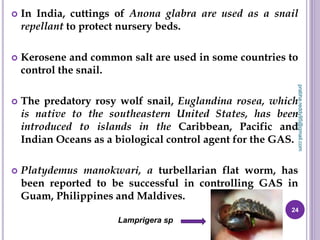
 In India, cuttings of Anona glabra are used as a snail
repellant to protect nursery beds.
 Kerosene and common salt are used in some countries to
control the snail.
 The predatory rosy wolf snail, Euglandina rosea, which
is native to the southeastern United States, has been
introduced to islands in the Caribbean, Pacific and
Indian Oceans as a biological control agent for the GAS.
 Platydemus manokwari, a turbellarian flat worm, has
been reported to be successful in controlling GAS in
Guam, Philippines and Maldives.
24
Lamprigera sp
prabha.reddy95@gmail.com
25
prabha.reddy95@gmail.com
26
prabha.reddy95@gmail.com

Giant african snail

  • 1.
  • 2.
    GIANT AFRICAN SNAIL-AS AN INTRODUCED PEST 2 prabha.reddy95@gmail.com
  • 3.
  • 4.
     One ofthe world's largest and most damaging land snail pests.  The snail is native to coastal East Africa (Kenya andTanzania), but is now widespread on all continents except Antarctica.  The Global Invasive Species Database has included this among the “100 World's Worst” invaders. 4 prabha.reddy95@gmail.com
  • 5.
     Consumes atleast 500 different types of plants, including breadfruit, cassava, cocoa, papaya, peanut and most varieties of beans, peas, cucumber and melon.  It is highly adaptive to a wide range of environmental conditions and is capable of modifying its life cycle to suit local conditions.  GAS is a threat to the sustainability of crop systems and native ecosystems, has a negative impact on native fauna, and acts as a vector of human diseases. 5 prabha.reddy95@gmail.com
  • 6.
    World : EastAfrica India : WB (1847) Karnataka : Bangalore (1961) 6 ORIGIN (Veeresh et al., 1979) (Mead, 1961) prabha.reddy95@gmail.com
  • 7.
    7 Dissemination of Achatinidsnails from Africa since 1804 prabha.reddy95@gmail.com
  • 8.
     Introduction ofGAS dates back to the early 1800’s.  These snails spread throughout East Africa into Ethiopa, Somalia, Mozambique, and Madagasar.  The first occurrence of these snails outside of Africa was Bengal, India in 1847. Since then, GAS has been transported mistakenly and purposefully throughout many countries.  First spotted in the US in the late 1940’s around San Pedro, California. Many of these snails were affixed to cargo imported to the US. 8 prabha.reddy95@gmail.com
  • 9.
     In 1958,a young boy stashed GAS into his suitcase from his travels in Hawaii returning to California. Once the snails were discovered in his belongings, it was released outdoors.  In 1966, another young boy visiting Hawaii decided to take a few GAS home to Miami, Florida to keep as pets and were released into the family’s garden.  The Florida State eradication process took 10 years costing over one million dollars. 9 prabha.reddy95@gmail.com
  • 10.
    10 Current status anddistribution of A. fulica in India (Jayashankar et al.,2013) on pest status unavailable prabha.reddy95@gmail.com
  • 11.
    122.25 114.43 113.01 101.42 23.02 25.53 Snails population/ 25sqm on different crops . sapota mango guava mulberry maize chilli (Rafee et al., 2013) 11 prabha.reddy95@gmail.com
  • 12.
    INVASIVENESS  GAS isa fast-growing polyphagous plant pest introduced from its native to many parts of the world as a commercial food source and as a novelty pet.  It easily becomes attached to any means of transport or machinery at any developmental stage, is able to go into a state of aestivation in cooler conditions and so is readily transportable over distances.  Once escaped it has managed to establish itself and reproduce prodigiously in every tropical location.  As a result, A. fulica has been classified as one of the world's top 100 invasive species by The World 12 prabha.reddy95@gmail.com
  • 13.
     Date ofU.S. Introduction: First introduced to Hawaii in 1936; first introduced to the continental U.S. in 1966  Means of Introduction: Imported as pets and for educational purposes; may also arrive accidentally in cargo (Thiengo et al., 2007)  Impact: Caused extensive damage to plants in tropical and subtropical agricultural systems as well as the environment (USDA 2011) 13 prabha.reddy95@gmail.com
  • 14.
    5- 6 months Lifecycle of GAS 6-10 days hatching After 8- 20 days 14 prabha.reddy95@gmail.com
  • 15.
    GIANT AFRICAN SNAILTHREATS  It is illegal to import this species into many countries.  A major agricultural pest, and may also threaten native snails and ecosystems in areas where it has been introduced.  It is also a carrier of several parasites, some of which are harmful to humans if ingested.  It also enhances the spread of plant diseases like black pod disease of cacao caused by Phytophthora palmivora, which it spreads through its faeces. 15 prabha.reddy95@gmail.com
  • 16.
     The GiantAfrican Snails’ greatest lethal threat to humans is eosinophilic meningitis caused by the parasitic nematode Angiostrongylus cantonensis.  Results from a person having eaten the raw or undercooked snail, but even handling live wild snails of this species can infect a person with the nematode and thus cause a life-threatening infection.  Giant African Snails also in addition, carry the gram-negative bacterium, Aeromonas hydrophila, causing a wide variety of symptoms, especially in persons with a weak immune system. 16 prabha.reddy95@gmail.com
  • 17.
     GAS causegreat economic peril to farmers – Consuming large amounts of crops.  Diet - 500 different plant species including horticulture and medicinal plants  Decrease in income for agricultural producers.  Impacts on living conditions - Decreases food and medical resources for humans, animals and other species.  Economic consequences - Eradication costing millions of dollars.  Decrease in tourism - GAS thrive in warm, tropical conditions – often tourist destinations. 17 prabha.reddy95@gmail.com
  • 18.
     GAS isa macro phytophagous herbivore and it also eats sand, very small stones, bones from carcasses and concrete as sources of calcium.  General nuisance in human habitations - decaying bodies release a bad stench.  Calcium carbonate in the shell neutralizes the acid soils, altering soil properties and also the types of plants that can grow in the soil.  In Florida, the cost of eradicating GAS after five years of its establishment was over US $1 million. 18 prabha.reddy95@gmail.com
  • 19.
    DAMAGE  Damage toornamental plants and vegetables in Bangalore (Veeresh et al., 1979)  Damage infestation of spinach, amaranthus, sarpagandha, marigold by snails (Puttaswamy et al., 1981)  20% damage of chilli by GAS in Dharwad (Sunita, 2007)  8-15 % infestation of A. fulica on bio fuel nursery plants, vegetables crops, garden plants and areca garden. (Basavaraju et al., 2010)  100 % damage of seedlings of forest nurseries (teak, amla ,pongamia, silveroak, neem, tamarind, moringa, cashew, sisso, jamun, almond, banyan, peepal, guava, citrus and papaya) by A. fulica grown in Khanapur taluk of Belagavi district. (Mallappa, 2014) 19 prabha.reddy95@gmail.com
  • 20.
    AS AN INTRODUCEDPEST...  USDA and the Florida Department of Agriculture and Consumer Services have been fighting to stop the spread of the giant African snail.  In six, months, more than 40,000 of these snails have been collected.  Alert home owners are the first line of defense in reporting signs of snail infestations. Please do your part in the fight against invasive species -- if you have a giant African snail or see the snails or signs of their presence, call the toll-free helpline at 888-397-1517 20 prabha.reddy95@gmail.com
  • 21.
    o GAS havespread to much of the Indo-Pacific region either by accidental means or purposeful introduction by humans as an alternative food source.  This snail does not occur in Australia. If introduced, it has the potential to be a serious environmental and agricultural pest, capable of feeding on over 500 species of plants - a number of which are of commercial importance.  An outbreak of these snails occurred in Gordonvale, Queensland in 1977 and was subsequently eradicated.  A more recent detection of a lone giant African snail was made on a property in the Currumbin Valley in 2004. 21 prabha.reddy95@gmail.com
  • 22.
    MANAGEMENT Prevention:  Preventing itsintroduction is the most cost effective option.  Because of the huge risk that GAS poses and also its multiple methods of dispersal, strict quarantine and surveillance activities are necessary to control its spread.  Creating awareness about the various negative impacts of the snail can help stop the illegal import of GAS for trade and its international spread. 22 prabha.reddy95@gmail.com
  • 23.
    CONTROL  Control methodslike collecting the snails by hand or incinerating them with flame throwers have been used to control infestations of GAS, but neither of these methods are very effective.  In China, the snail is used as a food item, which controls the population to a large extent, but may encourage further deliberate spread.  Chemical control involves using Metaldehyde, Methiocarb or a combination of these chemicals with other molluscicides as bait formulations or foliar sprays. But these chemicals can also harm non-target snails and endemic forms.  Other methods like creating frigid temperatures or saturating the snail in ethanol are also used. 23 prabha.reddy95@gmail.com
  • 24.
     In India,cuttings of Anona glabra are used as a snail repellant to protect nursery beds.  Kerosene and common salt are used in some countries to control the snail.  The predatory rosy wolf snail, Euglandina rosea, which is native to the southeastern United States, has been introduced to islands in the Caribbean, Pacific and Indian Oceans as a biological control agent for the GAS.  Platydemus manokwari, a turbellarian flat worm, has been reported to be successful in controlling GAS in Guam, Philippines and Maldives. 24 Lamprigera sp prabha.reddy95@gmail.com
  • 25.
  • 26.