Invasive Biology
Sajid Hussain
(萨伊德)
Murtaza Ali (牧塔)
(School of Forestry)
WORST INVASIVE SPECIES
Beijing Forestry University
Pomacea canaliculata
 Common Names: apple snail
 Kingdom: Animalia
 Phylum: Mollusca
 Class: Gastropoda
 Order: Architaenioglossa
 Family: Ampullariidae
 Pomacea canaliculata is a freshwater snail with a voracious appetite for water plants
including lotus, water chestnut, taro and rice Introduced widely from its native South
America by the aquarium trade and as a source of human food, it is a major crop
pest in south east Asia (primarily in rice) and Hawaii (taro) and poses a serious
threat to many wetlands around the world through potential habitat modification and
competition with native species.
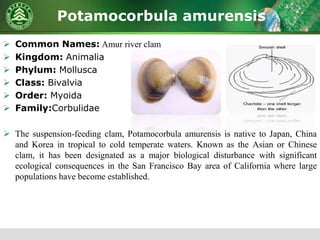
Potamocorbula amurensis
 Common Names: Amur river clam
 Kingdom: Animalia
 Phylum: Mollusca
 Class: Bivalvia
 Order: Myoida
 Family:Corbulidae
 The suspension-feeding clam, Potamocorbula amurensis is native to Japan, China
and Korea in tropical to cold temperate waters. Known as the Asian or Chinese
clam, it has been designated as a major biological disturbance with significant
ecological consequences in the San Francisco Bay area of California where large
populations have become established.
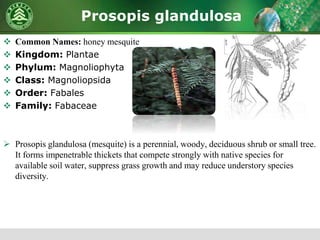
Prosopis glandulosa
 Common Names: honey mesquite
 Kingdom: Plantae
 Phylum: Magnoliophyta
 Class: Magnoliopsida
 Order: Fabales
 Family: Fabaceae
 Prosopis glandulosa (mesquite) is a perennial, woody, deciduous shrub or small tree.
It forms impenetrable thickets that compete strongly with native species for
available soil water, suppress grass growth and may reduce understory species
diversity.
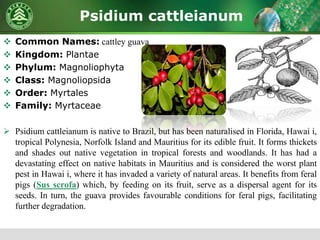
Psidium cattleianum
 Common Names: cattley guava
 Kingdom: Plantae
 Phylum: Magnoliophyta
 Class: Magnoliopsida
 Order: Myrtales
 Family: Myrtaceae
 Psidium cattleianum is native to Brazil, but has been naturalised in Florida, Hawai i,
tropical Polynesia, Norfolk Island and Mauritius for its edible fruit. It forms thickets
and shades out native vegetation in tropical forests and woodlands. It has had a
devastating effect on native habitats in Mauritius and is considered the worst plant
pest in Hawai i, where it has invaded a variety of natural areas. It benefits from feral
pigs (Sus scrofa) which, by feeding on its fruit, serve as a dispersal agent for its
seeds. In turn, the guava provides favourable conditions for feral pigs, facilitating
further degradation.
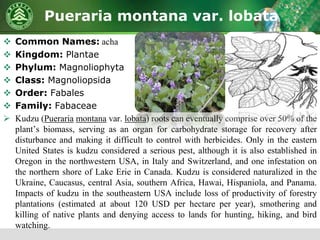
Pueraria montana var. lobata
 Common Names: acha
 Kingdom: Plantae
 Phylum: Magnoliophyta
 Class: Magnoliopsida
 Order: Fabales
 Family: Fabaceae
 Kudzu (Pueraria montana var. lobata) roots can eventually comprise over 50% of the
plant’s biomass, serving as an organ for carbohydrate storage for recovery after
disturbance and making it difficult to control with herbicides. Only in the eastern
United States is kudzu considered a serious pest, although it is also established in
Oregon in the northwestern USA, in Italy and Switzerland, and one infestation on
the northern shore of Lake Erie in Canada. Kudzu is considered naturalized in the
Ukraine, Caucasus, central Asia, southern Africa, Hawai, Hispaniola, and Panama.
Impacts of kudzu in the southeastern USA include loss of productivity of forestry
plantations (estimated at about 120 USD per hectare per year), smothering and
killing of native plants and denying access to lands for hunting, hiking, and bird
watching.
Pycnonotus cafer
Common Names: Bulbul à ventre rouge
 Kingdom: Animalia
 Phylum: Chordata
 Class: Aves
 Order: Passeriformes
 Family: Pycnonotidae
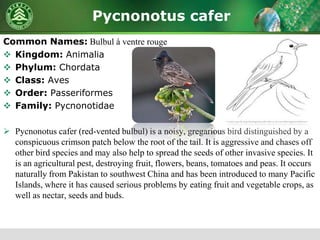
 Pycnonotus cafer (red-vented bulbul) is a noisy, gregarious bird distinguished by a
conspicuous crimson patch below the root of the tail. It is aggressive and chases off
other bird species and may also help to spread the seeds of other invasive species. It
is an agricultural pest, destroying fruit, flowers, beans, tomatoes and peas. It occurs
naturally from Pakistan to southwest China and has been introduced to many Pacific
Islands, where it has caused serious problems by eating fruit and vegetable crops, as
well as nectar, seeds and buds.
Lithobates catesbeianus
 Common Names: bullfrog
 Kingdom: Animalia
 Phylum: Chordata
 Class: Amphibia
 Order: Anura
 Family: Ranidae
 The American bullfrog (Lithobates catesbeianus (=Rana catesbeiana)) is native to North
America. It has been introduced all over the world to over 40 countries and four
continents. Many introductions have been intentional with the purpose of establishing
new food sources for human consumption. Other populations have been established from
unintentional escapes from bullfrog farms. Consequences of the introduction of non-
native amphibians to native herpetofauna can be severe. The American bullfrog has been
held responsible for outbreaks of the chytrid fungus found to be responsible for declining
amphibian populations in Central America and elsewhere. They are also important
predators and competitors of endangered native amphibians and fish. The control of this
invasive in Europe partly relies upon increasing awareness, monitoring and education
about the dangers of releasing pets into the wild. Strict laws are also in place to prevent
further introductions. Eradication is achieved largely by physical means including
shooting, spears/gigs, bow and arrow, nets and traps.
Rattus rattus
 Common Names: black rat
 Kingdom: Animalia
 Phylum: Chordata
 Class: Mammalia
 Order: Rodentia
 Family: Muridae
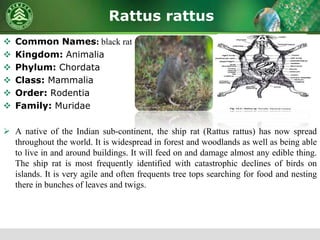
 A native of the Indian sub-continent, the ship rat (Rattus rattus) has now spread
throughout the world. It is widespread in forest and woodlands as well as being able
to live in and around buildings. It will feed on and damage almost any edible thing.
The ship rat is most frequently identified with catastrophic declines of birds on
islands. It is very agile and often frequents tree tops searching for food and nesting
there in bunches of leaves and twigs.
Rubus ellipticus
 Common Names: Asian wild raspberry
 Kingdom: Plantae
 Phylum: Magnoliophyta
 Class: Magnoliopsida
 Order: Rosales
 Family: Rosaceae
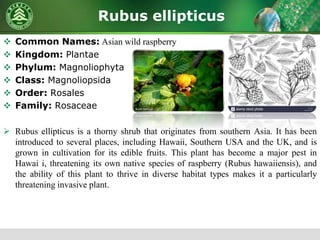
 Rubus ellipticus is a thorny shrub that originates from southern Asia. It has been
introduced to several places, including Hawaii, Southern USA and the UK, and is
grown in cultivation for its edible fruits. This plant has become a major pest in
Hawai i, threatening its own native species of raspberry (Rubus hawaiiensis), and
the ability of this plant to thrive in diverse habitat types makes it a particularly
threatening invasive plant.
Salmo trutta
 Common Names: an breac geal
 Kingdom: Animalia
 Phylum: Chordata
 Class: Actinopterygii
 Order: Salmoniformes
 Family: Salmonidae
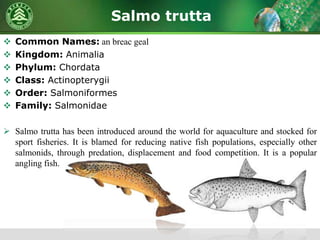
 Salmo trutta has been introduced around the world for aquaculture and stocked for
sport fisheries. It is blamed for reducing native fish populations, especially other
salmonids, through predation, displacement and food competition. It is a popular
angling fish.
Salvinia molesta
 Common Names: African payal
 Kingdom: Plantae
 Phylum: Pteridophyta
 Class: Filicopsida
 Order: Hydropteridales
 Family: Salviniaceae
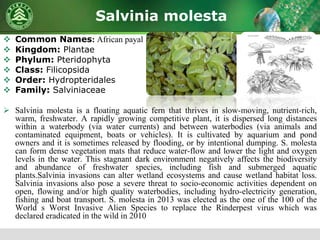
 Salvinia molesta is a floating aquatic fern that thrives in slow-moving, nutrient-rich,
warm, freshwater. A rapidly growing competitive plant, it is dispersed long distances
within a waterbody (via water currents) and between waterbodies (via animals and
contaminated equipment, boats or vehicles). It is cultivated by aquarium and pond
owners and it is sometimes released by flooding, or by intentional dumping. S. molesta
can form dense vegetation mats that reduce water-flow and lower the light and oxygen
levels in the water. This stagnant dark environment negatively affects the biodiversity
and abundance of freshwater species, including fish and submerged aquatic
plants.Salvinia invasions can alter wetland ecosystems and cause wetland habitat loss.
Salvinia invasions also pose a severe threat to socio-economic activities dependent on
open, flowing and/or high quality waterbodies, including hydro-electricity generation,
fishing and boat transport. S. molesta in 2013 was elected as the one of the 100 of the
World s Worst Invasive Alien Species to replace the Rinderpest virus which was
declared eradicated in the wild in 2010
Schinus terebinthifolius
 Common Names: baie rose
 Kingdom: Plantae
 Phylum: Magnoliophyta
 Class: Magnoliopsida
 Order: Sapindales
 Family: Anacardiaceae
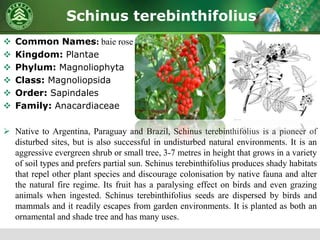
 Native to Argentina, Paraguay and Brazil, Schinus terebinthifolius is a pioneer of
disturbed sites, but is also successful in undisturbed natural environments. It is an
aggressive evergreen shrub or small tree, 3-7 metres in height that grows in a variety
of soil types and prefers partial sun. Schinus terebinthifolius produces shady habitats
that repel other plant species and discourage colonisation by native fauna and alter
the natural fire regime. Its fruit has a paralysing effect on birds and even grazing
animals when ingested. Schinus terebinthifolius seeds are dispersed by birds and
mammals and it readily escapes from garden environments. It is planted as both an
ornamental and shade tree and has many uses.
Invasive biology

Invasive biology

  • 1.
    Invasive Biology Sajid Hussain (萨伊德) MurtazaAli (牧塔) (School of Forestry) WORST INVASIVE SPECIES Beijing Forestry University
  • 2.
    Pomacea canaliculata  CommonNames: apple snail  Kingdom: Animalia  Phylum: Mollusca  Class: Gastropoda  Order: Architaenioglossa  Family: Ampullariidae  Pomacea canaliculata is a freshwater snail with a voracious appetite for water plants including lotus, water chestnut, taro and rice Introduced widely from its native South America by the aquarium trade and as a source of human food, it is a major crop pest in south east Asia (primarily in rice) and Hawaii (taro) and poses a serious threat to many wetlands around the world through potential habitat modification and competition with native species.
  • 3.
    Potamocorbula amurensis  CommonNames: Amur river clam  Kingdom: Animalia  Phylum: Mollusca  Class: Bivalvia  Order: Myoida  Family:Corbulidae  The suspension-feeding clam, Potamocorbula amurensis is native to Japan, China and Korea in tropical to cold temperate waters. Known as the Asian or Chinese clam, it has been designated as a major biological disturbance with significant ecological consequences in the San Francisco Bay area of California where large populations have become established.
  • 4.
    Prosopis glandulosa  CommonNames: honey mesquite  Kingdom: Plantae  Phylum: Magnoliophyta  Class: Magnoliopsida  Order: Fabales  Family: Fabaceae  Prosopis glandulosa (mesquite) is a perennial, woody, deciduous shrub or small tree. It forms impenetrable thickets that compete strongly with native species for available soil water, suppress grass growth and may reduce understory species diversity.
  • 5.
    Psidium cattleianum  CommonNames: cattley guava  Kingdom: Plantae  Phylum: Magnoliophyta  Class: Magnoliopsida  Order: Myrtales  Family: Myrtaceae  Psidium cattleianum is native to Brazil, but has been naturalised in Florida, Hawai i, tropical Polynesia, Norfolk Island and Mauritius for its edible fruit. It forms thickets and shades out native vegetation in tropical forests and woodlands. It has had a devastating effect on native habitats in Mauritius and is considered the worst plant pest in Hawai i, where it has invaded a variety of natural areas. It benefits from feral pigs (Sus scrofa) which, by feeding on its fruit, serve as a dispersal agent for its seeds. In turn, the guava provides favourable conditions for feral pigs, facilitating further degradation.
  • 6.
    Pueraria montana var.lobata  Common Names: acha  Kingdom: Plantae  Phylum: Magnoliophyta  Class: Magnoliopsida  Order: Fabales  Family: Fabaceae  Kudzu (Pueraria montana var. lobata) roots can eventually comprise over 50% of the plant’s biomass, serving as an organ for carbohydrate storage for recovery after disturbance and making it difficult to control with herbicides. Only in the eastern United States is kudzu considered a serious pest, although it is also established in Oregon in the northwestern USA, in Italy and Switzerland, and one infestation on the northern shore of Lake Erie in Canada. Kudzu is considered naturalized in the Ukraine, Caucasus, central Asia, southern Africa, Hawai, Hispaniola, and Panama. Impacts of kudzu in the southeastern USA include loss of productivity of forestry plantations (estimated at about 120 USD per hectare per year), smothering and killing of native plants and denying access to lands for hunting, hiking, and bird watching.
  • 7.
    Pycnonotus cafer Common Names:Bulbul à ventre rouge  Kingdom: Animalia  Phylum: Chordata  Class: Aves  Order: Passeriformes  Family: Pycnonotidae  Pycnonotus cafer (red-vented bulbul) is a noisy, gregarious bird distinguished by a conspicuous crimson patch below the root of the tail. It is aggressive and chases off other bird species and may also help to spread the seeds of other invasive species. It is an agricultural pest, destroying fruit, flowers, beans, tomatoes and peas. It occurs naturally from Pakistan to southwest China and has been introduced to many Pacific Islands, where it has caused serious problems by eating fruit and vegetable crops, as well as nectar, seeds and buds.
  • 8.
    Lithobates catesbeianus  CommonNames: bullfrog  Kingdom: Animalia  Phylum: Chordata  Class: Amphibia  Order: Anura  Family: Ranidae  The American bullfrog (Lithobates catesbeianus (=Rana catesbeiana)) is native to North America. It has been introduced all over the world to over 40 countries and four continents. Many introductions have been intentional with the purpose of establishing new food sources for human consumption. Other populations have been established from unintentional escapes from bullfrog farms. Consequences of the introduction of non- native amphibians to native herpetofauna can be severe. The American bullfrog has been held responsible for outbreaks of the chytrid fungus found to be responsible for declining amphibian populations in Central America and elsewhere. They are also important predators and competitors of endangered native amphibians and fish. The control of this invasive in Europe partly relies upon increasing awareness, monitoring and education about the dangers of releasing pets into the wild. Strict laws are also in place to prevent further introductions. Eradication is achieved largely by physical means including shooting, spears/gigs, bow and arrow, nets and traps.
  • 9.
    Rattus rattus  CommonNames: black rat  Kingdom: Animalia  Phylum: Chordata  Class: Mammalia  Order: Rodentia  Family: Muridae  A native of the Indian sub-continent, the ship rat (Rattus rattus) has now spread throughout the world. It is widespread in forest and woodlands as well as being able to live in and around buildings. It will feed on and damage almost any edible thing. The ship rat is most frequently identified with catastrophic declines of birds on islands. It is very agile and often frequents tree tops searching for food and nesting there in bunches of leaves and twigs.
  • 10.
    Rubus ellipticus  CommonNames: Asian wild raspberry  Kingdom: Plantae  Phylum: Magnoliophyta  Class: Magnoliopsida  Order: Rosales  Family: Rosaceae  Rubus ellipticus is a thorny shrub that originates from southern Asia. It has been introduced to several places, including Hawaii, Southern USA and the UK, and is grown in cultivation for its edible fruits. This plant has become a major pest in Hawai i, threatening its own native species of raspberry (Rubus hawaiiensis), and the ability of this plant to thrive in diverse habitat types makes it a particularly threatening invasive plant.
  • 11.
    Salmo trutta  CommonNames: an breac geal  Kingdom: Animalia  Phylum: Chordata  Class: Actinopterygii  Order: Salmoniformes  Family: Salmonidae  Salmo trutta has been introduced around the world for aquaculture and stocked for sport fisheries. It is blamed for reducing native fish populations, especially other salmonids, through predation, displacement and food competition. It is a popular angling fish.
  • 12.
    Salvinia molesta  CommonNames: African payal  Kingdom: Plantae  Phylum: Pteridophyta  Class: Filicopsida  Order: Hydropteridales  Family: Salviniaceae  Salvinia molesta is a floating aquatic fern that thrives in slow-moving, nutrient-rich, warm, freshwater. A rapidly growing competitive plant, it is dispersed long distances within a waterbody (via water currents) and between waterbodies (via animals and contaminated equipment, boats or vehicles). It is cultivated by aquarium and pond owners and it is sometimes released by flooding, or by intentional dumping. S. molesta can form dense vegetation mats that reduce water-flow and lower the light and oxygen levels in the water. This stagnant dark environment negatively affects the biodiversity and abundance of freshwater species, including fish and submerged aquatic plants.Salvinia invasions can alter wetland ecosystems and cause wetland habitat loss. Salvinia invasions also pose a severe threat to socio-economic activities dependent on open, flowing and/or high quality waterbodies, including hydro-electricity generation, fishing and boat transport. S. molesta in 2013 was elected as the one of the 100 of the World s Worst Invasive Alien Species to replace the Rinderpest virus which was declared eradicated in the wild in 2010
  • 13.
    Schinus terebinthifolius  CommonNames: baie rose  Kingdom: Plantae  Phylum: Magnoliophyta  Class: Magnoliopsida  Order: Sapindales  Family: Anacardiaceae  Native to Argentina, Paraguay and Brazil, Schinus terebinthifolius is a pioneer of disturbed sites, but is also successful in undisturbed natural environments. It is an aggressive evergreen shrub or small tree, 3-7 metres in height that grows in a variety of soil types and prefers partial sun. Schinus terebinthifolius produces shady habitats that repel other plant species and discourage colonisation by native fauna and alter the natural fire regime. Its fruit has a paralysing effect on birds and even grazing animals when ingested. Schinus terebinthifolius seeds are dispersed by birds and mammals and it readily escapes from garden environments. It is planted as both an ornamental and shade tree and has many uses.