Health System Building Blocks
Presented by
Syed
waliullah
2|
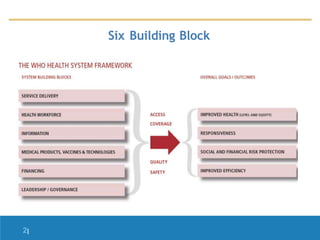
Six Building Block
Service Delivery
Good health services – deliver safe, effective, good quality,
minimum waste
• Services delivered, be they prevention, treatment or
rehabilitation, may be delivered in the home, the
community, in the workplace or in health facilities.
• For good service delivery there are some well-
established requirements:
– Raising demands for service through understanding the user
perspective, raising public knowledge and reducing financial,
cultural social and gender barriers
– Provide a package of integrated services based on population
need.
4|
Human Resources
All people engaged in actions whose primary intent is to
improve health
Includes:
• service providers, management and support workers
• Public and private sector workers
• Unpaid and paid workers
• Professional and lay workers
Strong correlation between health workforce density and
service coverage and health outcomes
5|
• A well functioning health information system is one that ensures
the production, analysis, dissemination and use of reliable and
timely health information. It involves three domains of health
information:
• Health determinants;
• Health systems performance; and
• Health status.
• To achieve this, a health information system must:
– Generate population and facility-based data
– Have the capacity to detect, investigate, communicate and contain
events that threaten public health security at the place they occur,
and as soon as they occur.
– Have the capacity to synthesize information
6|
Health Management Information System
Medical Products Vaccines and Technologies
Essential medical products, vaccines and technologies
Assured quality: Safety, efficacy, cost effective
• National policies, standards, guidelines and
regulations that support policy.
• Information on prices, set and negotiate prices
• Quality assessment of products
• Procurement, storage and distribution systems
• Rational use of essential medicines,
commodities and equipment
Medical products are the second largest expenditure
Vaccines are the most cost effective health interventions
7|
Health Financing
• A mix of public and private financing and public and
private provision.
• Effective and efficient use of governmentallocated
resources.
• Raising additional funds where health needs are high and
revenues insufficient.
• Reducing reliance on out-of-pocket payments where they
are high.
• Improving efficiency of resource use and addressing
fragmentation of financing arrangements for different
types of services
• Promoting transparency and accountability in health
financing systems.
8|
Governance
• Policy guidance
• Intelligence and oversight.
• Collaboration and coalition-building.
• Regulation.
9|
10|
Thank you

health system building block.pptx

  • 1.
    Health System BuildingBlocks Presented by Syed waliullah
  • 2.
  • 3.
    Service Delivery Good healthservices – deliver safe, effective, good quality, minimum waste • Services delivered, be they prevention, treatment or rehabilitation, may be delivered in the home, the community, in the workplace or in health facilities. • For good service delivery there are some well- established requirements: – Raising demands for service through understanding the user perspective, raising public knowledge and reducing financial, cultural social and gender barriers – Provide a package of integrated services based on population need. 4|
  • 4.
    Human Resources All peopleengaged in actions whose primary intent is to improve health Includes: • service providers, management and support workers • Public and private sector workers • Unpaid and paid workers • Professional and lay workers Strong correlation between health workforce density and service coverage and health outcomes 5|
  • 5.
    • A wellfunctioning health information system is one that ensures the production, analysis, dissemination and use of reliable and timely health information. It involves three domains of health information: • Health determinants; • Health systems performance; and • Health status. • To achieve this, a health information system must: – Generate population and facility-based data – Have the capacity to detect, investigate, communicate and contain events that threaten public health security at the place they occur, and as soon as they occur. – Have the capacity to synthesize information 6| Health Management Information System
  • 6.
    Medical Products Vaccinesand Technologies Essential medical products, vaccines and technologies Assured quality: Safety, efficacy, cost effective • National policies, standards, guidelines and regulations that support policy. • Information on prices, set and negotiate prices • Quality assessment of products • Procurement, storage and distribution systems • Rational use of essential medicines, commodities and equipment Medical products are the second largest expenditure Vaccines are the most cost effective health interventions 7|
  • 7.
    Health Financing • Amix of public and private financing and public and private provision. • Effective and efficient use of governmentallocated resources. • Raising additional funds where health needs are high and revenues insufficient. • Reducing reliance on out-of-pocket payments where they are high. • Improving efficiency of resource use and addressing fragmentation of financing arrangements for different types of services • Promoting transparency and accountability in health financing systems. 8|
  • 8.
    Governance • Policy guidance •Intelligence and oversight. • Collaboration and coalition-building. • Regulation. 9|
  • 9.