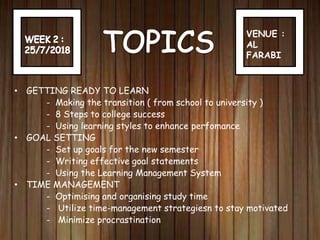
VENUE :
AL
FARABI
• GETTING READY TO LEARN
- Making the transition ( from school to university )
- 8 Steps to college success
- Using learning styles to enhance perfomance
• GOAL SETTING
- Set up goals for the new semester
- Writing effective goal statements
- Using the Learning Management System
• TIME MANAGEMENT
- Optimising and organising study time
- Utilize time-management strategiesn to stay motivated
- Minimize procrastination
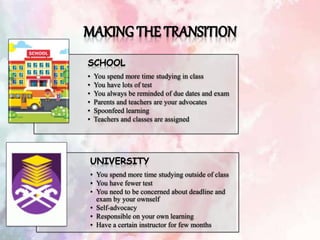
SCHOOL
• You spend more time studying in class
• You have lots of test
• You always be reminded of due dates and exam
• Parents and teachers are your advocates
• Spoonfeed learning
• Teachers and classes are assigned
UNIVERSITY
• You spend more time studying outside of class
• You have fewer test
• You need to be concerned about deadline and
exam by your ownself
• Self-advocacy
• Responsible on your own learning
• Have a certain instructor for few months
 Attend all classes
 Become an active learner
 Participate in university activities
 Get to know your lectures
 Form study groups
 Stay up to date with works
 Be receptive to change
 Work hard this semester
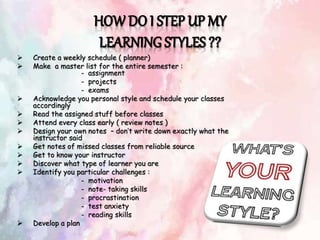
 Create a weekly schedule ( planner)
 Make a master list for the entire semester :
- assignment
- projects
- exams
 Acknowledge you personal style and schedule your classes
accordingly
 Read the assigned stuff before classes
 Attend every class early ( review notes )
 Design your own notes – don’t write down exactly what the
instructor said
 Get notes of missed classes from reliable source
 Get to know your instructor
 Discover what type of learner you are
 Identify you particular challenges :
- motivation
- note- taking skills
- procrastination
- test anxiety
- reading skills
 Develop a plan
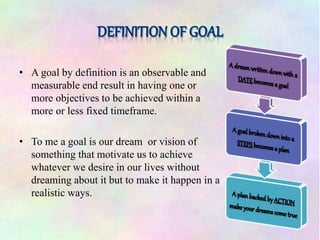
• A goal by definition is an observable and
measurable end result in having one or
more objectives to be achieved within a
more or less fixed timeframe.
• To me a goal is our dream or vision of
something that motivate us to achieve
whatever we desire in our lives without
dreaming about it but to make it happen in a
realistic ways.
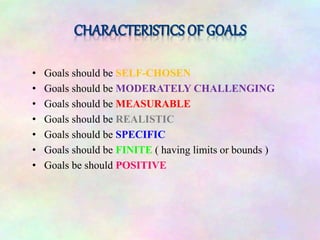
• Goals should be SELF-CHOSEN
• Goals should be MODERATELY CHALLENGING
• Goals should be MEASURABLE
• Goals should be REALISTIC
• Goals should be SPECIFIC
• Goals should be FINITE ( having limits or bounds )
• Goals be should POSITIVE
1. EVALUATE AND REFLECT
• The only way we can reasonably decide what we desire in the future and
how we’ll accomplish it, is to know where we are right now and what our
current level of sa tisfaction is. So first, take some time to think through
and write down your current situation; then ask this question on each key
point: ‘ Is that OK?’
• The purpose of evaluation is twofold. Firstly, it provides you an objective
way to look at your accomplishments and your pursuit of the vision you
have for life. Secondly, it shows you where you are; so you can decide
where you need to go. Evaluation gives you a baseline to work from.
• Take a couple of hours this week to evaluate and reflect. See where you are
and write it down so that as the months progress and you continue a regular
time of evaluation and reflection, you will see just how much ground you’re
gaining - and that will be inspiring !
2. DEFINE YOUR DREAMS AND GOALS
• One of the amazing things we have been given as humans is the
unquenchable desire to have dreams of a better life and the ability to form
and set goals to live out those dreams. We can look deep within our hearts
and dream of a better situation for ourselves and our families. We can dream
of better financial, emotional, spiritual or physical lives. We have also been
given the ability to not only dream, but pursue those dreams - and not just
pursue them, but the cognitive ability to design a plan and strategies
to achieve those dream. AMAZING !
• What are your dreams and goals? This isn’t what you already have or what
you have done, but what you want. Have you ever really take a deep breath
and think through your life values and decided what you really want? Have
you ever taken the time to truly reflect, to listen quietly to your heart and to
see what dreams live within you? Your dreams are there in fact everyone has
them. They may live right on the surface, or they may be buried deep from
years of others telling you they were foolish, but they are there.
• Take time to be quiet. This is something that we don’t really get through it in
this busy world of ours. We keep rushing and we’re constantly listening to
noise all around us. The human heart was meant for times of quiet - to peer
deep within. It is when we do this and our hearts are set free to soar and take
flight on the wings of our own dreams. Schedule some quiet “dream time” this
week. NO OTHER PEOPLE. NO CELLPHONE. NO COMPUTER. Just you,
a pad, a pen and your thoughts. Don’t think of any as too freakish or foolish
– remember - you’re dreaming! Let the thoughts freely fly and take
careful record.
• Think about what really thrills you. When you are quiet, think about those
things that really get your blood moving. What would you enjoy to do, either
for fun or for a living? What would you love to achieve? What would you try
if you were guaranteed to succeed? What big thoughts move your heart into a
state of excitement and enjoyment? When you answer these questions you
will feel fantastic and be in the “dream zone.” It is only when we get to this
point that we experience what our dreams are.
• Now, prioritize those dreams. Which are most essential? Which are most
achievable? Which would you love to do the most? Put them in the order in
which you will actually try to accomplish them. Remember, we are always
moving toward action - not just dreaming.
3. HAVE ACCOUNTABILITY
When someone knows what your goals are, they hold your accountable by
asking you to “give an account” of where you are in the process of executing
that goal. Accountability puts some teeth into the process. If a goal is set and
only one person knows it, does it really have any power? Most of the times,
NO. A goal isn’t as powerful if you don’t have one or more people who can
hold you accountable to it.
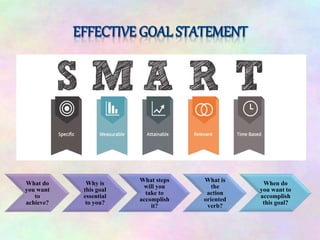
What do
you want
to
achieve?
Why is
this goal
essential
to you?
What steps
will you
take to
accomplish
it?
What is
the
action
oriented
verb?
When do
you want to
accomplish
this goal?
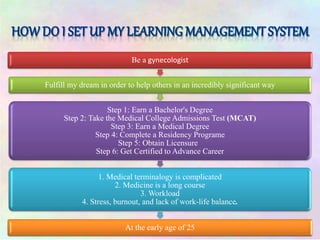
Be a gynecologist
Fulfill my dream in order to help others in an incredibly significant way
Step 1: Earn a Bachelor's Degree
Step 2: Take the Medical College Admissions Test (MCAT)
Step 3: Earn a Medical Degree
Step 4: Complete a Residency Programe
Step 5: Obtain Licensure
Step 6: Get Certified to Advance Career
1. Medical terminalogy is complicated
2. Medicine is a long course
3. Workload
4. Stress, burnout, and lack of work-life balance.
At the early age of 25
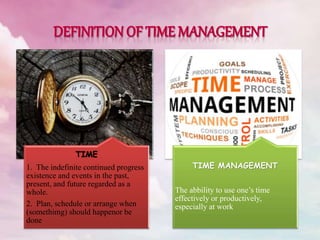
TIME
1. The indefinite continued progress
existence and events in the past,
present, and future regarded as a
whole.
2. Plan, schedule or arrange when
(somethimg) should happenor be
done
TIME MANAGEMENT
The abbility to use one’s time
effectively or productively,
especially at work
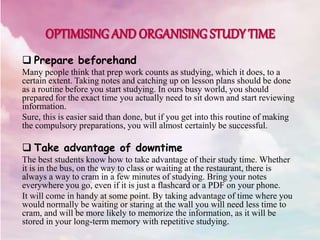
 Prepare beforehand
Many people think that prep work counts as studying, which it does, to a
certain extent. Taking notes and catching up on lesson plans should be done
as a routine before you start studying. In ours busy world, you should
prepared for the exact time you actually need to sit down and start reviewing
information.
Sure, this is easier said than done, but if you get into this routine of making
the compulsory preparations, you will almost certainly be successful.
 Take advantage of downtime
The best students know how to take advantage of their study time. Whether
it is in the bus, on the way to class or waiting at the restaurant, there is
always a way to cram in a few minutes of studying. Bring your notes
everywhere you go, even if it is just a flashcard or a PDF on your phone.
It will come in handy at some point. By taking advantage of time where you
would normally be waiting or staring at the wall you will need less time to
cram, and will be more likely to memorize the information, as it will be
stored in your long-term memory with repetitive studying.
 Take notes while studying
You won’t remember much if you simply stare at a page all day
long. Even if you’re studying a 1000 page textbook, take as many
notes as you can.
Sure, it might take a little bit longer, but by taking notes of what you
read, you are transferring the content that you learn from your short-
term memory to your long-term memory.
Furthermore, it will take less time when you go to review
information, as you will already have consolidated it on paper
 Concern about what you eat
Many college students think they can get by just on coffee and a bag
of chips, but that simply does not do the trick.
What you eat and drink is directly proportional to how you do on a
test. If you don’t eat, your attention span will be shorter, your brain
will not well function and you will not perform better on a test.
Furthermore, if you don’t drink water your brain will not work very
efficiently.
Try taking a bottled water everywhere you go. It will incentivize
you to drink more, which will help you to stay awake and make you
feel better.
 Sleep
You won’t get far if you don’t sleep. The stereotype of staying up all
night to cram for that big exam works less often than people
think.While they are studying all night, they retain almost nothing,
and most of the time, they are doing something counterproductive,
like scrolling Instagram or checking Twitter.Your brain cannot well
function without sleep, contrary to what many people think.
Furthermore, it only works at full capacity for around 30 minutes, so
if you don’t take sufficient breaks, you might as well be studying for
70 percent of the time.Take breaks, relax and get enough sleep . You
going to feel better during the test, and will likely be able to relay the
information you learned in a more concise manner.
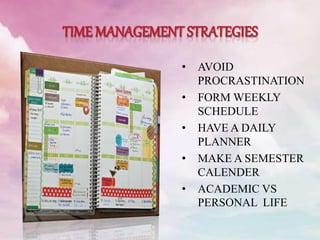
• AVOID
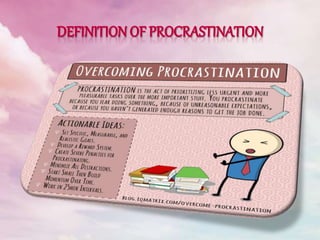
PROCRASTINATION
• FORM WEEKLY
SCHEDULE
• HAVE A DAILY
PLANNER
• MAKE A SEMESTER
CALENDER
• ACADEMIC VS
PERSONAL LIFE
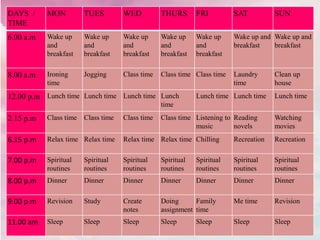
DAYS /
TIME
MON TUES WED THURS FRI SAT SUN
6.00 a.m Wake up
and
breakfast
Wake up
and
breakfast
Wake up
and
breakfast
Wake up
and
breakfast
Wake up
and
breakfast
Wake up and
breakfast
Wake up and
breakfast
8.00 a.m Ironing
time
Jogging Class time Class time Class time Laundry
time
Clean up
house
12.00 p.m Lunch time Lunch time Lunch time Lunch
time
Lunch time Lunch time Lunch time
2.15 p.m Class time Class time Class time Class time Listening to
music
Reading
novels
Watching
movies
6.15 p.m Relax time Relax time Relax time Relax time Chilling Recreation Recreation
7.00 p.m Spiritual
routines
Spiritual
routines
Spiritual
routines
Spiritual
routines
Spiritual
routines
Spiritual
routines
Spiritual
routines
8.00 p.m Dinner Dinner Dinner Dinner Dinner Dinner Dinner
9.00 p.m Revision Study Create
notes
Doing
assignment
Family
time
Me time Revision
11.00 am Sleep Sleep Sleep Sleep Sleep Sleep Sleep
1. Do tasks you enjoy
Remember, if you don’t enjoy in doing tasks that demotivate you, then
doing tasks you do like and can increase motivation, productivity and
success. If you’re not quite ready to start that big project, why not cross
off some of your other to-dos? Pick some tasks you enjoy – that have to
be done – and get them out of the way. It will put you in a better frame
of mind for handling the big task.
2. Balance your time
Ultimately, that task has to be done. Here are some ways to reduce
procrastination.
• Prime yourself for success by breaking the large project or task into
smaller tasks
• Minimize the amount of time you allocate to each of those tasks, then
it won’t feel like burdens hanging over your head
• Cross off those smaller tasks whenever you can so you feel a sense of
accomplishment
3. Psych yourself into productivity
Maybe you can psych yourself into being more productive.
Determine whether your tough principle is being as productive as
possible or doing as little as you can get away with. Here’s a hint
from Jim Collins, author of Good to Great. The most successful
people achieve “sustained excellence”, producing and delivering
day in, day out.
4. Make productivity a game
Tim Pychyl suggests another approach: reducing the boredom by
turning challenging tasks into a game. For instance, you can make a
private bet on how many words of that report you can write in the
next 30 minutes. The point is to accomplish something before you
become so bored then you can do nothing.
5. Imagine the upshot
If the carrot doesn’t work, try the stick. Ask yourself about the
outcome of failing to complete that project or task. Not only will you
feel like an underachiever, but it can have an impact on career
development. Sometimes knowing that is enough as an incentive to
get started.
6. Delegate or outsource
If you have tried everything but still can’t get that big project out of
the way, maybe it’s not right for you. In that case, delegate the project
to someone who will have the passion and motivation to succeed, and
move onto something that you find more inspiring.
VENUE :
AL
FARABI
• GETTING TO KNOW THE CAMPUS
- Making the most of college resources
• MEMORY LEARNING & IMPROVING CONCECENTERATION
- Understanding memory processes (Types of Memory)
- Memories strategies
- Understanding concentration
- Strategies for improving concentration
- Reading/study system (SQ3R)
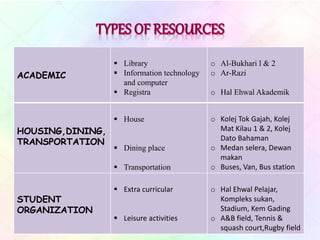
ACADEMIC
 Library
 Information technology
and computer
 Registra
o Al-Bukhari l & 2
o Ar-Razi
o Hal Ehwal Akademik
HOUSING,DINING,
TRANSPORTATION
 House
 Dining place
 Transportation
o Kolej Tok Gajah, Kolej
Mat Kilau 1 & 2, Kolej
Dato Bahaman
o Medan selera, Dewan
makan
o Buses, Van, Bus station
STUDENT
ORGANIZATION
 Extra curricular
 Leisure activities
o Hal Ehwal Pelajar,
Kompleks sukan,
Stadium, Kem Gading
o A&B field, Tennis &
squash court,Rugby field
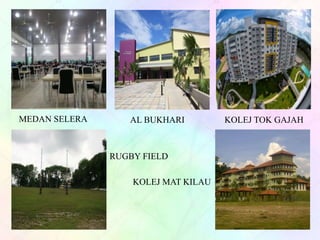
MEDAN SELERA AL BUKHARI KOLEJ TOK GAJAH
RUGBY FIELD
KOLEJ MAT KILAU
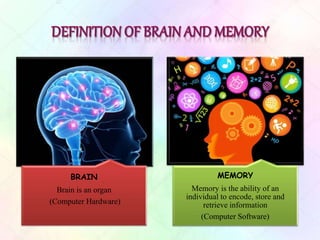
BRAIN
Brain is an organ
(Computer Hardware)
MEMORY
Memory is the ability of an
individual to encode, store and
retrieve information
(Computer Software)
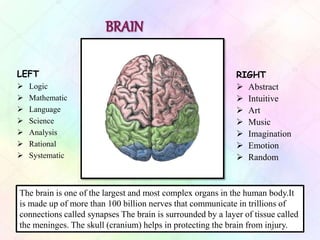
LEFT
 Logic
 Mathematic
 Language
 Science
 Analysis
 Rational
 Systematic
RIGHT
 Abstract
 Intuitive
 Art
 Music
 Imagination
 Emotion
 Random
The brain is one of the largest and most complex organs in the human body.It
is made up of more than 100 billion nerves that communicate in trillions of
connections called synapses The brain is surrounded by a layer of tissue called
the meninges. The skull (cranium) helps in protecting the brain from injury.
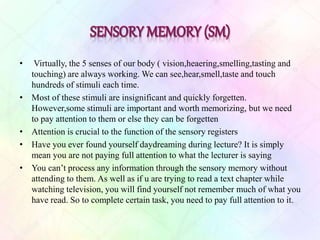
• Virtually, the 5 senses of our body ( vision,heaering,smelling,tasting and
touching) are always working. We can see,hear,smell,taste and touch
hundreds of stimuli each time.
• Most of these stimuli are insignificant and quickly forgetten.
However,some stimuli are important and worth memorizing, but we need
to pay attention to them or else they can be forgetten
• Attention is crucial to the function of the sensory registers
• Have you ever found yourself daydreaming during lecture? It is simply
mean you are not paying full attention to what the lecturer is saying
• You can’t process any information through the sensory memory without
attending to them. As well as if u are trying to read a text chapter while
watching television, you will find yourself not remember much of what you
have read. So to complete certain task, you need to pay full attention to it.
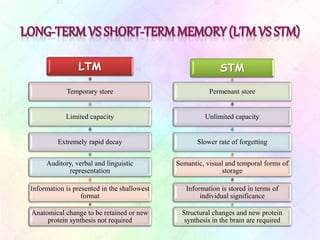
LTM
Temporary store
Limited capacity
Extremely rapid decay
Auditory, verbal and linguistic
representation
Information is presented in the shallowest
format
Anatomical change to be retained or new
protein synthesis not required
STM
Permenant store
Unlimited capacity
Slower rate of forgetting
Semantic, visual and temporal forms of
storage
Information is stored in terms of
individual significance
Structural changes and new protein
synthesis in the brain are required
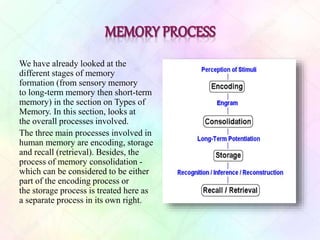
We have already looked at the
different stages of memory
formation (from sensory memory
to long-term memory then short-term
memory) in the section on Types of
Memory. In this section, looks at
the overall processes involved.
The three main processes involved in
human memory are encoding, storage
and recall (retrieval). Besides, the
process of memory consolidation -
which can be considered to be either
part of the encoding process or
the storage process is treated here as
a separate process in its own right.
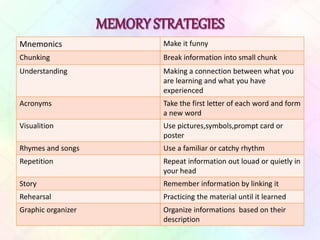
Mnemonics Make it funny
Chunking Break information into small chunk
Understanding Making a connection between what you
are learning and what you have
experienced
Acronyms Take the first letter of each word and form
a new word
Visualition Use pictures,symbols,prompt card or
poster
Rhymes and songs Use a familiar or catchy rhythm
Repetition Repeat information out louad or quietly in
your head
Story Remember information by linking it
Rehearsal Practicing the material until it learned
Graphic organizer Organize informations based on their
description
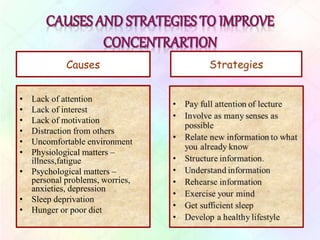
Causes
• Lack of attention
• Lack of interest
• Lack of motivation
• Distraction from others
• Uncomfortable environment
• Physiological matters –
illness,fatigue
• Psychological matters –
personal problems, worries,
anxieties, depression
• Sleep deprivation
• Hunger or poor diet
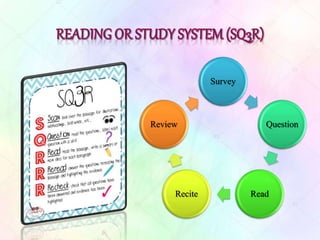
Survey
Question
ReadRecite
Review
VENUE :
AL
FARABI
• TAKING LECTURE NOTES
- Notes-taking strategies
- Effective note-taking system
• ACADEMIC INTEGRITY & PERFOMANCE
- Avoiding plagiarism
- Calculating grade point average
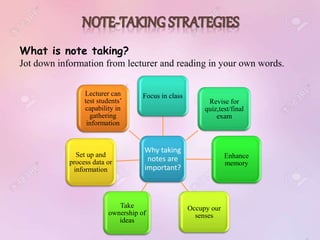
What is note taking?
Jot down information from lecturer and reading in your own words.
Why taking
notes are
important?
Focus in class
Revise for
quiz,test/final
exam
Enhance
memory
Take
ownership of
ideas
Occupy our
senses
Set up and
process data or
information
Lecturer can
test students’
capability in
gathering
information
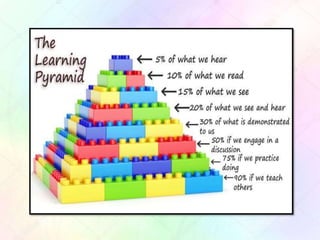
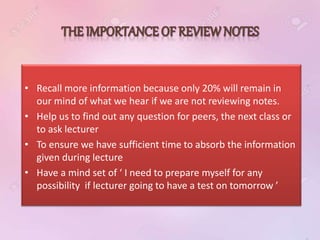
• Recall more information because only 20% will remain in
our mind of what we hear if we are not reviewing notes.
• Help us to find out any question for peers, the next class or
to ask lecturer
• To ensure we have sufficient time to absorb the information
given during lecture
• Have a mind set of ‘ I need to prepare myself for any
possibility if lecturer going to have a test on tomorrow ’
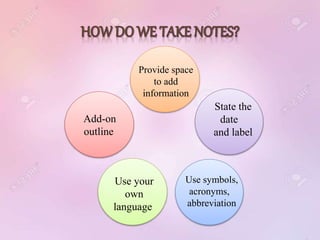
State the
date
and label
Use your
own
language
Add-on
outline
Provide space
to add
information
Use symbols,
acronyms,
abbreviation
 Do pre-reading and homework
 Go through syllabus
 Preview previous notes
 Identify key words
 Plan your study method during lecture :-
- 80% = listening
- 20% = writing
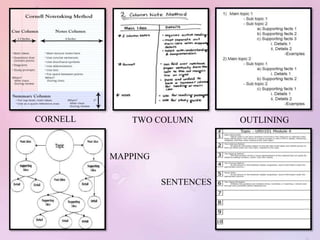
CORNELL TWO COLUMN OUTLINING
MAPPING
SENTENCES
• Be alert to repetition
- make a note when a lecturer repeats certain points
• Look up the board or overhead projector
- the information must be important if the lecturer
writes it on board
• Observe the lecture’s interest level
- the points probably will be on an exam if the
lecturer show their interest in that particular topic
• Free your mind from judments about lecture styles
- avoid yourself from being control by the bad
impression about lecture style
DEFINITION
• Process of copying
someone else’s
work and form it as
one’s own
FACTORS
• Lack of knowledge
• Fears of failure
• Student unable to
master the certain
topics
• Student don’t know
on how to manage
their time wisely
SOLUTIONS
• Gain more
information
through variety of
sources
• Be confident
• Focus during
lecture
• Plan your daily
schedule
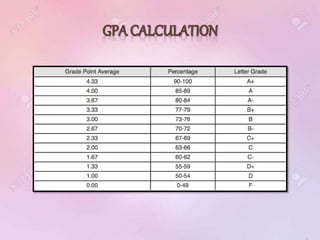
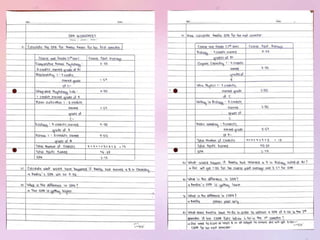
GPA: The total credit value registered and attempted in the assessment of a semester
The total credit units acquired in the same semester
1. Multiply each numeric grade value by the number of credits the course was worth
2. Add these numbers together
3. Divide by the total number of credits you took
CGPA: The total credit values registered and attempted in the assessment of all semester
The total credit units acquired in all semester
UED 102 STUDY SKILLS

UED 102 STUDY SKILLS

  • 3.
    VENUE : AL FARABI • GETTINGREADY TO LEARN - Making the transition ( from school to university ) - 8 Steps to college success - Using learning styles to enhance perfomance • GOAL SETTING - Set up goals for the new semester - Writing effective goal statements - Using the Learning Management System • TIME MANAGEMENT - Optimising and organising study time - Utilize time-management strategiesn to stay motivated - Minimize procrastination
  • 5.
    SCHOOL • You spendmore time studying in class • You have lots of test • You always be reminded of due dates and exam • Parents and teachers are your advocates • Spoonfeed learning • Teachers and classes are assigned UNIVERSITY • You spend more time studying outside of class • You have fewer test • You need to be concerned about deadline and exam by your ownself • Self-advocacy • Responsible on your own learning • Have a certain instructor for few months
  • 6.
     Attend allclasses  Become an active learner  Participate in university activities  Get to know your lectures  Form study groups  Stay up to date with works  Be receptive to change  Work hard this semester
  • 7.
     Create aweekly schedule ( planner)  Make a master list for the entire semester : - assignment - projects - exams  Acknowledge you personal style and schedule your classes accordingly  Read the assigned stuff before classes  Attend every class early ( review notes )  Design your own notes – don’t write down exactly what the instructor said  Get notes of missed classes from reliable source  Get to know your instructor  Discover what type of learner you are  Identify you particular challenges : - motivation - note- taking skills - procrastination - test anxiety - reading skills  Develop a plan
  • 9.
    • A goalby definition is an observable and measurable end result in having one or more objectives to be achieved within a more or less fixed timeframe. • To me a goal is our dream or vision of something that motivate us to achieve whatever we desire in our lives without dreaming about it but to make it happen in a realistic ways.
  • 10.
    • Goals shouldbe SELF-CHOSEN • Goals should be MODERATELY CHALLENGING • Goals should be MEASURABLE • Goals should be REALISTIC • Goals should be SPECIFIC • Goals should be FINITE ( having limits or bounds ) • Goals be should POSITIVE
  • 11.
    1. EVALUATE ANDREFLECT • The only way we can reasonably decide what we desire in the future and how we’ll accomplish it, is to know where we are right now and what our current level of sa tisfaction is. So first, take some time to think through and write down your current situation; then ask this question on each key point: ‘ Is that OK?’ • The purpose of evaluation is twofold. Firstly, it provides you an objective way to look at your accomplishments and your pursuit of the vision you have for life. Secondly, it shows you where you are; so you can decide where you need to go. Evaluation gives you a baseline to work from. • Take a couple of hours this week to evaluate and reflect. See where you are and write it down so that as the months progress and you continue a regular time of evaluation and reflection, you will see just how much ground you’re gaining - and that will be inspiring !
  • 12.
    2. DEFINE YOURDREAMS AND GOALS • One of the amazing things we have been given as humans is the unquenchable desire to have dreams of a better life and the ability to form and set goals to live out those dreams. We can look deep within our hearts and dream of a better situation for ourselves and our families. We can dream of better financial, emotional, spiritual or physical lives. We have also been given the ability to not only dream, but pursue those dreams - and not just pursue them, but the cognitive ability to design a plan and strategies to achieve those dream. AMAZING ! • What are your dreams and goals? This isn’t what you already have or what you have done, but what you want. Have you ever really take a deep breath and think through your life values and decided what you really want? Have you ever taken the time to truly reflect, to listen quietly to your heart and to see what dreams live within you? Your dreams are there in fact everyone has them. They may live right on the surface, or they may be buried deep from years of others telling you they were foolish, but they are there.
  • 13.
    • Take timeto be quiet. This is something that we don’t really get through it in this busy world of ours. We keep rushing and we’re constantly listening to noise all around us. The human heart was meant for times of quiet - to peer deep within. It is when we do this and our hearts are set free to soar and take flight on the wings of our own dreams. Schedule some quiet “dream time” this week. NO OTHER PEOPLE. NO CELLPHONE. NO COMPUTER. Just you, a pad, a pen and your thoughts. Don’t think of any as too freakish or foolish – remember - you’re dreaming! Let the thoughts freely fly and take careful record. • Think about what really thrills you. When you are quiet, think about those things that really get your blood moving. What would you enjoy to do, either for fun or for a living? What would you love to achieve? What would you try if you were guaranteed to succeed? What big thoughts move your heart into a state of excitement and enjoyment? When you answer these questions you will feel fantastic and be in the “dream zone.” It is only when we get to this point that we experience what our dreams are. • Now, prioritize those dreams. Which are most essential? Which are most achievable? Which would you love to do the most? Put them in the order in which you will actually try to accomplish them. Remember, we are always moving toward action - not just dreaming.
  • 14.
    3. HAVE ACCOUNTABILITY Whensomeone knows what your goals are, they hold your accountable by asking you to “give an account” of where you are in the process of executing that goal. Accountability puts some teeth into the process. If a goal is set and only one person knows it, does it really have any power? Most of the times, NO. A goal isn’t as powerful if you don’t have one or more people who can hold you accountable to it.
  • 15.
    What do you want to achieve? Whyis this goal essential to you? What steps will you take to accomplish it? What is the action oriented verb? When do you want to accomplish this goal?
  • 16.
    Be a gynecologist Fulfillmy dream in order to help others in an incredibly significant way Step 1: Earn a Bachelor's Degree Step 2: Take the Medical College Admissions Test (MCAT) Step 3: Earn a Medical Degree Step 4: Complete a Residency Programe Step 5: Obtain Licensure Step 6: Get Certified to Advance Career 1. Medical terminalogy is complicated 2. Medicine is a long course 3. Workload 4. Stress, burnout, and lack of work-life balance. At the early age of 25
  • 18.
    TIME 1. The indefinitecontinued progress existence and events in the past, present, and future regarded as a whole. 2. Plan, schedule or arrange when (somethimg) should happenor be done TIME MANAGEMENT The abbility to use one’s time effectively or productively, especially at work
  • 19.
     Prepare beforehand Manypeople think that prep work counts as studying, which it does, to a certain extent. Taking notes and catching up on lesson plans should be done as a routine before you start studying. In ours busy world, you should prepared for the exact time you actually need to sit down and start reviewing information. Sure, this is easier said than done, but if you get into this routine of making the compulsory preparations, you will almost certainly be successful.  Take advantage of downtime The best students know how to take advantage of their study time. Whether it is in the bus, on the way to class or waiting at the restaurant, there is always a way to cram in a few minutes of studying. Bring your notes everywhere you go, even if it is just a flashcard or a PDF on your phone. It will come in handy at some point. By taking advantage of time where you would normally be waiting or staring at the wall you will need less time to cram, and will be more likely to memorize the information, as it will be stored in your long-term memory with repetitive studying.
  • 20.
     Take noteswhile studying You won’t remember much if you simply stare at a page all day long. Even if you’re studying a 1000 page textbook, take as many notes as you can. Sure, it might take a little bit longer, but by taking notes of what you read, you are transferring the content that you learn from your short- term memory to your long-term memory. Furthermore, it will take less time when you go to review information, as you will already have consolidated it on paper  Concern about what you eat Many college students think they can get by just on coffee and a bag of chips, but that simply does not do the trick. What you eat and drink is directly proportional to how you do on a test. If you don’t eat, your attention span will be shorter, your brain will not well function and you will not perform better on a test. Furthermore, if you don’t drink water your brain will not work very efficiently. Try taking a bottled water everywhere you go. It will incentivize you to drink more, which will help you to stay awake and make you feel better.
  • 21.
     Sleep You won’tget far if you don’t sleep. The stereotype of staying up all night to cram for that big exam works less often than people think.While they are studying all night, they retain almost nothing, and most of the time, they are doing something counterproductive, like scrolling Instagram or checking Twitter.Your brain cannot well function without sleep, contrary to what many people think. Furthermore, it only works at full capacity for around 30 minutes, so if you don’t take sufficient breaks, you might as well be studying for 70 percent of the time.Take breaks, relax and get enough sleep . You going to feel better during the test, and will likely be able to relay the information you learned in a more concise manner.
  • 22.
    • AVOID PROCRASTINATION • FORMWEEKLY SCHEDULE • HAVE A DAILY PLANNER • MAKE A SEMESTER CALENDER • ACADEMIC VS PERSONAL LIFE
  • 23.
    DAYS / TIME MON TUESWED THURS FRI SAT SUN 6.00 a.m Wake up and breakfast Wake up and breakfast Wake up and breakfast Wake up and breakfast Wake up and breakfast Wake up and breakfast Wake up and breakfast 8.00 a.m Ironing time Jogging Class time Class time Class time Laundry time Clean up house 12.00 p.m Lunch time Lunch time Lunch time Lunch time Lunch time Lunch time Lunch time 2.15 p.m Class time Class time Class time Class time Listening to music Reading novels Watching movies 6.15 p.m Relax time Relax time Relax time Relax time Chilling Recreation Recreation 7.00 p.m Spiritual routines Spiritual routines Spiritual routines Spiritual routines Spiritual routines Spiritual routines Spiritual routines 8.00 p.m Dinner Dinner Dinner Dinner Dinner Dinner Dinner 9.00 p.m Revision Study Create notes Doing assignment Family time Me time Revision 11.00 am Sleep Sleep Sleep Sleep Sleep Sleep Sleep
  • 25.
    1. Do tasksyou enjoy Remember, if you don’t enjoy in doing tasks that demotivate you, then doing tasks you do like and can increase motivation, productivity and success. If you’re not quite ready to start that big project, why not cross off some of your other to-dos? Pick some tasks you enjoy – that have to be done – and get them out of the way. It will put you in a better frame of mind for handling the big task. 2. Balance your time Ultimately, that task has to be done. Here are some ways to reduce procrastination. • Prime yourself for success by breaking the large project or task into smaller tasks • Minimize the amount of time you allocate to each of those tasks, then it won’t feel like burdens hanging over your head • Cross off those smaller tasks whenever you can so you feel a sense of accomplishment
  • 26.
    3. Psych yourselfinto productivity Maybe you can psych yourself into being more productive. Determine whether your tough principle is being as productive as possible or doing as little as you can get away with. Here’s a hint from Jim Collins, author of Good to Great. The most successful people achieve “sustained excellence”, producing and delivering day in, day out. 4. Make productivity a game Tim Pychyl suggests another approach: reducing the boredom by turning challenging tasks into a game. For instance, you can make a private bet on how many words of that report you can write in the next 30 minutes. The point is to accomplish something before you become so bored then you can do nothing.
  • 27.
    5. Imagine theupshot If the carrot doesn’t work, try the stick. Ask yourself about the outcome of failing to complete that project or task. Not only will you feel like an underachiever, but it can have an impact on career development. Sometimes knowing that is enough as an incentive to get started. 6. Delegate or outsource If you have tried everything but still can’t get that big project out of the way, maybe it’s not right for you. In that case, delegate the project to someone who will have the passion and motivation to succeed, and move onto something that you find more inspiring.
  • 28.
    VENUE : AL FARABI • GETTINGTO KNOW THE CAMPUS - Making the most of college resources • MEMORY LEARNING & IMPROVING CONCECENTERATION - Understanding memory processes (Types of Memory) - Memories strategies - Understanding concentration - Strategies for improving concentration - Reading/study system (SQ3R)
  • 30.
    ACADEMIC  Library  Informationtechnology and computer  Registra o Al-Bukhari l & 2 o Ar-Razi o Hal Ehwal Akademik HOUSING,DINING, TRANSPORTATION  House  Dining place  Transportation o Kolej Tok Gajah, Kolej Mat Kilau 1 & 2, Kolej Dato Bahaman o Medan selera, Dewan makan o Buses, Van, Bus station STUDENT ORGANIZATION  Extra curricular  Leisure activities o Hal Ehwal Pelajar, Kompleks sukan, Stadium, Kem Gading o A&B field, Tennis & squash court,Rugby field
  • 31.
    MEDAN SELERA ALBUKHARI KOLEJ TOK GAJAH RUGBY FIELD KOLEJ MAT KILAU
  • 34.
    BRAIN Brain is anorgan (Computer Hardware) MEMORY Memory is the ability of an individual to encode, store and retrieve information (Computer Software)
  • 35.
    LEFT  Logic  Mathematic Language  Science  Analysis  Rational  Systematic RIGHT  Abstract  Intuitive  Art  Music  Imagination  Emotion  Random The brain is one of the largest and most complex organs in the human body.It is made up of more than 100 billion nerves that communicate in trillions of connections called synapses The brain is surrounded by a layer of tissue called the meninges. The skull (cranium) helps in protecting the brain from injury.
  • 37.
    • Virtually, the5 senses of our body ( vision,heaering,smelling,tasting and touching) are always working. We can see,hear,smell,taste and touch hundreds of stimuli each time. • Most of these stimuli are insignificant and quickly forgetten. However,some stimuli are important and worth memorizing, but we need to pay attention to them or else they can be forgetten • Attention is crucial to the function of the sensory registers • Have you ever found yourself daydreaming during lecture? It is simply mean you are not paying full attention to what the lecturer is saying • You can’t process any information through the sensory memory without attending to them. As well as if u are trying to read a text chapter while watching television, you will find yourself not remember much of what you have read. So to complete certain task, you need to pay full attention to it.
  • 38.
    LTM Temporary store Limited capacity Extremelyrapid decay Auditory, verbal and linguistic representation Information is presented in the shallowest format Anatomical change to be retained or new protein synthesis not required STM Permenant store Unlimited capacity Slower rate of forgetting Semantic, visual and temporal forms of storage Information is stored in terms of individual significance Structural changes and new protein synthesis in the brain are required
  • 39.
    We have alreadylooked at the different stages of memory formation (from sensory memory to long-term memory then short-term memory) in the section on Types of Memory. In this section, looks at the overall processes involved. The three main processes involved in human memory are encoding, storage and recall (retrieval). Besides, the process of memory consolidation - which can be considered to be either part of the encoding process or the storage process is treated here as a separate process in its own right.
  • 40.
    Mnemonics Make itfunny Chunking Break information into small chunk Understanding Making a connection between what you are learning and what you have experienced Acronyms Take the first letter of each word and form a new word Visualition Use pictures,symbols,prompt card or poster Rhymes and songs Use a familiar or catchy rhythm Repetition Repeat information out louad or quietly in your head Story Remember information by linking it Rehearsal Practicing the material until it learned Graphic organizer Organize informations based on their description
  • 42.
    Causes • Lack ofattention • Lack of interest • Lack of motivation • Distraction from others • Uncomfortable environment • Physiological matters – illness,fatigue • Psychological matters – personal problems, worries, anxieties, depression • Sleep deprivation • Hunger or poor diet
  • 43.
  • 44.
    VENUE : AL FARABI • TAKINGLECTURE NOTES - Notes-taking strategies - Effective note-taking system • ACADEMIC INTEGRITY & PERFOMANCE - Avoiding plagiarism - Calculating grade point average
  • 45.
    What is notetaking? Jot down information from lecturer and reading in your own words. Why taking notes are important? Focus in class Revise for quiz,test/final exam Enhance memory Take ownership of ideas Occupy our senses Set up and process data or information Lecturer can test students’ capability in gathering information
  • 46.
    • Recall moreinformation because only 20% will remain in our mind of what we hear if we are not reviewing notes. • Help us to find out any question for peers, the next class or to ask lecturer • To ensure we have sufficient time to absorb the information given during lecture • Have a mind set of ‘ I need to prepare myself for any possibility if lecturer going to have a test on tomorrow ’
  • 47.
    State the date and label Useyour own language Add-on outline Provide space to add information Use symbols, acronyms, abbreviation
  • 48.
     Do pre-readingand homework  Go through syllabus  Preview previous notes  Identify key words  Plan your study method during lecture :- - 80% = listening - 20% = writing
  • 50.
    CORNELL TWO COLUMNOUTLINING MAPPING SENTENCES
  • 51.
    • Be alertto repetition - make a note when a lecturer repeats certain points • Look up the board or overhead projector - the information must be important if the lecturer writes it on board • Observe the lecture’s interest level - the points probably will be on an exam if the lecturer show their interest in that particular topic • Free your mind from judments about lecture styles - avoid yourself from being control by the bad impression about lecture style
  • 52.
    DEFINITION • Process ofcopying someone else’s work and form it as one’s own FACTORS • Lack of knowledge • Fears of failure • Student unable to master the certain topics • Student don’t know on how to manage their time wisely SOLUTIONS • Gain more information through variety of sources • Be confident • Focus during lecture • Plan your daily schedule
  • 53.
    GPA: The totalcredit value registered and attempted in the assessment of a semester The total credit units acquired in the same semester 1. Multiply each numeric grade value by the number of credits the course was worth 2. Add these numbers together 3. Divide by the total number of credits you took CGPA: The total credit values registered and attempted in the assessment of all semester The total credit units acquired in all semester