
















GET WITH THE
How colleges and universities can provide better
major, minor, degree, and certificate information on the web
PROGRAM
Doug Gapinski of mStoner
Get this deck!
slideshare.com/thedougco
@DougGapinski
#heweb14
mStoner.com
It’s so totally not what it sounds like.
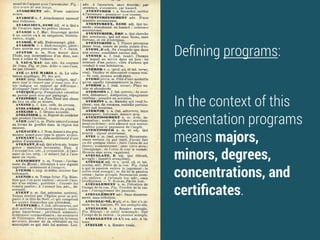
Defining programs:
In the context of this
presentation programs
means majors,
minors, degrees,
concentrations, and
certificates.
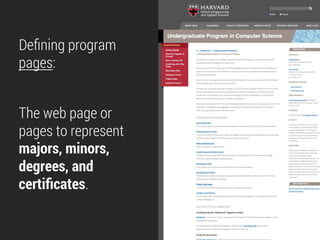
Defining program
pages:
The web page or
pages to represent
majors, minors,
degrees, and
certificates.
#heweb14
What are some of the best program pages
(degrees, minors, concentrations,
or certificates) you’ve seen?
Five reasons why program pages matter
When is a prospective student not a
prospective student?
Great examples
Kicking off your very own program page
redux initiative
Five reasons why program pages matter
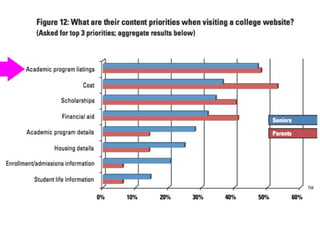
1Program listings are the top priority for
prospective students – according to them!
0%
7.5%
15.0%
22.5%
30.0%
Academic program/ major listing Cost Academic program/ majors details Financial aid Scholarships Enrollment/ admissions information Housing details
Students Parents
First content targets on
college and university websites
Source: Noel-Levitz
How can you demonstrate value?
29%
22%
16%
18%
4%
33%
25%
32%
6% 5%
Academic program content Testimonials Statistics (job placement/grad schools) Videos Calculators
Seniors
Parents
How can colleges and universities
demonstrate value?
Source: Noel-Levitz
2For higher education,
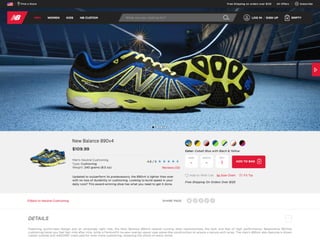
the programs are the core products!
But what about the experience?
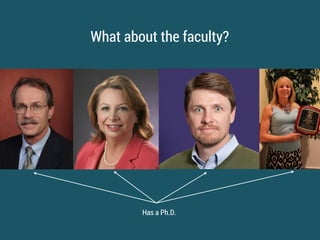
What about the faculty?
Has a Ph.D.
What about the facilities?
All that stuff is important.
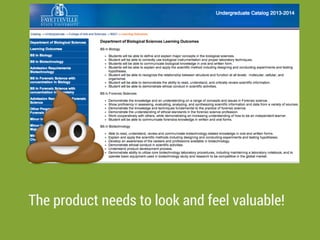
But the core products that colleges and
universities offer are the programs.
The product needs to look and feel valuable!
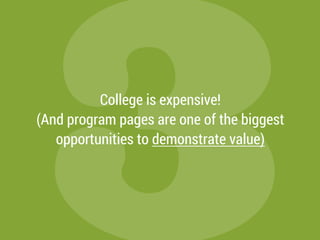
3College is expensive!
(And program pages are one of the biggest
opportunities to demonstrate value)
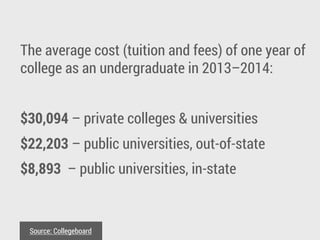
The average cost (tuition and fees) of one year of
college as an undergraduate in 2013–2014:
$30,094 – private colleges & universities
$22,203 – public universities, out-of-state
$8,893 – public universities, in-state
Source: Collegeboard
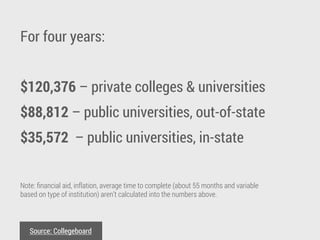
For four years:
$120,376 – private colleges & universities
$88,812 – public universities, out-of-state
$35,572 – public universities, in-state
Note: financial aid, inflation, average time to complete (about 55 months and variable
based on type of institution) aren’t calculated into the numbers above.
Source: Collegeboard
m
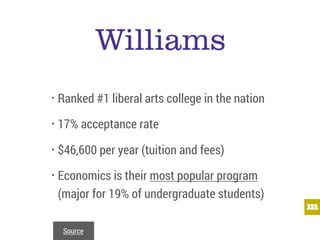
• Ranked #1 liberal arts college in the nation
• 17% acceptance rate
• $46,600 per year (tuition and fees)
• Economics is their most popular program
(major for 19% of undergraduate students)
Source
m
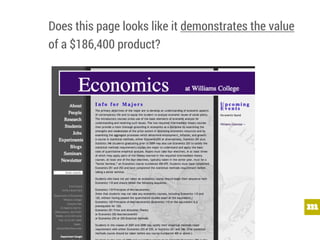
Does this page looks like it demonstrates the value
of a $186,400 product?
m
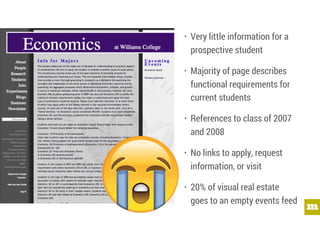
• Very little information for a
prospective student
• Majority of page describes
functional requirements for
current students
• References to class of 2007
and 2008
• No links to apply, request
information, or visit
• 20% of visual real estate
goes to an empty events feed
m
• Very little information for a
prospective student
• Majority of page describes
functional requirements for
current students
• References to class of 2007
and 2008
• No links to apply, request
information, or visit
• 20% of visual real estate
goes to an empty events feed
4Because Google.
Because Google is handing you targeted leads
that don’t come through your home page or your
admissions pages.
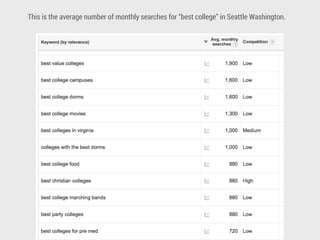
This is the average number of monthly searches for “best college” in Seattle Washington.
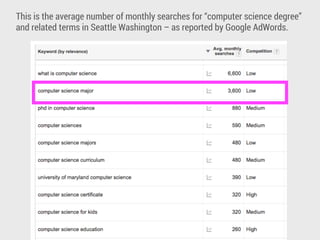
This is the average number of monthly searches for “computer science degree”
and related terms in Seattle Washington – as reported by Google AdWords.
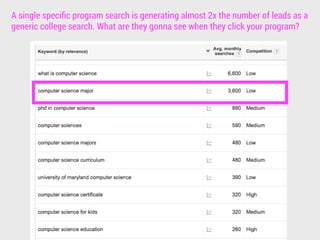
A single specific program search is generating almost 2x the number of leads as a
generic college search. What are they gonna see when they click your program?
5This content appeals to nerds.
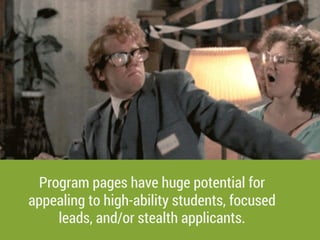
Program pages have huge potential for
appealing to high-ability students, focused
leads, and/or stealth applicants.
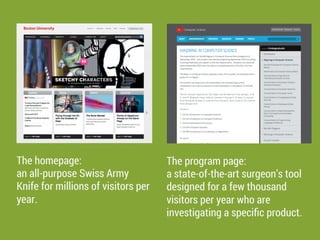
The homepage:
an all-purpose Swiss Army
Knife for millions of visitors per
year.
The program page:
a state-of-the-art surgeon’s tool
designed for a few thousand
visitors per year who are
investigating a specific product.
When is a prospective student not a
prospective student?
When they’re a curr-spective student.
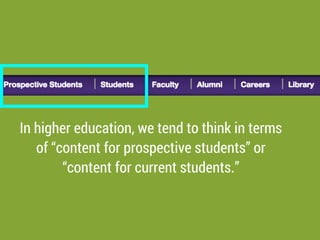
In higher education, we tend to think in terms
of “content for prospective students” or
“content for current students.”
Up to 50% of incoming college freshman
classes are undecided for majors.
Source
60–80% of all students in the US will change
majors while earning an undergraduate degree.
Source
What about transfer students?
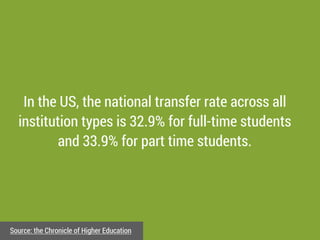
In the US, the national transfer rate across all
institution types is 32.9% for full-time students
and 33.9% for part time students.
Source: the Chronicle of Higher Education
undecided / undeclared students,
current student who will change majors,
and transfer students
are current students but they are
still shopping for a program
cürr-spéc-tiv
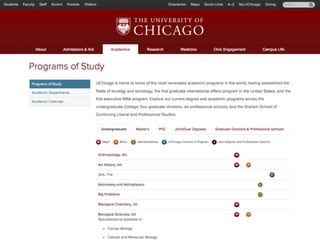
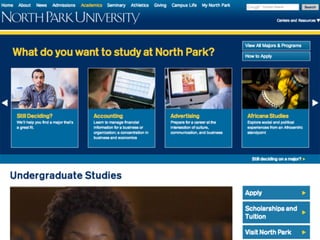
What makes a great program listing page?
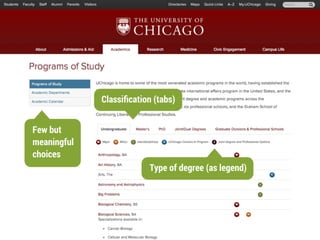
Few but
meaningful
choices
Classification (tabs)
Type of degree (as legend)
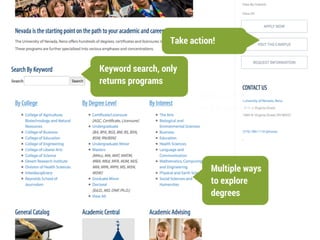
Keyword search, only
returns programs
Multiple ways
to explore
degrees
Take action!
Multiple ways
to the degrees
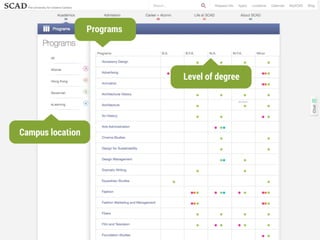
Campus location
Level of degree
Programs
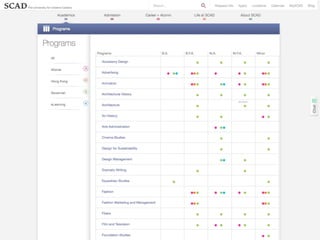
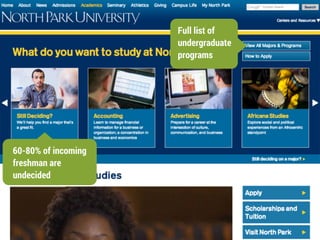
60-80% of incoming
freshman are
undecided
Full list of
undergraduate
programs
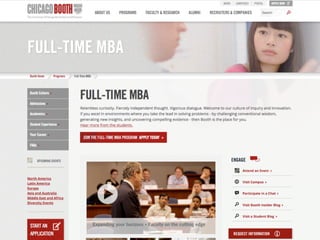
What makes a great program landing page
or pages?
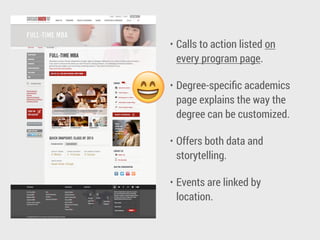
• Calls to action listed on
every program page.
• Degree-specific academics
page explains the way the
degree can be customized.
• Offers both data and
storytelling.
• Events are linked by
location.
• Calls to action listed on
every program page.
• Degree-specific academics
page explains the way the
degree can be customized.
• Offers both data and
storytelling.
• Events are linked by
location.
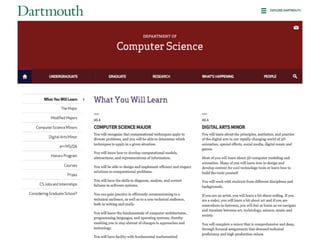
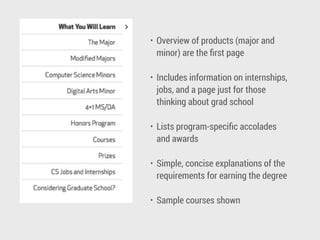
• Overview of products (major and
minor) are the first page
• Includes information on internships,
jobs, and a page just for those
thinking about grad school
• Lists program-specific accolades
and awards
• Simple, concise explanations of the
requirements for earning the degree
• Sample courses shown
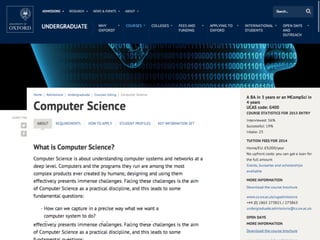
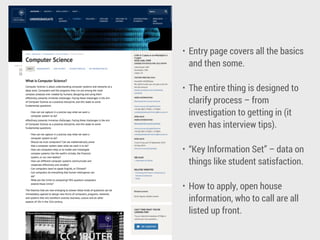
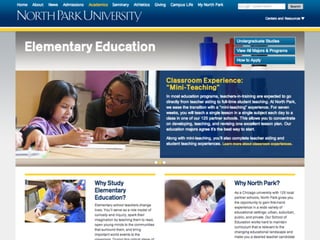
• Entry page covers all the basics
and then some.
• The entire thing is designed to
clarify process – from
investigation to getting in (it
even has interview tips).
• “Key Information Set” – data on
things like student satisfaction.
• How to apply, open house
information, who to call are all
listed up front.
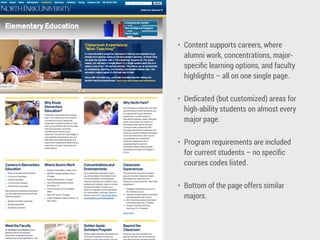
• Content supports careers, where
alumni work, concentrations, major-
specific learning options, and faculty
highlights – all on one single page.
• Dedicated (but customized) areas for
high-ability students on almost every
major page.
• Program requirements are included
for current students – no specific
courses codes listed.
• Bottom of the page offers similar
majors.
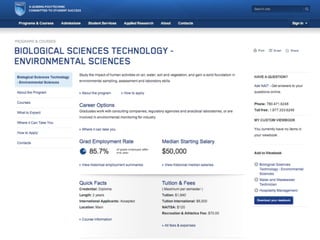
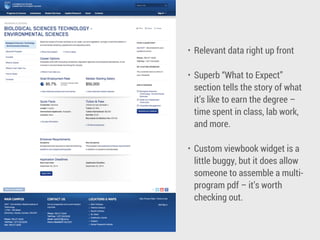
• Relevant data right up front
• Superb “What to Expect”
section tells the story of what
it’s like to earn the degree –
time spent in class, lab work,
and more.
• Custom viewbook widget is a
little buggy, but it does allow
someone to assemble a multi-
program pdf – it’s worth
checking out.
To recap, some of the things that make program pages good:
• You need to be giving them access to next steps from
program pages – no exceptions.
• Assume that it’s a visitor’s first time there – but have more
details available for the repeat visitor (think of the Oxford
example).
• Anything that explains what to expect – from selectivity, to
typical courses to time spent in class – is good.
• Part of the program page or section should be dedicated to
high ability students (honors, accolades, research
opportunities).
• Data AND storytelling, not one or the other.
• Programs should always link to similar programs or at least
have a button for a listing page.
Who can help with data (program, internship, placement and/or
academic satisfaction)?
• Director of institutional research (if you’ve got one)
• Academic deans
• Admissions
• Career services offices
If nobody has data, now is the time to start.
Seven ideas for rolling out new and
improved program pages
1Decide what’s the best model for your
programs – centralized or decentralized.
Decentralized (common) Find
“Computer
Science
Major”
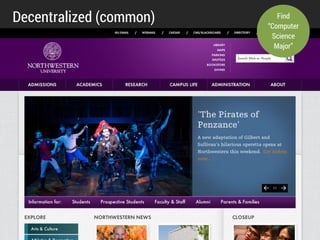
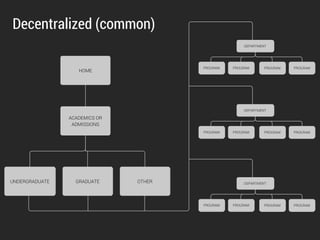
Decentralized (common)
Decentralized programs
In this model, the deans and/or content editors
for each department are usually responsible for
maintaining the program pages.
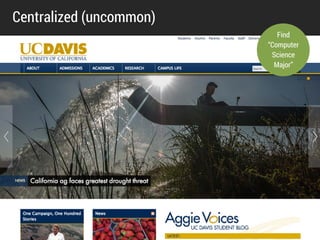
Find
“Computer
Science
Major”
Centralized (uncommon)
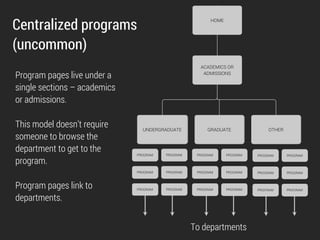
Centralized programs
(uncommon)
Program pages live under a
single sections – academics
or admissions.
This model doesn’t require
someone to browse the
department to get to the
program.
Program pages link to
departments.
To departments
ACADEMICS OR
ADMISSIONS
UNDERGRADUATE GRADUATE OTHER
HOME
PROGRAM PROGRAM
PROGRAM PROGRAM
PROGRAM PROGRAM
PROGRAM PROGRAM
PROGRAM PROGRAM
PROGRAM PROGRAM
PROGRAM PROGRAM
PROGRAM PROGRAM
PROGRAM PROGRAM
Is it possible to have both models?
Yes – sometimes undergraduate majors and
minors are contained in one centralized location on
the main .edu site and all graduate programs are
contained on the department sites.
My own recommendation is for these pages to be
centralized under academics.
Why? It doesn’t make sense to be kicking up to
50% undecided undergraduates down into the
college and school level.
2Assemble a core team to work on
program pages and decide...
... who needs to buy-in to the process.
... who will be writing / editing the pages.
3Pick 10 to 20 programs to pilot – could
be the most popular, the best-ranked, the
oldest (since these tend to have more
content), or a mix.
4Do a competitive analysis of the program
pages of your top three competitors and
top three aspirants.
5
Set up easy, semantic URLs for
redirection to program pages – so you
can promote or link to programs in
marketing materials.
fabercollege.edu/ecology
6Do a content table that lays out the
minimum viable content model for a
program page or section. You can always
scale up for the more robust majors.
7Test program pages with prospective or
current students. This could be your
current pages or concepts for new pages.
See for yourself what your audiences
want.
Questions?
higheredlive.com
Shows and resources for higher
education by higher education.
Thanks!
@DougGapinski mstoner.com

Get with the program

  • 1.
    GET WITH THE Howcolleges and universities can provide better major, minor, degree, and certificate information on the web PROGRAM Doug Gapinski of mStoner
  • 2.
  • 3.
  • 4.
    mStoner.com It’s so totallynot what it sounds like.
  • 5.
    Defining programs: In thecontext of this presentation programs means majors, minors, degrees, concentrations, and certificates.
  • 6.
    Defining program pages: The webpage or pages to represent majors, minors, degrees, and certificates.
  • 7.
    #heweb14 What are someof the best program pages (degrees, minors, concentrations, or certificates) you’ve seen?
  • 8.
    Five reasons whyprogram pages matter When is a prospective student not a prospective student? Great examples Kicking off your very own program page redux initiative
  • 9.
    Five reasons whyprogram pages matter
  • 10.
    1Program listings arethe top priority for prospective students – according to them!
  • 11.
    0% 7.5% 15.0% 22.5% 30.0% Academic program/ majorlisting Cost Academic program/ majors details Financial aid Scholarships Enrollment/ admissions information Housing details Students Parents First content targets on college and university websites Source: Noel-Levitz
  • 12.
    How can youdemonstrate value? 29% 22% 16% 18% 4% 33% 25% 32% 6% 5% Academic program content Testimonials Statistics (job placement/grad schools) Videos Calculators Seniors Parents How can colleges and universities demonstrate value? Source: Noel-Levitz
  • 13.
    2For higher education, theprograms are the core products!
  • 14.
    But what aboutthe experience?
  • 15.
    What about thefaculty? Has a Ph.D.
  • 16.
    What about thefacilities?
  • 17.
    All that stuffis important. But the core products that colleges and universities offer are the programs.
  • 20.
    The product needsto look and feel valuable!
  • 21.
    The product needsto look and feel valuable!
  • 23.
    3College is expensive! (Andprogram pages are one of the biggest opportunities to demonstrate value)
  • 24.
    The average cost(tuition and fees) of one year of college as an undergraduate in 2013–2014: $30,094 – private colleges & universities $22,203 – public universities, out-of-state $8,893 – public universities, in-state Source: Collegeboard
  • 25.
    For four years: $120,376– private colleges & universities $88,812 – public universities, out-of-state $35,572 – public universities, in-state Note: financial aid, inflation, average time to complete (about 55 months and variable based on type of institution) aren’t calculated into the numbers above. Source: Collegeboard
  • 26.
    m • Ranked #1liberal arts college in the nation • 17% acceptance rate • $46,600 per year (tuition and fees) • Economics is their most popular program (major for 19% of undergraduate students) Source
  • 27.
    m Does this pagelooks like it demonstrates the value of a $186,400 product?
  • 28.
    m • Very littleinformation for a prospective student • Majority of page describes functional requirements for current students • References to class of 2007 and 2008 • No links to apply, request information, or visit • 20% of visual real estate goes to an empty events feed
  • 29.
    m • Very littleinformation for a prospective student • Majority of page describes functional requirements for current students • References to class of 2007 and 2008 • No links to apply, request information, or visit • 20% of visual real estate goes to an empty events feed
  • 30.
  • 31.
    Because Google ishanding you targeted leads that don’t come through your home page or your admissions pages.
  • 32.
    This is theaverage number of monthly searches for “best college” in Seattle Washington.
  • 33.
    This is theaverage number of monthly searches for “computer science degree” and related terms in Seattle Washington – as reported by Google AdWords.
  • 34.
    A single specificprogram search is generating almost 2x the number of leads as a generic college search. What are they gonna see when they click your program?
  • 35.
  • 36.
    Program pages havehuge potential for appealing to high-ability students, focused leads, and/or stealth applicants.
  • 37.
    The homepage: an all-purposeSwiss Army Knife for millions of visitors per year. The program page: a state-of-the-art surgeon’s tool designed for a few thousand visitors per year who are investigating a specific product.
  • 38.
    When is aprospective student not a prospective student?
  • 39.
    When they’re acurr-spective student.
  • 40.
    In higher education,we tend to think in terms of “content for prospective students” or “content for current students.”
  • 41.
    Up to 50%of incoming college freshman classes are undecided for majors. Source
  • 42.
    60–80% of allstudents in the US will change majors while earning an undergraduate degree. Source
  • 43.
  • 44.
    In the US,the national transfer rate across all institution types is 32.9% for full-time students and 33.9% for part time students. Source: the Chronicle of Higher Education
  • 45.
    undecided / undeclaredstudents, current student who will change majors, and transfer students are current students but they are still shopping for a program cürr-spéc-tiv
  • 46.
    What makes agreat program listing page?
  • 48.
  • 50.
    Keyword search, only returnsprograms Multiple ways to explore degrees Take action! Multiple ways to the degrees
  • 52.
    Campus location Level ofdegree Programs
  • 55.
    60-80% of incoming freshmanare undecided Full list of undergraduate programs
  • 56.
    What makes agreat program landing page or pages?
  • 59.
    • Calls toaction listed on every program page. • Degree-specific academics page explains the way the degree can be customized. • Offers both data and storytelling. • Events are linked by location.
  • 60.
    • Calls toaction listed on every program page. • Degree-specific academics page explains the way the degree can be customized. • Offers both data and storytelling. • Events are linked by location.
  • 62.
    • Overview ofproducts (major and minor) are the first page • Includes information on internships, jobs, and a page just for those thinking about grad school • Lists program-specific accolades and awards • Simple, concise explanations of the requirements for earning the degree • Sample courses shown
  • 65.
    • Entry pagecovers all the basics and then some. • The entire thing is designed to clarify process – from investigation to getting in (it even has interview tips). • “Key Information Set” – data on things like student satisfaction. • How to apply, open house information, who to call are all listed up front.
  • 68.
    • Content supportscareers, where alumni work, concentrations, major- specific learning options, and faculty highlights – all on one single page. • Dedicated (but customized) areas for high-ability students on almost every major page. • Program requirements are included for current students – no specific courses codes listed. • Bottom of the page offers similar majors.
  • 71.
    • Relevant dataright up front • Superb “What to Expect” section tells the story of what it’s like to earn the degree – time spent in class, lab work, and more. • Custom viewbook widget is a little buggy, but it does allow someone to assemble a multi- program pdf – it’s worth checking out.
  • 72.
    To recap, someof the things that make program pages good: • You need to be giving them access to next steps from program pages – no exceptions. • Assume that it’s a visitor’s first time there – but have more details available for the repeat visitor (think of the Oxford example). • Anything that explains what to expect – from selectivity, to typical courses to time spent in class – is good.
  • 73.
    • Part ofthe program page or section should be dedicated to high ability students (honors, accolades, research opportunities). • Data AND storytelling, not one or the other. • Programs should always link to similar programs or at least have a button for a listing page.
  • 74.
    Who can helpwith data (program, internship, placement and/or academic satisfaction)? • Director of institutional research (if you’ve got one) • Academic deans • Admissions • Career services offices
  • 75.
    If nobody hasdata, now is the time to start.
  • 76.
    Seven ideas forrolling out new and improved program pages
  • 77.
    1Decide what’s thebest model for your programs – centralized or decentralized.
  • 78.
  • 79.
  • 80.
    Decentralized programs In thismodel, the deans and/or content editors for each department are usually responsible for maintaining the program pages.
  • 81.
  • 82.
    Centralized programs (uncommon) Program pageslive under a single sections – academics or admissions. This model doesn’t require someone to browse the department to get to the program. Program pages link to departments. To departments ACADEMICS OR ADMISSIONS UNDERGRADUATE GRADUATE OTHER HOME PROGRAM PROGRAM PROGRAM PROGRAM PROGRAM PROGRAM PROGRAM PROGRAM PROGRAM PROGRAM PROGRAM PROGRAM PROGRAM PROGRAM PROGRAM PROGRAM PROGRAM PROGRAM
  • 83.
    Is it possibleto have both models? Yes – sometimes undergraduate majors and minors are contained in one centralized location on the main .edu site and all graduate programs are contained on the department sites.
  • 84.
    My own recommendationis for these pages to be centralized under academics. Why? It doesn’t make sense to be kicking up to 50% undecided undergraduates down into the college and school level.
  • 85.
    2Assemble a coreteam to work on program pages and decide... ... who needs to buy-in to the process. ... who will be writing / editing the pages.
  • 86.
    3Pick 10 to20 programs to pilot – could be the most popular, the best-ranked, the oldest (since these tend to have more content), or a mix.
  • 87.
    4Do a competitiveanalysis of the program pages of your top three competitors and top three aspirants.
  • 88.
    5 Set up easy,semantic URLs for redirection to program pages – so you can promote or link to programs in marketing materials. fabercollege.edu/ecology
  • 89.
    6Do a contenttable that lays out the minimum viable content model for a program page or section. You can always scale up for the more robust majors.
  • 90.
    7Test program pageswith prospective or current students. This could be your current pages or concepts for new pages. See for yourself what your audiences want.
  • 91.
  • 92.
    higheredlive.com Shows and resourcesfor higher education by higher education.
  • 93.