Tests for Balance Assessment
CONTENTS
Static Balance Tests
• The Romberg Test
• The sharpened Romberg
• The Single-Leg Balance Stance Test (SLB)
• The Stork Stand Test
01
Anticipatory Postural Control Tests
• The Functional Reach Test and
the Multi-Directional Reach Test
• The Star Excursion Balance Test (SEBT)
03
Functional Tests
Timed Up and Go test
05
02 Dynamic Balance Tests
The Five-times-sit-to-stand test
04 Reactive Postural Control Tests
• Pushes (small or large, slow or
rapid, and anticipated and
unanticipated)
applied in different directions
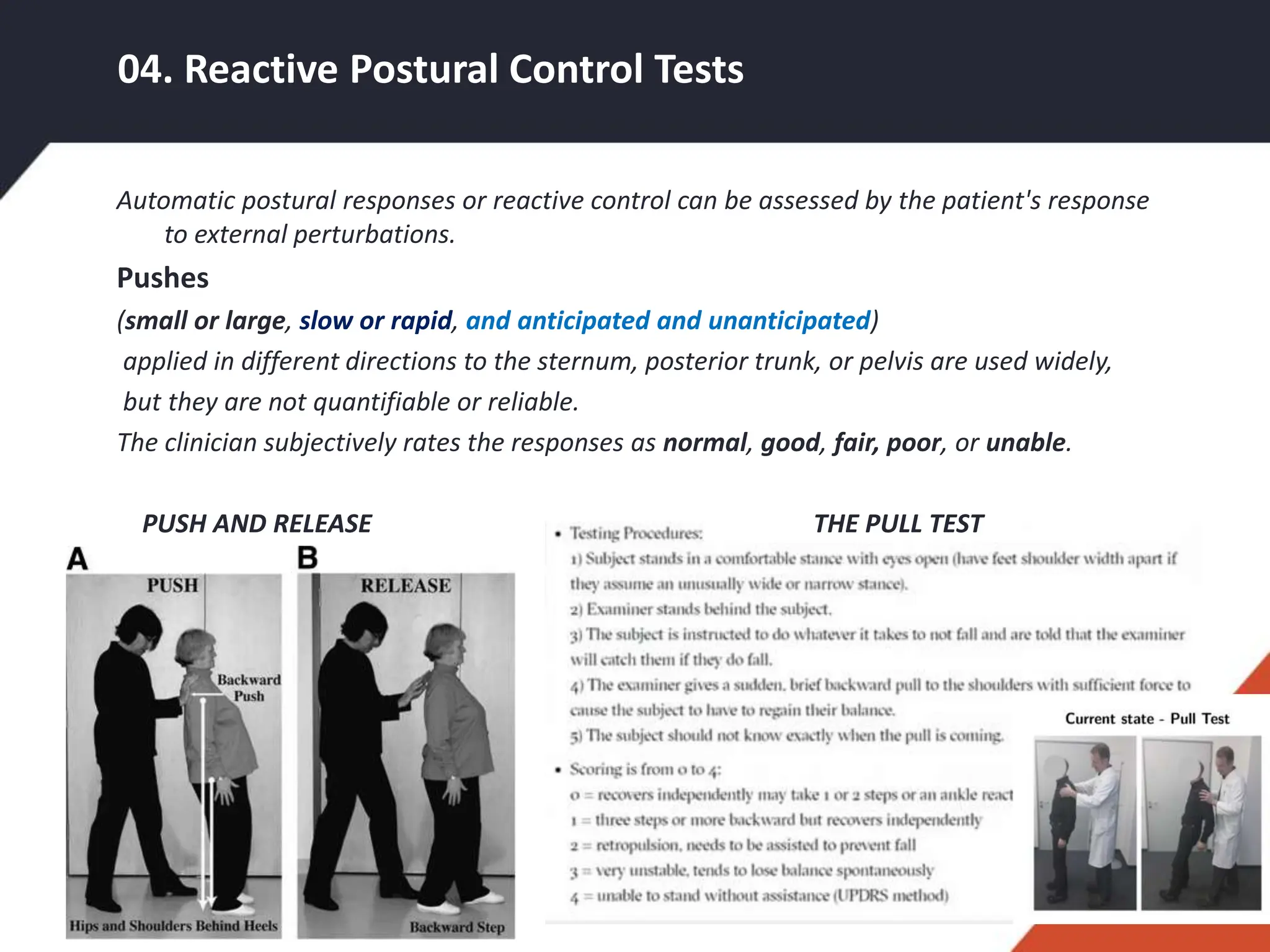
• PUSH AND RELEASE
• THE PULL TEST
01 Static Balance Tests
Static balance can be assessed by observing the
patient's ability to maintain different postures.
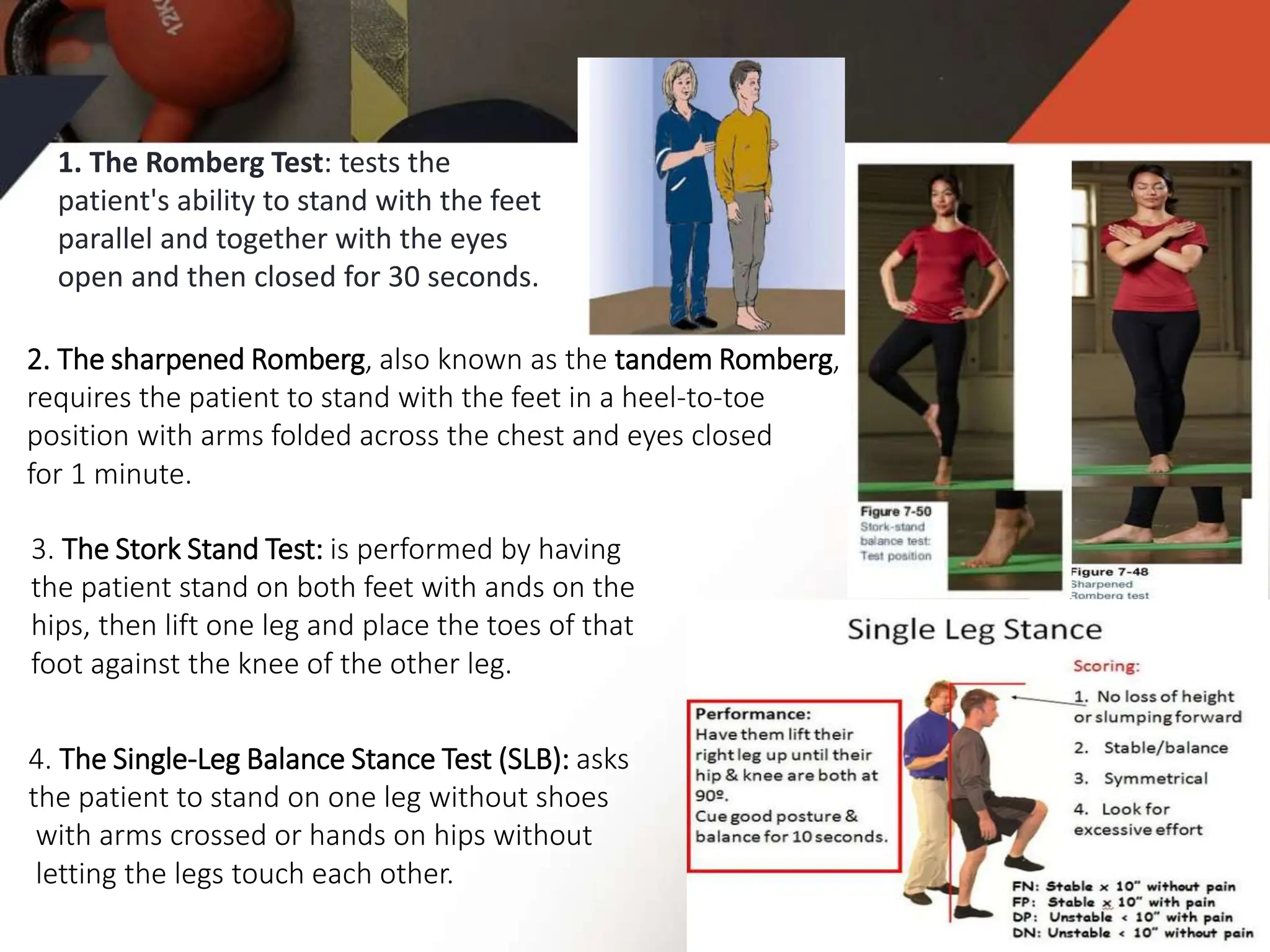
1. The Romberg Test: tests the
patient's ability to stand with the feet
parallel and together with the eyes
open and then closed for 30 seconds.
2. The sharpened Romberg, also known as the tandem Romberg,
requires the patient to stand with the feet in a heel-to-toe
position with arms folded across the chest and eyes closed
for 1 minute.
4. The Single-Leg Balance Stance Test (SLB): asks
the patient to stand on one leg without shoes
with arms crossed or hands on hips without
letting the legs touch each other.
3. The Stork Stand Test: is performed by having
the patient stand on both feet with ands on the
hips, then lift one leg and place the toes of that
foot against the knee of the other leg.
02. Dynamic Balance Tests
assessed by observations of how well the patient is able to
- stand or sit on unstable surfaces (e.g., foam or Swiss ball);
- transition from one position to another (e.g., supine-to-sit or sit-to-stand transfers);
- perform activities such as walking, jumping, hopping, and skipping.
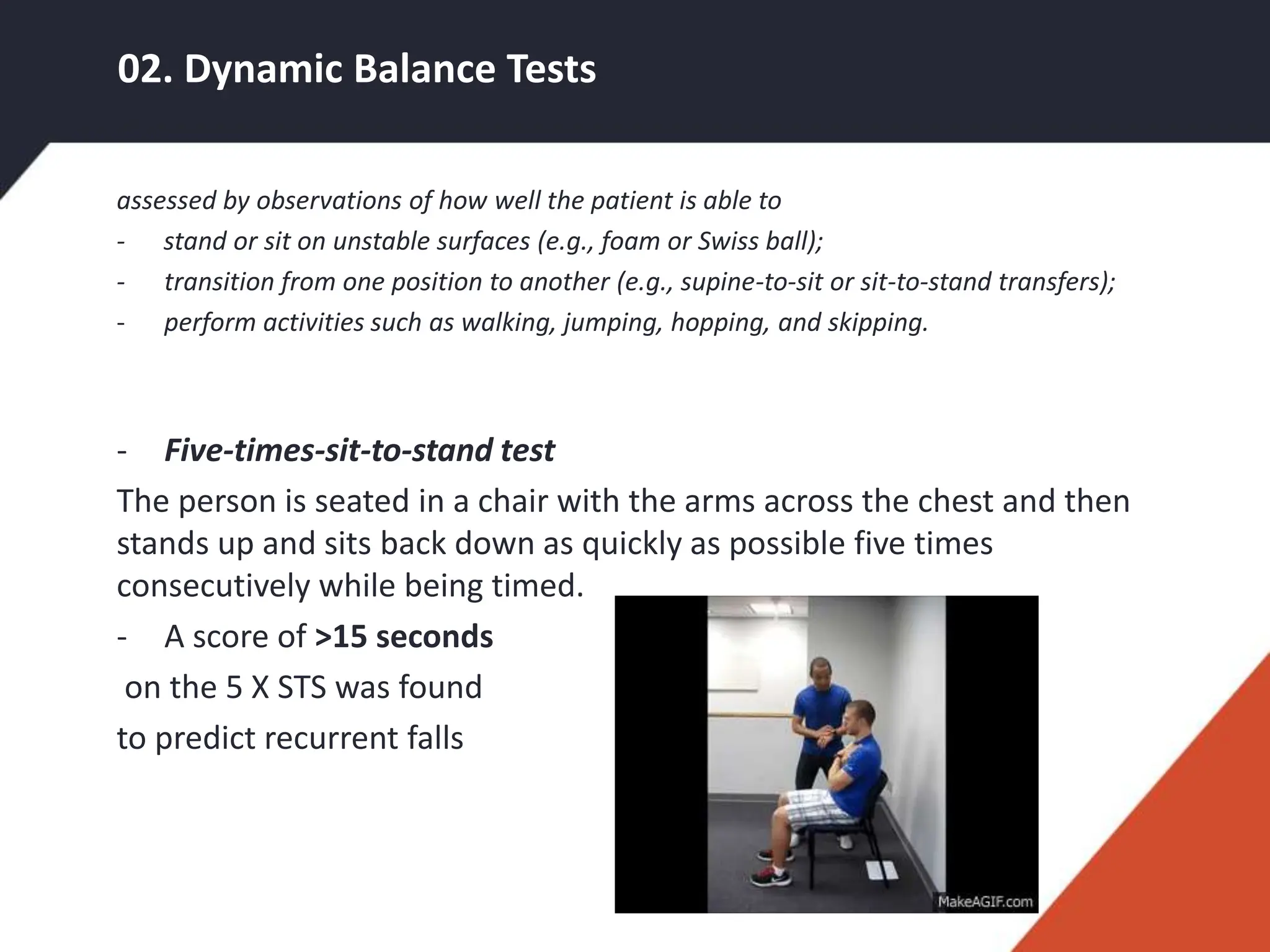
- Five-times-sit-to-stand test
The person is seated in a chair with the arms across the chest and then
stands up and sits back down as quickly as possible five times
consecutively while being timed.
- A score of >15 seconds
on the 5 X STS was found
to predict recurrent falls
03. Anticipatory Postural Control Tests
Anticipatory postural control is evaluated by having the patient perform voluntary movements
that require the development of a postural set to counteract a predicted postural disturbance.
• The Functional Reach Test and the Multi-Directional Reach Test
require the patient to reach in different
directions as far as possible without changing
the BOS. the tests are reliable and valid.
<6 inches = High Fall Risk ·
7-10 inches = Moderate Fall Risk
· >10 inches = Low Fall Risk.
• The Star Excursion Balance Test (SEBT)
is a test of lower extremity reach that challenges
an individual's limits of stability.
The patient is instructed to reach as far as
possible with one leg in each of eight
prescribed directions while maintaining
balance on the contralateral leg.
04. Reactive Postural Control Tests
Automatic postural responses or reactive control can be assessed by the patient's response
to external perturbations.
Pushes
(small or large, slow or rapid, and anticipated and unanticipated)
applied in different directions to the sternum, posterior trunk, or pelvis are used widely,
but they are not quantifiable or reliable.
The clinician subjectively rates the responses as normal, good, fair, poor, or unable.
PUSH AND RELEASE THE PULL TEST
05. Functional Tests
- Functional tests are used to determine activity limitations and participation restrictions
and to identify tasks that a patient needs to practice.
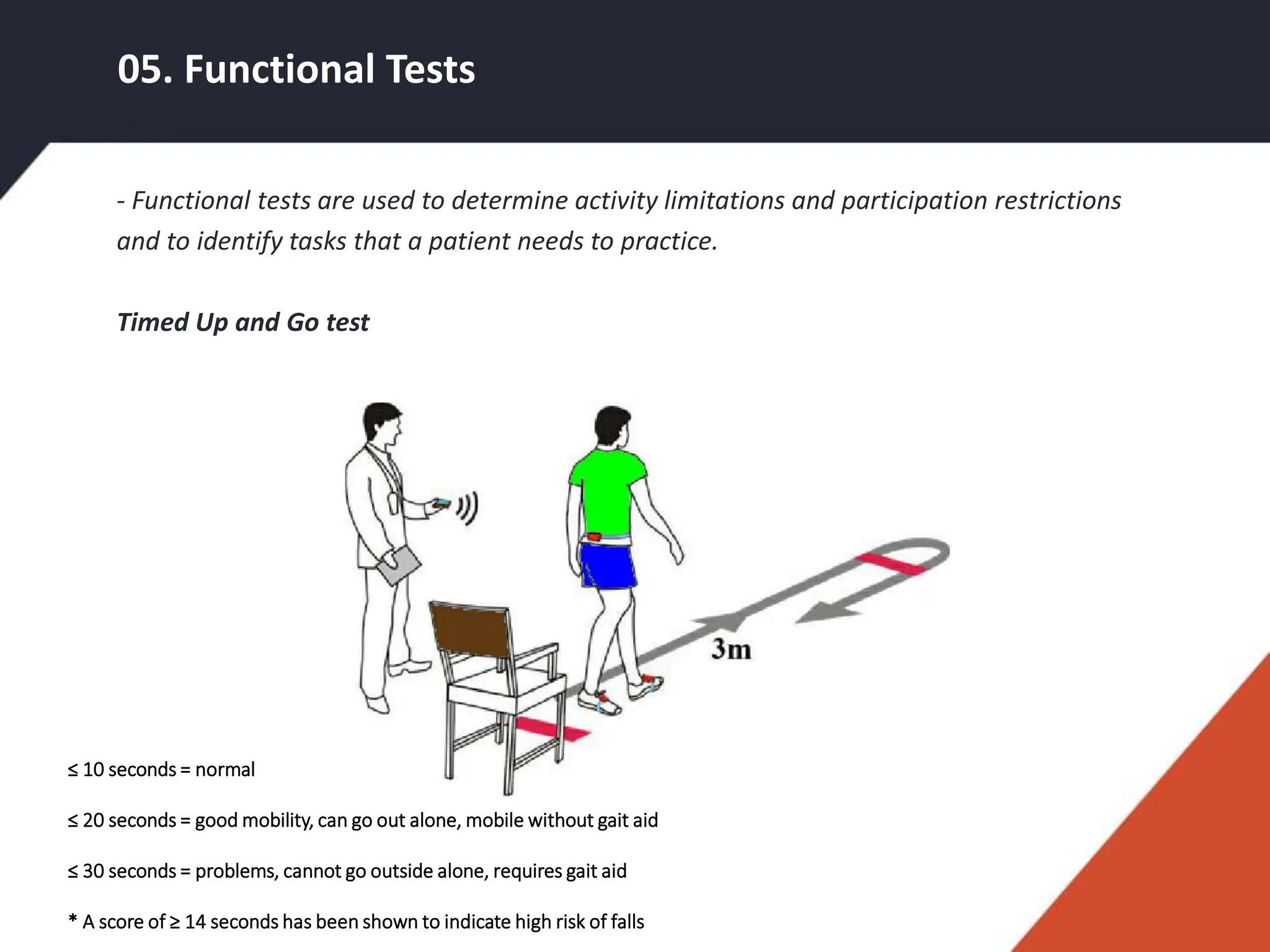
Timed Up and Go test
≤ 10 seconds = normal
≤ 20 seconds = good mobility, can go out alone, mobile without gait aid
≤ 30 seconds = problems, cannot go outside alone, requires gait aid
* A score of ≥ 14 seconds has been shown to indicate high risk of falls
THANK YOU

balance assessment before training .pptx

  • 1.
  • 2.
    CONTENTS Static Balance Tests •The Romberg Test • The sharpened Romberg • The Single-Leg Balance Stance Test (SLB) • The Stork Stand Test 01 Anticipatory Postural Control Tests • The Functional Reach Test and the Multi-Directional Reach Test • The Star Excursion Balance Test (SEBT) 03 Functional Tests Timed Up and Go test 05 02 Dynamic Balance Tests The Five-times-sit-to-stand test 04 Reactive Postural Control Tests • Pushes (small or large, slow or rapid, and anticipated and unanticipated) applied in different directions • PUSH AND RELEASE • THE PULL TEST
  • 3.
    01 Static BalanceTests Static balance can be assessed by observing the patient's ability to maintain different postures.
  • 4.
    1. The RombergTest: tests the patient's ability to stand with the feet parallel and together with the eyes open and then closed for 30 seconds. 2. The sharpened Romberg, also known as the tandem Romberg, requires the patient to stand with the feet in a heel-to-toe position with arms folded across the chest and eyes closed for 1 minute. 4. The Single-Leg Balance Stance Test (SLB): asks the patient to stand on one leg without shoes with arms crossed or hands on hips without letting the legs touch each other. 3. The Stork Stand Test: is performed by having the patient stand on both feet with ands on the hips, then lift one leg and place the toes of that foot against the knee of the other leg.
  • 5.
    02. Dynamic BalanceTests assessed by observations of how well the patient is able to - stand or sit on unstable surfaces (e.g., foam or Swiss ball); - transition from one position to another (e.g., supine-to-sit or sit-to-stand transfers); - perform activities such as walking, jumping, hopping, and skipping. - Five-times-sit-to-stand test The person is seated in a chair with the arms across the chest and then stands up and sits back down as quickly as possible five times consecutively while being timed. - A score of >15 seconds on the 5 X STS was found to predict recurrent falls
  • 6.
    03. Anticipatory PosturalControl Tests Anticipatory postural control is evaluated by having the patient perform voluntary movements that require the development of a postural set to counteract a predicted postural disturbance. • The Functional Reach Test and the Multi-Directional Reach Test require the patient to reach in different directions as far as possible without changing the BOS. the tests are reliable and valid. <6 inches = High Fall Risk · 7-10 inches = Moderate Fall Risk · >10 inches = Low Fall Risk. • The Star Excursion Balance Test (SEBT) is a test of lower extremity reach that challenges an individual's limits of stability. The patient is instructed to reach as far as possible with one leg in each of eight prescribed directions while maintaining balance on the contralateral leg.
  • 7.
    04. Reactive PosturalControl Tests Automatic postural responses or reactive control can be assessed by the patient's response to external perturbations. Pushes (small or large, slow or rapid, and anticipated and unanticipated) applied in different directions to the sternum, posterior trunk, or pelvis are used widely, but they are not quantifiable or reliable. The clinician subjectively rates the responses as normal, good, fair, poor, or unable. PUSH AND RELEASE THE PULL TEST
  • 8.
    05. Functional Tests -Functional tests are used to determine activity limitations and participation restrictions and to identify tasks that a patient needs to practice. Timed Up and Go test ≤ 10 seconds = normal ≤ 20 seconds = good mobility, can go out alone, mobile without gait aid ≤ 30 seconds = problems, cannot go outside alone, requires gait aid * A score of ≥ 14 seconds has been shown to indicate high risk of falls
  • 9.