IELTS: The listening test
format
overview
 The IELTS Listening Test tests your ability to understand spoken English in different
situations.
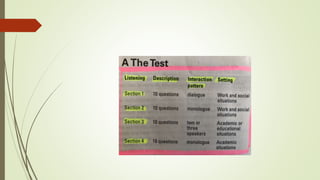
 The test lasts for approximately THIRTY minutes and has FOUR sections.
 In each section, you listen to a recording and answer TEN questions.
 The recordings in each section are divided into FOUR parts and there is generally a
pause between each part so that you can read the questions before you listen.
 You hear each section of the recording ONCE only.
 You should answer the questions as you listen, and write your answers directly onto
the question paper.
 You have TEN minutes at the end of the test to copy your answers onto the
separate answer sheet.
Strategies – before & during the test
 The information you hear about the speaker, the situation and the topic can
help you to be ready to understand what you hear.
 Predict the type of vocabulary and information you’re going to hear.
 Use the time during the pauses between the sections and parts to read the task
on the question paper. It helps to know about the type of information you’re
going to hear and the order the information is going to come in.
 Try to make the most of every opportunity to practice listening, for example, listen
to podcasts and broadcasts in English as often as you can.
 Use the internet to keep up with the latest news and current affairs in English.
At the end of the test
 When the recording has finished, you have TEN minutes to copy your answers
onto the separate answer sheet.
 You have time to check your answers, especially the spelling of the words you
wrote while you were listening.
 Remember to write ONE answer. If you’re not sure don’t put TWO answers. If you
do that, you don’t get the mark!
 If you don’t know the right answer to a question, always write something. You
may have understood more than you think.
Recommended slideshare website for more
information
1. Google – slideshare.net. For example,
https://www.slideshare.net/reeyahess/ielts-listening-236312583?qid=a641bc69-0a8a-
4f91-b352-fef053070f32&v=&b=&from_search=14
2. Search – IELTS – about the listening test
You will also have access to a variety of other IELTS listening material for self-study.
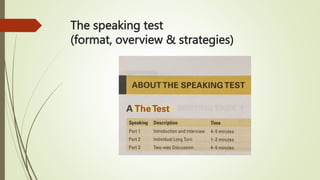
The speaking test
(format, overview & strategies)
The Basics
 IELTS Speaking Test is designed to test your ability to use spoken English
effectively.
 The interview takes place in a room where you sit down for a face-to-face
interview with the examiner.
 You don’t need to bring anything with you to the test, except for identification
documents.
 The test is recorded.
The Test
 PART ONE – Lasts for 4 – 5 minutes
The examiner asks you questions about your daily life and other everyday topics.
 PART TWO – Lasts for 3 – 4 minutes
You speak at length about a topic that the examiner gives you.
 PART THREE – Lasts for 4 – 5 minutes
You have a discussion with the examiner.
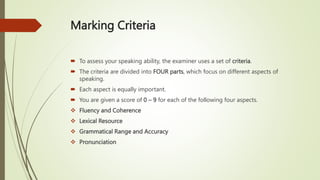
Marking Criteria
 To assess your speaking ability, the examiner uses a set of criteria.
 The criteria are divided into FOUR parts, which focus on different aspects of
speaking.
 Each aspect is equally important.
 You are given a score of 0 – 9 for each of the following four aspects.
 Fluency and Coherence
 Lexical Resource
 Grammatical Range and Accuracy
 Pronunciation
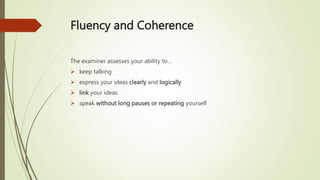
Fluency and Coherence
The examiner assesses your ability to…
 keep talking
 express your ideas clearly and logically
 link your ideas
 speak without long pauses or repeating yourself
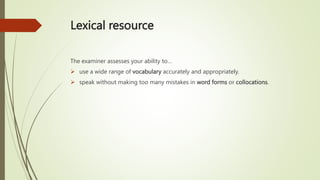
Lexical resource
The examiner assesses your ability to…
 use a wide range of vocabulary accurately and appropriately.
 speak without making too many mistakes in word forms or collocations.
Grammatical Range & Accuracy
Here the examiner assesses your ability to…
 use a range of grammatical structures flexibly and accurately
 use grammatical structures without making too many errors.
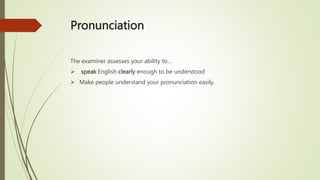
Pronunciation
The examiner assesses your ability to…
 speak English clearly enough to be understood
 Make people understand your pronunciation easily.
PART ONE
 At the beginning of the interview, the examiner asks for your name and checks
your identity.
 He/she then begins Part 1 by asking a series of questions on different topics on
everyday subjects such as work, study, hobbies, likes and dislikes, the weather, and
so on.
 You should give full answers.
 When you have said enough on a topic, the examiner will move on to the next
question.
PART TWO
 In Part 2 of the test, the examiner gives you a task card. On the card, you see a
familiar topic that your going to talk about.
 You have to talk on your own for between one and two minutes on this topic, and
you have one minute to prepare before you begin.
 There are some bullet points on the card to give you some ideas about what to
include in your talk.
 When the time is up, the examiner stops you, asks a question to ‘round off’ and
then collects the task card, paper and pencil from you.
PART THREE
 In Part 3 of the test, the examiner starts a discussion with you which is related to
the topic that you’ve spoken about in Part 2.
 The examiner asks for your opinion about things and encourages you to explain
and justify your ideas.
 This part of the test lasts for about 4 to 5 minutes.
 At the end of this time, the examiner thanks you and tells you that the test has
finished.
You can then stand up and leave the room.

IELTS Format, overview & strategies.pptx

  • 1.
  • 3.
    overview  The IELTSListening Test tests your ability to understand spoken English in different situations.  The test lasts for approximately THIRTY minutes and has FOUR sections.  In each section, you listen to a recording and answer TEN questions.  The recordings in each section are divided into FOUR parts and there is generally a pause between each part so that you can read the questions before you listen.  You hear each section of the recording ONCE only.
  • 4.
     You shouldanswer the questions as you listen, and write your answers directly onto the question paper.  You have TEN minutes at the end of the test to copy your answers onto the separate answer sheet.
  • 5.
    Strategies – before& during the test  The information you hear about the speaker, the situation and the topic can help you to be ready to understand what you hear.  Predict the type of vocabulary and information you’re going to hear.  Use the time during the pauses between the sections and parts to read the task on the question paper. It helps to know about the type of information you’re going to hear and the order the information is going to come in.
  • 6.
     Try tomake the most of every opportunity to practice listening, for example, listen to podcasts and broadcasts in English as often as you can.  Use the internet to keep up with the latest news and current affairs in English.
  • 7.
    At the endof the test  When the recording has finished, you have TEN minutes to copy your answers onto the separate answer sheet.  You have time to check your answers, especially the spelling of the words you wrote while you were listening.  Remember to write ONE answer. If you’re not sure don’t put TWO answers. If you do that, you don’t get the mark!  If you don’t know the right answer to a question, always write something. You may have understood more than you think.
  • 8.
    Recommended slideshare websitefor more information 1. Google – slideshare.net. For example, https://www.slideshare.net/reeyahess/ielts-listening-236312583?qid=a641bc69-0a8a- 4f91-b352-fef053070f32&v=&b=&from_search=14 2. Search – IELTS – about the listening test You will also have access to a variety of other IELTS listening material for self-study.
  • 9.
    The speaking test (format,overview & strategies)
  • 10.
    The Basics  IELTSSpeaking Test is designed to test your ability to use spoken English effectively.  The interview takes place in a room where you sit down for a face-to-face interview with the examiner.  You don’t need to bring anything with you to the test, except for identification documents.  The test is recorded.
  • 11.
    The Test  PARTONE – Lasts for 4 – 5 minutes The examiner asks you questions about your daily life and other everyday topics.  PART TWO – Lasts for 3 – 4 minutes You speak at length about a topic that the examiner gives you.  PART THREE – Lasts for 4 – 5 minutes You have a discussion with the examiner.
  • 12.
    Marking Criteria  Toassess your speaking ability, the examiner uses a set of criteria.  The criteria are divided into FOUR parts, which focus on different aspects of speaking.  Each aspect is equally important.  You are given a score of 0 – 9 for each of the following four aspects.  Fluency and Coherence  Lexical Resource  Grammatical Range and Accuracy  Pronunciation
  • 13.
    Fluency and Coherence Theexaminer assesses your ability to…  keep talking  express your ideas clearly and logically  link your ideas  speak without long pauses or repeating yourself
  • 14.
    Lexical resource The examinerassesses your ability to…  use a wide range of vocabulary accurately and appropriately.  speak without making too many mistakes in word forms or collocations.
  • 15.
    Grammatical Range &Accuracy Here the examiner assesses your ability to…  use a range of grammatical structures flexibly and accurately  use grammatical structures without making too many errors.
  • 16.
    Pronunciation The examiner assessesyour ability to…  speak English clearly enough to be understood  Make people understand your pronunciation easily.
  • 17.
    PART ONE  Atthe beginning of the interview, the examiner asks for your name and checks your identity.  He/she then begins Part 1 by asking a series of questions on different topics on everyday subjects such as work, study, hobbies, likes and dislikes, the weather, and so on.  You should give full answers.  When you have said enough on a topic, the examiner will move on to the next question.
  • 18.
    PART TWO  InPart 2 of the test, the examiner gives you a task card. On the card, you see a familiar topic that your going to talk about.  You have to talk on your own for between one and two minutes on this topic, and you have one minute to prepare before you begin.  There are some bullet points on the card to give you some ideas about what to include in your talk.  When the time is up, the examiner stops you, asks a question to ‘round off’ and then collects the task card, paper and pencil from you.
  • 19.
    PART THREE  InPart 3 of the test, the examiner starts a discussion with you which is related to the topic that you’ve spoken about in Part 2.  The examiner asks for your opinion about things and encourages you to explain and justify your ideas.  This part of the test lasts for about 4 to 5 minutes.  At the end of this time, the examiner thanks you and tells you that the test has finished. You can then stand up and leave the room.