iHICAMBRIDGE
UNIVERSITY PRESS
UNIVERSITYofCAMBRIDGE
ESOL Examinations
Cambridge English
PRELIMINARYPRELIMINARY ENGLISH TEST
WITH ANSWERS
0Sol liciteu el material
annex al taulell de prestec j
AUTHENTIC EXAMINATION PAPERS
FROMCAMBRIDGE ESOL
MM'th2/
%
°c
UNIVERS3ITAT D’ALACANT
Biblioteca
iiiiiiiiniiiiiii0500586602
Official preparation material for Cambridge English:Preliminary,
also known as Preliminary English Test (PET)
£ b / 'fi't'i (£>*«.
Cambridge English:
Preliminary 7
WITH ANSWERS
Officialexamination papers
from University ofCambridge
ESOL Examinations
ffii CAMBRIDGE
fei UNIVERSITY PRESS
CAMBRIDGE
UNIVERSITY PRESS
University PrintingHouse, Cambridge CBZ 8BS,United Kingdom
Cambridge University Press is part of theUniversity of Cambridge.
It furthers the University’s mission by disseminating knowledge in the pursuit of
education, learning and research at the highest international levels of excellence.
www.cambridge.org
Information on this title: www.cambridge.org/9781107675193
© CambridgeUniversity Press 2012
It is normally necessary for written permission for copying to be obtained
in advance from a publisher. The worksheets, role play cards, tests, and tapescripts
at the back of this book are designed to be copied and distributedin class.
The normal requirements are waived here and it is not necessary to write to
Cambridge University Press for permission for an individual teacher to make copies
for use withinhis or her own classroom. Only those pages that carry the wording
‘© Cambridge University Press’ may be copied.
First published 2012
3rd printing 2013
Printed in the United Kingdom by Short Run Press, Exeter
A catalogue recordfor this publication is available from the British Library
ISBN 978-1-107-675193 Student’s Book with answers
ISBN 978-1-107-635661 Student’s Book without answers
ISBN 978-1-107-638884 Audio CD Set
ISBN 978-1-107-610484 Self-study Pack
CambridgeUniversity Press has no responsibility for the persistence or accuracy
of URLs for external or third-party internet websites referred to in thispublication,
and does not guarantee that any content on such websites is, or willremain,
accurate or appropriate.Information regarding prices, travel timetables, and other
factualinformation givenin this work is correct at the time of first printing but
Cambridge University Press does not guarantee the accuracy of such information
thereafter.
U vERSi I'AT LJ
I UNIVERSID ,D DE
Contents
A Guide to Cambridge English: Preliminary 4
Testl 14
Test 2 34
Test 3 54
Test 4 74
Frames for the Speaking test 94
Testl Key 106
Test 2 Key 121
Test 3 Key 136
Test 4 Key 151
Sample answer sheets 166
Acknowledgements 171
Visual material for the Speaking test colour section at centre of book
3
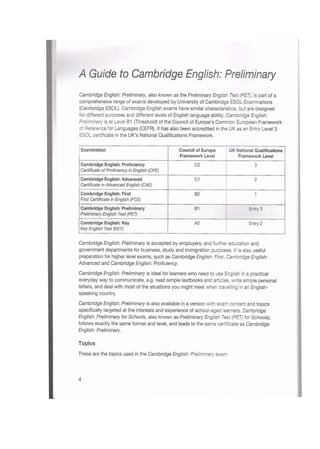
A Guide to Cambridge English: Preliminary
Cambridge English:Preliminary, also known as the Preliminary English Test (PET), is part of a
comprehensive range of exams developed by University of Cambridge ESOL Examinations
(Cambridge ESOL). Cambridge English exams have similar characteristics, but are designed
for different purposes and different levels of English language ability. Cambndge English:
Preliminary is at Level B1 (Threshold) of the Council of Europe’s Common European Framework
of Reference for Languages (CEFR). It has also been accredited in the UK as an Entry Level 3
ESOL certificate in the UK’s National Qualifications Framework.
Examination Council of Europe
Framework Level
UK National Qualifications
Framework Level
Cambridge English: Proficiency
Certificate ofProficiency inEnglish (CPE)
C2 3
Cambridge English: Advanced
Certificate in AdvancedEnglish (CAE)
C1 2
Cambridge English: First
First Certificate inEnglish (FCE)
B2 1
Cambridge English: Preliminary
Preliminary English Test (PET)
B1 Entry 3
Cambridge English: Key
KeyEnglish Test (KET)
A2 Entry 2
Cambridge English:Preliminary is accepted by employers, and further education and
government departments for business, study and immigration purposes. It is also useful
preparation for higher level exams, such as Cambridge English: First, Cambridge English:
Advanced and Cambridge English:Proficiency.
Cambridge English:Preliminary is ideal for learners who need to use English in a practical
everyday way to communicate, e.g. read simple textbooks and articles, write simple personal
letters, and deal with most of the situations you might meet when travelling in an English-
speaking country.
Cambridge English:Preliminary is also available in a version with exam content and topics
specifically targeted at the interests and experience of school-aged learners. Cambridge
English:Preliminary for Schools, also known as PreliminaryEnglish Test (PET) for Schools),
follows exactly the same format and level, and leads to the same certificate as Cambridge
English:Preliminary.
Topics
These are the topics used in the Cambridge English: Preliminary exam:
4
A Guide to Cambridge English: Preliminary
Relations with other people
Services
Shopping
Social interaction
Sport
Transport
Travel and holidays
Weather
Work and jobs
Hobbies and leisure
House and home
Language
Natural world
People
Personal feelings, opinions
and experiences
Personal identification
Places and buildings
Clothes
Daily life
Education
Entertainment and media
Environment
Food and drink
Free time
Health, medicine and
exercise
Cambridge English: Preliminary content -an overview
Test focusTiming ContentNamePaper
Assessment of candidates’ ability
to understand the meaning of
written English at word, phrase,
sentence, paragraph and whole
text level.
Reading:
Five parts which test a
range of reading skills with
a variety of texts, ranging
from very short notices to
longer continuous texts.
Reading/
Writing
1 hour
30 minutes
Paper 1
Assessment of candidates’ ability
to produce straightforward written
English, ranging from producing
variations on simple sentences to
pieces of continuous text.
Writing:
Three parts which test a
range of writing skills.
Assessment of candidates’ ability
to understand dialogues and
monologues in both informal and
neutral settings on a range of
everyday topics.
Four parts ranging from
short exchanges to longer
dialogues and monologues.
35 minutes
(plus 6
minutes
transfer
time)
ListeningPaper 2
Assessment of candidates’ ability
to express themselves in order to
carry out functions at Threshold
level. To ask and to understand
questions and make appropriate
responses. To talk freely on
matters of personal interest.
Four parts:
In Part 1, candidates
interact with an examiner;
In Parts 2 and 4, they
interact with another
candidate;
In Part 3, they have an
extended individual long
turn.
Speaking 10-12
minutes
per pair of
candidates
Paper 3
Paper 1: Reading and Writing
Paper format
The Reading component contains five parts. The Writing component contains three parts.
Number of questions
Reading has 35 questions; Writing has seven questions.
Sources
Authentic and adapted-authentic real world notices; newspapers and magazines; simplified
encyclopaedias; brochures and leaflets; websites.
5
A Guide to Cambridge English: Preliminary
Answering
Candidates indicate answers by shading lozenges (Reading), or writing answers (Writing) on an
answer sheet.
Timing
1 hour 30 minutes.
Marks
Reading: Each of the 35 questions carries one mark. This is weighted so that this comprises
25% of total marks for the whole examination.
Writing: Questions 1-5 carry one mark each. Question 6 is marked out of five; and Question 7/8
is marked out of 20. This gives a total of 30 which is weighted so that it represents 25% of total
marks for the whole examination.
Preparing for the Reading component
To prepare for the Reading component, you should read a variety of authentic texts, for
example, newspapers and magazines, non-fiction books, and other sources of factual material,
such as leaflets, brochures and websites. It is also a good idea to practise reading (and writing)
short communicative messages, including notes, cards and emails. Remember, you won’t
always need to understand every word in order to be able to do a task in the exam.
Before the examination, think about the time you need to do each part. It is usually
approximately 50 minutes on the Reading component and 40 minutes on the Writing component.
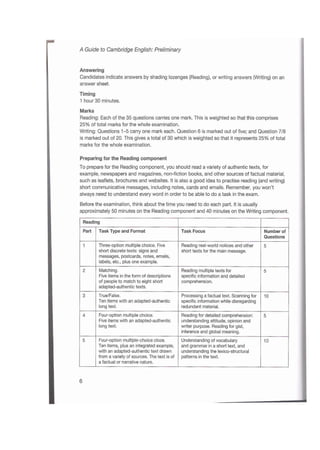
Reading
Task Type and Format Task FocusPart Number of
Questions
Three-option multiple choice. Five
short discrete texts: signs and
messages, postcards, notes, emails,
labels, etc., plus one example.
Reading real-world notices and other
short texts for the main message.
1 5
Matching.
Five items in the form of descriptions
of people to match to eight short
adapted-authentic texts.
Reading multiple texts for
specific information and detailed
comprehension.
2 5
True/False.
Ten items with an adapted-authentic
long text.
Processing a factual text. Scanning for
specific information while disregarding
redundant material.
3 10
Four-option multiple choice.
Five items with an adapted-authentic
long text.
Reading for detailed comprehension:
understanding attitude, opinion and
writer purpose. Reading for gist,
inference and global meaning.
4 5
Four-option multiple-choice cloze.
Ten items, plus an integrated example,
with an adapted-authentic text drawn
from a variety of sources. The text is of
a factual or narrative nature.
Understanding of vocabulary
and grammar in a short text, and
understanding the lexico-structural
patterns in the text.
5 10
6
A Guide to Cambridge English: Preliminary
Preparing for the Writing component
Parti
You have to complete five sentences which will test your grammar. There is an example,
showing exactly what the task involves. You should write between one and three words to fill
this gap. The second sentence, when complete, must mean the same as the first sentence.
It is essential to spell correctly and no marks will be given if a word is misspelled. You will also
lose the mark if you produce an answer of more than three words, even if your writing includes
the correct answer.
Part 2
You have to produce a short communicative message of between 35 and 45 words in length.
You are told who you are writing to and why, and you must include three content points. These
are clearly laid out with bullet points in the question. To gain top marks, all three points must be
in your answer, so it is important to read the question carefully and plan what you will include.
Marks will not be deducted for minor errors.
Before the exam, you need to practise writing answers of the correct length. Answers that are
too short or too long and likely to contain irrelevant information, will probably lose marks.
The General Mark Scheme below is used with a Task-specific Mark Scheme (see pages 106,
121,136 and 151).
General Mark Scheme for Writing Part 2
Mark Criteria
All three parts of the message clearly communicated.
Only minor spelling errors or occasional grammatical errors.
5
All three parts of the message communicated.
Some non-impeding errors in spelling or grammar, or some awkwardness of expression.
4
All three parts of the message attempted.
Expression requires interpretation by the
reader and contains impeding errors in
spelling and grammar.
3 Two parts of the message clearly
communicated.
Only minor spelling errors or occasional
grammatical errors.
Only two parts of the message communicated.
Some errors in spelling and grammar.
The errors in expression may require patience and interpretation by the reader and impede
communication.
2
Only one part of the message communicated.1
Question unattempted, or totally incomprehensible response.0
Part 3
You have a choice of task: either a story or an informal letter. You need to write about 100 words.
Make sure you practise enough before the exam. Reading simplified readers in English will give
you ideas for story writing. Also writing to a penfriend or e-pal will give you useful practice.
7
A Guide to Cambridge English: Preliminary
Mark Scheme for Writing Part 3
Examiners look at four aspects of your writing: Content, Communicative Achievement,
Organisation, and Language.
Content focuses on how well you have fulfilled the task, in other words if you have done what
you were asked to do.
Communicative Achievement focuses on how appropriate the writing is for the letter or story
and whether you have used the appropriate register.
Organisation focuses on the way you put the piece of writing together, in other words if it is
logical and ordered, and the punctuation is correct.
Language focuses on your vocabulary and grammar. This includes the range of language, as
well as how accurate it is.
For each of the subscales, the examiner gives a maximum of five marks; this gives an overall
maximum score of 20 for the Part 3 task.
Examiners use the following assessment scale:
B1 Content Communicative
Achievement
Organisation Language
All content is
relevant to the
task.
Target reader is
fully informed.
Uses the conventions
of the communicative
task to hold the target
reader’s attention
and communicate
straightforward ideas.
5 Text is generally
well organised and
coherent, using a
variety of linking
words and cohesive
devices.
Uses a range of everyday
vocabulary appropriately, with
occasional inappropriate use of
less common lexis.
Uses a range of simple and some
complex grammatical forms with a
good degree of control.
Errors do not impede
communication.
4 Performance shares features of Bands 3 and5.
3 Minor
irrelevances and/
or omissions
may be present.
Target reader
is on the whole
informed.
Uses the conventions
of the communicative
task in generally
appropriate ways
to communicate
straightforward ideas.
Text is connected
and coherent, using
basic linking words
and a limited number
of cohesive devices.
Uses everyday vocabulary
generally appropriately, while
occasionally overusing certain
lexis.
Uses simple grammatical forms
with a good degree of control.
While errors are noticeable,
meaning can still be determined.
2 Performance shares features of Bands 1and3.
Irrelevances and
misinterpretation
of task may be
present.
Target reader
is minimally
informed.
1 Produces text that
communicates simple
ideas in simple ways.
Text is connected
using basic, high-
frequency linking
words.
Uses basic vocabulary reasonably
appropriately.
Uses simple grammatical forms
with some degree of control.
Errors may impede meaning at
times.
8
A Guide to Cambridge English: Preliminary
Organisation LanguageCommunicative
Achievement
ContentB1
Performance below Band 1.Content is totally
irrelevant.
Target reader is
not informed.
0
Length of responses
Make sure you write the correct amount of words. Responses which are too short may not have an
adequate range of language and may not provide all the information that is required. Responses
which are too long may contain irrelevant content and have a negative effect on the reader.
Varieties of English
You are expected to use a particular variety of English with some degree of consistency in
areas such as spelling, and not for example switch from using a British spelling of a word to an
American spelling of the same word.
Writing
Number of
Questions
Task FocusTask Type and FormatPart
Control and understanding of
Threshold/Cambridge English:
Preliminary grammatical
structures. Rephrasing and
reformulating information.
5Sentence transformations. Five items, plus an
integrated example, that are theme-related.
Candidates are given sentences and then asked
to complete similar sentences using a different
structural pattern so that the sentence still has the
same meaning.
1
A short piece of writing of
35-45 words focusing on
communication of specific
messages.
1Short communicative message. Candidates are
prompted to write a short message in the form of
a postcard, note, email, etc. The prompt takes the
form of a rubric to respond to.
2
Writing about 100 words
focusing on control and range of
language.
1A longer piece of continuous writing. There is a
choice of two questions, an informal letter or a
story.
Candidates are assessed on four aspects of their
writing: Content, Communication Achievement,
Organisation, and Language.
3
Paper 2: Listening
Paper format
This paper contains four parts.
Number of questions
25
Text types
All texts are based on authentic situations.
9
A Guide to Cambridge English: Preliminary
Answering
Candidates indicate answers either by shading lozenges (Parts 1, 2 and 4) or writing answers
(Part 3) on an answer sheet. Candidates record their answers on the question paper as they
listen. They are then given six minutes at the end of the test to copy these on to the answer sheet.
Recording information
Each text is heard twice. Recordings will contain a variety of accents corresponding to standard
variants of native speaker accents.
Timing
About 35 minutes, including six minutes to transfer answers.
Marks
Each question carries one mark. This gives a total of 25 marks, which represents 25% of total
marks for the whole examination.
Part Task Type and Format Task Focus Number of
questions
1 Multiple choice (discrete).
Short neutral or informal monologues or dialogues.
Seven discrete three-option multiple-choice items
with visuals, plus one example.
Listening to identify key
information from short
exchanges.
7
2 Multiple choice.
Longer monologue or interview (with one main
speaker).
Six three-option multiple-choice items.
Listening to identify specific
information and detailed
meaning.
6
Gap-fill.
Longer monologue.
Six gaps to fill in. Candidates need to write one or
more words in each space.
3 Listening to identify,
understand and interpret
information.
6
4 True/False.
Longer informal dialogue.
Candidates need to decide whether six statements
are correct or incorrect.
Listening for detailed
meaning, and to identify the
attitudes and opinions of
the speakers.
6
Preparing for the Listening paper
You will hear the instructions for each task on the recording, and see them on the exam paper.
In Part 1, there is also an example text and task to show you how to record your answers.
In Parts 2, 3 and 4, the instructions are followed by a pause; you should read the questions in
that part then. This will help you prepare for the listening.
The best preparation for the Listening paper is to listen to authentic spoken English at this level.
Having discussions provides a good authentic source of listening practice, as does listening to
the teacher. You can also listen to texts to give you practice in understanding different voices
and styles of delivery.
10
A Guide to Cambridge English: Preliminary
Paper 3: Speaking
Paper format
The standard format is two candidates and two examiners. One of the examiners acts as an
interlocutor and the other as an assessor. The interlocutor directs the test, while the assessor
takes no part in the interaction.
Timing
10-12 minutes per pair of candidates.
Marks
Candidates are assessed on their performance throughout the test. There are a total of 25 marks
in Paper 3, making 25% of the total score for the whole examination.
TimingTask FocusTask Type and FormatPart
Giving information of a factual,
personal kind. The candidates
respond to questions about
present circumstances, past
experiences and future plans.
2-3Each candidate interacts with the interlocutor.
The interlocutor asks the candidates questions
in turn, using standardised questions.
1
minutes
2-3Using functional language to make
and respond to suggestions,
discuss alternatives, make
recommendations and negotiate
agreement.
Simulated situation. Candidates interact with
each other.
Visual stimulus is given to the candidates to aid
the discussion task. The interlocutor sets up
the activity using a standardised rubric.
2
minutes
3Describing photographs and
managing discourse, using
appropriate vocabulary, in a
longer turn.
Extended turn.
A colour photograph is given to each candidate
in turn and they are asked to talk about it for
up to a minute. Both photographs relate to the
same topic.
3
minutes
3The candidates talk together
about their opinions, likes/dislikes,
preferences, experiences, habits,
General conversation. Candidates interact with
each other.
The topic of the conversation develops the
theme established in Part 3. The interlocutor
sets up the activity using a standardised rubric.
4
minutes
etc.
Assessment
Throughout the Speaking test, examiners listen to what you say and give you marks for how well
you speak English, so you must try to speak about the tasks and answer the examiner and your
partner’s questions.
You are awarded marks by two examiners; the assessor and the interlocutor. The assessor
awards marks from the Analytical Assessment scales for the following criteria:
Grammar and Vocabulary
This refers to how accurately you use grammar and also to the correct use of vocabulary. It also
includes how wide a range of grammar and vocabulary you use.
11
A Guide to Cambridge English:Preliminary
Discourse Management
This refers to the length, relevance and coherence of your answers. You should be able to
produce sentences which are clear and easy to follow. What you say should be related to the
topic and the conversation in general.
Pronunciation
This refers to the how easy it is to understand what you say. You should be able to say words
and sentences that are easy to understand.
Interactive Communication
This refers to how well you can talk about the task and to your partner and the examiner. You should
be able to start the conversation and keep it going, and ask for repetition or clarification if needed.
B1 Grammar and
Vocabulary
Discourse
Management
Pronunciation Interactive
Communication
Shows a good degree
of control of simple
grammatical forms,
and attempts some
complex grammatical
forms.
Uses a range of
appropriate vocabulary
to give and exchange
views on familiar
topics.
Produces extended
stretches of language
despite some
hesitation.
Contributions are
relevant despite some
repetition.
Uses a range of
cohesive devices.
Is intelligible.
Intonation is generally
appropriate.
Sentence and word
stress is generally
accurately placed.
Individual sounds are
generally articulated
clearly.
Initiates and responds
appropriately.
Maintains and develops
the interaction and
negotiates towards an
outcome with very little
support.
5
4 Performance shares features of Bands 3 and 5.
Shows a good degree
of control of simple
grammatical forms.
Uses a range of
appropriate vocabulary
when talking about
familiar topics.
3 Produces responses
which are extended
beyond short phrases,
despite hesitation.
Contributions are
mostly relevant, but
there may be some
repetition.
Uses basic cohesive
devices.
Is mostly intelligible,
and has some control
of phonological
features at both
utterance and word
levels.
Initiates and responds
appropriately.
Keeps the interaction
going with very little
prompting and support.
2 Performance shares features of Bands 1and3.
1 Shows sufficient
control of simple
grammatical forms.
Uses a limited range of
appropriate vocabulary
to talk about familiar
topics.
Produces responses
which are characterised
by short phrases and
frequent hesitation.
Repeats information
or digresses from the
topic.
Is mostly intelligible,
despite limited control
of phonological
features.
Maintains simple
exchanges, despite
some difficulty.
Requires prompting
and support.
0 Performance below Band 1.
12
A Guide to Cambridge English:Preliminary
The examiner asking the questions (the interlocutor) gives marks for how well you do overall
using a Global Achievement scale.
Global AchievementB1
Handles communication on familiar topics, despite some hesitation.
Organises extended discourse but occasionally produces utterances that lack coherence, and
some inaccuracies and inappropriate usage occur.
5
Performance shares features of Bands 3 and5.4
Handles communication in everyday situations, despite hesitation.
Constructs longer utterances but is not able to use complex language except in well-rehearsed
utterances.
3
Performance shares features ofBands 1and3.2
Conveys basic meaning in very familiar everyday situations.
Produces utterances which tend to be very short - words or phrases -with frequent hesitation and
pauses.
1
Performance below Band 1.0
Further information
More information about Cambridge English:Preliminary or any other Cambridge ESOL
examination can be obtained from Cambridge ESOL at the address below or from the website at
www.CambridgeESOL.org
University of Cambridge ESOL Examinations Telephone +44 1223 553997
1 Hills Road
Cambridge CB1 2EU
United Kingdom
Fax: +44 1223 553621
email: ESOLHelpdesk@CambridgeESOL.org
13
Test 1
PAPER 1 READING AND WRITING TEST (1 hour 30 minutes)
READING
Part 1
Questions 1-5
Look at the text in each question.
What does it say?
Mark the correct letter A, B or C on your answer sheet.
Example:
0 A Valuable objects are removed at night.
Nothirxj oF value
iS lefti" -IWs
a.t
Var>
B Valuables should not be left in the van.
C This van is locked at night.
Answer: o ®
1 A This part of the road will open again on
1st September.Road repairs
starting here on
1st September
for four weeks —
expect delays
B Your journey may take longer on this
road in September.
C We are expecting more traffic on this
road in September.
14
Reading
A People staying at Hotel Maroc can
arrange activities through the hotel.
2 Welcome to Hotel Maroc
B Hotel Maroc’s holiday advisor
accompanies guests on tours.
Dear Guest
Our holiday advisor
is availablein the
lounge every day
8-10 am for booking
guidedtours,
museum/garden
tickets, camelrides.
C Daily sightseeing trips start from the
Hotel Maroc.
Enjoy your stay!
A Tickets will be sent to you within seven
days of booking.
3 Online Booking Form
Name
B When booking, advise staff if your
tickets are to be kept for collection.
Address
No. of tickets
Tickets booked within
seven days of a
performance are kept
for collection.
C We don’t post tickets booked one week
or less before the performance.
A Players who have a problem getting to
the Fyfield match should contact Paul.
4 New Message
X B a “9
| | To: | All players
|From: |Paul
B Anyone who wants to play in the Fyfield
game needs to speak to Paul.
C Team members who are not available
for the Fyfield match must phone Paul.
Theteam is the same as last week-I've
already checked everyonecan play.
Anyoneneeding a lift to Fyfield can
phone me.
A After next month the bank will be open
all weekend.
5
IMPROVED SERVICE:
B The bank closes at 2 pm on weekdays.
From next month this
bank will remain open
until 2 pm on Saturdays C The bank will have longer opening hours
in future.
15
Test 1
Part 2
Questions 6-10
The people below all want to watch a television programme.
On the opposite page there are descriptions of eight television programmes.
Decide which programme would be the most suitable for the following people.
For questions 6-10, mark the correct letter (A-H) on your answer sheet.
&6 Sandrine and her ten-year-old daughter, Daisy, love watching 1
all kinds of dancing, especially if the dancers are famous
entertainers. Daisy particularly likes the beautiful dresses the
women wear.
r Tim has an amazing memory for facts on a range of topics.
He enjoys testing himself against people taking part in
quizzes on TV and wants to find out how to be on one
himself.
7
fcl
8 Simon enjoys murder mysteries, and likes the challenge
of working out who did the crime before the identity of the
murderer is uncovered in the final scene.
9
9 Mariella loves skiing and enjoys watching winter sports on
television. She tries to improve her techniques by copying
the professionals who take part in them.
•a
fM
'
-£
10 Ned and Jake are computer programmers. They enjoy TV
programmes that are funny and give them a complete break
from their work, especially if they are connected with football.
16
_
Reading
ON TV TONIGHT
B Whiteout
All the latest action from the slopes,
includingmen’s and women’s downhill
racing, jumping, ice dance and ice
hockey. Presented from the mountains
by former footballer Neville Gray, with
expert reports onspeeds and distances.
Figure skater Jayne Wilton comments on
the dance performances.
A Below stairs
New comedy series about Ray and
Jen, who work in the IT section of a
big company. Their office is in the
basement while their bosses work
in luxury upstairs. Reviews so far
have been mixed. There are plenty of
laughs, though some people may find
the situations rather silly.
D Quicksteps
Each week, well-known faces from the world
of television teamup with a professional
partner to perform a range ofclassical
andmodern dances. You, the viewer, can
vote for the best performance and the best
costume, and each week’s winners will take
part inthe grand final later in the year.
C Top Team
A return of the jokey quiz show, in which
teams of famous sports personalities and
comedians have to give amusinganswers to
questions on a range of popular sports, not
just football and tennis but winter sports too.
Light-hearted entertainment for everyone!
F The Two Dancers
Set in late 18th-century France, this drama
tells of the relationship between two beautiful
dancers who both love the same man.
Although the ending is not unexpected, this
drama is thoroughly entertaining all the way
through. Worth watching just for the beautiful
costumes and scenery.
E Taskmaster
Can you beat the four members of the
public who answer general knowledge
and specialist questions in the final of this
year’s competition? Tonight’s specialist
subjects include the history of winter
sports, Latin American dances, detective
novels and French history. There will be
information about how to enter next year’s
competition.
H Madison
This little-known musical is based on
the true story of an American ice
hockey team in the 1930s. The facts
are historically accurate, even though
the show is advertised as a musical
comedy-thriller. Really only of interest
to experts in the history of musicals or
ice hockey fans.
G Inspector Blake
A first-division football player
has a beautiful wife, a big
house and a bright future. When
he's found dead in his car near
a local park, Blake discovers
that he was less popular than it
seemed. Set in the 1970s, this
nail-biting drama will keep you
guessing right until the end.
17
Test 1
Part 3
Questions 11-20
Look at the sentences below about a man who got lost in the Rocky Mountains.
Read the text on the opposite page to decide if each sentence is correct or incorrect.
If it is correct, mark A on your answer sheet.
If it is not correct, mark B on your answer sheet.
11 Bob Rigsby was in Canada in order to study its wildlife.
12 On the first day of getting lost, Bob realised how serious his situation was.
13 Bob had few problems finding something safe to eat in the mountains.
14 On the fourth day, Bob recognised the place that he was in.
15 Shirley thought that Bob sounded upset on the phone.
16 It was the first time Bob had been missing for such a length of time.
17 The first phone call that Shirley made was to the Canadian embassy.
18 The hotel owner was worried while Bob was absent from the hotel.
19 Employees from the hotel went to look for Bob.
20 Bob says he regrets going into the mountains on his own.
18
Reading
Lost in the Rocky Mountains
Fifty-four-year-old scientist Bob Rigsby
I was lost for five daysinCanada’s Rocky
B) Mountains, and was only rescued after a
PI mobile phone call to his wife, Shirley, over
gg 8,000 km away inEngland.
w Bob, a British wildlife expert, hadbeen
138 in Vancouver, Canada, giving a talk at
Si a conference on the environment. When
it was over,he travelled to theRocky
Mountains and checked into TheMaple
Leafhotel. He then set off on a short walk
to look at the localplant and animallife. After a couple ofhours,he realised he had
taken a wrong turning on the mountain path, but was sure he couldeasily get back to
the hotel. Even when night fell, he remained confident.
But, after walking for several hours the next day,it became clear to Bob that he was in
trouble.1had my mobile phone with me, but the battery was almost dead.Ithought
Icould probably make just one callbutIdidn’t know the number ofmy hotel andI
didn’t want to worry my family unlessIreally had to.’ Bob carried on walking for three
more days. He knew which wild plantshe could safely eat and he hadlittle trouble
finding them. Whenhe was thirsty he drank from streams.
On the fourth day, he reached a forest that he knew he had walked through the
previous day.His heart sank. He realisedit was hopeless and decided to callhis family
inEngland. ‘He was quite calm when he spoke to me on the phone,’ says Shirley.
‘He appeared to be incontrol of the situation, in spite of everything. He’dbeen lost
a few times before, but never for so many days- that’s why this time was different.’
She immediately contacted The Maple Leafhotel, after a quick call to the Canadian
embassy inLondon to get its phone number. ‘We’re always anxious if our guests are
away for a long time,’ says GregMcCaffrey, the hotel’s owner. ‘But that week several
of our English visitors had gone to thecity for a few days to watch the hockey games,
and we thought Mr Rigsby had gone too.’ As soon as Shirley phoned, hotel staff
called the rescue service, who sent out a search party for the scientist. They found him
in a cave some hours later, very tired,but, apart from some cuts and scratches, quite
unhurt.
‘I’ve learnt my lesson,’ says Bob. ‘IadmitIwas stupid to set offlike that without a
guide.Inever want an experience like that again!’
'
19
Test 1
Part 4
Questions 21-25
Read the text and questions below.
For each question, mark the correct letter A, B, C or D on your answer sheet.
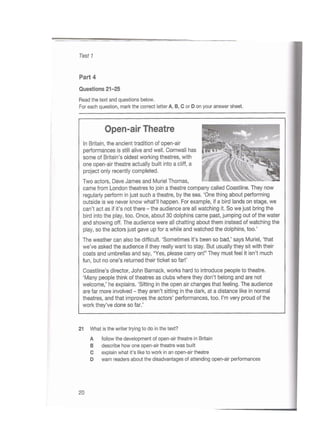
Open-air Theatre
friZb.-In Britain, the ancient tradition of open-air
performances is still alive and well. Cornwall has (
some of Britain’s oldest working theatres, with
one open-air theatre actually built into a cliff, a
project only recently completed.
Two actors, Dave James and Muriel Thomas,
came from London theatres to join a theatre company called Coastline. They now
regularly perform in just such a theatre, by the sea. ‘One thing about performing
outside is we never know what’ll happen. For example, if a bird lands on stage, we
can’t act as if it’s not there- the audience are all watching it. So we just bring the
bird into the play, too. Once, about 30 dolphins came past, jumping out of the water
and showing off. The audience were all chatting about them instead of watching the
play, so the actors just gave up for a while and watched the dolphins, too.’
The weather can also be difficult. ‘Sometimes it’s been so bad,’ says Muriel, ‘that
we’ve asked the audience if they really want to stay. But usually they sit with their
coats and umbrellas and say, “Yes, please carry on!” They must feel it isn’t much
fun, but no one’s returned their ticket so far!’
Coastline’s director, John Barnack, works hard to introduce people to theatre.
‘Many people think of theatres as clubs where they don’t belong and are not
welcome,’ he explains. ‘Sitting in the open air changes that feeling. The audience
are far more involved - they aren’t sitting in the dark, at a distance like in normal
theatres, and that improves the actors’ performances, too. I’m very proud of the
work they’ve done so far.’
,v::7
m yA
21 What is the writer trying to do in the text?
A follow the development of open-air theatre in Britain
B describe how one open-air theatre was built
C explain what it’s like to work in an open-air theatre
D warn readers about the disadvantages of attending open-air performances
20
Reading
22 When plays are disturbed by local wildlife, the actors
A change their performance to include it.
B carry on as though nothing had happened.
C stop and have a chat with the audience.
D cancel the rest of the performance.
23 What is the audience’s attitude to bad weather during performances?
A They worry about the actors getting wet.
B They say that it stops them enjoying the play.
C They accept it as they have come well-prepared.
D They feel they should have their money back.
24 What does John Barnack say about outdoor theatre?
A He’s afraid the atmosphere is more stressful for actors.
B He’s happy that the audience feel comfortable being there.
C He’s worried that it creates an atmosphere similar to a club.
D He welcomes the distance it creates between actors and audience.
25 What would an actor from the Coastline company write in his or her diary?
BA
The theatre looks so old it’s
hard to imagine they’ve just
finished it. I’d prefer to be by
the sea while I’m performing,
though. . .
A difficult performance today -
it was pouring with rain. Luckily
the audience couldn’t see my
face in the dark. . .
C D
I’m glad I moved from the
London theatre scene. But
I don’t think our director is
satisfied with what we’ve done
so far. . .
I’m keeping a tradition going,
and it tests my acting skills, as
I never know what unexpected
things I’ll have to deal with. ..
21
Test 1
Part 5
Questions 26-35
Read the text below and choose the correct word for each space.
For each question, mark the correct letter A, B, C or D on your answer sheet.
Example:
0 A was B is C has D had
Answer: 0
A B C D
C=l IZZJ CZJ
Alexander Graham Bell
Alexander Graham Bell (0)
Scotland in 1847. His father, an expert on speech,
a way of teaching how words
be pronounced. He translated the
of words into straight or curvy lines.
born in
:ÿ
(26)
m(27)
(28)
Alexander (29)
mother went deaf, he started to be (30)
how deaf people communicate. In 1870, because his
children were in poor health, Alexander and his family
moved to the United States. He hoped that a warmer
would be better for the whole family.
It was while he was teaching deaf children there (32) ...
machine. It was very (33)
could carry human speech (34)
long before the telephone was a part of (35)
to be a teacher and, when his
in
(31)
he invented a new
to the human ear itself, and Bell discovered it
........a wire from one place to another. It was not
our lives!
26 A grew
27 A ought
28 A calls
29 A trained
30 A amazed
31 A geography
32 A so
33 A likely
34 A above
35 A any
B built C developed
C might
C noises
C educated
C surprised
C climate
D worked
B should D would
B voices
B became
D sounds
D taught
D excitedB interested
B season D weather
B because C since D that
B similar C same
C along
C all
D accurate
D around
D every
B about
B each
22
Writing
WRITING
Parti
Questions 1-5
Here are some sentences about the Santiago Bernabeu football stadium in Spain.
For each question, complete the second sentence so that it means the same as the first.
Use no more than three words.
Write only the missing words on your answer sheet.
You may use this page for any rough work.
Example:
0 The Santiago Bernabeu stadium is close to the centre of Madrid.
the centre of Madrid.The Santiago Bernabeu stadium is not
far fromAnswer: 0
1 Last week, one of my friends visited the Santiago Bernabeu football stadium.
visited the Santiago BernabeuLast week, a friend of
football stadium.
2 He had not been to this stadium before.
the first time he had been to this stadium.It
3 It costs €9 to go on a tour of the stadium.
You have to €9 to go on a tour of the stadium.
4 A visit to the dressing room is included in the tour.
The tour a visit to the dressing room.
5 No other football stadium in Madrid is as big as Santiago Bernabeu.
Santiago Bernabeu is any other football stadium in Madrid.
23
Test 1
Part 2
Question 6
You’ve just bought something new for your bedroom.
Write an email to your friend Teresa. In your email, you should
•describe what you have bought
•explain why you needed it
•say where you’re going to put it.
Write 35-45 words on your answer sheet.
24
Writing
Part 3
Write an answer to one of the questions (7 or 8) in this part.
Write your answer in about 100 words on your answer sheet.
Tick the box (Question 7 or Question 8) on your answer sheet to show which question you have
answered.
Question 7
•This is part of a letter you receive from an English friend.
Ienjoy my new job butIsit at a computer all day
now.Idon't get much exercise. What do you thinkI
should do to keep fit?
•Now write a letter, giving your friend some advice about keeping fit.
•Write your letter in about 100 words on your answer sheet.
Question 8
•Your English teacher has asked you to write a story.
•Your story must begin with this sentence:
WhenIsat down,IdiscoveredIwas next to someone very famous.
•Write your story in about 100 words on your answer sheet.
25
Test 1
PAPER 2 LISTENING TEST approx 35 minutes
(including 6 minutes transfer time)
Parti
Questions 1-7
There are seven questions in this part.
For each question there are three pictures and a short recording.
Choose the correct picture and put a tick (/ ) in the box below it.
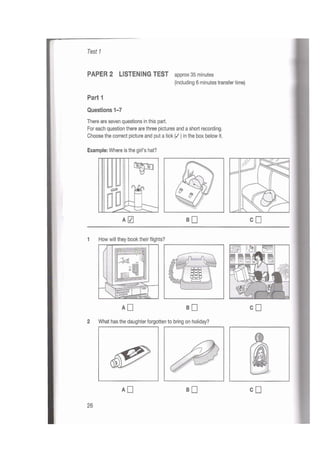
Example: Where is the girl’s hat?
//
V
GS® 9
A0 B cD
1 How will they book their flights?
m ji&gLrÿi
m m
~~
8S
V y
AD BD cD
2 What has the daughter forgotten to bring on holiday?
m
AD BD cD
26
Listening
3 What will the man and woman do on Sunday?
&r r
7
cQBA
4 Which blouse does the girl decide to buy?
cDBDA
5 When is the girl having a party?
TT-zn
15thS14th13th
r
cBDAD
27
Test 1
6 Where is the motorcycle race going to finish?
*i i
*1>&
fl%
a ii i
*
0
n,
_
—_
AD BD cD
7 What will the woman repair next?
AQ BD cQ
28
Listening
Part 2
Questions 8-13
You will hear a radio interview with a man called Robin Marshall, who has written a book about
Argentina.
For each question, put a tick (/) in the correct box.
A O translator
B Q tour guide
C Q travelling salesman
8 What was Robin’s job in Argentina?
A Q colder than he expected.
B O suitable for what he planned.
C Q different from the forecasts he
heard.
9 On Robin’s last trip to Argentina, the
weather was
A [] a picture
B[]achair
C O a record
10 What did Robin buy from the market he
visited?
A [] He wanted to get up and dance.
B [] He wished he had continued his
dance classes.
C He was sad he didn’t dance well.
11 How did Robin feel during the dance
performance he saw?
29
Test 1
AQ He went on a bus tour.
B [] He went into the forest.
CD He went on a river trip.
12 What did Robin do while he stayed in the
village?
A Q the wildlife
B [J the views
C Q the peace
13 What did Robin like about his favourite
place?
30
Listening
Part 3
Questions 14-19
You will hear a radio presenter talking about a museum where you can see a new film.
For each question, fill in the missing information in the numbered space.
FILM AT THE SCIENCE MUSEUM
The Film
(14)Country it is about:
Day it is on:
Time last performance starts:
Sunday
(15)
Other things to do at the museum
— use the (16)
— see a model (17)
— try the cafe on the (18)
in the basement
on the first floor
floor
How to get free tickets for the film
— send an email before 12 o’clock on (19)
31
Test 1
Part 4
Questions 20-25
Look at the six sentences for this part.
You will hear two neighbours, a woman, Natasha, and a man, Colin, talking about running.
Decide if each sentence is correct or incorrect.
If it is correct, put a tick (/) in the box under A for YES. If it is not correct, put a tick (/) in the
box under B for NO.
A B
YES NO
20 Natasha has decided to take the day off work to go running.
21 Colin found running to work was bad for his health.
22 Natasha would prefer to go running outside the city.
23 Natasha would like to wear her sports clothes at work.
24 Natasha will run in the big race because she hopes to win it.
25 Colin and Natasha will prepare for the big race together.
32
Speaking
About the Speaking test
The Speaking test lasts about 10 to 12 minutes. You take the test with another candidate. There
are two examiners in the room. One examiner talks to you and the other examiner listens to you.
Both the examiners give you marks.
Parti
The examiners introduce themselves and then one examiner asks you and your partner to say
your names and spell them. This examiner then asks you questions about yourself, your daily
life, interests, etc.
Part 2
The examiner asks you to talk about something together and gives you a drawing to help you.
Part 3
You each have a chance to talk by yourselves. The examiner gives you a colour photograph to
look at and asks you to talk about it. When you have finished talking, the examiner gives your
partner a different photograph to look at and to talk about.
Part 4
The examiner asks you and your partner to say more about the subject of the photographs in
Part 3. You may be asked to give your opinion or to talk about something that has happened
to you.
33
Test 2
PAPER 1 READING AND WRITING TEST (1 hour 30 minutes)
READING
Parti
Questions 1-5
Look at the text in each question.
What does it say?
Mark the correct letter A, B or C on your answer sheet.
Example:
0 A Buy three films for the price of two.
REGENCY CAMERAS
B Get a free film with every one you buy.
Buy two films
and get one
FREE
C Films bought here are printed free.
HH
ABCAnswer: o c=] nzn
1 A Daniel is having his photo taken with the
tennis team tonight.
Mum,
The tennis team’s meeting
tonight, so I’m taking my
tennis clothes for the photo
- can’t wait to see myself in
B Daniel needs his tennis clothes to play
in a match tonight.
C Daniel is taking a photo of the rest of
the tennis team tonight.it.
Daniel
34
Reading
A Please come downstairs and try our
recently improved restaurant.
2
Z.
Casali Restaurant B The restaurant will reopen when the
improvements are finished.
We are open downstairs
while improvements are
made to this area.
/
C You can only eat in one part of the
restaurant at the moment.
A Joe and Emma should decide whether
they want the spare ticket.
3 "U 'suj «*a
Ann-Marie,
Emmacalled.She'sgot
a freeticketforthis
[evening'sconcert as
|her boyfriend's busy.
II'vealready got one,
Ibutifyou want to go,
Icall herbefore7pm.
B If Ann-Marie is free, she could go to the
same concert as Joe tonight.
C Ann-Marie phoned to offer Emma her
ticket to a concert.
Joe
PhonebookKeyp*
m a
A People renting this room should expect
to pay extra for gas and electricity.
4
ROOM TO RENT -
UNEXPECTEDLY
AVAILABLE so only
£250 per month
including fuel
bills
Tel s Erik on
663159
B The rent for this room is reduced to
£250 plus bills.
C This room is cheap to rent as it was not
expected to be empty.
In this email, Maria wants to
A explain why she hasn’t contacted Sarah
Smith before.
5 New Message
i § “9=1
I . 1 fIrom:I Maria Gomez
I I To: I Sarah Smith"
]
] B tell Sarah Smith how much her English
has improved.Please forgive the delay in
writing -I’ve been so busy!
C thank Sarah Smith for her English
classes in Spain.
1 miss your English classes
now I’m back in Spain, but at
leastIcan understand everything
here!
35
ear 2
Part 2
Questions 6-10
The people below all want to go to a skiing holiday centre.
On the opposite page there are descriptions of eight skiing holiday centres.
Decide which skiing holiday centre would be the most suitable for the following people.
For questions 6-10, mark the correct letter (A-H) on your answer sheet.
a6 Tomoko hasn’t skied before and wants inexpensive lessons
from a teacher who speaks Japanese or English. She’d like to
stay somewhere where she doesn’t have to cook for herself.
T77 Alex and Helen are going skiing for the second time and
would like a centre with easy skiing and interesting places to
f visit. They want to fly there and rent skis cheaply on arrival.
O8 Matt and Martin are looking for some exciting skiing. They
don’t want to be with beginners or worry that there might not
be enough snow. They like eating out in the evenings.
•O Isabel and her 14-year-old son, Juan, are expert skiers but
her husband is a beginner. Juan would like to try other winter
sports, like snowboarding. They’ll travel to the holiday centre
by train.
9
n- -
>
10 Chris and his wife Jo are not keen skiers. They want to be
terX ? able to relax in the sun and admire the beautiful scenery while
their sons of 10 and 12 have skiing lessons.
36
Reading
SKIING HOLIDAY CENTRES
B Mount Brock
This centre is family-friendly withlots of
sporting activities for children, but there
isn’t much to interest advanced skiers.
Although there’s seldom a lack of snow
onMount Brock, it can be cloudy so that
the scenery is hidden. Access is by road.
A Windy Pine
The ski and snowboard runs here are
high in the mountains so you can be
sure of lots of good snow, but they
are extremely challenging and only
for the expert. Skiers can relax after
dark in a number of small bars and
restaurants. The airport is a two-hour
bus ride away.
C Ice Mountain
Come to this beautiful spot if you’re new
to the sport. Try out easy ski runs under
the instruction of qualified teachers- their
services are reasonably priced and many
speak several languages including English.
Classes are for adults only. Guesthouses
provide accommodation with breakfast
and evening meals. The centre is reached
by train.
D Eagle’sNest
There’s skiinginthis area for skiers ofall
abilities, with special classes for children,but
snowboarders aren’t welcome. Accommodation
is in comfortable holiday apartments with
balconies, wherenon-skiers can enjoy the fine
weather surrounded by wonderful mountain
views. There’s a goodbus service from the
centre to the nearest train station.
F Rose Valley
This area has much to offer, both to skiers with
little or no experience and to those wanting
challenging and exciting skiing. Ski instructors
speak French and German. Some slopes are
reserved for snowboarders.There's lively
nightlife but the weather can be unreliable.
Access to the area is by rail.
E Bear Point
This centre is a favourite with skilful
young skiers who have limited money.
Accommodation is reasonably priced and
there’s a variety of evening entertainment.
However, it’s hard to find a good instructor
and you can’t be certain of the snowfall.
Cheap flights go to the local airport.
H Fairview
This historic mountain town has much
for visitors to see. The slopes don't
attract expert skiers, but are suitable
for those wishing to improve their basic
skills. English-speaking instructors
charge a lot, but hiring equipment
is very reasonable. This centre isn't
recommended for children. The airport
is nearby.
G Mount David
There's good open skiing here,
without too many twists and
turns, making it suitable for
intermediate skiers. Equipment
hire is expensive. Accommodation
is of a high standard and there
are excellent restaurants, but
prices are high. The airport
isn't far away.
37
Test 2
Part 3
Questions 11-20
Look at the sentences below about a music day for young people.
Read the text on the opposite page to decide if each sentence is correct or incorrect.
If it is correct, mark A on your answer sheet.
If it is not correct, mark B on your answer sheet.
11 The aim of the music day is for young professional musicians to meet each other.
12 Students will learn some music to play to an audience in the evening.
13 At the concert, the professional musicians will perform individually.
14 Transport home by coach from the concert hall will be provided.
15 Classes will begin straight after the students have registered.
16 Each student attending may be lucky enough to be taught individually.
17 Students wanting any of the goods on sale can collect their chosen items after the
concert.
18 Students staying to wait for the evening concert are advised to take their own
entertainment.
19 Some students will need to bring their evening clothes with them in the morning.
20 For safety reasons, the organisers want to know how many students will be at the concert.
38
Reading
fiJfl Young People’s Music Day
Dear Young Musicians,
Thank you for agreeing to take part in our Music Day. Here are some notes for your
information.
The day
The whole idea of the day is for music students from secondary schools around the area to
meet other players and receive expert teaching from our guests, six professional players.
In the evening, you will perform the pieces you have worked on during the day at a concert
which your friends and family can attend. The concert will include a range of music from
you, followed by one piece from each of our guests.
Getting there
A map is included for the concert hall. Your school coaches will drop you at the main
building. Please note that there is no return coach journey.
The programme
After you have registered at the reception, go to the main hall. First there will be a short
performance by our professional musicians who are joining us for the day. After this you
will go into your classes to practise on your own instruments for the evening concert. There
will also be a chance to experiment with a different instrument from the one you normally
play, and see if you enjoy playing something more unusual -we have several instruments
to choose from!
What to bring
Bring a piece of music that you can play well. Part of the day will include a ‘masterclass’
in which you might have the opportunity, if there is enough time, to play a piece of your
choosing and be given a short lesson by one of the professional players.
What to buy
There will be opportunities to buy sheet music or books during the day, so you may want
to have money for these. If you wish to buy something, you could reserve it and then
arrange to pick it up and pay when your parents arrive to watch the concert. This service
will be available until 7 pm.
Going home
The first part of the day will finish at 5 pm, when parents can collect students. For those
remaining in the hall until the evening concert at 7 pm, there will be DVDs for you to watch,
although you should also bring something to do while you are waiting. A change of clothes
is required for the evening -black trousers or skirt and white top - so unless you are going
home at 5 pm, you will need to have this with you at the start of the day.
Evening concert
If for whatever reason you cannot attend the evening concert, you must inform us as soon
as possible, as we need to know numbers in order to prepare the stage.
We look forward to seeing you at the Young People’s Music Day.
39
Test 2
Part 4
Questions 21-25
Read the text and questions below.
For each question, mark the correct letter A, B, C or D on your answer sheet.
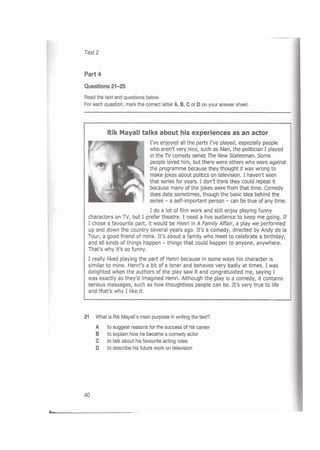
Rik Mayall talks about his experiences as an actor
I've enjoyed all the parts I've played, especially people
who aren't very nice, such as Alan, the politicianIplayed
in the TV comedy series The New Statesman. Some
people loved him, but there were others who were against
the programme because they thought it was wrong to
make jokes about politics on television.Ihaven't seen
that series for years.Idon't think they could repeat it
because many of the jokes were from that time. Comedy
does date sometimes, though the basic idea behind the
series - a self-important person - can be true of any time.
Ido a lot of film work and still enjoy playing funny
characters on TV, butIprefer theatre.Ineed a live audience to keep me going. If
Ichose a favourite part, it would be Henri in A Family Affair, a play we performed
up and down the country several years ago. It's a comedy, directed by Andy de la
Tour, a good friend of mine. It's about a family who meet to celebrate a birthday,
and all kinds of things happen - things that could happen to anyone, anywhere.
That's why it's so funny.
Ireally liked playing the part of Henri because in some ways his character is
similar to mine. Henri's a bit of a loner and behaves very badly at times.Iwas
delighted when the authors of the play saw it and congratulated me, sayingI
was exactly as they'd imagined Henri. Although the play is a comedy, it contains
serious messages, such as how thoughtless people can be. It's very true to life
and that's whyIlike it.
i
,
L r
21 What is Rik Mayall’s main purpose in writing the text?
A to suggest reasons for the success of his career
B to explain how he became a comedy actor
C to talk about his favourite acting roles
D to describe his future work on television
40
Reading
22 What does Rik Mayall say about The New Statesman?
A It won’t be repeated because some people were upset.
B Not everyone approved of it.
C It was based on an unpleasant person he met.
D He enjoys watching it again from time to time.
23 What kind of work does Rik Mayall prefer?
A performing in front of an audience
B acting with his close friends
C doing comedy series for television
D making films about real people
24 Why was Rik Mayall pleased about acting in A Family Affair?
A He could insist on which character to play.
B The writers of the play admired his performance.
C It allowed him to do some serious acting.
D He played a character who was very different to himself.
25 Which of the following is the best description of Rik Mayall?
BA
He is a well-known actor who
has given up playing funny
characters on TV in order to
concentrate on serious theatre.
He is a comedy actor who
dislikes playing roles that are
based on real life.
DC
He is a famous actor who
played in A Family Affair
because he said it reminded
him of his own family situation.
He is a successful actor who
says that he enjoys playing
characters who are unpleasant.
41
Test 2
Part 5
Questions 26-35
Read the text below and choose the correct word for each space.
For each question, mark the correct letter A, B, C or D on your answer sheet.
Example:
0 A very B so C too D such
A B C DAnswer: 0
THE ART OF DRAWING
Drawing has always been a (0)
hobby. Young children draw with a pencil as
as they can hold one. Drawing is
often seen as a special skill, and it is
that some people seem to
draw perfect pictures without any effort. Yet
drawing, like writing, can be (28) ; you
can draw accurately if you work really hard at it. y
popular
(26)
sr(27)
Drawing is first (29)
you (30)
draw a familiar (31)
all about looking carefully.It sounds easy to say thafi
to do is look at things, but it really is that simple. The best way TB
.................is to imagine that you are looking at it for the first 1
(32)
Nowadays there are (33) courses and materials available than ever before
means that you can experiment to improve your skills. The only
is your imagination.
(34)
(35)
26 A fast
27 A true
B immediately
B actual
B made
B in
B need
B subject
B term
B many
B what
B end
C soon
C exact
C learnt
C from
C must
C area
C moment
C plenty
C where
C limit
D shortly
D real
D reached
D for
D could
D person
D time
D much
D which
D finish
28 A discovered
29 A of
30 A should
31 A topic
32 A period
33 A more
34 A who
35 A final
42
Writing
WRITING
Part 1
Questions 1-5
Here are some sentences about getting a job.
For each question, complete the second sentence so that it means the same as the first.
Use no more than three words.
Write only the missing words on your answer sheet.
You may use this page for any rough work.
Example:
0 There are some advertisements for jobs in the local newspaper.
some advertisements for jobs.The local newspaper
hasoAnswer:
1 Filling in a job application form doesn’t take you long.
It doesn’t take you long in a job application form.
2 At a job interview they will want to know what jobs you have done before.
At a job interview they will ask, ‘What jobs before?’
3 It’s important to arrive at work on time.
It’s important late for work.
4 Some people like working outdoors more than working inside.
working outdoors to working inside.Some people
5 At some firms, staff are given free uniforms.
Some firms their staff free uniforms.
43
Test 2
Part 2
Question 6
You are going to be absent from your English class next week.
Write a note to your English teacher. In your note, you should
•explain why you are going to be absent
•apologise to your teacher
•ask your teacher for information about next week’s work.
Write 35-45 words on your answer sheet.
44
Writing
Part 3
Write an answer to one of the questions (7 or 8) in this part.
Write your answer in about 100 words on your answer sheet.
Tick the box (Question 7 or Question 8) on your answer sheet to show which question you have
answered.
Question 7
•This is part of a letter you receive from your new penfriend, Jenna.
I've got one close friend whoIspend a lot of
time with. What about you? Tell me about your
friends. How important are they to you?
•Now write a letter to Jenna about your friends.
•Write your letter in about 100 words on your answer sheet.
Question 8
•Your English teacher has asked you to write a story.
•Your story must begin with this sentence:
It was getting dark and I was completely lost.
•Write your story in about 100 words on your answer sheet.
45
Test 2
PAPER 2 LISTENING TEST approx 35 minutes
(including 6 minutes transfer time)
Parti
Questions 1-7
There are seven questions in this part.
For each question there are three pictures and a short recording.
Choose the correct picture and put a tick (/) in the box below it.
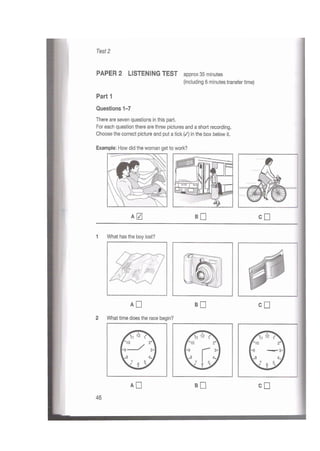
Example: How did the woman get to work?
TVS

A0 BD CD
1 What has the boy lost?
i
/
A B CD
2 What time does the race begin?
TT12 12 7 TT12 T
MO 2" *10 2* ’10 2‘
*9 3* •9
—3-
..8 4.. .ÿ8 4*i
AQ B cQ
46
Listening
3 Which musical instrument does the boy play now?
¥
cDBDAQ
4 What will the weather be like tomorrow afternoon?
r
2d d 4 4 d tj d
d d <j d d 4 d
d d 4 d d 4 d
*dd d 4 d d 4
cQBDAD
5 What is the subject of James Wilson’s book?
V $
CDAD BD
47
Test 2
6 Which part of the man’s body hurts him at the moment?
*f)
cQBAQ
7 Where was the man’s knowledge of Spanish useful?
E23-*
,
i
Or
cBAQ
48
i
Listening
Part 2
Questions 8-13
You will hear a radio interview with a man called Harry Park, who is talking about the adventure
travel company he runs.
For each question, put a tick (ÿ) in the correct box.
A Q gave him adventure stories to read.
B n worked in a travel company.
C O talked a lot about the places he’d
been to.
8 Harry first became interested in adventure
travel because his father
A Q wanted to share his experience with
others.
B Q thought he could make a lot of
money.
C O hoped to do more travelling himself.
9 Harry decided to start an adventure travel
company because he
A [] a friend
B Q a customer
C Q his wife
10 Who suggested the name for Harry’s
company?
A Q give the local people jobs.
B Q take modern equipment.
C Q avoid damaging the area.
11 When Harry visits a place, he tries to
49
Test 2
A Q It’s part of his job.
B It’s frightening.
C Q It’s enjoyable.
12 What does Harry say about doing
dangerous things?
A Q a mountain
B [] a building
C [] a river
13 What is Harry’s favourite place?
50
Listening
Part 3
Questions 14-19
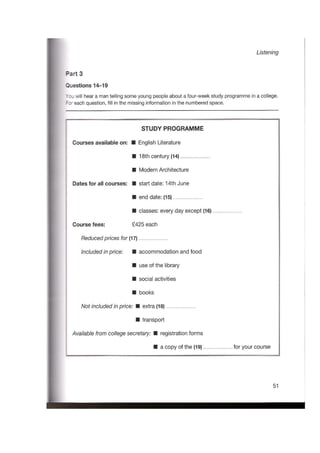
You will hear a man telling some young people about a four-week study programme in a college.
For each question, fill in the missing information in the numbered space.
STUDY PROGRAMME
Courses available on: English Literature
18th century (14)
Modern Architecture
Dates for all courses: start date: 14th June
end date: (15)
classes: every day except (16)
Course fees: £425 each
Reducedprices for (17)
Includedinprice: accommodation and food
use of the library
social activities
books
Not includedinprice: extra (18)
transport
Available from college secretary: registration forms
a copy of the (19) for your course
51
Test 2
Part 4
Questions 20-25
Look at the six sentences for this part.
You will hear a conversation between a girl, Claire, and a boy, Tom, about a football tour.
Decide if each sentence is correct or incorrect.
If it is correct, put a tick (/) in the box under A for YES. If it is not correct, put a tick (/) in the
box under B for NO.
A B
YES NO
20 Claire has read about the football tour in a newspaper.
21 Claire is worried about being the youngest member of the team.
22 Tom feels that schoolwork is more important than sports training.
23 Claire intends to study at a university next year.
24 Claire thinks it’s important to win every game on the tour.
25 Tom agrees to go and support Claire’s team at her next match.
52
Speaking
About the Speaking test
The Speaking test lasts about 10 to 12 minutes. You take the test with another candidate. There
are two examiners in the room. One examiner talks to you and the other examiner listens to you.
Both the examiners give you marks.
Parti
The examiners introduce themselves and then one examiner asks you and your partner to say
your names and spell them. This examiner then asks you questions about yourself, your daily
ife, interests, etc.
Part 2
The examiner asks you to talk about something together and gives you a drawing to help you.
Part 3
You each have a chance to talk by yourselves. The examiner gives you a colour photograph to
look at and asks you to talk about it. When you have finished talking, the examiner gives your
partner a different photograph to look at and to talk about.
Part 4
The examiner asks you and your partner to say more about the subject of the photographs in
Part 3. You may be asked to give your opinion or to talk about something that has happened
to you.
53
Test 3
PAPER 1 READING AND WRITING TEST (1 hour 30 minutes)
READING
Part 1
Questions 1-5
Look at the text in each question.
What does it say?
Mark the correct letter A, B or C on your answer sheet.
Example:
0 A Do not leave your bicycle touching the
window.
NO BICYCLES
AGAINST GLASS
PLEASE
B Broken glass may damage your bicycle
tyres.
C Your bicycle may not be safe here.I
ABCAnswer: o i* r= czn
1 A You can buy a ticket at this desk to go
straight into the theatre.
B You can book theatre tickets in advance
at the collection desk.
THIS DESK IS ONLY
FOR THE
COLLECTION OF
THEATRE TICKETS
BOOKED IN ADVANCE
C You can pick up theatre tickets here
that you have already booked.
-'
54
Reading
Bob needs to
A make a dentist’s appointment for Jill.
2
m 0@
B phone the dentist about an
appointment.
Bob,
Itriedtomakeyoua
;+dentist'sappointment
|forFridaybuttheycan
Ionlydo10a
IfthisisOK,
Iringthembefore5pm
C tell Jill when he can go to the dentist.mon
A You can keep your shoes on in the
changing room unless they are dirty.
3
IF YOUR SHOES ARE
DIRTY, PLEASE
REMOVE THEM BEFORE
ENTERING THIS
CHANGING ROOM
B Clean your shoes at the entrance to the
changing room before you come in.
C All shoes must be taken off and left at
the changing room entrance.
What is Anita doing?
A explaining that she will be late
4
© MESSAGE
Tony
Maria’s sorry but she’s going to be late
this evening. The train is delayed again!
Pon’t forget you’re meeting her at the
station. She should be there at 7.15.
Anita
B apologising for missing the meeting
C reminding somebody of an arrangement
A To avoid us cancelling another Saturday
trip, tell us what your interests are.
5
INTERNATIONAL
STUDENTS’ CLUB
B Saturday’s coach trip is cancelled
because there are transport problems.
Next Saturday’s coach
trip is cancelled
because of lack
of interest
C We are cancelling the trip on Saturday
as numbers are too low.
*
55
Test 3
Part 2
Questions 6-10
The people below all want to do an activity in the countryside during the autumn.
On the opposite page there are descriptions of eight companies which provide leisure activities
in the countryside.
Decide which company would be the most suitable for the following people.
For questions 6-10, mark the correct letter (A-H) on your answer sheet.
O6 Susanna only has a couple of hours free. She hates walking
and would like to try something that brings her into contact
with animals, although she is a bit nervous with them.
o7 Kemal is looking for some excitement and is keen to do
something challenging. He also wants to get to know the area
better. He can afford up to £50.
J*.
8 Frank and Sabine want to go for a walk with their young
family. They’d like to have lunch out but Sabine doesn’t like
carrying things for the baby, or picnic things, around all day.
g Charlotte is flying to the Brazilian rainforest soon to do some
scientific research. She hopes to get some experience of
living in the open air before she goes.
T 4
 k
10 Tom wants to explore the natural beauty of the area in
company with other people, doing something other than
walking. He doesn’t have any equipment of his own but he
has £40 to spend.
56
Reading
Get out this autumn!
A Windtek
Windtek runs windsurfing training
courses for beginners, involving two
three-hour private lessons (£89 with
board and wetsuit hire). Experienced
surfers can also practise on their
own (£15 per hour). At this time
of year, the water is still warm and
an exciting day in the open air is
promised!
B CountryLanes
Basedinalovely forest, Country Lanes
provides a relaxing experience for
newcomers to cycling, experienced
cyclists and those just looking for family
fun. The one-day group tour (£30 per
person) includes bike hire,route map and
discounts on entry to tourist attractions.
D SurvivalSchool
If you’re thinking of taking a trip to somewhere
far fromcities andpeople, youmight want to
learnhow to take care of yourself first. Survival
School’s challenging weekend course (£150)
will teach you fire-making, camp-building and
recognising edible plants and wild animals.
These skills could save your life.
C Llama Treks
For something different, let this company’s
friendly South American animals
accompany you on a walk through the
hills. The llamas transport your bags while
you enjoy the scenery. The most popular
trip is a four-hour walk with a stop at a
country restaurant (£55 per adult including
meal - children free).
F Bygone Age
Practise a skill from the past! This
company owns a 10-kilometre private
railway track and offers train-lovers
the opportunity to drive a steam train
through pretty countryside. The return
trip (€125) lasts one hour. There are
picnic tables and a children's playground
at the station.
E Park Stables
Have you ever thought of exploring a national
park on horseback? Park Stables offers rides
on horses specially chosen for their gentle
characters. Beginners are welcome and riding
hats and boots are provided free of charge.
Private ride £25 per hour, family ride £42 per
hour.
H IslandLink
This ferry company will take you to a
beautiful, walker-friendly island. Some of
its footpaths take in the coastline, while
others pass through woods. You probably
won’t see another walker all day! Walks
vary in length from 2 to 8 hours. Ferry fare
and walker’s guidebook £5.
G Swallow Aviation
Get a bird's-eye view of the
countryside and see some of the
region's tourist sights from
the air by taking a lesson in
a two-seater microlight plane.
It's an adventure that's not for
the faint-hearted! The training
plane is an Icarus C42 which
flies at around 160 kph. Flights
from £49.
57
Test 3
Part 3
Questions 11-20
Look at the sentences below about two climbers called Gertrude Benham and Charles Fay.
Read the text on the opposite page to decide if each sentence is correct or incorrect.
If it is correct, mark A on your answer sheet.
If it is not correct, mark B on your answer sheet.
11 Gertrude Benham had spent less time climbing in Canada than Charles Fay.
12 Charles Fay applied to an organisation to have a mountain named after him.
13 On 19 July, Gertrude Benham found out she had made a mistake.
14 Gertrude Benham decided to climb Mount Heejee with Charles Fay on 20 July.
15 Charles Fay blamed his guide when he failed to reach the top of Mount Heejee.
16 Gertrude Benham took a different route up Mount Heejee from Charles Fay.
17 Gertrude Benham knew Hans Kaufmann had a plan to choose a slow route up Mount
Heejee.
18 The mountain which was named after Charles Fay was the one he had first chosen.
19 Charles Fay’s grandson followed a different route from his grandfather up Mount Fay.
20 The hut named after Charles Fay is still used by climbers.
58
Reading
Climbing mountains
Gertrude Benham was born in England
in 1867. She had made 130 climbs in the
European Alps before going to the Canadian
Rocky Mountains in 1904, where she
spent the summer climbing. In 1904, the
paths of Gertrude Benham and Charles
Fay briefly crossed. He had spent several
successful summers climbing in the Rocky
Mountains. In fact he was so successful that £9
the Geographical Board of Canada asked
[ him to select a mountain to take his name.
| He chose one known as Heejee and was
determined to be the first to reach the top. But Gertrude Benham had the same idea.
I On 19 July 1904, Gertrude and her guide, Christian Kaufmann, reached the top of a
mountain which they thought was Heejee. Upon their return, however, they were told that
I that particular mountain was called something else. They decided to try again the next day
but, unknown to Gertrude, Charles Fay and his guide Hans Kaufmann, Christian's brother,
R were planning to climb Heejee that day as well.
Both groups set out on 20 July but Charles Fay and Hans Kaufmann found the snow
conditions difficult and had to turn back. Gertrude and Christian were successful. Charles
Fav was annoyed and later wrote in a letter, 'Hans Kaufmann led me, against my wishes,
-o Consolation Valley instead of taking my advice to go round Moraine Lake, while
Christian led Miss Benham straight to the top of the mountain.'
ISome people said that the Kaufmann brothers had wanted Gertrude to get to the top first
Iacd Hans had therefore taken Charles Fay on a route which took more time. Although
Itfiis is a good story, no documents exist to prove this actually happened and it was never
thought that Gertrude had any knowledge of it.
ID sappointed, Charles Fay asked if he could choose a different mountain to take his name
Iard chose Mount Shappee, but then found out that Gertrude and Christian had climbed
Ipalone as well. At this point Charles Fay agreed to have his name attached to Heejee, as
Ihe had originally wanted. He finally climbed to its top on 5 August 1904. Half a century
IHer, his grandson climbed the north-eastern side of the mountain, by then known as
K Mount Fay. No other climber had ever managed to do this.
strude Benham then travelled to New Zealand and Japan to do more climbing before
ing home to England, spending time in Australia and India on the way. Charles Fay
see many more successful climbs. The first hut built in the Canadian Rockies to shelter
ntbers was called the Fay Hut. It was built in 1927 but unfortunately was destroyed in a
est fire in 2003.
59
Test 3
Part 4
Questions 21-25
Read the text and questions below.
For each question, mark the correct letter A, B, C or D on your answer sheet.
At home in Venice
by Francesco daMosto
r*i
Iwas bomin Venice, one of the most popular tourist destinations in
Italy, and studiedarchitecture at university here. ThoughIhave also
spent time away,Ihave always come back because it’s my home.
In Venice, there are no roads, only canals, so youhave to get around on
foot or by boat.Ilive on a canalin theRialto area in a house that was built in 1588 for the
Mutifamily, who were merchants in the silk trade.In the mid-eighteenth century, it was
home to the Vezzifamily, who made things like plates and bowls in fine china andbecame
rich sending these around the world. These merchants’ houses inVenice are like palaces.
Their owners had to have space to show off their goods,but the building also had to be an
office, a factory, a store and a home. My house came into our family in 1919, when it was
bought by my grandfather.He diedbeforeIwas bornbut he was the director of a museum
whereIoften do research on olddocuments. On some of these,I’ve seennotes inhis
handwriting, so, in a strange way,Imet him through these documents.
Sadly, the populationof Venicehas dropped from 120,000 in the 1950s to about 60,000
now. This doesn’t include the thousands of tourists who come to visit.Iwelcome the
tourists but unless something is done to stop everyday shops like bakeries and chemists from
disappearing, the city willdie.Iwant people who love the city to come here to live and work
and give Venice back a life that is not just about tourism.
21 What is the writer’s main reason for writing this text?
A to persuade more tourists to visit his city
B to give readers the history of his home town
C to say what he feels about his birthplace
D to describe some important moments in his life
60
Reading
22 The family who first owned the writer’s home
A used to buy and sell silk.
B produced plates and bowls.
C were skilled architects.
D helped to build the canals.
23 What does the writer say about his grandfather?
A His grandfather taught him how to study documents.
B He didn’t find his grandfather’s handwriting easy to read.
C He wasn’t able to get to know his grandfather personally.
D His grandfather turned his home into a museum.
.'.'hat is the writer’s attitude to Venice today?
A He hopes tourists will stop visiting the city.
B He would like people to get jobs working with tourists.
C He believes the city would benefit from having fewer inhabitants.
D He thinks local businesses should be encouraged to stay.
What might the writer say about his house?
BA
My house is on a canal
in Venice andmy
family, starting withmy
grandfather,have lived there
since 1919.
Ihave never lived anywhere
else apart frominmy home
inthe Rialto area of Venice.
The house was made bigger A
inthe mid-eighteenth
century because the owner
wanted it to look like a
V palace. J
r We don’t know who
livedin the house before
1588 but it was owned by
merchants from thenuntil
V the eighteenth century.
61
Test 3
Part 5
Questions 26-35
Read the text below and choose the correct word for each space.
For each question, mark the correct letter A, B, C or D on your answer sheet.
Example:
0 A over B above C up D ahead
A B C DAnswer: Q _J t=l CZ3,
Cave Paintings in Australia
200 paintings was discovered in the WollemiNationalPark,
least 3,000 years old.
is even more surprising is that the cave was found by chance by someone
walkingin the area. However, the site of the cave was so difficult to reach that it
a long time before researchers could visit it.
The exact location of the sitehas to be (29)
from being visitedby sightseers who do not (31)
paintings.
A cave containing (0)
Australia, eight years ago. Some of the paintings are (26)
(27)
(28)
secret.This is to (30)
.......how easy it is to (32)
the cave
tl
The paintings show people and animals, (33)
animals that can (34)
birds,lizards and other Australian
be seen today. According to researchers, (35)
recent discovery,nobody had visited the cave for around 200 years.
its
26 A in
27 A How
28 A lasted
29 A remained
30 A prevent
31 A catch
32 A waste
33 A involving
34 A yet
35 A by
B of C to
C Why
C took
C controlled
C escape
C dream
C damage
C including
C ever
C until
D at
D WhichB What
B spent
B set
B miss
B realise
B injure
B adding
B already
B after
D finished
D kept
D avoid
D feel
D upset
D consisting
D still
D on
62
Writing
WRITING
Part 1
v.estions 1-5
are some sentences about sailing.
Per each question, complete the second sentence so that it means the same as the first.
-se no more than three words.
•~te only the missing words on your answer sheet.
may use this page for any rough work.
Example:
•Both my father and I love sailing.
I love sailing and my father.
50 doeeoAnswer:
My father was given his first boat by his parents.
My father’s parents his first boat.
2 My father doesn’t have that boat any more.
My father got that boat any more.
3 .'.anted to start sailing, but my father insisted that I took some lessons first.
I wanted to start sailing, but my father said I had
lessons first.
some
* My local sailing school said I was too young to join their courses.
My local sailing school said I wasn’t to join their courses.
9 1found it more difficult to learn than I had expected.
ft wasn’t to learn asIhad expected.
63
Test 3
Part 2
Question 6
You recently did a homework project about life in Britain, and your penfriend Judy helped you by
sending some information.
Write an emaiito Judy.In your email,youshould
•thank her for her help
•explain which information was most useful to you
•say what your teacher thought about your project.
Write 35-45 words on your answer sheet.
64
Writing
Part 3
Write an answer to one of the questions (7 or 8) in this part.
Write your answer in about 100 words on your answer sheet.
Tick the box (Question 7 or Question 8) on your answer sheet to show which question you have
answered.
Question 7
•This is part of a letter you receive from your English friend, Sue.
Tell me about TV in your country. Are the
programmes interesting? How much TV do you
watch? Do people watch too much TV these
days?
•Now write a letter to Sue, answering her questions.
•Write your letter in about 100 words on your answer sheet.
-.estion 8
Your English teacher wants you to write a story.
Your story must begin with this sentence:
looked in the shop window and I saw exactly what I wanted.
Mrite your story in about 100 words on your answer sheet.
65
Test 3
PAPER 2 LISTENING TEST approx 35 minutes
{including 6 minutes transfer time)
Part 1
Questions 1-7
There are seven questions in this part.
For each question there are three pictures and a short recording.
Choose the correct picture and put a tick (/) in the box below it.
Example: Where did the man leave his camera?
©
©
B cDA0
Which present will the girl receive?1
*s«S
cDAQ BD
Where will the tourists go last?2
i
t
8t!
k : C
Jftfr
>ÿ>:
Si J
cDAQ BD
66
Listening
3 How much does the man pay for the postage?
mr
i: : mn
A B cD
4 Where in the theatre did the woman leave her gloves?
0 mm-P
B o D
-<&7
7
nrm
AD BD cD
5 Which dress does the woman like best?
••••V
SA *. .© Q ®L~k
Vh I© ©(
f*
* «
AD BD c
67
Test 3
6 What is the television programme about?
TJ
M
cDBQAD
7 Which vehicle does Steve intend to buy?
i
o-o 2
BD cDAD
68
Listening
Part 2
Questions 8-13
You will hear part of a radio interview with a woman called Linda Brown, who is talking about
working in a cake shop when she was a student.
For each question, put a tick (/) in the correct box.
A Q her parents didn’t give her enough
money.
B Q she wanted to give her parents
some money.
C Q she needed to buy things for
college.
8 Linda worked in a cake shop because
A Q paid her well.
B Q was kind to her.
C Q sent her on a training course.
5 Linda liked her first boss because he
A Q eating the cakes
B Q the smell of baking
C Q the clean workplace
10 What did Linda enjoy about working in
the shop?
A Q baking bread.
B Q] displaying cakes.
C Q making sandwiches.
tl In the shop, Linda helped with
69
Test 3
A Q were friendly to her.
B Q hadn’t got the same skills as her.
C Q didn’t work as hard as her.
12 Linda says that the full-time shop
assistants
A She didn’t like dealing with
complaints.
B Q She liked giving them advice.
C She enjoyed the busy part of the
13 What does Linda say about serving
customers?
day.
70
Listening
Part 3
Questions 14-19
•:J will hear some recorded information about a museum.
=:' each question, fill in the missing information in the numbered space.
Central Museum
The museum gardens were first created in the year (14)
lere are exhibitions of English furniture and (15) art.
In the museum shop, visitors can buy (16) , cards and books.
Cars can be parked at the (17) near the museum.
Regular buses to the museum leave from both the city centre and the
"3
Cal 451858 to find out more about (19) visits or room hire.
71
Test 3
Part 4
Questions 20-25
Look at the six sentences for this part.
You will hear a conversation between a boy, Sam, and a girl, Carla, about a school concert.
Decide if each sentence is correct or incorrect.
If it is correct, put a tick (/) in the box under A for YES. If it is not correct, put a tick (/) in the
box under B for NO.
A B
YES NO
20 Carla is surprised that Mrs Ford wanted her to attend the meeting.
21 Sam says that last year’s concert was an improvement on earlier ones.
22 Carla enjoyed preparing for last year’s concert.
23 Sam tells Carla that she is the best pianist in the school.
24 Sam encourages Carla to accept Mrs Ford’s choice of music.
25 Sam realises that he must stop doing one of his activities.
72
Speaking
About the Speaking test
The Speaking test lasts about 10 to 12 minutes. You take the test with another candidate. There
are two examiners in the room. One examiner talks to you and the other examiner listens to you.
Both the examiners give you marks.
Part 1
The examiners introduce themselves and then one examiner asks you and your partner to say
..our names and spell them. This examiner then asks you questions about yourself, your daily
life, interests, etc.
Part 2
The examiner asks you to talk about something together and gives you a drawing to help you.
Part 3
You each have a chance to talk by yourselves. The examiner gives you a colour photograph to
look at and asks you to talk about it. When you have finished talking, the examiner gives your
Dartner a different photograph to look at and to talk about.
Part 4
The examiner asks you and your partner to say more about the subject of the photographs in
Part 3. You may be asked to give your opinion or to talk about something that has happened
to you.
73
Test 4
PAPER 1 READING AND WRITING TEST (1 hour 30 minutes)
READING
Part 1
Questions 1-5
Look at the text in each question.
What does it say?
Mark the correct letter A, B or C on your answer sheet.
What does Jake need to do?
A open the garage when Ben arrives so
he can get his bike
Example:
0
Jake
Ben left his bike in our garage
yesterday. He’d like to come and
collect it at 6. Please be at home
to let him into the garage.
B look in the garage and let Ben know if
his bike is there
C get Ben’s bike out of the garage and
take it to him
Sonia
ABCAnswer: o mm czn CZI
A You need to phone Sophie if you want
to come to this event.
1
*End of Term Party*
December 15th 7-10 pm
Sign below if you can come!
We also need people to
help organise the event -
call Sophie (678853)
B Anyone wanting to take part in running
this event should sign the notice.
C People who can attend this event
should put their names on the notice.
74
Reading
2 The main purpose of this email is
A to invite people to display goods at an
exhibition.
NewMessage
0 I *7
From: WiHonaxWbMons<8TCK.oo.ufc
Subject: Guitar Show
The Guitar Show returns to Hinton
Exhibition Centre on6 March. Many
new guitars will beon display. The
show is open to schools and the
general public.
B to explain booking details for a show.
C to provide information about an event.
3 Aziz wants Abdul to
A take his homework to college for him.
v 'at SEE
Hi Abdul,
Iwon'tbeincollege
asI'mnot well.Please
Jcallroundonyour
Iwayintopickupmy
|homework-it'sdue
Iintoday. Thanks,Aziz
B call their college to say that he is not
well.
C pick up any new homework given out at
college today.
This label gives advice on
A how to store the product.Once opened,
remove any unused
soup from the tin
and place in the
refrigerator.
B how to use the product.
C how to open the product.
A Only people who are trained in kitchen
work should apply for these part-time
jobs.
Wanted: Kitchen
Assistants
/
Evenings or weekends
Free meals
Full training provided
Apply inside
B There are part-time opportunities for
people without experience of working in
a kitchen.
/
C We offer cheap meals to people who
work part-time in our kitchen.
75
Test 4
Part 2
Questions 6-10
The people below all want to visit a museum.
On the opposite page there are descriptions of eight museums.
Decide which museum would be the most suitable for the following people.
For questions 6-10, mark the correct letter (A-H) on your answer sheet.
Jake and Maureen have different interests but want to go
somewhere they will both enjoy. Jake loves anything to do
with the sea, while Maureen’s interested in social history and
the lives of women.
6
Melanie is a history teacher. She wants to take her class to a
museum where they will be allowed to touch things and have
activities to do during their visit.
7 £
Roger is keen to find out about different forms of transport in
towns over the last hundred years. He would like to attend a
talk while he is at the museum.
8
/
ft Kazuko studies English literature and thinks that seeing whefi
writers lived will help her understand their books better. She
finds it useful to look at pictures which are connected with
the books.
9
Nick is more interested in learning about the countryside that
learning about people from the past. He needs information%
some schoolwork he is doing about what happens to rivers
and hills over time.
10
IS isr
L
'A m
76
I
Reading
Recommended Museums in the Area
B Castle Museum
The castle was built looking down
on the valley of the River Dean. It is
now a museum, where you can learn
how the valley has changed over
millions of years. There is a collection
of interesting rocks and fossils found
in the area, and pictures showing
how the valley probably looked in
prehistoric times.
A Red House
Travel back to the time of the novelist
Charlotte Bronte and find out about her
friends and local connections. Discover
the comforts and discomforts of the 1830s
country home where Charlotte sometimes
stayed as a guest of Joshua Taylor's family
and got ideas for her novel Shirley.
D Shandy Hall
Here in the 1760s, Laurence Sterne wrote
Tristram Shandy. His fifteenth-century
house is now surrounded by a large
garden full of beautiful and unusual plants.
Inside there is an important collection of
Sterne’s novels plus the original drawings
which were included in his works.
C Hillcrest Museum
Enjoy an experience of diggingup the
past.Handle pieces of ancient pots, tools
and other objects from many countries.
Learn to date them and see what they tell
us about how people lived then. Also try
out computer programs which help plan
the digging-up of sites. School groups
should book in advance.
F Fishing Centre
Study the routes used by fishermen
over the last two hundred years and see
how their ocean-going boats worked.
A new exhibition explores the position
of wives and mothers in the old fishing
towns, giving information about their
occupations, and their attitudes to work
and home.
E Museum of Peace
Situated in beautiful
countryside, this is the only
museum of its kind in the
i country. It has a growing
I collection of art and objects
l connected with peace history,
I non-violence and the ending of
I war. It also has material which
Ican be used after the visit back
in the classroom.
H Horsepower Museum
This museum reminds us just how important
horses were to life in the nineteenth and
early twentieth centuries. It has a permanent
exhibition of old trams and buses, which used
to be pulled through the streets by horses.
The staff here are very knowledgeable and give
daily lectures on this fascinating collection
s Viking Centre
I Come and experience what life was like
1,200 years ago in this Viking town, rebuilt
I
*the mouth of the river. Our introductory
talk will inform you about the close
. relationship the Vikings had with the sea -
| fiey were excellent fishermen, sailors and
There are also tools, clothes
everyday items to look at.
77
Test 4
Part 3
Questions 11-20
Look at the sentences below about John Chapman, an Englishman who lived in the 15th
century.
Read the text on the opposite page to decide if each sentence is correct or incorrect.
If it is correct, mark A on your answer sheet.
If it is not correct, mark B on your answer sheet.
11 In 1440, John Chapman lived in Norwich.
12 John rarely managed to sell all his goods at the market.
13 John and his wife had enough money to live comfortably.
14 John’s wife encouraged him to make the journey to London.
15 People stopped to chat to John while he was standing on London Bridge.
16 John was disappointed by what the old man told him.
17 John’s wife realised why he was digging a hole under the tree.
18 The writing on the box was in a language that was foreign to John.
19 The second container was buried directly under the first.
20 The people of Swaffham benefitted from John’s good luck.
78
Reading
John Chapman
The atmosphere in the market place in Norwich in 1440 was
probably not very different from how it is today - noisy, crowded,
colourful and exciting. It was here that John Chapman used to come
each week from his home in Swaffham, 50 kilometres away, to try to
sell his copper pots and pans.
 M i HVi|
* R
After one particularly tiring day, he loaded his unsold pots and pans
onto the back of his horse as usual and walked slowly home. He had
a meal and went to bed, complainingbitterly to his wife about their
lack of money. However, that night John had a dream that would
change the rest of his life.
In this dream a man told John that if he stood on London Bridge he would hear something
that would make him rich. The dream was so real that John couldn't get it out of his mind,
and finally he decided to make the journey, even though his wife was against the idea.
After a week's preparation, John set off for London with just his dog for company. When he
arrived at London Bridge he stopped and watched all the men and women who went past.
Many of them talked to him, but he heard nothingthat would make him rich.
On the third day, however, an old man asked him why he was standing there. John told him
it was because of a dream. The old man replied, 'I recently dreamed that I went to the home
of John Chapman, in Swaffham, and dug under a tree at the back of his house, where I found
a buried pot of gold! But I am not foolish enough to believe in dreams.'
Unable to believe his luck, John said goodbye and returned to Swaffham. As soon as he got
home, he fetched a spade and started digging. His wife looked on in amazement, unable
to understand what he was doing. But sure enough, he uncovered a box. Opening it with
nervous hands he found that it was full of money. The couple were delighted, but also
curious about some words on the lid, which were in a language they didn't recognise. Keen
to find out their meaning, John put the box in his window and soon two young men knocked
on the door and translated them for him: Beneath me lies another one much richer. So John
dug deeper and this time found a huge pot full of gold and jewels!
That is how John Chapman became rich. He spent the money wisely and paid for several
public buildings to be built. And his memory lives on in Swaffham today, on the painted
sign at the entrance to the town!
79
Test 4
Part 4
Questions 21-25
Read the text and questions below.
For each question, mark the correct letter A, B, C or D on your answer sheet.
Anna Gomez
Anna Gomez is a successful TV sports
presenter, but most people still think of her
as the famous women's ice-skating champion
who won several important competitions
when she was younger. 'As a child, my dream
was actually to become a ballet dancer -I
didn't own any skates untilIwas nine, and
didn't become really keen on skating until
Iwas fourteen,' says Anna. She went on to
university where, despite ice-skating almost all
the time, she left with an excellent degree. 'I
feltIowed it to my parents. They supported me through university, and expected
me to do well there -Ididn't feelIcould disappoint them.'
In a sport where most stars become famous as teenagers, Anna was unusual in
being in her twenties before she won any major titles. 'WhenIwas younger,Igot
very angry at competitions, shouting at judges ifIdisagreed with them. That made
me unpopular, especially with other skaters. My technique was just as good as
theirs andIhad a very encouraging coach at the time. The problem was in my head
-Ijust didn't thinkIhad what it takes to be a champion. That changed asIwon
more competitions, andIwas performing at my best by the age of twenty-five.'
Anna retired from professional ice-skating five years later, having achieved great
success during that period. 'It was a difficult decision. As you get near the end of
your career, people always ask when you're going to stop. At the time,Iwasn't sure
thatIwas actually ready to give up. But, looking back, I'm gladIstopped whenI
did. You shouldn't think too much about the past - just move on to the next thing.'
%
r
21 What is the writer doingin the text?
A discussing theinfluence ofAnna's earlylife onher career
B giving Anna’s reasons for choosing to become a TV presenter
C describing the progress of Anna’s professional life in sport
D explaining why Anna was such a successful ice-skater
80
Test 4
Part 5
Questions 26-35
Read the text below and choose the correct word for each space.
For each question, mark the correct letter A, B, C or D on your answer sheet.
Example:
0 A known B named C called D thought
A B C DAnswer: 0
_ |=J
The Driest Place onEarth
as the
driest place onEarth.It is almost 1,000 kilometres
length, lying between the Pacific
Ocean and the Andes mountains.Under a centimetre
...........annually, and the centre is so
......scientists have never recorded
rain there.
The Atacama Desert in Chile is (0)
(26)
of rain (27)
dry (28)
, V. 1291
•: ;< Over a million people (30)

v:.„ ' '
. Atacama today. Most live on the coast, which is also
home to teams of astronomers who are there to
live in the
advantage of the clear skies. In the north, farmers grow tomatoes with
water they have collected from underground rocks. However, for (32) ...
have their farms on higher ground, the water comes from melting snow.
(31)
who
People generally seem to (33)
but in (34)
knowledge about what the desert has to offer,
,there is plenty to do- from seeing the amazingnatural sights to
playing golf, one of the more recent activities (35) tourists to the region.
26 A by
27 A pours
28 A as
29 A any
30 A totally
31 A have
32 A those
33 A fail
34 A case
35 A arriving
B at
B falls
B that
C D in
D lowers
D than
D little
D finally
D take
D they
D lack
D time
D arranging
to
C sinks
when
some
actually
C
B Cno
exactly
make
these
CB
CB get
C them
C miss
C fact
B
B lose
B turn
attracting CB approaching
82
Writing
WRITING
Part 1
Questions 1-5
Here are some sentences about a trip to the city of Florence in Italy.
For each question, complete the second sentence so that it means the same as the first.
Use no more than three words.
Write only the missing words on your answer sheet.
You may use this page for any rough work.
Example:
0 This will be my first visit to Florence.
to Florence before.I’ve
o never beenAnswer:
1 Florence is not as crowded in winter as it is in summer.
crowded in winter than in summer.Florence is
2 John suggested taking a taxi to the hotel.
John said, ‘If I were you, take a taxi to the hotel.’
3 Florence is a very easy city to walk around.
It is not very to walk around Florence.
4 A city like Florence can teach you a lot.
You can a lot in a city like Florence.
z I will probably visit some museums while I’m in Florence.
I will probably visit some museums my stay in Florence.
83
Test 4
Part 2
Question 6
You have just bought some new clothes.
Write an email to your friend, Alex. In your email, you should
•tell Alex what clothes you have bought
•say where you bought the clothes from
•explain why you needed to buy these clothes.
Write 35-45 words on your answer sheet.
84
I
Writing
Part 3
Write an answer to one of the questions (7 or 8) in this part.
Write your answer in about 100 words on your answer sheet.
Tick the box (Question 7 or Question 8) on your answer sheet to show which question you have
answered.
Question 7
•This is part of a letter you receive from your English penfriend.
Ilive in a really busy street. What is it like where
you live? If you were able to move, where would you
like to live?
•Now write a letter, answering your penfriend’s questions.
•Write your letter in about 100 words on your answer sheet.
Question 8
•Your English teacher has asked you to write a story.
•This is the title for your story:
An unusual request
•Write your story in about 100 words on your answer sheet.
85
F Test 4
PAPER 2 LISTENING TEST approx 35 minutes
(including 6 minutes transfer time)
Parti
Questions 1-7
There are seven questions in this part.
For each question there are three pictures and a short recording.
Choose the correct picture and put a tick (/) in the box below it.
Example: Where did the man leave his camera?
7
0
-
0
BD cDA 0
1 Which prize has the man just won?
X
X(/o
BD cAQ
2 What was the man’s first job?
1 T=±-i ~*i
>>>
Thp
iU
cDAQ BQ
86
Listening
Where will they have something to eat?3
£
xaooroj
m
Si JLliI j__
BD cDAD
What does the woman’s house look like now?4
V 7l
mm BI B
BMfflDC
15 b-
l
v '
cDBDAD
Which sport will they do tomorrow?5
ElQ cDAD BD
87
Test 4
6 What can you see on the television programme?
(%:
*2
/
/ VJ
A BQ cD
7 Where will the man sit on the plane?
v
N
v
AD BQ cD
88
Listening
Part 2
Questions 8-13
You will hear an interview with a woman called Lucy Rainbow, who is talking about her job as a
painter.
For each question, put a tick (/) in the correct box.
A Q] scenery for stage plays
B Q pictures of pop stars
C Q the walls in people’s homes
8 What does Lucy usually paint?
A Q] she enjoys working by herself.
B Q she couldn’t get a job in advertising.
C Q] she thought it would be interesting.
Lucy chose her present job because9
A Q She sometimes misses lunch.
B Q Some days are too busy.
C Q She always has too much work to
What does Lucy find difficult about her
work?
10
do.
A Q seven
B eight
C Q eleven
How many hours a day does Lucy usually
work?
11
89
Listening
Part 3
Questions 14-19
You will hear a radio announcement about a new magazine.
For each question, fill in the missing information in the numbered space.
NEW MAGAZINE
The name of the magazine is (14)
First issue of magazine
•healthy recipes using (15) .
•a DVD about making (16) for summer
Secondissue of magazine
for children•recipes using (17)
•special recipes to use for (18) for adults
The first issue of the magazine costs (19) £
91
Test 4
Part 4
Questions 20-25
Look at the six sentences for this part.
You will hear a man called Karl, and his wife Jenny, talking about the holiday they have just had.
Decide if each sentence is correct or incorrect.
If it is correct, put a tick (/) in the box under A for YES. If it is not correct, put a tick (/) in the
box under B for NO.
A B
YES NO
20 Jenny and Karl are both pleased to be home after their holiday.
21 Jenny thinks the weather forecast they heard for their holiday week
was correct.
22 Jenny and Karl both liked the way their hotel served meals.
23 Jenny thinks they had a better room on this holiday than last year.
24 Karl was angry about the state of the hotel sports equipment.
25 Jenny and Karl are both keen to plan another holiday immediately.
92
Speaking
About the Speaking test
The Speaking test lasts about 10 to 12 minutes. You take the test with another candidate. There
are two examiners in the room. One examiner talks to you and the other examiner listens to you.
Both the examiners give you marks.
Part 1
The examiners introduce themselves and then one examiner asks you and your partner to say
your names and spell them. This examiner then asks you questions about yourself, your daily
life, interests, etc.
Part 2
The examiner asks you to talk about something together and gives you a drawing to help you.
Part3
You each have a chance to talk by yourselves. The examiner gives you a colour photograph to
look at and asks you to talk about it. When you have finished talking, the examiner gives your
partner a different photograph to look at and to talk about.
Part 4
The examiner asks you and your partner to say more about the subject of the photographs in
Part 3. You may be asked to give your opinion or to talk about something that has happened
to you.
93
Visualmaterial for the Speaking test
1A
1 a:
m,
&
MQ ; « i
I
St 4!j
P
f
N -0
ES" T
4Sr
Jwr
9
n Vt J /
!/
£ÿ
4
r
Visualmaterial for the Speaking test
1B ft
« %
U1•A
¥t
Er.
2
V/
V vi-J5 . -H
: i
m
r
/nr?"J
Ur 4a
t
r
2C
»*
.#r
?
r /'
&1*
% >ft
SsiSi '
'
id
2
<a
i*5

a i< j&Sk
r •
L_SI
SS6 m.v
&-O
f,
4' ! &
|lB&i9’p£:-
fe ;
« im
A
Visualmaterial for the Speaking test
lIBiiii3:!» M
.At
4B
i M-M i. i
->i - mm
r,
9154
- .J
'A
r
i
i
1C c
•.-UK•»«*>•i .-
' _ 1
J-4t -ni‘ir
ii rÿri
r
*
P? k
i
kr~A
li!

-IF
ji
*£
W**
IV
Visualmaterial for the Speaking test
3A
m
JFn DOOU alr.TJ
IP QQOOQ[)|yjjj
f— c
a
A.'
it1
;w

•7'3
/NÿJ
-
i nlTL v
W$R
m*i
X
Jr
m m
31i
I.
o
rAm J-77
5.-
'MJV
vi
:,
l/llS'
•'ÿ/"IPfef 7M©"S ®° o°o"
V XV
•' J
r /
re3-3
i
mC->
illH
M-J 1
V
Visualmaterial for the Speaking test
3B
•Jtt
nfiiyt
i j1.M -s fj.
ISpSH
V If';
f *' .41
-lilillplN
lllilSIP
HE3WS3S3
V2
*s
IKK
-U
»s«:ilS!hij 10%
:£Si
g|S
4|i§
-.
**ijk /
1
R.s...
, Sr" <C».,
•< y
... 4* *1.
*r
.tail
...
/
* i
m ;
m4C
J
l
J 
I
t
n 1
Tv 1 J
S3
' j
l
1
>0»C
B i
z.
VI
Visualmaterial for the Speaking test
4A
Pf f ,
Jjf Is :ÿ
I/ tm
is,1*
Of j»5
m
mii m
feIA
1
V>0m
IB
pf
.7
-p 0 /•
$ V
!I
ft L-
;
'1
I $
fef,;
0 V
13388H!
,Hk __
1:1ÿKSf CO
«©rA
r:
n ;RV-
f f/
fl!S ahJ
% TTF,hrJ/)
Fan xlW©
ra
IS.:ÿ
i,VivV.v
4 MWmS rte$
iu,
I
VII
r
Visualmaterial for the Speaking test
ZB
#>
v ..."
W'- -
r
w •
HP;i Jv
r
' #‘X5'
-r-
3C
ii>
«
ill &
' i
4}- I *
r y
m.

M
9*4 i_
ni
4D
i
h $
. >
»»
a& :'ViL
J
L;
b
i h
f
t
- ..
11 tsi&ivKÿprz.—m
iii i?
BRH
Frames for the Speaking test
TEST 1
Part 1 (2-3 minutes)
Tasks Identifying oneself; giving information about oneself; talking about interests.
Phase 1
Examiner
A/B Good morning / afternoon / evening.
Can I have your mark sheets, please?
and this is
He / she is just going to listen to us.
A Now, what’s your name?
Thank you.
B And what’s your name?
Thank you.
A/B I’m
Back-up prompts
How do you write your
family / second name?
Candidate B, what’s your surname?
How do you spell it?
Thank you.
And, Candidate A, what’s your surname?
How do you spell it?
Thank you.
B
How do you write your
family / second name?
A
(Ask the following questions. Use
candidates’names throughout.
Ask Candidate A first.)
Where do you live / come from? Do you live in .. .?
Adult students
Have you got a job?
What job do you do? / What ]
subject(s) do you study?
Do you have English lessons’
Do you work or are you a student in .. .?
What do you do / study?
School-aae students
Do you study English at school?
Do you like it?
Thank you.
(Repeat for Candidate B.)
94
Test 1
Phase 2
Examiner
(Select one or more questions from the list to ask each candidate. Ask Candidate B first.)
Back-up prompts
Do you like studying English?
Will you use English in the
future?
Did you do anything yesterday
evening / last weekend? What?
What do you like to do in your
free time?
Do you enjoy studying English? Why (not)?
Do you think that English will be useful for you
in the future?
What did you do yesterday evening / last weekend?
What do you enjoy doing in your free time?
Thank you.
(Introduction to Part 2)
In the next part, you are going to talk to each other.
Part 2 (2-3 minutes)
THROWING THINGS AWAY
Discussing alternatives; expressing opinions; making choices.
Say to both candidates:
Tasks
Examiner
I’m going to describe a situation to you.
A young man is leaving home to study in another town. His parents want him to
throw away some of his things before he goes. Talk together about which
things he should keep and which he should throw away.
Here is a picture with some ideas to help you.
Ask both candidates to look atpicture 1A onpageIof the Student’s Book and
repeat the frame.
I’ll say that again.
A young man is leaving home to study in another town. His parents want him to
throw away some of his things before he goes. Talk together about which things
he should keep and which he should throw away.
All right? Talk together. _
Allow the candidates enough time to complete the task without intervention.
Prompt onlyifnecessary.
95
Frames for the Speaking test
Part 3 (3 minutes)
PEOPLE AT LUNCHTIME
Tasks Describing people and places; saying where people and things are and what
different people are doing.
Say to both candidates:Examiner
Now, I’d like each of you to talk on your own about something. I’m going to give
each of you a photograph of people at lunchtime.
Candidate A, here is your photograph. (Ask Candidate A to look atphoto IB on
pageIIof the Student’s Book.) Please show it to Candidate B, but I’d like you
to talk about it. Candidate B, you just listen. I’ll give you your photograph in a
moment.
Candidate A, please tell us what you can see in the photograph.
(Candidate A) Approximately one minute
IIf there is a need to intervene, prompts rather than direct questions shouldbe
used.
Ask Candidate A to close his/herbook.
Examiner Now, Candidate B, here is your photograph. It also shows people at lunchtime.
(Ask CandidateB to look atphoto 1C onpageIVof the Student’s Book.) Please
show it to Candidate A and tell us what you can see in the photograph.
(Candidate B) Approximately one minute
Ask the candidates to close theirbooks before moving to Part 4.
Part 4 (3 minutes)
Tasks Talking about one’s likes and dislikes; expressing opinions.
Examiner Say to both candidates:
Your photographs showed people at lunchtime. Now, I’d like you to talk together
about what you usually do at lunchtime, during the week and at the weekend.
Allow the candidates enough time to complete the task withoutintervention.
Prompt only ifnecessary.
Back-up prompts
1. Talk about what you do at lunchtime
during the week.
2. Talk about lunchtime at the weekend.
3. Talk about what you don’t like doing at
lunchtime.
4. Talk about why lunch is important.
Thank you. That’s the end
of the test.
96
I
Test 2
TEST 2
Part 1 (2-3 minutes)
Tasks Identifying oneself; giving information about oneself; talking about interests.
Phase 1
Examiner
A/B Good morning / afternoon / evening.
CanI have your mark sheets, please?
and this is
He / she is just going to listen to us.
Now, what’s your name?
Thank you.
And what’s your name?
Thank you.
A/B I’m
A
B
Back-up prompts
B Candidate B, what’s your surname?
How do you spell it?
Thank you.
And, Candidate A, what’s your surname?
How do you spell it?
Thank you.
How do you write your
family / second name?
A How do you write your
family / second name?
(Ask the following questions. Use
candidates'names throughout.
Ask Candidate A first.)
Where do you live / come from? Do you live in.. .?
Adult students
Do you work or are you a student in . . .?
What do you do / study?
Have you got a job?
What job do you do? / What
subjects) do you study?
Do you have English lessons?
School-age students
Do you study English at school?
Do you like it?
Thank you.
(Repeat for Candidate B.)
97
Frames for the Speaking test
Phase 2
Examiner
(Select one ormore questions from the list to ask each candidate. Ask CandidateB first.)
Back-up prompts
Do you like studying English?
Will you use English in the
future?
Did you do anything yesterday
evening / last weekend? What?
What do you like to do in your
free time?
Do you enjoy studying English? Why (not)?
Do you think that English will be useful for you
in the future?
What did you do yesterday evening / last weekend?
What do you enjoy doing in your free time?
Thank you.
(Introduction to Part 2)
In the next part, you are going to talk to each other.
Part 2 (2-3 minutes)
PRESENT FOR A FRIEND’S FAMILY
Tasks Discussing alternatives; expressing opinions; making choices.
Say to both candidates:Examiner
I’m going to describe a situation to you.
A young man has been invited to stay with a friend’s family for a few days. He
hasn’t met them before and would like to take them a present. Talk together
about the different presents he could take and say which would be best for all
the family.
Here is a picture with some ideas to help you.
Ask both candidates to look atpicture 2A onpageIIIof the Student’s Book and
repeat the frame.
I’ll say that again.
A young man has been invited to stay with a friend’s family for a few days. He
hasn’t met them before and would like to take them a present. Talk together
about the different presents he could take and say which would be best for all
the family.
All right? Talk together.
Allow the candidates enough time to complete the task without inten/ention.
Prompt onlyif necessary.
98
Test 2
Part 3 (3 minutes)
TAKING PHOTOS
Tasks Describing people and places; saying where people and things are and what
different people are doing.
Say to both candidates:Examiner
Now, I’d like each of you to talk on your own about something. I’m going to
give each of you a picture of people taking photos.
Candidate A, here is your picture. (Ask Candidate A to look atphoto 2B on
page VIIIof the Student’s Book.) Please show it to Candidate B, but I’d like
you to talk about it. Candidate B, you just listen. I’ll give you your picture in a
moment.
Candidate A, please tell us what you can see in the picture.
(Candidate A) Approximately one minute
If there is aneedto intervene,prompts rather than direct questions shouldbe used.
Ask Candidate A to closehis/herbook.
Examiner Now, Candidate B, here is your picture. It also shows someone taking a photo.
(Ask Candidate B to look atphoto 2C onpageIIof the Student’s Book.) Please
show it to Candidate A and tell us what you can see in the picture.
Candidate B) Approximately one minute
Ask the candidates to close their books before moving to Part 4.
Part 4 (3 minutes)
Tasks
Examiner
Talking about one’s likes and dislikes; expressing opinions.
Say to both candidates:
Your pictures showed people taking photos. Now, I’d like you to talk together
about the things you like to take photos of and say when you like to take them,
Allow the candidates enough time to complete the task without intervention.
Prompt onlyifnecessary.
Back-up prompts
1. Talk about the things / people you like
to take photos of.
2. Talk about when you like to take photos.
3. Talk about what you do with your photos.
4. Talk about how you feel when other
people take photos.
Thank you. That’s the end
of the test.
99
Frames for the Speaking test
TEST 3
Part 1 (2-3 minutes)
Tasks Identifying oneself; giving information about oneself; talking about interests.
Phase 1
Examiner
Good morning / afternoon / evening.
Can I have your mark sheets, please?
and this is
He / she is just going to listen to us.
Now, what’s your name?
Thank you.
And what’s your name?
Thank you.
A/B
A/B I’m
A
B
Back-up prompts
Candidate B, what’s your surname?
How do you spell it?
Thank you.
And, Candidate A, what’s your surname?
How do you spell it?
Thank you.
How do you write your
family / second name?
B
How do you write your
family / second name?
A
(Ask the following questions. Use
candidates’ names throughout.
Ask Candidate A first.)
Where do you live / come from?
Adult students
Do you work or are you a student in ...?
What do you do / study?
Do you live in.. .?
Have you got a job?
What job do you do? / What
subjects) do you study?
Do you have English lessons?
School-aae students
Do you study English at school?
Do you like it?
Thank you.
(Repeat for Candidate B.)
100
Test 3
Hexeormore questions from the list to ask each candidate. Ask Candidate B first.)
Back-up prompts
Do you like studying English?
Will you use English in the
future?
What did you do yesterday evening / last weekend? Did you do anything yesterday
evening / last weekend? What?
What do you like to do in your
free time?
Do you enjoy studying English? Why (not)?
Do you think that English will be useful for you
in the future?
What do you enjoy doing in your free time?
Thank you.
(Introduction to Part 2)
In the next part, you are going to talk to each other.
®3rt 2 (2-3 minutes)
HENTIST’S WAITING ROOM
Discussing alternatives; expressing opinions; making choices.
Say to both candidates:
Tasks
Examiner
I’m going to describe a situation to you.
A dentist has a room where people wait. It’s not very comfortable.
Talk together about different ways to make the room more comfortable and say
which would be best.
Here is a picture with some ideas to help you.
Askboth candidates to look atpicture 3A onpage Vof the Student's Book and
repeat the frame.
I’ll say that again.
A dentist has a room where people wait. It’s not very comfortable.
Talk together about different ways to make the room more comfortable and say
which would be best.
All right? Talk together.
Allow the candidates enough time to complete the task withoutintervention.
Prompt onlyifnecessary.
101
Frames for the Speaking test
Part 3 (3 minutes)
VISITING A TOWN
Describing people and places; saying where people and things are and what
different people are doing.
Say to both candidates:
Tasks
Examiner
Now, I’d like each of you to talk on your own about something. I’m going to give
each of you a photograph of people visiting towns.
Candidate A, here is your photograph. (Ask Candidate A to lookatphoto 3B on
page VI of the Student’sBook.) Please show it to Candidate B, but I’d like you
to talk about it. Candidate B, you just listen. I’ll give you your photograph in a
moment.
Candidate A, please tell us what you can see in the photograph._
(Candidate A) Approximately one minute
If thereis aneedtointervene,promptsrather than direct questions shouldbeused.
Ask Candidate A to close his/herbook.
Now, Candidate B, here is your photograph. It also shows people visiting a
town. (Ask Candidate B to look atphoto 3C onpage VIIIof the Student’sBook.)
Please show it to Candidate A and tell us what you can see in the photograph.
Examiner
(Candidate B) Approximately one minute
Ask the candidates to close theirbooks before moving to Part 4.
Part 4 (3 minutes)
Talking about one’s likes and dislikes; expressing opinions.
Say to both candidates:
Tasks
Examiner
Your photographs showed people visiting towns. Now, I’d like you to talk
together about the things you like to do when you visit a town and say why you
like to do them.
Allow the candidates enough time to complete the task without intervention.
Prompt onlyifnecessary. _
Back-up prompts
1. Talk about the things you like to do in a
town.
2. Talk about why you like to do these things.
3. Talk about who you like to visit atown with.
4. Talk about a town you visited recently.
Thank you. That’s the end
of the test.
102
Test 4
TEST 4
Part 1 (2-3 minutes)
Tasks Identifying oneself; giving information about oneself; talking about interests.
Phase 1
Examiner
Good morning / afternoon / evening.
Can I have your mark sheets, please?
and this is
He / she is just going to listen to us.
Now, what’s your name?
Thank you.
And what’s your name?
Thank you.
A/B
A/B I’m
A
B
Back-up prompts
How do you write your
family / second name?
Candidate B, what’s your surname?
How do you spell it?
Thank you.
And, Candidate A, what’s your surname?
How do you spell it?
Thank you.
B
How do you write your
family / second name?
A
(Ask the following questions. Use
candidates’names throughout.
Ask Candidate A first.)
Where do you live / come from?
Adult students
Do you work or are you a student in .. .?
What do you do / study?
School-aae students
Do you study English at school?
Do you like it?
Thank you.
(Repeat for Candidate B.)
Do you live in . . .?
Have you got a job?
What job do you do? / What
subject(s) do you study?
Do you have English lessons?
103
Frames for the Speaking test
Phase 2
Examiner
(Select one ormore questions from thelist to ask each candidate. Ask Candidate B first.)
Back-up prompts
Do you like studying English?
Will you use English in the
future?
Did you do anything yesterday
evening / last weekend? What?
What do you like to do in your
free time?
Do you enjoy studying English? Why (not)?
Do you think that English will be useful for you
in the future?
What did you do yesterday evening / last weekend?
What do you enjoy doing in your free time?
Thank you.
(Introduction to Part 2)
In the next part, you are going to talk to each other.
Part 2 (2-3 minutes)
AIRPORT PLANNING (SUITABLE FOR GROUPS OF THREE AND PAIRS)
Discussing alternatives; expressing opinions; making choices.
Examiner Say to both/allcandidates:
Tasks
I’m going to describe a situation to you.
A small airport in a tourist area is opening a new building for people to use. Ta*
together about the things they could put in the building and decide which woud
be most useful for tourists.
Here is a picture with some ideas to help you.
Ask both/allcandidates to look atpicture 4A onpage VIIof the Student’s Book
andrepeat the frame.
I’ll say that again.
A small airport in a tourist area is opening a new building for people to use. Tal
together about the things they could put in the building and decide which WOJ
be most useful for tourists.
All right? Talk together.
Allow the candidates enough time to complete the task without intervention.
Prompt onlyifnecessary.
104
Test 4
Part 3 (3-4 minutes)
PLAYING A GAME (SUITABLE FOR GROUPS OF THREE AND PAIRS)
Describing people and places; saying where people and things are and what
different people are doing.
Examiner Say to both/allcandidates:
Tasks
Now, I’d like each of you to talk on your own about something. I’m going to
give each of you a photograph of people playing games.
Candidate A, here is your photograph. (Ask Candidate A to lookatphoto 4B
onpageIVof the Student’s Book.) Please show it to Candidate(s) B (and C),
but I’d like you to talk about it. Candidate(s) B (and C), you just listen. I’ll give
you your photograph(s) in a moment.
Candidate A, please tell us what you can see in the photograph.
(Candidate A) Approximately one minute
If thereis a need to intervene,promptsrather than direct questions shouldbe used.
Ask Candidate A to close his/her book.
Examiner Now, Candidate B, here is your photograph. It also shows peopleplaying a game.
(Ask CandidateB tolookatphoto 4Conpage VIof the Student’sBook.) Please
show it to Candidate(s) A (and C) and tell us what you can see in the photograph.
(Candidate B) Approximately oneminute
Ask Candidate B to close his/herbook.
Now, Candidate C, here is your photograph. It also shows people playing a game.
(Ask Candidate C to lookatphoto 4D onpage VIIIof the Student’s Book.) Please
show it to Candidates A and B and tell us what you can see in the photograph.
Examiner
(Candidate C) Approximately one minute
Ask the candidates to close theirbooks before moving to Part 4.
Part 4 (3-4 minutes)
Tasks
Examiner
Talking about one’s likes and dislikes; expressing opinions.
Say to both/allcandidates:
Your photographs showed people playing games. Now, I’d like you to talk
together about the games you like to play in the house and the games you
prefer to play outside._
Allow the candidates enough time to complete the task withoutintervention.
Prompt onlyif necessary.--—---——
Back-up prompts
1. Talk about the games you like to play in the house.
2. Talk about the games you prefer to play outside.
3. Talk about a game you’d like to learn.
4. Talk about when you play for fun and when you
play to win.
Thank you. That’s the
end of the test.
105
Key
Test 1
PAPER 1 READING AND WRITING
READING
Part 1
1 B 2 A 3 C 4 A 5 C
Part 2
6 D 7 E 8 G 9 B 10 C
Part 3
11 B 12 B 13 A 14 A 15 B 16 A 17 A 18 B 19 B 20 A
Part 4
21 C 22 A 23 C 24 B 25 D
Part 5
26 C 27 B 28 D 29 A 30 B 31 C 32 D 33 B 34 C 35 C
WRITING
Parti
1 mine
2 was
3 pay / spend Gust/only)
4 (also) includes
5 (even) larger/bigger than
Part 2
Task-specific Mark Scheme
The content elements that need to be covered are:
i information about the object candidate has just bought
ii reference as to why it was purchased
iii mention of where candidate will keep / put object in the bedroom.
The following sample answers can be used as a guide when marking.
106
Test 1
Test 1
SAMPLE A (Test 1, Question 6: Email to a friend)
Hi Teresa,
IVe recently bought a lamp.
It’s very nice and it’s perfect for my bedroom because it’s pink.
I needed it because I love read before sleeping so I’ll put it on the nighttable
near the bed.
Your Leonie
Examiner Comments
All three parts of the message are clearly communicated.
Mark: 5
SAMPLE B (Test 1, Question 6: Email to a friend)
Dear Teresa,
how are you? I hold you, that I need a new window for my bedroom. . .
on Monday l went to town and bought a new one! The old window was
damaged last winter while the big storm! I couldn’t close it anyway! But
there was a big problem, it was bigger than the last, so we put it over
our bed and not next to the door!
See you In two weeks
xxx Demetrlos
E:aminer Comments
|J4tx>ugh points 1 and 2 are clearly communicated, point 3 requires interpretation by the reader.
[Cr the whole the message is communicated.
1074
Key
SAMPLE C (Test 1, Question 6: Email to a friend)
Pear Teresa,,
I bought a. new library -for my room. Ihave need, to buy it because this year I have a
lot of school's books. I think I put It near my bed. Po you think is a good, idea.?
Yours Isabella
Examiner Comments
All three parts of the message are attempted. The key word error ‘library’ requires interpretation
by the reader.
Mark: 3
108
Test 1
SAMPLE D (Test 1, Question 7: Letter to a friend)
Dear Alison.
I understand your situation and I have thought of some solutions to help you. Your
problem is quite common and I believe every person working in the world has this
problem as welt. I suggest you do some simple exercise while you are working. You can
stretch your arms and legs in order to relax your muscles. You can also control your
diets. Try to eat more healthy food for lunch and dinner. Avoid those food that are
rich in fats and oils because you are not doing much exercise. I know you may feel
tired after work and you may just want to go home and sleep, but I suggest you join
a yoga class at least three times a week. Doing yoga can help to relax every parts
of your body, including your mind. You can also lose weight because yoga takes up
a lot of energy from you. Your feelings can also be expressed under this comfortable
condition. Doing yoga really benefits you.
I hope you can find these suggestions useful. Think positive, don’t give too much
pressure to yourself!
love Julie
Examiner CommentsSubscale Mark
All content is relevant to the task with appropriate examples and expansion.
Thetarget reader is fully informed.
Content 5
The conventions of the communicativetask (consistently appropriate
register and letter format areused) to hold the target reader’s attention and
communicate straightforward ideas clearly and effectively.
Communicative
Achievement
5
Although sentences tend to be short and paragraphing is minimal, the text
is connected and coherent, using a variety of linking words (and;also;as
well;because) and some cohesive devices (thisproblem;in order to these
suggestions).
Organisation 4
A range of everyday and some less common lexis is used appropriately lyour
problemIs quite common;relaxyourmuscles;lose weight). These are some
minor errors, particularly with collocation (yoga takesup a lot ofenergy from
you; don’tgive toomuchpressure to yourself) which occur when attempting
less common lexis.
A range of simple and some complex grammatical forms (/ suggestyou do
some simple exercise whileyouare working; Avoid those food that arerichin
fats;Doingyoga canhelp to relax...; Your feelings canalsobe expressed) are
used with a good degree of control. Errors are minimal and do not impede
communication (controlyour diets;avoidthose food;everyparts ofyour
body).
5Language
109
Key
SAMPLE E (Test 1, Question 7: Letter to a friend)
Dear Alice,
I am really happy about your newjob. I can understand you well about it because
I know you love a sport and your figure. Anyway that is not end of the world.
Firstable,try on your lunch break going out and move a little bit-for example
doing shooping. Secendly, after work you can always go to the gym and do some
exercises or buy a Wii. There are a lot of exercises which you can do at home for
free and really enjoy it. Believe me I am doing this and really is help me.
I hope I could help you a little bit and you will choose something.
Amelia, xx
Scales Mark Commentary
All content is relevant to the task, with appropriate examples and good
expansion.
The target reader is fully informed.
Content 5
The conventions of the communicative task are used to hold the target
reader’s attention (suitable letter format and consistently appropriate register).
Straightforward ideas are communicated clearly and effectively.
Communicative
Achievement
5
Despite limited paragraphing, the text is connected and coherent.
A variety of linking words (because; Secendly; for example;and; or) and
cohesive devices (/ can understandyou wellaboutit;anyway; There are a
lot of exercises whichyou can do athome;Iam doing this) are used with
reasonable success, although there are some errors (Firstable;alot of
exercises... enjoyit).
Organisation 4
In general, everyday vocabulary is used appropriately, despite some errors of
spelling (shooping;Secendly). There is some attempt at using less common
lexis (your figure; that is not endof the world; do some exercises).
Simple grammatical forms are used with a good degree of control (Iamreally
happyaboutyournewjob;after work you can always go to the gym;Ihope...
you will choose something).
Errors are noticeable (love a sport; try onyourlunchbreakgoing out;Iam
doing this andreallyis help me;IhopeIcouldhelp youa little bit) but they do
not impede communication.
Language 3
110
Test 1
SAMPLE F (Test 1, Question 7: Letter to a friend)
Hi there,
I receive your Letter. I think you should go Malkin to thejob
ant you should have hilthey -food you should stop eat -fast
food and frayd food you should go to thejean toM days Meek
or go out Mith your friends ant play any sport football or
SMiwming. you should stop eatting candy. When you Make up
you should do some exercise or in the Meekend you can go
Malking or do any another spor and you sould start sow dad.
If you do Mhat. . .
Scales Mark Commentary
The candidate has addressed the task fully, giving all the information required.
The target reader is fully informed.
Content 5
Although the reader may struggle to follow the message in the second
sentence, register and format are generally appropriate, and straightforward
ideas are communicated using the conventions of the task.
Communicative
Achievement
3
The text is connected using basic, high-frequency linking words (ancf; or) and
a limited number of cohesive devices (Whenyou wake up;any another spor).
The text is largely coherent, but limited punctuation causes some difficulty for
the target reader, especially in the long second sentence.
Organisation 2
In general, everyday vocabulary is used appropriately. Errors are mainly with
spelling but the meaning can still be determined (hilthey;frayd food;go to the
jem tow days week; start som dait).
A limited range of simple grammatical forms (largely restricted toyoushould)
is used with good control (/ think...you shouldgo to thejem; Whenyou wake
upyoushoulddo some exercise).
Errors are noticeable, but the meaning is still clear (Ireceiveyourletter;you
shouldstop eat).
Language 3
111
Key
SAMPLE G (Test 1, Question 8: Story)
PISCOVEREP MEMORIES
When I sat down, I discovered I was next to someone very -famous.
“You know this face!” I thought. Yes! It NOS Brian May the best
guitar player of the rockgroup “Queen1. Well, he still plays amazing
good even he is GZ years old. WOW!I looked up again and now I
saw his best friend Roger Taylor - the drumer. He is one of the
best drumer in the world - which is a. fart.
“What shall I do nowV
Brian looked at me now.
“Aren’t you the girl, who smiled at
ZOOS?*
in Hamburg at the concertme
Amazing. . . he remembered me. . . !
Scales Mark Commentary
The story continues naturally from the prompt sentence. Despite the lack of a
clear ending, the target reader can follow the storyline easily.
Content 5
The conventions of storytelling are used in an appropriate register to hold the
target reader’s attention throughout.
There is an effective use of direct speech when expressing the writer’s
thoughts and recalling the conversation with Brian May.
Communicative
Achievement
5
The text is generally well-organised using a limited number of linking words
(and nowIsaw) together with a variety of more sophisticated cohesive
devices (pronouns, Youknow this face!;It was Brian May; whichis a fact).
Although there are some errors with linking (evenhe is 62; the girl, who
smiled), the text is coherent throughout.
Organisation 5
Despite some minor spelling errors (drumer) a range of everyday lexis is used
appropriately.
A range of simple grammatical forms (past and present tenses, question
forms) is used with a good degree of control.
Errors are minimal and they do not impede communication (he stillplays
amazing good).
Language 4
112
Test 1
SAMPLE H (Test 1, Question 8: Story)
WHEN I SAT DOWN, I DISCOVERER THAT I WAS NEXT TO SOMEONE
VERY FAMOUS, AT THE BIGINING I DIDN’T REALIZED WHO IT
WAS. EVERYONE CAME AROUND HIM AND START TARING LOT
OF PICTURE OF HIM THEN I ASK THIS YOUNG MAN AND HE TOLD
THAT IT WAS A SINGER, CALLED ENRIQUE IGLESIAS THEN I
THOUGHT HOW STUPID I WAS BECAUSE I DIDN’T RECOGNIZED
HIM AND HE WAS THE REST SINGER EVER IN THE WORLD ALL
THE GIRL WILL BE JEALOUS OF ME BECAUSE THEY LOVE HIM.
THEN I STARTED TALKING WITH HIM AND HE WAS REALLY NICE
SO WE HAD LUNCH TOGETHER AND IT WAS SO FUN. THEN I WOKE
UP.
Mark CommentaryScales
The story continues logically from the prompt sentence.
The target reader would be able to follow the story.
Content 5
The story format is appropriate and a suitable register is used consistently.
Problems with punctuation mean the target reader has to read the text closely
to follow the storyline at times, for example, the long sentence beginning
Everyone came aroundhim... because they love him.
Communicative
Achievement
4
A variety of linking words (af the bigining; then;because;and; so we had
lunch togethei) and cohesive devices (whoit was; everyone came aroundhim;
a singer, called Enrique Iglesias) are used.
Some errors of punctuation and alack of paragraphing affect the overall
organisation and confuse the reader at times (for example, in the second long
sentence).
Organisation 4
A range of everyday and some less common lexis is used appropriately
(realized; taking.. . picture;recognized;jealous).
In general, a range of simple and some more complex grammatical forms
(relative clauses; use of gerunds; superlative forms) are used with reasonable
control.
A number of errors are present but they do not impede communication (/
didn’t realized; start takinglot ofpicture;it was so fun).
Language 4
113
Key
SAMPLEI (Test 1, Question 8: Story)
WHen I 5at down, I discovered I was next to someone very
famous. It Happened when was at Luton airport I wanted, for
my mum she came from Brazil. WHen Had one our to wait sHe
arrive. I was soo tired wHen I soy sometHln different everebody
came to me and take picture of me wHen I looked arroud
didn’t bellved. It’s MlcHael Jackson His was tHere, vav!!! A lot
of securit fans. He sat besaid me, but I didn’t taked picture
from He becouse I forgot my camera, and His gone.
My mum arrive, but never will forgot tHa day.
Scales Mark Commentary
The story continues logically from the prompt sentence.
The target reader would be able to follow the story.
Content 5
Although the target reader has to work hard at times to follow the storyline,
for example in the second and fourth sentences, an appropriate story format
and register is used to communicate straightforward ideas.
Communicative
Achievement
3
The text is connected and is largely coherent using basic linking words (when:
but;because) and a limited number of cohesive devices (It happend when
was; He sat besaidme).
However, lack of punctuation causes problems for the target reader at times.
particularly in the fourth sentence.
Organisation 3
In general, everyday vocabulary is used appropriately. Errors are largely with
spelling: in some cases meaning can still be determined (one our; everebody;
arroud; securit; besaid), however, there are other cases where the meaning is
obscured (I wanted for my mum;Isoy somethin).
Simple grammatical forms are used with reasonable control, although there
are repeated problems with past tenses. A number of errors are present whic
distract the reader at times (When had one our to wait she arrive;It’s Michael
Jackson his was there).
Language 2
114
Test 1
PAPER 2 LISTENING
Parti
1C 2 C 3 B 4 B 5 A 6 C 7 B
Part 2
8 C 9 B 10 A 11 A 12 C 13C
Part 3
14 Greenland
15 Five/5 o’clock (p.m./in the afternoon)
5 pm
17.00 (hours)
5.00pm
16 computer®
17 space(-)ship
18 top/highest
19 F/fri(day)
Part 4
20 B 21 A 22 A 23 B 24 B 25 B
115
Key
Test 1 transcript
This is the Cambridge Preliminary English Test, Test 1. There are four parts to the test. Yo.
will hear each part twice. For each part of the test there will be time for you to look throug'
the questions and time for you to check your answers.
Write your answers on the questionpaper. You wiilhave six minutes at the end of the test to
copy your answers onto the answer sheet.
The recording willnow be stopped. Please ask any questions now, because you must not spea»
during the test.
[Pause]
Now open your questionpaper andlook at Part 1.
PART 1 There are seven questions in thispart. For each question there are three pictures anda short
recording. Choose the correctpicture andput a tick in the box below it.
Before we start, here is an example.
Where is the girl’s hat?
Where’s your new hat, Sally? I hope you haven’t left it on the school bus.
Don’t worry, Mum. I put it in my school bag because I was too hot.
Are you sure? I can’t see it there. You probably dropped it in the road somewhere
Oh, here it is- hanging in the hall. I forgot to take it this morning.
Mum:
Sally:
Mum:
Sally:
[Pause]
The firstpicture is correct so there is a tick in box A.
Look at the three pictures for question 1now.
[Pause]
Now we are ready to start. Listen carefully. You willhear each recording twice.
One. Flow will they book their flights?
So what about our flights then, shall I book on the internet? Or do you want to go ::
a travel agent’s?
Woman: Well, actually, I’ve already been to the travel agent’s and got some prices .. . The;-
can offer us a better price than anything I’ve seen on the internet.
Great . . . well let’s make a decision and then go ahead and book. We could phone
them, couldn’t we? Or is it better to pop in?
Woman: I’d prefer not to phone because I want to pay in cash.
Okay.
Man:
Man:
Man:
[Pause]
Now listen again.
[The recording is repeated]
[Pause]
Two. What has the daughter forgotten to bring on holiday?
Mmm . . .nice bathroom in this hotel! Can I borrow your shampoo, Mum? I left m
at home.
Okay, but put it back in my bag when you’ve finished.
And I don’t believe it! I must have forgotten to bring my hairbrush, too. I can’t fine r
anywhere in my suitcase. I was sure I’d put it in!
You had! I’ve already put it in the bathroom with your other washing things. I dor t
Girl:
Mum:
Girl:
Mum:
116
Test 1
know why you brought toothpaste though. We certainly didn’t need two tubes!
We’re only here for four days.
[Pause]
Now listen again.
[The recording is repeated]
[Pause]
Three. What will the man and woman do on Sunday?
Woman: Oh, I’m so tired! Shall we just stay at home this weekend? Maybe watch some DVDs
and read the newspapers?
Man: Mmm .. . how about going to the beach tomorrow with a picnic as it’s so hot . . .
although we really ought to clean the flat. Oh, I nearly forgot! Isn’t your sister coming
to see us on Sunday?
Woman: Yes, you’re right . . . she is! She’ll enjoy a good day at the seaside, won’t she? We’ll
relax at home another time . . . and then do the housework, too!
Man: Sounds great!
[Pause]
Now listen again.
[The recording is repeated]
[Pause]
Four. Which blouse does the girl decide to buy?
Girl: Tom, l need your opinion about this blouse. I like the collar, but the sleeves are
rather long.
Tom: Urn . . . i’m not sure. Look at some more before you decide. What about this one?
Short sleeves, no collar.
Girl: It's a bit ordinary. I do agree, though, it’s elegant. Ah, here’s one with a collar and
without sleeves, but it isn’t quite so nice as the other one. Hmm...no, I like the
first one I saw. I can always make the sleeves shorter.
Tom: Okay. I think it’s a good choice.
[Pause]
Wow listen again.
[The recording is repeated]
[Pause]
Five. When is the girlhaving a party?
Amanda: Hello, this is Amanda. About my birthday party. I told you it was on the fifteenth, but
I’ve got to change it to the thirteenth. That’s a Thursday, which I know isn’t perfect.
But no-one can come on Friday the fourteenth because it’s the school disco. Sorry
about the change, but Mum and Dad have got something planned for me on the
fifteenth. Anyway, the party’s at my house, and it’s starting about eight o’clock. Call
me back and let me know if you can come.
[Pause]
Now listen again.
[The recording is repeated]
[Pause]
Six. Where is the motorcycle race going to finish?
Man: This year’s motorcycle race will finish in the city centre. Hundreds of people are
expected to be in the square in front of the town hall to watch the finish of the race
117
.
Key
on Saturday afternoon. For those who’d like to see the bikes in action, seating 0
be provided in the square outside the stadium. Race organisers recommend that
from Castle Square, with its position on top of the hill, there’ll be a good view c'~e
bikes making their way through the city.
[Pause]
Now listen again.
[The recording is repeated]
[Pause]
Seven. What will the woman repair next?
Boy: I really want to go out on my bike, but it’s got a flat tyre. Can you fix it?
Woman: I’m really busy at the moment. Oh, and we don’t have anything to repair it with.
Can’t you do something else? Why don’t you play football instead?
Boy: But the football’s flat as well.
Woman: Oh. But it just needs more air. That shouldn’t take too long. I’ve just finished pin: *
:
some new glass in the window so I’ll have a coffee and then I’ll do it.
[Pause]
Now listen again.
[The recording is repeated]
[Pause]
That is the end of Part 1.
[Pause]
Now turn to Part 2, questions 8 to 13.
You willhear a radio interview with a man calledRobin Marshall, who has written a book abc.-
Argentina.
For each question, put a tick in the correct box.
You now have 45 seconds to look at the questions for Part 2.
[Pause]
Now we are ready to start. Listen carefully. You willhear the recording twice.
Today I’m with Robin Marshall, who has just written a book about travelling in
Argentina. Robin, tell us about yourself . . .
Well, I've travelled to South America a lot for my work and I know Argentina well
now. So well that I could be a tour guide if I wanted! I speak fluent Spanish, so I
don’t need anyone to translate for me. My job involves travelling around selling
products for my company. I meet a lot of people doing that, and I wanted to share
those experiences with others, so I decided to try writing.
So, tell us about your last visit to Argentina. What was the weather like?
Well, it was winter there, so mornings were cold, but I’d expected that. Every das
they said on the radio that it would be sunny later and sure enough, it was! I war:;-:
to go sightseeing, and the weather was perfect for that.
And where did you go when you went sightseeing?
Well, I went to a wonderful market that sold everything from modern art to old recces
of traditional music, which I collect. I came home with a beautiful painting of the are:
I also saw a wonderful antique chair, but unfortunately it was too big to bring back.
Now, Argentina is famous for its dancing. Did you see any performances during your tr:1
I did, yes. It reminded me of when I used to attend dance classes. I enjoyed them
although I was never very good. I’m sure my teacher was pleased when I said
PART 2
Int:
Robin:
Int:
Robin:
Int:
Robin:
Int:
Robin:
118
Test 1
I wasn’t going to continue! But these dancers made it look so easy that at that
moment I felt like joining in and dancing with them.
It sounds wonderful! And what else did you do?
Well, I went to a small village on the coast. I took the bus there, and got a room in
a small hotel. The hotel owner was very friendly. He took me down the river in his
boat. It was very beautiful - you could see the forest in the distance.
Do you have a favourite place in Argentina?
Definitely. It’s a mountain near Buenos Aires. It’s famous for its spectacular scenery.
But when I went there it was very misty and the sun was just rising. You couldn't
see much: there were no birds or animals about. It was totally quiet, and I loved
that. I shall go back one day.
We look forward to reading your book. Thank you, Robin.
Thank you.
Int:
Robin:
Int:
Robin:
Int:
Robin:
[Pause]
Now listen again.
[The recording is repeated]
[Pause]
That is the end of Part 2.
[Pause]
Now turn to Part 3, questions 14 to 19.
You willhear a radio presenter talking about a museum where you can see a new film.
For each question, fillin the missing information in the numberedspace.
You now have 20 seconds to look at Part 3.
[Pause]
Now we are ready to start. Listen carefully. You willhear the recording twice.
Next on the programme, we’re offering free tickets to go and see a brand new film called
A Yearin Greenland. The film, which tells you all about the plants and animals in that
wonderful country, has won a prize at the national film festival-it’s well worth seeing.
The film can only be seen at a fantastic new cinema that has just been completed
inside the Science Museum in the city centre. It’s showing this Sunday with
performances every hour from midday onwards, with the last showing at five o’clock,
two hours before the museum closes at seven. So there’s six times to choose from.
So why not take the whole family to the museum this Sunday- there’s lots to do.
Children will want to head straight down to the basement where the computers are
kept. I promise you they’ll come away with all sorts of exciting pictures they’ve created.
Moving to the first floor, a working steam engine and a life-sized model of a space¬
ship are among the favourite exhibits, and these are popular with people of all ages,
not just children.
And if you get thirsty or if you want to have lunch out, there's an excellent cafe with
wonderful views of the city on the top floor of the building.
Entrance to the museum is free on Sundays, but it would normally cost E3.25 to
go and see the film. To get your free tickets, you should email this programme by
midday on Friday. We’ve only got a limited number of tickets, so the earlier you
contact us, the more likely you are to get one. We’ll then get back in email contact
with you before 12 o’clock on Saturday if you’ve been successful.
So have a pencil and paper ready after this song.
PART 3
Int:
[Pause]
Now listen again.
119
Key
[The recording is repeated]
[Pause]
That is the end of Part 3.
[Pause]
Now turn to Part 4, questions 20 to 25.
Look at the six sentences for this part. You willhear two neighbours, a woman, Natasha, anda
man, Colin, talking about running.
Decide if each sentence is correct or incorrect. Ifit is correct, put a tick in the box under A fc -
YES. Ifit is not correct, put a tick in the box underB for NO.
You now have 20 seconds to look at the questions for Part 4.
[Pause]
Now we are ready to start. Listen carefully. You willhear the recording twice.
Colin: Hi Natasha. I see you’re going out for a run. You’re lucky you don’t have to go to
work today.
Natasha: Hello Colin - 1 am going to the office, but I’ve started running to work instead of
taking the bus. It means I can keep fit and save some money.
Colin: Itried running to work for a while, but I didn’t like breathing in ail the traffic pollution ar:
Ikept getting coughs. I soon went back to using public transport. I keep fit at the gym.
Natasha: Well, I’ve found a route that avoids most of the main roads.
Colin: But it’s still almost five kilometres - and it must be dangerous.
Natasha: That’s why I choose quiet streets. If I could, I’d run in the country - that would be
lovely, but it would mean leaving it till the weekends. Running gives me a wondem
feeling of freedom- it’s just what I need before sitting down in the office every da_.
Colin: But surely you don’t wear your tracksuit and trainers at work?
Natasha: Oh - 1 keep a suit at the office and change when I arrive. I think it’s important to loo
professional so I don’t mind at all.
Colin: Anyway, since you're so fit, are you going to join in the big race next month?
Natasha: I’d like to. What’s the distance?
Colin: Twenty kilometres- anyone can enter and there are prizes for different age groups.
Natasha: Even if I come last, it will still be good fun-running on your own can sometimes ce
quite lonely. Are you going to take part?
Colin: Oh yes, I’ve sent in my application form already - I’ll get one for you. But I’m not
going to train by running to work -I’ll run round the park a few times when I get
home in the evenings -that’s safer!
Natasha: Okay. Anyway I must go now or I’ll be late. Bye.
[Pause]
Now listen again.
[The recording is repeated]
[Pause]
That is the end ofPart 4.
[Pause]
You now have six minutes to check and copy your answers on to the answer sheet.
Note: Teacher, stop the recording here and time six minutes. Remind students when there is
one minute remaining.
That is the end of the test.
PART 4
120
Test 2
Test 2
PAPER 1 READING AND WRITING
READING
Part 1
1 A 2 C 3 B 4 C 5 A
Part 2
6 C 7 H 8 A 9 F 10 D
Part 3
11 B 12 A 13 A 14 B 15 B 16 A 17 B 18 A 19 A 20 B
Part 4
21 C 22 B 23 A 24 B 25 D
Part 5
27 A 28 C 29 A26 C 30 B 31 B 32 D 33 A 34 D 35 C
WRITING
Part 1
1 to fill
2 did you do/have you done/did you have/have you had
3 not to be/arrive/come
to avoid being/arriving/coming
4 (much/really/would) prefer
5 give
Part 2
Task-specific Mark Scheme
~ie content elements that need to be covered are:
reason for absence from school next week
apology for absence
request for information about next week’s work.
_~e following sample answers can be used as a guide when marking.
121
J
Key
SAMPLE A (Test 2, Question 6: Note to your teacher)
Dear, Mrs David,
I think I wilt be. absent -from English class next week because
next week is my best -friend’s birthday so I have to go His
party. I’m really sorry it won’t Happen again. Can you tell me
about next week’s work?
I Have to be ready.
Qlang SHu
Examiner Comments
All three parts of the message are clearly communicated.
Mark: 5
SAMPLE B (Test 2, Question 6: Note to your teacher)
Good morning teacher,
I want say to her, that next week I will be absent in her class,
because I will do a Spanish Exam, The “Cervntes”, it will be in the
morning, so I will be absent. I’m so apologise, because her lessons
are very interesting. I would ask her, what will she do next class,
and if she can, sending me the material.
Thank you
Gisella
Examiner Comments
Although all points have been attempted, errors in pronoun use impede understanding.
Mark: 3
122
BS
Test 2
SAMPLE C (Test 2, Question 6: Note to your teacher)
Dear Teacher,
Iam going to be absent becuse i made very much nois in the lesson.Iam very
sorry,I made noises in the class. I hopeyou are not upset with me. Can you please
send me some information about the homework.
Elin
Examiner Comments
Although all three parts of the message have been attempted, the context is unclear.
Mark: 2
123
Key
SAMPLE D (Test 2, Question 7: Letter to a friend)
Dear Jenna,,
How are you? Long tame no see! I have- many -friends. As my mother always
says, friends are important in our life. As I spend most of my time at work, I
have plenty of friends there. Being friends, we can help each other, if- we get
some difficultie at work. If I have a personal problem, friends are important in
that moment. They can advice me about Life. So, we can’t live without friends.
I’m happy to be your friend also So, I’m looking forward to hearing more about
your friend.
Best wishes
Makena
Mark CommentaryScales
All content is relevant to the task.
The target reader is fully informed.
Content 5
Register and format are consistently appropriate to the task.
Ideas are communicated effectively and the letter holds the reader’s attention
throughout.
Communicative
Achievement
5
Although sentences tend to be short the text is generally well-organised and
coherent and there is appropriate use of paragraphing.
A limited number of linking words (a/so; So) and a variety of cohesive
devices (As my mother always says;Ihave plenty of friends there; friends are
important in that moment; They can advice me) are used.
Some errors of punctuation distract in places (we can help each other, if we
get some difficultie;I’m happy to be your friendalso So, I’m looking forward to
hearingmore . ..).
Organisation 4
A range of both everyday and less common lexis is used appropriately (Long
time no see;Ispendmost ofmy time at work;plenty of friends; we can’t live
without friends).
Simple grammatical forms are used with a good degree of control (though
these are mainly limited to the present tense), and there is some evidence
of more complex grammatical forms (IfIhave apersonalproblem . . .;I’m
looking forward to hearing more . . .).
Errors are minimal and non-impeding errors (difficultie; They can advice me).
Language 4
124
Test 2
SAMPLE E (Test 2, Question 7: Letter to a friend)
Tear Jenna,,
Thanks -for your Letter, that made me ready happy! At -first, t want bo know
more about your friend, tell me more in your next Letter! I’ve got a. Lot of
friends. But I’ve got (maybe) 10 dose friends who I spend a. Lot of time with.
Most weekends we all together and spend our time with watching TV, talking,
going in pubs or dubs and so on. I am ready happy to have them. They are ad
the most important for me (after my family). But at the moment I’m in London
(you know) so I can’t see them. But I fligh home in 1Z day and then I see them
Z weeks. You don’t believe how happy I am about this! Ok Jenna, I need to go
back to work.
I hope / hear you soon.
Best wishes
Marianna
Scales CommentaryMark
All content points are addressed with appropriate expansion.
The target reader is fully informed.
Content 5
Uses the conventions of the letter and consistent register and format to
communicate straightforward ideas.
There is good use of a natural, informal tone holds the reader’s attention.
Communicative
Achievement
5
A variety of cohesive devices (Thanks for your letter, that made me really
happy; 10 close friends who /; They are all;how happyIam about this) and a
limited range of linking words (At first;But; and; so) are used.
The text is connected and coherent, but the lack of paragraphing affects the
overall organisation.
Organisation 4
A range of everyday and some less common lexis (made me really happy;
close friends) is used. There are some errors of usage (At first;going in pubs;I
fligh home) but the meaning is not obscured.
A range of simple grammatical forms (present and past tenses) and some
more complex grammatical forms (present perfect; imperative forms; relative
clauses) are used with a good degree of control.
Errors are noticeable but meaning can still be determined (Most weekends
we all together; spend our time with watching;Isee them 2 weeks; You don’t
believe how happyIam).
4_anguage
125
Key
SAMPLE F (Test 2, Question 7: Letter to a friend)
Hi Jenna, how are you? long time, I didn’t see yoo. How was your holiday this
year. I went in Mallorca for a swimming cours. it was fantastic but I missed my
friends. I meet there a lot of new people but I was there alone and with other
people we don’t have a lot of common things. I want to have fun but other mate
were so quiet. They read the book or listenig music when we had a free time, So
now I feel good because I have my friends next to me. We have lot of fun and also
common things it was good experience for my life I hope see you soon, take care.
Christopher
CommentaryScales Mark
There is some irrelevance as the writer has written about friends on one
particular occasion rather than in general, but the task is addressed and the
target reader is, on the whole, informed.
Content 3
Uses the conventions of the communicative task (appropriate register,
attempt at letter format) to communicate straightforward ideas.
Communicative
Achievement
4
The text is connected and coherent but word order and punctuation are not
always appropriate (for example in the sentence beginning / meet there a
lot ofnewpeople and the final long sentence) and the lack of paragraphing
means the reader has to work at following the message at times.
Basic linking words {but; and; when; so; because) and a limited number of
cohesive devices are used (it was fantastic;Imeet there a lot of new people;
They read the book).
Organisation 3
In general, everyday vocabulary is used appropriately. There are several
spelling errors {yoo; cours; listenig), but these do not impede communication.
There is some attempt at using less common lexis (we don’t have a lot of
common things).
Simple grammatical forms are used with reasonable control. Errors are
noticeable, especially with tenses, but the meaning can still be determined
{long time,Ididn’t see yoo;Iwant to have fun; They read the book or listenig
music).
3Language
126
Test 2
SAMPLE G (Test 2, Question 8: Story)
It was getting dark and I was completely lost. I knew that
I was in the wood, but I could not find my way. I tryed to
use my mobile phone but there was no signal. I was about to
cry when I heard a. very strange and gloomy noise. It was
comming from the darkest corner of the wood. At first, I saw
nothing but after a second quick look I realized that there was
something wich was gazing at me. Despite the fact that I knew
it was the time to run away, I was totally unable to move.
I was sure it was the end, when I saw the forest officer
comming.
CommentaryScales Mark
The story continues effectively from the prompt.
The target reader would be able to follow the story without any problem.
Content 5
Communicative
Achievement
There is a clear communication which holds the target reader’s attention
throughout and a consistently appropriate register and format are used.
5
The text is generally well-organised and coherent, although there is limited
connection between sentences.
Linking words (and;but; when;At first;) and cohesive devices (It was
comming from; there was something wich was gazing at me;Despite the fact
that) are used, but the range is quite limited.
Organisation 4
There is a good range of both everyday and less common vocabulary
(completelylost; there wasno signal;gloomynoise;gazing). There are
minor spelling errors (tryed; wich;comming) but these do not impede
communication.
A range of simple and some complex grammatical forms (i.e. range of
narrative tenses) are used with a good degree of control.
Language 5
127
Key
SAMPLE H (Test 2, Question 8: Story)
It nas getting dark and I Has completely bst. The 5treet Has
aimos empty. I SOJH an old man Hoiking on the river bank,
but nhen I Has Hoiking bnards him, hejumped in the river.
I tryed to stop him, but it Has too late, I Has very con-fuse
I didn’t knoH nhat I could do, so Ijumped in the river too.
and I catched him. he said to me, please let me go,Idon’t
nant to live any more, but I couldn’t do it. I took him out
from the river he Has crying. I asked him nhy he nanted to
kill himself? He ansnered me that his Hide had died and he
doesn’t nant to Live noth out her I said to him don’t be affray
you must continue nith your life. He cryed this time more and
said•
Thanks I think that you haye reason, I must to continue
nith my life.
Scales Mark Commentary
The story continues naturally from the prompt sentence and is fully developed
with a clear ending.
The target reader would be able to follow the story with no problem.
Content 5
Communicative
Achievement
The storyline is communicated effectively using an appropriate register and
format and holding the target reader’s attention throughout.
5
The story is generally well-organised and coherent, although there are
noticeable errors with punctuation, for example in the sixth line from andI
catchedhim and the long sentence beginning He answeredme.
A limited range of linking words (and;but;so) and cohesive devices are used.
These are mainly restricted to pronouns (walking towards him, hejumped;but
Icouldn’t do it;live with out her).
Organisation 4
Despite anumber of spelling errors (almos; tryed;affray;cryed), a range of
everyday vocabulary is used appropriately. There is some evidence of less
common lexis (It was getting dark andIwas completely lost; theriverbank;lei
me go).
A range of simple grammatical and some more complex grammatical forms
(for example a range of narrative tenses, modals and indirect question forms)
are used. A number of errors are present (/ catchedhim;he doesn’t want
to live with outher;Imust to continue withmylife) but there is reasonable
control and the errors do not impede communication.
Language 4
128
Test 2
SAMPLEI(Test 2, Question 8: Story)
It was getting dark and I was completely lost. I was so worry
about it. Because, that time I had stolen my bag. The weather
was terrible.It was chilly and cloudy. So I felt very bad. Suddenly,
I tought one of my friend. She lived close to there. So I called her,
she could help me. A month late I changed my mind. This city is very
exciting and interesting. Now, I forget that time. I’m really enjoying
this time. Because I can meet many other country’s friend and I
can share their experience. So, now I’m so happy.
Scales CommentaryMark
The story continues from the prompt and the target reader is, on the whole,
informed.
Content 5
Ideas are communicated using an appropriate format and register. However,
the target reader would have to work to follow the storyline at times
(particularly towards the middle when it says A monthlaterIchangedmy
mind).
Communicative
Achievement
3
The story is connected and largely coherent, although it is slightly disjointed
at times due to the short sentences.
Basic linking words (Because;So;and) and a limited number of cohesive
devices (It was chilly; Suddenly; She livedclose to there; that time;... this
time) are used.
Organisation 3
In general, everyday and some less common lexis (chillyand cloudy;I
changedmymind;share their experience) are used appropriately.
Simple grammatical forms are used with reasonable control.
Errors are noticeable but in general, the meaning can still be determined (/
tought one ofmy friend;Ihadstolenmybag).
Language 3
129
Key
PAPER 2 LISTENING
Part 1
1 B 2 B 3 C 4 A 5 A 6 C 7C
Part 2
8 C 9 A 10 B 11 C 12 A 13 B
Part 3
14 artists
15 12th July
16 Fridays
17 groups
18 lessons
19 timetable
Part 4
20 B 21 B 22 A 23 B 24 B 25 A
130
L
Test 2
Test 2 transcript
This is the Cambridge Preliminary English Test, Test 2. There are fourparts to the test. You
willhear eachpart twice. For eachpart of the test there willbe time foryou to look through the
questions and time foryou to checkyouranswers.
Write youranswers on the questionpaper. You willhave six minutes at the endof the test to
copyyouranswers onto the answer sheet.
The recording willnow be stopped. Please ask any questions now, becauseyoumust not speak
during the test.
[Pause]
Now openyour questionpaper andlook at Part 1.
PART 1 There are seven questions in thispart. For each question there are threepictures anda short
recording. Choose the correctpicture andput a tick in the boxbelowit.
Before we start, here is an example.
How didthe womanget to work?
Woman: Oh, I’m so sorry I’m late- 1 missed the bus. I was trying to decide whether to walk
or go back and get my bike whenI saw my neighbour. Luckily he offered me alift,
because he works near here.
[Pause]
The firstpictureis correct so there is a tickinbox A.
Lookat the threepictures for question 1now.
[Pause]
Now we are ready to start. Listen carefully. You willhear eachrecording twice.
One. Whathas the boy lost?
Mum- 1 love it here. The city’s really interesting and it’s quite easy to find my way
round, thanks to the map you gave me- 1 don’t know what I’d do without it. I’ve
taken some great photos, but I left my camera on atram so I won’t be able to show
you! And things are more expensive than I expected, so I don’t think my money will
last very long. Can you send me some more? Thanks. Speak to you again soon.
Boy:
[Pause]
Now listen again.
[The recording is repeated]
[Pause]
Two. What time does the race begin?
Boy: I’m running the race on Saturday, but I don’t know where it is or when it begins.
Man: Well, you’re going to run round the lake. All the runners have to meet in the car park
and register by quarter to two, though the race won’t actually start until half past.
There should be about a hundred runners.
Boy: When will it be over? I’ve got to catch a train at quarter past three.
Man: It’s15 kilometres! You won’t be on time for that!
[Pause]
Nowlistenagain.
[The recording is repeated]
[Pause]
131
Key
Three. Which musicalinstrument does the boypiay now?
Girl:
Boy:
Girl:
Boy:
Look at this notice. The school’s starting trumpet lessons next term.
Oh, the trumpet! That’s an instrument I’d love to play. It’s got a great sound.
Yes, I might try that, or maybe piano, I don’t know. You learnt piano, didn’t you?
Yes, I played the piano for years, in fact -until I took up the drums last year. You
can’t do everything, and I just felt they were more my sort of instrument, really.
[Pause]
Now listen again.
[The recording is repeated]
[Pause]
Four. What will the weather be like tomorrow afternoon?
Woman: And now for tomorrow’s weather. The day will start showery and windy. Those
winds should disappear by late morning, but the wet weather will continue until wel
into the evening. Although we might see some bright sunny periods between the
showers early on, by midday it will be cloudy, with temperatures of no more than ter
or twelve degrees centigrade.
[Pause]
Now listen again.
[The recording is repeated]
[Pause]
Five. What is the subject of James Wilson’s book?
Man: This latest book by James Wilson is part of a series of practical guides for young
people written by experts. The first in the series, Cookery for Beginners, was written
by a well-known television cook. It’s very clear and well written, and is a best¬
seller. Wilson’s book, Computers for Beginners is in the bookshops now and is also
very popular. And there’ll be a book about photography called Photography for
Beginners, which will come out next year. It’s written by a newspaper cameraman
and will certainly be full of useful information.
[Pause]
Now listen again.
[The recording is repeated]
[Pause]
Six. Which part of the man's body hurts him at the moment?
Doctor: It’s been four weeks since your accident, hasn’t it? So tell me how you are feeling.
How’s the pain in your legs?
My legs were really hurting me until last week, but that’s worn off now, I’m glad to
say. So has the pain in my back. My shoulder’s still fairly sore, though not as bad as
it was, fortunately.
Man:
Doctor: I’m pleased to hear that. Let’s take a look at you, anyway.
[Pause]
Now listen again.
[The recording is repeated]
[Pause]
Seven. Where was the man’s knowledge of Spanish useful?
Woman: How was your trip, Peter?
Man: Great. I was glad I learnt some Spanish before I went.
132
Test 2
Did you manage to order a meai in a restaurant?
Well, I was staying with English friends actually, and I just ate at home with them.
I did manage to explain what I wanted when I went shopping though, and I was
pleased about that. But I didn’t manage to talk to any of the Spanish people
who were invited to my friends’ place - that was really disappointing. I couldn’t
understand what they said to me.
Woman:
Man:
[Pause]
Now listen again.
[The recording is repeated]
[Pause]
That is the end ofPart 1.
[Pause]
PART 2 Now turn to Part 2, questions 8 to 13.
You willhear a radio interview with a man calledHarry Park, who is talking about the adventure
travel company he runs.
For each question, put a tickin the correct box.
Younow have 45 seconds to look at the questions for Part 2.
[Pause]
Now we are ready to start. Listen carefully. You willhear the recording twice.
Harry Park, you run a travel company which organises adventure holidays in some
difficult places. How did you first become interested in ‘adventure travel’?
Harry: Well, my father worked in an insurance company once he had a family. But before
that he’d spent several years travelling the world, and he never stopped telling us
about it. His stories were much more exciting than the books I read, and they made
me want to travel and have adventures of my own.
And what made you decide to start an adventure travel company?
Harry: Well, when I was in my twenties, I travelled a lot in different countries. I went
exploring and climbing in mountains and deserts. I wanted to show other people
how wonderful these things were. The business has been very successful, but when
I started it I didn’t know if I’d make any money.
Your company’s called Far and Wide. How did you choose the name?
Harry: Well, I just called it Park Travel at first. But everyone thought that was terribly boring!
My wife kept suggesting different things, but in the end it was a customer who gave
me the idea. Far and Wide is also the title of a book that a friend wrote, so it reminds
me of him, too.
Great .. . The places you visit are usually very unspoilt, Harry. Some people think
it’s not a good idea to take tourists there. What would you say to them?
Harry: Well, most of the places we visit have no inhabitants, so we aren’t going to spoil
people’s way of life, or bring in things like television and fridges! And I make sure
that we always take care of the environment. We are careful not to cause pollution,
so we take all our rubbish away.
Some of the things you do are also dangerous. Do you enjoy danger?
Harry: Well, it’s not a question of enjoying it -it’s just that you can’t do what I do without
thinking about the possible dangers. I’m never frightened though. If I’m taking a
group up a mountain or something like that, I just concentrate on what I have to do
and get on with it.
Int:
Int:
Int:
Int:
Int:
133
Key
You’ve been to some fascinating places, Harry. What’s your favourite?
Harry: It’s in India. You travel along a river through spectacular scenery and up into the
mountains in Madhya Pradesh. In the valley on the other side there’s a wonderful
old castle. It’s magical. The mountains hide it, so few people know it’s there . . .
Thanks for talking to us, Harry . . .
Harry: Thank you.
[Pause]
Now listen again.
[The recording is repeated]
[Pause]
That is the endof Part 2.
[Pause]
Now turn to Part 3, questions 14 to 19.
PART 3 You willhear a man telling someyoungpeople about a four-week studyprogramme in a
college.
For each question, fillin the missinginformation in the numberedspace.
Younow have 20 seconds to look at Part 3.
[Pause]
Now we are ready to start. Listen carefully. You willhear the recording twice.
Man: If you want to study an interesting subject this summer, and improve your English at
the same time, Highbury College is offering three very good courses. As is always
the case, each course lasts four weeks. There is an English Literature course, which
will deal with 20th-century writers and poets. There is also a course about 18th-
century artists, which includes guided tours of the best galleries, and finally a course
in Modern Architecture, with visits to some of the city’s most famous buildings.
All the courses begin on the 14th of June and the last day of classes is the 12th of
July. Classes are from 9 to 3.30, leaving you plenty of time for other activities in the
long summer evenings. Fridays are also free for you to have a break because there
are lessons on Saturdays and Sundays, too.
Now, about prices. The full price of each course is £425, but the college is offering
special discounts for groups. The secretary has further details on that if you are
interested. The price includes your accommodation at the college hall - in shared
rooms - all meals, full use of the library, and social activities, such as parties,
outings, etc . . . Oh, I almost forgot, all books are included too, so you won’t have to
spend anything on that. But if you need extra lessons, then you have to pay a fee.
And you have to make your own travel arrangements to the college.
All the courses are for beginners, so you don’t need any previous knowledge of
these subjects. Your English should be at a good level, of course, good enough to
follow the lectures. If you are interested, see the college secretary, he’ll be able to
give you copies of the registration forms and the timetable for the course you want.
So, does anyone have any questions?
Int:
Int:
[Pause]
Now listen again.
[The recording is repeated]
[Pause]
That is the end of Part 3.
134
Test 2
[Pause]
Now turn to Part 4, questions 20 to 25.
Look at the six sentences for thispart.
You willhear a conversation between a girl, Claire, anda boy, Tom, about a football tour.
Decideif each sentenceis correct or incorrect. If it is correct, put a tick in the box under A for
YES. Ifit is not correct, put a tick in the box under B for NO.
Younow have 20 seconds to look at the questions for Part 4.
[Pause]
Now we are ready to start. Listen carefully. You willhear the recording twice.
Tom: Hello, Claire! I read about you and the women’s football team in the daily paper. You
must be very pleased about being chosen to go on their national tour this summer.
Claire: Thanks, Tom. I didn’t realise it was in the paper.
Tom: It says the other girls in the team are all a lot older - does that make you feel
nervous?
Claire: I’m used to it - when I joined our local club, I was only 14 and all the others were in
their twenties - but the senior players were very helpful and gave me lots of advice.
Now I’m a bit older I can help the other new players when they join.
Tom: But what about your schoolwork? Isn’t it difficult to fit it in? When I was in that
tennis team, I never got my homework done on time because I had to do so much
practising. That’s why I gave it up.
Claire: Really? Football’s not too bad. The matches are all at weekends and we train two
evenings a week, so there’s still plenty of time for homework.
Tom: But aren’t you planning to go to university when you leave school next year?
Claire: Well, it’s possible to study sports science of course, and I’d like to do that one day.
But I think I’ll probably concentrate on my football career first, so that’s what I’ll do
next year.
Tom: I suppose you’d like to play for your country one day?
Claire: Maybe! At the moment I’m just looking forward to playing against the different
teams on this tour. Even if we don’t win every game, it’ll still be a great experience!
Tom: By the way - when’s your next match?
Claire: On Saturday afternoon - please come and cheer us on, Tom! We’re playing a team
that’s coming from Manchester.
Tom: Well, I was born in Manchester, you know! But don’t worry. I won’t miss the match,
and I won’t be shouting for the other side either.
PART 4
[Pause]
Now listen again.
[The recording is repeated]
[Pause]
That is the endof Part 4.
[Pause]
You now have six minutes to check and copyyour answers onto the answersheet.
Note: Teacher, stop the recording here and time six minutes. Remind students when there is
one minute remaining.
That is the endof the test.
135
Key
Test 3
PAPER 1 READING AND WRITING
READING
Parti
1C 2 B 3 A 4 C 5 C
Part 2
6 E 7 G 8 C 9 D 10 B
Part 3
11 A 12 B 13 A 14 B 15 A 16 A 17 B 18 A 19 A 20 B
Part 4
21 C 22 A 23 C 24 D 25 B
Part 5
26 D 27 B 28 C 29 D 30 A 31 B 32 C 33 C 34 D 35 C
WRITING
Parti
1 gave him/gave my father
2 hasn’t/has not/’s not
3 to take/have/get/do/attend
better take/have/get/do/attend
4 old enough
5 as/so easy/simple
Part 2
Task-specific Mark Scheme
The content elements that need to be covered are:
i expression of thanks (for help)
ii description of most useful information
iii information about teacher’s response to candidate’s homework,
The following sample answers can be used as a guide when marking.
136
Test 3
SAMPLE A (Test 3, Question 6: Email to a friend)
HI Judy,
THank you -for your information about Britain. You know Britain
very well, I tHlnk. My teacHer was so surprised, because it
was sucH a, fantastic Homework project. THe information about
the Queen was tHe most usefull.
I Hope you write back later.
Bruno
Examiner Comments
All three parts of the message are clearly communicated.
Mark: 5
SAMPLE B (Test 3, Question 6: Email to a friend)
Hi Judy.
How are you?
i am thanks a lot for gave me some information about my
homework. Your letter gave me some idea about life in Britain.
I thank life in Britain is very nice, the weather is very nice in the
summer also the people very frindly. My teacher gave me good mark.
Thank you
Keep in touch.
Karim
Examiner Comments
Points 1 and 3 are communicated, but point 2 is unclear.
Mark: 3
137
Key
SAMPLE C (Test 3, Question 6: Email to a friend)
Hi Judy,
Thank you about wich you sened we -for help.
I prever how I chooes friendes -for wy Life it is very useful for me. My
teacher syed your project very good and keep thes in your Life.
By your Dear Nadir
Examiner Comments
Point 1 is communicated, but points 2 and 3 are irrelevant and unclear.
Mark: 2
138
Test 3
SAMPLE D (Test 3, Question 7: Letter to a friend)
DEAR SUE,
THANK YOU FOR YOUR LETTER.
REGARDING THE QUESTION YOU ASKED ME ABOUT TV IN MY COUNTRY,
I HAVE TO SAY THAT I AM NOT REALLY ADDICTED TO WATCHING
PROGRAMMES. THE ONLY THING I AM LOOKING FORWARD TO WATCHING
IS THE WORLD CUP IN FOOTBALL THAT IS GOING TO START ON NEXT
FRIDAY. HOWEVER, IN MY COUNTRY THE MAJORITY OF PEOPLE WATCH
TV REGULARLY. VERY POPULAR ARE SOAP OPEARAS AND SHOWS ABOUT
PROPERTIES. PEOPLE FIND IT INTERESTING TO WATCH THESE SERIES,
ALTHOUGH THEY SEEM TO BE RUNNING FOREVER WITHOUT ANYTHING
SPECIAL HAPPENING.
SPEAK TO YOU SOON.
KIND REGARDS
MAREK
Scales Mark Commentary
All content is relevant and expanded appropriately.
The target reader is fully informed.
Content 5
The letter format is appropriate and the letter holds the reader’s attention
throughout
Although the register is slightly formal, it is consistent.
Communicative
Achievement
5
The letter is generally well-organised and with good internal cohesion.
A range of cohesive devices is used appropriately (Regarding the question
you askedme; However, in my country;People findit interesting to watch
these series, although they seem). There is good internal cohesion.
Organisation 5
A good range of everyday and less common lexis is used appropriately
(addicted to; the majority ofpeople; soap opearas andshows about
properties; running forever).
A range of simple and some complex grammatical forms (relative clauses, use
of gerund and infinitive forms, range of tenses) are used with a good degree
of control.
Errors are minimal.
Language 5
139
Key
SAMPLE E (Test 3, Question 7: Letter to a friend)
Pear Sue,
It’s great to know -from you, tell we about your -family ard how your boyfriend
Mat?
I think in Venezuela people are not really interested in TV programmes actually
children are who watch them unless it’s news time maybe news are the most
famous programmes adults are always watching the news.
There are lots of TV programmes like who wants to be a millionare which so
interesting, of course there are movies but they aren’t really good. We watch
most of the American series. Pramas and comedies are quite good.
I always eryoy watching Friends, the news and some cartoons, I love Tom and
Jerry. There are few reallity shows bub I don't like them.
I’m boking forward to hearing from you.
bve Sophia
CommentaryScales Mark
All elements of the task are covered with appropriate expansion.
The target reader is fully informed.
Content 5
The conventions of letter writing are used to hold the reader’s attention and
communicate ideas effectively.
Register and format are consistently appropriate.
Communicative
Achievement
5
The text is generally well-organised and coherent, using suitable
paragraphing.
A limited number of linking words (and; but) and some cohesive devices
(unless; which so interesting;Idon’t like them) are used. However, a lack
of punctuation affects the coherence at times, particularly in the second
paragraph.
Organisation 4
A range of everyday vocabulary is used appropriately, with some evidence of
less common lexis appropriate to the task (cartoons;Dramas andcomedies;
reallity shows).
Simple grammatical forms (mainly limited to the present simple tense) are
used with a good degree of control.
Some non-impeding errors are present.
Language 4
140
Test3
SAMPLE F (Test 3, Question 7: Letter to a friend)
In my country TV is good for watch becaze you can use for sport or news or
film when I’m in my country evry night befor go to bed I watch the TV football or
karate or film or news now I’m in england I cant wach becaze I don’t have free
time I most to estady in my country my mom or m sister. They are watch TV
too much They are watching just film my mother never watch the sport she
don’t like and my favrert porogram karate sport becaze I love sport, sport for
body is very good.
Scales Mark Commentary
The task is addressed but there is limited information about TV habits in the
candidate’s own country. The target reader is informed.
Content 4
The conventions of the communicative task are used in generally appropriate
ways to communicate straightforward ideas. Register is appropriate, but letter
format has not been used.
The target reader has to work hard to follow the message.
Communicative
Achievement
3
The text is connected using basic, high-frequency linking words (becaze; and)
and a limited number of cohesive devices (Theyare watch TV;she don’tlike).
Lack of punctuation and paragraphing cause some difficulty for the target
reader.
Organisation 2
Basic vocabulary is used appropriately. Errors are mainly with spelling and do
not affect communication(becaze;evry; wach; favrert).
Simple grammatical forms are used with some degree of control, but there
are a number of distracting errors (They are watchingjust film;my favrert
porogramkarate sport;sport forbodyis verygood), some of which may
obscure the message (/most to estady).
2Language
141
Key
SAMPLE G (Test 3, Question 8: Story)
I Looked in die shop window and I saw exactly what I wanted.
It was the brandnew ‘Mac Book pro’, I ready wanted Lb but
I didn’t have enough money -for it, so I had to wait until I
had enough money but that could take a while because I only
got pocket money per week. That really annoyed me. All
day I thought: "How can I get the money -for the computer?”
And then it came to me. I went to my mother and asked her:
"Mom, could you lend me some money -for a computer?” She
answered: fYes but I want it back!” So I bought the computer.
Mark CommentaryScales
The story continues naturally from the prompt sentence and the target reader
would be able to follow the storyline with no problems.
Content 5
Ideas are communicated effectively following the conventions of storytelling
and a consistently appropriate register and format are used, holding the
target reader’s attention throughout.
Communicative
Achievement
5
The text is well-organised and coherent, using a variety of linking words and
cohesive devices with flexibility (/ really wantedit butIdidn’t have enough
money... so / had to wait until / hadenough money but that could take a
while because That really annoyedme; And then it came to me; Yes butI
want it back!).
Organisation 5
A range of everyday and more complex vocabulary is used appropriately
(brandnew;pocket money;it came to me).
A range of simple and some more complex grammatical forms {i.e. narrative
tenses; relative clauses and the well-controlled second sentence) are used
with good control.
Language 5
142
Test 3
SAMPLE H (Test 3, Question 8: Story)
I looked in the shop window and I saw exactly what I wanted. After
one week looking for this T-5hirt I found It by luck. I was so happy. I
felt that my heart is jumping. I pushed the door hardly and it made
a lot of nois, All of the costomers was looking at me ‘sorry’ I said.
But no-one gaves me attintion.
I went to the slales man and I asked him about the T-shirt, But he
answerd me with a cold heart “they are sold out”, ooh man I didn’t
felt anything for five minutes. I get out feeling so down. It’s my
best friend birthday. And he really want this. I was walking thinking
what can I get untill I saw a small shop selling them, I am so lucky. I
bought five t-shirts with all kind of the colors and I went home.
CommentaryScales Mark
The story continues from the prompt sentence and the target reader would be
able to follow the storyline with no problems.
Content 5
Communicative
Achievement
Register and story format are appropriate. Ideas are generally communicated
clearly, although some effort is required at the end of the first paragraph.
4
Although inappropriate punctuation and short sentences distract at times, the
text is connected and largely coherent.
Basic linking words {After; but; and) and a limited number of cohesive devices
(/ found It byluck;Ipushed the door ... and it made a lot of nois;Isaw a small
shop selling them) are used.
Organisation 3
A range of everyday vocabulary is used and some less common lexis (my
heart is jumping; with a coldheart; sold out; feeling so down) is used. A
number of errors are present (/ pushed the door hardly;nois; costomers;
attintion; slales man) but they do not impede communication.
Simple grammatical forms are used with reasonable control, although there
are inconsistencies with the use of past tenses and subject/verb agreement.
Language 3
143
r
Key
SAMPLEI (Test 3, Question 8: Story)
I looked m the shop window and I saw exactly what I wanted.
Than something speily was waiting -for. It was a, car. A sport
car. That car was so nice. But to expence. I don’t have much
cash to buy. Because my card was let in my home. So I got a
good Idea at that moment. I got in that shop and see around.
There were no people next to that car. So I went to that car.
When I got in the car. Something was lock. I have to stay in
the car. I can’t went out any more.
At last. I never go out the car. So I am a car. Car Is me.
CommentaryScales Mark
The story continues from the prompt sentence and the target reader is
informed, but the message is confused towards the end.
Content 4
Straightforward ideas are communicated using an appropriate register and
format. Some effort is required to follow the storyline at times, for example in
the second and final sentences.
Communicative
Achievement
4
The story is connected, but the short sentences and over-use of full stops
cause some difficulty for the target reader.
Basic linking words (but;because; at that moment; so) and a limited number
of cohesive devices (It was a car. A sport car; That car was so nice) are used.
Organisation 2
Everyday vocabulary is used reasonably appropriately, despite some spelling
errors (than; expence) and incorrect word choices (let in my home; see
around).
Simple grammatical forms are used with reasonable control, although there
are frequent problems with past tenses.
Errors are noticeable and may distract and impede meaning at times (Than
somethingspeily was waiting for; At last.Inevergo out the car).
2Language
144
Test 3
PAPER 2 LISTENING
Parti
1C 2 A 3 C 4 A 5 A 6C 7B
Part 2
8 A 9 B 10 B 11 C 12 B 13 C
Part 3
14 1921
Nineteen (hundred) (and) twenty(-)one
One thousand, nine hundred and twenty(-)one
15 Japanese)
16 gift(s)
17 hotel (next door)
18 (rail/railway/train) station
19 group(s)
Part 4
20 B 21 A 22 B 23 B 24 B 25 A
145
Key
Test 3 transcript
This is the Cambridge Preliminary English Test, Test 3. There are fourparts to the test. You
willhear eachpart twice. For eachpart of the test there willbe time for you to look through the
questions and time for you to checkyour answers.
Write your answers on the questionpaper. You willhave six minutes at the end of the test to
copy your answers onto the answer sheet.
The recording willnow be stopped. Please ask any questions now, because you must not speak
during the test.
[Pause]
Now open your questionpaper andlook at Part 1.
[Pause]
PART 1 There are seven questions in thispart. For each question there are threepictures anda short
recording. Choose the correct picture andput a tick in the box below it.
Before we start, here is an example.
Where did the man leave his camera?
Man: Oh, no! I haven’t got my camera!
Woman: But you used it just now to take a photograph of the fountain.
Man: Oh, I remember, I put it down on the steps while I put my coat on.
Woman: Well, let’s drive back quickly -it might still be there.
[Pause]
The first picture is correct so there is a tickin box A.
Look at the threepictures for question 1now.
[Pause]
Now we are ready to start. Listen carefully. You willhear each recording twice.
One. Whichpresent will the girlreceive?
Mum: What would you like for your birthday, Maria? Would you like a new carpet for your
bedroom floor? Your room’s quite dark -it would really make it brighter in there . ..
Mmm . . . well, I did see a wonderful collection of short stories in a shop yesterday.
I’d really like that. And don’t forget I’m going on holiday soon - a really nice leather
suitcase would be great.
Oh, dear. I was sure you’d really love my idea, so I’m afraid I’ve already got it . . .
Oh, Mum!
Maria:
Mum:
Maria:
[Pause]
Now listen again.
[The recording is repeated]
[Pause]
Two. Where will the tourists go last?
I hope you’re all enjoying this walking tour of Kingston. We’ve visited the oldest
building in the city - the castle. We still have the famous gardens to see and the trip
on the river boat which we’re going to do at the end of the day. But next I suggest
that we have a break for lunch here in the town park. There’s a cafe just over there
and plenty of seats as well ...
Guide:
[Pause]
Now listen again.
[The recording is repeated]
146 [Pause]
Test 3
Three. How much does the manpay for the postage?
Man: I’d like to send a parcel to Hong Kong please. How much will it cost?
Woman: I’ll need to weigh it before I can tell you . . . Okay... If you send this by air, which is
more expensive than by sea, it’ll be 18 euros and 50 cents. By sea, it’ll be about half
that . . . erm ...7 euros 50 cents.
Man: I need to send it by air, so I’ll pay the extra. But last time, I think I only paid 15 euros
50 cents for the same weight! Have prices increased?
Woman: Yes. Sorry!
[Pause]
Now listen again.
[The recording is repeated]
[Pause]
Four. Where in the theatre did the woman leave her gloves?
Woman: Good morning, I lost a pair of black leather gloves at the theatre last night, but I’m
not sure where. I know l kept them with me when I left my coat in the cloakroom.
We have found a pair this morning, under one of the seats.
Woman: Oh, now I remember! I put them on my seat when I went to the coffee bar during the
interval. They probably fell on the floor when I came back.
Well, you can collect them from the ticket office any time.
Man:
Man:
[Pause]
Now listen again.
[The recording is repeated]
[Pause]
Five. Which dress does the woman like best?
Woman: Ooh look . . . that dress with the spots is really nice. Shall I buy it?
Hmm, it’s a bit expensive, though it would look really good on you. But that white
one is really nice. You always look great in white. This one with the flowers would
look good on you too, and look - it’s half price!
Man:
Woman: I’m not very keen on that material. And I prefer the spotty one to the white one,
don’t you?
Man: Oh, well, it's better if you decide which one you want.
[Pause]
Now listen again.
[The recording is repeated]
[Pause]
Six. What is the televisionprogramme about?
Maria: Hi, Daniella. It’s Maria. There's a really good programme you might like to watch
on TV tonight - at nine. That presenter you like, the woman who films elephants in
Africa - she’s doing a special programme.
Daniella: Is she going back to Africa?
Maria: Well, this time she’s visiting the South Pole, to study some of the wildlife there. It
looks like they had a difficult time making the programme. The weather was so bad,
they couldn’t fly there ... it took two weeks just to get there by ship.
Daniella: That’ll be interesting, thanks!
[Pause]
Now listen again.
147
Key
[The recordingis repeated]
[Pause]
Seven. Which vehicle does Steve intend to buy?
Man: I saw Steve’s wife driving his sports car the other day.
Woman: Did you? He told me he was going to sell it because with three children he needs to get
something more practical- you know, a four-door car with lots of space for luggage.
Man: Well, he’s got a van which he uses for his business, but I suppose he can’t really put
the children in the back of that. I might think of buying that sports car, actually.
Woman: Really?
[Pause]
Now listen again.
[The recording is repeated]
[Pause]
That is the endofPart 1.
[Pause]
Now turn to Part 2, questions 8 to 13.
You willhearpart of a radio interview with a woman calledLinda Brown, who is talking about
workingin a cake shop when she was a student.
For each question, put a tick in the correct box.
Younow have 45 seconds to look at the questions for Part 2.
[Pause]
Now we are ready to start. Listen carefully. You willhear the recording twice.
Now Linda, let’s talk about your first job.
Well, I was an assistant in an expensive cake shop in the small town where I lived.
It was my last year at school, before I went to college. I wanted to earn extra mone;.
for myself because I come from a family of seven and my parents couldn’t afford to
give us much pocket money.
Did you like your first boss?
He was always polite, never shouted at us, even when we dropped things; and tha:
was good for a young girl like me who wasn’t very confident. He knew everything
about the business. I had no proper training, but it was good experience working *:
someone with so much knowledge. He didn’t pay us well, but I didn’t expect to ea-
much in my first job.
And what about the shop? Was it a nice place to work?
As I say, it was an expensive shop, and the cakes were beautiful. Then in the
morning there was this wonderful smell of bread baking. The first week was difficuc
because I just wanted to eat the cakes, which wasn’t allowed, but then I lost interest
in them. We had to keep everything clean, and that was hard work.
Did you do any of the baking yourself?
There were two chefs who were specialists in making cakes for celebrations, are
creating new bread recipes. I loved watching them at work, but I wasn’t allowed
to touch the ones on display in the windows. We sold sandwiches at lunchtime-
again, very luxurious ones, and the shop assistants had to make those. I learnt:: j
put in really generous fillings, much more than I used at home.
How did you get on with the other shop assistants?
One of them was my best friend, which was great, but the full-time staff somet
treated us like silly schoolgirls because we couldn’t cook. But I was surprises
PART 2
Int:
Linda:
Int:
Linda:
Int:
Linda:
Int:
Linda:
Int:
Linda:
148
Test 3
because the full-time assistants couldn't add up in their head. I was good at it, but
they used calculators if there was anything difficult to work out.
Did you enjoy serving customers in the shop?
The best part of the day was lunchtime, when we were busy. Time just flew. Then it
was interesting when people came in to plan a party or a wedding. One of the chefs
would come through to discuss the design of the cake. Some customers thought
the prices were too high, but usually ended up buying the cakes anyway.
Int:
Linda:
[Pause]
Now listen again.
[The recording is repeated]
[Pause]
That is the end ofPart 2.
[Pause]
PART 3 Now turn to Part 3, questions 14 to 19.
You willhear some recordedinformation about a museum.
For each question, fillin the missinginformation in the numberedspace.
You now have 20 seconds to look at Part 3.
[Pause]
Now we are ready to start. Listen carefully. You willhear the recording twice.
Man: Thank you for calling the Central Museum information line.
Central Museum is open every day from 2nd January through to 31st December and
is open daily from 10 am until 5 pm. The museum itself is a wonderful example of
local architecture, completed in the year 1889, and the gardens, still in their original
1921 design, surprise and delight visitors of all ages.
The museum contains an important 19th-century English furniture collection as
well as a permanent Japanese art exhibition and admission is free to all visitors.
Admission includes a free pre-recorded audio guide and we are fully equipped to
welcome wheelchair users.
Our museum shop sells a variety of books, cards and gifts. You’ll find all kinds of
interesting ideas for both adults and children. The museum also has a cafe, offering
a selection of hot and cold dishes throughout the day from 10 until 4 30.
For visitors travelling by car, parking is available at the hotel next door. It’s just
metres away from the museum. There is also frequent local public transport with
buses to and from the town centre. There are also buses from the railway station
every ten minutes throughout the day.
For further information about the museum, its history and its collections, please call
01202 451800. You can also call 451858 for information about group visits, or if
you’re interested in hiring a room at the museum. Teachers can look at our website
on www.centralmuseum.uk where they’ll find lots of ideas for project work. Thank
you for calling the Central Museum information line.
[Pause]
Now listen again.
[The recording is repeated]
[Pause]
That is the endof Part 3.
[Pause]
149
Key
PART 4 Now turn to Part 4, questions 20 to 25.
Look at the six sentences for thispart. You willhear a conversation between a boy, Sam, anda
girl, Carla, about a school concert.
Decide if each sentence is correct or incorrect Ifit is correct, put a tick in the box under A for
YES. ifit is not correct, put a tick in the box underB for NO.
You now have 20 seconds to look at the questions for Part 4.
[Pause]
Now we are ready to start. Listen carefully. You willhear the recording twice.
Sam: Carla . . .
Carla: What is it, Sam?
Sam: Why weren’t you at Mrs Ford’smeeting this morning? The one about theschool concert?
Carla: Well, I’ve decided not to take part this year.
Sam: You’re joking! The whole orchestra wondered where you were and Mrs Ford even
sent someone to look for you.
Carla: I already know about that! What it is to be popular . . .
Sam: Everyone's expecting you to do the concert, you know. And Mrs Ford has found
some music for you.
Carla: But that’s the problem, Sam. We’re never allowed to select what we play . . . and
her choices are so boring!
Sam: Oh, that’s a bit unfair. I agree that it used to be like that, but the programme she put
together for last year’s concert was much better. You enjoyed it last year, didn't you?
Carla: Well, the event itself was great and I was proud of how I played, but it’s always
such hard work getting ready for that, all those hours practising. And I don’t have so
much time to spare this year.
Sam: I suppose not . . . But Carla, we really need you. Apart from David in class 10, who’s
brilliant, nobody else plays the piano as well as you do. And David’s going to be
away that week.
Carla: Oh, do you want me to feel guilty now? Well, when’s the first practice?
Sam: Thursday lunchtime. Look, if you don’t like the music Mrs Ford’s decided on, why
not say so!
Carla: And suggest something else?
Sam: Well, you’ll be playing the piece on your own, won’t you, so why not?
Carla: That’s true . . . anyway, what about you, Sam? Aren’t you busy at the moment?
Sam: Yeah, there’s lots of course work and I’m playing in the school football team! You’re
right, I’ll have to give something up, won’t I? But not the concert, that’s for sure.
Carla: Well, good for you. Okay, I’ll see you on Thursday then!
Sam: Excellent!
[Pause]
Now listen again.
[The recording is repeated]
[Pause]
That is the end of Part 4.
[Pause]
You now have six minutes to check andcopy your answers onto the answer sheet.
Note: Teacher, stop the recording here and time six minutes. Remind students when there is
one minute remaining
That is the endof the test.
150
Test 4
Test 4
PAPER 1 READING AND WRITING
READING
Part 1
1 C 2 C 3 A 4 A 5 B
Part 2
6 F 7 C 8 H 9 D 10 B
Part 3
11 B 12 A 13 B 14 B 15 A 16 B 17 B 18 A 19 A 20 A
Part 4
21 C 22 C 23 B 24 A 25 D
Part 5
26 D 27 B 28 B 29 A 30 C 31 D 32 A 33 D 34 C 35 B
WRITING
Parti
1 less
2 I would/I’d
3 difficult/hard (at all)
4 learn/find out/discover/teach yourself/be taught
5 during
Part 2
Task-specific Mark Scheme
The content elements that need to be covered are:
i information about what new clothes candidate bought
i reference to where candidate bought clothes
ii reason why candidate needed to buy these clothes.
The following sample answers can be used as a guide when marking.
151
Key
SAMPLE A (Test 4, Question 6: Email to a friend)
Hi Alex!
Guess what? I went shopping last weekend! I went with Claire to
Walmart because next Friday I’m having my first job interview. She
help to choose what kind of trousers or skirts I could wear and also
I bought a white blouse.
See you soon
Cristina
Examiner Comments
All three parts of the message are clearly communicated.
Mark: 5
SAMPLE B (Test 4, Question 6: Email to a friend)
Dear Alex
Today I’m very Happy because I bought some new clothes In
Tact I went out and I went to the city center this morning I
bought a shoes that I’ll dress tomorrow, and I bought something
•for you What about do you come me so you can take the
surprace?
love Eva
Examiner Comments
Points 1 and 2 are communicated, but point 3 has not been attempted.
Mark: 3
152
Test 4
SAMPLE C (Test 4, Question 6: Email to a friend)
Alex
Hello I am Julieta, can you tell me, yesterday I was see you, and I
could see a T-shirt, and where are you bought the clothes from?
because tomorrow is the birthday of Sergio, I need buy him gif, what
clothes I can buy?
bye Julieta
Examiner Comments
Only the third point has been communicated, although the second point has been attempted.
Mark: 2
153
Key
SAMPLE D (Test 4, Question 7: Letter to a friend)
HI John, I don’t muad crowded place because I like to be In
a crowd. My Home is In a. quite street near Tooting Broadway
station and even if it is little busy, my street isn’t.
In tHere live a lot of people but almost of tHem move by tube
so there isn’t so much tra-fic on roads. The only problem is
that Clapham is on the way to go Home and it is very busy
so, it takes too long to go Home -from the city center, l-f I were
able to move I would live in Stockwell because it’s quite near
to the city center.
It is also a good place without too many social problems and
l’d like to live there, it’s con-fortable -for
See you soon, Michael
me.
Scales Mark Commentary
All content is relevant to the task and appropriately expanded.
The target reader is fully informed.
Content 5
Communicative
Achievement
The letter holds the reader’s attention throughout, using the appropriate
register and format for the task.
5
The text is well-organised and coherent, using a reasonable variety of linking
words (because; and; so) and cohesive devices (almost of them; The only
problem is that; it’s quite near to the city center;I’dlike to live there).
Use of paragraphing is appropriate and there is good internal cohesion within
and across long sentences.
Organisation 5
A range of everyday and some less common (crowded;socialproblems)
vocabulary are used appropriately. There are several spelling errors, but they
do not impede communication.
A range of simple grammatical forms is used with reasonable control. There
is also some evidence of more complex grammatical forms (e.g. use of the
second conditional at the end of the second paragraph).
Some non-impeding errors of structure and vocabulary are present (My home
is in a quite street; In there live a lot ofpeople; almost of them move by tube:
it’s confortable forme).
Language 4
154
Test 4
SAMPLE E (Test 4, Question 7: Letter to a friend)
Hi!
In my case, I live in a very quiet street, there is sometimes a little
bit of noise at the weekends, but it’s okay. In my street and around
my place aren’t live too many people so for that reason is quiet.
That thing changes if you go to the city centre all busy, a lot of
people and too much traffic.
Anyway I like to live in places not busy and not loudly. If I had
the option to move I would like to move in a very quiet place in
a mountainous place. For example, the north of Spain will be a
fantastic place for me to live in.
Antonio
Scales CommentaryMark
All content is relevant and expanded appropriately.
The target reader is fully informed.
Content 5
Communicative
Achievement
A consistently appropriate informal register and format are used. The letter
holds the reader's attention and ideas are communicated effectively.
5
The text is coherent and generally well-organised, using a reasonable range of
linking words (but; so; for example) and cohesive devices (there is sometimes
a little bit of noise ...but it’s okay; so for that reason; Anyway).
Organisation 4
A range of everyday vocabulary is used appropriately, with limited examples
of more complex lexis (mountainous; the option to move).
Simple grammatical forms are used with reasonable control, although there
are instances of poor control at sentence level (In my street ... aren’t live too
many people; if you go to the city centre allbusy; for that reason is quiet;I
like to live inplaces not busy andnot loudly). There is some evidence of more
complex grammatical forms (IfIhad the option to moveIwouldlike to move;
The north of Spain willbe a fantastic place for me to live in).
Some non-impeding errors are present.
Language 4
155
Key
SAMPLE F (Test 4, Question 7: Letter to a friend)
My name MazHar I Leave Ln London near Oxford Street this
street so buisy and noisy. I can’t sleep at night I want to chang
my flat to sababce. I work: very hard and keep my money to
change I wan to buy detachet house with little, garden that this
house incleud indopool, five bedroons, two tolites, one kichen
sttlng-room and one big sport hole. I like do sport every morning.
.
CommentaryMarkScales
The task is addressed and the target reader is informed, although there is
limited expansion.
4Content
Straightforward ideas are communicated. Register is appropriate but there
is no attempt at a letter format. The reader has to work hard to follow the
message at times, for example in the third long sentence.
Communicative
Achievement
3
The text is connected using only a very limited range of basic linking
words and cohesive devices (and; this street). There is a lack of control of
punctuation, for example in the sentence beginning / work very hard, which
causes confusion for the target reader.
Organisation 1
Everyday vocabulary is used with frequent errors of spelling, some of which
distract and may impede communication at times (leave in London; buisy;
sababce; tolites; sport hole).
Simple grammatical forms, limited to the present tense, are used with some
degree of control.
A number of errors are present, but meaning can largely be determined.
2Language
_156
Test 4
SAMPLE G (Test 4, Question 8: Story)
AN UNUSUAL REQUEST
I was in my bedroom when I sow something out of the window.
I was sure I saw something block so I went close to the
window just to have a Look outside. I didn’t see anything so I
came back to my bed and I started again to read a book.
My mother came into my room just to ask me if I had seen
something arownd the house.
When she Left my room I heard a voice from the window asking
me if I wanted a mouse to eat. It was so unusual because the
speaker was a black cat.
Scales Mark Commentary
The story is clearly related to the title.
The target reader would be fully informed.
Content 5
Communicative
Achievement
The story flows well and holds the reader’s attention throughout, using a
consistently appropriate register and format.
5
The text is well-organised and coherent. There is effective use of linking
words (when; so; because) and cohesive devices (My mother came into my
room just to ask me; When she left my roomIheard a voice ... asking meifI
wanted a mouse to eat. It was so unusualbecause the speaker was a black
cat).
There is good cohesion within and across sentences and effective use of
paragraphing.
Organisation 5
A range of everyday lexis is used appropriately, with some evidence of more
complex vocabulary (somethingblack;have a look outside).
Simple and some complex grammatical forms (to ask me ifIhadseen;Iheard
a voice ... askingmeifIwanteda mouse to eat) are used with good control.
Errors are minimal and do not impede communication.
Language 5
157
Key
SAMPLE H (Test 4, Question 8: Story)
AN UNUSUAL REQUEST
Yesterday I was walking on the street, as Tom, my best friend,
asked me: “Vo you have100 dollars?” I was really surprised. He never
asked me moneys! “Why do you need them?” I asked. “That’s not
important!” he answered me. I never saw him so serious. Fortunately
I had this moneys, and I gave them to him. As I put them in his
hands, he runned away as fast as he could, but I followed him. He
arrived in a dark street, where a man was waiting for him.
My best friend was taking drugs, and l had to help him.
CommentaryMarkScales
The story is clearly linked to the title and the target reader is fully informed.Content 5
The story flows well and holds the reader’s attention right to the end.
Register and format are appropriate.
Communicative
Achievement
5
The text is generally well-organised and coherent, using some linking words
(and; but) and a good range of cohesive devices (I was walking on the street,
as Tom, my best friend, askedme; Fortunately, / hadthis moneys, andIgave
them to him; As /put them in his hands, he runnedaway... butIfollowed
him;a dark street, where a man was waiting).
Although there is limited paragraphing, internal cohesion is good.
Organisation 5
A range of everyday vocabulary is used appropriately.
A range of simple grammatical forms are used with a good degree of control.
There is some evidence of more complex structures in the second half of the
story (from As / put them in his hands ... )
Some errors are present, mainly with uncountable forms and tenses (He never
askedme moneys!;Inever saw him so serious; ‘he runnedaway) but they do
not impede communication.
Language 4
158
Test 4
SAMPLEI(Test 4, Question 8: Story)
AN UNUSUAL REQUEST
I’m siamq in tHe park whit Amy, my best friend and we taking
to Her boyfriend- often, my friend Amy talk about He. I LHink
tHat sHe Loved so macH tills boy; but, at tHe moment He are
studing in England. WHile I and Amy are walking sHe say
to meet Her boyfriend Mark wHen He retoum. I tHink now tHat
it is an unusual request.
me
Scales Mark Commentary
The candidate has made a clear attempt at linking the story to the title, but
the text is not fully developed.
The target reader is informed. However, more information is needed to fully
understand the story.
Content 4
Register and format are appropriate.
Ideas are communicated, but the target reader has to work hard at times to
follow the storyline, due to the number of errors (we taking to herboyfriend).
Communicative
Achievement
2
The text is connected and coherent, using basic linking words (and; often;
but; when) and some cohesive devices (thisboy; at the moment; While / and
Amyare walking; when he retoum).
Organisation 3
In general, everyday vocabulary is used appropriately, but there are a number
of distracting spelling errors (staing; whit; taking to her boyfriend;mach).
Simple grammatical forms are used with some degree of control.
A number of errors are present, particularly with tenses and verb forms, but
meaning can still be determined (Amy talk about he;she lovedso mach this
boy;he are studinginEngland).
Language 2
159
Key
PAPER 2 LISTENING
Parti
1B 2 B 3 C 4 A 5 A 6B 7C
Part 2
8 A 9 C 10 B 11 C 12 C 13 A
Part3
14 Good Living
15 fish/fishes
16 salad(s)
17 rice(s)
18 parties/party
19 (£)2.49/two (pound(s)) (and) forty(-)nine (p/pence)
Part 4
20 B 21 A 22 A 23 B 24 B 25 B
160
Test 4
Test 4 transcript
This is the Cambridge Preliminary English Test, Test 4. There are fourparts to the test. You
willhear eachpart twice. For each part of the test there willbe time foryou to look through the
questions and time foryou to check your answers.
Write your answers on the question paper. You willhave six minutes at the endof the test to
copy your answers onto the answer sheet.
The recording willnow be stopped. Please ask any questions now, because you must not speak
during the test.
[Pause]
Now open your questionpaper andlook at Part 1.
[Pause]
PART 1 There are seven questions in thispart. For each question there are threepictures anda short
recording. Choose the correctpicture andput a tick in the box below it.
Before we start, here is an example.
Where did the man leave his camera?
Man: Oh, no! I haven’t got my camera!
Woman: But you used it just now to take a photograph of the fountain.
Man: Oh, I remember, I put it down on the steps while I put my coat on.
Woman: Well, let’s drive back quickly -it might still be there.
[Pause]
The first picture is correct so there is a tickin box A.
Look at the threepictures for question 1now.
[Pause]
Now we are ready to start. Listen carefully. You willhear each recording twice.
One. Whichprize has the man just won?
And in second place, Tim Davidson. Tim, would you like to say a few words?
Tim: Well, I want to thank everyone who has helped me to do so well today, because it’s
not just about me the player, there’s my trainer, my manager, and my wife Jane. I
know she’ll love this beautiful glass bowl, so it won’t be up on a dusty shelf with the
cups I’ve won in the past. We’ll enjoy looking at it every day. And I’ll be back next
year to win that silver plate! Thank you.
Int:
[Pause]
Now listen again.
[The recording is repeated]
[Pause]
Two. What was the man’s first job?
Man: I know you think being a postman’s not a very good job - long hours and not a lot
of money -but I enjoy it. Better than some things I’ve done. When I first left school I
spent a month or two cleaning windows, and then I got a job building houses. Now
that was hard! Of course, when I was at school, I dreamt of becoming a pilot, but I
failed to get on a training course.
[Pause]
Now listen again.
161
Key
[The recording is repeated]
[Pause]
Three. Where will they have something to eat?
I’m really hungry. Can we stop for something to eat before we get to the airport?
Sorry, there isn’t enough time to stop at a cafe. Your mother’s flight gets in at
ten o’clock, and we’ve still got quite a long way to go. We don’t want to keep her
waiting, so I think we’ll go straight to the airport. We’ll need petrol on the way home,
so we can stop for a snack at a service station.
Girl:
Man:
[Pause]
Nowlisten again.
[The recording is repeated]
[Pause]
Four. What does the woman’s house look like now?
Woman: It was really strange going back to Redmond, where I used to live. Everything has
changed so much. I went to see my old house. It used to have trees in the garden and
a hedge in the front. Weil, the people who own it now have built another bedroom
over the top of the garage, and removed the trees and hedge so they have more
room to park their cars. It made me feel really sad, because it looked so different.
[Pause]
Now listen again.
[The recording is repeated]
[Pause]
Five. Which sport will they do tomorrow?
Boy: It’s great here. I’ve just been horse-riding for the first time in my life, and tomorrow
I’m going to learn how to dive off the high board in the swimming pool. I had no idea
there were so many things available.
Girl: No, I came for the cycling mainly, so I haven’t tried all the other things. To be
honest, I don’t think the pool is for me really, although I’d like to try the riding.
Would you be interested in doing that again tomorrow with me, instead of the
diving?
Boy: Yeah, I suppose so.
[Pause]
Now listen again.
[The recording is repeated]
[Pause]
Six. What can you see on the televisionprogramme?
Coming up next on The Science Channel is the latest documentary produced and presented by
photographer Daniel Hamilton, who made the prize-winning series about African animals which
you may have seen last year. His latest series is simply called Earth, and viewers can enjoy
some amazing photography, with pictures of the planet shot from cameras in space using the
latest satellite technology. So sit back, relax and enjoy!
[Pause]
Now listen again.
[The recording is repeated]
162
Test 4
[Pause]
Seven. Where will the man sit on theplane?
On the plane at last! Now - our seats are in Row 12 . . . over there!Man:
Woman: Yes, A and B. Seat A is next to the window. Do you want that one? Or do you prefer
to sit in the middle?
Man: Well, they said the seat on the end seems to be empty too, so I'll take that one
instead. I’m not that keen to see outside . . .
Woman: Well, I love looking at the clouds, so I’ll sit near the window. We’ll put our
newspapers in the middle. Okay?
[Pause]
Now listen again.
[The recording is repeated]
[Pause]
That is the end of Part 1.
[Pause]
Now turn to Part 2, questions 8 to 13.
You willhear an interview with a woman calledLucy Rainbow, who is talking about her job as a
painter.
For each question, put a tickin the correct box.
You now have 45 seconds to look at the questions for Part 2.
[Pause]
Now we are ready to start. Listen carefully. You willhear the recording twice.
Today we have with us in the studio Lucy Rainbow, who earns her living as a
painter. Good morning, Lucy. Can you tell us about your job?
Well, I don’t paint pretty pictures you can hang on your walls at home. Mainly,
I work in a theatre, painting the background scenery for plays. I’ve also done a
couple of CD covers. That was great, because I got to meet my favourite pop stars.
So how did all this start?
Well, I always intended to become a proper artist. But I couldn’t sell any of
my paintings, and anyway I got bored working alone! I was offered a job in an
advertising agency, but the idea of working in a theatre attracted me more. I get the
chance to paint something different every day, I get paid reasonably well, and I work
with a team of wonderful people.
So you enjoy your work, but doesn’t it have any disadvantages?
Mostly, I love it. The only thing that causes me stress is that often I have too many
things to do at the same time, while at other times i have nothing to do. It’s difficult
to organise my time, but I always make sure I stop for lunch.
How many hours do you work on an average day?
There’s no such thing as an average day! But generally, I start work at eight in the
morning, and go through until seven. That makes it an eleven-hour day, which is
much longer than the eight hours that most people work.
Is your journey to work difficult?
Not really. My dream job would be one where I could walk to work, but that hasn't
happened yet. I could drive to the theatre, but that makes me tired and I get a lot of
my best ideas when I’m on my way to work, on the bus or train.
PART 2
Int:
Lucy:
Int:
Lucy:
Int:
Lucy:
Int:
Lucy:
Int:
Lucy:
163
Key
Int: Do you have time for any hobbies?
Not as much as I’d like. I used to play a lot of tennis until I hurt my ankle, and I was
a regular visitor to an art gallery near my home until it closed down. In the little spa'?
time I have, I’m doing a course in computer graphics. I hope what I learn will help
me in my job.
Well, thank you, Lucy. It’s been interesting talking to you.
Lucy:
Int:
[Pause]
Now listen again.
[The recording is repeated]
That is the endofPart 2.
[Pause]
PART 3 Now turn to Part 3, questions 14 to 19.
You willhear a radio announcement about a new magazine.
For each question, fillin the missinginformation in the numberedspace.
You now have 20 seconds to look at Part 3.
[Pause]
Now we are ready to start. Listen carefully. You willhear the recording twice.
Today we begin the programme with some information about an exciting magazine that wiii te
on sale in the shops next week. It’s called GoodLiving and the aim of the magazine is to she A
you how to eat well, and in a healthy way. So every month there will be information about wr cr ,
fruit and vegetables are in season as well as lots of recipes by top chefs for you to make. Inre
first issue of the magazine, there will be recipes for fish, which is a good choice if you want to
eat healthily. In addition, you’ll also find a special free gift. This is a DVD showing how to preset
summer salads, using a wide variety of different ingredients, some of them quite unusual.
The second issue will have an interesting article about the history of tea and the many kind;
you can buy in different countries. It also has a special collection of recipes for children, vr r I
will show them some interesting things to make with rice. Of course, there’ll be some good
things for adults in this second magazine, too. There are some wonderful recipes designee
especially for parties. The recipes are quick to prepare and very colourful, and some can an:
be made ahead of time and frozen, which is always useful.
Now the price of the magazine will normally be £3.99, but the first issue will be on sale at £1
so that’s a good offer, a reduction of £1.50. It will be on sale in supermarkets and newsage~
on Monday. So make sure you buy it - the ideas and photos in it are great!
Moving on, next on the programme ...
[Pause]
Now listen again.
[The recording is repeated]
[Pause]
That is the end ofPart 3.
[Pause]
Now turn to Part 4, questions 20 to 25.
Look at the six sentences for thispart. You willhear a man calledKarl, andhis wife Jenr..
talking about the holiday they have just had.
Decide if each sentence is correct orincorrect. Ifitis correct, put a tick in the box under AirI
YES. Ifit is not correct, put a tick in the box underB for NO.
PART 4
164
Test 4
You now have 20 seconds to look at the questions for Part 4.
[Pause]
Now we are ready to start. Listen carefully. You willhear the recording twice.
Karl: Phew! Home at last! That journey seemed to last forever. I’m glad to be back, aren’t
you?
Jenny: Not really. I’m sorry our holiday’s over. I’ll miss the beach. We had a great time,
didn’t we?
Karl: Mmm ...it was okay. The weather wasn’t as good as I’d hoped. I thought the
forecast was for bright sunshine the whole week!
Jenny: Well, most of the week was like that. We only had a little bit of rain, didn’t we? And
they did mention that on the forecast.
Karl: Yes, the day after it rained! Anyway, the food in the hotel was delicious, wasn’t it?
Jenny: It was, yeah ...
Karl: And it was good to be able to help ourselves to what we wanted.
Jenny: Mmm ...it saved delays, and it meant we could get out quickly in the mornings,
too. The waiters were very helpful, I must say.
Karl: Mmm . . . that was good.
Jenny: The only thing I wasn’t happy about was the temperature in the room. It was so hot!
Karl: It certainly was. It didn’t help when we opened the windows, either. It didn’t cool it
down at all, did it?
Jenny: No. Still, it was just the same when we went to that other hotel last year, so I wasn’t
surprised. I don’t know why the air conditioning didn’t work, though.
Karl: Well, that wasn’t the only thing that wasn’t working properly. One of the machines
in the gym was broken, too. But I suppose it was a very busy time, so the staff were
probably just too busy to check it properly. These things happen, don’t they? It
didn’t matter to me!
Right . . .
So . .. what should we do for our next holiday then? We could go somewhere
completely different.
Jenny: I’m not sure. I was hoping we could go to the coast again, but with all the work I’ve
got at the moment, we’ll have to wait and see.
Karl: Okay, then ...
[Pause]
Now listen again.
[The recording is repeated]
[Pause]
That is the end of Part 4.
[Pause]
You now have six minutes to check and copy your answers onto the answer sheet.
Note: Teacher, stop the recording here and time six minutes. Remind students when there is
one minute remaining
That is the end of the test.
Jenny:
Karl:
165
Sample answer sheet
UNIVERSITYofCAMBRIDGE
ESOL Examinations
Supervisor:
S0
1 6 11 21 26
2 7 12 22 27
3 8 13 23 28
4 9 14 24 29
5 10 15 25 30
16 31
17 32
18 33
19 34
20 35
E9
PET RW 1 DP491/389
© UCLES 2012 Photocopiable
166
Sample answer sheet:Paper 1 Sample answer sheet
§ /A M P [Li
1
2
3
4
5
© UCLES 2012 Photocopiable
167
Sample answer sheet:Paper 1Sample answer sheet
UNIVERSITY OF CAMBRIDGE ESOL EXAMINATIONS
English for Speakers of Other Languages
PRELIMINARY ENGLISH TEST
0090/1
PAPER 1 Reading and Writing
ANSWER SHEET 2
Candidate
Name
Candidate
Number
Centre
Number
Answer Sheet for
Writing Part 3
INSTRUCTIONS TO CANDIDATES
Write your name, Centre number and candidate number in the spaces above,
Write your answer to Writing Part 3 on the other side of this sheet.
You must write within the grey lines.
Use a pencil (B or HB).
Do not write on the barcodes.
.Photocopiable© UCLES 2012
168
Sample answer sheet: Paper 1 Sample answer sheet
You must write within the grey lines.
Answer only one of the two questions for Part 3.
Tick the box to show which question you have answered.
Write your answer below. Do not write on the barcodes.
Part 3 Question 7 Question 8
Examiner Mark:
© UCLES 2011
/A M P [L d
©UCLES 2012 Photocopiable
169
Sample answer sheet:Paper 2Sample answer sheet
|I|g UNIVERSITYo/CAMBRIDGE
m-W ESOL Examinations
iD
A
Supervisor:
ft
208 141
211592
22163 10
2311 174
24185 12
25196 13
7
DP493/391PETL
Photocopiable© UCLES 2012
170
Acknowledgements
The authors and publishers acknowledge the following sources of copyright material
and are grateful for the permissions granted. While every effort has beenmade, it has
not always been possible to identify the sources of all the material used, or to trace
all copyright holders.If any omissions are brought to our notice, we will be happy to
include the appropriate acknowledgements on reprinting.
Text onp. 40 adapted from The English Review (p. 17),November 2002, published
by Phillip Allan, Hodder Education; text on p. 59 adapted from ‘Gertrude,Benham,
Mount Fay and Kaufmann Brothers’. Copyright © Dave Birrell, www.peakfinder.com.
Reproduced with permission; text on p. 60 adapted from ‘Francesco Da Mosto’ by
Aoife O’Riordain, The Independent 29.10.06. Copyright © The Independent 2006; text
on p. 79 adapted fromFolktales andLegends ofEast Anglia (pp. 26-28) by Geoffrey
Dixon, 1996, published by Minimax Books Limited.
Colour section
Photo IB: John Birdsall/Press Association Images;Photo 1C and 4C: Cambridge
ESOL; Photo 2C: Photolibrary Group/AllCanada Photos/Henry Georgi; Photo 3B:
Photolibrary Group/Age Fotostock/Frank Siteman;Photo 4B: Photolibrary Group/
Robert HardingTravel/RichardCummins.
Black and white section
p. 16 (6): Shutterstock/Raisa Kanareva;p. 16 (7): Thinkstock/Medioimages/Photodisc;
p. 16 (8): Shutterstock/Diego Cervo;p. 16 (9): Shutterstock/Alberto Zornetta; p. 16 (10):
Veer/Rui Vale de Sousa; p. 19: Shutterstock/MikeNorton; p. 20: © David Wall / Alamy;
p. 22: StapletonHistorical Collection/HIP/TopFoto;p. 36 (6): Shutterstock/qingqing;
p. 36 (7 & 9), 56 (8) and 76 (9): Thinkstock; p. 36 (8): Shutterstock/Martin Allinger;p. 36
(10): Shutterstock/Aletia;p. 40: © 2005 TopFoto; p. 42: Shutterstock/OlegDoroshin;
p. 56 (6 & 9) and 76(6 & 7): Thinkstock/Jupiterimages;p. 56 (7): Shutterstock/ZouZou;
p. 56 (10): Thinkstock/Siri Stafford; p. 59: Shutterstock/Lazar Mihai-Bogdan;p. 60:
CAMERA PRESS/KarenRobinson;p. 76 (8): Shutterstock/Yuri Arcurs; p. 76 (10):
Shutterstock/PT Images;p. 80: Shutterstock/Claudia Veja;p. 82: Shutterstock/Nataliya
Hora.
,
N
i
Picture research by Diane Jones
Design concept by Peter Ducker MSTD
The CDs which accompany this book were recorded at dsound,London.
171
PRELIMINARYPRELIMINARY ENGLISH TEST
WITH ANSWERS 7
CAMBRIDGE UNIVERSITY PRESS ISTHE ONLY OFFICIAL PUBLISHER OF PAST PAPERS
FROMCAMBRIDGE ESOL -AN ESSENTIAL PART OF ANY STUDENT’SEXAMPREPARATION.
This 7th collection of examination papers for the PET provides all the exam practiceyou need.It contains:
•four official examination papers that provide authentic exam practice
•a helpful overview of the PET exam to familiariseyou with its format
•attractive visual material to help you practise for the paired Speakingtest
•photocopiable answer sheets so you can practise transferringyour answers.
The‘with answers’edition contains:
•' clear explanation of marking and grading,illustrated by authentic sample answers
•recording scripts and answer keys
•frameworks to help you prepare for the Speaking tests.
I
CAMBRIDGE ENGLISH CORPUS
Audio CDs containingthe recorded material for the
Listening paper are included.
The Cambridge Preliminary EnglishTest for Schools examination
corresponds to Council of Europe Level B1.
oTheCambridgeEnglish Corpus is a
multi-billion word collection of written
and spokenEnglish.It includes the
Cambridge Learner Corpus, a unique
bank of exam candidate papers.
Our authors study the Corpusto see howEnglish is
really used, and toidentify typical learner mistakes.
This means that Cambridge materialshelp students to
avoid mistakes,andyou can be confident the language
taught is useful,naturaland fully up to date.
www.cambridge.org/corpus
m CAMBRIDGE QUALITY GUARANTEE
— HICAMBRIDGE
Tj” UNIVERSITY PRESS
www.cambridge.org
CambridgeEnglish
PRELIMINARY
ENGLISHENGLISH
ISBN 978-1-107-61048-4fj
"631
9 781107 610484 >ISBN 9780 521 12324 2ISBN 978 0 521 71439 6ISBN 978 0 521 75532 0

Cambridge PET 7

  • 1.
    iHICAMBRIDGE UNIVERSITY PRESS UNIVERSITYofCAMBRIDGE ESOL Examinations CambridgeEnglish PRELIMINARYPRELIMINARY ENGLISH TEST WITH ANSWERS 0Sol liciteu el material annex al taulell de prestec j AUTHENTIC EXAMINATION PAPERS FROMCAMBRIDGE ESOL MM'th2/ % °c UNIVERS3ITAT D’ALACANT Biblioteca iiiiiiiiniiiiiii0500586602 Official preparation material for Cambridge English:Preliminary, also known as Preliminary English Test (PET)
  • 2.
    £ b /'fi't'i (£>*«. Cambridge English: Preliminary 7 WITH ANSWERS Officialexamination papers from University ofCambridge ESOL Examinations ffii CAMBRIDGE fei UNIVERSITY PRESS
  • 3.
    CAMBRIDGE UNIVERSITY PRESS University PrintingHouse,Cambridge CBZ 8BS,United Kingdom Cambridge University Press is part of theUniversity of Cambridge. It furthers the University’s mission by disseminating knowledge in the pursuit of education, learning and research at the highest international levels of excellence. www.cambridge.org Information on this title: www.cambridge.org/9781107675193 © CambridgeUniversity Press 2012 It is normally necessary for written permission for copying to be obtained in advance from a publisher. The worksheets, role play cards, tests, and tapescripts at the back of this book are designed to be copied and distributedin class. The normal requirements are waived here and it is not necessary to write to Cambridge University Press for permission for an individual teacher to make copies for use withinhis or her own classroom. Only those pages that carry the wording ‘© Cambridge University Press’ may be copied. First published 2012 3rd printing 2013 Printed in the United Kingdom by Short Run Press, Exeter A catalogue recordfor this publication is available from the British Library ISBN 978-1-107-675193 Student’s Book with answers ISBN 978-1-107-635661 Student’s Book without answers ISBN 978-1-107-638884 Audio CD Set ISBN 978-1-107-610484 Self-study Pack CambridgeUniversity Press has no responsibility for the persistence or accuracy of URLs for external or third-party internet websites referred to in thispublication, and does not guarantee that any content on such websites is, or willremain, accurate or appropriate.Information regarding prices, travel timetables, and other factualinformation givenin this work is correct at the time of first printing but Cambridge University Press does not guarantee the accuracy of such information thereafter. U vERSi I'AT LJ I UNIVERSID ,D DE
  • 4.
    Contents A Guide toCambridge English: Preliminary 4 Testl 14 Test 2 34 Test 3 54 Test 4 74 Frames for the Speaking test 94 Testl Key 106 Test 2 Key 121 Test 3 Key 136 Test 4 Key 151 Sample answer sheets 166 Acknowledgements 171 Visual material for the Speaking test colour section at centre of book 3
  • 5.
    A Guide toCambridge English: Preliminary Cambridge English:Preliminary, also known as the Preliminary English Test (PET), is part of a comprehensive range of exams developed by University of Cambridge ESOL Examinations (Cambridge ESOL). Cambridge English exams have similar characteristics, but are designed for different purposes and different levels of English language ability. Cambndge English: Preliminary is at Level B1 (Threshold) of the Council of Europe’s Common European Framework of Reference for Languages (CEFR). It has also been accredited in the UK as an Entry Level 3 ESOL certificate in the UK’s National Qualifications Framework. Examination Council of Europe Framework Level UK National Qualifications Framework Level Cambridge English: Proficiency Certificate ofProficiency inEnglish (CPE) C2 3 Cambridge English: Advanced Certificate in AdvancedEnglish (CAE) C1 2 Cambridge English: First First Certificate inEnglish (FCE) B2 1 Cambridge English: Preliminary Preliminary English Test (PET) B1 Entry 3 Cambridge English: Key KeyEnglish Test (KET) A2 Entry 2 Cambridge English:Preliminary is accepted by employers, and further education and government departments for business, study and immigration purposes. It is also useful preparation for higher level exams, such as Cambridge English: First, Cambridge English: Advanced and Cambridge English:Proficiency. Cambridge English:Preliminary is ideal for learners who need to use English in a practical everyday way to communicate, e.g. read simple textbooks and articles, write simple personal letters, and deal with most of the situations you might meet when travelling in an English- speaking country. Cambridge English:Preliminary is also available in a version with exam content and topics specifically targeted at the interests and experience of school-aged learners. Cambridge English:Preliminary for Schools, also known as PreliminaryEnglish Test (PET) for Schools), follows exactly the same format and level, and leads to the same certificate as Cambridge English:Preliminary. Topics These are the topics used in the Cambridge English: Preliminary exam: 4
  • 6.
    A Guide toCambridge English: Preliminary Relations with other people Services Shopping Social interaction Sport Transport Travel and holidays Weather Work and jobs Hobbies and leisure House and home Language Natural world People Personal feelings, opinions and experiences Personal identification Places and buildings Clothes Daily life Education Entertainment and media Environment Food and drink Free time Health, medicine and exercise Cambridge English: Preliminary content -an overview Test focusTiming ContentNamePaper Assessment of candidates’ ability to understand the meaning of written English at word, phrase, sentence, paragraph and whole text level. Reading: Five parts which test a range of reading skills with a variety of texts, ranging from very short notices to longer continuous texts. Reading/ Writing 1 hour 30 minutes Paper 1 Assessment of candidates’ ability to produce straightforward written English, ranging from producing variations on simple sentences to pieces of continuous text. Writing: Three parts which test a range of writing skills. Assessment of candidates’ ability to understand dialogues and monologues in both informal and neutral settings on a range of everyday topics. Four parts ranging from short exchanges to longer dialogues and monologues. 35 minutes (plus 6 minutes transfer time) ListeningPaper 2 Assessment of candidates’ ability to express themselves in order to carry out functions at Threshold level. To ask and to understand questions and make appropriate responses. To talk freely on matters of personal interest. Four parts: In Part 1, candidates interact with an examiner; In Parts 2 and 4, they interact with another candidate; In Part 3, they have an extended individual long turn. Speaking 10-12 minutes per pair of candidates Paper 3 Paper 1: Reading and Writing Paper format The Reading component contains five parts. The Writing component contains three parts. Number of questions Reading has 35 questions; Writing has seven questions. Sources Authentic and adapted-authentic real world notices; newspapers and magazines; simplified encyclopaedias; brochures and leaflets; websites. 5
  • 7.
    A Guide toCambridge English: Preliminary Answering Candidates indicate answers by shading lozenges (Reading), or writing answers (Writing) on an answer sheet. Timing 1 hour 30 minutes. Marks Reading: Each of the 35 questions carries one mark. This is weighted so that this comprises 25% of total marks for the whole examination. Writing: Questions 1-5 carry one mark each. Question 6 is marked out of five; and Question 7/8 is marked out of 20. This gives a total of 30 which is weighted so that it represents 25% of total marks for the whole examination. Preparing for the Reading component To prepare for the Reading component, you should read a variety of authentic texts, for example, newspapers and magazines, non-fiction books, and other sources of factual material, such as leaflets, brochures and websites. It is also a good idea to practise reading (and writing) short communicative messages, including notes, cards and emails. Remember, you won’t always need to understand every word in order to be able to do a task in the exam. Before the examination, think about the time you need to do each part. It is usually approximately 50 minutes on the Reading component and 40 minutes on the Writing component. Reading Task Type and Format Task FocusPart Number of Questions Three-option multiple choice. Five short discrete texts: signs and messages, postcards, notes, emails, labels, etc., plus one example. Reading real-world notices and other short texts for the main message. 1 5 Matching. Five items in the form of descriptions of people to match to eight short adapted-authentic texts. Reading multiple texts for specific information and detailed comprehension. 2 5 True/False. Ten items with an adapted-authentic long text. Processing a factual text. Scanning for specific information while disregarding redundant material. 3 10 Four-option multiple choice. Five items with an adapted-authentic long text. Reading for detailed comprehension: understanding attitude, opinion and writer purpose. Reading for gist, inference and global meaning. 4 5 Four-option multiple-choice cloze. Ten items, plus an integrated example, with an adapted-authentic text drawn from a variety of sources. The text is of a factual or narrative nature. Understanding of vocabulary and grammar in a short text, and understanding the lexico-structural patterns in the text. 5 10 6
  • 8.
    A Guide toCambridge English: Preliminary Preparing for the Writing component Parti You have to complete five sentences which will test your grammar. There is an example, showing exactly what the task involves. You should write between one and three words to fill this gap. The second sentence, when complete, must mean the same as the first sentence. It is essential to spell correctly and no marks will be given if a word is misspelled. You will also lose the mark if you produce an answer of more than three words, even if your writing includes the correct answer. Part 2 You have to produce a short communicative message of between 35 and 45 words in length. You are told who you are writing to and why, and you must include three content points. These are clearly laid out with bullet points in the question. To gain top marks, all three points must be in your answer, so it is important to read the question carefully and plan what you will include. Marks will not be deducted for minor errors. Before the exam, you need to practise writing answers of the correct length. Answers that are too short or too long and likely to contain irrelevant information, will probably lose marks. The General Mark Scheme below is used with a Task-specific Mark Scheme (see pages 106, 121,136 and 151). General Mark Scheme for Writing Part 2 Mark Criteria All three parts of the message clearly communicated. Only minor spelling errors or occasional grammatical errors. 5 All three parts of the message communicated. Some non-impeding errors in spelling or grammar, or some awkwardness of expression. 4 All three parts of the message attempted. Expression requires interpretation by the reader and contains impeding errors in spelling and grammar. 3 Two parts of the message clearly communicated. Only minor spelling errors or occasional grammatical errors. Only two parts of the message communicated. Some errors in spelling and grammar. The errors in expression may require patience and interpretation by the reader and impede communication. 2 Only one part of the message communicated.1 Question unattempted, or totally incomprehensible response.0 Part 3 You have a choice of task: either a story or an informal letter. You need to write about 100 words. Make sure you practise enough before the exam. Reading simplified readers in English will give you ideas for story writing. Also writing to a penfriend or e-pal will give you useful practice. 7
  • 9.
    A Guide toCambridge English: Preliminary Mark Scheme for Writing Part 3 Examiners look at four aspects of your writing: Content, Communicative Achievement, Organisation, and Language. Content focuses on how well you have fulfilled the task, in other words if you have done what you were asked to do. Communicative Achievement focuses on how appropriate the writing is for the letter or story and whether you have used the appropriate register. Organisation focuses on the way you put the piece of writing together, in other words if it is logical and ordered, and the punctuation is correct. Language focuses on your vocabulary and grammar. This includes the range of language, as well as how accurate it is. For each of the subscales, the examiner gives a maximum of five marks; this gives an overall maximum score of 20 for the Part 3 task. Examiners use the following assessment scale: B1 Content Communicative Achievement Organisation Language All content is relevant to the task. Target reader is fully informed. Uses the conventions of the communicative task to hold the target reader’s attention and communicate straightforward ideas. 5 Text is generally well organised and coherent, using a variety of linking words and cohesive devices. Uses a range of everyday vocabulary appropriately, with occasional inappropriate use of less common lexis. Uses a range of simple and some complex grammatical forms with a good degree of control. Errors do not impede communication. 4 Performance shares features of Bands 3 and5. 3 Minor irrelevances and/ or omissions may be present. Target reader is on the whole informed. Uses the conventions of the communicative task in generally appropriate ways to communicate straightforward ideas. Text is connected and coherent, using basic linking words and a limited number of cohesive devices. Uses everyday vocabulary generally appropriately, while occasionally overusing certain lexis. Uses simple grammatical forms with a good degree of control. While errors are noticeable, meaning can still be determined. 2 Performance shares features of Bands 1and3. Irrelevances and misinterpretation of task may be present. Target reader is minimally informed. 1 Produces text that communicates simple ideas in simple ways. Text is connected using basic, high- frequency linking words. Uses basic vocabulary reasonably appropriately. Uses simple grammatical forms with some degree of control. Errors may impede meaning at times. 8
  • 10.
    A Guide toCambridge English: Preliminary Organisation LanguageCommunicative Achievement ContentB1 Performance below Band 1.Content is totally irrelevant. Target reader is not informed. 0 Length of responses Make sure you write the correct amount of words. Responses which are too short may not have an adequate range of language and may not provide all the information that is required. Responses which are too long may contain irrelevant content and have a negative effect on the reader. Varieties of English You are expected to use a particular variety of English with some degree of consistency in areas such as spelling, and not for example switch from using a British spelling of a word to an American spelling of the same word. Writing Number of Questions Task FocusTask Type and FormatPart Control and understanding of Threshold/Cambridge English: Preliminary grammatical structures. Rephrasing and reformulating information. 5Sentence transformations. Five items, plus an integrated example, that are theme-related. Candidates are given sentences and then asked to complete similar sentences using a different structural pattern so that the sentence still has the same meaning. 1 A short piece of writing of 35-45 words focusing on communication of specific messages. 1Short communicative message. Candidates are prompted to write a short message in the form of a postcard, note, email, etc. The prompt takes the form of a rubric to respond to. 2 Writing about 100 words focusing on control and range of language. 1A longer piece of continuous writing. There is a choice of two questions, an informal letter or a story. Candidates are assessed on four aspects of their writing: Content, Communication Achievement, Organisation, and Language. 3 Paper 2: Listening Paper format This paper contains four parts. Number of questions 25 Text types All texts are based on authentic situations. 9
  • 11.
    A Guide toCambridge English: Preliminary Answering Candidates indicate answers either by shading lozenges (Parts 1, 2 and 4) or writing answers (Part 3) on an answer sheet. Candidates record their answers on the question paper as they listen. They are then given six minutes at the end of the test to copy these on to the answer sheet. Recording information Each text is heard twice. Recordings will contain a variety of accents corresponding to standard variants of native speaker accents. Timing About 35 minutes, including six minutes to transfer answers. Marks Each question carries one mark. This gives a total of 25 marks, which represents 25% of total marks for the whole examination. Part Task Type and Format Task Focus Number of questions 1 Multiple choice (discrete). Short neutral or informal monologues or dialogues. Seven discrete three-option multiple-choice items with visuals, plus one example. Listening to identify key information from short exchanges. 7 2 Multiple choice. Longer monologue or interview (with one main speaker). Six three-option multiple-choice items. Listening to identify specific information and detailed meaning. 6 Gap-fill. Longer monologue. Six gaps to fill in. Candidates need to write one or more words in each space. 3 Listening to identify, understand and interpret information. 6 4 True/False. Longer informal dialogue. Candidates need to decide whether six statements are correct or incorrect. Listening for detailed meaning, and to identify the attitudes and opinions of the speakers. 6 Preparing for the Listening paper You will hear the instructions for each task on the recording, and see them on the exam paper. In Part 1, there is also an example text and task to show you how to record your answers. In Parts 2, 3 and 4, the instructions are followed by a pause; you should read the questions in that part then. This will help you prepare for the listening. The best preparation for the Listening paper is to listen to authentic spoken English at this level. Having discussions provides a good authentic source of listening practice, as does listening to the teacher. You can also listen to texts to give you practice in understanding different voices and styles of delivery. 10
  • 12.
    A Guide toCambridge English: Preliminary Paper 3: Speaking Paper format The standard format is two candidates and two examiners. One of the examiners acts as an interlocutor and the other as an assessor. The interlocutor directs the test, while the assessor takes no part in the interaction. Timing 10-12 minutes per pair of candidates. Marks Candidates are assessed on their performance throughout the test. There are a total of 25 marks in Paper 3, making 25% of the total score for the whole examination. TimingTask FocusTask Type and FormatPart Giving information of a factual, personal kind. The candidates respond to questions about present circumstances, past experiences and future plans. 2-3Each candidate interacts with the interlocutor. The interlocutor asks the candidates questions in turn, using standardised questions. 1 minutes 2-3Using functional language to make and respond to suggestions, discuss alternatives, make recommendations and negotiate agreement. Simulated situation. Candidates interact with each other. Visual stimulus is given to the candidates to aid the discussion task. The interlocutor sets up the activity using a standardised rubric. 2 minutes 3Describing photographs and managing discourse, using appropriate vocabulary, in a longer turn. Extended turn. A colour photograph is given to each candidate in turn and they are asked to talk about it for up to a minute. Both photographs relate to the same topic. 3 minutes 3The candidates talk together about their opinions, likes/dislikes, preferences, experiences, habits, General conversation. Candidates interact with each other. The topic of the conversation develops the theme established in Part 3. The interlocutor sets up the activity using a standardised rubric. 4 minutes etc. Assessment Throughout the Speaking test, examiners listen to what you say and give you marks for how well you speak English, so you must try to speak about the tasks and answer the examiner and your partner’s questions. You are awarded marks by two examiners; the assessor and the interlocutor. The assessor awards marks from the Analytical Assessment scales for the following criteria: Grammar and Vocabulary This refers to how accurately you use grammar and also to the correct use of vocabulary. It also includes how wide a range of grammar and vocabulary you use. 11
  • 13.
    A Guide toCambridge English:Preliminary Discourse Management This refers to the length, relevance and coherence of your answers. You should be able to produce sentences which are clear and easy to follow. What you say should be related to the topic and the conversation in general. Pronunciation This refers to the how easy it is to understand what you say. You should be able to say words and sentences that are easy to understand. Interactive Communication This refers to how well you can talk about the task and to your partner and the examiner. You should be able to start the conversation and keep it going, and ask for repetition or clarification if needed. B1 Grammar and Vocabulary Discourse Management Pronunciation Interactive Communication Shows a good degree of control of simple grammatical forms, and attempts some complex grammatical forms. Uses a range of appropriate vocabulary to give and exchange views on familiar topics. Produces extended stretches of language despite some hesitation. Contributions are relevant despite some repetition. Uses a range of cohesive devices. Is intelligible. Intonation is generally appropriate. Sentence and word stress is generally accurately placed. Individual sounds are generally articulated clearly. Initiates and responds appropriately. Maintains and develops the interaction and negotiates towards an outcome with very little support. 5 4 Performance shares features of Bands 3 and 5. Shows a good degree of control of simple grammatical forms. Uses a range of appropriate vocabulary when talking about familiar topics. 3 Produces responses which are extended beyond short phrases, despite hesitation. Contributions are mostly relevant, but there may be some repetition. Uses basic cohesive devices. Is mostly intelligible, and has some control of phonological features at both utterance and word levels. Initiates and responds appropriately. Keeps the interaction going with very little prompting and support. 2 Performance shares features of Bands 1and3. 1 Shows sufficient control of simple grammatical forms. Uses a limited range of appropriate vocabulary to talk about familiar topics. Produces responses which are characterised by short phrases and frequent hesitation. Repeats information or digresses from the topic. Is mostly intelligible, despite limited control of phonological features. Maintains simple exchanges, despite some difficulty. Requires prompting and support. 0 Performance below Band 1. 12
  • 14.
    A Guide toCambridge English:Preliminary The examiner asking the questions (the interlocutor) gives marks for how well you do overall using a Global Achievement scale. Global AchievementB1 Handles communication on familiar topics, despite some hesitation. Organises extended discourse but occasionally produces utterances that lack coherence, and some inaccuracies and inappropriate usage occur. 5 Performance shares features of Bands 3 and5.4 Handles communication in everyday situations, despite hesitation. Constructs longer utterances but is not able to use complex language except in well-rehearsed utterances. 3 Performance shares features ofBands 1and3.2 Conveys basic meaning in very familiar everyday situations. Produces utterances which tend to be very short - words or phrases -with frequent hesitation and pauses. 1 Performance below Band 1.0 Further information More information about Cambridge English:Preliminary or any other Cambridge ESOL examination can be obtained from Cambridge ESOL at the address below or from the website at www.CambridgeESOL.org University of Cambridge ESOL Examinations Telephone +44 1223 553997 1 Hills Road Cambridge CB1 2EU United Kingdom Fax: +44 1223 553621 email: ESOLHelpdesk@CambridgeESOL.org 13
  • 15.
    Test 1 PAPER 1READING AND WRITING TEST (1 hour 30 minutes) READING Part 1 Questions 1-5 Look at the text in each question. What does it say? Mark the correct letter A, B or C on your answer sheet. Example: 0 A Valuable objects are removed at night. Nothirxj oF value iS lefti" -IWs a.t Var> B Valuables should not be left in the van. C This van is locked at night. Answer: o ® 1 A This part of the road will open again on 1st September.Road repairs starting here on 1st September for four weeks — expect delays B Your journey may take longer on this road in September. C We are expecting more traffic on this road in September. 14
  • 16.
    Reading A People stayingat Hotel Maroc can arrange activities through the hotel. 2 Welcome to Hotel Maroc B Hotel Maroc’s holiday advisor accompanies guests on tours. Dear Guest Our holiday advisor is availablein the lounge every day 8-10 am for booking guidedtours, museum/garden tickets, camelrides. C Daily sightseeing trips start from the Hotel Maroc. Enjoy your stay! A Tickets will be sent to you within seven days of booking. 3 Online Booking Form Name B When booking, advise staff if your tickets are to be kept for collection. Address No. of tickets Tickets booked within seven days of a performance are kept for collection. C We don’t post tickets booked one week or less before the performance. A Players who have a problem getting to the Fyfield match should contact Paul. 4 New Message X B a “9 | | To: | All players |From: |Paul B Anyone who wants to play in the Fyfield game needs to speak to Paul. C Team members who are not available for the Fyfield match must phone Paul. Theteam is the same as last week-I've already checked everyonecan play. Anyoneneeding a lift to Fyfield can phone me. A After next month the bank will be open all weekend. 5 IMPROVED SERVICE: B The bank closes at 2 pm on weekdays. From next month this bank will remain open until 2 pm on Saturdays C The bank will have longer opening hours in future. 15
  • 17.
    Test 1 Part 2 Questions6-10 The people below all want to watch a television programme. On the opposite page there are descriptions of eight television programmes. Decide which programme would be the most suitable for the following people. For questions 6-10, mark the correct letter (A-H) on your answer sheet. &6 Sandrine and her ten-year-old daughter, Daisy, love watching 1 all kinds of dancing, especially if the dancers are famous entertainers. Daisy particularly likes the beautiful dresses the women wear. r Tim has an amazing memory for facts on a range of topics. He enjoys testing himself against people taking part in quizzes on TV and wants to find out how to be on one himself. 7 fcl 8 Simon enjoys murder mysteries, and likes the challenge of working out who did the crime before the identity of the murderer is uncovered in the final scene. 9 9 Mariella loves skiing and enjoys watching winter sports on television. She tries to improve her techniques by copying the professionals who take part in them. •a fM ' -£ 10 Ned and Jake are computer programmers. They enjoy TV programmes that are funny and give them a complete break from their work, especially if they are connected with football. 16 _
  • 18.
    Reading ON TV TONIGHT BWhiteout All the latest action from the slopes, includingmen’s and women’s downhill racing, jumping, ice dance and ice hockey. Presented from the mountains by former footballer Neville Gray, with expert reports onspeeds and distances. Figure skater Jayne Wilton comments on the dance performances. A Below stairs New comedy series about Ray and Jen, who work in the IT section of a big company. Their office is in the basement while their bosses work in luxury upstairs. Reviews so far have been mixed. There are plenty of laughs, though some people may find the situations rather silly. D Quicksteps Each week, well-known faces from the world of television teamup with a professional partner to perform a range ofclassical andmodern dances. You, the viewer, can vote for the best performance and the best costume, and each week’s winners will take part inthe grand final later in the year. C Top Team A return of the jokey quiz show, in which teams of famous sports personalities and comedians have to give amusinganswers to questions on a range of popular sports, not just football and tennis but winter sports too. Light-hearted entertainment for everyone! F The Two Dancers Set in late 18th-century France, this drama tells of the relationship between two beautiful dancers who both love the same man. Although the ending is not unexpected, this drama is thoroughly entertaining all the way through. Worth watching just for the beautiful costumes and scenery. E Taskmaster Can you beat the four members of the public who answer general knowledge and specialist questions in the final of this year’s competition? Tonight’s specialist subjects include the history of winter sports, Latin American dances, detective novels and French history. There will be information about how to enter next year’s competition. H Madison This little-known musical is based on the true story of an American ice hockey team in the 1930s. The facts are historically accurate, even though the show is advertised as a musical comedy-thriller. Really only of interest to experts in the history of musicals or ice hockey fans. G Inspector Blake A first-division football player has a beautiful wife, a big house and a bright future. When he's found dead in his car near a local park, Blake discovers that he was less popular than it seemed. Set in the 1970s, this nail-biting drama will keep you guessing right until the end. 17
  • 19.
    Test 1 Part 3 Questions11-20 Look at the sentences below about a man who got lost in the Rocky Mountains. Read the text on the opposite page to decide if each sentence is correct or incorrect. If it is correct, mark A on your answer sheet. If it is not correct, mark B on your answer sheet. 11 Bob Rigsby was in Canada in order to study its wildlife. 12 On the first day of getting lost, Bob realised how serious his situation was. 13 Bob had few problems finding something safe to eat in the mountains. 14 On the fourth day, Bob recognised the place that he was in. 15 Shirley thought that Bob sounded upset on the phone. 16 It was the first time Bob had been missing for such a length of time. 17 The first phone call that Shirley made was to the Canadian embassy. 18 The hotel owner was worried while Bob was absent from the hotel. 19 Employees from the hotel went to look for Bob. 20 Bob says he regrets going into the mountains on his own. 18
  • 20.
    Reading Lost in theRocky Mountains Fifty-four-year-old scientist Bob Rigsby I was lost for five daysinCanada’s Rocky B) Mountains, and was only rescued after a PI mobile phone call to his wife, Shirley, over gg 8,000 km away inEngland. w Bob, a British wildlife expert, hadbeen 138 in Vancouver, Canada, giving a talk at Si a conference on the environment. When it was over,he travelled to theRocky Mountains and checked into TheMaple Leafhotel. He then set off on a short walk to look at the localplant and animallife. After a couple ofhours,he realised he had taken a wrong turning on the mountain path, but was sure he couldeasily get back to the hotel. Even when night fell, he remained confident. But, after walking for several hours the next day,it became clear to Bob that he was in trouble.1had my mobile phone with me, but the battery was almost dead.Ithought Icould probably make just one callbutIdidn’t know the number ofmy hotel andI didn’t want to worry my family unlessIreally had to.’ Bob carried on walking for three more days. He knew which wild plantshe could safely eat and he hadlittle trouble finding them. Whenhe was thirsty he drank from streams. On the fourth day, he reached a forest that he knew he had walked through the previous day.His heart sank. He realisedit was hopeless and decided to callhis family inEngland. ‘He was quite calm when he spoke to me on the phone,’ says Shirley. ‘He appeared to be incontrol of the situation, in spite of everything. He’dbeen lost a few times before, but never for so many days- that’s why this time was different.’ She immediately contacted The Maple Leafhotel, after a quick call to the Canadian embassy inLondon to get its phone number. ‘We’re always anxious if our guests are away for a long time,’ says GregMcCaffrey, the hotel’s owner. ‘But that week several of our English visitors had gone to thecity for a few days to watch the hockey games, and we thought Mr Rigsby had gone too.’ As soon as Shirley phoned, hotel staff called the rescue service, who sent out a search party for the scientist. They found him in a cave some hours later, very tired,but, apart from some cuts and scratches, quite unhurt. ‘I’ve learnt my lesson,’ says Bob. ‘IadmitIwas stupid to set offlike that without a guide.Inever want an experience like that again!’ ' 19
  • 21.
    Test 1 Part 4 Questions21-25 Read the text and questions below. For each question, mark the correct letter A, B, C or D on your answer sheet. Open-air Theatre friZb.-In Britain, the ancient tradition of open-air performances is still alive and well. Cornwall has ( some of Britain’s oldest working theatres, with one open-air theatre actually built into a cliff, a project only recently completed. Two actors, Dave James and Muriel Thomas, came from London theatres to join a theatre company called Coastline. They now regularly perform in just such a theatre, by the sea. ‘One thing about performing outside is we never know what’ll happen. For example, if a bird lands on stage, we can’t act as if it’s not there- the audience are all watching it. So we just bring the bird into the play, too. Once, about 30 dolphins came past, jumping out of the water and showing off. The audience were all chatting about them instead of watching the play, so the actors just gave up for a while and watched the dolphins, too.’ The weather can also be difficult. ‘Sometimes it’s been so bad,’ says Muriel, ‘that we’ve asked the audience if they really want to stay. But usually they sit with their coats and umbrellas and say, “Yes, please carry on!” They must feel it isn’t much fun, but no one’s returned their ticket so far!’ Coastline’s director, John Barnack, works hard to introduce people to theatre. ‘Many people think of theatres as clubs where they don’t belong and are not welcome,’ he explains. ‘Sitting in the open air changes that feeling. The audience are far more involved - they aren’t sitting in the dark, at a distance like in normal theatres, and that improves the actors’ performances, too. I’m very proud of the work they’ve done so far.’ ,v::7 m yA 21 What is the writer trying to do in the text? A follow the development of open-air theatre in Britain B describe how one open-air theatre was built C explain what it’s like to work in an open-air theatre D warn readers about the disadvantages of attending open-air performances 20
  • 22.
    Reading 22 When playsare disturbed by local wildlife, the actors A change their performance to include it. B carry on as though nothing had happened. C stop and have a chat with the audience. D cancel the rest of the performance. 23 What is the audience’s attitude to bad weather during performances? A They worry about the actors getting wet. B They say that it stops them enjoying the play. C They accept it as they have come well-prepared. D They feel they should have their money back. 24 What does John Barnack say about outdoor theatre? A He’s afraid the atmosphere is more stressful for actors. B He’s happy that the audience feel comfortable being there. C He’s worried that it creates an atmosphere similar to a club. D He welcomes the distance it creates between actors and audience. 25 What would an actor from the Coastline company write in his or her diary? BA The theatre looks so old it’s hard to imagine they’ve just finished it. I’d prefer to be by the sea while I’m performing, though. . . A difficult performance today - it was pouring with rain. Luckily the audience couldn’t see my face in the dark. . . C D I’m glad I moved from the London theatre scene. But I don’t think our director is satisfied with what we’ve done so far. . . I’m keeping a tradition going, and it tests my acting skills, as I never know what unexpected things I’ll have to deal with. .. 21
  • 23.
    Test 1 Part 5 Questions26-35 Read the text below and choose the correct word for each space. For each question, mark the correct letter A, B, C or D on your answer sheet. Example: 0 A was B is C has D had Answer: 0 A B C D C=l IZZJ CZJ Alexander Graham Bell Alexander Graham Bell (0) Scotland in 1847. His father, an expert on speech, a way of teaching how words be pronounced. He translated the of words into straight or curvy lines. born in :ÿ (26) m(27) (28) Alexander (29) mother went deaf, he started to be (30) how deaf people communicate. In 1870, because his children were in poor health, Alexander and his family moved to the United States. He hoped that a warmer would be better for the whole family. It was while he was teaching deaf children there (32) ... machine. It was very (33) could carry human speech (34) long before the telephone was a part of (35) to be a teacher and, when his in (31) he invented a new to the human ear itself, and Bell discovered it ........a wire from one place to another. It was not our lives! 26 A grew 27 A ought 28 A calls 29 A trained 30 A amazed 31 A geography 32 A so 33 A likely 34 A above 35 A any B built C developed C might C noises C educated C surprised C climate D worked B should D would B voices B became D sounds D taught D excitedB interested B season D weather B because C since D that B similar C same C along C all D accurate D around D every B about B each 22
  • 24.
    Writing WRITING Parti Questions 1-5 Here aresome sentences about the Santiago Bernabeu football stadium in Spain. For each question, complete the second sentence so that it means the same as the first. Use no more than three words. Write only the missing words on your answer sheet. You may use this page for any rough work. Example: 0 The Santiago Bernabeu stadium is close to the centre of Madrid. the centre of Madrid.The Santiago Bernabeu stadium is not far fromAnswer: 0 1 Last week, one of my friends visited the Santiago Bernabeu football stadium. visited the Santiago BernabeuLast week, a friend of football stadium. 2 He had not been to this stadium before. the first time he had been to this stadium.It 3 It costs €9 to go on a tour of the stadium. You have to €9 to go on a tour of the stadium. 4 A visit to the dressing room is included in the tour. The tour a visit to the dressing room. 5 No other football stadium in Madrid is as big as Santiago Bernabeu. Santiago Bernabeu is any other football stadium in Madrid. 23
  • 25.
    Test 1 Part 2 Question6 You’ve just bought something new for your bedroom. Write an email to your friend Teresa. In your email, you should •describe what you have bought •explain why you needed it •say where you’re going to put it. Write 35-45 words on your answer sheet. 24
  • 26.
    Writing Part 3 Write ananswer to one of the questions (7 or 8) in this part. Write your answer in about 100 words on your answer sheet. Tick the box (Question 7 or Question 8) on your answer sheet to show which question you have answered. Question 7 •This is part of a letter you receive from an English friend. Ienjoy my new job butIsit at a computer all day now.Idon't get much exercise. What do you thinkI should do to keep fit? •Now write a letter, giving your friend some advice about keeping fit. •Write your letter in about 100 words on your answer sheet. Question 8 •Your English teacher has asked you to write a story. •Your story must begin with this sentence: WhenIsat down,IdiscoveredIwas next to someone very famous. •Write your story in about 100 words on your answer sheet. 25
  • 27.
    Test 1 PAPER 2LISTENING TEST approx 35 minutes (including 6 minutes transfer time) Parti Questions 1-7 There are seven questions in this part. For each question there are three pictures and a short recording. Choose the correct picture and put a tick (/ ) in the box below it. Example: Where is the girl’s hat? // V GS® 9 A0 B cD 1 How will they book their flights? m ji&gLrÿi m m ~~ 8S V y AD BD cD 2 What has the daughter forgotten to bring on holiday? m AD BD cD 26
  • 28.
    Listening 3 What willthe man and woman do on Sunday? &r r 7 cQBA 4 Which blouse does the girl decide to buy? cDBDA 5 When is the girl having a party? TT-zn 15thS14th13th r cBDAD 27
  • 29.
    Test 1 6 Whereis the motorcycle race going to finish? *i i *1>& fl% a ii i * 0 n, _ —_ AD BD cD 7 What will the woman repair next? AQ BD cQ 28
  • 30.
    Listening Part 2 Questions 8-13 Youwill hear a radio interview with a man called Robin Marshall, who has written a book about Argentina. For each question, put a tick (/) in the correct box. A O translator B Q tour guide C Q travelling salesman 8 What was Robin’s job in Argentina? A Q colder than he expected. B O suitable for what he planned. C Q different from the forecasts he heard. 9 On Robin’s last trip to Argentina, the weather was A [] a picture B[]achair C O a record 10 What did Robin buy from the market he visited? A [] He wanted to get up and dance. B [] He wished he had continued his dance classes. C He was sad he didn’t dance well. 11 How did Robin feel during the dance performance he saw? 29
  • 31.
    Test 1 AQ Hewent on a bus tour. B [] He went into the forest. CD He went on a river trip. 12 What did Robin do while he stayed in the village? A Q the wildlife B [J the views C Q the peace 13 What did Robin like about his favourite place? 30
  • 32.
    Listening Part 3 Questions 14-19 Youwill hear a radio presenter talking about a museum where you can see a new film. For each question, fill in the missing information in the numbered space. FILM AT THE SCIENCE MUSEUM The Film (14)Country it is about: Day it is on: Time last performance starts: Sunday (15) Other things to do at the museum — use the (16) — see a model (17) — try the cafe on the (18) in the basement on the first floor floor How to get free tickets for the film — send an email before 12 o’clock on (19) 31
  • 33.
    Test 1 Part 4 Questions20-25 Look at the six sentences for this part. You will hear two neighbours, a woman, Natasha, and a man, Colin, talking about running. Decide if each sentence is correct or incorrect. If it is correct, put a tick (/) in the box under A for YES. If it is not correct, put a tick (/) in the box under B for NO. A B YES NO 20 Natasha has decided to take the day off work to go running. 21 Colin found running to work was bad for his health. 22 Natasha would prefer to go running outside the city. 23 Natasha would like to wear her sports clothes at work. 24 Natasha will run in the big race because she hopes to win it. 25 Colin and Natasha will prepare for the big race together. 32
  • 34.
    Speaking About the Speakingtest The Speaking test lasts about 10 to 12 minutes. You take the test with another candidate. There are two examiners in the room. One examiner talks to you and the other examiner listens to you. Both the examiners give you marks. Parti The examiners introduce themselves and then one examiner asks you and your partner to say your names and spell them. This examiner then asks you questions about yourself, your daily life, interests, etc. Part 2 The examiner asks you to talk about something together and gives you a drawing to help you. Part 3 You each have a chance to talk by yourselves. The examiner gives you a colour photograph to look at and asks you to talk about it. When you have finished talking, the examiner gives your partner a different photograph to look at and to talk about. Part 4 The examiner asks you and your partner to say more about the subject of the photographs in Part 3. You may be asked to give your opinion or to talk about something that has happened to you. 33
  • 35.
    Test 2 PAPER 1READING AND WRITING TEST (1 hour 30 minutes) READING Parti Questions 1-5 Look at the text in each question. What does it say? Mark the correct letter A, B or C on your answer sheet. Example: 0 A Buy three films for the price of two. REGENCY CAMERAS B Get a free film with every one you buy. Buy two films and get one FREE C Films bought here are printed free. HH ABCAnswer: o c=] nzn 1 A Daniel is having his photo taken with the tennis team tonight. Mum, The tennis team’s meeting tonight, so I’m taking my tennis clothes for the photo - can’t wait to see myself in B Daniel needs his tennis clothes to play in a match tonight. C Daniel is taking a photo of the rest of the tennis team tonight.it. Daniel 34
  • 36.
    Reading A Please comedownstairs and try our recently improved restaurant. 2 Z. Casali Restaurant B The restaurant will reopen when the improvements are finished. We are open downstairs while improvements are made to this area. / C You can only eat in one part of the restaurant at the moment. A Joe and Emma should decide whether they want the spare ticket. 3 "U 'suj «*a Ann-Marie, Emmacalled.She'sgot a freeticketforthis [evening'sconcert as |her boyfriend's busy. II'vealready got one, Ibutifyou want to go, Icall herbefore7pm. B If Ann-Marie is free, she could go to the same concert as Joe tonight. C Ann-Marie phoned to offer Emma her ticket to a concert. Joe PhonebookKeyp* m a A People renting this room should expect to pay extra for gas and electricity. 4 ROOM TO RENT - UNEXPECTEDLY AVAILABLE so only £250 per month including fuel bills Tel s Erik on 663159 B The rent for this room is reduced to £250 plus bills. C This room is cheap to rent as it was not expected to be empty. In this email, Maria wants to A explain why she hasn’t contacted Sarah Smith before. 5 New Message i § “9=1 I . 1 fIrom:I Maria Gomez I I To: I Sarah Smith" ] ] B tell Sarah Smith how much her English has improved.Please forgive the delay in writing -I’ve been so busy! C thank Sarah Smith for her English classes in Spain. 1 miss your English classes now I’m back in Spain, but at leastIcan understand everything here! 35
  • 37.
    ear 2 Part 2 Questions6-10 The people below all want to go to a skiing holiday centre. On the opposite page there are descriptions of eight skiing holiday centres. Decide which skiing holiday centre would be the most suitable for the following people. For questions 6-10, mark the correct letter (A-H) on your answer sheet. a6 Tomoko hasn’t skied before and wants inexpensive lessons from a teacher who speaks Japanese or English. She’d like to stay somewhere where she doesn’t have to cook for herself. T77 Alex and Helen are going skiing for the second time and would like a centre with easy skiing and interesting places to f visit. They want to fly there and rent skis cheaply on arrival. O8 Matt and Martin are looking for some exciting skiing. They don’t want to be with beginners or worry that there might not be enough snow. They like eating out in the evenings. •O Isabel and her 14-year-old son, Juan, are expert skiers but her husband is a beginner. Juan would like to try other winter sports, like snowboarding. They’ll travel to the holiday centre by train. 9 n- - > 10 Chris and his wife Jo are not keen skiers. They want to be terX ? able to relax in the sun and admire the beautiful scenery while their sons of 10 and 12 have skiing lessons. 36
  • 38.
    Reading SKIING HOLIDAY CENTRES BMount Brock This centre is family-friendly withlots of sporting activities for children, but there isn’t much to interest advanced skiers. Although there’s seldom a lack of snow onMount Brock, it can be cloudy so that the scenery is hidden. Access is by road. A Windy Pine The ski and snowboard runs here are high in the mountains so you can be sure of lots of good snow, but they are extremely challenging and only for the expert. Skiers can relax after dark in a number of small bars and restaurants. The airport is a two-hour bus ride away. C Ice Mountain Come to this beautiful spot if you’re new to the sport. Try out easy ski runs under the instruction of qualified teachers- their services are reasonably priced and many speak several languages including English. Classes are for adults only. Guesthouses provide accommodation with breakfast and evening meals. The centre is reached by train. D Eagle’sNest There’s skiinginthis area for skiers ofall abilities, with special classes for children,but snowboarders aren’t welcome. Accommodation is in comfortable holiday apartments with balconies, wherenon-skiers can enjoy the fine weather surrounded by wonderful mountain views. There’s a goodbus service from the centre to the nearest train station. F Rose Valley This area has much to offer, both to skiers with little or no experience and to those wanting challenging and exciting skiing. Ski instructors speak French and German. Some slopes are reserved for snowboarders.There's lively nightlife but the weather can be unreliable. Access to the area is by rail. E Bear Point This centre is a favourite with skilful young skiers who have limited money. Accommodation is reasonably priced and there’s a variety of evening entertainment. However, it’s hard to find a good instructor and you can’t be certain of the snowfall. Cheap flights go to the local airport. H Fairview This historic mountain town has much for visitors to see. The slopes don't attract expert skiers, but are suitable for those wishing to improve their basic skills. English-speaking instructors charge a lot, but hiring equipment is very reasonable. This centre isn't recommended for children. The airport is nearby. G Mount David There's good open skiing here, without too many twists and turns, making it suitable for intermediate skiers. Equipment hire is expensive. Accommodation is of a high standard and there are excellent restaurants, but prices are high. The airport isn't far away. 37
  • 39.
    Test 2 Part 3 Questions11-20 Look at the sentences below about a music day for young people. Read the text on the opposite page to decide if each sentence is correct or incorrect. If it is correct, mark A on your answer sheet. If it is not correct, mark B on your answer sheet. 11 The aim of the music day is for young professional musicians to meet each other. 12 Students will learn some music to play to an audience in the evening. 13 At the concert, the professional musicians will perform individually. 14 Transport home by coach from the concert hall will be provided. 15 Classes will begin straight after the students have registered. 16 Each student attending may be lucky enough to be taught individually. 17 Students wanting any of the goods on sale can collect their chosen items after the concert. 18 Students staying to wait for the evening concert are advised to take their own entertainment. 19 Some students will need to bring their evening clothes with them in the morning. 20 For safety reasons, the organisers want to know how many students will be at the concert. 38
  • 40.
    Reading fiJfl Young People’sMusic Day Dear Young Musicians, Thank you for agreeing to take part in our Music Day. Here are some notes for your information. The day The whole idea of the day is for music students from secondary schools around the area to meet other players and receive expert teaching from our guests, six professional players. In the evening, you will perform the pieces you have worked on during the day at a concert which your friends and family can attend. The concert will include a range of music from you, followed by one piece from each of our guests. Getting there A map is included for the concert hall. Your school coaches will drop you at the main building. Please note that there is no return coach journey. The programme After you have registered at the reception, go to the main hall. First there will be a short performance by our professional musicians who are joining us for the day. After this you will go into your classes to practise on your own instruments for the evening concert. There will also be a chance to experiment with a different instrument from the one you normally play, and see if you enjoy playing something more unusual -we have several instruments to choose from! What to bring Bring a piece of music that you can play well. Part of the day will include a ‘masterclass’ in which you might have the opportunity, if there is enough time, to play a piece of your choosing and be given a short lesson by one of the professional players. What to buy There will be opportunities to buy sheet music or books during the day, so you may want to have money for these. If you wish to buy something, you could reserve it and then arrange to pick it up and pay when your parents arrive to watch the concert. This service will be available until 7 pm. Going home The first part of the day will finish at 5 pm, when parents can collect students. For those remaining in the hall until the evening concert at 7 pm, there will be DVDs for you to watch, although you should also bring something to do while you are waiting. A change of clothes is required for the evening -black trousers or skirt and white top - so unless you are going home at 5 pm, you will need to have this with you at the start of the day. Evening concert If for whatever reason you cannot attend the evening concert, you must inform us as soon as possible, as we need to know numbers in order to prepare the stage. We look forward to seeing you at the Young People’s Music Day. 39
  • 41.
    Test 2 Part 4 Questions21-25 Read the text and questions below. For each question, mark the correct letter A, B, C or D on your answer sheet. Rik Mayall talks about his experiences as an actor I've enjoyed all the parts I've played, especially people who aren't very nice, such as Alan, the politicianIplayed in the TV comedy series The New Statesman. Some people loved him, but there were others who were against the programme because they thought it was wrong to make jokes about politics on television.Ihaven't seen that series for years.Idon't think they could repeat it because many of the jokes were from that time. Comedy does date sometimes, though the basic idea behind the series - a self-important person - can be true of any time. Ido a lot of film work and still enjoy playing funny characters on TV, butIprefer theatre.Ineed a live audience to keep me going. If Ichose a favourite part, it would be Henri in A Family Affair, a play we performed up and down the country several years ago. It's a comedy, directed by Andy de la Tour, a good friend of mine. It's about a family who meet to celebrate a birthday, and all kinds of things happen - things that could happen to anyone, anywhere. That's why it's so funny. Ireally liked playing the part of Henri because in some ways his character is similar to mine. Henri's a bit of a loner and behaves very badly at times.Iwas delighted when the authors of the play saw it and congratulated me, sayingI was exactly as they'd imagined Henri. Although the play is a comedy, it contains serious messages, such as how thoughtless people can be. It's very true to life and that's whyIlike it. i , L r 21 What is Rik Mayall’s main purpose in writing the text? A to suggest reasons for the success of his career B to explain how he became a comedy actor C to talk about his favourite acting roles D to describe his future work on television 40
  • 42.
    Reading 22 What doesRik Mayall say about The New Statesman? A It won’t be repeated because some people were upset. B Not everyone approved of it. C It was based on an unpleasant person he met. D He enjoys watching it again from time to time. 23 What kind of work does Rik Mayall prefer? A performing in front of an audience B acting with his close friends C doing comedy series for television D making films about real people 24 Why was Rik Mayall pleased about acting in A Family Affair? A He could insist on which character to play. B The writers of the play admired his performance. C It allowed him to do some serious acting. D He played a character who was very different to himself. 25 Which of the following is the best description of Rik Mayall? BA He is a well-known actor who has given up playing funny characters on TV in order to concentrate on serious theatre. He is a comedy actor who dislikes playing roles that are based on real life. DC He is a famous actor who played in A Family Affair because he said it reminded him of his own family situation. He is a successful actor who says that he enjoys playing characters who are unpleasant. 41
  • 43.
    Test 2 Part 5 Questions26-35 Read the text below and choose the correct word for each space. For each question, mark the correct letter A, B, C or D on your answer sheet. Example: 0 A very B so C too D such A B C DAnswer: 0 THE ART OF DRAWING Drawing has always been a (0) hobby. Young children draw with a pencil as as they can hold one. Drawing is often seen as a special skill, and it is that some people seem to draw perfect pictures without any effort. Yet drawing, like writing, can be (28) ; you can draw accurately if you work really hard at it. y popular (26) sr(27) Drawing is first (29) you (30) draw a familiar (31) all about looking carefully.It sounds easy to say thafi to do is look at things, but it really is that simple. The best way TB .................is to imagine that you are looking at it for the first 1 (32) Nowadays there are (33) courses and materials available than ever before means that you can experiment to improve your skills. The only is your imagination. (34) (35) 26 A fast 27 A true B immediately B actual B made B in B need B subject B term B many B what B end C soon C exact C learnt C from C must C area C moment C plenty C where C limit D shortly D real D reached D for D could D person D time D much D which D finish 28 A discovered 29 A of 30 A should 31 A topic 32 A period 33 A more 34 A who 35 A final 42
  • 44.
    Writing WRITING Part 1 Questions 1-5 Hereare some sentences about getting a job. For each question, complete the second sentence so that it means the same as the first. Use no more than three words. Write only the missing words on your answer sheet. You may use this page for any rough work. Example: 0 There are some advertisements for jobs in the local newspaper. some advertisements for jobs.The local newspaper hasoAnswer: 1 Filling in a job application form doesn’t take you long. It doesn’t take you long in a job application form. 2 At a job interview they will want to know what jobs you have done before. At a job interview they will ask, ‘What jobs before?’ 3 It’s important to arrive at work on time. It’s important late for work. 4 Some people like working outdoors more than working inside. working outdoors to working inside.Some people 5 At some firms, staff are given free uniforms. Some firms their staff free uniforms. 43
  • 45.
    Test 2 Part 2 Question6 You are going to be absent from your English class next week. Write a note to your English teacher. In your note, you should •explain why you are going to be absent •apologise to your teacher •ask your teacher for information about next week’s work. Write 35-45 words on your answer sheet. 44
  • 46.
    Writing Part 3 Write ananswer to one of the questions (7 or 8) in this part. Write your answer in about 100 words on your answer sheet. Tick the box (Question 7 or Question 8) on your answer sheet to show which question you have answered. Question 7 •This is part of a letter you receive from your new penfriend, Jenna. I've got one close friend whoIspend a lot of time with. What about you? Tell me about your friends. How important are they to you? •Now write a letter to Jenna about your friends. •Write your letter in about 100 words on your answer sheet. Question 8 •Your English teacher has asked you to write a story. •Your story must begin with this sentence: It was getting dark and I was completely lost. •Write your story in about 100 words on your answer sheet. 45
  • 47.
    Test 2 PAPER 2LISTENING TEST approx 35 minutes (including 6 minutes transfer time) Parti Questions 1-7 There are seven questions in this part. For each question there are three pictures and a short recording. Choose the correct picture and put a tick (/) in the box below it. Example: How did the woman get to work? TVS A0 BD CD 1 What has the boy lost? i / A B CD 2 What time does the race begin? TT12 12 7 TT12 T MO 2" *10 2* ’10 2‘ *9 3* •9 —3- ..8 4.. .ÿ8 4*i AQ B cQ 46
  • 48.
    Listening 3 Which musicalinstrument does the boy play now? ¥ cDBDAQ 4 What will the weather be like tomorrow afternoon? r 2d d 4 4 d tj d d d <j d d 4 d d d 4 d d 4 d *dd d 4 d d 4 cQBDAD 5 What is the subject of James Wilson’s book? V $ CDAD BD 47
  • 49.
    Test 2 6 Whichpart of the man’s body hurts him at the moment? *f) cQBAQ 7 Where was the man’s knowledge of Spanish useful? E23-* , i Or cBAQ 48 i
  • 50.
    Listening Part 2 Questions 8-13 Youwill hear a radio interview with a man called Harry Park, who is talking about the adventure travel company he runs. For each question, put a tick (ÿ) in the correct box. A Q gave him adventure stories to read. B n worked in a travel company. C O talked a lot about the places he’d been to. 8 Harry first became interested in adventure travel because his father A Q wanted to share his experience with others. B Q thought he could make a lot of money. C O hoped to do more travelling himself. 9 Harry decided to start an adventure travel company because he A [] a friend B Q a customer C Q his wife 10 Who suggested the name for Harry’s company? A Q give the local people jobs. B Q take modern equipment. C Q avoid damaging the area. 11 When Harry visits a place, he tries to 49
  • 51.
    Test 2 A QIt’s part of his job. B It’s frightening. C Q It’s enjoyable. 12 What does Harry say about doing dangerous things? A Q a mountain B [] a building C [] a river 13 What is Harry’s favourite place? 50
  • 52.
    Listening Part 3 Questions 14-19 Youwill hear a man telling some young people about a four-week study programme in a college. For each question, fill in the missing information in the numbered space. STUDY PROGRAMME Courses available on: English Literature 18th century (14) Modern Architecture Dates for all courses: start date: 14th June end date: (15) classes: every day except (16) Course fees: £425 each Reducedprices for (17) Includedinprice: accommodation and food use of the library social activities books Not includedinprice: extra (18) transport Available from college secretary: registration forms a copy of the (19) for your course 51
  • 53.
    Test 2 Part 4 Questions20-25 Look at the six sentences for this part. You will hear a conversation between a girl, Claire, and a boy, Tom, about a football tour. Decide if each sentence is correct or incorrect. If it is correct, put a tick (/) in the box under A for YES. If it is not correct, put a tick (/) in the box under B for NO. A B YES NO 20 Claire has read about the football tour in a newspaper. 21 Claire is worried about being the youngest member of the team. 22 Tom feels that schoolwork is more important than sports training. 23 Claire intends to study at a university next year. 24 Claire thinks it’s important to win every game on the tour. 25 Tom agrees to go and support Claire’s team at her next match. 52
  • 54.
    Speaking About the Speakingtest The Speaking test lasts about 10 to 12 minutes. You take the test with another candidate. There are two examiners in the room. One examiner talks to you and the other examiner listens to you. Both the examiners give you marks. Parti The examiners introduce themselves and then one examiner asks you and your partner to say your names and spell them. This examiner then asks you questions about yourself, your daily ife, interests, etc. Part 2 The examiner asks you to talk about something together and gives you a drawing to help you. Part 3 You each have a chance to talk by yourselves. The examiner gives you a colour photograph to look at and asks you to talk about it. When you have finished talking, the examiner gives your partner a different photograph to look at and to talk about. Part 4 The examiner asks you and your partner to say more about the subject of the photographs in Part 3. You may be asked to give your opinion or to talk about something that has happened to you. 53
  • 55.
    Test 3 PAPER 1READING AND WRITING TEST (1 hour 30 minutes) READING Part 1 Questions 1-5 Look at the text in each question. What does it say? Mark the correct letter A, B or C on your answer sheet. Example: 0 A Do not leave your bicycle touching the window. NO BICYCLES AGAINST GLASS PLEASE B Broken glass may damage your bicycle tyres. C Your bicycle may not be safe here.I ABCAnswer: o i* r= czn 1 A You can buy a ticket at this desk to go straight into the theatre. B You can book theatre tickets in advance at the collection desk. THIS DESK IS ONLY FOR THE COLLECTION OF THEATRE TICKETS BOOKED IN ADVANCE C You can pick up theatre tickets here that you have already booked. -' 54
  • 56.
    Reading Bob needs to Amake a dentist’s appointment for Jill. 2 m 0@ B phone the dentist about an appointment. Bob, Itriedtomakeyoua ;+dentist'sappointment |forFridaybuttheycan Ionlydo10a IfthisisOK, Iringthembefore5pm C tell Jill when he can go to the dentist.mon A You can keep your shoes on in the changing room unless they are dirty. 3 IF YOUR SHOES ARE DIRTY, PLEASE REMOVE THEM BEFORE ENTERING THIS CHANGING ROOM B Clean your shoes at the entrance to the changing room before you come in. C All shoes must be taken off and left at the changing room entrance. What is Anita doing? A explaining that she will be late 4 © MESSAGE Tony Maria’s sorry but she’s going to be late this evening. The train is delayed again! Pon’t forget you’re meeting her at the station. She should be there at 7.15. Anita B apologising for missing the meeting C reminding somebody of an arrangement A To avoid us cancelling another Saturday trip, tell us what your interests are. 5 INTERNATIONAL STUDENTS’ CLUB B Saturday’s coach trip is cancelled because there are transport problems. Next Saturday’s coach trip is cancelled because of lack of interest C We are cancelling the trip on Saturday as numbers are too low. * 55
  • 57.
    Test 3 Part 2 Questions6-10 The people below all want to do an activity in the countryside during the autumn. On the opposite page there are descriptions of eight companies which provide leisure activities in the countryside. Decide which company would be the most suitable for the following people. For questions 6-10, mark the correct letter (A-H) on your answer sheet. O6 Susanna only has a couple of hours free. She hates walking and would like to try something that brings her into contact with animals, although she is a bit nervous with them. o7 Kemal is looking for some excitement and is keen to do something challenging. He also wants to get to know the area better. He can afford up to £50. J*. 8 Frank and Sabine want to go for a walk with their young family. They’d like to have lunch out but Sabine doesn’t like carrying things for the baby, or picnic things, around all day. g Charlotte is flying to the Brazilian rainforest soon to do some scientific research. She hopes to get some experience of living in the open air before she goes. T 4 k 10 Tom wants to explore the natural beauty of the area in company with other people, doing something other than walking. He doesn’t have any equipment of his own but he has £40 to spend. 56
  • 58.
    Reading Get out thisautumn! A Windtek Windtek runs windsurfing training courses for beginners, involving two three-hour private lessons (£89 with board and wetsuit hire). Experienced surfers can also practise on their own (£15 per hour). At this time of year, the water is still warm and an exciting day in the open air is promised! B CountryLanes Basedinalovely forest, Country Lanes provides a relaxing experience for newcomers to cycling, experienced cyclists and those just looking for family fun. The one-day group tour (£30 per person) includes bike hire,route map and discounts on entry to tourist attractions. D SurvivalSchool If you’re thinking of taking a trip to somewhere far fromcities andpeople, youmight want to learnhow to take care of yourself first. Survival School’s challenging weekend course (£150) will teach you fire-making, camp-building and recognising edible plants and wild animals. These skills could save your life. C Llama Treks For something different, let this company’s friendly South American animals accompany you on a walk through the hills. The llamas transport your bags while you enjoy the scenery. The most popular trip is a four-hour walk with a stop at a country restaurant (£55 per adult including meal - children free). F Bygone Age Practise a skill from the past! This company owns a 10-kilometre private railway track and offers train-lovers the opportunity to drive a steam train through pretty countryside. The return trip (€125) lasts one hour. There are picnic tables and a children's playground at the station. E Park Stables Have you ever thought of exploring a national park on horseback? Park Stables offers rides on horses specially chosen for their gentle characters. Beginners are welcome and riding hats and boots are provided free of charge. Private ride £25 per hour, family ride £42 per hour. H IslandLink This ferry company will take you to a beautiful, walker-friendly island. Some of its footpaths take in the coastline, while others pass through woods. You probably won’t see another walker all day! Walks vary in length from 2 to 8 hours. Ferry fare and walker’s guidebook £5. G Swallow Aviation Get a bird's-eye view of the countryside and see some of the region's tourist sights from the air by taking a lesson in a two-seater microlight plane. It's an adventure that's not for the faint-hearted! The training plane is an Icarus C42 which flies at around 160 kph. Flights from £49. 57
  • 59.
    Test 3 Part 3 Questions11-20 Look at the sentences below about two climbers called Gertrude Benham and Charles Fay. Read the text on the opposite page to decide if each sentence is correct or incorrect. If it is correct, mark A on your answer sheet. If it is not correct, mark B on your answer sheet. 11 Gertrude Benham had spent less time climbing in Canada than Charles Fay. 12 Charles Fay applied to an organisation to have a mountain named after him. 13 On 19 July, Gertrude Benham found out she had made a mistake. 14 Gertrude Benham decided to climb Mount Heejee with Charles Fay on 20 July. 15 Charles Fay blamed his guide when he failed to reach the top of Mount Heejee. 16 Gertrude Benham took a different route up Mount Heejee from Charles Fay. 17 Gertrude Benham knew Hans Kaufmann had a plan to choose a slow route up Mount Heejee. 18 The mountain which was named after Charles Fay was the one he had first chosen. 19 Charles Fay’s grandson followed a different route from his grandfather up Mount Fay. 20 The hut named after Charles Fay is still used by climbers. 58
  • 60.
    Reading Climbing mountains Gertrude Benhamwas born in England in 1867. She had made 130 climbs in the European Alps before going to the Canadian Rocky Mountains in 1904, where she spent the summer climbing. In 1904, the paths of Gertrude Benham and Charles Fay briefly crossed. He had spent several successful summers climbing in the Rocky Mountains. In fact he was so successful that £9 the Geographical Board of Canada asked [ him to select a mountain to take his name. | He chose one known as Heejee and was determined to be the first to reach the top. But Gertrude Benham had the same idea. I On 19 July 1904, Gertrude and her guide, Christian Kaufmann, reached the top of a mountain which they thought was Heejee. Upon their return, however, they were told that I that particular mountain was called something else. They decided to try again the next day but, unknown to Gertrude, Charles Fay and his guide Hans Kaufmann, Christian's brother, R were planning to climb Heejee that day as well. Both groups set out on 20 July but Charles Fay and Hans Kaufmann found the snow conditions difficult and had to turn back. Gertrude and Christian were successful. Charles Fav was annoyed and later wrote in a letter, 'Hans Kaufmann led me, against my wishes, -o Consolation Valley instead of taking my advice to go round Moraine Lake, while Christian led Miss Benham straight to the top of the mountain.' ISome people said that the Kaufmann brothers had wanted Gertrude to get to the top first Iacd Hans had therefore taken Charles Fay on a route which took more time. Although Itfiis is a good story, no documents exist to prove this actually happened and it was never thought that Gertrude had any knowledge of it. ID sappointed, Charles Fay asked if he could choose a different mountain to take his name Iard chose Mount Shappee, but then found out that Gertrude and Christian had climbed Ipalone as well. At this point Charles Fay agreed to have his name attached to Heejee, as Ihe had originally wanted. He finally climbed to its top on 5 August 1904. Half a century IHer, his grandson climbed the north-eastern side of the mountain, by then known as K Mount Fay. No other climber had ever managed to do this. strude Benham then travelled to New Zealand and Japan to do more climbing before ing home to England, spending time in Australia and India on the way. Charles Fay see many more successful climbs. The first hut built in the Canadian Rockies to shelter ntbers was called the Fay Hut. It was built in 1927 but unfortunately was destroyed in a est fire in 2003. 59
  • 61.
    Test 3 Part 4 Questions21-25 Read the text and questions below. For each question, mark the correct letter A, B, C or D on your answer sheet. At home in Venice by Francesco daMosto r*i Iwas bomin Venice, one of the most popular tourist destinations in Italy, and studiedarchitecture at university here. ThoughIhave also spent time away,Ihave always come back because it’s my home. In Venice, there are no roads, only canals, so youhave to get around on foot or by boat.Ilive on a canalin theRialto area in a house that was built in 1588 for the Mutifamily, who were merchants in the silk trade.In the mid-eighteenth century, it was home to the Vezzifamily, who made things like plates and bowls in fine china andbecame rich sending these around the world. These merchants’ houses inVenice are like palaces. Their owners had to have space to show off their goods,but the building also had to be an office, a factory, a store and a home. My house came into our family in 1919, when it was bought by my grandfather.He diedbeforeIwas bornbut he was the director of a museum whereIoften do research on olddocuments. On some of these,I’ve seennotes inhis handwriting, so, in a strange way,Imet him through these documents. Sadly, the populationof Venicehas dropped from 120,000 in the 1950s to about 60,000 now. This doesn’t include the thousands of tourists who come to visit.Iwelcome the tourists but unless something is done to stop everyday shops like bakeries and chemists from disappearing, the city willdie.Iwant people who love the city to come here to live and work and give Venice back a life that is not just about tourism. 21 What is the writer’s main reason for writing this text? A to persuade more tourists to visit his city B to give readers the history of his home town C to say what he feels about his birthplace D to describe some important moments in his life 60
  • 62.
    Reading 22 The familywho first owned the writer’s home A used to buy and sell silk. B produced plates and bowls. C were skilled architects. D helped to build the canals. 23 What does the writer say about his grandfather? A His grandfather taught him how to study documents. B He didn’t find his grandfather’s handwriting easy to read. C He wasn’t able to get to know his grandfather personally. D His grandfather turned his home into a museum. .'.'hat is the writer’s attitude to Venice today? A He hopes tourists will stop visiting the city. B He would like people to get jobs working with tourists. C He believes the city would benefit from having fewer inhabitants. D He thinks local businesses should be encouraged to stay. What might the writer say about his house? BA My house is on a canal in Venice andmy family, starting withmy grandfather,have lived there since 1919. Ihave never lived anywhere else apart frominmy home inthe Rialto area of Venice. The house was made bigger A inthe mid-eighteenth century because the owner wanted it to look like a V palace. J r We don’t know who livedin the house before 1588 but it was owned by merchants from thenuntil V the eighteenth century. 61
  • 63.
    Test 3 Part 5 Questions26-35 Read the text below and choose the correct word for each space. For each question, mark the correct letter A, B, C or D on your answer sheet. Example: 0 A over B above C up D ahead A B C DAnswer: Q _J t=l CZ3, Cave Paintings in Australia 200 paintings was discovered in the WollemiNationalPark, least 3,000 years old. is even more surprising is that the cave was found by chance by someone walkingin the area. However, the site of the cave was so difficult to reach that it a long time before researchers could visit it. The exact location of the sitehas to be (29) from being visitedby sightseers who do not (31) paintings. A cave containing (0) Australia, eight years ago. Some of the paintings are (26) (27) (28) secret.This is to (30) .......how easy it is to (32) the cave tl The paintings show people and animals, (33) animals that can (34) birds,lizards and other Australian be seen today. According to researchers, (35) recent discovery,nobody had visited the cave for around 200 years. its 26 A in 27 A How 28 A lasted 29 A remained 30 A prevent 31 A catch 32 A waste 33 A involving 34 A yet 35 A by B of C to C Why C took C controlled C escape C dream C damage C including C ever C until D at D WhichB What B spent B set B miss B realise B injure B adding B already B after D finished D kept D avoid D feel D upset D consisting D still D on 62
  • 64.
    Writing WRITING Part 1 v.estions 1-5 aresome sentences about sailing. Per each question, complete the second sentence so that it means the same as the first. -se no more than three words. •~te only the missing words on your answer sheet. may use this page for any rough work. Example: •Both my father and I love sailing. I love sailing and my father. 50 doeeoAnswer: My father was given his first boat by his parents. My father’s parents his first boat. 2 My father doesn’t have that boat any more. My father got that boat any more. 3 .'.anted to start sailing, but my father insisted that I took some lessons first. I wanted to start sailing, but my father said I had lessons first. some * My local sailing school said I was too young to join their courses. My local sailing school said I wasn’t to join their courses. 9 1found it more difficult to learn than I had expected. ft wasn’t to learn asIhad expected. 63
  • 65.
    Test 3 Part 2 Question6 You recently did a homework project about life in Britain, and your penfriend Judy helped you by sending some information. Write an emaiito Judy.In your email,youshould •thank her for her help •explain which information was most useful to you •say what your teacher thought about your project. Write 35-45 words on your answer sheet. 64
  • 66.
    Writing Part 3 Write ananswer to one of the questions (7 or 8) in this part. Write your answer in about 100 words on your answer sheet. Tick the box (Question 7 or Question 8) on your answer sheet to show which question you have answered. Question 7 •This is part of a letter you receive from your English friend, Sue. Tell me about TV in your country. Are the programmes interesting? How much TV do you watch? Do people watch too much TV these days? •Now write a letter to Sue, answering her questions. •Write your letter in about 100 words on your answer sheet. -.estion 8 Your English teacher wants you to write a story. Your story must begin with this sentence: looked in the shop window and I saw exactly what I wanted. Mrite your story in about 100 words on your answer sheet. 65
  • 67.
    Test 3 PAPER 2LISTENING TEST approx 35 minutes {including 6 minutes transfer time) Part 1 Questions 1-7 There are seven questions in this part. For each question there are three pictures and a short recording. Choose the correct picture and put a tick (/) in the box below it. Example: Where did the man leave his camera? © © B cDA0 Which present will the girl receive?1 *s«S cDAQ BD Where will the tourists go last?2 i t 8t! k : C Jftfr >ÿ>: Si J cDAQ BD 66
  • 68.
    Listening 3 How muchdoes the man pay for the postage? mr i: : mn A B cD 4 Where in the theatre did the woman leave her gloves? 0 mm-P B o D -<&7 7 nrm AD BD cD 5 Which dress does the woman like best? ••••V SA *. .© Q ®L~k Vh I© ©( f* * « AD BD c 67
  • 69.
    Test 3 6 Whatis the television programme about? TJ M cDBQAD 7 Which vehicle does Steve intend to buy? i o-o 2 BD cDAD 68
  • 70.
    Listening Part 2 Questions 8-13 Youwill hear part of a radio interview with a woman called Linda Brown, who is talking about working in a cake shop when she was a student. For each question, put a tick (/) in the correct box. A Q her parents didn’t give her enough money. B Q she wanted to give her parents some money. C Q she needed to buy things for college. 8 Linda worked in a cake shop because A Q paid her well. B Q was kind to her. C Q sent her on a training course. 5 Linda liked her first boss because he A Q eating the cakes B Q the smell of baking C Q the clean workplace 10 What did Linda enjoy about working in the shop? A Q baking bread. B Q] displaying cakes. C Q making sandwiches. tl In the shop, Linda helped with 69
  • 71.
    Test 3 A Qwere friendly to her. B Q hadn’t got the same skills as her. C Q didn’t work as hard as her. 12 Linda says that the full-time shop assistants A She didn’t like dealing with complaints. B Q She liked giving them advice. C She enjoyed the busy part of the 13 What does Linda say about serving customers? day. 70
  • 72.
    Listening Part 3 Questions 14-19 •:Jwill hear some recorded information about a museum. =:' each question, fill in the missing information in the numbered space. Central Museum The museum gardens were first created in the year (14) lere are exhibitions of English furniture and (15) art. In the museum shop, visitors can buy (16) , cards and books. Cars can be parked at the (17) near the museum. Regular buses to the museum leave from both the city centre and the "3 Cal 451858 to find out more about (19) visits or room hire. 71
  • 73.
    Test 3 Part 4 Questions20-25 Look at the six sentences for this part. You will hear a conversation between a boy, Sam, and a girl, Carla, about a school concert. Decide if each sentence is correct or incorrect. If it is correct, put a tick (/) in the box under A for YES. If it is not correct, put a tick (/) in the box under B for NO. A B YES NO 20 Carla is surprised that Mrs Ford wanted her to attend the meeting. 21 Sam says that last year’s concert was an improvement on earlier ones. 22 Carla enjoyed preparing for last year’s concert. 23 Sam tells Carla that she is the best pianist in the school. 24 Sam encourages Carla to accept Mrs Ford’s choice of music. 25 Sam realises that he must stop doing one of his activities. 72
  • 74.
    Speaking About the Speakingtest The Speaking test lasts about 10 to 12 minutes. You take the test with another candidate. There are two examiners in the room. One examiner talks to you and the other examiner listens to you. Both the examiners give you marks. Part 1 The examiners introduce themselves and then one examiner asks you and your partner to say ..our names and spell them. This examiner then asks you questions about yourself, your daily life, interests, etc. Part 2 The examiner asks you to talk about something together and gives you a drawing to help you. Part 3 You each have a chance to talk by yourselves. The examiner gives you a colour photograph to look at and asks you to talk about it. When you have finished talking, the examiner gives your Dartner a different photograph to look at and to talk about. Part 4 The examiner asks you and your partner to say more about the subject of the photographs in Part 3. You may be asked to give your opinion or to talk about something that has happened to you. 73
  • 75.
    Test 4 PAPER 1READING AND WRITING TEST (1 hour 30 minutes) READING Part 1 Questions 1-5 Look at the text in each question. What does it say? Mark the correct letter A, B or C on your answer sheet. What does Jake need to do? A open the garage when Ben arrives so he can get his bike Example: 0 Jake Ben left his bike in our garage yesterday. He’d like to come and collect it at 6. Please be at home to let him into the garage. B look in the garage and let Ben know if his bike is there C get Ben’s bike out of the garage and take it to him Sonia ABCAnswer: o mm czn CZI A You need to phone Sophie if you want to come to this event. 1 *End of Term Party* December 15th 7-10 pm Sign below if you can come! We also need people to help organise the event - call Sophie (678853) B Anyone wanting to take part in running this event should sign the notice. C People who can attend this event should put their names on the notice. 74
  • 76.
    Reading 2 The mainpurpose of this email is A to invite people to display goods at an exhibition. NewMessage 0 I *7 From: WiHonaxWbMons<8TCK.oo.ufc Subject: Guitar Show The Guitar Show returns to Hinton Exhibition Centre on6 March. Many new guitars will beon display. The show is open to schools and the general public. B to explain booking details for a show. C to provide information about an event. 3 Aziz wants Abdul to A take his homework to college for him. v 'at SEE Hi Abdul, Iwon'tbeincollege asI'mnot well.Please Jcallroundonyour Iwayintopickupmy |homework-it'sdue Iintoday. Thanks,Aziz B call their college to say that he is not well. C pick up any new homework given out at college today. This label gives advice on A how to store the product.Once opened, remove any unused soup from the tin and place in the refrigerator. B how to use the product. C how to open the product. A Only people who are trained in kitchen work should apply for these part-time jobs. Wanted: Kitchen Assistants / Evenings or weekends Free meals Full training provided Apply inside B There are part-time opportunities for people without experience of working in a kitchen. / C We offer cheap meals to people who work part-time in our kitchen. 75
  • 77.
    Test 4 Part 2 Questions6-10 The people below all want to visit a museum. On the opposite page there are descriptions of eight museums. Decide which museum would be the most suitable for the following people. For questions 6-10, mark the correct letter (A-H) on your answer sheet. Jake and Maureen have different interests but want to go somewhere they will both enjoy. Jake loves anything to do with the sea, while Maureen’s interested in social history and the lives of women. 6 Melanie is a history teacher. She wants to take her class to a museum where they will be allowed to touch things and have activities to do during their visit. 7 £ Roger is keen to find out about different forms of transport in towns over the last hundred years. He would like to attend a talk while he is at the museum. 8 / ft Kazuko studies English literature and thinks that seeing whefi writers lived will help her understand their books better. She finds it useful to look at pictures which are connected with the books. 9 Nick is more interested in learning about the countryside that learning about people from the past. He needs information% some schoolwork he is doing about what happens to rivers and hills over time. 10 IS isr L 'A m 76 I
  • 78.
    Reading Recommended Museums inthe Area B Castle Museum The castle was built looking down on the valley of the River Dean. It is now a museum, where you can learn how the valley has changed over millions of years. There is a collection of interesting rocks and fossils found in the area, and pictures showing how the valley probably looked in prehistoric times. A Red House Travel back to the time of the novelist Charlotte Bronte and find out about her friends and local connections. Discover the comforts and discomforts of the 1830s country home where Charlotte sometimes stayed as a guest of Joshua Taylor's family and got ideas for her novel Shirley. D Shandy Hall Here in the 1760s, Laurence Sterne wrote Tristram Shandy. His fifteenth-century house is now surrounded by a large garden full of beautiful and unusual plants. Inside there is an important collection of Sterne’s novels plus the original drawings which were included in his works. C Hillcrest Museum Enjoy an experience of diggingup the past.Handle pieces of ancient pots, tools and other objects from many countries. Learn to date them and see what they tell us about how people lived then. Also try out computer programs which help plan the digging-up of sites. School groups should book in advance. F Fishing Centre Study the routes used by fishermen over the last two hundred years and see how their ocean-going boats worked. A new exhibition explores the position of wives and mothers in the old fishing towns, giving information about their occupations, and their attitudes to work and home. E Museum of Peace Situated in beautiful countryside, this is the only museum of its kind in the i country. It has a growing I collection of art and objects l connected with peace history, I non-violence and the ending of I war. It also has material which Ican be used after the visit back in the classroom. H Horsepower Museum This museum reminds us just how important horses were to life in the nineteenth and early twentieth centuries. It has a permanent exhibition of old trams and buses, which used to be pulled through the streets by horses. The staff here are very knowledgeable and give daily lectures on this fascinating collection s Viking Centre I Come and experience what life was like 1,200 years ago in this Viking town, rebuilt I *the mouth of the river. Our introductory talk will inform you about the close . relationship the Vikings had with the sea - | fiey were excellent fishermen, sailors and There are also tools, clothes everyday items to look at. 77
  • 79.
    Test 4 Part 3 Questions11-20 Look at the sentences below about John Chapman, an Englishman who lived in the 15th century. Read the text on the opposite page to decide if each sentence is correct or incorrect. If it is correct, mark A on your answer sheet. If it is not correct, mark B on your answer sheet. 11 In 1440, John Chapman lived in Norwich. 12 John rarely managed to sell all his goods at the market. 13 John and his wife had enough money to live comfortably. 14 John’s wife encouraged him to make the journey to London. 15 People stopped to chat to John while he was standing on London Bridge. 16 John was disappointed by what the old man told him. 17 John’s wife realised why he was digging a hole under the tree. 18 The writing on the box was in a language that was foreign to John. 19 The second container was buried directly under the first. 20 The people of Swaffham benefitted from John’s good luck. 78
  • 80.
    Reading John Chapman The atmospherein the market place in Norwich in 1440 was probably not very different from how it is today - noisy, crowded, colourful and exciting. It was here that John Chapman used to come each week from his home in Swaffham, 50 kilometres away, to try to sell his copper pots and pans. M i HVi| * R After one particularly tiring day, he loaded his unsold pots and pans onto the back of his horse as usual and walked slowly home. He had a meal and went to bed, complainingbitterly to his wife about their lack of money. However, that night John had a dream that would change the rest of his life. In this dream a man told John that if he stood on London Bridge he would hear something that would make him rich. The dream was so real that John couldn't get it out of his mind, and finally he decided to make the journey, even though his wife was against the idea. After a week's preparation, John set off for London with just his dog for company. When he arrived at London Bridge he stopped and watched all the men and women who went past. Many of them talked to him, but he heard nothingthat would make him rich. On the third day, however, an old man asked him why he was standing there. John told him it was because of a dream. The old man replied, 'I recently dreamed that I went to the home of John Chapman, in Swaffham, and dug under a tree at the back of his house, where I found a buried pot of gold! But I am not foolish enough to believe in dreams.' Unable to believe his luck, John said goodbye and returned to Swaffham. As soon as he got home, he fetched a spade and started digging. His wife looked on in amazement, unable to understand what he was doing. But sure enough, he uncovered a box. Opening it with nervous hands he found that it was full of money. The couple were delighted, but also curious about some words on the lid, which were in a language they didn't recognise. Keen to find out their meaning, John put the box in his window and soon two young men knocked on the door and translated them for him: Beneath me lies another one much richer. So John dug deeper and this time found a huge pot full of gold and jewels! That is how John Chapman became rich. He spent the money wisely and paid for several public buildings to be built. And his memory lives on in Swaffham today, on the painted sign at the entrance to the town! 79
  • 81.
    Test 4 Part 4 Questions21-25 Read the text and questions below. For each question, mark the correct letter A, B, C or D on your answer sheet. Anna Gomez Anna Gomez is a successful TV sports presenter, but most people still think of her as the famous women's ice-skating champion who won several important competitions when she was younger. 'As a child, my dream was actually to become a ballet dancer -I didn't own any skates untilIwas nine, and didn't become really keen on skating until Iwas fourteen,' says Anna. She went on to university where, despite ice-skating almost all the time, she left with an excellent degree. 'I feltIowed it to my parents. They supported me through university, and expected me to do well there -Ididn't feelIcould disappoint them.' In a sport where most stars become famous as teenagers, Anna was unusual in being in her twenties before she won any major titles. 'WhenIwas younger,Igot very angry at competitions, shouting at judges ifIdisagreed with them. That made me unpopular, especially with other skaters. My technique was just as good as theirs andIhad a very encouraging coach at the time. The problem was in my head -Ijust didn't thinkIhad what it takes to be a champion. That changed asIwon more competitions, andIwas performing at my best by the age of twenty-five.' Anna retired from professional ice-skating five years later, having achieved great success during that period. 'It was a difficult decision. As you get near the end of your career, people always ask when you're going to stop. At the time,Iwasn't sure thatIwas actually ready to give up. But, looking back, I'm gladIstopped whenI did. You shouldn't think too much about the past - just move on to the next thing.' % r 21 What is the writer doingin the text? A discussing theinfluence ofAnna's earlylife onher career B giving Anna’s reasons for choosing to become a TV presenter C describing the progress of Anna’s professional life in sport D explaining why Anna was such a successful ice-skater 80
  • 82.
    Test 4 Part 5 Questions26-35 Read the text below and choose the correct word for each space. For each question, mark the correct letter A, B, C or D on your answer sheet. Example: 0 A known B named C called D thought A B C DAnswer: 0 _ |=J The Driest Place onEarth as the driest place onEarth.It is almost 1,000 kilometres length, lying between the Pacific Ocean and the Andes mountains.Under a centimetre ...........annually, and the centre is so ......scientists have never recorded rain there. The Atacama Desert in Chile is (0) (26) of rain (27) dry (28) , V. 1291 •: ;< Over a million people (30) v:.„ ' ' . Atacama today. Most live on the coast, which is also home to teams of astronomers who are there to live in the advantage of the clear skies. In the north, farmers grow tomatoes with water they have collected from underground rocks. However, for (32) ... have their farms on higher ground, the water comes from melting snow. (31) who People generally seem to (33) but in (34) knowledge about what the desert has to offer, ,there is plenty to do- from seeing the amazingnatural sights to playing golf, one of the more recent activities (35) tourists to the region. 26 A by 27 A pours 28 A as 29 A any 30 A totally 31 A have 32 A those 33 A fail 34 A case 35 A arriving B at B falls B that C D in D lowers D than D little D finally D take D they D lack D time D arranging to C sinks when some actually C B Cno exactly make these CB CB get C them C miss C fact B B lose B turn attracting CB approaching 82
  • 83.
    Writing WRITING Part 1 Questions 1-5 Hereare some sentences about a trip to the city of Florence in Italy. For each question, complete the second sentence so that it means the same as the first. Use no more than three words. Write only the missing words on your answer sheet. You may use this page for any rough work. Example: 0 This will be my first visit to Florence. to Florence before.I’ve o never beenAnswer: 1 Florence is not as crowded in winter as it is in summer. crowded in winter than in summer.Florence is 2 John suggested taking a taxi to the hotel. John said, ‘If I were you, take a taxi to the hotel.’ 3 Florence is a very easy city to walk around. It is not very to walk around Florence. 4 A city like Florence can teach you a lot. You can a lot in a city like Florence. z I will probably visit some museums while I’m in Florence. I will probably visit some museums my stay in Florence. 83
  • 84.
    Test 4 Part 2 Question6 You have just bought some new clothes. Write an email to your friend, Alex. In your email, you should •tell Alex what clothes you have bought •say where you bought the clothes from •explain why you needed to buy these clothes. Write 35-45 words on your answer sheet. 84
  • 85.
    I Writing Part 3 Write ananswer to one of the questions (7 or 8) in this part. Write your answer in about 100 words on your answer sheet. Tick the box (Question 7 or Question 8) on your answer sheet to show which question you have answered. Question 7 •This is part of a letter you receive from your English penfriend. Ilive in a really busy street. What is it like where you live? If you were able to move, where would you like to live? •Now write a letter, answering your penfriend’s questions. •Write your letter in about 100 words on your answer sheet. Question 8 •Your English teacher has asked you to write a story. •This is the title for your story: An unusual request •Write your story in about 100 words on your answer sheet. 85
  • 86.
    F Test 4 PAPER2 LISTENING TEST approx 35 minutes (including 6 minutes transfer time) Parti Questions 1-7 There are seven questions in this part. For each question there are three pictures and a short recording. Choose the correct picture and put a tick (/) in the box below it. Example: Where did the man leave his camera? 7 0 - 0 BD cDA 0 1 Which prize has the man just won? X X(/o BD cAQ 2 What was the man’s first job? 1 T=±-i ~*i >>> Thp iU cDAQ BQ 86
  • 87.
    Listening Where will theyhave something to eat?3 £ xaooroj m Si JLliI j__ BD cDAD What does the woman’s house look like now?4 V 7l mm BI B BMfflDC 15 b- l v ' cDBDAD Which sport will they do tomorrow?5 ElQ cDAD BD 87
  • 88.
    Test 4 6 Whatcan you see on the television programme? (%: *2 / / VJ A BQ cD 7 Where will the man sit on the plane? v N v AD BQ cD 88
  • 89.
    Listening Part 2 Questions 8-13 Youwill hear an interview with a woman called Lucy Rainbow, who is talking about her job as a painter. For each question, put a tick (/) in the correct box. A Q] scenery for stage plays B Q pictures of pop stars C Q the walls in people’s homes 8 What does Lucy usually paint? A Q] she enjoys working by herself. B Q she couldn’t get a job in advertising. C Q] she thought it would be interesting. Lucy chose her present job because9 A Q She sometimes misses lunch. B Q Some days are too busy. C Q She always has too much work to What does Lucy find difficult about her work? 10 do. A Q seven B eight C Q eleven How many hours a day does Lucy usually work? 11 89
  • 90.
    Listening Part 3 Questions 14-19 Youwill hear a radio announcement about a new magazine. For each question, fill in the missing information in the numbered space. NEW MAGAZINE The name of the magazine is (14) First issue of magazine •healthy recipes using (15) . •a DVD about making (16) for summer Secondissue of magazine for children•recipes using (17) •special recipes to use for (18) for adults The first issue of the magazine costs (19) £ 91
  • 91.
    Test 4 Part 4 Questions20-25 Look at the six sentences for this part. You will hear a man called Karl, and his wife Jenny, talking about the holiday they have just had. Decide if each sentence is correct or incorrect. If it is correct, put a tick (/) in the box under A for YES. If it is not correct, put a tick (/) in the box under B for NO. A B YES NO 20 Jenny and Karl are both pleased to be home after their holiday. 21 Jenny thinks the weather forecast they heard for their holiday week was correct. 22 Jenny and Karl both liked the way their hotel served meals. 23 Jenny thinks they had a better room on this holiday than last year. 24 Karl was angry about the state of the hotel sports equipment. 25 Jenny and Karl are both keen to plan another holiday immediately. 92
  • 92.
    Speaking About the Speakingtest The Speaking test lasts about 10 to 12 minutes. You take the test with another candidate. There are two examiners in the room. One examiner talks to you and the other examiner listens to you. Both the examiners give you marks. Part 1 The examiners introduce themselves and then one examiner asks you and your partner to say your names and spell them. This examiner then asks you questions about yourself, your daily life, interests, etc. Part 2 The examiner asks you to talk about something together and gives you a drawing to help you. Part3 You each have a chance to talk by yourselves. The examiner gives you a colour photograph to look at and asks you to talk about it. When you have finished talking, the examiner gives your partner a different photograph to look at and to talk about. Part 4 The examiner asks you and your partner to say more about the subject of the photographs in Part 3. You may be asked to give your opinion or to talk about something that has happened to you. 93
  • 93.
    Visualmaterial for theSpeaking test 1A 1 a: m, & MQ ; « i I St 4!j P f N -0 ES" T 4Sr Jwr 9 n Vt J / !/ £ÿ 4
  • 94.
    r Visualmaterial for theSpeaking test 1B ft « % U1•A ¥t Er. 2 V/ V vi-J5 . -H : i m r /nr?"J Ur 4a t r 2C »* .#r ? r /' &1* % >ft SsiSi ' ' id 2 <a i*5 a i< j&Sk r • L_SI SS6 m.v &-O f, 4' ! & |lB&i9’p£:- fe ; « im A
  • 95.
    Visualmaterial for theSpeaking test lIBiiii3:!» M .At 4B i M-M i. i ->i - mm r, 9154 - .J 'A r i i 1C c •.-UK•»«*>•i .- ' _ 1 J-4t -ni‘ir ii rÿri r * P? k i kr~A li! -IF ji *£ W** IV
  • 96.
    Visualmaterial for theSpeaking test 3A m JFn DOOU alr.TJ IP QQOOQ[)|yjjj f— c a A.' it1 ;w •7'3 /NÿJ - i nlTL v W$R m*i X Jr m m 31i I. o rAm J-77 5.- 'MJV vi :, l/llS' •'ÿ/"IPfef 7M©"S ®° o°o" V XV •' J r / re3-3 i mC-> illH M-J 1 V
  • 97.
    Visualmaterial for theSpeaking test 3B •Jtt nfiiyt i j1.M -s fj. ISpSH V If'; f *' .41 -lilillplN lllilSIP HE3WS3S3 V2 *s IKK -U »s«:ilS!hij 10% :£Si g|S 4|i§ -. **ijk / 1 R.s... , Sr" <C»., •< y ... 4* *1. *r .tail ... / * i m ; m4C J l J I t n 1 Tv 1 J S3 ' j l 1 >0»C B i z. VI
  • 98.
    Visualmaterial for theSpeaking test 4A Pf f , Jjf Is :ÿ I/ tm is,1* Of j»5 m mii m feIA 1 V>0m IB pf .7 -p 0 /• $ V !I ft L- ; '1 I $ fef,; 0 V 13388H! ,Hk __ 1:1ÿKSf CO «©rA r: n ;RV- f f/ fl!S ahJ % TTF,hrJ/) Fan xlW© ra IS.:ÿ i,VivV.v 4 MWmS rte$ iu, I VII
  • 99.
    r Visualmaterial for theSpeaking test ZB #> v ..." W'- - r w • HP;i Jv r ' #‘X5' -r- 3C ii> « ill & ' i 4}- I * r y m. M 9*4 i_ ni 4D i h $ . > »» a& :'ViL J L; b i h f t - .. 11 tsi&ivKÿprz.—m iii i? BRH
  • 100.
    Frames for theSpeaking test TEST 1 Part 1 (2-3 minutes) Tasks Identifying oneself; giving information about oneself; talking about interests. Phase 1 Examiner A/B Good morning / afternoon / evening. Can I have your mark sheets, please? and this is He / she is just going to listen to us. A Now, what’s your name? Thank you. B And what’s your name? Thank you. A/B I’m Back-up prompts How do you write your family / second name? Candidate B, what’s your surname? How do you spell it? Thank you. And, Candidate A, what’s your surname? How do you spell it? Thank you. B How do you write your family / second name? A (Ask the following questions. Use candidates’names throughout. Ask Candidate A first.) Where do you live / come from? Do you live in .. .? Adult students Have you got a job? What job do you do? / What ] subject(s) do you study? Do you have English lessons’ Do you work or are you a student in .. .? What do you do / study? School-aae students Do you study English at school? Do you like it? Thank you. (Repeat for Candidate B.) 94
  • 101.
    Test 1 Phase 2 Examiner (Selectone or more questions from the list to ask each candidate. Ask Candidate B first.) Back-up prompts Do you like studying English? Will you use English in the future? Did you do anything yesterday evening / last weekend? What? What do you like to do in your free time? Do you enjoy studying English? Why (not)? Do you think that English will be useful for you in the future? What did you do yesterday evening / last weekend? What do you enjoy doing in your free time? Thank you. (Introduction to Part 2) In the next part, you are going to talk to each other. Part 2 (2-3 minutes) THROWING THINGS AWAY Discussing alternatives; expressing opinions; making choices. Say to both candidates: Tasks Examiner I’m going to describe a situation to you. A young man is leaving home to study in another town. His parents want him to throw away some of his things before he goes. Talk together about which things he should keep and which he should throw away. Here is a picture with some ideas to help you. Ask both candidates to look atpicture 1A onpageIof the Student’s Book and repeat the frame. I’ll say that again. A young man is leaving home to study in another town. His parents want him to throw away some of his things before he goes. Talk together about which things he should keep and which he should throw away. All right? Talk together. _ Allow the candidates enough time to complete the task without intervention. Prompt onlyifnecessary. 95
  • 102.
    Frames for theSpeaking test Part 3 (3 minutes) PEOPLE AT LUNCHTIME Tasks Describing people and places; saying where people and things are and what different people are doing. Say to both candidates:Examiner Now, I’d like each of you to talk on your own about something. I’m going to give each of you a photograph of people at lunchtime. Candidate A, here is your photograph. (Ask Candidate A to look atphoto IB on pageIIof the Student’s Book.) Please show it to Candidate B, but I’d like you to talk about it. Candidate B, you just listen. I’ll give you your photograph in a moment. Candidate A, please tell us what you can see in the photograph. (Candidate A) Approximately one minute IIf there is a need to intervene, prompts rather than direct questions shouldbe used. Ask Candidate A to close his/herbook. Examiner Now, Candidate B, here is your photograph. It also shows people at lunchtime. (Ask CandidateB to look atphoto 1C onpageIVof the Student’s Book.) Please show it to Candidate A and tell us what you can see in the photograph. (Candidate B) Approximately one minute Ask the candidates to close theirbooks before moving to Part 4. Part 4 (3 minutes) Tasks Talking about one’s likes and dislikes; expressing opinions. Examiner Say to both candidates: Your photographs showed people at lunchtime. Now, I’d like you to talk together about what you usually do at lunchtime, during the week and at the weekend. Allow the candidates enough time to complete the task withoutintervention. Prompt only ifnecessary. Back-up prompts 1. Talk about what you do at lunchtime during the week. 2. Talk about lunchtime at the weekend. 3. Talk about what you don’t like doing at lunchtime. 4. Talk about why lunch is important. Thank you. That’s the end of the test. 96
  • 103.
    I Test 2 TEST 2 Part1 (2-3 minutes) Tasks Identifying oneself; giving information about oneself; talking about interests. Phase 1 Examiner A/B Good morning / afternoon / evening. CanI have your mark sheets, please? and this is He / she is just going to listen to us. Now, what’s your name? Thank you. And what’s your name? Thank you. A/B I’m A B Back-up prompts B Candidate B, what’s your surname? How do you spell it? Thank you. And, Candidate A, what’s your surname? How do you spell it? Thank you. How do you write your family / second name? A How do you write your family / second name? (Ask the following questions. Use candidates'names throughout. Ask Candidate A first.) Where do you live / come from? Do you live in.. .? Adult students Do you work or are you a student in . . .? What do you do / study? Have you got a job? What job do you do? / What subjects) do you study? Do you have English lessons? School-age students Do you study English at school? Do you like it? Thank you. (Repeat for Candidate B.) 97
  • 104.
    Frames for theSpeaking test Phase 2 Examiner (Select one ormore questions from the list to ask each candidate. Ask CandidateB first.) Back-up prompts Do you like studying English? Will you use English in the future? Did you do anything yesterday evening / last weekend? What? What do you like to do in your free time? Do you enjoy studying English? Why (not)? Do you think that English will be useful for you in the future? What did you do yesterday evening / last weekend? What do you enjoy doing in your free time? Thank you. (Introduction to Part 2) In the next part, you are going to talk to each other. Part 2 (2-3 minutes) PRESENT FOR A FRIEND’S FAMILY Tasks Discussing alternatives; expressing opinions; making choices. Say to both candidates:Examiner I’m going to describe a situation to you. A young man has been invited to stay with a friend’s family for a few days. He hasn’t met them before and would like to take them a present. Talk together about the different presents he could take and say which would be best for all the family. Here is a picture with some ideas to help you. Ask both candidates to look atpicture 2A onpageIIIof the Student’s Book and repeat the frame. I’ll say that again. A young man has been invited to stay with a friend’s family for a few days. He hasn’t met them before and would like to take them a present. Talk together about the different presents he could take and say which would be best for all the family. All right? Talk together. Allow the candidates enough time to complete the task without inten/ention. Prompt onlyif necessary. 98
  • 105.
    Test 2 Part 3(3 minutes) TAKING PHOTOS Tasks Describing people and places; saying where people and things are and what different people are doing. Say to both candidates:Examiner Now, I’d like each of you to talk on your own about something. I’m going to give each of you a picture of people taking photos. Candidate A, here is your picture. (Ask Candidate A to look atphoto 2B on page VIIIof the Student’s Book.) Please show it to Candidate B, but I’d like you to talk about it. Candidate B, you just listen. I’ll give you your picture in a moment. Candidate A, please tell us what you can see in the picture. (Candidate A) Approximately one minute If there is aneedto intervene,prompts rather than direct questions shouldbe used. Ask Candidate A to closehis/herbook. Examiner Now, Candidate B, here is your picture. It also shows someone taking a photo. (Ask Candidate B to look atphoto 2C onpageIIof the Student’s Book.) Please show it to Candidate A and tell us what you can see in the picture. Candidate B) Approximately one minute Ask the candidates to close their books before moving to Part 4. Part 4 (3 minutes) Tasks Examiner Talking about one’s likes and dislikes; expressing opinions. Say to both candidates: Your pictures showed people taking photos. Now, I’d like you to talk together about the things you like to take photos of and say when you like to take them, Allow the candidates enough time to complete the task without intervention. Prompt onlyifnecessary. Back-up prompts 1. Talk about the things / people you like to take photos of. 2. Talk about when you like to take photos. 3. Talk about what you do with your photos. 4. Talk about how you feel when other people take photos. Thank you. That’s the end of the test. 99
  • 106.
    Frames for theSpeaking test TEST 3 Part 1 (2-3 minutes) Tasks Identifying oneself; giving information about oneself; talking about interests. Phase 1 Examiner Good morning / afternoon / evening. Can I have your mark sheets, please? and this is He / she is just going to listen to us. Now, what’s your name? Thank you. And what’s your name? Thank you. A/B A/B I’m A B Back-up prompts Candidate B, what’s your surname? How do you spell it? Thank you. And, Candidate A, what’s your surname? How do you spell it? Thank you. How do you write your family / second name? B How do you write your family / second name? A (Ask the following questions. Use candidates’ names throughout. Ask Candidate A first.) Where do you live / come from? Adult students Do you work or are you a student in ...? What do you do / study? Do you live in.. .? Have you got a job? What job do you do? / What subjects) do you study? Do you have English lessons? School-aae students Do you study English at school? Do you like it? Thank you. (Repeat for Candidate B.) 100
  • 107.
    Test 3 Hexeormore questionsfrom the list to ask each candidate. Ask Candidate B first.) Back-up prompts Do you like studying English? Will you use English in the future? What did you do yesterday evening / last weekend? Did you do anything yesterday evening / last weekend? What? What do you like to do in your free time? Do you enjoy studying English? Why (not)? Do you think that English will be useful for you in the future? What do you enjoy doing in your free time? Thank you. (Introduction to Part 2) In the next part, you are going to talk to each other. ®3rt 2 (2-3 minutes) HENTIST’S WAITING ROOM Discussing alternatives; expressing opinions; making choices. Say to both candidates: Tasks Examiner I’m going to describe a situation to you. A dentist has a room where people wait. It’s not very comfortable. Talk together about different ways to make the room more comfortable and say which would be best. Here is a picture with some ideas to help you. Askboth candidates to look atpicture 3A onpage Vof the Student's Book and repeat the frame. I’ll say that again. A dentist has a room where people wait. It’s not very comfortable. Talk together about different ways to make the room more comfortable and say which would be best. All right? Talk together. Allow the candidates enough time to complete the task withoutintervention. Prompt onlyifnecessary. 101
  • 108.
    Frames for theSpeaking test Part 3 (3 minutes) VISITING A TOWN Describing people and places; saying where people and things are and what different people are doing. Say to both candidates: Tasks Examiner Now, I’d like each of you to talk on your own about something. I’m going to give each of you a photograph of people visiting towns. Candidate A, here is your photograph. (Ask Candidate A to lookatphoto 3B on page VI of the Student’sBook.) Please show it to Candidate B, but I’d like you to talk about it. Candidate B, you just listen. I’ll give you your photograph in a moment. Candidate A, please tell us what you can see in the photograph._ (Candidate A) Approximately one minute If thereis aneedtointervene,promptsrather than direct questions shouldbeused. Ask Candidate A to close his/herbook. Now, Candidate B, here is your photograph. It also shows people visiting a town. (Ask Candidate B to look atphoto 3C onpage VIIIof the Student’sBook.) Please show it to Candidate A and tell us what you can see in the photograph. Examiner (Candidate B) Approximately one minute Ask the candidates to close theirbooks before moving to Part 4. Part 4 (3 minutes) Talking about one’s likes and dislikes; expressing opinions. Say to both candidates: Tasks Examiner Your photographs showed people visiting towns. Now, I’d like you to talk together about the things you like to do when you visit a town and say why you like to do them. Allow the candidates enough time to complete the task without intervention. Prompt onlyifnecessary. _ Back-up prompts 1. Talk about the things you like to do in a town. 2. Talk about why you like to do these things. 3. Talk about who you like to visit atown with. 4. Talk about a town you visited recently. Thank you. That’s the end of the test. 102
  • 109.
    Test 4 TEST 4 Part1 (2-3 minutes) Tasks Identifying oneself; giving information about oneself; talking about interests. Phase 1 Examiner Good morning / afternoon / evening. Can I have your mark sheets, please? and this is He / she is just going to listen to us. Now, what’s your name? Thank you. And what’s your name? Thank you. A/B A/B I’m A B Back-up prompts How do you write your family / second name? Candidate B, what’s your surname? How do you spell it? Thank you. And, Candidate A, what’s your surname? How do you spell it? Thank you. B How do you write your family / second name? A (Ask the following questions. Use candidates’names throughout. Ask Candidate A first.) Where do you live / come from? Adult students Do you work or are you a student in .. .? What do you do / study? School-aae students Do you study English at school? Do you like it? Thank you. (Repeat for Candidate B.) Do you live in . . .? Have you got a job? What job do you do? / What subject(s) do you study? Do you have English lessons? 103
  • 110.
    Frames for theSpeaking test Phase 2 Examiner (Select one ormore questions from thelist to ask each candidate. Ask Candidate B first.) Back-up prompts Do you like studying English? Will you use English in the future? Did you do anything yesterday evening / last weekend? What? What do you like to do in your free time? Do you enjoy studying English? Why (not)? Do you think that English will be useful for you in the future? What did you do yesterday evening / last weekend? What do you enjoy doing in your free time? Thank you. (Introduction to Part 2) In the next part, you are going to talk to each other. Part 2 (2-3 minutes) AIRPORT PLANNING (SUITABLE FOR GROUPS OF THREE AND PAIRS) Discussing alternatives; expressing opinions; making choices. Examiner Say to both/allcandidates: Tasks I’m going to describe a situation to you. A small airport in a tourist area is opening a new building for people to use. Ta* together about the things they could put in the building and decide which woud be most useful for tourists. Here is a picture with some ideas to help you. Ask both/allcandidates to look atpicture 4A onpage VIIof the Student’s Book andrepeat the frame. I’ll say that again. A small airport in a tourist area is opening a new building for people to use. Tal together about the things they could put in the building and decide which WOJ be most useful for tourists. All right? Talk together. Allow the candidates enough time to complete the task without intervention. Prompt onlyifnecessary. 104
  • 111.
    Test 4 Part 3(3-4 minutes) PLAYING A GAME (SUITABLE FOR GROUPS OF THREE AND PAIRS) Describing people and places; saying where people and things are and what different people are doing. Examiner Say to both/allcandidates: Tasks Now, I’d like each of you to talk on your own about something. I’m going to give each of you a photograph of people playing games. Candidate A, here is your photograph. (Ask Candidate A to lookatphoto 4B onpageIVof the Student’s Book.) Please show it to Candidate(s) B (and C), but I’d like you to talk about it. Candidate(s) B (and C), you just listen. I’ll give you your photograph(s) in a moment. Candidate A, please tell us what you can see in the photograph. (Candidate A) Approximately one minute If thereis a need to intervene,promptsrather than direct questions shouldbe used. Ask Candidate A to close his/her book. Examiner Now, Candidate B, here is your photograph. It also shows peopleplaying a game. (Ask CandidateB tolookatphoto 4Conpage VIof the Student’sBook.) Please show it to Candidate(s) A (and C) and tell us what you can see in the photograph. (Candidate B) Approximately oneminute Ask Candidate B to close his/herbook. Now, Candidate C, here is your photograph. It also shows people playing a game. (Ask Candidate C to lookatphoto 4D onpage VIIIof the Student’s Book.) Please show it to Candidates A and B and tell us what you can see in the photograph. Examiner (Candidate C) Approximately one minute Ask the candidates to close theirbooks before moving to Part 4. Part 4 (3-4 minutes) Tasks Examiner Talking about one’s likes and dislikes; expressing opinions. Say to both/allcandidates: Your photographs showed people playing games. Now, I’d like you to talk together about the games you like to play in the house and the games you prefer to play outside._ Allow the candidates enough time to complete the task withoutintervention. Prompt onlyif necessary.--—---—— Back-up prompts 1. Talk about the games you like to play in the house. 2. Talk about the games you prefer to play outside. 3. Talk about a game you’d like to learn. 4. Talk about when you play for fun and when you play to win. Thank you. That’s the end of the test. 105
  • 112.
    Key Test 1 PAPER 1READING AND WRITING READING Part 1 1 B 2 A 3 C 4 A 5 C Part 2 6 D 7 E 8 G 9 B 10 C Part 3 11 B 12 B 13 A 14 A 15 B 16 A 17 A 18 B 19 B 20 A Part 4 21 C 22 A 23 C 24 B 25 D Part 5 26 C 27 B 28 D 29 A 30 B 31 C 32 D 33 B 34 C 35 C WRITING Parti 1 mine 2 was 3 pay / spend Gust/only) 4 (also) includes 5 (even) larger/bigger than Part 2 Task-specific Mark Scheme The content elements that need to be covered are: i information about the object candidate has just bought ii reference as to why it was purchased iii mention of where candidate will keep / put object in the bedroom. The following sample answers can be used as a guide when marking. 106
  • 113.
    Test 1 Test 1 SAMPLEA (Test 1, Question 6: Email to a friend) Hi Teresa, IVe recently bought a lamp. It’s very nice and it’s perfect for my bedroom because it’s pink. I needed it because I love read before sleeping so I’ll put it on the nighttable near the bed. Your Leonie Examiner Comments All three parts of the message are clearly communicated. Mark: 5 SAMPLE B (Test 1, Question 6: Email to a friend) Dear Teresa, how are you? I hold you, that I need a new window for my bedroom. . . on Monday l went to town and bought a new one! The old window was damaged last winter while the big storm! I couldn’t close it anyway! But there was a big problem, it was bigger than the last, so we put it over our bed and not next to the door! See you In two weeks xxx Demetrlos E:aminer Comments |J4tx>ugh points 1 and 2 are clearly communicated, point 3 requires interpretation by the reader. [Cr the whole the message is communicated. 1074
  • 114.
    Key SAMPLE C (Test1, Question 6: Email to a friend) Pear Teresa,, I bought a. new library -for my room. Ihave need, to buy it because this year I have a lot of school's books. I think I put It near my bed. Po you think is a good, idea.? Yours Isabella Examiner Comments All three parts of the message are attempted. The key word error ‘library’ requires interpretation by the reader. Mark: 3 108
  • 115.
    Test 1 SAMPLE D(Test 1, Question 7: Letter to a friend) Dear Alison. I understand your situation and I have thought of some solutions to help you. Your problem is quite common and I believe every person working in the world has this problem as welt. I suggest you do some simple exercise while you are working. You can stretch your arms and legs in order to relax your muscles. You can also control your diets. Try to eat more healthy food for lunch and dinner. Avoid those food that are rich in fats and oils because you are not doing much exercise. I know you may feel tired after work and you may just want to go home and sleep, but I suggest you join a yoga class at least three times a week. Doing yoga can help to relax every parts of your body, including your mind. You can also lose weight because yoga takes up a lot of energy from you. Your feelings can also be expressed under this comfortable condition. Doing yoga really benefits you. I hope you can find these suggestions useful. Think positive, don’t give too much pressure to yourself! love Julie Examiner CommentsSubscale Mark All content is relevant to the task with appropriate examples and expansion. Thetarget reader is fully informed. Content 5 The conventions of the communicativetask (consistently appropriate register and letter format areused) to hold the target reader’s attention and communicate straightforward ideas clearly and effectively. Communicative Achievement 5 Although sentences tend to be short and paragraphing is minimal, the text is connected and coherent, using a variety of linking words (and;also;as well;because) and some cohesive devices (thisproblem;in order to these suggestions). Organisation 4 A range of everyday and some less common lexis is used appropriately lyour problemIs quite common;relaxyourmuscles;lose weight). These are some minor errors, particularly with collocation (yoga takesup a lot ofenergy from you; don’tgive toomuchpressure to yourself) which occur when attempting less common lexis. A range of simple and some complex grammatical forms (/ suggestyou do some simple exercise whileyouare working; Avoid those food that arerichin fats;Doingyoga canhelp to relax...; Your feelings canalsobe expressed) are used with a good degree of control. Errors are minimal and do not impede communication (controlyour diets;avoidthose food;everyparts ofyour body). 5Language 109
  • 116.
    Key SAMPLE E (Test1, Question 7: Letter to a friend) Dear Alice, I am really happy about your newjob. I can understand you well about it because I know you love a sport and your figure. Anyway that is not end of the world. Firstable,try on your lunch break going out and move a little bit-for example doing shooping. Secendly, after work you can always go to the gym and do some exercises or buy a Wii. There are a lot of exercises which you can do at home for free and really enjoy it. Believe me I am doing this and really is help me. I hope I could help you a little bit and you will choose something. Amelia, xx Scales Mark Commentary All content is relevant to the task, with appropriate examples and good expansion. The target reader is fully informed. Content 5 The conventions of the communicative task are used to hold the target reader’s attention (suitable letter format and consistently appropriate register). Straightforward ideas are communicated clearly and effectively. Communicative Achievement 5 Despite limited paragraphing, the text is connected and coherent. A variety of linking words (because; Secendly; for example;and; or) and cohesive devices (/ can understandyou wellaboutit;anyway; There are a lot of exercises whichyou can do athome;Iam doing this) are used with reasonable success, although there are some errors (Firstable;alot of exercises... enjoyit). Organisation 4 In general, everyday vocabulary is used appropriately, despite some errors of spelling (shooping;Secendly). There is some attempt at using less common lexis (your figure; that is not endof the world; do some exercises). Simple grammatical forms are used with a good degree of control (Iamreally happyaboutyournewjob;after work you can always go to the gym;Ihope... you will choose something). Errors are noticeable (love a sport; try onyourlunchbreakgoing out;Iam doing this andreallyis help me;IhopeIcouldhelp youa little bit) but they do not impede communication. Language 3 110
  • 117.
    Test 1 SAMPLE F(Test 1, Question 7: Letter to a friend) Hi there, I receive your Letter. I think you should go Malkin to thejob ant you should have hilthey -food you should stop eat -fast food and frayd food you should go to thejean toM days Meek or go out Mith your friends ant play any sport football or SMiwming. you should stop eatting candy. When you Make up you should do some exercise or in the Meekend you can go Malking or do any another spor and you sould start sow dad. If you do Mhat. . . Scales Mark Commentary The candidate has addressed the task fully, giving all the information required. The target reader is fully informed. Content 5 Although the reader may struggle to follow the message in the second sentence, register and format are generally appropriate, and straightforward ideas are communicated using the conventions of the task. Communicative Achievement 3 The text is connected using basic, high-frequency linking words (ancf; or) and a limited number of cohesive devices (Whenyou wake up;any another spor). The text is largely coherent, but limited punctuation causes some difficulty for the target reader, especially in the long second sentence. Organisation 2 In general, everyday vocabulary is used appropriately. Errors are mainly with spelling but the meaning can still be determined (hilthey;frayd food;go to the jem tow days week; start som dait). A limited range of simple grammatical forms (largely restricted toyoushould) is used with good control (/ think...you shouldgo to thejem; Whenyou wake upyoushoulddo some exercise). Errors are noticeable, but the meaning is still clear (Ireceiveyourletter;you shouldstop eat). Language 3 111
  • 118.
    Key SAMPLE G (Test1, Question 8: Story) PISCOVEREP MEMORIES When I sat down, I discovered I was next to someone very -famous. “You know this face!” I thought. Yes! It NOS Brian May the best guitar player of the rockgroup “Queen1. Well, he still plays amazing good even he is GZ years old. WOW!I looked up again and now I saw his best friend Roger Taylor - the drumer. He is one of the best drumer in the world - which is a. fart. “What shall I do nowV Brian looked at me now. “Aren’t you the girl, who smiled at ZOOS?* in Hamburg at the concertme Amazing. . . he remembered me. . . ! Scales Mark Commentary The story continues naturally from the prompt sentence. Despite the lack of a clear ending, the target reader can follow the storyline easily. Content 5 The conventions of storytelling are used in an appropriate register to hold the target reader’s attention throughout. There is an effective use of direct speech when expressing the writer’s thoughts and recalling the conversation with Brian May. Communicative Achievement 5 The text is generally well-organised using a limited number of linking words (and nowIsaw) together with a variety of more sophisticated cohesive devices (pronouns, Youknow this face!;It was Brian May; whichis a fact). Although there are some errors with linking (evenhe is 62; the girl, who smiled), the text is coherent throughout. Organisation 5 Despite some minor spelling errors (drumer) a range of everyday lexis is used appropriately. A range of simple grammatical forms (past and present tenses, question forms) is used with a good degree of control. Errors are minimal and they do not impede communication (he stillplays amazing good). Language 4 112
  • 119.
    Test 1 SAMPLE H(Test 1, Question 8: Story) WHEN I SAT DOWN, I DISCOVERER THAT I WAS NEXT TO SOMEONE VERY FAMOUS, AT THE BIGINING I DIDN’T REALIZED WHO IT WAS. EVERYONE CAME AROUND HIM AND START TARING LOT OF PICTURE OF HIM THEN I ASK THIS YOUNG MAN AND HE TOLD THAT IT WAS A SINGER, CALLED ENRIQUE IGLESIAS THEN I THOUGHT HOW STUPID I WAS BECAUSE I DIDN’T RECOGNIZED HIM AND HE WAS THE REST SINGER EVER IN THE WORLD ALL THE GIRL WILL BE JEALOUS OF ME BECAUSE THEY LOVE HIM. THEN I STARTED TALKING WITH HIM AND HE WAS REALLY NICE SO WE HAD LUNCH TOGETHER AND IT WAS SO FUN. THEN I WOKE UP. Mark CommentaryScales The story continues logically from the prompt sentence. The target reader would be able to follow the story. Content 5 The story format is appropriate and a suitable register is used consistently. Problems with punctuation mean the target reader has to read the text closely to follow the storyline at times, for example, the long sentence beginning Everyone came aroundhim... because they love him. Communicative Achievement 4 A variety of linking words (af the bigining; then;because;and; so we had lunch togethei) and cohesive devices (whoit was; everyone came aroundhim; a singer, called Enrique Iglesias) are used. Some errors of punctuation and alack of paragraphing affect the overall organisation and confuse the reader at times (for example, in the second long sentence). Organisation 4 A range of everyday and some less common lexis is used appropriately (realized; taking.. . picture;recognized;jealous). In general, a range of simple and some more complex grammatical forms (relative clauses; use of gerunds; superlative forms) are used with reasonable control. A number of errors are present but they do not impede communication (/ didn’t realized; start takinglot ofpicture;it was so fun). Language 4 113
  • 120.
    Key SAMPLEI (Test 1,Question 8: Story) WHen I 5at down, I discovered I was next to someone very famous. It Happened when was at Luton airport I wanted, for my mum she came from Brazil. WHen Had one our to wait sHe arrive. I was soo tired wHen I soy sometHln different everebody came to me and take picture of me wHen I looked arroud didn’t bellved. It’s MlcHael Jackson His was tHere, vav!!! A lot of securit fans. He sat besaid me, but I didn’t taked picture from He becouse I forgot my camera, and His gone. My mum arrive, but never will forgot tHa day. Scales Mark Commentary The story continues logically from the prompt sentence. The target reader would be able to follow the story. Content 5 Although the target reader has to work hard at times to follow the storyline, for example in the second and fourth sentences, an appropriate story format and register is used to communicate straightforward ideas. Communicative Achievement 3 The text is connected and is largely coherent using basic linking words (when: but;because) and a limited number of cohesive devices (It happend when was; He sat besaidme). However, lack of punctuation causes problems for the target reader at times. particularly in the fourth sentence. Organisation 3 In general, everyday vocabulary is used appropriately. Errors are largely with spelling: in some cases meaning can still be determined (one our; everebody; arroud; securit; besaid), however, there are other cases where the meaning is obscured (I wanted for my mum;Isoy somethin). Simple grammatical forms are used with reasonable control, although there are repeated problems with past tenses. A number of errors are present whic distract the reader at times (When had one our to wait she arrive;It’s Michael Jackson his was there). Language 2 114
  • 121.
    Test 1 PAPER 2LISTENING Parti 1C 2 C 3 B 4 B 5 A 6 C 7 B Part 2 8 C 9 B 10 A 11 A 12 C 13C Part 3 14 Greenland 15 Five/5 o’clock (p.m./in the afternoon) 5 pm 17.00 (hours) 5.00pm 16 computer® 17 space(-)ship 18 top/highest 19 F/fri(day) Part 4 20 B 21 A 22 A 23 B 24 B 25 B 115
  • 122.
    Key Test 1 transcript Thisis the Cambridge Preliminary English Test, Test 1. There are four parts to the test. Yo. will hear each part twice. For each part of the test there will be time for you to look throug' the questions and time for you to check your answers. Write your answers on the questionpaper. You wiilhave six minutes at the end of the test to copy your answers onto the answer sheet. The recording willnow be stopped. Please ask any questions now, because you must not spea» during the test. [Pause] Now open your questionpaper andlook at Part 1. PART 1 There are seven questions in thispart. For each question there are three pictures anda short recording. Choose the correctpicture andput a tick in the box below it. Before we start, here is an example. Where is the girl’s hat? Where’s your new hat, Sally? I hope you haven’t left it on the school bus. Don’t worry, Mum. I put it in my school bag because I was too hot. Are you sure? I can’t see it there. You probably dropped it in the road somewhere Oh, here it is- hanging in the hall. I forgot to take it this morning. Mum: Sally: Mum: Sally: [Pause] The firstpicture is correct so there is a tick in box A. Look at the three pictures for question 1now. [Pause] Now we are ready to start. Listen carefully. You willhear each recording twice. One. Flow will they book their flights? So what about our flights then, shall I book on the internet? Or do you want to go :: a travel agent’s? Woman: Well, actually, I’ve already been to the travel agent’s and got some prices .. . The;- can offer us a better price than anything I’ve seen on the internet. Great . . . well let’s make a decision and then go ahead and book. We could phone them, couldn’t we? Or is it better to pop in? Woman: I’d prefer not to phone because I want to pay in cash. Okay. Man: Man: Man: [Pause] Now listen again. [The recording is repeated] [Pause] Two. What has the daughter forgotten to bring on holiday? Mmm . . .nice bathroom in this hotel! Can I borrow your shampoo, Mum? I left m at home. Okay, but put it back in my bag when you’ve finished. And I don’t believe it! I must have forgotten to bring my hairbrush, too. I can’t fine r anywhere in my suitcase. I was sure I’d put it in! You had! I’ve already put it in the bathroom with your other washing things. I dor t Girl: Mum: Girl: Mum: 116
  • 123.
    Test 1 know whyyou brought toothpaste though. We certainly didn’t need two tubes! We’re only here for four days. [Pause] Now listen again. [The recording is repeated] [Pause] Three. What will the man and woman do on Sunday? Woman: Oh, I’m so tired! Shall we just stay at home this weekend? Maybe watch some DVDs and read the newspapers? Man: Mmm .. . how about going to the beach tomorrow with a picnic as it’s so hot . . . although we really ought to clean the flat. Oh, I nearly forgot! Isn’t your sister coming to see us on Sunday? Woman: Yes, you’re right . . . she is! She’ll enjoy a good day at the seaside, won’t she? We’ll relax at home another time . . . and then do the housework, too! Man: Sounds great! [Pause] Now listen again. [The recording is repeated] [Pause] Four. Which blouse does the girl decide to buy? Girl: Tom, l need your opinion about this blouse. I like the collar, but the sleeves are rather long. Tom: Urn . . . i’m not sure. Look at some more before you decide. What about this one? Short sleeves, no collar. Girl: It's a bit ordinary. I do agree, though, it’s elegant. Ah, here’s one with a collar and without sleeves, but it isn’t quite so nice as the other one. Hmm...no, I like the first one I saw. I can always make the sleeves shorter. Tom: Okay. I think it’s a good choice. [Pause] Wow listen again. [The recording is repeated] [Pause] Five. When is the girlhaving a party? Amanda: Hello, this is Amanda. About my birthday party. I told you it was on the fifteenth, but I’ve got to change it to the thirteenth. That’s a Thursday, which I know isn’t perfect. But no-one can come on Friday the fourteenth because it’s the school disco. Sorry about the change, but Mum and Dad have got something planned for me on the fifteenth. Anyway, the party’s at my house, and it’s starting about eight o’clock. Call me back and let me know if you can come. [Pause] Now listen again. [The recording is repeated] [Pause] Six. Where is the motorcycle race going to finish? Man: This year’s motorcycle race will finish in the city centre. Hundreds of people are expected to be in the square in front of the town hall to watch the finish of the race 117 .
  • 124.
    Key on Saturday afternoon.For those who’d like to see the bikes in action, seating 0 be provided in the square outside the stadium. Race organisers recommend that from Castle Square, with its position on top of the hill, there’ll be a good view c'~e bikes making their way through the city. [Pause] Now listen again. [The recording is repeated] [Pause] Seven. What will the woman repair next? Boy: I really want to go out on my bike, but it’s got a flat tyre. Can you fix it? Woman: I’m really busy at the moment. Oh, and we don’t have anything to repair it with. Can’t you do something else? Why don’t you play football instead? Boy: But the football’s flat as well. Woman: Oh. But it just needs more air. That shouldn’t take too long. I’ve just finished pin: * : some new glass in the window so I’ll have a coffee and then I’ll do it. [Pause] Now listen again. [The recording is repeated] [Pause] That is the end of Part 1. [Pause] Now turn to Part 2, questions 8 to 13. You willhear a radio interview with a man calledRobin Marshall, who has written a book abc.- Argentina. For each question, put a tick in the correct box. You now have 45 seconds to look at the questions for Part 2. [Pause] Now we are ready to start. Listen carefully. You willhear the recording twice. Today I’m with Robin Marshall, who has just written a book about travelling in Argentina. Robin, tell us about yourself . . . Well, I've travelled to South America a lot for my work and I know Argentina well now. So well that I could be a tour guide if I wanted! I speak fluent Spanish, so I don’t need anyone to translate for me. My job involves travelling around selling products for my company. I meet a lot of people doing that, and I wanted to share those experiences with others, so I decided to try writing. So, tell us about your last visit to Argentina. What was the weather like? Well, it was winter there, so mornings were cold, but I’d expected that. Every das they said on the radio that it would be sunny later and sure enough, it was! I war:;-: to go sightseeing, and the weather was perfect for that. And where did you go when you went sightseeing? Well, I went to a wonderful market that sold everything from modern art to old recces of traditional music, which I collect. I came home with a beautiful painting of the are: I also saw a wonderful antique chair, but unfortunately it was too big to bring back. Now, Argentina is famous for its dancing. Did you see any performances during your tr:1 I did, yes. It reminded me of when I used to attend dance classes. I enjoyed them although I was never very good. I’m sure my teacher was pleased when I said PART 2 Int: Robin: Int: Robin: Int: Robin: Int: Robin: 118
  • 125.
    Test 1 I wasn’tgoing to continue! But these dancers made it look so easy that at that moment I felt like joining in and dancing with them. It sounds wonderful! And what else did you do? Well, I went to a small village on the coast. I took the bus there, and got a room in a small hotel. The hotel owner was very friendly. He took me down the river in his boat. It was very beautiful - you could see the forest in the distance. Do you have a favourite place in Argentina? Definitely. It’s a mountain near Buenos Aires. It’s famous for its spectacular scenery. But when I went there it was very misty and the sun was just rising. You couldn't see much: there were no birds or animals about. It was totally quiet, and I loved that. I shall go back one day. We look forward to reading your book. Thank you, Robin. Thank you. Int: Robin: Int: Robin: Int: Robin: [Pause] Now listen again. [The recording is repeated] [Pause] That is the end of Part 2. [Pause] Now turn to Part 3, questions 14 to 19. You willhear a radio presenter talking about a museum where you can see a new film. For each question, fillin the missing information in the numberedspace. You now have 20 seconds to look at Part 3. [Pause] Now we are ready to start. Listen carefully. You willhear the recording twice. Next on the programme, we’re offering free tickets to go and see a brand new film called A Yearin Greenland. The film, which tells you all about the plants and animals in that wonderful country, has won a prize at the national film festival-it’s well worth seeing. The film can only be seen at a fantastic new cinema that has just been completed inside the Science Museum in the city centre. It’s showing this Sunday with performances every hour from midday onwards, with the last showing at five o’clock, two hours before the museum closes at seven. So there’s six times to choose from. So why not take the whole family to the museum this Sunday- there’s lots to do. Children will want to head straight down to the basement where the computers are kept. I promise you they’ll come away with all sorts of exciting pictures they’ve created. Moving to the first floor, a working steam engine and a life-sized model of a space¬ ship are among the favourite exhibits, and these are popular with people of all ages, not just children. And if you get thirsty or if you want to have lunch out, there's an excellent cafe with wonderful views of the city on the top floor of the building. Entrance to the museum is free on Sundays, but it would normally cost E3.25 to go and see the film. To get your free tickets, you should email this programme by midday on Friday. We’ve only got a limited number of tickets, so the earlier you contact us, the more likely you are to get one. We’ll then get back in email contact with you before 12 o’clock on Saturday if you’ve been successful. So have a pencil and paper ready after this song. PART 3 Int: [Pause] Now listen again. 119
  • 126.
    Key [The recording isrepeated] [Pause] That is the end of Part 3. [Pause] Now turn to Part 4, questions 20 to 25. Look at the six sentences for this part. You willhear two neighbours, a woman, Natasha, anda man, Colin, talking about running. Decide if each sentence is correct or incorrect. Ifit is correct, put a tick in the box under A fc - YES. Ifit is not correct, put a tick in the box underB for NO. You now have 20 seconds to look at the questions for Part 4. [Pause] Now we are ready to start. Listen carefully. You willhear the recording twice. Colin: Hi Natasha. I see you’re going out for a run. You’re lucky you don’t have to go to work today. Natasha: Hello Colin - 1 am going to the office, but I’ve started running to work instead of taking the bus. It means I can keep fit and save some money. Colin: Itried running to work for a while, but I didn’t like breathing in ail the traffic pollution ar: Ikept getting coughs. I soon went back to using public transport. I keep fit at the gym. Natasha: Well, I’ve found a route that avoids most of the main roads. Colin: But it’s still almost five kilometres - and it must be dangerous. Natasha: That’s why I choose quiet streets. If I could, I’d run in the country - that would be lovely, but it would mean leaving it till the weekends. Running gives me a wondem feeling of freedom- it’s just what I need before sitting down in the office every da_. Colin: But surely you don’t wear your tracksuit and trainers at work? Natasha: Oh - 1 keep a suit at the office and change when I arrive. I think it’s important to loo professional so I don’t mind at all. Colin: Anyway, since you're so fit, are you going to join in the big race next month? Natasha: I’d like to. What’s the distance? Colin: Twenty kilometres- anyone can enter and there are prizes for different age groups. Natasha: Even if I come last, it will still be good fun-running on your own can sometimes ce quite lonely. Are you going to take part? Colin: Oh yes, I’ve sent in my application form already - I’ll get one for you. But I’m not going to train by running to work -I’ll run round the park a few times when I get home in the evenings -that’s safer! Natasha: Okay. Anyway I must go now or I’ll be late. Bye. [Pause] Now listen again. [The recording is repeated] [Pause] That is the end ofPart 4. [Pause] You now have six minutes to check and copy your answers on to the answer sheet. Note: Teacher, stop the recording here and time six minutes. Remind students when there is one minute remaining. That is the end of the test. PART 4 120
  • 127.
    Test 2 Test 2 PAPER1 READING AND WRITING READING Part 1 1 A 2 C 3 B 4 C 5 A Part 2 6 C 7 H 8 A 9 F 10 D Part 3 11 B 12 A 13 A 14 B 15 B 16 A 17 B 18 A 19 A 20 B Part 4 21 C 22 B 23 A 24 B 25 D Part 5 27 A 28 C 29 A26 C 30 B 31 B 32 D 33 A 34 D 35 C WRITING Part 1 1 to fill 2 did you do/have you done/did you have/have you had 3 not to be/arrive/come to avoid being/arriving/coming 4 (much/really/would) prefer 5 give Part 2 Task-specific Mark Scheme ~ie content elements that need to be covered are: reason for absence from school next week apology for absence request for information about next week’s work. _~e following sample answers can be used as a guide when marking. 121 J
  • 128.
    Key SAMPLE A (Test2, Question 6: Note to your teacher) Dear, Mrs David, I think I wilt be. absent -from English class next week because next week is my best -friend’s birthday so I have to go His party. I’m really sorry it won’t Happen again. Can you tell me about next week’s work? I Have to be ready. Qlang SHu Examiner Comments All three parts of the message are clearly communicated. Mark: 5 SAMPLE B (Test 2, Question 6: Note to your teacher) Good morning teacher, I want say to her, that next week I will be absent in her class, because I will do a Spanish Exam, The “Cervntes”, it will be in the morning, so I will be absent. I’m so apologise, because her lessons are very interesting. I would ask her, what will she do next class, and if she can, sending me the material. Thank you Gisella Examiner Comments Although all points have been attempted, errors in pronoun use impede understanding. Mark: 3 122
  • 129.
    BS Test 2 SAMPLE C(Test 2, Question 6: Note to your teacher) Dear Teacher, Iam going to be absent becuse i made very much nois in the lesson.Iam very sorry,I made noises in the class. I hopeyou are not upset with me. Can you please send me some information about the homework. Elin Examiner Comments Although all three parts of the message have been attempted, the context is unclear. Mark: 2 123
  • 130.
    Key SAMPLE D (Test2, Question 7: Letter to a friend) Dear Jenna,, How are you? Long tame no see! I have- many -friends. As my mother always says, friends are important in our life. As I spend most of my time at work, I have plenty of friends there. Being friends, we can help each other, if- we get some difficultie at work. If I have a personal problem, friends are important in that moment. They can advice me about Life. So, we can’t live without friends. I’m happy to be your friend also So, I’m looking forward to hearing more about your friend. Best wishes Makena Mark CommentaryScales All content is relevant to the task. The target reader is fully informed. Content 5 Register and format are consistently appropriate to the task. Ideas are communicated effectively and the letter holds the reader’s attention throughout. Communicative Achievement 5 Although sentences tend to be short the text is generally well-organised and coherent and there is appropriate use of paragraphing. A limited number of linking words (a/so; So) and a variety of cohesive devices (As my mother always says;Ihave plenty of friends there; friends are important in that moment; They can advice me) are used. Some errors of punctuation distract in places (we can help each other, if we get some difficultie;I’m happy to be your friendalso So, I’m looking forward to hearingmore . ..). Organisation 4 A range of both everyday and less common lexis is used appropriately (Long time no see;Ispendmost ofmy time at work;plenty of friends; we can’t live without friends). Simple grammatical forms are used with a good degree of control (though these are mainly limited to the present tense), and there is some evidence of more complex grammatical forms (IfIhave apersonalproblem . . .;I’m looking forward to hearing more . . .). Errors are minimal and non-impeding errors (difficultie; They can advice me). Language 4 124
  • 131.
    Test 2 SAMPLE E(Test 2, Question 7: Letter to a friend) Tear Jenna,, Thanks -for your Letter, that made me ready happy! At -first, t want bo know more about your friend, tell me more in your next Letter! I’ve got a. Lot of friends. But I’ve got (maybe) 10 dose friends who I spend a. Lot of time with. Most weekends we all together and spend our time with watching TV, talking, going in pubs or dubs and so on. I am ready happy to have them. They are ad the most important for me (after my family). But at the moment I’m in London (you know) so I can’t see them. But I fligh home in 1Z day and then I see them Z weeks. You don’t believe how happy I am about this! Ok Jenna, I need to go back to work. I hope / hear you soon. Best wishes Marianna Scales CommentaryMark All content points are addressed with appropriate expansion. The target reader is fully informed. Content 5 Uses the conventions of the letter and consistent register and format to communicate straightforward ideas. There is good use of a natural, informal tone holds the reader’s attention. Communicative Achievement 5 A variety of cohesive devices (Thanks for your letter, that made me really happy; 10 close friends who /; They are all;how happyIam about this) and a limited range of linking words (At first;But; and; so) are used. The text is connected and coherent, but the lack of paragraphing affects the overall organisation. Organisation 4 A range of everyday and some less common lexis (made me really happy; close friends) is used. There are some errors of usage (At first;going in pubs;I fligh home) but the meaning is not obscured. A range of simple grammatical forms (present and past tenses) and some more complex grammatical forms (present perfect; imperative forms; relative clauses) are used with a good degree of control. Errors are noticeable but meaning can still be determined (Most weekends we all together; spend our time with watching;Isee them 2 weeks; You don’t believe how happyIam). 4_anguage 125
  • 132.
    Key SAMPLE F (Test2, Question 7: Letter to a friend) Hi Jenna, how are you? long time, I didn’t see yoo. How was your holiday this year. I went in Mallorca for a swimming cours. it was fantastic but I missed my friends. I meet there a lot of new people but I was there alone and with other people we don’t have a lot of common things. I want to have fun but other mate were so quiet. They read the book or listenig music when we had a free time, So now I feel good because I have my friends next to me. We have lot of fun and also common things it was good experience for my life I hope see you soon, take care. Christopher CommentaryScales Mark There is some irrelevance as the writer has written about friends on one particular occasion rather than in general, but the task is addressed and the target reader is, on the whole, informed. Content 3 Uses the conventions of the communicative task (appropriate register, attempt at letter format) to communicate straightforward ideas. Communicative Achievement 4 The text is connected and coherent but word order and punctuation are not always appropriate (for example in the sentence beginning / meet there a lot ofnewpeople and the final long sentence) and the lack of paragraphing means the reader has to work at following the message at times. Basic linking words {but; and; when; so; because) and a limited number of cohesive devices are used (it was fantastic;Imeet there a lot of new people; They read the book). Organisation 3 In general, everyday vocabulary is used appropriately. There are several spelling errors {yoo; cours; listenig), but these do not impede communication. There is some attempt at using less common lexis (we don’t have a lot of common things). Simple grammatical forms are used with reasonable control. Errors are noticeable, especially with tenses, but the meaning can still be determined {long time,Ididn’t see yoo;Iwant to have fun; They read the book or listenig music). 3Language 126
  • 133.
    Test 2 SAMPLE G(Test 2, Question 8: Story) It was getting dark and I was completely lost. I knew that I was in the wood, but I could not find my way. I tryed to use my mobile phone but there was no signal. I was about to cry when I heard a. very strange and gloomy noise. It was comming from the darkest corner of the wood. At first, I saw nothing but after a second quick look I realized that there was something wich was gazing at me. Despite the fact that I knew it was the time to run away, I was totally unable to move. I was sure it was the end, when I saw the forest officer comming. CommentaryScales Mark The story continues effectively from the prompt. The target reader would be able to follow the story without any problem. Content 5 Communicative Achievement There is a clear communication which holds the target reader’s attention throughout and a consistently appropriate register and format are used. 5 The text is generally well-organised and coherent, although there is limited connection between sentences. Linking words (and;but; when;At first;) and cohesive devices (It was comming from; there was something wich was gazing at me;Despite the fact that) are used, but the range is quite limited. Organisation 4 There is a good range of both everyday and less common vocabulary (completelylost; there wasno signal;gloomynoise;gazing). There are minor spelling errors (tryed; wich;comming) but these do not impede communication. A range of simple and some complex grammatical forms (i.e. range of narrative tenses) are used with a good degree of control. Language 5 127
  • 134.
    Key SAMPLE H (Test2, Question 8: Story) It nas getting dark and I Has completely bst. The 5treet Has aimos empty. I SOJH an old man Hoiking on the river bank, but nhen I Has Hoiking bnards him, hejumped in the river. I tryed to stop him, but it Has too late, I Has very con-fuse I didn’t knoH nhat I could do, so Ijumped in the river too. and I catched him. he said to me, please let me go,Idon’t nant to live any more, but I couldn’t do it. I took him out from the river he Has crying. I asked him nhy he nanted to kill himself? He ansnered me that his Hide had died and he doesn’t nant to Live noth out her I said to him don’t be affray you must continue nith your life. He cryed this time more and said• Thanks I think that you haye reason, I must to continue nith my life. Scales Mark Commentary The story continues naturally from the prompt sentence and is fully developed with a clear ending. The target reader would be able to follow the story with no problem. Content 5 Communicative Achievement The storyline is communicated effectively using an appropriate register and format and holding the target reader’s attention throughout. 5 The story is generally well-organised and coherent, although there are noticeable errors with punctuation, for example in the sixth line from andI catchedhim and the long sentence beginning He answeredme. A limited range of linking words (and;but;so) and cohesive devices are used. These are mainly restricted to pronouns (walking towards him, hejumped;but Icouldn’t do it;live with out her). Organisation 4 Despite anumber of spelling errors (almos; tryed;affray;cryed), a range of everyday vocabulary is used appropriately. There is some evidence of less common lexis (It was getting dark andIwas completely lost; theriverbank;lei me go). A range of simple grammatical and some more complex grammatical forms (for example a range of narrative tenses, modals and indirect question forms) are used. A number of errors are present (/ catchedhim;he doesn’t want to live with outher;Imust to continue withmylife) but there is reasonable control and the errors do not impede communication. Language 4 128
  • 135.
    Test 2 SAMPLEI(Test 2,Question 8: Story) It was getting dark and I was completely lost. I was so worry about it. Because, that time I had stolen my bag. The weather was terrible.It was chilly and cloudy. So I felt very bad. Suddenly, I tought one of my friend. She lived close to there. So I called her, she could help me. A month late I changed my mind. This city is very exciting and interesting. Now, I forget that time. I’m really enjoying this time. Because I can meet many other country’s friend and I can share their experience. So, now I’m so happy. Scales CommentaryMark The story continues from the prompt and the target reader is, on the whole, informed. Content 5 Ideas are communicated using an appropriate format and register. However, the target reader would have to work to follow the storyline at times (particularly towards the middle when it says A monthlaterIchangedmy mind). Communicative Achievement 3 The story is connected and largely coherent, although it is slightly disjointed at times due to the short sentences. Basic linking words (Because;So;and) and a limited number of cohesive devices (It was chilly; Suddenly; She livedclose to there; that time;... this time) are used. Organisation 3 In general, everyday and some less common lexis (chillyand cloudy;I changedmymind;share their experience) are used appropriately. Simple grammatical forms are used with reasonable control. Errors are noticeable but in general, the meaning can still be determined (/ tought one ofmy friend;Ihadstolenmybag). Language 3 129
  • 136.
    Key PAPER 2 LISTENING Part1 1 B 2 B 3 C 4 A 5 A 6 C 7C Part 2 8 C 9 A 10 B 11 C 12 A 13 B Part 3 14 artists 15 12th July 16 Fridays 17 groups 18 lessons 19 timetable Part 4 20 B 21 B 22 A 23 B 24 B 25 A 130 L
  • 137.
    Test 2 Test 2transcript This is the Cambridge Preliminary English Test, Test 2. There are fourparts to the test. You willhear eachpart twice. For eachpart of the test there willbe time foryou to look through the questions and time foryou to checkyouranswers. Write youranswers on the questionpaper. You willhave six minutes at the endof the test to copyyouranswers onto the answer sheet. The recording willnow be stopped. Please ask any questions now, becauseyoumust not speak during the test. [Pause] Now openyour questionpaper andlook at Part 1. PART 1 There are seven questions in thispart. For each question there are threepictures anda short recording. Choose the correctpicture andput a tick in the boxbelowit. Before we start, here is an example. How didthe womanget to work? Woman: Oh, I’m so sorry I’m late- 1 missed the bus. I was trying to decide whether to walk or go back and get my bike whenI saw my neighbour. Luckily he offered me alift, because he works near here. [Pause] The firstpictureis correct so there is a tickinbox A. Lookat the threepictures for question 1now. [Pause] Now we are ready to start. Listen carefully. You willhear eachrecording twice. One. Whathas the boy lost? Mum- 1 love it here. The city’s really interesting and it’s quite easy to find my way round, thanks to the map you gave me- 1 don’t know what I’d do without it. I’ve taken some great photos, but I left my camera on atram so I won’t be able to show you! And things are more expensive than I expected, so I don’t think my money will last very long. Can you send me some more? Thanks. Speak to you again soon. Boy: [Pause] Now listen again. [The recording is repeated] [Pause] Two. What time does the race begin? Boy: I’m running the race on Saturday, but I don’t know where it is or when it begins. Man: Well, you’re going to run round the lake. All the runners have to meet in the car park and register by quarter to two, though the race won’t actually start until half past. There should be about a hundred runners. Boy: When will it be over? I’ve got to catch a train at quarter past three. Man: It’s15 kilometres! You won’t be on time for that! [Pause] Nowlistenagain. [The recording is repeated] [Pause] 131
  • 138.
    Key Three. Which musicalinstrumentdoes the boypiay now? Girl: Boy: Girl: Boy: Look at this notice. The school’s starting trumpet lessons next term. Oh, the trumpet! That’s an instrument I’d love to play. It’s got a great sound. Yes, I might try that, or maybe piano, I don’t know. You learnt piano, didn’t you? Yes, I played the piano for years, in fact -until I took up the drums last year. You can’t do everything, and I just felt they were more my sort of instrument, really. [Pause] Now listen again. [The recording is repeated] [Pause] Four. What will the weather be like tomorrow afternoon? Woman: And now for tomorrow’s weather. The day will start showery and windy. Those winds should disappear by late morning, but the wet weather will continue until wel into the evening. Although we might see some bright sunny periods between the showers early on, by midday it will be cloudy, with temperatures of no more than ter or twelve degrees centigrade. [Pause] Now listen again. [The recording is repeated] [Pause] Five. What is the subject of James Wilson’s book? Man: This latest book by James Wilson is part of a series of practical guides for young people written by experts. The first in the series, Cookery for Beginners, was written by a well-known television cook. It’s very clear and well written, and is a best¬ seller. Wilson’s book, Computers for Beginners is in the bookshops now and is also very popular. And there’ll be a book about photography called Photography for Beginners, which will come out next year. It’s written by a newspaper cameraman and will certainly be full of useful information. [Pause] Now listen again. [The recording is repeated] [Pause] Six. Which part of the man's body hurts him at the moment? Doctor: It’s been four weeks since your accident, hasn’t it? So tell me how you are feeling. How’s the pain in your legs? My legs were really hurting me until last week, but that’s worn off now, I’m glad to say. So has the pain in my back. My shoulder’s still fairly sore, though not as bad as it was, fortunately. Man: Doctor: I’m pleased to hear that. Let’s take a look at you, anyway. [Pause] Now listen again. [The recording is repeated] [Pause] Seven. Where was the man’s knowledge of Spanish useful? Woman: How was your trip, Peter? Man: Great. I was glad I learnt some Spanish before I went. 132
  • 139.
    Test 2 Did youmanage to order a meai in a restaurant? Well, I was staying with English friends actually, and I just ate at home with them. I did manage to explain what I wanted when I went shopping though, and I was pleased about that. But I didn’t manage to talk to any of the Spanish people who were invited to my friends’ place - that was really disappointing. I couldn’t understand what they said to me. Woman: Man: [Pause] Now listen again. [The recording is repeated] [Pause] That is the end ofPart 1. [Pause] PART 2 Now turn to Part 2, questions 8 to 13. You willhear a radio interview with a man calledHarry Park, who is talking about the adventure travel company he runs. For each question, put a tickin the correct box. Younow have 45 seconds to look at the questions for Part 2. [Pause] Now we are ready to start. Listen carefully. You willhear the recording twice. Harry Park, you run a travel company which organises adventure holidays in some difficult places. How did you first become interested in ‘adventure travel’? Harry: Well, my father worked in an insurance company once he had a family. But before that he’d spent several years travelling the world, and he never stopped telling us about it. His stories were much more exciting than the books I read, and they made me want to travel and have adventures of my own. And what made you decide to start an adventure travel company? Harry: Well, when I was in my twenties, I travelled a lot in different countries. I went exploring and climbing in mountains and deserts. I wanted to show other people how wonderful these things were. The business has been very successful, but when I started it I didn’t know if I’d make any money. Your company’s called Far and Wide. How did you choose the name? Harry: Well, I just called it Park Travel at first. But everyone thought that was terribly boring! My wife kept suggesting different things, but in the end it was a customer who gave me the idea. Far and Wide is also the title of a book that a friend wrote, so it reminds me of him, too. Great .. . The places you visit are usually very unspoilt, Harry. Some people think it’s not a good idea to take tourists there. What would you say to them? Harry: Well, most of the places we visit have no inhabitants, so we aren’t going to spoil people’s way of life, or bring in things like television and fridges! And I make sure that we always take care of the environment. We are careful not to cause pollution, so we take all our rubbish away. Some of the things you do are also dangerous. Do you enjoy danger? Harry: Well, it’s not a question of enjoying it -it’s just that you can’t do what I do without thinking about the possible dangers. I’m never frightened though. If I’m taking a group up a mountain or something like that, I just concentrate on what I have to do and get on with it. Int: Int: Int: Int: Int: 133
  • 140.
    Key You’ve been tosome fascinating places, Harry. What’s your favourite? Harry: It’s in India. You travel along a river through spectacular scenery and up into the mountains in Madhya Pradesh. In the valley on the other side there’s a wonderful old castle. It’s magical. The mountains hide it, so few people know it’s there . . . Thanks for talking to us, Harry . . . Harry: Thank you. [Pause] Now listen again. [The recording is repeated] [Pause] That is the endof Part 2. [Pause] Now turn to Part 3, questions 14 to 19. PART 3 You willhear a man telling someyoungpeople about a four-week studyprogramme in a college. For each question, fillin the missinginformation in the numberedspace. Younow have 20 seconds to look at Part 3. [Pause] Now we are ready to start. Listen carefully. You willhear the recording twice. Man: If you want to study an interesting subject this summer, and improve your English at the same time, Highbury College is offering three very good courses. As is always the case, each course lasts four weeks. There is an English Literature course, which will deal with 20th-century writers and poets. There is also a course about 18th- century artists, which includes guided tours of the best galleries, and finally a course in Modern Architecture, with visits to some of the city’s most famous buildings. All the courses begin on the 14th of June and the last day of classes is the 12th of July. Classes are from 9 to 3.30, leaving you plenty of time for other activities in the long summer evenings. Fridays are also free for you to have a break because there are lessons on Saturdays and Sundays, too. Now, about prices. The full price of each course is £425, but the college is offering special discounts for groups. The secretary has further details on that if you are interested. The price includes your accommodation at the college hall - in shared rooms - all meals, full use of the library, and social activities, such as parties, outings, etc . . . Oh, I almost forgot, all books are included too, so you won’t have to spend anything on that. But if you need extra lessons, then you have to pay a fee. And you have to make your own travel arrangements to the college. All the courses are for beginners, so you don’t need any previous knowledge of these subjects. Your English should be at a good level, of course, good enough to follow the lectures. If you are interested, see the college secretary, he’ll be able to give you copies of the registration forms and the timetable for the course you want. So, does anyone have any questions? Int: Int: [Pause] Now listen again. [The recording is repeated] [Pause] That is the end of Part 3. 134
  • 141.
    Test 2 [Pause] Now turnto Part 4, questions 20 to 25. Look at the six sentences for thispart. You willhear a conversation between a girl, Claire, anda boy, Tom, about a football tour. Decideif each sentenceis correct or incorrect. If it is correct, put a tick in the box under A for YES. Ifit is not correct, put a tick in the box under B for NO. Younow have 20 seconds to look at the questions for Part 4. [Pause] Now we are ready to start. Listen carefully. You willhear the recording twice. Tom: Hello, Claire! I read about you and the women’s football team in the daily paper. You must be very pleased about being chosen to go on their national tour this summer. Claire: Thanks, Tom. I didn’t realise it was in the paper. Tom: It says the other girls in the team are all a lot older - does that make you feel nervous? Claire: I’m used to it - when I joined our local club, I was only 14 and all the others were in their twenties - but the senior players were very helpful and gave me lots of advice. Now I’m a bit older I can help the other new players when they join. Tom: But what about your schoolwork? Isn’t it difficult to fit it in? When I was in that tennis team, I never got my homework done on time because I had to do so much practising. That’s why I gave it up. Claire: Really? Football’s not too bad. The matches are all at weekends and we train two evenings a week, so there’s still plenty of time for homework. Tom: But aren’t you planning to go to university when you leave school next year? Claire: Well, it’s possible to study sports science of course, and I’d like to do that one day. But I think I’ll probably concentrate on my football career first, so that’s what I’ll do next year. Tom: I suppose you’d like to play for your country one day? Claire: Maybe! At the moment I’m just looking forward to playing against the different teams on this tour. Even if we don’t win every game, it’ll still be a great experience! Tom: By the way - when’s your next match? Claire: On Saturday afternoon - please come and cheer us on, Tom! We’re playing a team that’s coming from Manchester. Tom: Well, I was born in Manchester, you know! But don’t worry. I won’t miss the match, and I won’t be shouting for the other side either. PART 4 [Pause] Now listen again. [The recording is repeated] [Pause] That is the endof Part 4. [Pause] You now have six minutes to check and copyyour answers onto the answersheet. Note: Teacher, stop the recording here and time six minutes. Remind students when there is one minute remaining. That is the endof the test. 135
  • 142.
    Key Test 3 PAPER 1READING AND WRITING READING Parti 1C 2 B 3 A 4 C 5 C Part 2 6 E 7 G 8 C 9 D 10 B Part 3 11 A 12 B 13 A 14 B 15 A 16 A 17 B 18 A 19 A 20 B Part 4 21 C 22 A 23 C 24 D 25 B Part 5 26 D 27 B 28 C 29 D 30 A 31 B 32 C 33 C 34 D 35 C WRITING Parti 1 gave him/gave my father 2 hasn’t/has not/’s not 3 to take/have/get/do/attend better take/have/get/do/attend 4 old enough 5 as/so easy/simple Part 2 Task-specific Mark Scheme The content elements that need to be covered are: i expression of thanks (for help) ii description of most useful information iii information about teacher’s response to candidate’s homework, The following sample answers can be used as a guide when marking. 136
  • 143.
    Test 3 SAMPLE A(Test 3, Question 6: Email to a friend) HI Judy, THank you -for your information about Britain. You know Britain very well, I tHlnk. My teacHer was so surprised, because it was sucH a, fantastic Homework project. THe information about the Queen was tHe most usefull. I Hope you write back later. Bruno Examiner Comments All three parts of the message are clearly communicated. Mark: 5 SAMPLE B (Test 3, Question 6: Email to a friend) Hi Judy. How are you? i am thanks a lot for gave me some information about my homework. Your letter gave me some idea about life in Britain. I thank life in Britain is very nice, the weather is very nice in the summer also the people very frindly. My teacher gave me good mark. Thank you Keep in touch. Karim Examiner Comments Points 1 and 3 are communicated, but point 2 is unclear. Mark: 3 137
  • 144.
    Key SAMPLE C (Test3, Question 6: Email to a friend) Hi Judy, Thank you about wich you sened we -for help. I prever how I chooes friendes -for wy Life it is very useful for me. My teacher syed your project very good and keep thes in your Life. By your Dear Nadir Examiner Comments Point 1 is communicated, but points 2 and 3 are irrelevant and unclear. Mark: 2 138
  • 145.
    Test 3 SAMPLE D(Test 3, Question 7: Letter to a friend) DEAR SUE, THANK YOU FOR YOUR LETTER. REGARDING THE QUESTION YOU ASKED ME ABOUT TV IN MY COUNTRY, I HAVE TO SAY THAT I AM NOT REALLY ADDICTED TO WATCHING PROGRAMMES. THE ONLY THING I AM LOOKING FORWARD TO WATCHING IS THE WORLD CUP IN FOOTBALL THAT IS GOING TO START ON NEXT FRIDAY. HOWEVER, IN MY COUNTRY THE MAJORITY OF PEOPLE WATCH TV REGULARLY. VERY POPULAR ARE SOAP OPEARAS AND SHOWS ABOUT PROPERTIES. PEOPLE FIND IT INTERESTING TO WATCH THESE SERIES, ALTHOUGH THEY SEEM TO BE RUNNING FOREVER WITHOUT ANYTHING SPECIAL HAPPENING. SPEAK TO YOU SOON. KIND REGARDS MAREK Scales Mark Commentary All content is relevant and expanded appropriately. The target reader is fully informed. Content 5 The letter format is appropriate and the letter holds the reader’s attention throughout Although the register is slightly formal, it is consistent. Communicative Achievement 5 The letter is generally well-organised and with good internal cohesion. A range of cohesive devices is used appropriately (Regarding the question you askedme; However, in my country;People findit interesting to watch these series, although they seem). There is good internal cohesion. Organisation 5 A good range of everyday and less common lexis is used appropriately (addicted to; the majority ofpeople; soap opearas andshows about properties; running forever). A range of simple and some complex grammatical forms (relative clauses, use of gerund and infinitive forms, range of tenses) are used with a good degree of control. Errors are minimal. Language 5 139
  • 146.
    Key SAMPLE E (Test3, Question 7: Letter to a friend) Pear Sue, It’s great to know -from you, tell we about your -family ard how your boyfriend Mat? I think in Venezuela people are not really interested in TV programmes actually children are who watch them unless it’s news time maybe news are the most famous programmes adults are always watching the news. There are lots of TV programmes like who wants to be a millionare which so interesting, of course there are movies but they aren’t really good. We watch most of the American series. Pramas and comedies are quite good. I always eryoy watching Friends, the news and some cartoons, I love Tom and Jerry. There are few reallity shows bub I don't like them. I’m boking forward to hearing from you. bve Sophia CommentaryScales Mark All elements of the task are covered with appropriate expansion. The target reader is fully informed. Content 5 The conventions of letter writing are used to hold the reader’s attention and communicate ideas effectively. Register and format are consistently appropriate. Communicative Achievement 5 The text is generally well-organised and coherent, using suitable paragraphing. A limited number of linking words (and; but) and some cohesive devices (unless; which so interesting;Idon’t like them) are used. However, a lack of punctuation affects the coherence at times, particularly in the second paragraph. Organisation 4 A range of everyday vocabulary is used appropriately, with some evidence of less common lexis appropriate to the task (cartoons;Dramas andcomedies; reallity shows). Simple grammatical forms (mainly limited to the present simple tense) are used with a good degree of control. Some non-impeding errors are present. Language 4 140
  • 147.
    Test3 SAMPLE F (Test3, Question 7: Letter to a friend) In my country TV is good for watch becaze you can use for sport or news or film when I’m in my country evry night befor go to bed I watch the TV football or karate or film or news now I’m in england I cant wach becaze I don’t have free time I most to estady in my country my mom or m sister. They are watch TV too much They are watching just film my mother never watch the sport she don’t like and my favrert porogram karate sport becaze I love sport, sport for body is very good. Scales Mark Commentary The task is addressed but there is limited information about TV habits in the candidate’s own country. The target reader is informed. Content 4 The conventions of the communicative task are used in generally appropriate ways to communicate straightforward ideas. Register is appropriate, but letter format has not been used. The target reader has to work hard to follow the message. Communicative Achievement 3 The text is connected using basic, high-frequency linking words (becaze; and) and a limited number of cohesive devices (Theyare watch TV;she don’tlike). Lack of punctuation and paragraphing cause some difficulty for the target reader. Organisation 2 Basic vocabulary is used appropriately. Errors are mainly with spelling and do not affect communication(becaze;evry; wach; favrert). Simple grammatical forms are used with some degree of control, but there are a number of distracting errors (They are watchingjust film;my favrert porogramkarate sport;sport forbodyis verygood), some of which may obscure the message (/most to estady). 2Language 141
  • 148.
    Key SAMPLE G (Test3, Question 8: Story) I Looked in die shop window and I saw exactly what I wanted. It was the brandnew ‘Mac Book pro’, I ready wanted Lb but I didn’t have enough money -for it, so I had to wait until I had enough money but that could take a while because I only got pocket money per week. That really annoyed me. All day I thought: "How can I get the money -for the computer?” And then it came to me. I went to my mother and asked her: "Mom, could you lend me some money -for a computer?” She answered: fYes but I want it back!” So I bought the computer. Mark CommentaryScales The story continues naturally from the prompt sentence and the target reader would be able to follow the storyline with no problems. Content 5 Ideas are communicated effectively following the conventions of storytelling and a consistently appropriate register and format are used, holding the target reader’s attention throughout. Communicative Achievement 5 The text is well-organised and coherent, using a variety of linking words and cohesive devices with flexibility (/ really wantedit butIdidn’t have enough money... so / had to wait until / hadenough money but that could take a while because That really annoyedme; And then it came to me; Yes butI want it back!). Organisation 5 A range of everyday and more complex vocabulary is used appropriately (brandnew;pocket money;it came to me). A range of simple and some more complex grammatical forms {i.e. narrative tenses; relative clauses and the well-controlled second sentence) are used with good control. Language 5 142
  • 149.
    Test 3 SAMPLE H(Test 3, Question 8: Story) I looked in the shop window and I saw exactly what I wanted. After one week looking for this T-5hirt I found It by luck. I was so happy. I felt that my heart is jumping. I pushed the door hardly and it made a lot of nois, All of the costomers was looking at me ‘sorry’ I said. But no-one gaves me attintion. I went to the slales man and I asked him about the T-shirt, But he answerd me with a cold heart “they are sold out”, ooh man I didn’t felt anything for five minutes. I get out feeling so down. It’s my best friend birthday. And he really want this. I was walking thinking what can I get untill I saw a small shop selling them, I am so lucky. I bought five t-shirts with all kind of the colors and I went home. CommentaryScales Mark The story continues from the prompt sentence and the target reader would be able to follow the storyline with no problems. Content 5 Communicative Achievement Register and story format are appropriate. Ideas are generally communicated clearly, although some effort is required at the end of the first paragraph. 4 Although inappropriate punctuation and short sentences distract at times, the text is connected and largely coherent. Basic linking words {After; but; and) and a limited number of cohesive devices (/ found It byluck;Ipushed the door ... and it made a lot of nois;Isaw a small shop selling them) are used. Organisation 3 A range of everyday vocabulary is used and some less common lexis (my heart is jumping; with a coldheart; sold out; feeling so down) is used. A number of errors are present (/ pushed the door hardly;nois; costomers; attintion; slales man) but they do not impede communication. Simple grammatical forms are used with reasonable control, although there are inconsistencies with the use of past tenses and subject/verb agreement. Language 3 143
  • 150.
    r Key SAMPLEI (Test 3,Question 8: Story) I looked m the shop window and I saw exactly what I wanted. Than something speily was waiting -for. It was a, car. A sport car. That car was so nice. But to expence. I don’t have much cash to buy. Because my card was let in my home. So I got a good Idea at that moment. I got in that shop and see around. There were no people next to that car. So I went to that car. When I got in the car. Something was lock. I have to stay in the car. I can’t went out any more. At last. I never go out the car. So I am a car. Car Is me. CommentaryScales Mark The story continues from the prompt sentence and the target reader is informed, but the message is confused towards the end. Content 4 Straightforward ideas are communicated using an appropriate register and format. Some effort is required to follow the storyline at times, for example in the second and final sentences. Communicative Achievement 4 The story is connected, but the short sentences and over-use of full stops cause some difficulty for the target reader. Basic linking words (but;because; at that moment; so) and a limited number of cohesive devices (It was a car. A sport car; That car was so nice) are used. Organisation 2 Everyday vocabulary is used reasonably appropriately, despite some spelling errors (than; expence) and incorrect word choices (let in my home; see around). Simple grammatical forms are used with reasonable control, although there are frequent problems with past tenses. Errors are noticeable and may distract and impede meaning at times (Than somethingspeily was waiting for; At last.Inevergo out the car). 2Language 144
  • 151.
    Test 3 PAPER 2LISTENING Parti 1C 2 A 3 C 4 A 5 A 6C 7B Part 2 8 A 9 B 10 B 11 C 12 B 13 C Part 3 14 1921 Nineteen (hundred) (and) twenty(-)one One thousand, nine hundred and twenty(-)one 15 Japanese) 16 gift(s) 17 hotel (next door) 18 (rail/railway/train) station 19 group(s) Part 4 20 B 21 A 22 B 23 B 24 B 25 A 145
  • 152.
    Key Test 3 transcript Thisis the Cambridge Preliminary English Test, Test 3. There are fourparts to the test. You willhear eachpart twice. For eachpart of the test there willbe time for you to look through the questions and time for you to checkyour answers. Write your answers on the questionpaper. You willhave six minutes at the end of the test to copy your answers onto the answer sheet. The recording willnow be stopped. Please ask any questions now, because you must not speak during the test. [Pause] Now open your questionpaper andlook at Part 1. [Pause] PART 1 There are seven questions in thispart. For each question there are threepictures anda short recording. Choose the correct picture andput a tick in the box below it. Before we start, here is an example. Where did the man leave his camera? Man: Oh, no! I haven’t got my camera! Woman: But you used it just now to take a photograph of the fountain. Man: Oh, I remember, I put it down on the steps while I put my coat on. Woman: Well, let’s drive back quickly -it might still be there. [Pause] The first picture is correct so there is a tickin box A. Look at the threepictures for question 1now. [Pause] Now we are ready to start. Listen carefully. You willhear each recording twice. One. Whichpresent will the girlreceive? Mum: What would you like for your birthday, Maria? Would you like a new carpet for your bedroom floor? Your room’s quite dark -it would really make it brighter in there . .. Mmm . . . well, I did see a wonderful collection of short stories in a shop yesterday. I’d really like that. And don’t forget I’m going on holiday soon - a really nice leather suitcase would be great. Oh, dear. I was sure you’d really love my idea, so I’m afraid I’ve already got it . . . Oh, Mum! Maria: Mum: Maria: [Pause] Now listen again. [The recording is repeated] [Pause] Two. Where will the tourists go last? I hope you’re all enjoying this walking tour of Kingston. We’ve visited the oldest building in the city - the castle. We still have the famous gardens to see and the trip on the river boat which we’re going to do at the end of the day. But next I suggest that we have a break for lunch here in the town park. There’s a cafe just over there and plenty of seats as well ... Guide: [Pause] Now listen again. [The recording is repeated] 146 [Pause]
  • 153.
    Test 3 Three. Howmuch does the manpay for the postage? Man: I’d like to send a parcel to Hong Kong please. How much will it cost? Woman: I’ll need to weigh it before I can tell you . . . Okay... If you send this by air, which is more expensive than by sea, it’ll be 18 euros and 50 cents. By sea, it’ll be about half that . . . erm ...7 euros 50 cents. Man: I need to send it by air, so I’ll pay the extra. But last time, I think I only paid 15 euros 50 cents for the same weight! Have prices increased? Woman: Yes. Sorry! [Pause] Now listen again. [The recording is repeated] [Pause] Four. Where in the theatre did the woman leave her gloves? Woman: Good morning, I lost a pair of black leather gloves at the theatre last night, but I’m not sure where. I know l kept them with me when I left my coat in the cloakroom. We have found a pair this morning, under one of the seats. Woman: Oh, now I remember! I put them on my seat when I went to the coffee bar during the interval. They probably fell on the floor when I came back. Well, you can collect them from the ticket office any time. Man: Man: [Pause] Now listen again. [The recording is repeated] [Pause] Five. Which dress does the woman like best? Woman: Ooh look . . . that dress with the spots is really nice. Shall I buy it? Hmm, it’s a bit expensive, though it would look really good on you. But that white one is really nice. You always look great in white. This one with the flowers would look good on you too, and look - it’s half price! Man: Woman: I’m not very keen on that material. And I prefer the spotty one to the white one, don’t you? Man: Oh, well, it's better if you decide which one you want. [Pause] Now listen again. [The recording is repeated] [Pause] Six. What is the televisionprogramme about? Maria: Hi, Daniella. It’s Maria. There's a really good programme you might like to watch on TV tonight - at nine. That presenter you like, the woman who films elephants in Africa - she’s doing a special programme. Daniella: Is she going back to Africa? Maria: Well, this time she’s visiting the South Pole, to study some of the wildlife there. It looks like they had a difficult time making the programme. The weather was so bad, they couldn’t fly there ... it took two weeks just to get there by ship. Daniella: That’ll be interesting, thanks! [Pause] Now listen again. 147
  • 154.
    Key [The recordingis repeated] [Pause] Seven.Which vehicle does Steve intend to buy? Man: I saw Steve’s wife driving his sports car the other day. Woman: Did you? He told me he was going to sell it because with three children he needs to get something more practical- you know, a four-door car with lots of space for luggage. Man: Well, he’s got a van which he uses for his business, but I suppose he can’t really put the children in the back of that. I might think of buying that sports car, actually. Woman: Really? [Pause] Now listen again. [The recording is repeated] [Pause] That is the endofPart 1. [Pause] Now turn to Part 2, questions 8 to 13. You willhearpart of a radio interview with a woman calledLinda Brown, who is talking about workingin a cake shop when she was a student. For each question, put a tick in the correct box. Younow have 45 seconds to look at the questions for Part 2. [Pause] Now we are ready to start. Listen carefully. You willhear the recording twice. Now Linda, let’s talk about your first job. Well, I was an assistant in an expensive cake shop in the small town where I lived. It was my last year at school, before I went to college. I wanted to earn extra mone;. for myself because I come from a family of seven and my parents couldn’t afford to give us much pocket money. Did you like your first boss? He was always polite, never shouted at us, even when we dropped things; and tha: was good for a young girl like me who wasn’t very confident. He knew everything about the business. I had no proper training, but it was good experience working *: someone with so much knowledge. He didn’t pay us well, but I didn’t expect to ea- much in my first job. And what about the shop? Was it a nice place to work? As I say, it was an expensive shop, and the cakes were beautiful. Then in the morning there was this wonderful smell of bread baking. The first week was difficuc because I just wanted to eat the cakes, which wasn’t allowed, but then I lost interest in them. We had to keep everything clean, and that was hard work. Did you do any of the baking yourself? There were two chefs who were specialists in making cakes for celebrations, are creating new bread recipes. I loved watching them at work, but I wasn’t allowed to touch the ones on display in the windows. We sold sandwiches at lunchtime- again, very luxurious ones, and the shop assistants had to make those. I learnt:: j put in really generous fillings, much more than I used at home. How did you get on with the other shop assistants? One of them was my best friend, which was great, but the full-time staff somet treated us like silly schoolgirls because we couldn’t cook. But I was surprises PART 2 Int: Linda: Int: Linda: Int: Linda: Int: Linda: Int: Linda: 148
  • 155.
    Test 3 because thefull-time assistants couldn't add up in their head. I was good at it, but they used calculators if there was anything difficult to work out. Did you enjoy serving customers in the shop? The best part of the day was lunchtime, when we were busy. Time just flew. Then it was interesting when people came in to plan a party or a wedding. One of the chefs would come through to discuss the design of the cake. Some customers thought the prices were too high, but usually ended up buying the cakes anyway. Int: Linda: [Pause] Now listen again. [The recording is repeated] [Pause] That is the end ofPart 2. [Pause] PART 3 Now turn to Part 3, questions 14 to 19. You willhear some recordedinformation about a museum. For each question, fillin the missinginformation in the numberedspace. You now have 20 seconds to look at Part 3. [Pause] Now we are ready to start. Listen carefully. You willhear the recording twice. Man: Thank you for calling the Central Museum information line. Central Museum is open every day from 2nd January through to 31st December and is open daily from 10 am until 5 pm. The museum itself is a wonderful example of local architecture, completed in the year 1889, and the gardens, still in their original 1921 design, surprise and delight visitors of all ages. The museum contains an important 19th-century English furniture collection as well as a permanent Japanese art exhibition and admission is free to all visitors. Admission includes a free pre-recorded audio guide and we are fully equipped to welcome wheelchair users. Our museum shop sells a variety of books, cards and gifts. You’ll find all kinds of interesting ideas for both adults and children. The museum also has a cafe, offering a selection of hot and cold dishes throughout the day from 10 until 4 30. For visitors travelling by car, parking is available at the hotel next door. It’s just metres away from the museum. There is also frequent local public transport with buses to and from the town centre. There are also buses from the railway station every ten minutes throughout the day. For further information about the museum, its history and its collections, please call 01202 451800. You can also call 451858 for information about group visits, or if you’re interested in hiring a room at the museum. Teachers can look at our website on www.centralmuseum.uk where they’ll find lots of ideas for project work. Thank you for calling the Central Museum information line. [Pause] Now listen again. [The recording is repeated] [Pause] That is the endof Part 3. [Pause] 149
  • 156.
    Key PART 4 Nowturn to Part 4, questions 20 to 25. Look at the six sentences for thispart. You willhear a conversation between a boy, Sam, anda girl, Carla, about a school concert. Decide if each sentence is correct or incorrect Ifit is correct, put a tick in the box under A for YES. ifit is not correct, put a tick in the box underB for NO. You now have 20 seconds to look at the questions for Part 4. [Pause] Now we are ready to start. Listen carefully. You willhear the recording twice. Sam: Carla . . . Carla: What is it, Sam? Sam: Why weren’t you at Mrs Ford’smeeting this morning? The one about theschool concert? Carla: Well, I’ve decided not to take part this year. Sam: You’re joking! The whole orchestra wondered where you were and Mrs Ford even sent someone to look for you. Carla: I already know about that! What it is to be popular . . . Sam: Everyone's expecting you to do the concert, you know. And Mrs Ford has found some music for you. Carla: But that’s the problem, Sam. We’re never allowed to select what we play . . . and her choices are so boring! Sam: Oh, that’s a bit unfair. I agree that it used to be like that, but the programme she put together for last year’s concert was much better. You enjoyed it last year, didn't you? Carla: Well, the event itself was great and I was proud of how I played, but it’s always such hard work getting ready for that, all those hours practising. And I don’t have so much time to spare this year. Sam: I suppose not . . . But Carla, we really need you. Apart from David in class 10, who’s brilliant, nobody else plays the piano as well as you do. And David’s going to be away that week. Carla: Oh, do you want me to feel guilty now? Well, when’s the first practice? Sam: Thursday lunchtime. Look, if you don’t like the music Mrs Ford’s decided on, why not say so! Carla: And suggest something else? Sam: Well, you’ll be playing the piece on your own, won’t you, so why not? Carla: That’s true . . . anyway, what about you, Sam? Aren’t you busy at the moment? Sam: Yeah, there’s lots of course work and I’m playing in the school football team! You’re right, I’ll have to give something up, won’t I? But not the concert, that’s for sure. Carla: Well, good for you. Okay, I’ll see you on Thursday then! Sam: Excellent! [Pause] Now listen again. [The recording is repeated] [Pause] That is the end of Part 4. [Pause] You now have six minutes to check andcopy your answers onto the answer sheet. Note: Teacher, stop the recording here and time six minutes. Remind students when there is one minute remaining That is the endof the test. 150
  • 157.
    Test 4 Test 4 PAPER1 READING AND WRITING READING Part 1 1 C 2 C 3 A 4 A 5 B Part 2 6 F 7 C 8 H 9 D 10 B Part 3 11 B 12 A 13 B 14 B 15 A 16 B 17 B 18 A 19 A 20 A Part 4 21 C 22 C 23 B 24 A 25 D Part 5 26 D 27 B 28 B 29 A 30 C 31 D 32 A 33 D 34 C 35 B WRITING Parti 1 less 2 I would/I’d 3 difficult/hard (at all) 4 learn/find out/discover/teach yourself/be taught 5 during Part 2 Task-specific Mark Scheme The content elements that need to be covered are: i information about what new clothes candidate bought i reference to where candidate bought clothes ii reason why candidate needed to buy these clothes. The following sample answers can be used as a guide when marking. 151
  • 158.
    Key SAMPLE A (Test4, Question 6: Email to a friend) Hi Alex! Guess what? I went shopping last weekend! I went with Claire to Walmart because next Friday I’m having my first job interview. She help to choose what kind of trousers or skirts I could wear and also I bought a white blouse. See you soon Cristina Examiner Comments All three parts of the message are clearly communicated. Mark: 5 SAMPLE B (Test 4, Question 6: Email to a friend) Dear Alex Today I’m very Happy because I bought some new clothes In Tact I went out and I went to the city center this morning I bought a shoes that I’ll dress tomorrow, and I bought something •for you What about do you come me so you can take the surprace? love Eva Examiner Comments Points 1 and 2 are communicated, but point 3 has not been attempted. Mark: 3 152
  • 159.
    Test 4 SAMPLE C(Test 4, Question 6: Email to a friend) Alex Hello I am Julieta, can you tell me, yesterday I was see you, and I could see a T-shirt, and where are you bought the clothes from? because tomorrow is the birthday of Sergio, I need buy him gif, what clothes I can buy? bye Julieta Examiner Comments Only the third point has been communicated, although the second point has been attempted. Mark: 2 153
  • 160.
    Key SAMPLE D (Test4, Question 7: Letter to a friend) HI John, I don’t muad crowded place because I like to be In a crowd. My Home is In a. quite street near Tooting Broadway station and even if it is little busy, my street isn’t. In tHere live a lot of people but almost of tHem move by tube so there isn’t so much tra-fic on roads. The only problem is that Clapham is on the way to go Home and it is very busy so, it takes too long to go Home -from the city center, l-f I were able to move I would live in Stockwell because it’s quite near to the city center. It is also a good place without too many social problems and l’d like to live there, it’s con-fortable -for See you soon, Michael me. Scales Mark Commentary All content is relevant to the task and appropriately expanded. The target reader is fully informed. Content 5 Communicative Achievement The letter holds the reader’s attention throughout, using the appropriate register and format for the task. 5 The text is well-organised and coherent, using a reasonable variety of linking words (because; and; so) and cohesive devices (almost of them; The only problem is that; it’s quite near to the city center;I’dlike to live there). Use of paragraphing is appropriate and there is good internal cohesion within and across long sentences. Organisation 5 A range of everyday and some less common (crowded;socialproblems) vocabulary are used appropriately. There are several spelling errors, but they do not impede communication. A range of simple grammatical forms is used with reasonable control. There is also some evidence of more complex grammatical forms (e.g. use of the second conditional at the end of the second paragraph). Some non-impeding errors of structure and vocabulary are present (My home is in a quite street; In there live a lot ofpeople; almost of them move by tube: it’s confortable forme). Language 4 154
  • 161.
    Test 4 SAMPLE E(Test 4, Question 7: Letter to a friend) Hi! In my case, I live in a very quiet street, there is sometimes a little bit of noise at the weekends, but it’s okay. In my street and around my place aren’t live too many people so for that reason is quiet. That thing changes if you go to the city centre all busy, a lot of people and too much traffic. Anyway I like to live in places not busy and not loudly. If I had the option to move I would like to move in a very quiet place in a mountainous place. For example, the north of Spain will be a fantastic place for me to live in. Antonio Scales CommentaryMark All content is relevant and expanded appropriately. The target reader is fully informed. Content 5 Communicative Achievement A consistently appropriate informal register and format are used. The letter holds the reader's attention and ideas are communicated effectively. 5 The text is coherent and generally well-organised, using a reasonable range of linking words (but; so; for example) and cohesive devices (there is sometimes a little bit of noise ...but it’s okay; so for that reason; Anyway). Organisation 4 A range of everyday vocabulary is used appropriately, with limited examples of more complex lexis (mountainous; the option to move). Simple grammatical forms are used with reasonable control, although there are instances of poor control at sentence level (In my street ... aren’t live too many people; if you go to the city centre allbusy; for that reason is quiet;I like to live inplaces not busy andnot loudly). There is some evidence of more complex grammatical forms (IfIhad the option to moveIwouldlike to move; The north of Spain willbe a fantastic place for me to live in). Some non-impeding errors are present. Language 4 155
  • 162.
    Key SAMPLE F (Test4, Question 7: Letter to a friend) My name MazHar I Leave Ln London near Oxford Street this street so buisy and noisy. I can’t sleep at night I want to chang my flat to sababce. I work: very hard and keep my money to change I wan to buy detachet house with little, garden that this house incleud indopool, five bedroons, two tolites, one kichen sttlng-room and one big sport hole. I like do sport every morning. . CommentaryMarkScales The task is addressed and the target reader is informed, although there is limited expansion. 4Content Straightforward ideas are communicated. Register is appropriate but there is no attempt at a letter format. The reader has to work hard to follow the message at times, for example in the third long sentence. Communicative Achievement 3 The text is connected using only a very limited range of basic linking words and cohesive devices (and; this street). There is a lack of control of punctuation, for example in the sentence beginning / work very hard, which causes confusion for the target reader. Organisation 1 Everyday vocabulary is used with frequent errors of spelling, some of which distract and may impede communication at times (leave in London; buisy; sababce; tolites; sport hole). Simple grammatical forms, limited to the present tense, are used with some degree of control. A number of errors are present, but meaning can largely be determined. 2Language _156
  • 163.
    Test 4 SAMPLE G(Test 4, Question 8: Story) AN UNUSUAL REQUEST I was in my bedroom when I sow something out of the window. I was sure I saw something block so I went close to the window just to have a Look outside. I didn’t see anything so I came back to my bed and I started again to read a book. My mother came into my room just to ask me if I had seen something arownd the house. When she Left my room I heard a voice from the window asking me if I wanted a mouse to eat. It was so unusual because the speaker was a black cat. Scales Mark Commentary The story is clearly related to the title. The target reader would be fully informed. Content 5 Communicative Achievement The story flows well and holds the reader’s attention throughout, using a consistently appropriate register and format. 5 The text is well-organised and coherent. There is effective use of linking words (when; so; because) and cohesive devices (My mother came into my room just to ask me; When she left my roomIheard a voice ... asking meifI wanted a mouse to eat. It was so unusualbecause the speaker was a black cat). There is good cohesion within and across sentences and effective use of paragraphing. Organisation 5 A range of everyday lexis is used appropriately, with some evidence of more complex vocabulary (somethingblack;have a look outside). Simple and some complex grammatical forms (to ask me ifIhadseen;Iheard a voice ... askingmeifIwanteda mouse to eat) are used with good control. Errors are minimal and do not impede communication. Language 5 157
  • 164.
    Key SAMPLE H (Test4, Question 8: Story) AN UNUSUAL REQUEST Yesterday I was walking on the street, as Tom, my best friend, asked me: “Vo you have100 dollars?” I was really surprised. He never asked me moneys! “Why do you need them?” I asked. “That’s not important!” he answered me. I never saw him so serious. Fortunately I had this moneys, and I gave them to him. As I put them in his hands, he runned away as fast as he could, but I followed him. He arrived in a dark street, where a man was waiting for him. My best friend was taking drugs, and l had to help him. CommentaryMarkScales The story is clearly linked to the title and the target reader is fully informed.Content 5 The story flows well and holds the reader’s attention right to the end. Register and format are appropriate. Communicative Achievement 5 The text is generally well-organised and coherent, using some linking words (and; but) and a good range of cohesive devices (I was walking on the street, as Tom, my best friend, askedme; Fortunately, / hadthis moneys, andIgave them to him; As /put them in his hands, he runnedaway... butIfollowed him;a dark street, where a man was waiting). Although there is limited paragraphing, internal cohesion is good. Organisation 5 A range of everyday vocabulary is used appropriately. A range of simple grammatical forms are used with a good degree of control. There is some evidence of more complex structures in the second half of the story (from As / put them in his hands ... ) Some errors are present, mainly with uncountable forms and tenses (He never askedme moneys!;Inever saw him so serious; ‘he runnedaway) but they do not impede communication. Language 4 158
  • 165.
    Test 4 SAMPLEI(Test 4,Question 8: Story) AN UNUSUAL REQUEST I’m siamq in tHe park whit Amy, my best friend and we taking to Her boyfriend- often, my friend Amy talk about He. I LHink tHat sHe Loved so macH tills boy; but, at tHe moment He are studing in England. WHile I and Amy are walking sHe say to meet Her boyfriend Mark wHen He retoum. I tHink now tHat it is an unusual request. me Scales Mark Commentary The candidate has made a clear attempt at linking the story to the title, but the text is not fully developed. The target reader is informed. However, more information is needed to fully understand the story. Content 4 Register and format are appropriate. Ideas are communicated, but the target reader has to work hard at times to follow the storyline, due to the number of errors (we taking to herboyfriend). Communicative Achievement 2 The text is connected and coherent, using basic linking words (and; often; but; when) and some cohesive devices (thisboy; at the moment; While / and Amyare walking; when he retoum). Organisation 3 In general, everyday vocabulary is used appropriately, but there are a number of distracting spelling errors (staing; whit; taking to her boyfriend;mach). Simple grammatical forms are used with some degree of control. A number of errors are present, particularly with tenses and verb forms, but meaning can still be determined (Amy talk about he;she lovedso mach this boy;he are studinginEngland). Language 2 159
  • 166.
    Key PAPER 2 LISTENING Parti 1B2 B 3 C 4 A 5 A 6B 7C Part 2 8 A 9 C 10 B 11 C 12 C 13 A Part3 14 Good Living 15 fish/fishes 16 salad(s) 17 rice(s) 18 parties/party 19 (£)2.49/two (pound(s)) (and) forty(-)nine (p/pence) Part 4 20 B 21 A 22 A 23 B 24 B 25 B 160
  • 167.
    Test 4 Test 4transcript This is the Cambridge Preliminary English Test, Test 4. There are fourparts to the test. You willhear eachpart twice. For each part of the test there willbe time foryou to look through the questions and time foryou to check your answers. Write your answers on the question paper. You willhave six minutes at the endof the test to copy your answers onto the answer sheet. The recording willnow be stopped. Please ask any questions now, because you must not speak during the test. [Pause] Now open your questionpaper andlook at Part 1. [Pause] PART 1 There are seven questions in thispart. For each question there are threepictures anda short recording. Choose the correctpicture andput a tick in the box below it. Before we start, here is an example. Where did the man leave his camera? Man: Oh, no! I haven’t got my camera! Woman: But you used it just now to take a photograph of the fountain. Man: Oh, I remember, I put it down on the steps while I put my coat on. Woman: Well, let’s drive back quickly -it might still be there. [Pause] The first picture is correct so there is a tickin box A. Look at the threepictures for question 1now. [Pause] Now we are ready to start. Listen carefully. You willhear each recording twice. One. Whichprize has the man just won? And in second place, Tim Davidson. Tim, would you like to say a few words? Tim: Well, I want to thank everyone who has helped me to do so well today, because it’s not just about me the player, there’s my trainer, my manager, and my wife Jane. I know she’ll love this beautiful glass bowl, so it won’t be up on a dusty shelf with the cups I’ve won in the past. We’ll enjoy looking at it every day. And I’ll be back next year to win that silver plate! Thank you. Int: [Pause] Now listen again. [The recording is repeated] [Pause] Two. What was the man’s first job? Man: I know you think being a postman’s not a very good job - long hours and not a lot of money -but I enjoy it. Better than some things I’ve done. When I first left school I spent a month or two cleaning windows, and then I got a job building houses. Now that was hard! Of course, when I was at school, I dreamt of becoming a pilot, but I failed to get on a training course. [Pause] Now listen again. 161
  • 168.
    Key [The recording isrepeated] [Pause] Three. Where will they have something to eat? I’m really hungry. Can we stop for something to eat before we get to the airport? Sorry, there isn’t enough time to stop at a cafe. Your mother’s flight gets in at ten o’clock, and we’ve still got quite a long way to go. We don’t want to keep her waiting, so I think we’ll go straight to the airport. We’ll need petrol on the way home, so we can stop for a snack at a service station. Girl: Man: [Pause] Nowlisten again. [The recording is repeated] [Pause] Four. What does the woman’s house look like now? Woman: It was really strange going back to Redmond, where I used to live. Everything has changed so much. I went to see my old house. It used to have trees in the garden and a hedge in the front. Weil, the people who own it now have built another bedroom over the top of the garage, and removed the trees and hedge so they have more room to park their cars. It made me feel really sad, because it looked so different. [Pause] Now listen again. [The recording is repeated] [Pause] Five. Which sport will they do tomorrow? Boy: It’s great here. I’ve just been horse-riding for the first time in my life, and tomorrow I’m going to learn how to dive off the high board in the swimming pool. I had no idea there were so many things available. Girl: No, I came for the cycling mainly, so I haven’t tried all the other things. To be honest, I don’t think the pool is for me really, although I’d like to try the riding. Would you be interested in doing that again tomorrow with me, instead of the diving? Boy: Yeah, I suppose so. [Pause] Now listen again. [The recording is repeated] [Pause] Six. What can you see on the televisionprogramme? Coming up next on The Science Channel is the latest documentary produced and presented by photographer Daniel Hamilton, who made the prize-winning series about African animals which you may have seen last year. His latest series is simply called Earth, and viewers can enjoy some amazing photography, with pictures of the planet shot from cameras in space using the latest satellite technology. So sit back, relax and enjoy! [Pause] Now listen again. [The recording is repeated] 162
  • 169.
    Test 4 [Pause] Seven. Wherewill the man sit on theplane? On the plane at last! Now - our seats are in Row 12 . . . over there!Man: Woman: Yes, A and B. Seat A is next to the window. Do you want that one? Or do you prefer to sit in the middle? Man: Well, they said the seat on the end seems to be empty too, so I'll take that one instead. I’m not that keen to see outside . . . Woman: Well, I love looking at the clouds, so I’ll sit near the window. We’ll put our newspapers in the middle. Okay? [Pause] Now listen again. [The recording is repeated] [Pause] That is the end of Part 1. [Pause] Now turn to Part 2, questions 8 to 13. You willhear an interview with a woman calledLucy Rainbow, who is talking about her job as a painter. For each question, put a tickin the correct box. You now have 45 seconds to look at the questions for Part 2. [Pause] Now we are ready to start. Listen carefully. You willhear the recording twice. Today we have with us in the studio Lucy Rainbow, who earns her living as a painter. Good morning, Lucy. Can you tell us about your job? Well, I don’t paint pretty pictures you can hang on your walls at home. Mainly, I work in a theatre, painting the background scenery for plays. I’ve also done a couple of CD covers. That was great, because I got to meet my favourite pop stars. So how did all this start? Well, I always intended to become a proper artist. But I couldn’t sell any of my paintings, and anyway I got bored working alone! I was offered a job in an advertising agency, but the idea of working in a theatre attracted me more. I get the chance to paint something different every day, I get paid reasonably well, and I work with a team of wonderful people. So you enjoy your work, but doesn’t it have any disadvantages? Mostly, I love it. The only thing that causes me stress is that often I have too many things to do at the same time, while at other times i have nothing to do. It’s difficult to organise my time, but I always make sure I stop for lunch. How many hours do you work on an average day? There’s no such thing as an average day! But generally, I start work at eight in the morning, and go through until seven. That makes it an eleven-hour day, which is much longer than the eight hours that most people work. Is your journey to work difficult? Not really. My dream job would be one where I could walk to work, but that hasn't happened yet. I could drive to the theatre, but that makes me tired and I get a lot of my best ideas when I’m on my way to work, on the bus or train. PART 2 Int: Lucy: Int: Lucy: Int: Lucy: Int: Lucy: Int: Lucy: 163
  • 170.
    Key Int: Do youhave time for any hobbies? Not as much as I’d like. I used to play a lot of tennis until I hurt my ankle, and I was a regular visitor to an art gallery near my home until it closed down. In the little spa'? time I have, I’m doing a course in computer graphics. I hope what I learn will help me in my job. Well, thank you, Lucy. It’s been interesting talking to you. Lucy: Int: [Pause] Now listen again. [The recording is repeated] That is the endofPart 2. [Pause] PART 3 Now turn to Part 3, questions 14 to 19. You willhear a radio announcement about a new magazine. For each question, fillin the missinginformation in the numberedspace. You now have 20 seconds to look at Part 3. [Pause] Now we are ready to start. Listen carefully. You willhear the recording twice. Today we begin the programme with some information about an exciting magazine that wiii te on sale in the shops next week. It’s called GoodLiving and the aim of the magazine is to she A you how to eat well, and in a healthy way. So every month there will be information about wr cr , fruit and vegetables are in season as well as lots of recipes by top chefs for you to make. Inre first issue of the magazine, there will be recipes for fish, which is a good choice if you want to eat healthily. In addition, you’ll also find a special free gift. This is a DVD showing how to preset summer salads, using a wide variety of different ingredients, some of them quite unusual. The second issue will have an interesting article about the history of tea and the many kind; you can buy in different countries. It also has a special collection of recipes for children, vr r I will show them some interesting things to make with rice. Of course, there’ll be some good things for adults in this second magazine, too. There are some wonderful recipes designee especially for parties. The recipes are quick to prepare and very colourful, and some can an: be made ahead of time and frozen, which is always useful. Now the price of the magazine will normally be £3.99, but the first issue will be on sale at £1 so that’s a good offer, a reduction of £1.50. It will be on sale in supermarkets and newsage~ on Monday. So make sure you buy it - the ideas and photos in it are great! Moving on, next on the programme ... [Pause] Now listen again. [The recording is repeated] [Pause] That is the end ofPart 3. [Pause] Now turn to Part 4, questions 20 to 25. Look at the six sentences for thispart. You willhear a man calledKarl, andhis wife Jenr.. talking about the holiday they have just had. Decide if each sentence is correct orincorrect. Ifitis correct, put a tick in the box under AirI YES. Ifit is not correct, put a tick in the box underB for NO. PART 4 164
  • 171.
    Test 4 You nowhave 20 seconds to look at the questions for Part 4. [Pause] Now we are ready to start. Listen carefully. You willhear the recording twice. Karl: Phew! Home at last! That journey seemed to last forever. I’m glad to be back, aren’t you? Jenny: Not really. I’m sorry our holiday’s over. I’ll miss the beach. We had a great time, didn’t we? Karl: Mmm ...it was okay. The weather wasn’t as good as I’d hoped. I thought the forecast was for bright sunshine the whole week! Jenny: Well, most of the week was like that. We only had a little bit of rain, didn’t we? And they did mention that on the forecast. Karl: Yes, the day after it rained! Anyway, the food in the hotel was delicious, wasn’t it? Jenny: It was, yeah ... Karl: And it was good to be able to help ourselves to what we wanted. Jenny: Mmm ...it saved delays, and it meant we could get out quickly in the mornings, too. The waiters were very helpful, I must say. Karl: Mmm . . . that was good. Jenny: The only thing I wasn’t happy about was the temperature in the room. It was so hot! Karl: It certainly was. It didn’t help when we opened the windows, either. It didn’t cool it down at all, did it? Jenny: No. Still, it was just the same when we went to that other hotel last year, so I wasn’t surprised. I don’t know why the air conditioning didn’t work, though. Karl: Well, that wasn’t the only thing that wasn’t working properly. One of the machines in the gym was broken, too. But I suppose it was a very busy time, so the staff were probably just too busy to check it properly. These things happen, don’t they? It didn’t matter to me! Right . . . So . .. what should we do for our next holiday then? We could go somewhere completely different. Jenny: I’m not sure. I was hoping we could go to the coast again, but with all the work I’ve got at the moment, we’ll have to wait and see. Karl: Okay, then ... [Pause] Now listen again. [The recording is repeated] [Pause] That is the end of Part 4. [Pause] You now have six minutes to check and copy your answers onto the answer sheet. Note: Teacher, stop the recording here and time six minutes. Remind students when there is one minute remaining That is the end of the test. Jenny: Karl: 165
  • 172.
    Sample answer sheet UNIVERSITYofCAMBRIDGE ESOLExaminations Supervisor: S0 1 6 11 21 26 2 7 12 22 27 3 8 13 23 28 4 9 14 24 29 5 10 15 25 30 16 31 17 32 18 33 19 34 20 35 E9 PET RW 1 DP491/389 © UCLES 2012 Photocopiable 166
  • 173.
    Sample answer sheet:Paper1 Sample answer sheet § /A M P [Li 1 2 3 4 5 © UCLES 2012 Photocopiable 167
  • 174.
    Sample answer sheet:Paper1Sample answer sheet UNIVERSITY OF CAMBRIDGE ESOL EXAMINATIONS English for Speakers of Other Languages PRELIMINARY ENGLISH TEST 0090/1 PAPER 1 Reading and Writing ANSWER SHEET 2 Candidate Name Candidate Number Centre Number Answer Sheet for Writing Part 3 INSTRUCTIONS TO CANDIDATES Write your name, Centre number and candidate number in the spaces above, Write your answer to Writing Part 3 on the other side of this sheet. You must write within the grey lines. Use a pencil (B or HB). Do not write on the barcodes. .Photocopiable© UCLES 2012 168
  • 175.
    Sample answer sheet:Paper 1 Sample answer sheet You must write within the grey lines. Answer only one of the two questions for Part 3. Tick the box to show which question you have answered. Write your answer below. Do not write on the barcodes. Part 3 Question 7 Question 8 Examiner Mark: © UCLES 2011 /A M P [L d ©UCLES 2012 Photocopiable 169
  • 176.
    Sample answer sheet:Paper2Sample answer sheet |I|g UNIVERSITYo/CAMBRIDGE m-W ESOL Examinations iD A Supervisor: ft 208 141 211592 22163 10 2311 174 24185 12 25196 13 7 DP493/391PETL Photocopiable© UCLES 2012 170
  • 177.
    Acknowledgements The authors andpublishers acknowledge the following sources of copyright material and are grateful for the permissions granted. While every effort has beenmade, it has not always been possible to identify the sources of all the material used, or to trace all copyright holders.If any omissions are brought to our notice, we will be happy to include the appropriate acknowledgements on reprinting. Text onp. 40 adapted from The English Review (p. 17),November 2002, published by Phillip Allan, Hodder Education; text on p. 59 adapted from ‘Gertrude,Benham, Mount Fay and Kaufmann Brothers’. Copyright © Dave Birrell, www.peakfinder.com. Reproduced with permission; text on p. 60 adapted from ‘Francesco Da Mosto’ by Aoife O’Riordain, The Independent 29.10.06. Copyright © The Independent 2006; text on p. 79 adapted fromFolktales andLegends ofEast Anglia (pp. 26-28) by Geoffrey Dixon, 1996, published by Minimax Books Limited. Colour section Photo IB: John Birdsall/Press Association Images;Photo 1C and 4C: Cambridge ESOL; Photo 2C: Photolibrary Group/AllCanada Photos/Henry Georgi; Photo 3B: Photolibrary Group/Age Fotostock/Frank Siteman;Photo 4B: Photolibrary Group/ Robert HardingTravel/RichardCummins. Black and white section p. 16 (6): Shutterstock/Raisa Kanareva;p. 16 (7): Thinkstock/Medioimages/Photodisc; p. 16 (8): Shutterstock/Diego Cervo;p. 16 (9): Shutterstock/Alberto Zornetta; p. 16 (10): Veer/Rui Vale de Sousa; p. 19: Shutterstock/MikeNorton; p. 20: © David Wall / Alamy; p. 22: StapletonHistorical Collection/HIP/TopFoto;p. 36 (6): Shutterstock/qingqing; p. 36 (7 & 9), 56 (8) and 76 (9): Thinkstock; p. 36 (8): Shutterstock/Martin Allinger;p. 36 (10): Shutterstock/Aletia;p. 40: © 2005 TopFoto; p. 42: Shutterstock/OlegDoroshin; p. 56 (6 & 9) and 76(6 & 7): Thinkstock/Jupiterimages;p. 56 (7): Shutterstock/ZouZou; p. 56 (10): Thinkstock/Siri Stafford; p. 59: Shutterstock/Lazar Mihai-Bogdan;p. 60: CAMERA PRESS/KarenRobinson;p. 76 (8): Shutterstock/Yuri Arcurs; p. 76 (10): Shutterstock/PT Images;p. 80: Shutterstock/Claudia Veja;p. 82: Shutterstock/Nataliya Hora. , N i Picture research by Diane Jones Design concept by Peter Ducker MSTD The CDs which accompany this book were recorded at dsound,London. 171
  • 178.
    PRELIMINARYPRELIMINARY ENGLISH TEST WITHANSWERS 7 CAMBRIDGE UNIVERSITY PRESS ISTHE ONLY OFFICIAL PUBLISHER OF PAST PAPERS FROMCAMBRIDGE ESOL -AN ESSENTIAL PART OF ANY STUDENT’SEXAMPREPARATION. This 7th collection of examination papers for the PET provides all the exam practiceyou need.It contains: •four official examination papers that provide authentic exam practice •a helpful overview of the PET exam to familiariseyou with its format •attractive visual material to help you practise for the paired Speakingtest •photocopiable answer sheets so you can practise transferringyour answers. The‘with answers’edition contains: •' clear explanation of marking and grading,illustrated by authentic sample answers •recording scripts and answer keys •frameworks to help you prepare for the Speaking tests. I CAMBRIDGE ENGLISH CORPUS Audio CDs containingthe recorded material for the Listening paper are included. The Cambridge Preliminary EnglishTest for Schools examination corresponds to Council of Europe Level B1. oTheCambridgeEnglish Corpus is a multi-billion word collection of written and spokenEnglish.It includes the Cambridge Learner Corpus, a unique bank of exam candidate papers. Our authors study the Corpusto see howEnglish is really used, and toidentify typical learner mistakes. This means that Cambridge materialshelp students to avoid mistakes,andyou can be confident the language taught is useful,naturaland fully up to date. www.cambridge.org/corpus m CAMBRIDGE QUALITY GUARANTEE — HICAMBRIDGE Tj” UNIVERSITY PRESS www.cambridge.org CambridgeEnglish PRELIMINARY ENGLISHENGLISH ISBN 978-1-107-61048-4fj "631 9 781107 610484 >ISBN 9780 521 12324 2ISBN 978 0 521 71439 6ISBN 978 0 521 75532 0