GESTALT PRINCIPLES
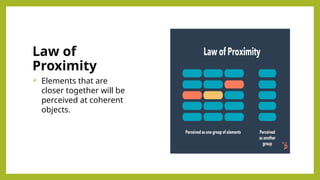
Law of
Proximity
 Elements that are
closer together will be
perceived at coherent
objects.
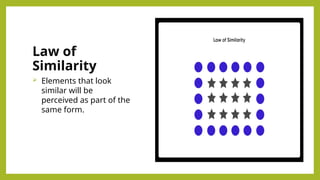
Law of
Similarity
 Elements that look
similar will be
perceived as part of the
same form.
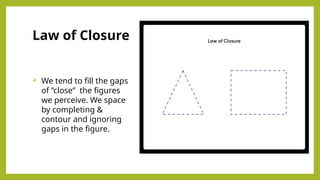
Law of Closure
 We tend to fill the gaps
of ”close” the figures
we perceive. We space
by completing &
contour and ignoring
gaps in the figure.
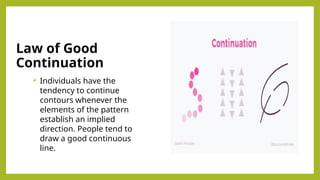
Law of Good
Continuation
 Individuals have the
tendency to continue
contours whenever the
elements of the pattern
establish an implied
direction. People tend to
draw a good continuous
line.
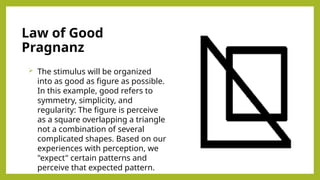
Law of Good
Pragnanz
 The stimulus will be organized
into as good as figure as possible.
In this example, good refers to
symmetry, simplicity, and
regularity: The figure is perceive
as a square overlapping a triangle
not a combination of several
complicated shapes. Based on our
experiences with perception, we
"expect" certain patterns and
perceive that expected pattern.
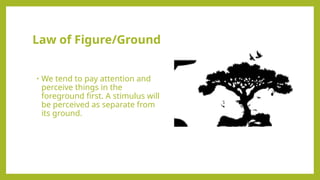
Law of Figure/Ground
• We tend to pay attention and
perceive things in the
foreground first. A stimulus will
be perceived as separate from
its ground.
Relevance of Gestalt Psychology to
Education according to Marion Polito
• Gestalt psychology is focused on the experience of contact that occurs in the
here and now. It talks interest in the complexity of experience, without
neglecting anything, but accepting and amplifying all that emerges. It stimulates
learning as experience and the experience as a source of learning Knowledge is
conceived as a continuous organization and rearrangement of information
according to needs, purposes and meanings. Autonomy and freedom of the
student is stimulated by the teacher.
• Gestalt is a theory of learning that focuses on the minds perspective. It is useful
as a behavioral tool as it enables the teacher to channel the pupil's energy into
thinking of an item or subject as parts of a whole, e.g., a car, being metal, paint,
wheels etc. By thinking of components and breaking down a situation it enables
for a more psychological process to take place and over time will broaden a
pupil's mind into thinking of the sum of the whole rather than just a complete
thing of situation.
GESTALT PRINCIPLES for your  report .pptx

GESTALT PRINCIPLES for your report .pptx

  • 1.
  • 2.
    Law of Proximity  Elementsthat are closer together will be perceived at coherent objects.
  • 3.
    Law of Similarity  Elementsthat look similar will be perceived as part of the same form.
  • 4.
    Law of Closure We tend to fill the gaps of ”close” the figures we perceive. We space by completing & contour and ignoring gaps in the figure.
  • 5.
    Law of Good Continuation Individuals have the tendency to continue contours whenever the elements of the pattern establish an implied direction. People tend to draw a good continuous line.
  • 6.
    Law of Good Pragnanz The stimulus will be organized into as good as figure as possible. In this example, good refers to symmetry, simplicity, and regularity: The figure is perceive as a square overlapping a triangle not a combination of several complicated shapes. Based on our experiences with perception, we "expect" certain patterns and perceive that expected pattern.
  • 7.
    Law of Figure/Ground •We tend to pay attention and perceive things in the foreground first. A stimulus will be perceived as separate from its ground.
  • 8.
    Relevance of GestaltPsychology to Education according to Marion Polito • Gestalt psychology is focused on the experience of contact that occurs in the here and now. It talks interest in the complexity of experience, without neglecting anything, but accepting and amplifying all that emerges. It stimulates learning as experience and the experience as a source of learning Knowledge is conceived as a continuous organization and rearrangement of information according to needs, purposes and meanings. Autonomy and freedom of the student is stimulated by the teacher. • Gestalt is a theory of learning that focuses on the minds perspective. It is useful as a behavioral tool as it enables the teacher to channel the pupil's energy into thinking of an item or subject as parts of a whole, e.g., a car, being metal, paint, wheels etc. By thinking of components and breaking down a situation it enables for a more psychological process to take place and over time will broaden a pupil's mind into thinking of the sum of the whole rather than just a complete thing of situation.