Composition I    Laura Gang        Week 2
Developing Ideas for Writing a Paragraph1. Brainstormingquickly writing down all the thoughts that come into your head.
It doesn’t matter if the first ideas are good or bad
 a good writer thinks before he writes.
 not linear, consecutive; rather messy
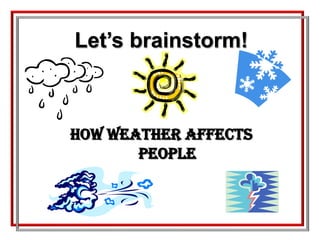
 ideas are associatedLet’s brainstorm!How weather affects people
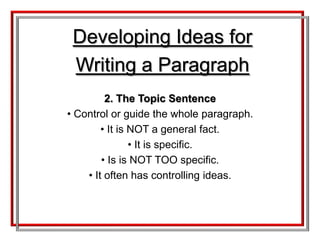
Developing Ideas for Writing a Paragraph2. The Topic Sentence Control or guide the whole paragraph.
 It is NOT a general fact.
 It is specific.
 Is is NOT TOO specific.
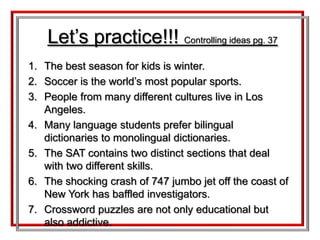
 It often has controlling ideas.Let’s practice!!! Controlling ideas pg. 37The best season for kids is winter.Soccer is the world’s most popular sports.People from many different cultures live in Los Angeles.Many language students prefer bilingual dictionaries to monolingual dictionaries.The SAT contains two distinct sections that deal with two different skills.The shocking crash of 747 jumbo jet off the coast of New York has baffled investigators.Crossword puzzles are not only educational but also addictive.
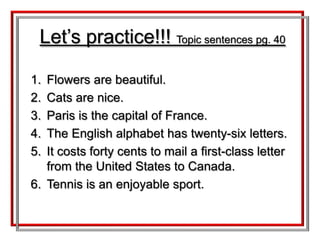
Let’s practice!!!Topic sentences pg. 40Flowers are beautiful.Cats are nice.Paris is the capital of France.The English alphabet has twenty-six letters.It costs forty cents to mail a first-class letter from the United States to Canada.Tennis is an enjoyable sport.
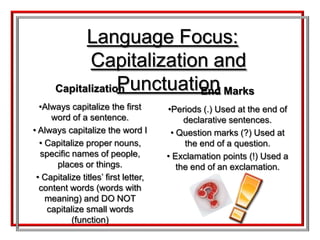
Language Focus: Capitalization and PunctuationCapitalizationAlways capitalize the first word of a sentence.
 Always capitalize the word I
 Capitalize proper nouns, specific names of people, places or things.
 Capitalize titles’ first letter, content words (words with meaning) and DO NOT capitalize small words (function) End MarksPeriods (.) Used at the end of declarative sentences.
 Question marks (?) Used at the end of a question.
 Exclamation points (!) Used a the end of an exclamation.HomeworkChoose one of the general topics below. 2. Brainstorm your ideas on a separate paper.3. Circle the ideas that you think are better to include in a paragraph.4. Write a paragraph using the brainstorming you did and an appropriate topic sentence.5. Be ready to share your writing.ON LINE HOMEWORK>  http://www.sheppardsoftware.com/grammar/capitalization.htmhttp://owl.english.purdue.edu/exercises/3/16/14/
Supporting and Concluding SentencesLike a good foundation of a house,supporting sentences need to hold theparagraph together. The concludingsentence will close the deal.
Supporting SentencesSupporting sentences should:Explain and support the topic
Answer the main wh questions (who, what, where, when, why, how)

Composition i week 2

  • 1.
    Composition I Laura Gang Week 2
  • 2.
    Developing Ideas forWriting a Paragraph1. Brainstormingquickly writing down all the thoughts that come into your head.
  • 3.
    It doesn’t matterif the first ideas are good or bad
  • 4.
    a goodwriter thinks before he writes.
  • 5.
    not linear,consecutive; rather messy
  • 6.
    ideas areassociatedLet’s brainstorm!How weather affects people
  • 7.
    Developing Ideas forWriting a Paragraph2. The Topic Sentence Control or guide the whole paragraph.
  • 8.
    It isNOT a general fact.
  • 9.
    It isspecific.
  • 10.
    Is isNOT TOO specific.
  • 11.
    It oftenhas controlling ideas.Let’s practice!!! Controlling ideas pg. 37The best season for kids is winter.Soccer is the world’s most popular sports.People from many different cultures live in Los Angeles.Many language students prefer bilingual dictionaries to monolingual dictionaries.The SAT contains two distinct sections that deal with two different skills.The shocking crash of 747 jumbo jet off the coast of New York has baffled investigators.Crossword puzzles are not only educational but also addictive.
  • 12.
    Let’s practice!!!Topic sentencespg. 40Flowers are beautiful.Cats are nice.Paris is the capital of France.The English alphabet has twenty-six letters.It costs forty cents to mail a first-class letter from the United States to Canada.Tennis is an enjoyable sport.
  • 13.
    Language Focus: Capitalizationand PunctuationCapitalizationAlways capitalize the first word of a sentence.
  • 14.
  • 15.
    Capitalize propernouns, specific names of people, places or things.
  • 16.
    Capitalize titles’first letter, content words (words with meaning) and DO NOT capitalize small words (function) End MarksPeriods (.) Used at the end of declarative sentences.
  • 17.
    Question marks(?) Used at the end of a question.
  • 18.
    Exclamation points(!) Used a the end of an exclamation.HomeworkChoose one of the general topics below. 2. Brainstorm your ideas on a separate paper.3. Circle the ideas that you think are better to include in a paragraph.4. Write a paragraph using the brainstorming you did and an appropriate topic sentence.5. Be ready to share your writing.ON LINE HOMEWORK> http://www.sheppardsoftware.com/grammar/capitalization.htmhttp://owl.english.purdue.edu/exercises/3/16/14/
  • 19.
    Supporting and ConcludingSentencesLike a good foundation of a house,supporting sentences need to hold theparagraph together. The concludingsentence will close the deal.
  • 20.
    Supporting SentencesSupporting sentencesshould:Explain and support the topic
  • 21.
    Answer the mainwh questions (who, what, where, when, why, how)
  • 22.
  • 23.
    Be related tothe topic sentence.Go to pg. 50 Activity 1-2
  • 24.
    Supporting SentencesKinds ofsupporting sentencesExplainingDescribingGiving reasonsGiving factsGiving examplesGo to pg. 52 Activity 3
  • 25.
    Supporting SentencesAnalyzing andwriting supporting sentencesDo pg 54 Activity 5
  • 26.
    Concluding SentencesConcluding sentencesshould:Be the last sentence of the paragraph.
  • 27.
    Give the paragrapha logical conclusionYou should read many examples of concluding sentences to help you learn how to write an effective one.
  • 28.
    Concluding SentencesKinds ofconcluding sentencesThere are many types of concluding sentences. The following are two examples from our textbook.Restate the main ideaMake a prediction
  • 29.
    Concluding SentencesRestating themain ideaIn other words, the concluding sentences summarizes the most relevant points of the paragraph. It is probably the easiest one.Go to pg. 61 ‘Examples’
  • 30.
    Concluding SentencesMaking apredictionTo predict is to guess. An interesting conclusion can be one that makes a guess about what will happen, or in what way a certain event or situation will be resolved. It is also a good way to state your opinions.Go to pg. 62 ‘Examples’
  • 31.
    Concluding SentencesAnalyzing andWriting Good Concluding SentencesBefore writing the concluding sentence you should read the paragraph again, identify the topic sentence, and circle any relevant details. These steps can help you, once more, organize the ideas properly before writing an appropriate final sentence.Go to pg. 62 Do Activity 9
  • 32.
    Language FocusPronounsWhen writinga paragraph, which is about one topic (or subject), it is common and necessary to use key nouns (the paragraph’s ‘main character’). However, constant repetition and mentioning of our main character causes the writer to fall into repetition that sounds confusing, awkard, and definitely mistaken. A way to solve such a problem can be by using pronouns. Using pronouns effectively helps the written text sound more smoothly.
  • 33.
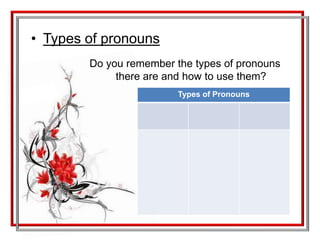
    Types of pronounsDoyou remember the types of pronouns there are and how to use them?
  • 34.
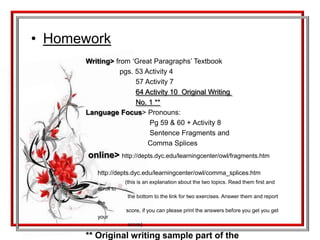
    HomeworkWriting> from ‘GreatParagraphs’ Textbook pgs. 53 Activity 4 57 Activity 7 64 Activity 10 Original Writing No. 1 **Language Focus> Pronouns: Pg 59 & 60 + Activity 8 Sentence Fragments and Comma Splicesonline> http://depts.dyc.edu/learningcenter/owl/fragments.htm http://depts.dyc.edu/learningcenter/owl/comma_splices.htm (this is an explanation about the two topics. Read them first and scroll to the bottom to the link for two exercises. Answer them and report the score, if you can please print the answers before you get you get your score)** Original writing sample part of the portfolio!!!
  • 35.
  • 36.
  • 37.
    Online Writing Labwebsite > http://depts.dyc.edu/learningcenter/owl/index.htm