1
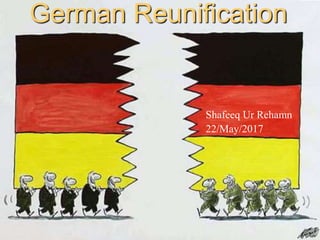
German Reunification
Shafeeq Ur Rehamn
22/May/2017
2
Why Germany Was
Divided?
 After World War II
1. German military leaders' unconditional surrender in
May 1945
2. sovereign authority passed to the victorious Allied
powers
3. end of the war: “zero hour”
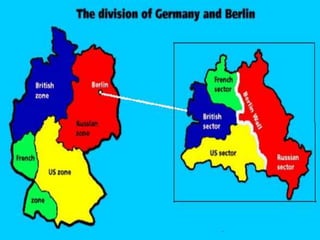
4. Americans, British, French, and Soviets divided
Germany into four zones
5. the American, British, and French zones together
made up the western two-thirds of Germany, while the
Soviet zone comprised the eastern third
3
Burlin
 Berlin, the former capital, was placed under
joint four-power authority but was
partitioned into four sectors for
administrative purposes
 an Allied Control Council was to exercise
overall joint authority
4
5
Burlin Wall
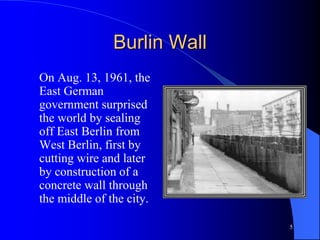
On Aug. 13, 1961, the
East German
government surprised
the world by sealing
off East Berlin from
West Berlin, first by
cutting wire and later
by construction of a
concrete wall through
the middle of the city.
6
Burlin Wall
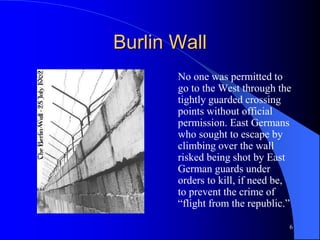
No one was permitted to
go to the West through the
tightly guarded crossing
points without official
permission. East Germans
who sought to escape by
climbing over the wall
risked being shot by East
German guards under
orders to kill, if need be,
to prevent the crime of
“flight from the republic.”
7
Reasons for the building of
the Wall
Two major reasons for the building of the Wall:
 1. Economics: too many well-educated people
moved from East Germany, and some worked
in West Berlin and lived in East Berlin (it's
cheaper there), so DDR lost money on this
 2. Political: the West side interfered with the
East side (the Russian sector)
8
Reunification Off German
The reunification of Germany was one of
the greatest events in world history.Los
Angeles Times It was a once-in-a-lifetime
chance for many to witness such a
humanitarian effort toward peace and
prosperity. The following images capture
just a few of the celebrations of the
reunification and the stories they have to
tell.
9
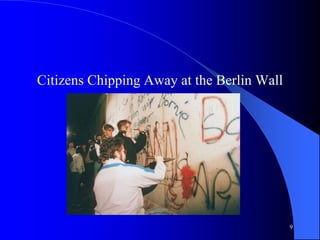
Citizens Chipping Away at the Berlin Wall
10
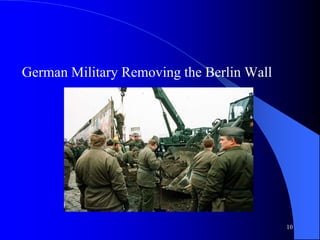
German Military Removing the Berlin Wall
11
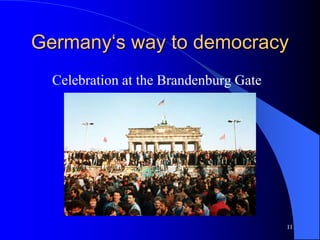
Germany‘s way to democracy
Celebration at the Brandenburg Gate
12
Mergence Of East And West
Germany
West Germany and East Germany merged their
financial systems in July 1990, and in October
East Germany dissolved and all its citizens
became citizens of the Federal Republic of
Germany.
The final obstacle to reunification was removed in
July 1990.
13
Problems after Reunification
 Reunification promised to quickly alleviate
forty years of East German Socialism by
means of tax money, which proved wrong.
 Reunification promised to bring "social
freedom" by ignoring the crimes of former
Socialist party leaders.
 Economic and political unstability.
 There was massive confusion about
property rights.
14
Effects of Reunification
The cost of reunification has been a heavy burden
to the German economy and has contributed to
Germany's inability today to be the locomotive of
the European economy that it had been in the past.
The costs of reunification are estimated to amount
to over 1.5 trillion Euro.
15
Effects of Reunification
Following reunification, Germany followed the
social policies of working through history and
mastering the past to deal with their violent
history.
Since unification, hundreds of thousands of former
East Germans have continued to migrate to
western Germany to find well-paying jobs.

Germanys way to_democracy

  • 1.
  • 2.
    2 Why Germany Was Divided? After World War II 1. German military leaders' unconditional surrender in May 1945 2. sovereign authority passed to the victorious Allied powers 3. end of the war: “zero hour” 4. Americans, British, French, and Soviets divided Germany into four zones 5. the American, British, and French zones together made up the western two-thirds of Germany, while the Soviet zone comprised the eastern third
  • 3.
    3 Burlin  Berlin, theformer capital, was placed under joint four-power authority but was partitioned into four sectors for administrative purposes  an Allied Control Council was to exercise overall joint authority
  • 4.
  • 5.
    5 Burlin Wall On Aug.13, 1961, the East German government surprised the world by sealing off East Berlin from West Berlin, first by cutting wire and later by construction of a concrete wall through the middle of the city.
  • 6.
    6 Burlin Wall No onewas permitted to go to the West through the tightly guarded crossing points without official permission. East Germans who sought to escape by climbing over the wall risked being shot by East German guards under orders to kill, if need be, to prevent the crime of “flight from the republic.”
  • 7.
    7 Reasons for thebuilding of the Wall Two major reasons for the building of the Wall:  1. Economics: too many well-educated people moved from East Germany, and some worked in West Berlin and lived in East Berlin (it's cheaper there), so DDR lost money on this  2. Political: the West side interfered with the East side (the Russian sector)
  • 8.
    8 Reunification Off German Thereunification of Germany was one of the greatest events in world history.Los Angeles Times It was a once-in-a-lifetime chance for many to witness such a humanitarian effort toward peace and prosperity. The following images capture just a few of the celebrations of the reunification and the stories they have to tell.
  • 9.
    9 Citizens Chipping Awayat the Berlin Wall
  • 10.
  • 11.
    11 Germany‘s way todemocracy Celebration at the Brandenburg Gate
  • 12.
    12 Mergence Of EastAnd West Germany West Germany and East Germany merged their financial systems in July 1990, and in October East Germany dissolved and all its citizens became citizens of the Federal Republic of Germany. The final obstacle to reunification was removed in July 1990.
  • 13.
    13 Problems after Reunification Reunification promised to quickly alleviate forty years of East German Socialism by means of tax money, which proved wrong.  Reunification promised to bring "social freedom" by ignoring the crimes of former Socialist party leaders.  Economic and political unstability.  There was massive confusion about property rights.
  • 14.
    14 Effects of Reunification Thecost of reunification has been a heavy burden to the German economy and has contributed to Germany's inability today to be the locomotive of the European economy that it had been in the past. The costs of reunification are estimated to amount to over 1.5 trillion Euro.
  • 15.
    15 Effects of Reunification Followingreunification, Germany followed the social policies of working through history and mastering the past to deal with their violent history. Since unification, hundreds of thousands of former East Germans have continued to migrate to western Germany to find well-paying jobs.