Czechoslovakia, 1938
By: Josefina Tasca, Felix Okecki, Gastón Posse and Tota Lupi
The Sudetenland, Czechoslovakia
Czechoslovakia was a new country
created by the Treaty of Versailles.
A part of it used to belong to Germany.
The Sudetenland was an important
industrial region in Czechoslovakia.
It had a large amount of German
Population.
Introduction
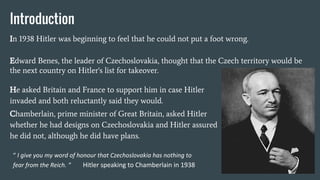
In 1938 Hitler was beginning to feel that he could not put a foot wrong.
Edward Benes, the leader of Czechoslovakia, thought that the Czech territory would be
the next country on Hitler's list for takeover.
He asked Britain and France to support him in case Hitler
invaded and both reluctantly said they would.
“ I give you my word of honour that Czechoslovakia has nothing to
fear from the Reich. “ Hitler speaking to Chamberlain in 1938
Chamberlain, prime minister of Great Britain, asked Hitler
whether he had designs on Czechoslovakia and Hitler assured
he did not, although he did have plans.
Hitler’s moves
On September the 7th of 1938, the German Sudeten Party demanded union with Germany and started
rioting.
On September the 15th Chamberlain met Hitler at Berchtesgaden
● There, Hitler promised him that that was the last problem to be solved.
● Chamberlain decided that Hitler was a man that could be trusted
● Chamberlain persuaded the Czechs to hand over the Sudetenland.
On September the 22nd Chamberlain met Hitler at Bad Godesberg
● There, Hitler made more demands. Now he wanted all the Sudetenland.
● To justify his demand, he claimed the Czech government was mistreating the Germans in the
Sudetenland and that he intended to rescue them.
● At first Chamberlain refused and defined Hitler’s demands as unreasonable, but then he decided
that Czechoslovakia was not one of the ‘greatest issues’ which justified war, and described it as ‘a
quarrel in a faraway country between people of whom we know nothing’.
Munich Agreement
On September 29th, in a final meeting in Munich, the leaders of Britain and
France decided to give Hitler what he wanted, in order to avoid war.
This is an example of the policy known as “Appeasement”, which Britain and
France used with Germany.
After the meeting, the leaders of Britain and France, announced that
Czechoslovakia was to lose the Sudetenland, although they did not consult
Czechoslovakia.
“Be glad in your hearts. Give thanks to your God. The wings of peace settle about us and the
peoples of Europe. The prayers of the troubled hearts are answered. People of Britain, your
children are safe. Your husbands and sons will not march into battle. It was a war that nobody
wanted. Nobody in Germany. Nobody in France. Nobody, above all, in Britain, which had no
concern at all with the issues at stake. Through these black days, this newspaper clung to the
belief that peace would prevail. Over and over again we said it, ‘There will be no European war.’ If
we must have a victor, let us choose Chamberlain. For the Prime Minister’s conquests are mighty.
And now let us get back to our own affairs. We have had enough of those menaces from the
Continent. “
From a British newspaper, 31 September 1938.
On September the 30th, the following morning, Chamberlain returned to
England and triumphantly said ‘I believe it is peace for our time’, to the
cheering crowds.
Failure of Appeasement
In March 1939, Hitler marched his troops into Czechoslovakia,
to finish what he had started.
There was no resistance from the Czechs.
Nor did Britain and France do anything
about the situation.
This made it clear that appeasement
had failed, because now it was also clear
that Hitler could not be trusted.
Source
● Hitler is demanding
that all Germans
have the right to live
under German rule.
● The line of ghosts
represents the Nazi
persecution that will
take place in these
countries.
Source
● Chamberlain rolls the
world towards peace.
● Although the czech
crisis did not trigger
war, it is clear that the
threat was there.
● The road to peace
seems very difficult.
Source
In this source we can see
how Hitler disobeyed the
treaty of Versailles by
having an army, that was
forbidden, and by taking
control over and
independent country.

Czechoslovakia

  • 1.
    Czechoslovakia, 1938 By: JosefinaTasca, Felix Okecki, Gastón Posse and Tota Lupi
  • 2.
    The Sudetenland, Czechoslovakia Czechoslovakiawas a new country created by the Treaty of Versailles. A part of it used to belong to Germany. The Sudetenland was an important industrial region in Czechoslovakia. It had a large amount of German Population.
  • 3.
    Introduction In 1938 Hitlerwas beginning to feel that he could not put a foot wrong. Edward Benes, the leader of Czechoslovakia, thought that the Czech territory would be the next country on Hitler's list for takeover. He asked Britain and France to support him in case Hitler invaded and both reluctantly said they would. “ I give you my word of honour that Czechoslovakia has nothing to fear from the Reich. “ Hitler speaking to Chamberlain in 1938 Chamberlain, prime minister of Great Britain, asked Hitler whether he had designs on Czechoslovakia and Hitler assured he did not, although he did have plans.
  • 4.
    Hitler’s moves On Septemberthe 7th of 1938, the German Sudeten Party demanded union with Germany and started rioting. On September the 15th Chamberlain met Hitler at Berchtesgaden ● There, Hitler promised him that that was the last problem to be solved. ● Chamberlain decided that Hitler was a man that could be trusted ● Chamberlain persuaded the Czechs to hand over the Sudetenland. On September the 22nd Chamberlain met Hitler at Bad Godesberg ● There, Hitler made more demands. Now he wanted all the Sudetenland. ● To justify his demand, he claimed the Czech government was mistreating the Germans in the Sudetenland and that he intended to rescue them. ● At first Chamberlain refused and defined Hitler’s demands as unreasonable, but then he decided that Czechoslovakia was not one of the ‘greatest issues’ which justified war, and described it as ‘a quarrel in a faraway country between people of whom we know nothing’.
  • 5.
    Munich Agreement On September29th, in a final meeting in Munich, the leaders of Britain and France decided to give Hitler what he wanted, in order to avoid war. This is an example of the policy known as “Appeasement”, which Britain and France used with Germany. After the meeting, the leaders of Britain and France, announced that Czechoslovakia was to lose the Sudetenland, although they did not consult Czechoslovakia.
  • 6.
    “Be glad inyour hearts. Give thanks to your God. The wings of peace settle about us and the peoples of Europe. The prayers of the troubled hearts are answered. People of Britain, your children are safe. Your husbands and sons will not march into battle. It was a war that nobody wanted. Nobody in Germany. Nobody in France. Nobody, above all, in Britain, which had no concern at all with the issues at stake. Through these black days, this newspaper clung to the belief that peace would prevail. Over and over again we said it, ‘There will be no European war.’ If we must have a victor, let us choose Chamberlain. For the Prime Minister’s conquests are mighty. And now let us get back to our own affairs. We have had enough of those menaces from the Continent. “ From a British newspaper, 31 September 1938. On September the 30th, the following morning, Chamberlain returned to England and triumphantly said ‘I believe it is peace for our time’, to the cheering crowds.
  • 7.
    Failure of Appeasement InMarch 1939, Hitler marched his troops into Czechoslovakia, to finish what he had started. There was no resistance from the Czechs. Nor did Britain and France do anything about the situation. This made it clear that appeasement had failed, because now it was also clear that Hitler could not be trusted.
  • 8.
    Source ● Hitler isdemanding that all Germans have the right to live under German rule. ● The line of ghosts represents the Nazi persecution that will take place in these countries.
  • 9.
    Source ● Chamberlain rollsthe world towards peace. ● Although the czech crisis did not trigger war, it is clear that the threat was there. ● The road to peace seems very difficult.
  • 10.
    Source In this sourcewe can see how Hitler disobeyed the treaty of Versailles by having an army, that was forbidden, and by taking control over and independent country.