GERMANY
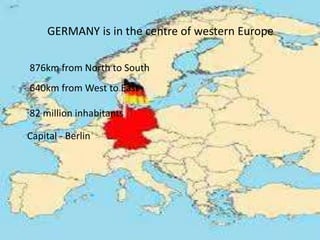
GERMANY is in the centre of western Europe
876km from North to South
640km from West to East
82 million inhabitants
Capital - Berlin
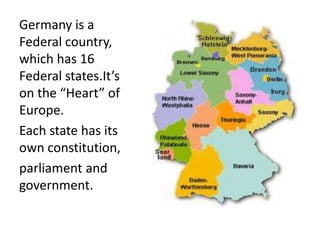
Germany is a
Federal country,
which has 16
Federal states.It’s
on the “Heart” of
Europe.
Each state has its
own constitution,
parliament and
government.
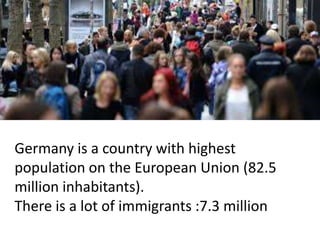
Germany is a country with highest
population on the European Union (82.5
million inhabitants).
There is a lot of immigrants :7.3 million
GERMAN HISTORY
TIMELINE
• 900- The Celtaes moved to the place now called Germany.
• 1815- Germany was separated into 35 Federate states from
Congress of Vienna.
• 1871-German states united in creating the German Empire
under Prussian leadership with Bismarck as Chancellor.
• 1914-1919- Germany was defeated WW1 & forced to sign
Treaty OF Versailles.
• 1933- Hitler becomes chancellor of Germany & began
dictatorship rule in Germany.
• 1935 – Hitler passses the Nuremberg laws oppressing Jews
& starts Jews massacre.
• 1939- Germany invaded Poland & the outbreak of WW2.
• 1945- Hitler commits suicide, Germany surrenders &
seperated into North & South Germany.
• 1945- Hitler commits suicide, Germany surrenders &
seperated into North & South Germany.
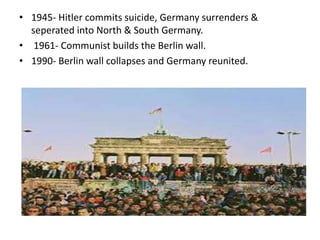
• 1961- Communist builds the Berlin wall.
• 1990- Berlin wall collapses and Germany reunited.
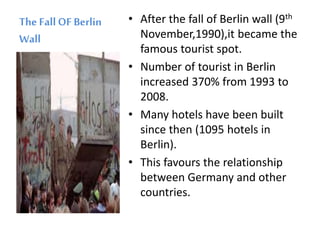
The FallOF Berlin
Wall
• After the fall of Berlin wall (9th
November,1990),it became the
famous tourist spot.
• Number of tourist in Berlin
increased 370% from 1993 to
2008.
• Many hotels have been built
since then (1095 hotels in
Berlin).
• This favours the relationship
between Germany and other
countries.
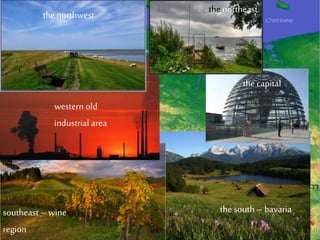
the capital
the south – bavariasoutheast – wine
region
western old
industrial area
the northwest thenortheast
RELIGION
Christianity is the largest
religion in Germany
73%.
Then Islam 4%.
Protestants are 39%
Catholics are 31%
Orthodox are 4.7%
Nonreligious 25%.
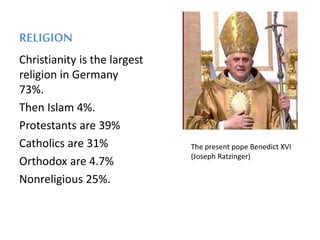
The present pope Benedict XVI
(Joseph Ratzinger)
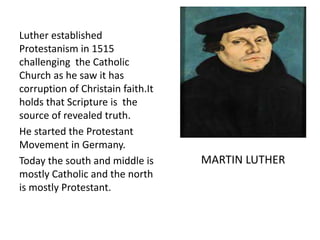
Luther established
Protestanism in 1515
challenging the Catholic
Church as he saw it has
corruption of Christain faith.It
holds that Scripture is the
source of revealed truth.
He started the Protestant
Movement in Germany.
Today the south and middle is
mostly Catholic and the north
is mostly Protestant.
MARTIN LUTHER
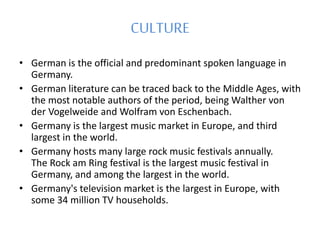
CULTURE
• German is the official and predominant spoken language in
Germany.
• German literature can be traced back to the Middle Ages, with
the most notable authors of the period, being Walther von
der Vogelweide and Wolfram von Eschenbach.
• Germany is the largest music market in Europe, and third
largest in the world.
• Germany hosts many large rock music festivals annually.
The Rock am Ring festival is the largest music festival in
Germany, and among the largest in the world.
• Germany's television market is the largest in Europe, with
some 34 million TV households.
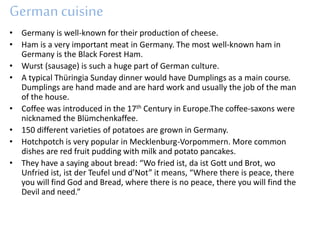
Germancuisine
• Germany is well-known for their production of cheese.
• Ham is a very important meat in Germany. The most well-known ham in
Germany is the Black Forest Ham.
• Wurst (sausage) is such a huge part of German culture.
• A typical Thüringia Sunday dinner would have Dumplings as a main course.
Dumplings are hand made and are hard work and usually the job of the man
of the house.
• Coffee was introduced in the 17th Century in Europe.The coffee-saxons were
nicknamed the Blümchenkaffee.
• 150 different varieties of potatoes are grown in Germany.
• Hotchpotch is very popular in Mecklenburg-Vorpommern. More common
dishes are red fruit pudding with milk and potato pancakes.
• They have a saying about bread: “Wo fried ist, da ist Gott und Brot, wo
Unfried ist, ist der Teufel und d’Not” it means, “Where there is peace, there
you will find God and Bread, where there is no peace, there you will find the
Devil and need.”
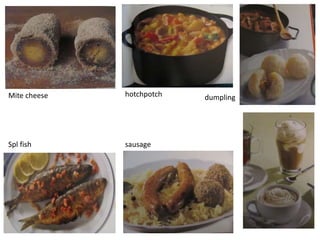
Mite cheese hotchpotch dumpling
Spl fish sausage
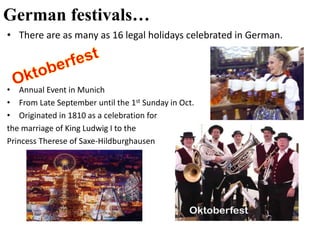
German festivals…
• There are as many as 16 legal holidays celebrated in German.
• Annual Event in Munich
• From Late September until the 1st Sunday in Oct.
• Originated in 1810 as a celebration for
the marriage of King Ludwig I to the
Princess Therese of Saxe-Hildburghausen
NATIONALBIRD NATIONALTREE
Since antiquity, the eagle has been
a symbol of vitality and the life-
giving power of the sun
The Oak is a common symbol
of strength and endurance
MONUMENTS
NEUSCHWANSTEIN castle
is a 19th century Bavarian
castle on a rugged
hill.The palace was
commissioned by Ludwig
II of Bavarian known as
the “Insane King”. It is
one of the country’s most
popular destination.
The Brandenburg Gate is an 18th-century neoclassical triumphal
arch in Berlin, and one of the best-known landmarks
of Germany. It is built on the site of a former city gate that
marked the start of the road from Berlin to the town
of Brandenburg an der Havel.
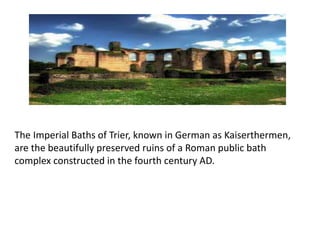
The Imperial Baths of Trier, known in German as Kaiserthermen,
are the beautifully preserved ruins of a Roman public bath
complex constructed in the fourth century AD.
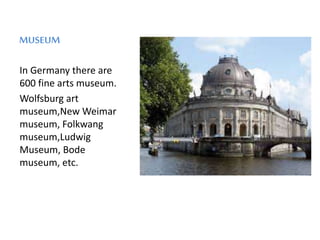
MUSEUM
In Germany there are
600 fine arts museum.
Wolfsburg art
museum,New Weimar
museum, Folkwang
museum,Ludwig
Museum, Bode
museum, etc.
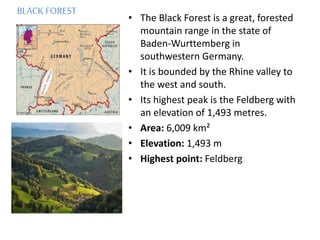
BLACK FOREST
• The Black Forest is a great, forested
mountain range in the state of
Baden-Wurttemberg in
southwestern Germany.
• It is bounded by the Rhine valley to
the west and south.
• Its highest peak is the Feldberg with
an elevation of 1,493 metres.
• Area: 6,009 km²
• Elevation: 1,493 m
• Highest point: Feldberg
SPORTS
FOOTBALL
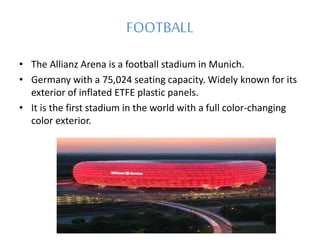
• The Allianz Arena is a football stadium in Munich.
• Germany with a 75,024 seating capacity. Widely known for its
exterior of inflated ETFE plastic panels.
• It is the first stadium in the world with a full color-changing
color exterior.
FORMULAONE
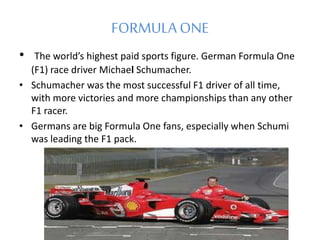
• The world’s highest paid sports figure. German Formula One
(F1) race driver Michael Schumacher.
• Schumacher was the most successful F1 driver of all time,
with more victories and more championships than any other
F1 racer.
• Germans are big Formula One fans, especially when Schumi
was leading the F1 pack.
HANDBALL
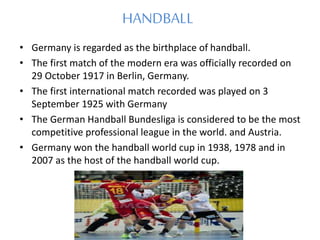
• Germany is regarded as the birthplace of handball.
• The first match of the modern era was officially recorded on
29 October 1917 in Berlin, Germany.
• The first international match recorded was played on 3
September 1925 with Germany
• The German Handball Bundesliga is considered to be the most
competitive professional league in the world. and Austria.
• Germany won the handball world cup in 1938, 1978 and in
2007 as the host of the handball world cup.
ECONOMY
• Germany is the largest national economy in Europe,
the fourth-largest by nominal GDP in the world, and fifth by
GDP (PPP).
• The GDP figure in 2014 was $3,730,261 million.
• The GDP per capita of Germany in 2014 was $46,269.
• The average inflation of Germany in 2014: 0.91 %
• 1.00 DEM (German Deutsche Mark)=36.0345 INR
• Germany recorded the highest trade surplus in the world
worth $270 billion,making it the biggest capital exporter
globally.
• The service sector contributes around 70% of the total GDP,
industry 29.1%, and agriculture 0.9%.
• Germany is the world's top location for trade fairs.
• Germany is the third largest exporter and importer in the
world with $1.516 trillion exported in 2012.
• Exports of goods and services also made up about 52 percent
of its GDP.
• Total value of exports: $1.492 trillion
• Primary exports – commodities: motor vehicles, machinery,
chemicals, computer and electronic products, electrical
equipment, pharmaceuticals, metals, transport equipment,
foodstuffs, textiles, rubber and plastic products
• Primary exports partners: European Union (58.2 percent of
total exports), US (7.0 percent), China (6.1 percent),
Switzerland (4.5 percent), Russia (3.3 percent)
• Total value of imports: $1.276 trillion
• Primary imports - commodities: machinery, data processing
equipment, vehicles, chemicals, oil and gas, metals, electric
equipment, pharmaceuticals, foodstuffs, agricultural products
• Primary imports partners: European Union (54.8 percent),
China (8.9 percent), US (5.5 percent), Switzerland (4.2
percent), Russia (3.3 percent)
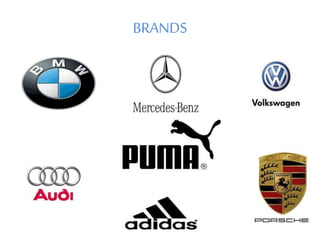
BRANDS
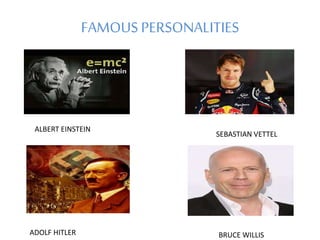
FAMOUS PERSONALITIES
ALBERT EINSTEIN
ADOLF HITLER
SEBASTIAN VETTEL
BRUCE WILLIS
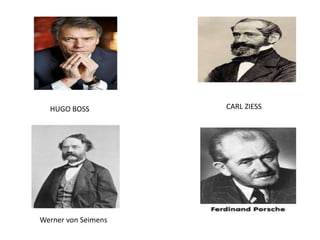
HUGO BOSS CARL ZIESS
Werner von Seimens
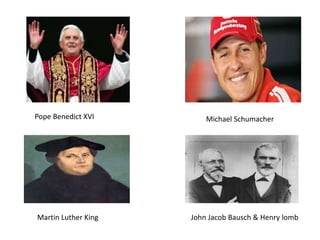
Pope Benedict XVI
Martin Luther King
Michael Schumacher
John Jacob Bausch & Henry lomb
THANK YOU FOR PAYING ATTENTION

Germany by Mushir Usmani

  • 1.
  • 2.
    GERMANY is inthe centre of western Europe 876km from North to South 640km from West to East 82 million inhabitants Capital - Berlin
  • 3.
    Germany is a Federalcountry, which has 16 Federal states.It’s on the “Heart” of Europe. Each state has its own constitution, parliament and government.
  • 4.
    Germany is acountry with highest population on the European Union (82.5 million inhabitants). There is a lot of immigrants :7.3 million
  • 5.
  • 6.
    TIMELINE • 900- TheCeltaes moved to the place now called Germany. • 1815- Germany was separated into 35 Federate states from Congress of Vienna. • 1871-German states united in creating the German Empire under Prussian leadership with Bismarck as Chancellor. • 1914-1919- Germany was defeated WW1 & forced to sign Treaty OF Versailles. • 1933- Hitler becomes chancellor of Germany & began dictatorship rule in Germany. • 1935 – Hitler passses the Nuremberg laws oppressing Jews & starts Jews massacre. • 1939- Germany invaded Poland & the outbreak of WW2. • 1945- Hitler commits suicide, Germany surrenders & seperated into North & South Germany.
  • 7.
    • 1945- Hitlercommits suicide, Germany surrenders & seperated into North & South Germany. • 1961- Communist builds the Berlin wall. • 1990- Berlin wall collapses and Germany reunited.
  • 8.
    The FallOF Berlin Wall •After the fall of Berlin wall (9th November,1990),it became the famous tourist spot. • Number of tourist in Berlin increased 370% from 1993 to 2008. • Many hotels have been built since then (1095 hotels in Berlin). • This favours the relationship between Germany and other countries.
  • 9.
    the capital the south– bavariasoutheast – wine region western old industrial area the northwest thenortheast
  • 10.
    RELIGION Christianity is thelargest religion in Germany 73%. Then Islam 4%. Protestants are 39% Catholics are 31% Orthodox are 4.7% Nonreligious 25%. The present pope Benedict XVI (Joseph Ratzinger)
  • 11.
    Luther established Protestanism in1515 challenging the Catholic Church as he saw it has corruption of Christain faith.It holds that Scripture is the source of revealed truth. He started the Protestant Movement in Germany. Today the south and middle is mostly Catholic and the north is mostly Protestant. MARTIN LUTHER
  • 12.
    CULTURE • German isthe official and predominant spoken language in Germany. • German literature can be traced back to the Middle Ages, with the most notable authors of the period, being Walther von der Vogelweide and Wolfram von Eschenbach. • Germany is the largest music market in Europe, and third largest in the world. • Germany hosts many large rock music festivals annually. The Rock am Ring festival is the largest music festival in Germany, and among the largest in the world. • Germany's television market is the largest in Europe, with some 34 million TV households.
  • 13.
    Germancuisine • Germany iswell-known for their production of cheese. • Ham is a very important meat in Germany. The most well-known ham in Germany is the Black Forest Ham. • Wurst (sausage) is such a huge part of German culture. • A typical Thüringia Sunday dinner would have Dumplings as a main course. Dumplings are hand made and are hard work and usually the job of the man of the house. • Coffee was introduced in the 17th Century in Europe.The coffee-saxons were nicknamed the Blümchenkaffee. • 150 different varieties of potatoes are grown in Germany. • Hotchpotch is very popular in Mecklenburg-Vorpommern. More common dishes are red fruit pudding with milk and potato pancakes. • They have a saying about bread: “Wo fried ist, da ist Gott und Brot, wo Unfried ist, ist der Teufel und d’Not” it means, “Where there is peace, there you will find God and Bread, where there is no peace, there you will find the Devil and need.”
  • 14.
    Mite cheese hotchpotchdumpling Spl fish sausage
  • 15.
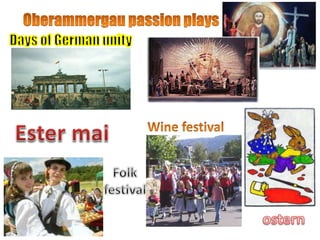
    German festivals… • Thereare as many as 16 legal holidays celebrated in German. • Annual Event in Munich • From Late September until the 1st Sunday in Oct. • Originated in 1810 as a celebration for the marriage of King Ludwig I to the Princess Therese of Saxe-Hildburghausen
  • 17.
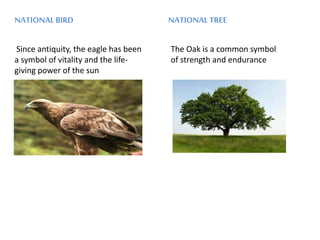
    NATIONALBIRD NATIONALTREE Since antiquity,the eagle has been a symbol of vitality and the life- giving power of the sun The Oak is a common symbol of strength and endurance
  • 18.
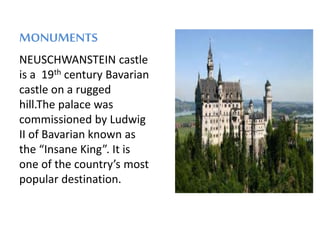
    MONUMENTS NEUSCHWANSTEIN castle is a19th century Bavarian castle on a rugged hill.The palace was commissioned by Ludwig II of Bavarian known as the “Insane King”. It is one of the country’s most popular destination.
  • 19.
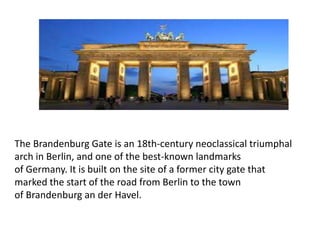
    The Brandenburg Gateis an 18th-century neoclassical triumphal arch in Berlin, and one of the best-known landmarks of Germany. It is built on the site of a former city gate that marked the start of the road from Berlin to the town of Brandenburg an der Havel.
  • 20.
    The Imperial Bathsof Trier, known in German as Kaiserthermen, are the beautifully preserved ruins of a Roman public bath complex constructed in the fourth century AD.
  • 21.
    MUSEUM In Germany thereare 600 fine arts museum. Wolfsburg art museum,New Weimar museum, Folkwang museum,Ludwig Museum, Bode museum, etc.
  • 22.
    BLACK FOREST • TheBlack Forest is a great, forested mountain range in the state of Baden-Wurttemberg in southwestern Germany. • It is bounded by the Rhine valley to the west and south. • Its highest peak is the Feldberg with an elevation of 1,493 metres. • Area: 6,009 km² • Elevation: 1,493 m • Highest point: Feldberg
  • 23.
  • 24.
    FOOTBALL • The AllianzArena is a football stadium in Munich. • Germany with a 75,024 seating capacity. Widely known for its exterior of inflated ETFE plastic panels. • It is the first stadium in the world with a full color-changing color exterior.
  • 25.
    FORMULAONE • The world’shighest paid sports figure. German Formula One (F1) race driver Michael Schumacher. • Schumacher was the most successful F1 driver of all time, with more victories and more championships than any other F1 racer. • Germans are big Formula One fans, especially when Schumi was leading the F1 pack.
  • 26.
    HANDBALL • Germany isregarded as the birthplace of handball. • The first match of the modern era was officially recorded on 29 October 1917 in Berlin, Germany. • The first international match recorded was played on 3 September 1925 with Germany • The German Handball Bundesliga is considered to be the most competitive professional league in the world. and Austria. • Germany won the handball world cup in 1938, 1978 and in 2007 as the host of the handball world cup.
  • 27.
    ECONOMY • Germany isthe largest national economy in Europe, the fourth-largest by nominal GDP in the world, and fifth by GDP (PPP). • The GDP figure in 2014 was $3,730,261 million. • The GDP per capita of Germany in 2014 was $46,269. • The average inflation of Germany in 2014: 0.91 % • 1.00 DEM (German Deutsche Mark)=36.0345 INR • Germany recorded the highest trade surplus in the world worth $270 billion,making it the biggest capital exporter globally. • The service sector contributes around 70% of the total GDP, industry 29.1%, and agriculture 0.9%. • Germany is the world's top location for trade fairs.
  • 28.
    • Germany isthe third largest exporter and importer in the world with $1.516 trillion exported in 2012. • Exports of goods and services also made up about 52 percent of its GDP. • Total value of exports: $1.492 trillion • Primary exports – commodities: motor vehicles, machinery, chemicals, computer and electronic products, electrical equipment, pharmaceuticals, metals, transport equipment, foodstuffs, textiles, rubber and plastic products • Primary exports partners: European Union (58.2 percent of total exports), US (7.0 percent), China (6.1 percent), Switzerland (4.5 percent), Russia (3.3 percent)
  • 29.
    • Total valueof imports: $1.276 trillion • Primary imports - commodities: machinery, data processing equipment, vehicles, chemicals, oil and gas, metals, electric equipment, pharmaceuticals, foodstuffs, agricultural products • Primary imports partners: European Union (54.8 percent), China (8.9 percent), US (5.5 percent), Switzerland (4.2 percent), Russia (3.3 percent)
  • 30.
  • 32.
    FAMOUS PERSONALITIES ALBERT EINSTEIN ADOLFHITLER SEBASTIAN VETTEL BRUCE WILLIS
  • 33.
    HUGO BOSS CARLZIESS Werner von Seimens
  • 34.
    Pope Benedict XVI MartinLuther King Michael Schumacher John Jacob Bausch & Henry lomb
  • 35.
    THANK YOU FORPAYING ATTENTION

Editor's Notes

  • #17 Oberrammgau- performed every 10 yrs. Traditional. Role casting is very specific Days of german unity – oct 3 since 1990. first celebration in berlin. Since then diff city celebrate acc to their dates. Ester mai – 1st may. May day. Maypole-young men of village protect the town maypole so it not stolen by neighbouring towns. German labour day Folk festival – popular in bavaria. Folk music. “leonhardi-farht” Wine festival- celebrated along rhine and moselle river. It’s a popular tourist attraction. Ostern – easter. Easter bunny originated in germany. Bonfires are lit before easter to chase away the evil spirits.