GERMANY
LOCATION
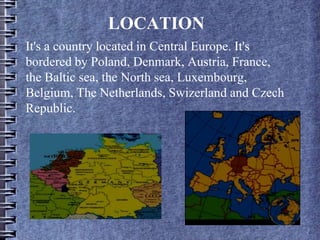
It's a country located in Central Europe. It's
bordered by Poland, Denmark, Austria, France,
the Baltic sea, the North sea, Luxembourg,
Belgium, The Netherlands, Swizerland and Czech
Republic.
CAPITAL
The capital of Germany is Berlín.
The population of Berlín is 3,375, 200.
The area of Berlín is 892 km2
FLAG
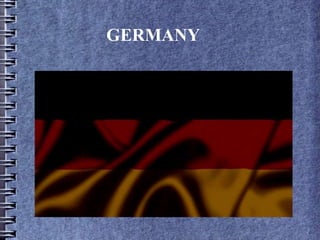
The flag of Germany is a tricolour consisting of
three equal horizontal bands displaying the national
colours of Germany: black, red, and gold.
The flag was first adopted as the national flag of
modern Germany in 1919, during the Weimar
Republic.
COAT OF ARMS
The coat of arms of Germany displays a black eagle with red
feet, beak and tongue on a yellow field. It has a big black eagle
in the centre.
IMPORTANT INFORMATION
 The total area of Germany is 137,837 square
miles.
 In June 2013 it had a population of 80,6
millions.
 After the United States, Germamy is the second
most popular country for migration in the
world.
CULTURE
LANGUAGES
The official language of Germany is German, with
over 95% of the country speaking it or German
dialects as their first language.
Other languages spoken in the country are Sorbian,
Romani, Danish and North Frisian.
GOVERNMENT
Germany is a federal, parliamentary, representative
democratic republic.
Angela Merkel is chancellor since 2005. Joachin
Gauck is president since 2012
Currency
The currency of Germany has been the Euro since
2002.
Other currency abolished : Deutsche Mark ( 2002
), East German Mark ( 1990 ), Saar Franc ( 1959
), Saar Marc ( 1947 ), Reichsmark ( 1948 ),
German Rentenmark ( 1924 ), German
Papiermark ( 1923 ) .....
RELIGION
Christianity is the largest religion in Germany with
62% of the total population The second largest
religion is Islam with 4.6 to 5.2% of the country's
total population. There is also a small presence of
other religions such as Buddhism and Judaism.
During the last few decades, the two largest
churches in Germany, namely the Protestant
Evangelical Church and the Roman Catholic
Church, have lost significant number of adherents.
More than 30% of the population is not affiliated
with any church or other religious body.
SPORTS
In Germany most people practice ice hockey,
basketball, handball, motorsports, wintersports,
tennis, cycling, chess, golf, boxing, rugby union and
waters sports.
In 2006 they celebrated the FIFA world cup. The
last match of this cup was in the stadium Allianz
Arena
FOOD
German cuisine varies from region to region. Across
German regions, meat is often eaten as sausages
which are produced in almost 1,500 varieties. the
national alcoholic drink is beer.
CLIMATE
●Germany's climate is temperate and marine,
with cold, cloudy, wet winters and moderate
warm summers and in the south occasional warm
wind.
●The greater part of Germany lies in the
cool/temperate climatic zone in which humid
westerly winds predominate
THE
END!!!!!!

GERMANY

  • 1.
  • 2.
    LOCATION It's a countrylocated in Central Europe. It's bordered by Poland, Denmark, Austria, France, the Baltic sea, the North sea, Luxembourg, Belgium, The Netherlands, Swizerland and Czech Republic.
  • 3.
    CAPITAL The capital ofGermany is Berlín. The population of Berlín is 3,375, 200. The area of Berlín is 892 km2
  • 4.
    FLAG The flag ofGermany is a tricolour consisting of three equal horizontal bands displaying the national colours of Germany: black, red, and gold. The flag was first adopted as the national flag of modern Germany in 1919, during the Weimar Republic.
  • 5.
    COAT OF ARMS Thecoat of arms of Germany displays a black eagle with red feet, beak and tongue on a yellow field. It has a big black eagle in the centre.
  • 6.
    IMPORTANT INFORMATION  Thetotal area of Germany is 137,837 square miles.  In June 2013 it had a population of 80,6 millions.  After the United States, Germamy is the second most popular country for migration in the world.
  • 7.
  • 8.
    LANGUAGES The official languageof Germany is German, with over 95% of the country speaking it or German dialects as their first language. Other languages spoken in the country are Sorbian, Romani, Danish and North Frisian.
  • 9.
    GOVERNMENT Germany is afederal, parliamentary, representative democratic republic. Angela Merkel is chancellor since 2005. Joachin Gauck is president since 2012
  • 10.
    Currency The currency ofGermany has been the Euro since 2002. Other currency abolished : Deutsche Mark ( 2002 ), East German Mark ( 1990 ), Saar Franc ( 1959 ), Saar Marc ( 1947 ), Reichsmark ( 1948 ), German Rentenmark ( 1924 ), German Papiermark ( 1923 ) .....
  • 11.
    RELIGION Christianity is thelargest religion in Germany with 62% of the total population The second largest religion is Islam with 4.6 to 5.2% of the country's total population. There is also a small presence of other religions such as Buddhism and Judaism. During the last few decades, the two largest churches in Germany, namely the Protestant Evangelical Church and the Roman Catholic Church, have lost significant number of adherents. More than 30% of the population is not affiliated with any church or other religious body.
  • 12.
    SPORTS In Germany mostpeople practice ice hockey, basketball, handball, motorsports, wintersports, tennis, cycling, chess, golf, boxing, rugby union and waters sports. In 2006 they celebrated the FIFA world cup. The last match of this cup was in the stadium Allianz Arena
  • 13.
    FOOD German cuisine variesfrom region to region. Across German regions, meat is often eaten as sausages which are produced in almost 1,500 varieties. the national alcoholic drink is beer.
  • 14.
    CLIMATE ●Germany's climate istemperate and marine, with cold, cloudy, wet winters and moderate warm summers and in the south occasional warm wind. ●The greater part of Germany lies in the cool/temperate climatic zone in which humid westerly winds predominate
  • 15.