Germany

By: Miranda Gross


Take A Tour Of Germany!!!!!
Where Do You Want To Go?
Geography     Geography 2            People             Religion


Economy 3       People 2            Economy            Economy 2


Alphabet 2    Geography 3            Climate            Alphabet


 History        Numbers            Numbers 2        Natural Disasters

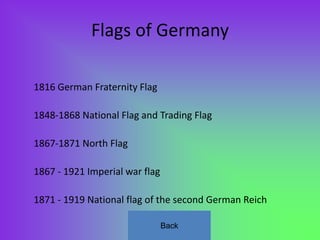
                                Flags of Germany
 Holidays    Flags of Germany                      Greatest Inventions
                                         2


                      Click Here To Exit
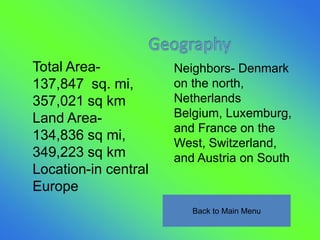
Total Area-           Neighbors- Denmark
137,847 sq. mi,       on the north,
357,021 sq km         Netherlands
Land Area-            Belgium, Luxemburg,
                      and France on the
134,836 sq mi,
                      West, Switzerland,
349,223 sq km         and Austria on South
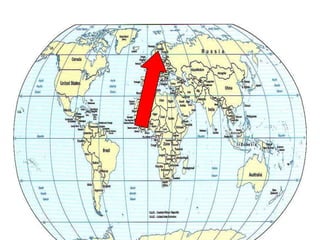
Location-in central
Europe
                         Back to Main Menu
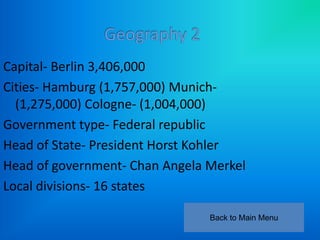
Capital- Berlin 3,406,000
Cities- Hamburg (1,757,000) Munich-
  (1,275,000) Cologne- (1,004,000)
Government type- Federal republic
Head of State- President Horst Kohler
Head of government- Chan Angela Merkel
Local divisions- 16 states

                                Back to Main Menu
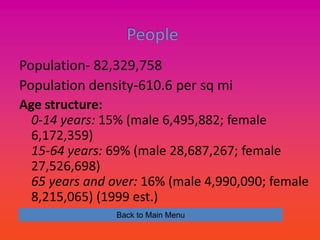
Population- 82,329,758
Population density-610.6 per sq mi
Age structure:
  0-14 years: 15% (male 6,495,882; female
  6,172,359)
  15-64 years: 69% (male 28,687,267; female
  27,526,698)
  65 years and over: 16% (male 4,990,090; female
  8,215,065) (1999 est.)
                Back to Main Menu
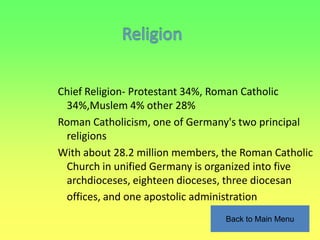
Chief Religion- Protestant 34%, Roman Catholic
 34%,Muslem 4% other 28%
Roman Catholicism, one of Germany's two principal
 religions
With about 28.2 million members, the Roman Catholic
 Church in unified Germany is organized into five
 archdioceses, eighteen dioceses, three diocesan
 offices, and one apostolic administration
                                 Back to Main Menu
Age structure:
  0-14 years: 15% (male 6,495,882; female
  6,172,359)
  15-64 years: 69% (male 28,687,267; female
  27,526,698)
  65 years and over: 16% (male 4,990,090;
  female 8,215,065) (1999 est.)
                                Back
Government type- Federal republic
Head of State- President Horst Kohler
Head of government- Chan Angela Merkel
Economy Industries-iron, steel, coal, cement, chemicals, machinery,
   vehicles, machine tools, electronics, food and beverages,
   shipbuilding
Chief crops- potatoes, wheat, barley, sugars, beets, fruits, cabbages
Natural Resources- coal, lignite, natural gas, iron ore, copper nickel,
   uranium potash, salt


                                                      Back to Main Menu
Chief crops- potatoes, wheat, barley,
 sugars, beets, fruits, cabbages
Natural Resources- coal, lignite, natural
 gas, iron ore, copper nickel, uranium
 potash, salt


                               Back
Germany is the largest national economy in
 Europe
Germany is relatively poor in raw materials


                           Back
• Neighbors- Denmark on the north,
  Netherlands
• Belgium, Luxemburg, and France on the
  West, Switzerland, and Austria on South


                    Back
Germany's climate is temperate with cool,
 cloudy, wet winters and summers and in
 the south occasional warm wind

The warmest regions of Germany can be
  found in the south-west
                          Back
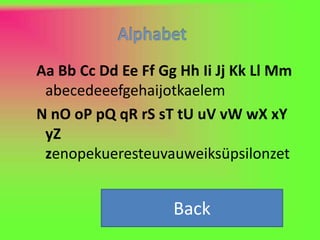
Aa Bb Cc Dd Ee Ff Gg Hh Ii Jj Kk Ll Mm
 abecedeeefgehaijotkaelem
N nO oP pQ qR rS sT tU uV vW wX xY
 yZ
 zenopekueresteuvauweiksüpsilonzet


                    Back
Back
eins -one
zwei - two
drei -three
Vier- four
fünf -five
sechs - six
sieben -seven
Acht-eight
neun -nine      Back
Zehn- ten
Back
A 69-year-old man was killed when his car was hit by a tree in the
   Black Forest, a jogger and a rambler were killed in separate
   incidents in Bergheim and Bad Schwalbach

At least four people were killed in Germany as storm Xynthia
    continued east across Europe.


                                       Back
History
The German Confederation was the association of
  Central European states created by the Congress of
  Vienna in 1815 to serve as the successor to the Holy
  Roman Empire of the German Nation, which had
  been abolished in 1806. In 1848, revolutions by
  liberals and nationalists occurred in an attempt to
  establish a unified German state


                                        Back
Flags of Germany

1816 German Fraternity Flag

1848-1868 National Flag and Trading Flag

1867-1871 North Flag

1867 - 1921 Imperial war flag

1871 - 1919 National flag of the second German Reich

                                Back
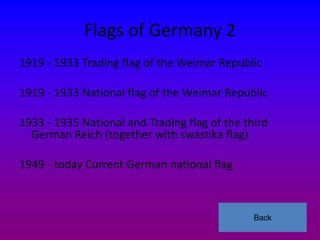
Flags of Germany 2
1919 - 1933 Trading flag of the Weimar Republic

1919 - 1933 National flag of the Weimar Republic

1933 - 1935 National and Trading flag of the third
  German Reich (together with swastika flag)

1949 - today Current German national flag


                                               Back
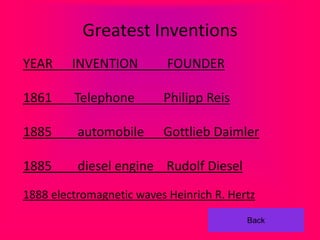
Greatest Inventions
YEAR     INVENTION         FOUNDER

1861     Telephone        Philipp Reis

1885      automobile      Gottlieb Daimler

1885      diesel engine Rudolf Diesel
1888 electromagnetic waves Heinrich R. Hertz
                                          Back
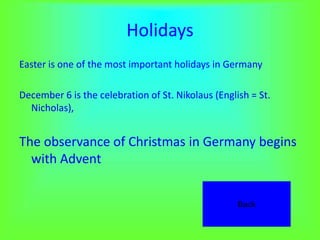
Holidays
Easter is one of the most important holidays in Germany

December 6 is the celebration of St. Nikolaus (English = St.
  Nicholas),


The observance of Christmas in Germany begins
  with Advent


                                                    Back

Germany

  • 1.
    Germany By: Miranda Gross TakeA Tour Of Germany!!!!!
  • 3.
    Where Do YouWant To Go? Geography Geography 2 People Religion Economy 3 People 2 Economy Economy 2 Alphabet 2 Geography 3 Climate Alphabet History Numbers Numbers 2 Natural Disasters Flags of Germany Holidays Flags of Germany Greatest Inventions 2 Click Here To Exit
  • 4.
    Total Area- Neighbors- Denmark 137,847 sq. mi, on the north, 357,021 sq km Netherlands Land Area- Belgium, Luxemburg, and France on the 134,836 sq mi, West, Switzerland, 349,223 sq km and Austria on South Location-in central Europe Back to Main Menu
  • 5.
    Capital- Berlin 3,406,000 Cities-Hamburg (1,757,000) Munich- (1,275,000) Cologne- (1,004,000) Government type- Federal republic Head of State- President Horst Kohler Head of government- Chan Angela Merkel Local divisions- 16 states Back to Main Menu
  • 6.
    Population- 82,329,758 Population density-610.6per sq mi Age structure: 0-14 years: 15% (male 6,495,882; female 6,172,359) 15-64 years: 69% (male 28,687,267; female 27,526,698) 65 years and over: 16% (male 4,990,090; female 8,215,065) (1999 est.) Back to Main Menu
  • 7.
    Chief Religion- Protestant34%, Roman Catholic 34%,Muslem 4% other 28% Roman Catholicism, one of Germany's two principal religions With about 28.2 million members, the Roman Catholic Church in unified Germany is organized into five archdioceses, eighteen dioceses, three diocesan offices, and one apostolic administration Back to Main Menu
  • 8.
    Age structure: 0-14 years: 15% (male 6,495,882; female 6,172,359) 15-64 years: 69% (male 28,687,267; female 27,526,698) 65 years and over: 16% (male 4,990,090; female 8,215,065) (1999 est.) Back
  • 9.
    Government type- Federalrepublic Head of State- President Horst Kohler Head of government- Chan Angela Merkel Economy Industries-iron, steel, coal, cement, chemicals, machinery, vehicles, machine tools, electronics, food and beverages, shipbuilding Chief crops- potatoes, wheat, barley, sugars, beets, fruits, cabbages Natural Resources- coal, lignite, natural gas, iron ore, copper nickel, uranium potash, salt Back to Main Menu
  • 10.
    Chief crops- potatoes,wheat, barley, sugars, beets, fruits, cabbages Natural Resources- coal, lignite, natural gas, iron ore, copper nickel, uranium potash, salt Back
  • 11.
    Germany is thelargest national economy in Europe Germany is relatively poor in raw materials Back
  • 12.
    • Neighbors- Denmarkon the north, Netherlands • Belgium, Luxemburg, and France on the West, Switzerland, and Austria on South Back
  • 13.
    Germany's climate istemperate with cool, cloudy, wet winters and summers and in the south occasional warm wind The warmest regions of Germany can be found in the south-west Back
  • 14.
    Aa Bb CcDd Ee Ff Gg Hh Ii Jj Kk Ll Mm abecedeeefgehaijotkaelem N nO oP pQ qR rS sT tU uV vW wX xY yZ zenopekueresteuvauweiksüpsilonzet Back
  • 15.
  • 16.
    eins -one zwei -two drei -three Vier- four fünf -five sechs - six sieben -seven Acht-eight neun -nine Back Zehn- ten
  • 17.
  • 18.
    A 69-year-old manwas killed when his car was hit by a tree in the Black Forest, a jogger and a rambler were killed in separate incidents in Bergheim and Bad Schwalbach At least four people were killed in Germany as storm Xynthia continued east across Europe. Back
  • 19.
    History The German Confederationwas the association of Central European states created by the Congress of Vienna in 1815 to serve as the successor to the Holy Roman Empire of the German Nation, which had been abolished in 1806. In 1848, revolutions by liberals and nationalists occurred in an attempt to establish a unified German state Back
  • 20.
    Flags of Germany 1816German Fraternity Flag 1848-1868 National Flag and Trading Flag 1867-1871 North Flag 1867 - 1921 Imperial war flag 1871 - 1919 National flag of the second German Reich Back
  • 21.
    Flags of Germany2 1919 - 1933 Trading flag of the Weimar Republic 1919 - 1933 National flag of the Weimar Republic 1933 - 1935 National and Trading flag of the third German Reich (together with swastika flag) 1949 - today Current German national flag Back
  • 22.
    Greatest Inventions YEAR INVENTION FOUNDER 1861 Telephone Philipp Reis 1885 automobile Gottlieb Daimler 1885 diesel engine Rudolf Diesel 1888 electromagnetic waves Heinrich R. Hertz Back
  • 23.
    Holidays Easter is oneof the most important holidays in Germany December 6 is the celebration of St. Nikolaus (English = St. Nicholas), The observance of Christmas in Germany begins with Advent Back