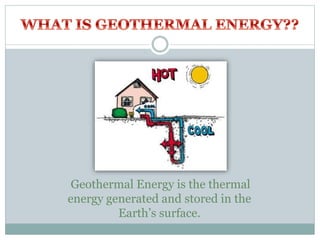
Geothermal Energy is the thermal
energy generated and stored in the
Earth’s surface.
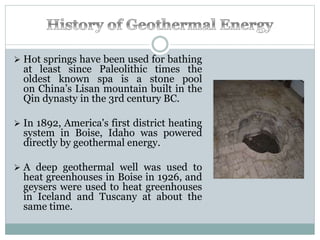
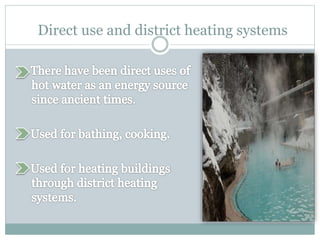
 Hot springs have been used for bathing
at least since Paleolithic times the
oldest known spa is a stone pool
on China’s Lisan mountain built in the
Qin dynasty in the 3rd century BC.
 In 1892, America's first district heating
system in Boise, Idaho was powered
directly by geothermal energy.
 A deep geothermal well was used to
heat greenhouses in Boise in 1926, and
geysers were used to heat greenhouses
in Iceland and Tuscany at about the
same time.
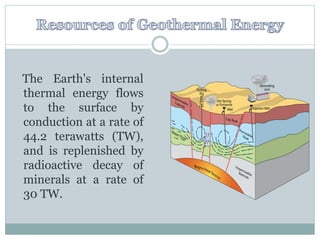
The Earth's internal
thermal energy flows
to the surface by
conduction at a rate of
44.2 terawatts (TW),
and is replenished by
radioactive decay of
minerals at a rate of
30 TW.
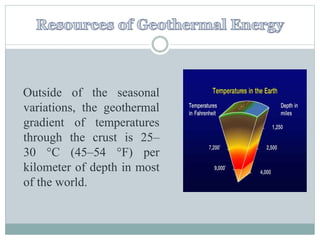
Outside of the seasonal
variations, the geothermal
gradient of temperatures
through the crust is 25–
30 °C (45–54 °F) per
kilometer of depth in most
of the world.
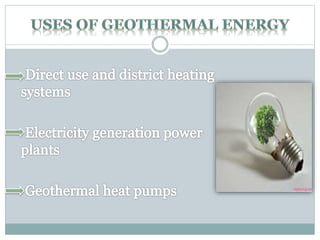
Direct use and district heating systems
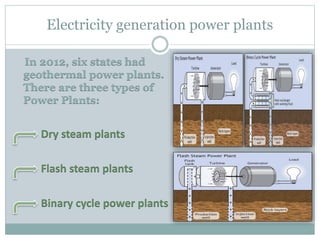
Electricity generation power plants
In 2012, six states had
geothermal power plants.
There are three types of
Power Plants:
Dry steam plants
Flash steam plants
Binary cycle power plants
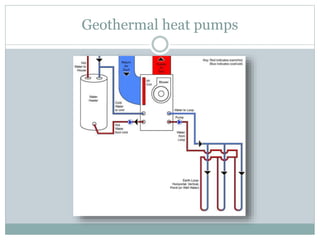
Geothermal heat pumps
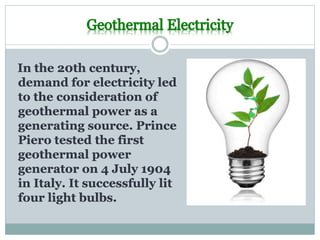
In the 20th century,
demand for electricity led
to the consideration of
geothermal power as a
generating source. Prince
Piero tested the first
geothermal power
generator on 4 July 1904
in Italy. It successfully lit
four light bulbs.
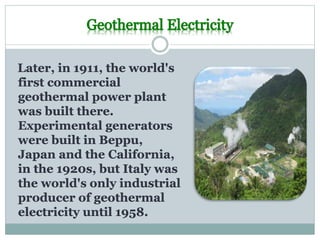
Later, in 1911, the world's
first commercial
geothermal power plant
was built there.
Experimental generators
were built in Beppu,
Japan and the California,
in the 1920s, but Italy was
the world's only industrial
producer of geothermal
electricity until 1958.
The International
Geothermal Association
(IGA) has reported that
10,715 megawatts (MW)
of geothermal power in
24 countries is online,
which is expected to
generate 67,246 GWh of
electricity in 2010.
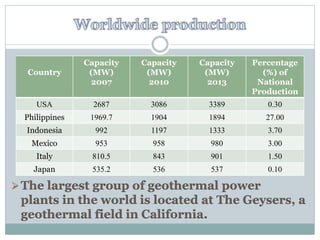
The largest group of geothermal power
plants in the world is located at The Geysers, a
geothermal field in California.
Country
Capacity
(MW)
2007
Capacity
(MW)
2010
Capacity
(MW)
2013
Percentage
(%) of
National
Production
USA 2687 3086 3389 0.30
Philippines 1969.7 1904 1894 27.00
Indonesia 992 1197 1333 3.70
Mexico 953 958 980 3.00
Italy 810.5 843 901 1.50
Japan 535.2 536 537 0.10
Environmental effects
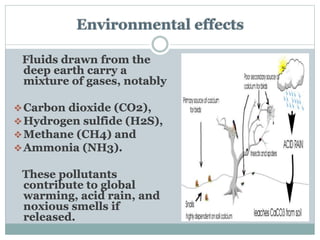
Fluids drawn from the
deep earth carry a
mixture of gases, notably
Carbon dioxide (CO2),
Hydrogen sulfide (H2S),
Methane (CH4) and
Ammonia (NH3).
These pollutants
contribute to global
warming, acid rain, and
noxious smells if
released.
Environmental effects
Existing geothermal
electric plants emit an
average of 122 kilograms
(270 lb) of CO2 per
megawatt-hour (MWh)
of electricity, a small
fraction of the emission
intensity of conventional
fossil fuel plants.
Environmental effects
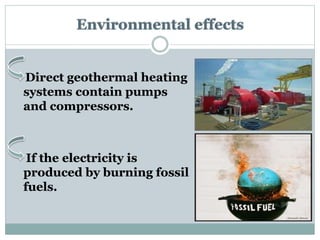
Direct geothermal heating
systems contain pumps
and compressors.
If the electricity is
produced by burning fossil
fuels.
THANK YOU
Presented By
Manas Patra
Electrical Engineering
Final Year
Asansol Engineering College

Geothermal energy

  • 2.
    Geothermal Energy isthe thermal energy generated and stored in the Earth’s surface.
  • 4.
     Hot springshave been used for bathing at least since Paleolithic times the oldest known spa is a stone pool on China’s Lisan mountain built in the Qin dynasty in the 3rd century BC.  In 1892, America's first district heating system in Boise, Idaho was powered directly by geothermal energy.  A deep geothermal well was used to heat greenhouses in Boise in 1926, and geysers were used to heat greenhouses in Iceland and Tuscany at about the same time.
  • 5.
    The Earth's internal thermalenergy flows to the surface by conduction at a rate of 44.2 terawatts (TW), and is replenished by radioactive decay of minerals at a rate of 30 TW.
  • 6.
    Outside of theseasonal variations, the geothermal gradient of temperatures through the crust is 25– 30 °C (45–54 °F) per kilometer of depth in most of the world.
  • 9.
    Direct use anddistrict heating systems
  • 10.
    Electricity generation powerplants In 2012, six states had geothermal power plants. There are three types of Power Plants: Dry steam plants Flash steam plants Binary cycle power plants
  • 11.
  • 12.
    In the 20thcentury, demand for electricity led to the consideration of geothermal power as a generating source. Prince Piero tested the first geothermal power generator on 4 July 1904 in Italy. It successfully lit four light bulbs.
  • 13.
    Later, in 1911,the world's first commercial geothermal power plant was built there. Experimental generators were built in Beppu, Japan and the California, in the 1920s, but Italy was the world's only industrial producer of geothermal electricity until 1958.
  • 14.
    The International Geothermal Association (IGA)has reported that 10,715 megawatts (MW) of geothermal power in 24 countries is online, which is expected to generate 67,246 GWh of electricity in 2010.
  • 15.
    The largest groupof geothermal power plants in the world is located at The Geysers, a geothermal field in California. Country Capacity (MW) 2007 Capacity (MW) 2010 Capacity (MW) 2013 Percentage (%) of National Production USA 2687 3086 3389 0.30 Philippines 1969.7 1904 1894 27.00 Indonesia 992 1197 1333 3.70 Mexico 953 958 980 3.00 Italy 810.5 843 901 1.50 Japan 535.2 536 537 0.10
  • 16.
    Environmental effects Fluids drawnfrom the deep earth carry a mixture of gases, notably Carbon dioxide (CO2), Hydrogen sulfide (H2S), Methane (CH4) and Ammonia (NH3). These pollutants contribute to global warming, acid rain, and noxious smells if released.
  • 17.
    Environmental effects Existing geothermal electricplants emit an average of 122 kilograms (270 lb) of CO2 per megawatt-hour (MWh) of electricity, a small fraction of the emission intensity of conventional fossil fuel plants.
  • 18.
    Environmental effects Direct geothermalheating systems contain pumps and compressors. If the electricity is produced by burning fossil fuels.
  • 19.
    THANK YOU Presented By ManasPatra Electrical Engineering Final Year Asansol Engineering College