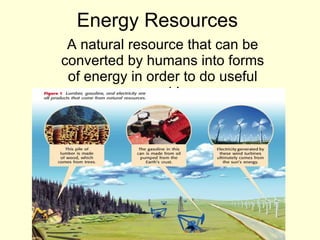
Energy Resources A natural resource that can be converted by humans into forms of energy in order to do useful work!
Renewable Resources
Solar Energy Solar Energy:  The Ultimate  Renewable Resource
Energy produced by the sun Clean, renewable source of energy Harnessed by solar collection methods such as solar cells Converted into usable energy such as electricity   Originates with the thermonuclear fusion reactions occurring in the sun What is Solar Energy?
. Advantages: All chemical and radioactive polluting byproducts of the thermonuclear reactions remain behind on the sun, while only pure radiant energy reaches the Earth. Energy reaching the earth is incredible.  By one calculation, 30 days of sunshine striking the Earth have the energy equivalent of the total of all the planet’s fossil fuels, both used and unused! Advantages and Disadvantages Disadvantage: Sun does not shine consistently. Solar energy is a diffuse source.  To harness it, we must concentrate it into an amount and form that we can use, such as heat and electricity. Addressed by approaching the problem through:  1) collection, 2) conversion, 3) storage.
Solar Energy
Using Solar Energy to Provide Heat collector Passive solar heating Active solar heating
Solar energy collectors passive (no moving parts) and active (pumps). In both, a flat-plate collector is used to absorb the sun’s energy to heat the water. Passive method used sand and rocks and bricks Active methodd used water or air as medium
Photovoltaic Solar Cells
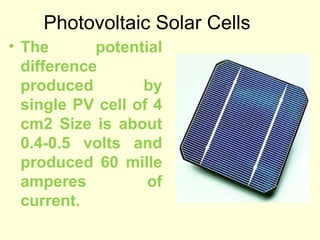
Photovoltaic Solar Cells The potential difference produced by single PV cell of 4 cm2 Size is about 0.4-0.5 volts and produced 60 mille amperes of current.
Because they work best under direct sunlight, parabolic dishes and troughs must be steered throughout the day in the direction of the sun. Parabolic   Dishes and Troughs
Direct Conversion into Electricity Photovoltaic cells are capable of directly converting sunlight into electricity. A simple wafer of silicon with wires attached to the layers.  Current is produced based on types of silicon (n- and p-types) used for the layers.  Each cell=0.5 volts. Battery needed as storage No moving parts  do no wear out, but because they are exposed to the weather, their lifespan is about 20 years.
Solar cookers
Solar cooker Solar cooker is work through reflect light with mirror. Concave or parabolic reflectors works more efficiency Solar cooker food have more nutrients due to slow heating
Solar water Heater Solar Furnace
Power Towers Power tower in Barstow, California.
Renewable Resources Wind -  electricity  No Greenhouse Gas Emissions Insurance Against Conventional Fossil-based Price Risk No Sulfur Dioxide (SO2), Nitrous Oxide (NOx), or Mercury Emissions
Why Wind Energy? Wind, for now, is the renewable energy resource/technology of choice “ Free” resource A “clean” resource due to: Replacement of a “dirty” energy source (coal) and,  No emissions associated with its use  Can be utilized on underutilized land or on lands currently in commodity crop production (“harvest” on the surface and “harvest” above the surface)
Energy Production and the Environment Energy use in power plants accounts for: 67% of air emissions of SO 2 , the primary cause of acid rain. SO 2  causes acidification of lakes and damages forests and other habitats. 25% of NO x , which causes smog and respiratory ailments.  33% of Hg (mercury), a persistent, bio-accumulative toxin which increases in concentration as it moves up the food chain, e.g. from fish to birds, causing serious deformities and nerve disorders.   SOURCES:  Union of Concerned Scientists (UCS)
Wind Energy Benefits No air emissions  No fuel to mine, transport, or store  No cooling water  No water pollution  No wastes
Wind Resources in the United States Wind resources are characterized by wind-power density classes, ranging from class 1 (the lowest) to class 7 (the highest).  Good wind resources (class 3 and above) which have an average annual wind speed of at least 13 miles per hour, are found along the east coast, the Appalachian Mountain chain, the Great Plains, the Pacific Northwest, and some other locations.
Kansas Wind Potential Kansas is one of the three best wind  states in the country Total “windy” land equals more than 108,000 square kilometers (about 1/2 of state) Total Energy Potential = 1.07 trillion kWh or 121,900 MWa Most of that potential probably won’t  be developed . . .
Wind Turbines
Turbines:  Different Sizes and Applications Small   (  10 kW) Homes (Grid-connected) Farms Remote Applications (e.g. battery changing, water pumping, telecom sites) Intermediate (10-500 kW) Village Power Hybrid Systems Distributed Power Large (500 kW – 5 MW) Central Station Wind Farms Distributed Power Offshore Wind
Wind Turbine Schematic
Wind - Natural Gas Comparison Wind Low Operating Cost High Capital Cost Non-dispatchable No Fuel Supply/Cost Risk No Emissions Natural Gas High Operating Costs Low Capital Cost Dispatchable Fuel Supply/Cost Risk Smog, Greenhouse Gas Emissions
Wind Power Isn’t Perfect Wind Power output varies over time; it isn’t dispatchable Wind Power is location-dependent (rural vs. urban where it is needed most) Wind Power is transmission-dependent for tie-in to the grid Wind Power has environmental impacts  Wind Power can only meet part of the electrical load
Common Misunderstandings Wind turbines are only generating electricity about one third of the time. Wind turbines generate electricity essentially all the time, but only at their  rated capacity  about 30-40% of the time
Hydro power Water flowing energy convert to electric energy The minimum height of the waterfalls should be 10 m The hydropower potential in India has 4x10 11 KW /hours. But we are utilize 11% in that only Hydro power does not cause any pollution.
Tidal energy Ocean tides produces by gravitational forces of sun and moon High tide enters the sea water into reservoir and rotate the turbine generate energy. Low tides return the reservoir water into ocean and once again rotate the turbine  Only few sites are suitable for tidal energy in the world.
Ocean Thermal energy The energy is available due to the difference in temperature of water at surface of the ocean and at deeper levels is called  “  ocean thermal energy(OTE)” The difference temperate required 20 degrees The warm surface water of ocean is used to boil liquid ammonia and it passed with high pressure through the turbine. Later cooled the gas ammonia with use of deeper water The process continuously takes place.
Geo Thermal energy The energy getting from the hot rocks  Present inside of the earth is called  “ Geo Thermal Energy ” The heat comes from the fission of radio active naturally present in the rocks. We can drill a hole up to rocks and get steam and pass through the turbine and generate electricity. USA and New Zealand has several Geo thermal plants
Geothermal Energy Dry steam Wet steam Hot water Molten rock Hot dry-rock zones Geothermal reservoirs
M.NagaPrasaRreddy. Save energy for Our life

environmental studies

  • 1.
    Energy Resources Anatural resource that can be converted by humans into forms of energy in order to do useful work!
  • 2.
  • 3.
    Solar Energy SolarEnergy: The Ultimate Renewable Resource
  • 4.
    Energy produced bythe sun Clean, renewable source of energy Harnessed by solar collection methods such as solar cells Converted into usable energy such as electricity Originates with the thermonuclear fusion reactions occurring in the sun What is Solar Energy?
  • 5.
    . Advantages: Allchemical and radioactive polluting byproducts of the thermonuclear reactions remain behind on the sun, while only pure radiant energy reaches the Earth. Energy reaching the earth is incredible. By one calculation, 30 days of sunshine striking the Earth have the energy equivalent of the total of all the planet’s fossil fuels, both used and unused! Advantages and Disadvantages Disadvantage: Sun does not shine consistently. Solar energy is a diffuse source. To harness it, we must concentrate it into an amount and form that we can use, such as heat and electricity. Addressed by approaching the problem through: 1) collection, 2) conversion, 3) storage.
  • 6.
  • 7.
    Using Solar Energyto Provide Heat collector Passive solar heating Active solar heating
  • 8.
    Solar energy collectorspassive (no moving parts) and active (pumps). In both, a flat-plate collector is used to absorb the sun’s energy to heat the water. Passive method used sand and rocks and bricks Active methodd used water or air as medium
  • 9.
  • 10.
    Photovoltaic Solar CellsThe potential difference produced by single PV cell of 4 cm2 Size is about 0.4-0.5 volts and produced 60 mille amperes of current.
  • 11.
    Because they workbest under direct sunlight, parabolic dishes and troughs must be steered throughout the day in the direction of the sun. Parabolic Dishes and Troughs
  • 12.
    Direct Conversion intoElectricity Photovoltaic cells are capable of directly converting sunlight into electricity. A simple wafer of silicon with wires attached to the layers. Current is produced based on types of silicon (n- and p-types) used for the layers. Each cell=0.5 volts. Battery needed as storage No moving parts  do no wear out, but because they are exposed to the weather, their lifespan is about 20 years.
  • 13.
  • 14.
    Solar cooker Solarcooker is work through reflect light with mirror. Concave or parabolic reflectors works more efficiency Solar cooker food have more nutrients due to slow heating
  • 15.
    Solar water HeaterSolar Furnace
  • 16.
    Power Towers Powertower in Barstow, California.
  • 17.
    Renewable Resources Wind- electricity No Greenhouse Gas Emissions Insurance Against Conventional Fossil-based Price Risk No Sulfur Dioxide (SO2), Nitrous Oxide (NOx), or Mercury Emissions
  • 18.
    Why Wind Energy?Wind, for now, is the renewable energy resource/technology of choice “ Free” resource A “clean” resource due to: Replacement of a “dirty” energy source (coal) and, No emissions associated with its use Can be utilized on underutilized land or on lands currently in commodity crop production (“harvest” on the surface and “harvest” above the surface)
  • 19.
    Energy Production andthe Environment Energy use in power plants accounts for: 67% of air emissions of SO 2 , the primary cause of acid rain. SO 2 causes acidification of lakes and damages forests and other habitats. 25% of NO x , which causes smog and respiratory ailments. 33% of Hg (mercury), a persistent, bio-accumulative toxin which increases in concentration as it moves up the food chain, e.g. from fish to birds, causing serious deformities and nerve disorders. SOURCES: Union of Concerned Scientists (UCS)
  • 20.
    Wind Energy BenefitsNo air emissions No fuel to mine, transport, or store No cooling water No water pollution No wastes
  • 21.
    Wind Resources inthe United States Wind resources are characterized by wind-power density classes, ranging from class 1 (the lowest) to class 7 (the highest). Good wind resources (class 3 and above) which have an average annual wind speed of at least 13 miles per hour, are found along the east coast, the Appalachian Mountain chain, the Great Plains, the Pacific Northwest, and some other locations.
  • 22.
    Kansas Wind PotentialKansas is one of the three best wind states in the country Total “windy” land equals more than 108,000 square kilometers (about 1/2 of state) Total Energy Potential = 1.07 trillion kWh or 121,900 MWa Most of that potential probably won’t be developed . . .
  • 23.
  • 24.
    Turbines: DifferentSizes and Applications Small (  10 kW) Homes (Grid-connected) Farms Remote Applications (e.g. battery changing, water pumping, telecom sites) Intermediate (10-500 kW) Village Power Hybrid Systems Distributed Power Large (500 kW – 5 MW) Central Station Wind Farms Distributed Power Offshore Wind
  • 25.
  • 26.
    Wind - NaturalGas Comparison Wind Low Operating Cost High Capital Cost Non-dispatchable No Fuel Supply/Cost Risk No Emissions Natural Gas High Operating Costs Low Capital Cost Dispatchable Fuel Supply/Cost Risk Smog, Greenhouse Gas Emissions
  • 27.
    Wind Power Isn’tPerfect Wind Power output varies over time; it isn’t dispatchable Wind Power is location-dependent (rural vs. urban where it is needed most) Wind Power is transmission-dependent for tie-in to the grid Wind Power has environmental impacts Wind Power can only meet part of the electrical load
  • 28.
    Common Misunderstandings Windturbines are only generating electricity about one third of the time. Wind turbines generate electricity essentially all the time, but only at their rated capacity about 30-40% of the time
  • 29.
    Hydro power Waterflowing energy convert to electric energy The minimum height of the waterfalls should be 10 m The hydropower potential in India has 4x10 11 KW /hours. But we are utilize 11% in that only Hydro power does not cause any pollution.
  • 30.
    Tidal energy Oceantides produces by gravitational forces of sun and moon High tide enters the sea water into reservoir and rotate the turbine generate energy. Low tides return the reservoir water into ocean and once again rotate the turbine Only few sites are suitable for tidal energy in the world.
  • 31.
    Ocean Thermal energyThe energy is available due to the difference in temperature of water at surface of the ocean and at deeper levels is called “ ocean thermal energy(OTE)” The difference temperate required 20 degrees The warm surface water of ocean is used to boil liquid ammonia and it passed with high pressure through the turbine. Later cooled the gas ammonia with use of deeper water The process continuously takes place.
  • 32.
    Geo Thermal energyThe energy getting from the hot rocks Present inside of the earth is called “ Geo Thermal Energy ” The heat comes from the fission of radio active naturally present in the rocks. We can drill a hole up to rocks and get steam and pass through the turbine and generate electricity. USA and New Zealand has several Geo thermal plants
  • 33.
    Geothermal Energy Drysteam Wet steam Hot water Molten rock Hot dry-rock zones Geothermal reservoirs
  • 34.