Geothermal Energy
Sources of Earth’s Internal Energy
  •70% comes from the decay of radioactive nuclei with long half
  lives that are embedded within the Earth
  •Some energy is from residual heat left over from Earths formation.
  •The rest of the energy comes from meteorite impacts.
Different Geothermal Energy
               Sources
•Hot Water Reservoirs: As the name implies these are reservoirs of hot
underground water. There is a large amount of them in the US, but they
are more suited for space heating than for electricity production.
•Natural Stem Reservoirs: In this case a hole dug into the ground can
cause steam to come to the surface. This type of resource is rare in the
US.
•Geopressured Reservoirs: In this type of reserve, brine completely
saturated with natural gas in stored under pressure from the weight of
overlying rock. This type of resource can be used for both heat and for
natural gas.
•Normal Geothermal Gradient: At any place on the planet, there is a
normal temperature gradient of +300C per km dug into the earth. Therefore,
if one digs 20,000 feet the temperature will be about 1900C above the surface
temperature. This difference will be enough to produce electricity. However,
no useful and economical technology has been developed to extracted this
large source of energy.


•Hot Dry Rock: This type of condition exists in 5% of the US. It is similar to
Normal Geothermal Gradient, but the gradient is 400C/km dug underground.


•Molten Magma: No technology exists to tap into the heat reserves stored
in magma. The best sources for this in the US are in Alaska and Hawaii.
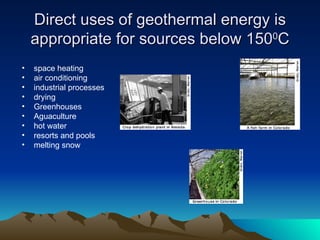
Direct uses of geothermal energy is
    appropriate for sources below 1500C
•   space heating
•   air conditioning
•   industrial processes
•   drying
•   Greenhouses
•   Aguaculture
•   hot water
•   resorts and pools
•   melting snow
How Direct Uses Work
•Direct Sources function by sending water down a well to be heated by the
Earth’s warmth.
•Then a heat pump is used to take the heat from the underground water to the
substance that heats the house.
• Then after the water it is cooled is injected back into the Earth.
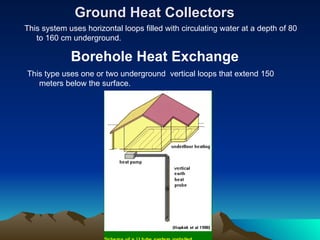
Ground Heat Collectors
This system uses horizontal loops filled with circulating water at a depth of 80
   to 160 cm underground.

             Borehole Heat Exchange
This type uses one or two underground vertical loops that extend 150
   meters below the surface.
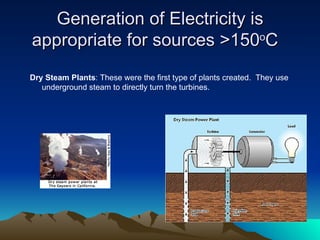
Generation of Electricity is
appropriate for sources >150oC
Dry Steam Plants: These were the first type of plants created. They use
   underground steam to directly turn the turbines.
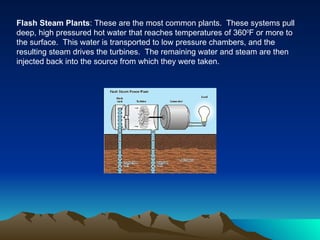
Flash Steam Plants: These are the most common plants. These systems pull
deep, high pressured hot water that reaches temperatures of 3600F or more to
the surface. This water is transported to low pressure chambers, and the
resulting steam drives the turbines. The remaining water and steam are then
injected back into the source from which they were taken.
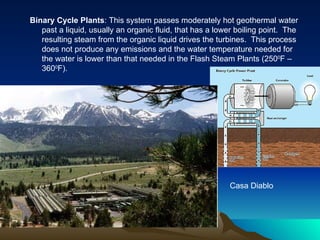
Binary Cycle Plants: This system passes moderately hot geothermal water
   past a liquid, usually an organic fluid, that has a lower boiling point. The
   resulting steam from the organic liquid drives the turbines. This process
   does not produce any emissions and the water temperature needed for
   the water is lower than that needed in the Flash Steam Plants (2500F –
   3600F).


                                                          Casa Diablo
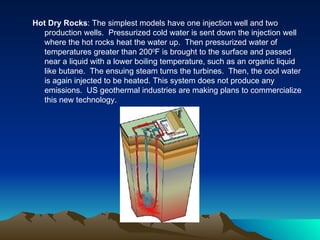
Hot Dry Rocks: The simplest models have one injection well and two
   production wells. Pressurized cold water is sent down the injection well
   where the hot rocks heat the water up. Then pressurized water of
   temperatures greater than 2000F is brought to the surface and passed
   near a liquid with a lower boiling temperature, such as an organic liquid
   like butane. The ensuing steam turns the turbines. Then, the cool water
   is again injected to be heated. This system does not produce any
   emissions. US geothermal industries are making plans to commercialize
   this new technology.
Geothermal’s Harmful Effects
•   Brine can salinate soil if the water is not injected back into the reserve after
    the heat is extracted.

•   Extracting large amounts of water can cause land subsidence, and this can
    lead to an increase in seismic activity. To prevented this the cooled water
    must be injected back into the reserve in order to keep the water pressure
    constant underground.

•   Power plants that do not inject the cooled water back into the ground can
    release H2S, the “rotten eggs” gas. This gas can cause problems if large
    quantities escape because inhaling too much is fatal.
•One well “blew its top” 10 years after it was built, and this threw hundreds
of tons of rock, mud and steam into the atmosphere.

•There is the fear of noise pollution during the drilling of wells.
Geothermal’s Positive Attributes
•   Useful minerals, such as zinc and silica, can be extracted from underground
    water.


•   Geothermal energy is “homegrown.” This will create jobs, a better global
    trading position and less reliance on oil producing countries.


•   US geothermal companies have signed $6 billion worth of contracts to build
    plants in foreign countries in the past couple of years.

•   In large plants the cost is 4-8 cents per kilowatt hour. This cost is almost
    competitive with conventional energy sources.
•Geothermal plants can be online 100%-90% of the time. Coal plants can only be
online 75% of the time and nuclear plants can only be online 65% of the time.

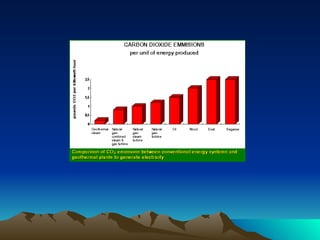
•Flash and Dry Steam Power Plants emit 1000x to 2000x less carbon dioxide than
fossil fuel plants, no nitrogen oxides and little SO2.

•Geothermal electric plants production in 13.380 g of Carbon dioxide per kWh,
whereas the CO2 emissions are 453 g/kWh for natural gas, 906g g/kWh for oil and
1042 g/kWh for coal.

•Binary and Hot Dry Rock plants have no gaseous emission at all.

•Geothermal plants do not require a lot of land, 400m2 can produce a gigawatt of
energy over 30 years.
•Geothermal Heat Pumps:
          - produces 4 times the energy that they consume.
           -initially costs more to install, but its maintenance cost is 1/3 of the
           cost for a typical conventional heating system and it decreases
 electric bill. This means that geothermal space heating will save the
 consumer money.
          -can be installed with the help of special programs that offer low
          interest rate loans.

•Electricity generated by geothermal plants saves 83.3 million barrels of fuel
each year from being burned world wide. This prevents 40.2 million tons of
CO2 from being emitted into the atmosphere.
•Direct use of geothermal energy prevents 103.6 million barrels of fuel each
year from being burned world wide. This stops 49.6 tons of CO2 from being
emitted into the atmosphere.
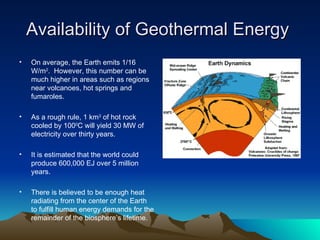
Availability of Geothermal Energy
•   On average, the Earth emits 1/16
    W/m2. However, this number can be
    much higher in areas such as regions
    near volcanoes, hot springs and
    fumaroles.

•   As a rough rule, 1 km3 of hot rock
    cooled by 1000C will yield 30 MW of
    electricity over thirty years.

•   It is estimated that the world could
    produce 600,000 EJ over 5 million
    years.

•   There is believed to be enough heat
    radiating from the center of the Earth
    to fulfill human energy demands for the
    remainder of the biosphere’s lifetime.
Geothermal production of energy is 3rd highest among renewable
energies. It is behind hydro and biomass, but before solar and wind.


Iceland is one of the more countries successful in using geothermal
energy:
          -86% of their space heating uses geothermal energy.
          -16% of their electricity generation uses geothermal energy.
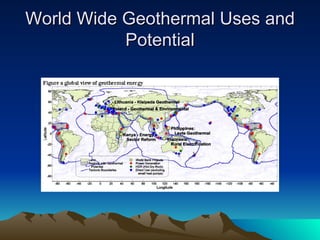
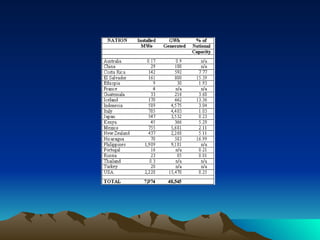
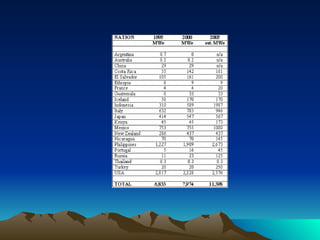
World Wide Geothermal Uses and
           Potential
Geothermal energy
Geothermal energy

Geothermal energy

  • 1.
  • 2.
    Sources of Earth’sInternal Energy •70% comes from the decay of radioactive nuclei with long half lives that are embedded within the Earth •Some energy is from residual heat left over from Earths formation. •The rest of the energy comes from meteorite impacts.
  • 3.
    Different Geothermal Energy Sources •Hot Water Reservoirs: As the name implies these are reservoirs of hot underground water. There is a large amount of them in the US, but they are more suited for space heating than for electricity production. •Natural Stem Reservoirs: In this case a hole dug into the ground can cause steam to come to the surface. This type of resource is rare in the US. •Geopressured Reservoirs: In this type of reserve, brine completely saturated with natural gas in stored under pressure from the weight of overlying rock. This type of resource can be used for both heat and for natural gas.
  • 4.
    •Normal Geothermal Gradient:At any place on the planet, there is a normal temperature gradient of +300C per km dug into the earth. Therefore, if one digs 20,000 feet the temperature will be about 1900C above the surface temperature. This difference will be enough to produce electricity. However, no useful and economical technology has been developed to extracted this large source of energy. •Hot Dry Rock: This type of condition exists in 5% of the US. It is similar to Normal Geothermal Gradient, but the gradient is 400C/km dug underground. •Molten Magma: No technology exists to tap into the heat reserves stored in magma. The best sources for this in the US are in Alaska and Hawaii.
  • 5.
    Direct uses ofgeothermal energy is appropriate for sources below 1500C • space heating • air conditioning • industrial processes • drying • Greenhouses • Aguaculture • hot water • resorts and pools • melting snow
  • 6.
    How Direct UsesWork •Direct Sources function by sending water down a well to be heated by the Earth’s warmth. •Then a heat pump is used to take the heat from the underground water to the substance that heats the house. • Then after the water it is cooled is injected back into the Earth.
  • 7.
    Ground Heat Collectors Thissystem uses horizontal loops filled with circulating water at a depth of 80 to 160 cm underground. Borehole Heat Exchange This type uses one or two underground vertical loops that extend 150 meters below the surface.
  • 8.
    Generation of Electricityis appropriate for sources >150oC Dry Steam Plants: These were the first type of plants created. They use underground steam to directly turn the turbines.
  • 9.
    Flash Steam Plants:These are the most common plants. These systems pull deep, high pressured hot water that reaches temperatures of 3600F or more to the surface. This water is transported to low pressure chambers, and the resulting steam drives the turbines. The remaining water and steam are then injected back into the source from which they were taken.
  • 10.
    Binary Cycle Plants:This system passes moderately hot geothermal water past a liquid, usually an organic fluid, that has a lower boiling point. The resulting steam from the organic liquid drives the turbines. This process does not produce any emissions and the water temperature needed for the water is lower than that needed in the Flash Steam Plants (2500F – 3600F). Casa Diablo
  • 11.
    Hot Dry Rocks:The simplest models have one injection well and two production wells. Pressurized cold water is sent down the injection well where the hot rocks heat the water up. Then pressurized water of temperatures greater than 2000F is brought to the surface and passed near a liquid with a lower boiling temperature, such as an organic liquid like butane. The ensuing steam turns the turbines. Then, the cool water is again injected to be heated. This system does not produce any emissions. US geothermal industries are making plans to commercialize this new technology.
  • 12.
    Geothermal’s Harmful Effects • Brine can salinate soil if the water is not injected back into the reserve after the heat is extracted. • Extracting large amounts of water can cause land subsidence, and this can lead to an increase in seismic activity. To prevented this the cooled water must be injected back into the reserve in order to keep the water pressure constant underground. • Power plants that do not inject the cooled water back into the ground can release H2S, the “rotten eggs” gas. This gas can cause problems if large quantities escape because inhaling too much is fatal.
  • 13.
    •One well “blewits top” 10 years after it was built, and this threw hundreds of tons of rock, mud and steam into the atmosphere. •There is the fear of noise pollution during the drilling of wells.
  • 14.
    Geothermal’s Positive Attributes • Useful minerals, such as zinc and silica, can be extracted from underground water. • Geothermal energy is “homegrown.” This will create jobs, a better global trading position and less reliance on oil producing countries. • US geothermal companies have signed $6 billion worth of contracts to build plants in foreign countries in the past couple of years. • In large plants the cost is 4-8 cents per kilowatt hour. This cost is almost competitive with conventional energy sources.
  • 15.
    •Geothermal plants canbe online 100%-90% of the time. Coal plants can only be online 75% of the time and nuclear plants can only be online 65% of the time. •Flash and Dry Steam Power Plants emit 1000x to 2000x less carbon dioxide than fossil fuel plants, no nitrogen oxides and little SO2. •Geothermal electric plants production in 13.380 g of Carbon dioxide per kWh, whereas the CO2 emissions are 453 g/kWh for natural gas, 906g g/kWh for oil and 1042 g/kWh for coal. •Binary and Hot Dry Rock plants have no gaseous emission at all. •Geothermal plants do not require a lot of land, 400m2 can produce a gigawatt of energy over 30 years.
  • 16.
    •Geothermal Heat Pumps: - produces 4 times the energy that they consume. -initially costs more to install, but its maintenance cost is 1/3 of the cost for a typical conventional heating system and it decreases electric bill. This means that geothermal space heating will save the consumer money. -can be installed with the help of special programs that offer low interest rate loans. •Electricity generated by geothermal plants saves 83.3 million barrels of fuel each year from being burned world wide. This prevents 40.2 million tons of CO2 from being emitted into the atmosphere. •Direct use of geothermal energy prevents 103.6 million barrels of fuel each year from being burned world wide. This stops 49.6 tons of CO2 from being emitted into the atmosphere.
  • 20.
    Availability of GeothermalEnergy • On average, the Earth emits 1/16 W/m2. However, this number can be much higher in areas such as regions near volcanoes, hot springs and fumaroles. • As a rough rule, 1 km3 of hot rock cooled by 1000C will yield 30 MW of electricity over thirty years. • It is estimated that the world could produce 600,000 EJ over 5 million years. • There is believed to be enough heat radiating from the center of the Earth to fulfill human energy demands for the remainder of the biosphere’s lifetime.
  • 21.
    Geothermal production ofenergy is 3rd highest among renewable energies. It is behind hydro and biomass, but before solar and wind. Iceland is one of the more countries successful in using geothermal energy: -86% of their space heating uses geothermal energy. -16% of their electricity generation uses geothermal energy.
  • 22.
    World Wide GeothermalUses and Potential