CONCRETE TECHNOLOGY
DAYANANDA SAGAR ACADEMY OF TECHONOLOGY
AND MANAGEMENT
BCV503
MATERIALS,REQUIREMENT MIX PROPORTION & PROPERTIES OF GEO
POLYMER CONCRETE
SUBMITTED BY: SUBMITTED TO:
KIRAN 1DT23CV411 PROF. VINAYAK A HOSUR
NITHIN B 1DT23CV412 Dept. of civil engineering
NITHISHA B 1DT23CV413
NITISH NAIDU 1DT23CV414
PREM BIRADAR 1DT23CV415
PRITHVI SINGH 1DT23CV416
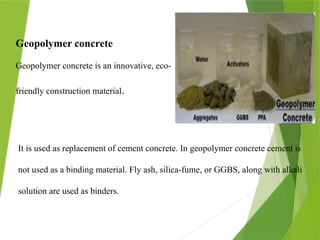
Geopolymer concrete
Geopolymer concrete is an innovative, eco-
friendly construction material.
It is used as replacement of cement concrete. In geopolymer concrete cement is
not used as a binding material. Fly ash, silica-fume, or GGBS, along with alkali
solution are used as binders.
WHY GEOPOLYMER CONCRETE?
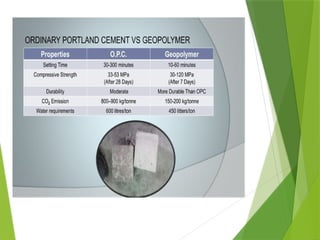
Reduces the demand of OPC which leads CO2 emission.
Utilise waste materials from industries such as fly ash, silica-fume, GGBS.
Protect water bodies from contamination due to fly ash disposal.
Conserve acres of land that would have been used for coal combustion
products disposal.
Produce a more durable infrastructure.
CONSTITUENTS
Coarse aggregate:
Fine aggregate - sand or bottom ash can be used:
Admixture - super plasticizers(naphthalene based or naphthalene sulphonate
based).
Alkaline activators -Alkaline activation is a process of mixing powdery
aluminosilicate with an alkaline activator:
It produce a paste which sets and hardens within short duration
Alkaline activators commonly used are sodium or potassium hydroxide.
-They are used in combination with sodium silicate(water glass) or potassium
silicate solution.
-NaOH and Na2SiO3 are more commonly used as it leads to higher
geopolymerisation rate.
-K2SiO3 solution rarely used because of high cost and lack of easy
availability.
-Alkali hydroxide is used for dissolution and sodium-silicate solution as
binder.
Fly ash
Combustion by-product of coal in coal fired power plants.
GGBS
A mineral admixture of silicates and aluminates of Ca and other bases,
same main chemical constituents as OPC but in different proportions
improves compressive strength of GPU.
Silica fume
Also called as micro silica or condensed silica fume-produced during
manufacture of silicon by electric arc furnace.
TYPES OF GEOPOLYMER
Slag based geopolymer
Slag is a mixture of metal oxides and silicon dioxide
transparent by-product material formed in the processing of melting iron ore.
-OPC replacement with slag improve workability and reduce lifecycle costs
it also increase its compressive strength-corex slag, steel slag, iron blast furnace
slag are examples
Rock based geopolymer
-MK-750 in the slag based geopolymer replaced by natural rock forming minerals
forms this geopolymer
-feldspar and quartz are natural rock forming minerals
* Fly ash based geopolymer
improves workability and increase compressive strength
-reduce cost of OPC along with CO2 emission-reduce drying shrinkage
-class F fly ash used commonly Alkali activated geopolymer: Heat curing at
60 to 80 °c is done. Into 1:2 aluminosilicate gel fly ash particles are
embedded.
Slag based geopolymer: It contains silicate, blast furnace slag and fly ash
Ferro-silicate based geopolymer
-same properties as that of rock based geopolymers
-has a red color-high iron oxide content
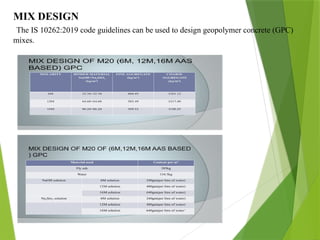
MIX DESIGN
The IS 10262:2019 code guidelines can be used to design geopolymer concrete (GPC)
mixes.
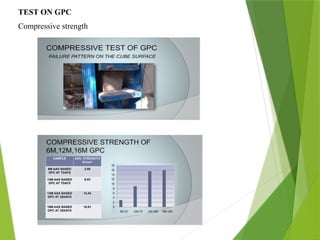
TEST ON GPC
Compressive strength
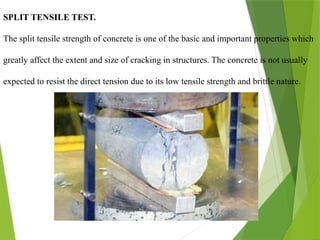
SPLIT TENSILE TEST.
The split tensile strength of concrete is one of the basic and important properties which
greatly affect the extent and size of cracking in structures. The concrete is not usually
expected to resist the direct tension due to its low tensile strength and brittle nature.
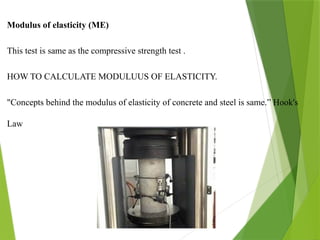
Modulus of elasticity (ME)
This test is same as the compressive strength test .
HOW TO CALCULATE MODULUUS OF ELASTICITY.
"Concepts behind the modulus of elasticity of concrete and steel is same.” Hook's
Law
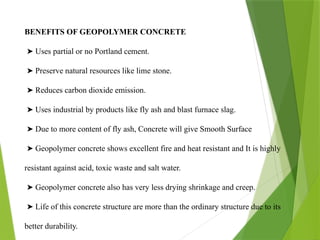
BENEFITS OF GEOPOLYMER CONCRETE
Uses partial or no Portland cement.
➤
Preserve natural resources like lime stone.
➤
Reduces carbon dioxide emission.
➤
Uses industrial by products like fly ash and blast furnace slag.
➤
Due to more content of fly ash, Concrete will give Smooth Surface
➤
Geopolymer concrete shows excellent fire and heat resistant and It is highly
➤
resistant against acid, toxic waste and salt water.
Geopolymer concrete also has very less drying shrinkage and creep.
➤
Life of this concrete structure are more than the ordinary structure due to its
➤
better durability.
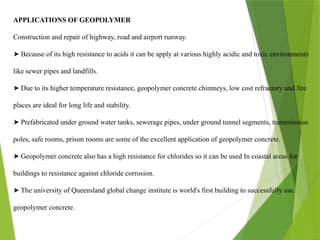
APPLICATIONS OF GEOPOLYMER
Construction and repair of highway, road and airport runway.
Because of its high resistance to acids it can be apply at various highly acidic and toxic environments
➤
like sewer pipes and landfills.
Due to its higher temperature resistance, geopolymer concrete chimneys, low cost refractory and fire
➤
places are ideal for long life and stability.
Prefabricated under ground water tanks, sewerage pipes, under ground tunnel segments, transmission
➤
poles, safe rooms, prison rooms are some of the excellent application of geopolymer concrete.
Geopolymer concrete also has a high resistance for chlorides so it can be used In coastal areas for
➤
buildings to resistance against chloride corrosion.
The university of Queensland global change institute is world's first building to successfully use
➤
geopolymer concrete.
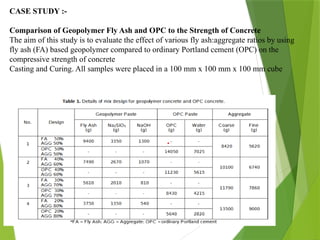
CASE STUDY :-
Comparison of Geopolymer Fly Ash and OPC to the Strength of Concrete
The aim of this study is to evaluate the effect of various fly ash:aggregate ratios by using
fly ash (FA) based geopolymer compared to ordinary Portland cement (OPC) on the
compressive strength of concrete
Casting and Curing. All samples were placed in a 100 mm x 100 mm x 100 mm cube
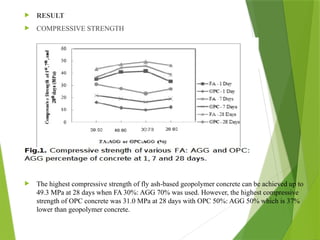
 RESULT
 COMPRESSIVE STRENGTH
 The highest compressive strength of fly ash-based geopolymer concrete can be achieved up to
49.3 MPa at 28 days when FA 30%: AGG 70% was used. However, the highest compressive
strength of OPC concrete was 31.0 MPa at 28 days with OPC 50%: AGG 50% which is 37%
lower than geopolymer concrete.
 DENSITY
The density of fly ash-based geopolymer concrete (2290 – 2460 kg/m3) is denser than
OPC concrete (2200 – 2400 kg/m3) but still comparable to the properties as OPC
concrete.
Water absorption and porosity
 The water absorption of the fly ash-based geopolymer concrete was in the range of
0.4 – 1.0%, meanwhile, for OPC concrete, exhibited water absorption of 1.3 – 2.5%.
OPC concrete has high porosity concrete of 3.0-5.1%, meanwhile for fly ash-based
geopolymer concrete, the porosity was in the lower range of 1.0 – 1.9%.
CONCLUSION
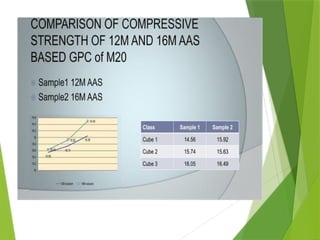
As we conducted the experiment on cubes of
➤
different molarity of 6M, 12M, 16M NaOH
solution. And experiment suggests that as we
increase the molarity, strength of concrete is also
increases.
Geopolymer concrete is more suitable for
➤
precast concreting than on-site concreting due to
following reasons:-As it requires steam curing,
which may not available at site.
NaOH is very sensitive when it comes in
➤
contact with air. So, it will be difficult for
labours to work with it.
As GPC have less setting time, So it should
➤
not be transported and it have to be prepared on
site.
TEST ON GPC
COMPRESSIVE AND BENDING TEST
https://youtu.be/rcYWCc_Bv0E?si=RkPpfn8QpdLzXT0S
OPPORTUNITIES
https://youtu.be/VG5TKYXIiH8?si=MpoWq9DZk_k2PvyV

CT PPT FINAL. Concrete technology for engg

  • 1.
    CONCRETE TECHNOLOGY DAYANANDA SAGARACADEMY OF TECHONOLOGY AND MANAGEMENT BCV503 MATERIALS,REQUIREMENT MIX PROPORTION & PROPERTIES OF GEO POLYMER CONCRETE SUBMITTED BY: SUBMITTED TO: KIRAN 1DT23CV411 PROF. VINAYAK A HOSUR NITHIN B 1DT23CV412 Dept. of civil engineering NITHISHA B 1DT23CV413 NITISH NAIDU 1DT23CV414 PREM BIRADAR 1DT23CV415 PRITHVI SINGH 1DT23CV416
  • 2.
    Geopolymer concrete Geopolymer concreteis an innovative, eco- friendly construction material. It is used as replacement of cement concrete. In geopolymer concrete cement is not used as a binding material. Fly ash, silica-fume, or GGBS, along with alkali solution are used as binders.
  • 3.
    WHY GEOPOLYMER CONCRETE? Reducesthe demand of OPC which leads CO2 emission. Utilise waste materials from industries such as fly ash, silica-fume, GGBS. Protect water bodies from contamination due to fly ash disposal. Conserve acres of land that would have been used for coal combustion products disposal. Produce a more durable infrastructure.
  • 4.
    CONSTITUENTS Coarse aggregate: Fine aggregate- sand or bottom ash can be used: Admixture - super plasticizers(naphthalene based or naphthalene sulphonate based). Alkaline activators -Alkaline activation is a process of mixing powdery aluminosilicate with an alkaline activator: It produce a paste which sets and hardens within short duration
  • 5.
    Alkaline activators commonlyused are sodium or potassium hydroxide. -They are used in combination with sodium silicate(water glass) or potassium silicate solution. -NaOH and Na2SiO3 are more commonly used as it leads to higher geopolymerisation rate. -K2SiO3 solution rarely used because of high cost and lack of easy availability. -Alkali hydroxide is used for dissolution and sodium-silicate solution as binder.
  • 6.
    Fly ash Combustion by-productof coal in coal fired power plants. GGBS A mineral admixture of silicates and aluminates of Ca and other bases, same main chemical constituents as OPC but in different proportions improves compressive strength of GPU. Silica fume Also called as micro silica or condensed silica fume-produced during manufacture of silicon by electric arc furnace.
  • 7.
    TYPES OF GEOPOLYMER Slagbased geopolymer Slag is a mixture of metal oxides and silicon dioxide transparent by-product material formed in the processing of melting iron ore. -OPC replacement with slag improve workability and reduce lifecycle costs it also increase its compressive strength-corex slag, steel slag, iron blast furnace slag are examples Rock based geopolymer -MK-750 in the slag based geopolymer replaced by natural rock forming minerals forms this geopolymer -feldspar and quartz are natural rock forming minerals
  • 8.
    * Fly ashbased geopolymer improves workability and increase compressive strength -reduce cost of OPC along with CO2 emission-reduce drying shrinkage -class F fly ash used commonly Alkali activated geopolymer: Heat curing at 60 to 80 °c is done. Into 1:2 aluminosilicate gel fly ash particles are embedded. Slag based geopolymer: It contains silicate, blast furnace slag and fly ash Ferro-silicate based geopolymer -same properties as that of rock based geopolymers -has a red color-high iron oxide content
  • 9.
    MIX DESIGN The IS10262:2019 code guidelines can be used to design geopolymer concrete (GPC) mixes.
  • 10.
  • 13.
    SPLIT TENSILE TEST. Thesplit tensile strength of concrete is one of the basic and important properties which greatly affect the extent and size of cracking in structures. The concrete is not usually expected to resist the direct tension due to its low tensile strength and brittle nature.
  • 14.
    Modulus of elasticity(ME) This test is same as the compressive strength test . HOW TO CALCULATE MODULUUS OF ELASTICITY. "Concepts behind the modulus of elasticity of concrete and steel is same.” Hook's Law
  • 15.
    BENEFITS OF GEOPOLYMERCONCRETE Uses partial or no Portland cement. ➤ Preserve natural resources like lime stone. ➤ Reduces carbon dioxide emission. ➤ Uses industrial by products like fly ash and blast furnace slag. ➤ Due to more content of fly ash, Concrete will give Smooth Surface ➤ Geopolymer concrete shows excellent fire and heat resistant and It is highly ➤ resistant against acid, toxic waste and salt water. Geopolymer concrete also has very less drying shrinkage and creep. ➤ Life of this concrete structure are more than the ordinary structure due to its ➤ better durability.
  • 16.
    APPLICATIONS OF GEOPOLYMER Constructionand repair of highway, road and airport runway. Because of its high resistance to acids it can be apply at various highly acidic and toxic environments ➤ like sewer pipes and landfills. Due to its higher temperature resistance, geopolymer concrete chimneys, low cost refractory and fire ➤ places are ideal for long life and stability. Prefabricated under ground water tanks, sewerage pipes, under ground tunnel segments, transmission ➤ poles, safe rooms, prison rooms are some of the excellent application of geopolymer concrete. Geopolymer concrete also has a high resistance for chlorides so it can be used In coastal areas for ➤ buildings to resistance against chloride corrosion. The university of Queensland global change institute is world's first building to successfully use ➤ geopolymer concrete.
  • 17.
    CASE STUDY :- Comparisonof Geopolymer Fly Ash and OPC to the Strength of Concrete The aim of this study is to evaluate the effect of various fly ash:aggregate ratios by using fly ash (FA) based geopolymer compared to ordinary Portland cement (OPC) on the compressive strength of concrete Casting and Curing. All samples were placed in a 100 mm x 100 mm x 100 mm cube
  • 18.
     RESULT  COMPRESSIVESTRENGTH  The highest compressive strength of fly ash-based geopolymer concrete can be achieved up to 49.3 MPa at 28 days when FA 30%: AGG 70% was used. However, the highest compressive strength of OPC concrete was 31.0 MPa at 28 days with OPC 50%: AGG 50% which is 37% lower than geopolymer concrete.
  • 19.
     DENSITY The densityof fly ash-based geopolymer concrete (2290 – 2460 kg/m3) is denser than OPC concrete (2200 – 2400 kg/m3) but still comparable to the properties as OPC concrete. Water absorption and porosity  The water absorption of the fly ash-based geopolymer concrete was in the range of 0.4 – 1.0%, meanwhile, for OPC concrete, exhibited water absorption of 1.3 – 2.5%. OPC concrete has high porosity concrete of 3.0-5.1%, meanwhile for fly ash-based geopolymer concrete, the porosity was in the lower range of 1.0 – 1.9%.
  • 20.
    CONCLUSION As we conductedthe experiment on cubes of ➤ different molarity of 6M, 12M, 16M NaOH solution. And experiment suggests that as we increase the molarity, strength of concrete is also increases. Geopolymer concrete is more suitable for ➤ precast concreting than on-site concreting due to following reasons:-As it requires steam curing, which may not available at site. NaOH is very sensitive when it comes in ➤ contact with air. So, it will be difficult for labours to work with it. As GPC have less setting time, So it should ➤ not be transported and it have to be prepared on site.
  • 21.
    TEST ON GPC COMPRESSIVEAND BENDING TEST https://youtu.be/rcYWCc_Bv0E?si=RkPpfn8QpdLzXT0S OPPORTUNITIES https://youtu.be/VG5TKYXIiH8?si=MpoWq9DZk_k2PvyV