EARTH CRUST AND ITS COMPOSITION
DR. S.H.SINGH
Did you know………..?????
Earth is over 4.5 billion years old
The continents move and have joined together to create supercontinen
Geology is the study of the earth (geo means earth, and ology
means study of).
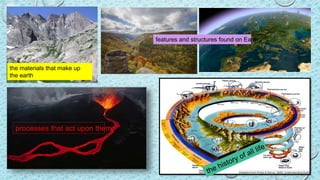
the materials that make up
the earth
features and structures found on Earth
processes that act upon them
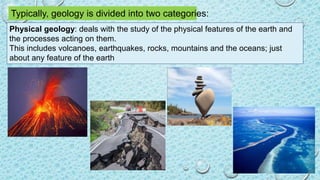
Typically, geology is divided into two categories:
Physical geology: deals with the study of the physical features of the earth and
the processes acting on them.
This includes volcanoes, earthquakes, rocks, mountains and the oceans; just
about any feature of the earth
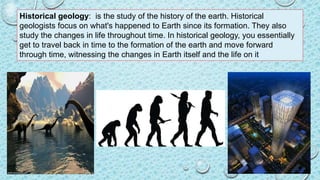
Historical geology: is the study of the history of the earth. Historical
geologists focus on what's happened to Earth since its formation. They also
study the changes in life throughout time. In historical geology, you essentially
get to travel back in time to the formation of the earth and move forward
through time, witnessing the changes in Earth itself and the life on it
H
I
S
T
O
R
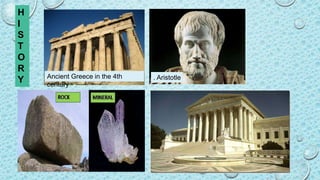
Y Ancient Greece in the 4th
century
. Aristotle
17th century: fossils played a key role in the debate about the age of Earth
18th century: two main
theories
-all rocks were deposited by
the oceans during flooding
events.
- some rocks were formed
through heat or fire
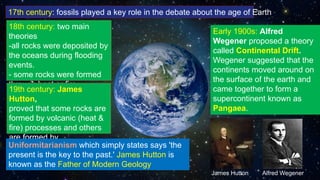
19th century: James
Hutton,
proved that some rocks are
formed by volcanic (heat &
fire) processes and others
are formed by
sedimentation.Uniformitarianism which simply states says 'the
present is the key to the past.' James Hutton is
known as the Father of Modern Geology
Early 1900s: Alfred
Wegener proposed a theory
called Continental Drift.
Wegener suggested that the
continents moved around on
the surface of the earth and
came together to form a
supercontinent known as
Pangaea.
James Hutton Alfred Wegener
INTRODUCTION
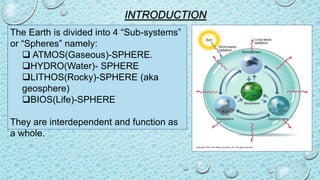
The Earth is divided into 4 “Sub-systems”
or “Spheres” namely:
 ATMOS(Gaseous)-SPHERE.
HYDRO(Water)- SPHERE
LITHOS(Rocky)-SPHERE (aka
geosphere)
BIOS(Life)-SPHERE
They are interdependent and function as
a whole.
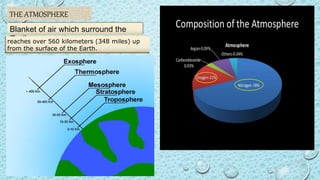
THE ATMOSPHERE
Blanket of air which surround the
Earthreaches over 560 kilometers (348 miles) up
from the surface of the Earth.
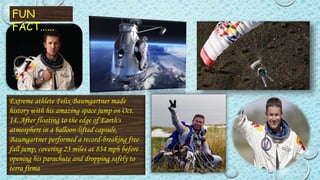
FUN
FACT……
Extreme athlete Felix Baumgartner made
history with his amazing space jump on Oct.
14. After floating to the edge of Earth's
atmosphere in a balloon-lifted capsule,
Baumgartner performed a record-breaking free-
fall jump, covering 23 miles at 834 mph before
opening his parachute and dropping safely to
terra firma
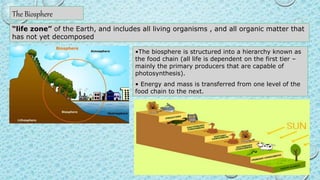
The Biosphere
“life zone” of the Earth, and includes all living organisms , and all organic matter that
has not yet decomposed
•The biosphere is structured into a hierarchy known as
the food chain (all life is dependent on the first tier –
mainly the primary producers that are capable of
photosynthesis).
• Energy and mass is transferred from one level of the
food chain to the next.
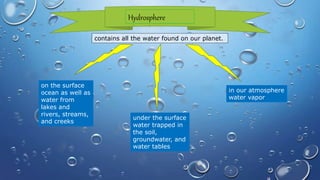
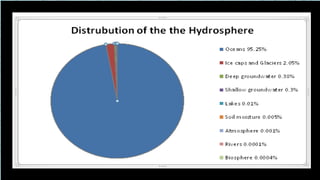
contains all the water found on our planet.
Hydrosphere
on the surface
ocean as well as
water from
lakes and
rivers, streams,
and creeks
under the surface
water trapped in
the soil,
groundwater, and
water tables
in our atmosphere
water vapor
Lithosphere
The lithosphere (from the Greek [lithos] for "rocky" + [sphaira] for "sphere") is the
rigid outermost shell of a rocky planet.
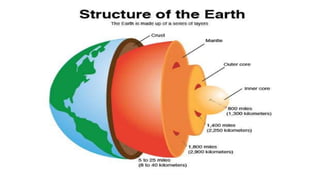
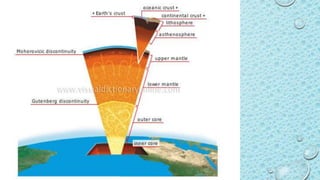
It consists of three main layers: crust, mantle and core.
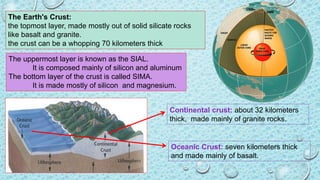
The Earth's Crust:
the topmost layer, made mostly out of solid silicate rocks
like basalt and granite.
the crust can be a whopping 70 kilometers thick
The uppermost layer is known as the SIAL.
It is composed mainly of silicon and aluminum
The bottom layer of the crust is called SIMA.
It is made mostly of silicon and magnesium.
Continental crust: about 32 kilometers
thick, made mainly of granite rocks.
Oceanic Crust: seven kilometers thick
and made mainly of basalt.
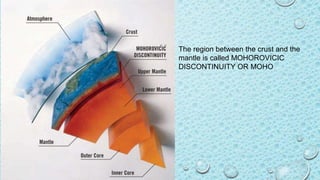
The region between the crust and the
mantle is called MOHOROVICIC
DISCONTINUITY OR MOHO
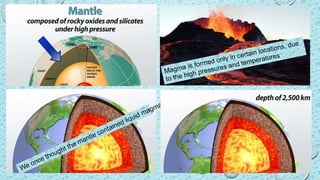
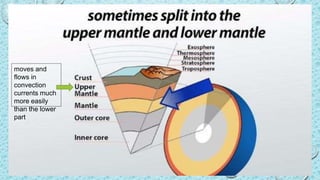
moves and
flows in
convection
currents much
more easily
than the lower
part
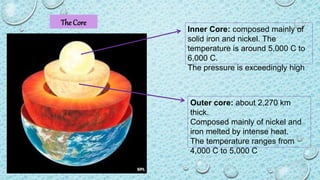
The Core
Outer core: about 2,270 km
thick.
Composed mainly of nickel and
iron melted by intense heat.
The temperature ranges from
4,000 C to 5,000 C
Inner Core: composed mainly of
solid iron and nickel. The
temperature is around 5,000 C to
6,000 C.
The pressure is exceedingly high
Geologya nd soil science

Geologya nd soil science

  • 1.
    EARTH CRUST ANDITS COMPOSITION DR. S.H.SINGH
  • 2.
    Did you know………..????? Earthis over 4.5 billion years old The continents move and have joined together to create supercontinen Geology is the study of the earth (geo means earth, and ology means study of).
  • 3.
    the materials thatmake up the earth features and structures found on Earth processes that act upon them
  • 4.
    Typically, geology isdivided into two categories: Physical geology: deals with the study of the physical features of the earth and the processes acting on them. This includes volcanoes, earthquakes, rocks, mountains and the oceans; just about any feature of the earth
  • 5.
    Historical geology: isthe study of the history of the earth. Historical geologists focus on what's happened to Earth since its formation. They also study the changes in life throughout time. In historical geology, you essentially get to travel back in time to the formation of the earth and move forward through time, witnessing the changes in Earth itself and the life on it
  • 6.
    H I S T O R Y Ancient Greecein the 4th century . Aristotle
  • 7.
    17th century: fossilsplayed a key role in the debate about the age of Earth 18th century: two main theories -all rocks were deposited by the oceans during flooding events. - some rocks were formed through heat or fire 19th century: James Hutton, proved that some rocks are formed by volcanic (heat & fire) processes and others are formed by sedimentation.Uniformitarianism which simply states says 'the present is the key to the past.' James Hutton is known as the Father of Modern Geology Early 1900s: Alfred Wegener proposed a theory called Continental Drift. Wegener suggested that the continents moved around on the surface of the earth and came together to form a supercontinent known as Pangaea. James Hutton Alfred Wegener
  • 8.
    INTRODUCTION The Earth isdivided into 4 “Sub-systems” or “Spheres” namely:  ATMOS(Gaseous)-SPHERE. HYDRO(Water)- SPHERE LITHOS(Rocky)-SPHERE (aka geosphere) BIOS(Life)-SPHERE They are interdependent and function as a whole.
  • 9.
    THE ATMOSPHERE Blanket ofair which surround the Earthreaches over 560 kilometers (348 miles) up from the surface of the Earth.
  • 10.
    FUN FACT…… Extreme athlete FelixBaumgartner made history with his amazing space jump on Oct. 14. After floating to the edge of Earth's atmosphere in a balloon-lifted capsule, Baumgartner performed a record-breaking free- fall jump, covering 23 miles at 834 mph before opening his parachute and dropping safely to terra firma
  • 11.
    The Biosphere “life zone”of the Earth, and includes all living organisms , and all organic matter that has not yet decomposed •The biosphere is structured into a hierarchy known as the food chain (all life is dependent on the first tier – mainly the primary producers that are capable of photosynthesis). • Energy and mass is transferred from one level of the food chain to the next.
  • 12.
    contains all thewater found on our planet. Hydrosphere on the surface ocean as well as water from lakes and rivers, streams, and creeks under the surface water trapped in the soil, groundwater, and water tables in our atmosphere water vapor
  • 14.
    Lithosphere The lithosphere (fromthe Greek [lithos] for "rocky" + [sphaira] for "sphere") is the rigid outermost shell of a rocky planet. It consists of three main layers: crust, mantle and core.
  • 16.
    The Earth's Crust: thetopmost layer, made mostly out of solid silicate rocks like basalt and granite. the crust can be a whopping 70 kilometers thick The uppermost layer is known as the SIAL. It is composed mainly of silicon and aluminum The bottom layer of the crust is called SIMA. It is made mostly of silicon and magnesium. Continental crust: about 32 kilometers thick, made mainly of granite rocks. Oceanic Crust: seven kilometers thick and made mainly of basalt.
  • 18.
    The region betweenthe crust and the mantle is called MOHOROVICIC DISCONTINUITY OR MOHO
  • 20.
    moves and flows in convection currentsmuch more easily than the lower part
  • 21.
    The Core Outer core:about 2,270 km thick. Composed mainly of nickel and iron melted by intense heat. The temperature ranges from 4,000 C to 5,000 C Inner Core: composed mainly of solid iron and nickel. The temperature is around 5,000 C to 6,000 C. The pressure is exceedingly high