Group-3
Topic: Geodesy and its types
Group Members:
Wissam Salman BCE213017
Shaban Khan BCE213014
Aadil Hassan BCE213093
Muhammad Haseeb Afsar BCE213001
Table of Contents
 Geodesy
 Who is a geodesist and what are his responsibilities ?
 Evolution in geodesy
Geodesy
 The geodetic surveying is that type of surveying which takes into account the
curvature of the earth’s surface for achieving high precision using principles of higher
degree of accuracy in linear and angular observations is achieved. It generally
extends over large areas. The geodetic surveys extend over large areas and lines
connecting any two points on the surface of the earth are treated as arcs. For
calculating their projected distances on the plans or maps, the correction for the
earth’s curvature is applied to the measured distances. The angles between
the curved lines are treated as spherical angles. A knowledge
of spherical trigonometry is necessary for making measurements for
the geodetic surveys.
Who is a geodesist and what are his
responsibilities?
 A geodesist is a person who does geodetic survey.
 By using GPS, geodesists can monitor the movement of a site 24 hours a
seven days a week.
 To measure points on the Earth’s surface, geodesists assign coordinates
(similar to a unique address) to points all over the Earth.
 He can determine land boundaries and improve transportation and
safety.
 A geodesist measures and considers the following properties: its
shape, its orientation in space, and its gravity field— as well as the
these properties with time.
Evolution in geodesy
 In the past, geodesists determined the coordinates of points by using
Earth-based surveying tools to measure the distances between points.
 Today, geodesists use space-based tools like the Global Positioning
System (GPS) to measure points on the Earth’s surface.
 Geodesists must accurately define the coordinates of points on the
surface of the Earth in a consistent manner. A set of accurately measured
points is the basis for the National Spatial Reference System, which
allows different kinds of maps to be consistent with one another.
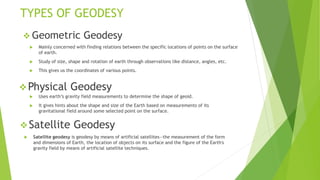
TYPES OF GEODESY
 Mainly concerned with finding relations between the specific locations of points on the surface
of earth.
 Study of size, shape and rotation of earth through observations like distance, angles, etc.
 This gives us the coordinates of various points.
Satellite Geodesy
Physical Geodesy
 Uses earth’s gravity field measurements to determine the shape of geoid.
 It gives hints about the shape and size of the Earth based on measurements of its
gravitational field around some selected point on the surface.
 Geometric Geodesy
 Satellite geodesy is geodesy by means of artificial satellites—the measurement of the form
and dimensions of Earth, the location of objects on its surface and the figure of the Earth's
gravity field by means of artificial satellite techniques.
USES OF GEODESY
 Boundary determination
 Plays role in determining the coordinates of border markers between states or
administrative boundaries.
 Depends upon the accurate positioning.
Engineering Construction
 When constructing any engineering projects(roads, bridges, etc.), it is necessary to
determine their exact locations by defining their coordinates.
USES OF GEODESY
 Topographic Mapping
 With several geodetic stations, the vertical and horizontal coordinates of an area
are calculated to know the topography.
 Traffic and Transportation
 A high efficiency and accurate satellite navigation and positioning make a
significant decrease in accidents and a vast improvement in transport efficiency
 Space Sciences
 To launch, monitor, remotely control and spacecraft return, a precise geodetic
coordinate system, position of surface points and global gravity field parameters of
the surface points are required.
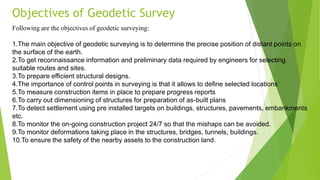
Following are the objectives of geodetic surveying:
1.The main objective of geodetic surveying is to determine the precise position of distant points on
the surface of the earth.
2.To get reconnaissance information and preliminary data required by engineers for selecting
suitable routes and sites.
3.To prepare efficient structural designs.
4.The importance of control points in surveying is that it allows to define selected locations
5.To measure construction items in place to prepare progress reports
6.To carry out dimensioning of structures for preparation of as-built plans
7.To detect settlement using pre installed targets on buildings, structures, pavements, embankments
etc.
8.To monitor the on-going construction project 24/7 so that the mishaps can be avoided.
9.To monitor deformations taking place in the structures, bridges, tunnels, buildings.
10.To ensure the safety of the nearby assets to the construction land.
Objectives of Geodetic Survey
Geodetic Datums
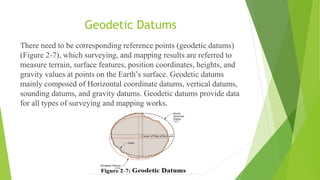
There need to be corresponding reference points (geodetic datums)
(Figure 2-7), which surveying, and mapping results are referred to
measure terrain, surface features, position coordinates, heights, and
gravity values at points on the Earth’s surface. Geodetic datums
mainly composed of Horizontal coordinate datums, vertical datums,
sounding datums, and gravity datums. Geodetic datums provide data
for all types of surveying and mapping works.
Geodetic Control Networks
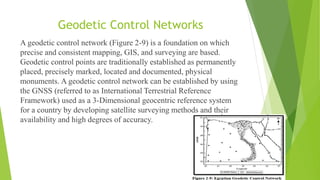
A geodetic control network (Figure 2-9) is a foundation on which
precise and consistent mapping, GIS, and surveying are based.
Geodetic control points are traditionally established as permanently
placed, precisely marked, located and documented, physical
monuments. A geodetic control network can be established by using
the GNSS (referred to as International Terrestrial Reference
Framework) used as a 3-Dimensional geocentric reference system
for a country by developing satellite surveying methods and their
availability and high degrees of accuracy.
Geographic information system (GIS)
data
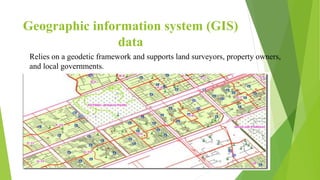
Relies on a geodetic framework and supports land surveyors, property owners,
and local governments.
Geosciences and Environmental
Applications
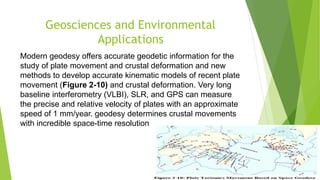
Modern geodesy offers accurate geodetic information for the
study of plate movement and crustal deformation and new
methods to develop accurate kinematic models of recent plate
movement (Figure 2-10) and crustal deformation. Very long
baseline interferometry (VLBI), SLR, and GPS can measure
the precise and relative velocity of plates with an approximate
speed of 1 mm/year. geodesy determines crustal movements
with incredible space-time resolution
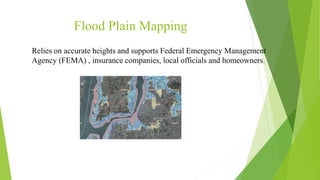
Flood Plain Mapping
Relies on accurate heights and supports Federal Emergency Management
Agency (FEMA) , insurance companies, local officials and homeowners.

geodesy-1 (1).pptx

  • 1.
    Group-3 Topic: Geodesy andits types Group Members: Wissam Salman BCE213017 Shaban Khan BCE213014 Aadil Hassan BCE213093 Muhammad Haseeb Afsar BCE213001
  • 2.
    Table of Contents Geodesy  Who is a geodesist and what are his responsibilities ?  Evolution in geodesy
  • 3.
    Geodesy  The geodeticsurveying is that type of surveying which takes into account the curvature of the earth’s surface for achieving high precision using principles of higher degree of accuracy in linear and angular observations is achieved. It generally extends over large areas. The geodetic surveys extend over large areas and lines connecting any two points on the surface of the earth are treated as arcs. For calculating their projected distances on the plans or maps, the correction for the earth’s curvature is applied to the measured distances. The angles between the curved lines are treated as spherical angles. A knowledge of spherical trigonometry is necessary for making measurements for the geodetic surveys.
  • 4.
    Who is ageodesist and what are his responsibilities?  A geodesist is a person who does geodetic survey.  By using GPS, geodesists can monitor the movement of a site 24 hours a seven days a week.  To measure points on the Earth’s surface, geodesists assign coordinates (similar to a unique address) to points all over the Earth.  He can determine land boundaries and improve transportation and safety.  A geodesist measures and considers the following properties: its shape, its orientation in space, and its gravity field— as well as the these properties with time.
  • 5.
    Evolution in geodesy In the past, geodesists determined the coordinates of points by using Earth-based surveying tools to measure the distances between points.  Today, geodesists use space-based tools like the Global Positioning System (GPS) to measure points on the Earth’s surface.  Geodesists must accurately define the coordinates of points on the surface of the Earth in a consistent manner. A set of accurately measured points is the basis for the National Spatial Reference System, which allows different kinds of maps to be consistent with one another.
  • 6.
    TYPES OF GEODESY Mainly concerned with finding relations between the specific locations of points on the surface of earth.  Study of size, shape and rotation of earth through observations like distance, angles, etc.  This gives us the coordinates of various points. Satellite Geodesy Physical Geodesy  Uses earth’s gravity field measurements to determine the shape of geoid.  It gives hints about the shape and size of the Earth based on measurements of its gravitational field around some selected point on the surface.  Geometric Geodesy  Satellite geodesy is geodesy by means of artificial satellites—the measurement of the form and dimensions of Earth, the location of objects on its surface and the figure of the Earth's gravity field by means of artificial satellite techniques.
  • 7.
    USES OF GEODESY Boundary determination  Plays role in determining the coordinates of border markers between states or administrative boundaries.  Depends upon the accurate positioning. Engineering Construction  When constructing any engineering projects(roads, bridges, etc.), it is necessary to determine their exact locations by defining their coordinates.
  • 8.
    USES OF GEODESY Topographic Mapping  With several geodetic stations, the vertical and horizontal coordinates of an area are calculated to know the topography.  Traffic and Transportation  A high efficiency and accurate satellite navigation and positioning make a significant decrease in accidents and a vast improvement in transport efficiency  Space Sciences  To launch, monitor, remotely control and spacecraft return, a precise geodetic coordinate system, position of surface points and global gravity field parameters of the surface points are required.
  • 9.
    Following are theobjectives of geodetic surveying: 1.The main objective of geodetic surveying is to determine the precise position of distant points on the surface of the earth. 2.To get reconnaissance information and preliminary data required by engineers for selecting suitable routes and sites. 3.To prepare efficient structural designs. 4.The importance of control points in surveying is that it allows to define selected locations 5.To measure construction items in place to prepare progress reports 6.To carry out dimensioning of structures for preparation of as-built plans 7.To detect settlement using pre installed targets on buildings, structures, pavements, embankments etc. 8.To monitor the on-going construction project 24/7 so that the mishaps can be avoided. 9.To monitor deformations taking place in the structures, bridges, tunnels, buildings. 10.To ensure the safety of the nearby assets to the construction land. Objectives of Geodetic Survey
  • 10.
    Geodetic Datums There needto be corresponding reference points (geodetic datums) (Figure 2-7), which surveying, and mapping results are referred to measure terrain, surface features, position coordinates, heights, and gravity values at points on the Earth’s surface. Geodetic datums mainly composed of Horizontal coordinate datums, vertical datums, sounding datums, and gravity datums. Geodetic datums provide data for all types of surveying and mapping works.
  • 11.
    Geodetic Control Networks Ageodetic control network (Figure 2-9) is a foundation on which precise and consistent mapping, GIS, and surveying are based. Geodetic control points are traditionally established as permanently placed, precisely marked, located and documented, physical monuments. A geodetic control network can be established by using the GNSS (referred to as International Terrestrial Reference Framework) used as a 3-Dimensional geocentric reference system for a country by developing satellite surveying methods and their availability and high degrees of accuracy.
  • 12.
    Geographic information system(GIS) data Relies on a geodetic framework and supports land surveyors, property owners, and local governments.
  • 13.
    Geosciences and Environmental Applications Moderngeodesy offers accurate geodetic information for the study of plate movement and crustal deformation and new methods to develop accurate kinematic models of recent plate movement (Figure 2-10) and crustal deformation. Very long baseline interferometry (VLBI), SLR, and GPS can measure the precise and relative velocity of plates with an approximate speed of 1 mm/year. geodesy determines crustal movements with incredible space-time resolution
  • 14.
    Flood Plain Mapping Relieson accurate heights and supports Federal Emergency Management Agency (FEMA) , insurance companies, local officials and homeowners.