

CLINICAL
MANAGEMENT OF PAIN
INTRODUCTION
TYPES OF PAIN
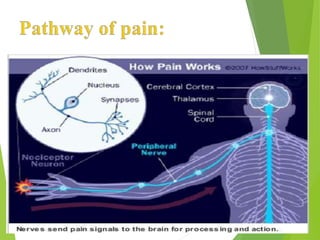
PATHWAYOF PAIN
MANAGEMENT OF PAIN
PAIN
Pain can be defined as an unpleasant sensory and
emotional experience that is associated with
actual or potential tissue damage.
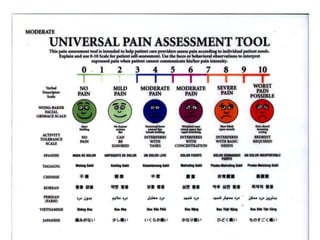
Accurate assessment of pain is necessary if pain
management is to be effective. Patients with pain
are often undertreated.
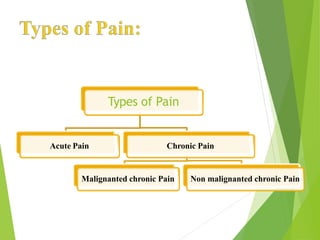
Types of Pain
Acute Pain Chronic Pain
Malignanted chronic Pain Non malignanted chronic Pain
Acute pain is of short duration and lasts less
than 3 to 6 months. Intensity of acute pain is
from mild to severe.
Causes of acute pain include postoperative
pain, procedural pain, and traumatic pain.
Acute pain usually sub-sides when the injury
heals.
Malignanted chronic pain:
Chronic pain associated with malignancy includes the
pain of cancer, acquired immunodeficiency syndrome
(AIDS), multiple sclerosis, sickle cell disease, and
end-stage organ system failure.
Non malignanted chronic pain:
The exact cause of this pain is unknown but it is
associated with various musculoskeletal disorder
rheumatoid arthritis, and osteoarthritis ect
Different types of stimuli
Chemical stimuli Exogenous
Endogenous
Thermal
Mechanical
Physiologic Signs of pain
Result of catecholamine release and activation of the
sympathetic nervous system.
Systemic Changes
Cardiovascular system - heart rate & BP.
Pulmonary sys - resp. rate, shallow breathing.
Musculoskeletal sys - tense muscles, M. tremors.
Immune sys - resistance, stress leukogram.
Neuroendocrine sys - catabolism, anabolism.
Digestive sys - vomiting, diarrhoea.
 Degree of Pain
 Mild pain.
 Moderate pain.
It is the common degree of pain that is treated.
 Severe pain
it is intolerable
unprovoked vocalization
chance of self mutilation
Why pain management ?
 Feel better
 Physiologic changes that accompany
pain.
 Should be able to eliminate pathologic
pain
 Pain free sleep
12 – 24 hr. post operative pain
management is important.
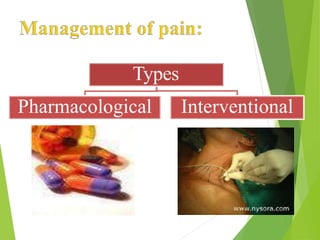
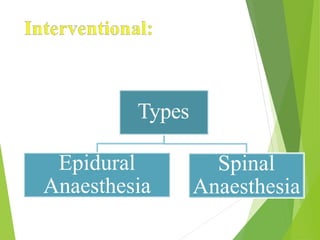
Types
Pharmacological Interventional
Non pharmacologic approach
1. Keep patient clean & dry.
2. Keep the patient warm.
3. Room with moderate temperature and
humidity.
4. Well padded place to sleep.
5. Patients surrounding should be pleasant &
quiet.
6. Human contact
7. Acupressure, acupuncture, massage,
manipulation stimulate A-beta nerve fibers.
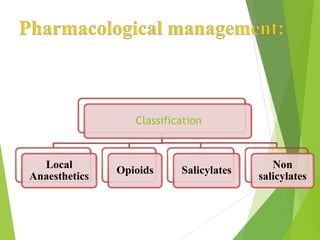
Classification
Local
Anaesthetics
Opioids Salicylates
Non
salicylates
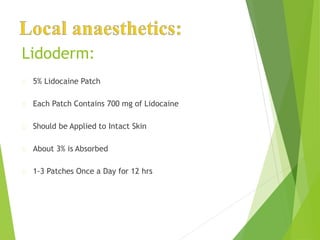
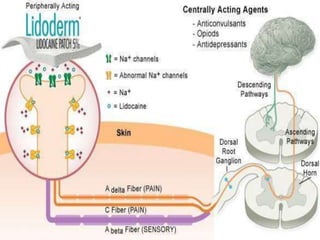
Lidoderm:
5% Lidocaine Patch
Each Patch Contains 700 mg of Lidocaine
Should be Applied to Intact Skin
About 3% is Absorbed
1-3 Patches Once a Day for 12 hrs
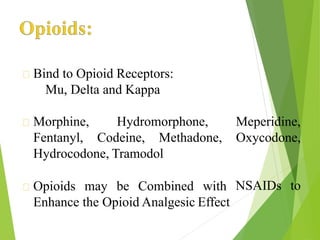
Bind to Opioid Receptors:
Mu, Delta and Kappa
Meperidine,
Oxycodone,
NSAIDs to
Morphine, Hydromorphone,
Fentanyl, Codeine, Methadone,
Hydrocodone, Tramodol
Opioids may be Combined with
Enhance the Opioid Analgesic Effect
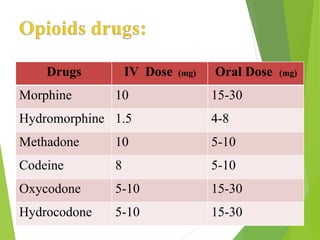
Drugs IV Dose (mg) Oral Dose (mg)
Morphine 10 15-30
Hydromorphine 1.5 4-8
Methadone 10 5-10
Codeine 8 5-10
Oxycodone 5-10 15-30
Hydrocodone 5-10 15-30
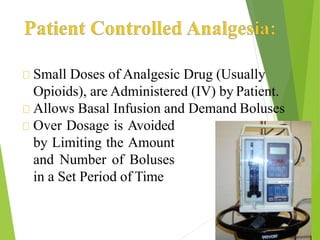
Small Doses of Analgesic Drug (Usually
Opioids), are Administered (IV) by Patient.
Allows Basal Infusion and Demand Boluses
Over Dosage is Avoided
by Limiting the Amount
and Number of Boluses
in a Set Period of Time
The salicylates include aspirin (acetylsalicylic
acid) and related drugs, such as magnesium
salicylate and sodium salicylate. The salicylates
have analgesic (relieves pain), antipyretic(reduces
elevated body tem-perature), and anti-
inflammatory effects.
Eg . Aspirin
Buffered aspirin
Magnesium salicylates
Sodium salicylates
The major drug classified as a non salicylate is
acetaminophen , (Panadol).
It is the most widely used aspirin substitute for
patients who are allergic to aspirin or who
experience extreme gastric upset when taking
aspirin.
Nonsteroidal anti-inflammatory
drugs(NSAIDs)
Inhibition of prostaglandin synthesis by
inhibiting cyclooxygenase enzyme (COX).
NSAIDs vary in their ability to inhibit COX 1 &
2
COX 2 inhibition will provide enhanced
analgesia.
Eg. Ketoprofen, Meloxicam, Flunixin
meglumine.
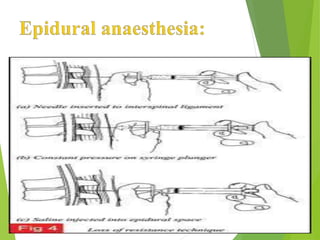
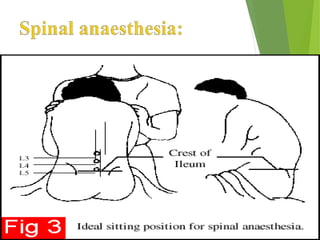
Types
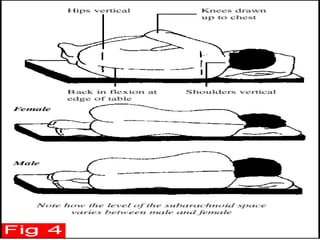
Epidural
Anaesthesia
Spinal
Anaesthesia
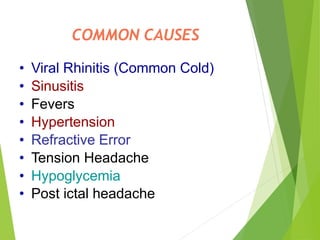
COMMON CAUSES
• Viral Rhinitis (Common Cold)
• Sinusitis
• Fevers
• Hypertension
• Refractive Error
• Tension Headache
• Hypoglycemia
• Post ictal headache
SPECIFIC CAUSES
• Migraine Headache
• Cluster Headache
• Temporal Arteritis
• Post traumatic Headache
• Thunderclap Headache
(Subarachnoid Haemorrhage)
Specific Causes
Contd..
•Intracerebral Haemorrahage
•Subdural Haematoma
•Brain Abscess
•Primary Brain Tumor
•Metastatic Brain Tumor
•Meningitis
•Hydrocephalus
•Glaucoma
CRANIAL STRUCTURES
SENSITIVE TO PAIN
• The scalp
• Scalp blood supply
• Head and neck muscles
• Great venous sinuses
• Arteries of the meninges
• Larger cerebral arteries
• Pain –sensitive fibers of the fifth, ninth and tenth
cranial nerves
• Parts of the dura mater at the base of the brain
• Migraine occurs commonly in
– Females – 70%
– Males – 30%
• Cluster Headache occurs almost
entirely in men – 90%
• Tension Headache seen equally in
both sexes
Location of Headache
• Hemicranial
• Bi-Temporal
• Occipital
• Frontal
• Peri-Orbital
• Vertex
Nature of Headache
• Constant
• Paroxysmal
• Lancinating
• Throbbing
MIGRAINE HEADACHE
• Familial Disorder characterised by
periodic, Commonly unilateral , often pulsa
tile headache.
• Age of onset
– Begins in childhood , adolescents in early adult
life and diminishes in frequency and severity
during advancing years. (Typically begins in
teenage years and seldom begins after 40yeras
of age)
TYPES
• Classic Migraine or Neurologic Migraine
– Is characterised by aura
• Common Migraine
– Migraine without aura
• Ratio
– Classic Migraine : Common Migraine 1: 5
CLASSIC MIGRAINE
• Prodrome :
– Occurs hours to days before headache and consists
of change in mood, behavior, apetite and cognition.
• Aura :
– Occurs within 1 hour of headache, and is most
commonly visual or sensory
– Visual Aura
• Most Common
• Consist of photopsias, bright flashing lights, scintillating
scotomas, field cuts and fortification spectra (zigzag lines /
Teichopsia)
pain management

pain management

  • 1.
  • 2.
    INTRODUCTION TYPES OF PAIN PATHWAYOFPAIN MANAGEMENT OF PAIN
  • 3.
    PAIN Pain can bedefined as an unpleasant sensory and emotional experience that is associated with actual or potential tissue damage. Accurate assessment of pain is necessary if pain management is to be effective. Patients with pain are often undertreated.
  • 4.
    Types of Pain AcutePain Chronic Pain Malignanted chronic Pain Non malignanted chronic Pain
  • 5.
    Acute pain isof short duration and lasts less than 3 to 6 months. Intensity of acute pain is from mild to severe. Causes of acute pain include postoperative pain, procedural pain, and traumatic pain. Acute pain usually sub-sides when the injury heals.
  • 6.
    Malignanted chronic pain: Chronicpain associated with malignancy includes the pain of cancer, acquired immunodeficiency syndrome (AIDS), multiple sclerosis, sickle cell disease, and end-stage organ system failure. Non malignanted chronic pain: The exact cause of this pain is unknown but it is associated with various musculoskeletal disorder rheumatoid arthritis, and osteoarthritis ect
  • 8.
    Different types ofstimuli Chemical stimuli Exogenous Endogenous Thermal Mechanical
  • 9.
    Physiologic Signs ofpain Result of catecholamine release and activation of the sympathetic nervous system. Systemic Changes Cardiovascular system - heart rate & BP. Pulmonary sys - resp. rate, shallow breathing. Musculoskeletal sys - tense muscles, M. tremors. Immune sys - resistance, stress leukogram. Neuroendocrine sys - catabolism, anabolism. Digestive sys - vomiting, diarrhoea.
  • 10.
     Degree ofPain  Mild pain.  Moderate pain. It is the common degree of pain that is treated.  Severe pain it is intolerable unprovoked vocalization chance of self mutilation
  • 11.
    Why pain management?  Feel better  Physiologic changes that accompany pain.  Should be able to eliminate pathologic pain  Pain free sleep 12 – 24 hr. post operative pain management is important.
  • 12.
  • 13.
    Non pharmacologic approach 1.Keep patient clean & dry. 2. Keep the patient warm. 3. Room with moderate temperature and humidity. 4. Well padded place to sleep. 5. Patients surrounding should be pleasant & quiet. 6. Human contact 7. Acupressure, acupuncture, massage, manipulation stimulate A-beta nerve fibers.
  • 14.
  • 15.
    Lidoderm: 5% Lidocaine Patch EachPatch Contains 700 mg of Lidocaine Should be Applied to Intact Skin About 3% is Absorbed 1-3 Patches Once a Day for 12 hrs
  • 17.
    Bind to OpioidReceptors: Mu, Delta and Kappa Meperidine, Oxycodone, NSAIDs to Morphine, Hydromorphone, Fentanyl, Codeine, Methadone, Hydrocodone, Tramodol Opioids may be Combined with Enhance the Opioid Analgesic Effect
  • 18.
    Drugs IV Dose(mg) Oral Dose (mg) Morphine 10 15-30 Hydromorphine 1.5 4-8 Methadone 10 5-10 Codeine 8 5-10 Oxycodone 5-10 15-30 Hydrocodone 5-10 15-30
  • 19.
    Small Doses ofAnalgesic Drug (Usually Opioids), are Administered (IV) by Patient. Allows Basal Infusion and Demand Boluses Over Dosage is Avoided by Limiting the Amount and Number of Boluses in a Set Period of Time
  • 20.
    The salicylates includeaspirin (acetylsalicylic acid) and related drugs, such as magnesium salicylate and sodium salicylate. The salicylates have analgesic (relieves pain), antipyretic(reduces elevated body tem-perature), and anti- inflammatory effects. Eg . Aspirin Buffered aspirin Magnesium salicylates Sodium salicylates
  • 21.
    The major drugclassified as a non salicylate is acetaminophen , (Panadol). It is the most widely used aspirin substitute for patients who are allergic to aspirin or who experience extreme gastric upset when taking aspirin.
  • 22.
    Nonsteroidal anti-inflammatory drugs(NSAIDs) Inhibition ofprostaglandin synthesis by inhibiting cyclooxygenase enzyme (COX). NSAIDs vary in their ability to inhibit COX 1 & 2 COX 2 inhibition will provide enhanced analgesia. Eg. Ketoprofen, Meloxicam, Flunixin meglumine.
  • 23.
  • 30.
    COMMON CAUSES • ViralRhinitis (Common Cold) • Sinusitis • Fevers • Hypertension • Refractive Error • Tension Headache • Hypoglycemia • Post ictal headache
  • 31.
    SPECIFIC CAUSES • MigraineHeadache • Cluster Headache • Temporal Arteritis • Post traumatic Headache • Thunderclap Headache (Subarachnoid Haemorrhage)
  • 32.
    Specific Causes Contd.. •Intracerebral Haemorrahage •SubduralHaematoma •Brain Abscess •Primary Brain Tumor •Metastatic Brain Tumor •Meningitis •Hydrocephalus •Glaucoma
  • 33.
    CRANIAL STRUCTURES SENSITIVE TOPAIN • The scalp • Scalp blood supply • Head and neck muscles • Great venous sinuses • Arteries of the meninges • Larger cerebral arteries • Pain –sensitive fibers of the fifth, ninth and tenth cranial nerves • Parts of the dura mater at the base of the brain
  • 34.
    • Migraine occurscommonly in – Females – 70% – Males – 30% • Cluster Headache occurs almost entirely in men – 90% • Tension Headache seen equally in both sexes
  • 35.
    Location of Headache •Hemicranial • Bi-Temporal • Occipital • Frontal • Peri-Orbital • Vertex
  • 36.
    Nature of Headache •Constant • Paroxysmal • Lancinating • Throbbing
  • 38.
    MIGRAINE HEADACHE • FamilialDisorder characterised by periodic, Commonly unilateral , often pulsa tile headache. • Age of onset – Begins in childhood , adolescents in early adult life and diminishes in frequency and severity during advancing years. (Typically begins in teenage years and seldom begins after 40yeras of age)
  • 39.
    TYPES • Classic Migraineor Neurologic Migraine – Is characterised by aura • Common Migraine – Migraine without aura • Ratio – Classic Migraine : Common Migraine 1: 5
  • 40.
    CLASSIC MIGRAINE • Prodrome: – Occurs hours to days before headache and consists of change in mood, behavior, apetite and cognition. • Aura : – Occurs within 1 hour of headache, and is most commonly visual or sensory – Visual Aura • Most Common • Consist of photopsias, bright flashing lights, scintillating scotomas, field cuts and fortification spectra (zigzag lines / Teichopsia)