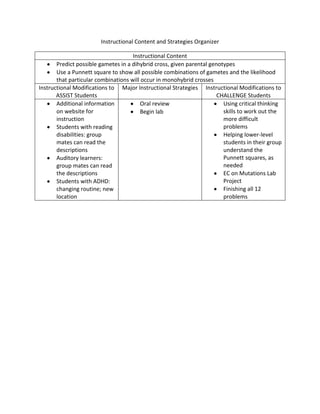
Unit: Genetics – Block 3<br />Introduction <br />Lesson topic: Punnett Squares<br />Length of Lesson: 1.5 hr lab<br />VA Standards of Learning: <br />° BIO 1.i and j– Students will plan and conduct investigations in which appropriate technology is used for gathering and analyzing data and communicating results; utilizing scientific literature<br />° BIO 6.d – Students will investigate and understand how to predict the inheritance of traits based on the Mendelian laws of heredity<br />Cognitive Objectives for All Students:<br />SWBAT predict possible gametes in a dihybrid cross, given parental genotypes<br />SWBAT use a Punnett square to show all possible combinations of gametes and the likelihood that particular combinations will occur in monohybrid crosses<br />SWBAT demonstrate knowledge by completing journal<br />SWBAT demonstrate prior knowledge by Punnett Square practice problem<br />SWBAT participate – at least by listening – in class discussion<br />SWBAT participate in small group Punnett Square lab<br />SWBAT rate themselves on their understanding by discussing with group mates the Punnett Square lab<br />Cognitive Objectives for Some Students:<br />SWBAT complete all crosses<br />SWBAT participate – by contribution – in class discussion<br />SWBAT assist other students in lab work<br />Materials and Advanced Preparation <br />Miller and Levine’s Biology textbook  CITATION Mil08 \l 1033 (Miller & Joseph, 2008): Chapter 11.1 – 11.3<br />Book the computer lab<br />Have computers set to Carter’s Genetics Practice Problems website: http://biology.clc.uc.edu/courses/bio105/geneprob.htm <br />Teaching and Learning Sequence <br />Introduction/Anticipatory Set <br />° Begin with an oral overview of what was taught the day before, answering questions as needed (Reflection – previous day)<br />° Have each group do a Punnett Square and then discuss it (Preparation)<br />Lesson Development <br />° Working in groups (of students with different abilities), have students work through all 12 problems in their journal<br />° Each group must show me their answers before moving on to the next problem (Assistance)<br />Closure <br />° By checking journals, make sure each student feels confident with their ability to complete Punnett Squares (they will only be tested on monohybrid and dihybrid crosses) (Reflection)<br />° Assign chapter 12.4 and 12.5 to read for homework in preparation of the next day’s lesson; mutations lab<br />Homework <br />Assign chapter 12.4 and 12.5 to read for homework in preparation of the next day’s lesson; mutations lab<br />Assessment <br />Formative – Going around the room making sure each group is on task and working together <br />Summative – After completion of the lab, students will be evaluated on their journals <br />References <br />Carter, J. S. (2010, January 8). Genetics Practice Problems. Retrieved August 27, 2010, from http://biology.clc.uc.edu/courses/bio105/geneprob.htm<br />Miller, K., & Joseph, L. (2008). Biology. Pearson Prentice Hall.<br />Virginia Department of Education. (2010). Science: Biology: Scope and Sequence. Retrieved August 31, 2010, from Virginia Department of Education: http://www.doe.virginia.gov/testing/sol/scope_sequence/science_scope_sequence/scopeseq_science_biology.pdf<br />Appended Materials <br />Instructional Content and Strategies Organizer <br />Curriculum Framework Document  <br />Instructional Content and Strategies Organizer<br />Instructional ContentPredict possible gametes in a dihybrid cross, given parental genotypesUse a Punnett square to show all possible combinations of gametes and the likelihood that particular combinations will occur in monohybrid crossesInstructional Modifications to ASSIST StudentsMajor Instructional StrategiesInstructional Modifications to CHALLENGE StudentsAdditional information on website for instructionStudents with reading disabilities: group mates can read the descriptionsAuditory learners: group mates can read the descriptions Students with ADHD: changing routine; new location Oral reviewBegin labUsing critical thinking skills to work out the more difficult problemsHelping lower-level students in their group understand the Punnett squares, as neededEC on Mutations Lab ProjectFinishing all 12 problems
Genetics block 3
Genetics block 3

Genetics block 3

  • 1.
    Unit: Genetics –Block 3<br />Introduction <br />Lesson topic: Punnett Squares<br />Length of Lesson: 1.5 hr lab<br />VA Standards of Learning: <br />° BIO 1.i and j– Students will plan and conduct investigations in which appropriate technology is used for gathering and analyzing data and communicating results; utilizing scientific literature<br />° BIO 6.d – Students will investigate and understand how to predict the inheritance of traits based on the Mendelian laws of heredity<br />Cognitive Objectives for All Students:<br />SWBAT predict possible gametes in a dihybrid cross, given parental genotypes<br />SWBAT use a Punnett square to show all possible combinations of gametes and the likelihood that particular combinations will occur in monohybrid crosses<br />SWBAT demonstrate knowledge by completing journal<br />SWBAT demonstrate prior knowledge by Punnett Square practice problem<br />SWBAT participate – at least by listening – in class discussion<br />SWBAT participate in small group Punnett Square lab<br />SWBAT rate themselves on their understanding by discussing with group mates the Punnett Square lab<br />Cognitive Objectives for Some Students:<br />SWBAT complete all crosses<br />SWBAT participate – by contribution – in class discussion<br />SWBAT assist other students in lab work<br />Materials and Advanced Preparation <br />Miller and Levine’s Biology textbook CITATION Mil08 \l 1033 (Miller & Joseph, 2008): Chapter 11.1 – 11.3<br />Book the computer lab<br />Have computers set to Carter’s Genetics Practice Problems website: http://biology.clc.uc.edu/courses/bio105/geneprob.htm <br />Teaching and Learning Sequence <br />Introduction/Anticipatory Set <br />° Begin with an oral overview of what was taught the day before, answering questions as needed (Reflection – previous day)<br />° Have each group do a Punnett Square and then discuss it (Preparation)<br />Lesson Development <br />° Working in groups (of students with different abilities), have students work through all 12 problems in their journal<br />° Each group must show me their answers before moving on to the next problem (Assistance)<br />Closure <br />° By checking journals, make sure each student feels confident with their ability to complete Punnett Squares (they will only be tested on monohybrid and dihybrid crosses) (Reflection)<br />° Assign chapter 12.4 and 12.5 to read for homework in preparation of the next day’s lesson; mutations lab<br />Homework <br />Assign chapter 12.4 and 12.5 to read for homework in preparation of the next day’s lesson; mutations lab<br />Assessment <br />Formative – Going around the room making sure each group is on task and working together <br />Summative – After completion of the lab, students will be evaluated on their journals <br />References <br />Carter, J. S. (2010, January 8). Genetics Practice Problems. Retrieved August 27, 2010, from http://biology.clc.uc.edu/courses/bio105/geneprob.htm<br />Miller, K., & Joseph, L. (2008). Biology. Pearson Prentice Hall.<br />Virginia Department of Education. (2010). Science: Biology: Scope and Sequence. Retrieved August 31, 2010, from Virginia Department of Education: http://www.doe.virginia.gov/testing/sol/scope_sequence/science_scope_sequence/scopeseq_science_biology.pdf<br />Appended Materials <br />Instructional Content and Strategies Organizer <br />Curriculum Framework Document <br />Instructional Content and Strategies Organizer<br />Instructional ContentPredict possible gametes in a dihybrid cross, given parental genotypesUse a Punnett square to show all possible combinations of gametes and the likelihood that particular combinations will occur in monohybrid crossesInstructional Modifications to ASSIST StudentsMajor Instructional StrategiesInstructional Modifications to CHALLENGE StudentsAdditional information on website for instructionStudents with reading disabilities: group mates can read the descriptionsAuditory learners: group mates can read the descriptions Students with ADHD: changing routine; new location Oral reviewBegin labUsing critical thinking skills to work out the more difficult problemsHelping lower-level students in their group understand the Punnett squares, as neededEC on Mutations Lab ProjectFinishing all 12 problems