

Key Concepts

•What is probability and how does it help
 explain the results of genetic crosses?

•Whatis meant by genotype and
phenotype?

•What   is codominance?
Key Terms
 Probability
 Punnett square
 Phenotype
 Genotype
 Homozygous
 Heterozygous
 codominance
Principles of Probability
 Probability – a number that describes
  how likely it is that an event will occur
 Mathematics of probability – In a coin
  toss there are 2 possible outcomes. The
  coin can land heads up or tails up. Each
  result has an equal chance of occurring
  – 1 out of 2.
 Probability can be expressed as a ratio,
  fraction orpercent – 1:2, ½, or 50%
Percentage
•   Percentage – a number compared to 100

•   If 3 out of 5 coins land with heads up. The
    percentage is calculated as follows:
    l    3 out of 5 = 3/5
         3/5 x 100% = 60%


•   Practice:
    Suppose 3 out of 12 coins landed with tails up.
    How can you express this as a percentage?
Percentage
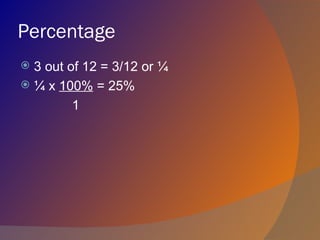
 3 out of 12 = 3/12 or ¼
 ¼ x 100% = 25%
         1
Independence of Events
 The results of one coin toss do not affect
  the results of subsequent coin tosses
 Each event occurs independently
 Ex. If you toss a coin 5 times and it
  lands heads up each time. What is the
  probability that it will land heads up on
  the next toss?
Independence of Events
   The probability is still 1 out of 2 or 50%
Probability and Genetics
•   Mendel was the first to recognize that the
    principles of probability could be used to
    predict the results of genetic crosses
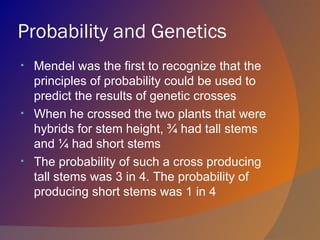
•   When he crossed the two plants that were
    hybrids for stem height, ¾ had tall stems
    and ¼ had short stems
•   The probability of such a cross producing
    tall stems was 3 in 4. The probability of
    producing short stems was 1 in 4
Punnett Squares
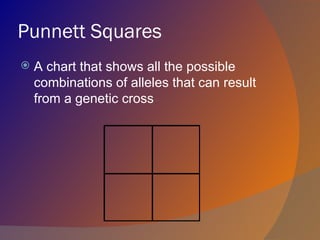
   A chart that shows all the possible
    combinations of alleles that can result
    from a genetic cross
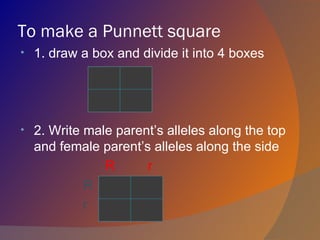
To make a Punnett square
•   1. draw a box and divide it into 4 boxes


•   2. Write male parent’s alleles along the top
    and female parent’s alleles along the side
                R      r
             R
             r
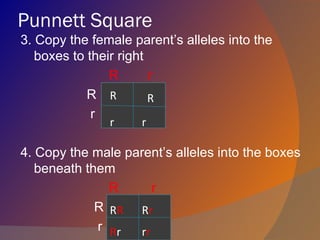
Punnett Square
3. Copy the female parent’s alleles into the
   boxes to their right
                R       r
            R R R       R
             r
               r     r

4. Copy the male parent’s alleles into the boxes
   beneath them
               R      r
             R RR Rr
             r Rr  rr
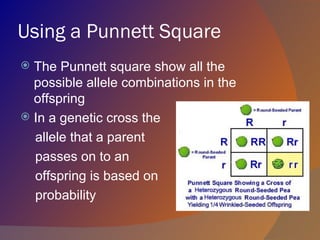
Using a Punnett Square
 The Punnett square show all the
  possible allele combinations in the
  offspring
 In a genetic cross the
  allele that a parent
  passes on to an
  offspring is based on
  probability
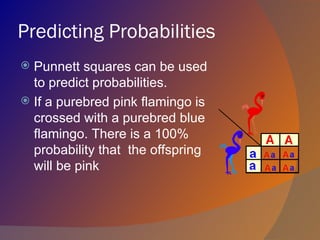
Predicting Probabilities
 Punnett squares can be used
  to predict probabilities.
 If a purebred pink flamingo is
  crossed with a purebred blue
  flamingo. There is a 100%
  probability that the offspring
  will be pink
Phenotypes and Genotypes
 Phenotype – an organism’s physical
  appearance, or visible traits (what you
  see)
 Genotype – genetic makeup, or allele
  combination
 The genotypes Tt and TT have the
  same phenotype – tall
 The genotype tt has the phenotype short
Phenotypes and Genotypes
   Homozygous- an organism that has
    two identical alleles for a trait
     Ex. TT or tt
   Heterozygous – an organism that has
    two different alleles for a trait. Also
    called hybrid
     Ex.Tt
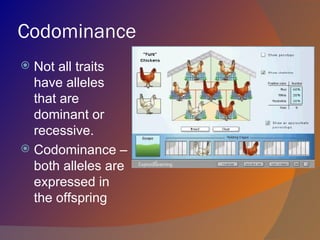
Codominance
 Not all traits
  have alleles
  that are
  dominant or
  recessive.
 Codominance –
  both alleles are
  expressed in
  the offspring
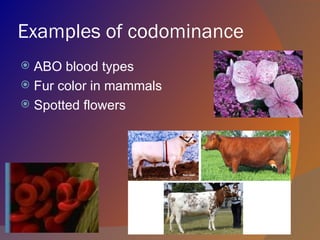
Examples of codominance
 ABO blood types
 Fur color in mammals
 Spotted flowers
18

Probability+and+heredity

  • 1.
    Key Concepts •What isprobability and how does it help explain the results of genetic crosses? •Whatis meant by genotype and phenotype? •What is codominance?
  • 2.
    Key Terms  Probability Punnett square  Phenotype  Genotype  Homozygous  Heterozygous  codominance
  • 3.
    Principles of Probability Probability – a number that describes how likely it is that an event will occur  Mathematics of probability – In a coin toss there are 2 possible outcomes. The coin can land heads up or tails up. Each result has an equal chance of occurring – 1 out of 2.  Probability can be expressed as a ratio, fraction orpercent – 1:2, ½, or 50%
  • 4.
    Percentage • Percentage – a number compared to 100 • If 3 out of 5 coins land with heads up. The percentage is calculated as follows: l 3 out of 5 = 3/5 3/5 x 100% = 60% • Practice: Suppose 3 out of 12 coins landed with tails up. How can you express this as a percentage?
  • 5.
    Percentage  3 outof 12 = 3/12 or ¼  ¼ x 100% = 25% 1
  • 6.
    Independence of Events The results of one coin toss do not affect the results of subsequent coin tosses  Each event occurs independently  Ex. If you toss a coin 5 times and it lands heads up each time. What is the probability that it will land heads up on the next toss?
  • 7.
    Independence of Events  The probability is still 1 out of 2 or 50%
  • 8.
    Probability and Genetics • Mendel was the first to recognize that the principles of probability could be used to predict the results of genetic crosses • When he crossed the two plants that were hybrids for stem height, ¾ had tall stems and ¼ had short stems • The probability of such a cross producing tall stems was 3 in 4. The probability of producing short stems was 1 in 4
  • 9.
    Punnett Squares  A chart that shows all the possible combinations of alleles that can result from a genetic cross
  • 10.
    To make aPunnett square • 1. draw a box and divide it into 4 boxes • 2. Write male parent’s alleles along the top and female parent’s alleles along the side R r R r
  • 11.
    Punnett Square 3. Copythe female parent’s alleles into the boxes to their right R r R R R R r r r 4. Copy the male parent’s alleles into the boxes beneath them R r R RR Rr r Rr rr
  • 12.
    Using a PunnettSquare  The Punnett square show all the possible allele combinations in the offspring  In a genetic cross the allele that a parent passes on to an offspring is based on probability
  • 13.
    Predicting Probabilities  Punnettsquares can be used to predict probabilities.  If a purebred pink flamingo is crossed with a purebred blue flamingo. There is a 100% probability that the offspring will be pink
  • 14.
    Phenotypes and Genotypes Phenotype – an organism’s physical appearance, or visible traits (what you see)  Genotype – genetic makeup, or allele combination  The genotypes Tt and TT have the same phenotype – tall  The genotype tt has the phenotype short
  • 15.
    Phenotypes and Genotypes  Homozygous- an organism that has two identical alleles for a trait  Ex. TT or tt  Heterozygous – an organism that has two different alleles for a trait. Also called hybrid  Ex.Tt
  • 16.
    Codominance  Not alltraits have alleles that are dominant or recessive.  Codominance – both alleles are expressed in the offspring
  • 17.
    Examples of codominance ABO blood types  Fur color in mammals  Spotted flowers
  • 18.