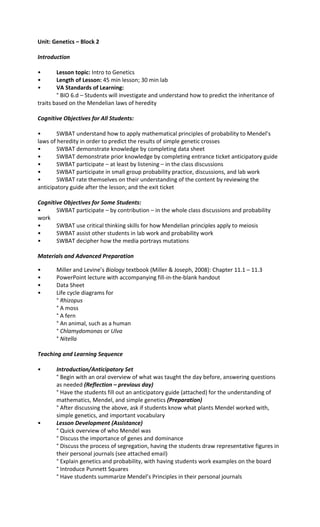
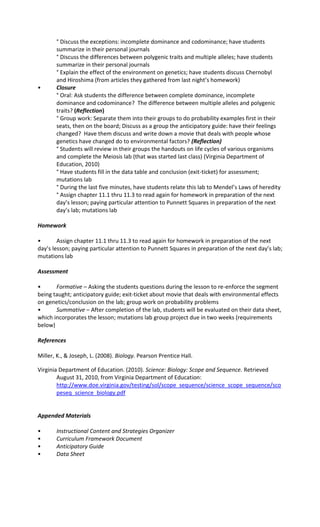
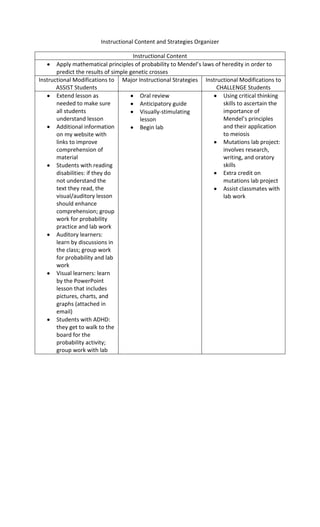
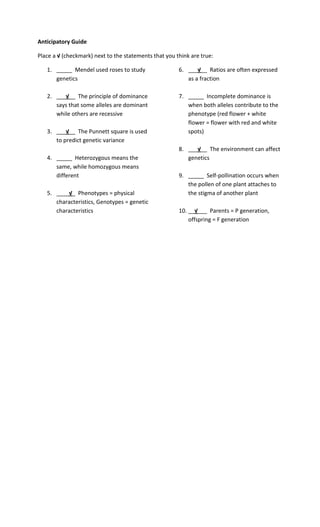
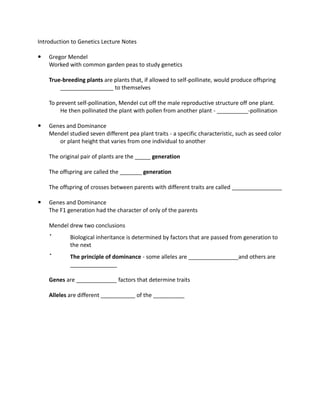
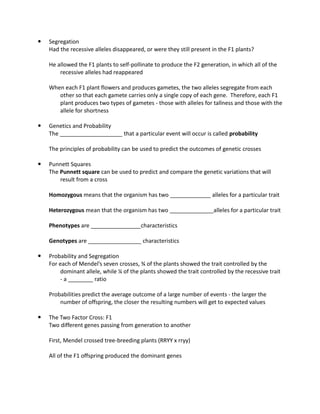
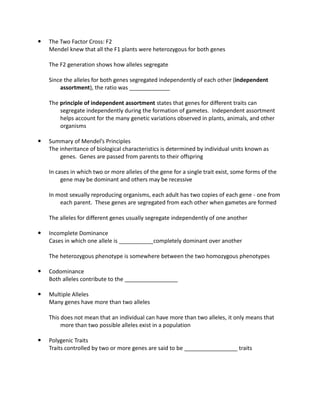
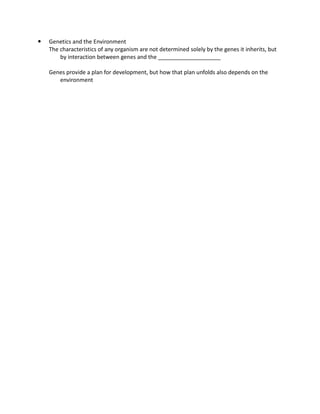
Unit: Genetics – Block 2<br />Introduction <br />Lesson topic: Intro to Genetics<br />Length of Lesson: 45 min lesson; 30 min lab<br />VA Standards of Learning: <br />° BIO 6.d – Students will investigate and understand how to predict the inheritance of traits based on the Mendelian laws of heredity<br />Cognitive Objectives for All Students: <br />SWBAT understand how to apply mathematical principles of probability to Mendel’s laws of heredity in order to predict the results of simple genetic crosses<br />SWBAT demonstrate knowledge by completing data sheet<br />SWBAT demonstrate prior knowledge by completing entrance ticket anticipatory guide<br />SWBAT participate – at least by listening – in the class discussions<br />SWBAT participate in small group probability practice, discussions, and lab work<br />SWBAT rate themselves on their understanding of the content by reviewing the anticipatory guide after the lesson; and the exit ticket<br />Cognitive Objectives for Some Students:<br />SWBAT participate – by contribution – in the whole class discussions and probability work<br />SWBAT use critical thinking skills for how Mendelian principles apply to meiosis<br />SWBAT assist other students in lab work and probability work<br />SWBAT decipher how the media portrays mutations<br />Materials and Advanced Preparation <br />Miller and Levine’s Biology textbook  CITATION Mil08 \l 1033 (Miller & Joseph, 2008): Chapter 11.1 – 11.3<br />PowerPoint lecture with accompanying fill-in-the-blank handout<br />Data Sheet<br />Life cycle diagrams for<br />° Rhizopus <br />° A moss <br />° A fern <br />° An animal, such as a human<br />° Chlamydomonas or Ulva<br />° Nitella <br />Teaching and Learning Sequence <br />Introduction/Anticipatory Set <br />° Begin with an oral overview of what was taught the day before, answering questions as needed (Reflection – previous day)<br />° Have the students fill out an anticipatory guide (attached) for the understanding of mathematics, Mendel, and simple genetics (Preparation) <br />° After discussing the above, ask if students know what plants Mendel worked with, simple genetics, and important vocabulary<br />Lesson Development (Assistance)<br />° Quick overview of who Mendel was<br />° Discuss the importance of genes and dominance<br />° Discuss the process of segregation, having the students draw representative figures in their personal journals (see attached email) <br />° Explain genetics and probability, with having students work examples on the board<br />° Introduce Punnett Squares<br />° Have students summarize Mendel’s Principles in their personal journals  <br />° Discuss the exceptions: incomplete dominance and codominance; have students summarize in their personal journals <br />° Discuss the differences between polygenic traits and multiple alleles; have students summarize in their personal journals <br />° Explain the effect of the environment on genetics; have students discuss Chernobyl and Hiroshima (from articles they gathered from last night’s homework)<br />Closure <br />° Oral: Ask students the difference between complete dominance, incomplete dominance and codominance?  The difference between multiple alleles and polygenic traits? (Reflection)<br />° Group work: Separate them into their groups to do probability examples first in their seats, then on the board; Discuss as a group the anticipatory guide: have their feelings changed?  Have them discuss and write down a movie that deals with people whose genetics have changed do to environmental factors? (Reflection) <br />° Students will review in their groups the handouts on life cycles of various organisms and complete the Meiosis lab (that was started last class)  CITATION Vir102 \l 1033 (Virginia Department of Education, 2010) <br />° Have students fill in the data table and conclusion (exit-ticket) for assessment; mutations lab <br />° During the last five minutes, have students relate this lab to Mendel’s Laws of heredity<br />° Assign chapter 11.1 thru 11.3 to read again for homework in preparation of the next day’s lesson; paying particular attention to Punnett Squares in preparation of the next day’s lab; mutations lab <br />Homework <br />Assign chapter 11.1 thru 11.3 to read again for homework in preparation of the next day’s lesson; paying particular attention to Punnett Squares in preparation of the next day’s lab; mutations lab<br />Assessment <br />Formative – Asking the students questions during the lesson to re-enforce the segment being taught; anticipatory guide; exit-ticket about movie that deals with environmental effects on genetics/conclusion on the lab; group work on probability problems <br />Summative – After completion of the lab, students will be evaluated on their data sheet, which incorporates the lesson; mutations lab group project due in two weeks (requirements below) <br />References <br />Miller, K., & Joseph, L. (2008). Biology. Pearson Prentice Hall.<br />Virginia Department of Education. (2010). Science: Biology: Scope and Sequence. Retrieved August 31, 2010, from Virginia Department of Education: http://www.doe.virginia.gov/testing/sol/scope_sequence/science_scope_sequence/scopeseq_science_biology.pdf<br />Appended Materials <br />Instructional Content and Strategies Organizer <br />Curriculum Framework Document  <br />Anticipatory Guide<br />Data Sheet<br />Instructional Content and Strategies Organizer<br />Instructional ContentApply mathematical principles of probability to Mendel’s laws of heredity in order to predict the results of simple genetic crossesInstructional Modifications to ASSIST StudentsMajor Instructional StrategiesInstructional Modifications to CHALLENGE StudentsExtend lesson as needed to make sure all students understand lessonAdditional information on my website with links to improve comprehension of material Students with reading disabilities: if they do not understand the text they read, the visual/auditory lesson should enhance comprehension; group work for probability practice and lab work Auditory learners: learn by discussions in the class; group work for probability and lab work  Visual learners: learn by the PowerPoint lesson that includes pictures, charts, and graphs (attached in email)Students with ADHD: they get to walk to the board for the probability activity; group work with lab Oral reviewAnticipatory guideVisually-stimulating lessonBegin labUsing critical thinking skills to ascertain the importance of Mendel’s principles and their application to meiosisMutations lab project: involves research, writing, and oratory skillsExtra credit on mutations lab projectAssist classmates with lab work  Anticipatory Guide<br />Place a √ (checkmark) next to the statements that you think are true:<br />_____  Mendel used roses to study genetics
___√__  The principle of dominance says that some alleles are dominant while others are recessive
___√__  The Punnett square is used to predict genetic variance
_____  Heterozygous means the same, while homozygous means different
____√_  Phenotypes = physical characteristics, Genotypes = genetic characteristics
___√__  Ratios are often expressed as a fraction
_____  Incomplete dominance is when both alleles contribute to the phenotype (red flower + white flower = flower with red and white spots)
___√__  The environment can affect genetics
_____  Self-pollination occurs when the pollen of one plant attaches to the stigma of another plant

Meiosis Block 2

  • 1.
    Unit: Genetics –Block 2<br />Introduction <br />Lesson topic: Intro to Genetics<br />Length of Lesson: 45 min lesson; 30 min lab<br />VA Standards of Learning: <br />° BIO 6.d – Students will investigate and understand how to predict the inheritance of traits based on the Mendelian laws of heredity<br />Cognitive Objectives for All Students: <br />SWBAT understand how to apply mathematical principles of probability to Mendel’s laws of heredity in order to predict the results of simple genetic crosses<br />SWBAT demonstrate knowledge by completing data sheet<br />SWBAT demonstrate prior knowledge by completing entrance ticket anticipatory guide<br />SWBAT participate – at least by listening – in the class discussions<br />SWBAT participate in small group probability practice, discussions, and lab work<br />SWBAT rate themselves on their understanding of the content by reviewing the anticipatory guide after the lesson; and the exit ticket<br />Cognitive Objectives for Some Students:<br />SWBAT participate – by contribution – in the whole class discussions and probability work<br />SWBAT use critical thinking skills for how Mendelian principles apply to meiosis<br />SWBAT assist other students in lab work and probability work<br />SWBAT decipher how the media portrays mutations<br />Materials and Advanced Preparation <br />Miller and Levine’s Biology textbook CITATION Mil08 \l 1033 (Miller & Joseph, 2008): Chapter 11.1 – 11.3<br />PowerPoint lecture with accompanying fill-in-the-blank handout<br />Data Sheet<br />Life cycle diagrams for<br />° Rhizopus <br />° A moss <br />° A fern <br />° An animal, such as a human<br />° Chlamydomonas or Ulva<br />° Nitella <br />Teaching and Learning Sequence <br />Introduction/Anticipatory Set <br />° Begin with an oral overview of what was taught the day before, answering questions as needed (Reflection – previous day)<br />° Have the students fill out an anticipatory guide (attached) for the understanding of mathematics, Mendel, and simple genetics (Preparation) <br />° After discussing the above, ask if students know what plants Mendel worked with, simple genetics, and important vocabulary<br />Lesson Development (Assistance)<br />° Quick overview of who Mendel was<br />° Discuss the importance of genes and dominance<br />° Discuss the process of segregation, having the students draw representative figures in their personal journals (see attached email) <br />° Explain genetics and probability, with having students work examples on the board<br />° Introduce Punnett Squares<br />° Have students summarize Mendel’s Principles in their personal journals <br />° Discuss the exceptions: incomplete dominance and codominance; have students summarize in their personal journals <br />° Discuss the differences between polygenic traits and multiple alleles; have students summarize in their personal journals <br />° Explain the effect of the environment on genetics; have students discuss Chernobyl and Hiroshima (from articles they gathered from last night’s homework)<br />Closure <br />° Oral: Ask students the difference between complete dominance, incomplete dominance and codominance? The difference between multiple alleles and polygenic traits? (Reflection)<br />° Group work: Separate them into their groups to do probability examples first in their seats, then on the board; Discuss as a group the anticipatory guide: have their feelings changed? Have them discuss and write down a movie that deals with people whose genetics have changed do to environmental factors? (Reflection) <br />° Students will review in their groups the handouts on life cycles of various organisms and complete the Meiosis lab (that was started last class) CITATION Vir102 \l 1033 (Virginia Department of Education, 2010) <br />° Have students fill in the data table and conclusion (exit-ticket) for assessment; mutations lab <br />° During the last five minutes, have students relate this lab to Mendel’s Laws of heredity<br />° Assign chapter 11.1 thru 11.3 to read again for homework in preparation of the next day’s lesson; paying particular attention to Punnett Squares in preparation of the next day’s lab; mutations lab <br />Homework <br />Assign chapter 11.1 thru 11.3 to read again for homework in preparation of the next day’s lesson; paying particular attention to Punnett Squares in preparation of the next day’s lab; mutations lab<br />Assessment <br />Formative – Asking the students questions during the lesson to re-enforce the segment being taught; anticipatory guide; exit-ticket about movie that deals with environmental effects on genetics/conclusion on the lab; group work on probability problems <br />Summative – After completion of the lab, students will be evaluated on their data sheet, which incorporates the lesson; mutations lab group project due in two weeks (requirements below) <br />References <br />Miller, K., & Joseph, L. (2008). Biology. Pearson Prentice Hall.<br />Virginia Department of Education. (2010). Science: Biology: Scope and Sequence. Retrieved August 31, 2010, from Virginia Department of Education: http://www.doe.virginia.gov/testing/sol/scope_sequence/science_scope_sequence/scopeseq_science_biology.pdf<br />Appended Materials <br />Instructional Content and Strategies Organizer <br />Curriculum Framework Document <br />Anticipatory Guide<br />Data Sheet<br />Instructional Content and Strategies Organizer<br />Instructional ContentApply mathematical principles of probability to Mendel’s laws of heredity in order to predict the results of simple genetic crossesInstructional Modifications to ASSIST StudentsMajor Instructional StrategiesInstructional Modifications to CHALLENGE StudentsExtend lesson as needed to make sure all students understand lessonAdditional information on my website with links to improve comprehension of material Students with reading disabilities: if they do not understand the text they read, the visual/auditory lesson should enhance comprehension; group work for probability practice and lab work Auditory learners: learn by discussions in the class; group work for probability and lab work Visual learners: learn by the PowerPoint lesson that includes pictures, charts, and graphs (attached in email)Students with ADHD: they get to walk to the board for the probability activity; group work with lab Oral reviewAnticipatory guideVisually-stimulating lessonBegin labUsing critical thinking skills to ascertain the importance of Mendel’s principles and their application to meiosisMutations lab project: involves research, writing, and oratory skillsExtra credit on mutations lab projectAssist classmates with lab work Anticipatory Guide<br />Place a √ (checkmark) next to the statements that you think are true:<br />_____ Mendel used roses to study genetics
  • 2.
    ___√__ Theprinciple of dominance says that some alleles are dominant while others are recessive
  • 3.
    ___√__ ThePunnett square is used to predict genetic variance
  • 4.
    _____ Heterozygousmeans the same, while homozygous means different
  • 5.
    ____√_ Phenotypes= physical characteristics, Genotypes = genetic characteristics
  • 6.
    ___√__ Ratiosare often expressed as a fraction
  • 7.
    _____ Incompletedominance is when both alleles contribute to the phenotype (red flower + white flower = flower with red and white spots)
  • 8.
    ___√__ Theenvironment can affect genetics
  • 9.
    _____ Self-pollinationoccurs when the pollen of one plant attaches to the stigma of another plant